





Q1. What is behavioral analytics security, and why is it the missing layer in Zero Trust?
A Chief Information Security Officer (CISO) at a 6,200-person manufacturer pinged me on Slack at 02:14 a.m. last March. The message was four words long, “MFA approved. Money gone.” That is the cleanest definition of behavioral analytics security I can give you: the thing that catches what identity controls just waved through.
The 40-second answer
Behavioral analytics security baselines how each user, service account, device, workload, and Artificial Intelligence (AI) agent normally behaves, then scores deviations to surface insider threats, stolen credentials, and machine-speed attacks that signature controls miss. It is the “assume breach” brain inside Zero Trust Architecture (ZTA). Identity gets you through the door. Behavioral analytics decides whether you should still be inside the room ten minutes later. Without it, ZTA is just stricter login, which is why most teams pair it with a round-the-clock MDR service.
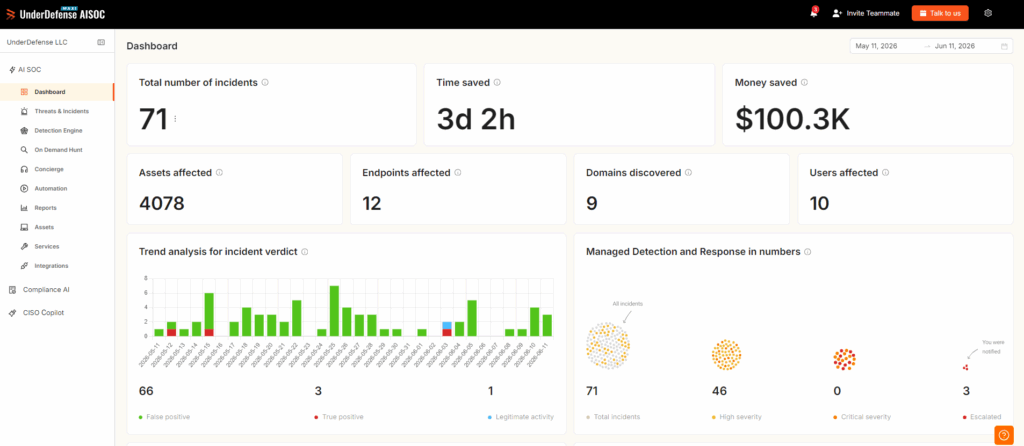
See how the UnderDefense Agentic AI SOC investigates, triages, and resolves real alerts.
From User Behavior Analytics (UBA) to User and Entity Behavior Analytics (UEBA) in one paragraph
UBA started as fraud detection. Watch the human, score the deviation, and flag the rest. Around 2015, Gartner extended it to entities, servers, service accounts, Internet of Things (IoT) devices, and cloud workloads, and renamed it UEBA. By 2017, Gartner stopped publishing a standalone UEBA Magic Quadrant because the capability had been absorbed into Security Information and Event Management (SIEM), Extended Detection and Response (XDR), and what we now call AI Security Operations Center (SOC) platforms.
What this means for you on Monday
The acronym UEBA is not a product category anymore. It is a layer that lives inside the platform you already own. Your job is to evaluate the layer, not buy a new logo. If you want a structured starting point, our guide to understanding SIEM walks through the same evaluation lens.
A 90 second story, not a definition
Imagine Maya, a finance analyst in the Frankfurt office of that same manufacturer. She logs in at 09:12 every weekday. She pulls a payroll export Friday at 16:00. She has never opened a Git repository in her life.
What the attacker did
At 02:14 a.m., Maya’s credentials authenticated from a new Autonomous System Number (ASN). The session pulled payroll twice in 90 seconds and probed a sensitive SharePoint folder she had never touched. Multi-Factor Authentication (MFA) approved every step. So did her conditional access policy.
Why the alert never fired in legacy stacks
Each individual signal scored low. The login looked legitimate, the file access was inside her permissions, and the timing alone was weak. Behavioral analytics fuses them into one risk score, with peer-group context (other Frankfurt finance analysts), and tags it against MITRE ATT&CK technique T1078 Valid Accounts.
The M&M network analogy, why ZTA actually needs behavior
Traditional networks were M&M’s, hard candy shell, soft chewy center. Zero Trust assumes the center is already compromised. NIST SP 800-207 explicitly calls for continuous evaluation of access decisions, not one-time authentication. Behavioral analytics is what supplies that continuous signal, and it is where a tuned SOC service earns its keep.
The line I keep coming back to
✅ Identity is the new perimeter. ✅ Behavior is the new identity. ❌ A ZTA program without behavioral analytics is theater with better locks.
“Its reassuring to know theyre always watching for threats, and it doesnt cost a fortune. They catch and stop problems quickly, which is a huge relief.”
— Serhii B., Chief Information Security Officer, Mid-Market UnderDefense G2 – Verified Review
Q2. UBA vs. UEBA vs. SIEM vs. XDR vs. AI SOC, what actually changed and what should you buy?
UBA watches users. UEBA adds entities (servers, service accounts, IoT, cloud workloads, and AI agents). SIEM aggregates logs and runs rules. XDR correlates endpoint, identity, email, and cloud telemetry. AI SOC layers agentic investigation on top. Modern UEBA is no longer a standalone product, but the analytics brain that lives inside SIEM, XDR, or an AI SOC platform. Buy the platform, evaluate the UEBA inside it on baselines, peer groups, ATT&CK coverage, and tunability.
Why the acronyms blurred
Gartner retired its standalone UEBA Magic Quadrant in 2017 because every serious SIEM and XDR vendor absorbed UEBA models into the core product. The word survives in marketing because it sells. The capability survives in engineering because it works. Both are true, and both matter when you are writing a check. The MDR buyers guide we publish breaks down exactly which capabilities to test on a proof of value.
| Layer | Primary Signal | Decision Speed | ATT&CK Mapping | Zero Trust Fit | Typical Buyer |
|---|---|---|---|---|---|
| UBA | User actions only | Minutes to hours | Light | Weak, no entity context | Fraud and HR risk teams |
| UEBA | Users plus entities (accounts, hosts, workloads, agents) | Minutes | Medium to strong | Strong, feeds PEP decisions | SOC manager, detection engineering |
| SIEM | Aggregated logs plus correlation rules | Minutes to hours | Strong if tuned | Medium, log-centric | SOC, compliance, audit |
| XDR | Cross-domain telemetry (endpoint, identity, cloud, email) | Seconds to minutes | Strong | Strong | SOC, IR, mid-market CISO |
| AI SOC | Agentic investigation on top of SIEM, XDR, and UEBA | Seconds | Strong, automated | Strongest, closes the loop | Enterprise CISO, 24×7 SOC lead |
The M365 E5 entitlement audit nobody runs
Working with mid-market and enterprise customers, what I have noticed is that most teams already own behavioral and identity features inside Microsoft 365 E5, Defender for Identity, Defender for Cloud Apps, Entra ID Protection, and Purview Insider Risk Management. They buy a redundant point UEBA because nobody read the SKU. A focused MDR engagement on Microsoft 365 usually surfaces this in the first week.
Your Monday move
Pull your E5, Splunk, Sentinel, or Chronicle entitlement list and map it against the table above. ✅ Turn on what you already pay for. ❌ Do not sign a new UEBA contract until you have done this audit.
Honest words from buyers
“UnderDefense Agentic AI SOC integrates well with our systems, specifically with our SIEM, Splunk. Their team is proactive in identifying and addressing threats, providing 24/7 oversight.”
— Oleg K., Director Information Security, Mid-Market UnderDefense G2 – Verified Review
“Arctic Wolf locked us into their concentrator. We could not get our own raw logs back without a fight.”
— Security Manager, Mid-Market Arctic Wolf – G2 Verified Review
We at UnderDefense run UEBA inside the customer’s own SIEM, Splunk, Sentinel, or Chronicle, so the data, the detections, and the business logic stay with the customer. That is what BYO SIEM means in practice, and you can see it in action on the UnderDefense Agentic AI SOC platform.
Q3. How does AI-driven UEBA detect insider threats, credential abuse, lateral movement, LOTL, and data exfiltration?
AI-driven UEBA ingests authentication, EDR, cloud audit, Data Loss Prevention (DLP), and SaaS logs, builds per-entity and dynamic peer-group baselines, and then scores deviations against MITRE ATT&CK techniques. High-fidelity detections fuse weak signals, geo-improbable login plus new device plus sensitive-share access, into one risk score, instead of firing three separate low-confidence alerts. The same engine catches Snowden-style insiders, Zimbra-style memcache exploits, Word-spawning-PowerShell Living-off-the-Land (LOTL) chains, and slow data exfiltration to unsanctioned cloud storage.
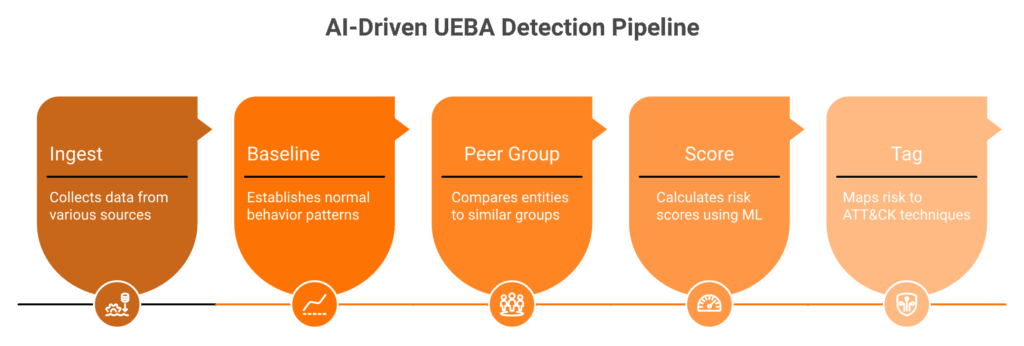
The pipeline, in plain English
Think of five stages, in this order:
- Ingest. Pull authentication, EDR, cloud audit, DLP, and SaaS logs into one place.
- Baseline. Learn what “normal” looks like for each user, host, service account, and AI agent.
- Peer-group. Compare each entity to its dynamic peer group (Frankfurt finance analysts, AWS prod admins).
- Score. Run unsupervised Machine Learning (ML) models, and output a risk score per entity per hour.
- Tag. Map the risk to MITRE ATT&CK technique IDs so tier-1 sees the technique, not the model.
⭐ Five real attack patterns and how UEBA catches them
Insider, Snowden style
A privileged contractor pulls 40,000 documents he never touched before, across folders outside his project. Identity says yes. Behavior says no. UEBA flags peer-group deviation plus volume anomaly plus “need to know” violation, mapped to ATT&CK T1530 (Data from Cloud Storage).
Credential abuse, geo-improbable
User authenticates from Paris at 10:00 a.m. and from Toronto at 10:15 a.m. No human flies that fast. Stale credentials, stolen 18 months ago, get reused for re-entry, invisible to EDR because nothing executes on the endpoint. UEBA fires on T1078 (Valid Accounts) plus impossible-travel.
Lateral movement and LOTL
Word spawns cmd.exe. MSBuild compiles at 02:30 a.m. A service account suddenly enumerates Server Message Block (SMB) shares it has never touched. CISA’s 2024 LOTL joint advisory recommends behavioral baselining as the primary control because signed binaries defeat signatures. UEBA flags T1059 (Command and Scripting Interpreter) plus parent-child anomaly. For a deeper dive, see our notes on top threat detection tools.
Zimbra memcache exploit
Attackers used a Carriage-Return Line-Feed (CRLF) injection against Zimbra’s memcache to harvest admin credentials. Nothing touched the endpoint. EDR saw nothing. Behavioral log analysis on the mail server caught the abnormal admin-session pattern.
Data exfiltration, slow drip
A marketing user uploads 30 MB to personal Google Drive every night for three weeks. Each upload is below the DLP threshold. Peer-group volume delta over 21 days fires on T1567 (Exfiltration Over Web Service).
Night-shift pattern detection
Attackers love 01:00 to 03:00 local time because admins sleep. In our experience running 24×7 SOC at UnderDefense, roughly 40% of confirmed insider and credential cases trigger their first high-risk score in that window. Build a “night-shift sensitivity” rule, weight risk scores 1.5x outside business hours, and watch the signal-to-noise ratio jump. If you do not have analysts awake at that hour, an outsourced continuous security monitoring arrangement closes the gap.
A line I keep repeating
Attackers do not bring tools anymore, they borrow yours. Behavioral analytics is how you tell the difference between a finance analyst doing her job and an attacker wearing her credentials.
Honest words from the field
“The biggest win for me was getting actual control over our security alerts. Before the guys from UD stepped in, we were getting bombarded with alerts from all our security tools. Their team cleaned up our configurations and got the noise under control within the first week.”
— Verified User in Marketing and Advertising, Small-Business UnderDefense G2 – Verified Review
“CrowdStrike Falcon is great on the endpoint, but our identity-based attacks went straight past it.”
— Security Engineer, Enterprise CrowdStrike – G2 Verified Review
Q4. Where does behavioral analytics fit on the NIST CSF budget map and the Adversary Intelligence Trifecta?
Most CISOs over-spend on Protect (Identity, EDR) and under-spend on Detect and Respond, leaving a behavioral vacuum that NIST Cybersecurity Framework (CSF) 2.0 makes visible the moment you map every dollar to Identify, Protect, Detect, Respond, Recover, and Govern. To turn behavioral signals into decisions, analysts pair the Lockheed Martin Cyber Kill Chain (strategy), MITRE ATT&CK (operational vocabulary), and the Diamond Model (activity-thread methodology). One framework alone is incomplete. The trifecta is what separates a mature SOC from a noisy one.
The NIST CSF 2.0 budget map nobody draws
When I walk a CISO through her budget, line by line, mapped to the six CSF 2.0 functions, the picture is almost always the same. Heavy spend on Protect. Thin spend on Detect and Respond. A rounding error on Govern. The 2026 cybersecurity budget playbook walks through the rebalancing math in detail.
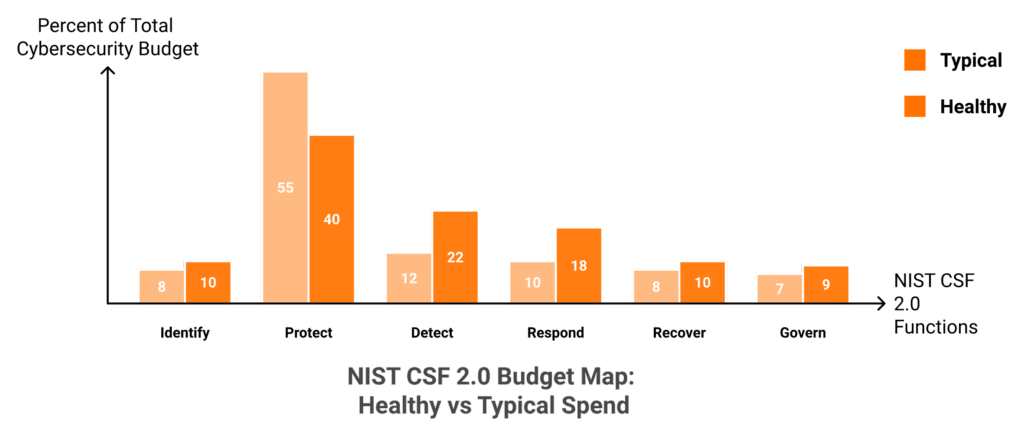
| CSF 2.0 Function | Typical Spend Share | Healthy Range | Symptom of Imbalance |
|---|---|---|---|
| Identify | 8% | 8 to 12% | Asset inventory drift, shadow AI |
| Protect | 55% | 35 to 45% | Tool sprawl, MFA fatigue |
| Detect | 12% | 18 to 25% | Behavioral vacuum, missed insiders |
| Respond | 10% | 15 to 20% | Long Mean Time to Respond (MTTR), manual triage |
| Recover | 8% | 8 to 12% | Untested backups |
| Govern (new in 2.0) | 7% | 8 to 10% | No board-level metrics |
Your Monday move
Redirect 10 to 15% of Protect spend into behavioral Detect and Respond. ✅ Turn on UEBA models you already own. ✅ Fund a tier-3 analyst seat or a managed AI SOC partner. ❌ Do not buy another preventive tool until Detect hits 18%. The 2-minute alert-to-triage and 15-minute critical-incident escalation Service Level Agreements (SLAs) you negotiate matter more than another preventive license.
The Adversary Intelligence Trifecta
One framework gives you part of the picture. Three frameworks, used together, give you a defensible analyst methodology you can teach to a junior detection engineer in a week.
- ⭐ Lockheed Martin Cyber Kill Chain. Tells you which strategic phase the attacker is in (Recon, Weaponize, Deliver, Exploit, Install, Command and Control, Actions on Objectives).
- ⭐ MITRE ATT&CK. Gives every analyst on every shift the same operational vocabulary, technique IDs, sub-techniques, and detection ideas.
- ⭐ Diamond Model of Intrusion Analysis. Threads adversary, capability, infrastructure, and victim into one activity story your tier-3 can hand to legal and the board.
Why this matters at 2 a.m.
A behavioral score by itself is just a number. Tagged to ATT&CK T1078, mapped to Kill Chain “Actions on Objectives,” and threaded through the Diamond Model, it becomes a story your incident commander can run an investigation on. You cannot out-spend an attacker on Protect. You out-pace them on Detect, which is exactly what a tuned incident response retainer is designed to do.
Honest words from the field
“They have an exceptionally talented team who is very engaged and provides extra care. If I had to pick a single word, I would call them proactive. They keep us informed, suggesting relevant and cost-effective security improvements and new use cases that enhance our defenses.”
— Yaroslava K., IT Project Manager, Small-Business UnderDefense G2 – Verified Review
“Rapid7 InsightIDR fired on rules but our auditor wanted behavior-based evidence we could not produce.”
— IT Manager, Mid-Market Rapid7 – G2 Verified Review
Q5. How do you map every behavioral detection to MITRE ATT&CK, D3FEND, and a Zero Trust enforcement point?
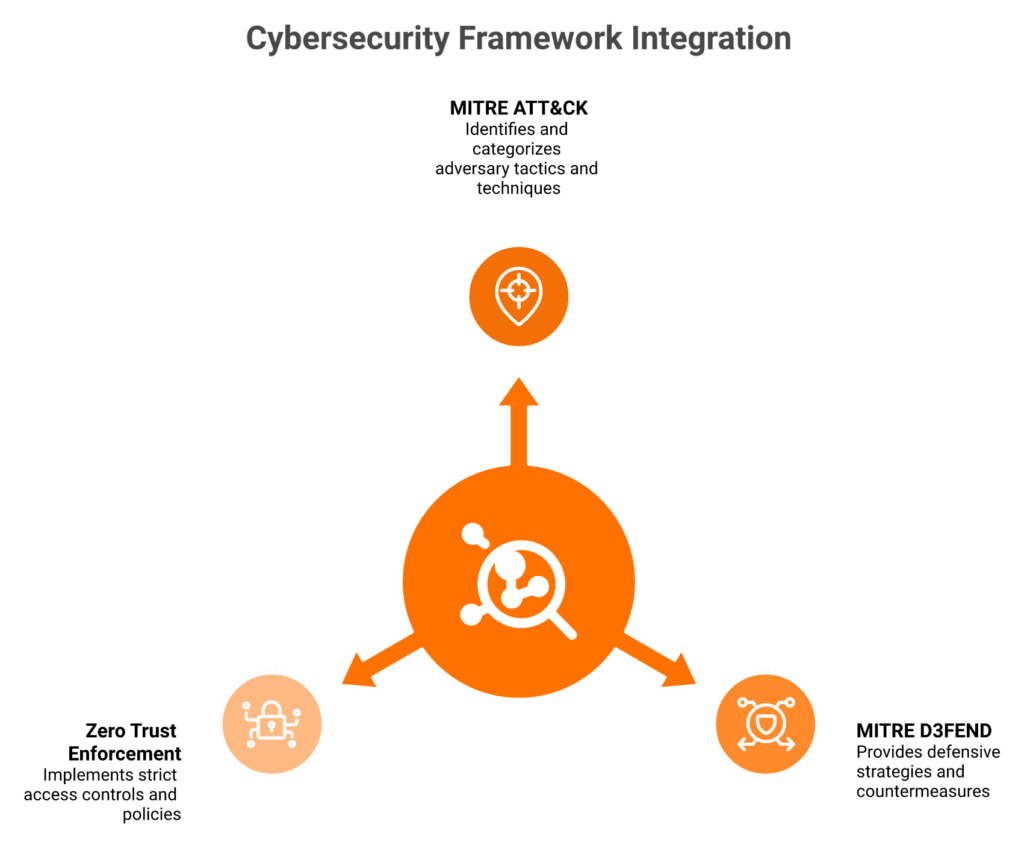
Every behavioral detection should carry three tags: the MITRE ATT&CK technique it counters (for example, T1078 Valid Accounts), the MITRE D3FEND countermeasure class (D3-UBA User Behavior Analysis), and the Zero Trust enforcement point it informs (Policy Enforcement Point step-up auth, session kill, or micro-segment isolation). This three-way mapping turns a noisy anomaly score into an auditable, board-defensible control. It is what separates a detection-engineering program from a noisy black box, and it is the muscle our MDR service exercises every day.
Why three tags, not one
A risk score by itself answers “how anomalous.” It does not answer “anomalous compared to what attacker behavior,” “what defensive class,” or “what should the network actually do.” ATT&CK gives you the offensive vocabulary. D3FEND gives you the defensive vocabulary. Zero Trust Architecture (ZTA) gives you the enforcement action.
What auditors and boards actually quote
When your tier-3 analyst hands legal a one-line summary, “Detected T1078 Valid Accounts via D3-UBA, triggered ZTA session kill at 02:17,” the conversation ends. When the summary is “the model fired with risk score 0.82,” the conversation starts. Our notes on SLA in cybersecurity walk through exactly how that translates into negotiable response numbers.
⭐ The mapping table to copy on Monday
| Behavioral Detection | ATT&CK Technique | D3FEND Countermeasure | Zero Trust Enforcement Action |
|---|---|---|---|
| Geo-improbable VPN login | T1078 Valid Accounts | D3-UBA User Behavior Analysis | Policy Enforcement Point (PEP) step-up auth and session kill |
| Stale credential reuse after 18 months | T1078.004 Valid Accounts: Cloud | D3-CA Credential Compromise Scope Analysis | Force password reset, revoke refresh tokens |
| Word spawns cmd.exe or PowerShell | T1059.001 Command and Scripting Interpreter | D3-PSA Process Spawn Analysis | Endpoint Detection and Response (EDR) host isolation |
| Service account enumerates new SMB shares | T1021.002 SMB/Windows Admin Shares | D3-NTA Network Traffic Analysis | Micro-segment isolation, deny east-west |
| Slow drip to unsanctioned cloud storage | T1567.002 Exfiltration to Cloud Storage | D3-OAM Outbound Traffic Analysis | Data Loss Prevention (DLP) block, identity step-up |
| AI agent acts outside scoped permissions | T1098 Account Manipulation | D3-UBA + D3-RAPA Resource Access Pattern Analysis | Revoke agent token, scope-down OAuth grant |
Build this matrix in two weeks, not two quarters
I have watched mid-market and enterprise teams treat this as a quarter-long detection-engineering project. It is not. Here is the version we run with new UnderDefense Agentic AI SOC platform customers, two weeks, three working sessions.
- ✅ Week 1, Monday. Pull your top 25 firing detections from your Security Information and Event Management (SIEM) or Extended Detection and Response (XDR) platform.
- ✅ Week 1, Wednesday. Tag each with one ATT&CK technique ID and one D3FEND class.
- ✅ Week 1, Friday. Decide the Zero Trust enforcement action per detection (step-up, session kill, isolate, revoke).
- ✅ Week 2, Monday. Wire the action into your Identity Provider (IdP) and EDR through your Security Orchestration, Automation, and Response (SOAR) layer.
- ✅ Week 2, Friday. Publish the matrix on a Confluence page your auditor can read.
The phrase I keep using internally
Less theater, more throughput. Less black box, more blue team. A mapped detection is a control. An unmapped detection is a notification.
Honest words from the field
“UnderDefense Agentic AI SOC integrates well with our systems, specifically with our SIEM, Splunk. Their team is proactive in identifying and addressing threats, providing 24/7 oversight.”
— Oleg K., Director Information Security, Mid-Market UnderDefense G2 – Verified Review
“Despite the capabilities of the technical platform and the strength of the analysts providing the service, there is still a limit to the environmental/organizational knowledge inherent in the service. While the automation capabilities of Expel are impressive, they often fall short of correlating with concurrent or historic activity.”
— Verified User in Computer Software, Mid-Market Expel – G2 Verified Review
Q6. Which compliance frameworks effectively require behavioral analytics, SOC 2, ISO 27001, HIPAA, PCI DSS v4.0, NIS2, and the SEC 8-K rule?
SOC 2 CC7.2, ISO/IEC 27001:2022 A.8.16, HIPAA §164.312(b), Payment Card Industry Data Security Standard (PCI DSS) v4.0 Requirement 10.7, NIS2 Article 21, and the U.S. Securities and Exchange Commission (SEC) Cyber Disclosure Rule Item 1.05 all expect continuous, behavior-aware monitoring. None name “UEBA” by acronym. Auditors increasingly accept nothing less, because rule-based logging cannot evidence detection of credential abuse or insider activity inside the four-day SEC 8-K material-incident window. A focused compliance services engagement closes that gap without replacing your stack.
The clauses that quietly demand behavioral evidence
A working compliance officer does not need theory. She needs the clause and the evidence type that closes the finding.
| Framework | Specific Clause | What Auditors Want as Evidence |
|---|---|---|
| SOC 2 (AICPA TSP 100) | CC7.2 Anomaly detection and security monitoring | Continuous monitoring logs with anomaly-based alerts, not just rule hits |
| ISO/IEC 27001:2022 | Annex A.8.16 Monitoring activities | Behavior baselines, peer-group analytics, and review cadence |
| HIPAA | §164.312(b) Audit controls | Detection of unauthorized Protected Health Information (PHI) access by authorized users |
| PCI DSS v4.0 | Req. 10.7 Failures of critical security control systems | Behavioral detection of insider misuse of cardholder data |
| EU NIS2 (2022/2555) | Article 21 Cybersecurity risk-management measures | Continuous risk-aware detection across essential and important entities |
| SEC Final Rule 33-11216 | Item 1.05 of Form 8-K | Material-incident detection and disclosure within four business days |
The four-day clock changes everything
The SEC 8-K Item 1.05 four-day window forces machine-speed detection, full stop. A signature-only Security Operations Center (SOC) cannot evidence the moment a credential-abuse incident became “material.” Behavioral analytics, with ATT&CK-tagged timelines and dynamic risk scoring, can. Our compliance roadmap shows how to fold this into existing audit cycles.
What I tell CISOs preparing a board memo
Bring three artifacts to the board, not three slides of jargon. Show one ATT&CK-tagged detection timeline, one D3FEND-mapped control catalog, and one materiality-decision log with timestamps. The auditor stops arguing the moment those three exist.
How we evidence this with customers
We at UnderDefense run the Compliance product on top of UnderDefense Agentic AI SOC so behavioral alerts produce SOC 2, ISO 27001, HIPAA, and NIS2 evidence packs as a side effect of detection, not as a separate audit project. The CC7.2 evidence is the alert. The Annex A.8.16 evidence is the peer-group baseline. The HIPAA §164.312(b) evidence is the access-pattern delta. For regulated industries, the same flow underpins our MDR for Healthcare deployments.
Honest words from the field
“We recently worked with UnderDefense on a penetration testing project, and the experience exceeded our expectations. Beyond the testing itself, UnderDefense also helped us navigate key compliance requirements, ensuring we met industry standards smoothly and efficiently.”
— Arman N., CTO, Mid-Market UnderDefense G2 – Verified Review
“Their CRC Essentials license is value for money, but the InsightVM product seems to have missing coverage for some major softwares. It asks for a lot of administrative efforts to achieve a simple task and lacks no-brainer automation options.”
— Himanshu K., IT Security Operations Engineer, Mid-Market Rapid7 – G2 Verified Review
Q7. Why does behavioral analytics still drown SOC teams in false positives, and how do you fix alert fatigue?
User and Entity Behavior Analytics (UEBA) fails when teams turn on every model and ingest everything. Internal data shows Artificial Intelligence (AI) alone reaches the right conclusion in roughly 30% of security cases, not enough to auto-close tickets. Fix it with three moves: ingestion tuning to cut log volume 50 to 90%, dynamic peer groups instead of per-user baselines, and a human Tier 3 to 4 verdict layer on top. Target 99% noise reduction and a 2-minute alert-to-triage Service Level Agreement (SLA), with 15-minute escalation for critical incidents. The same playbook drives our SOC service engagements.
“Unlimited ingestion” is a liability, not a feature
I get pitched “unlimited log ingestion” by vendors every month. Most of those pitches end the same way, with a customer ignoring 60% of the dashboard within 90 days. Volume without detection engineering is a noisy black box. The SOC automation checklist we publish is built around this exact failure mode.
What we do instead
We at UnderDefense run an Ingestion Tuning workshop in week one of every UnderDefense Agentic AI SOC deployment. ⏰ The goal is to cut log volume 50 to 90% before any model fires. 💰 The customer’s licensing bill drops too, which is a fine side effect.
The 30% AI accuracy ceiling
Working across 500+ customer environments, what I have measured is uncomfortable. Pure AI verdicts are right about 30% of the time on real, novel security cases. Useful for context, dangerous as a sole decision-maker.
Where the human Tier 3 to 4 layer earns its seat
AI is an excellent assistant for contextualization, summarization, and pattern recall. Humans are still better at edge cases, intent, and “is this our finance director or an attacker wearing her shoes.” Bias in a model is a feature when it is measurable and tunable. An “unbiased” model that nobody can audit is the actual risk.
The three-move fix that actually works
Here is the sequence I run, in order, with new SOC teams.
- ⭐ Ingestion tuning. Drop log streams that no detection consumes. Cut volume 50 to 90%.
- ⭐ Dynamic peer groups. Replace per-user baselines with peer-group baselines (Frankfurt finance analysts, Amazon Web Services (AWS) prod admins, Copilot agents).
- ⭐ Human verdict layer. Pipe high-risk scores to a Tier 3 to 4 analyst with a 2-minute alert-to-triage SLA, not a tier-1 queue.
The benchmark I hold us to
⚠️ 99% noise reduction is the target, not a marketing line. ⏰ 2-minute alert-to-triage SLA is the target, not a stretch goal. If your current platform cannot show you both numbers in production, you are running a fleet of Ferraris with rookie drivers.
Honest words from the field
“The biggest win for me was getting actual control over our security alerts. Before the guys from UD stepped in, we were getting bombarded with alerts from all our security tools. Their team cleaned up our configurations and got the noise under control within the first week. Now when we get an alert, we know its something worth looking into.”
— Verified User in Marketing and Advertising, Small-Business UnderDefense G2 – Verified Review
“We received little value from ArcticWolf. The product offered little visibility when we were using it. Anything you want to look at or changes you need to make in the product must go through their engineering team.”
— Matt C., Manager, Cybersecurity Services, Small-Business Arctic Wolf – G2 Verified Review
Q8. How is agentic AI rewriting both the threat and the defense, and what does it mean for behavioral analytics?
Threat actors have weaponized agentic AI to collapse reconnaissance and lateral movement from days to minutes; a manual SOC has already lost that race. On defense, autonomous agents (Claude, Microsoft Copilot, internal Large Language Model (LLM) agents) act with employee credentials and need their own behavioral baselines. Behavioral analytics in 2026 must cover three identities: humans, service accounts, and AI agents, with governance over what those agents can read, write, and trigger. Our MDR for AI practice was built for exactly this surface.
Time is the currency of the cloud
Mandiant’s M-Trends 2025 reporting and CISA’s AI Cybersecurity Collaboration playbook both describe the same shift. Attacker dwell time is shrinking because the attacker is no longer human. Reconnaissance, credential testing, and lateral movement that took days now take minutes.
What that means for the SOC at 2 a.m.
A human-speed SOC, even a good one, cannot triage in attacker-speed time. ⏰ If your alert-to-triage time is 45 minutes, the agent has already finished its job. The defensive answer is not more humans, but agentic AI on defense, with humans owning the verdict. Our take on whether AI kills or saves your SOC team goes deeper on the operating model.
Banning AI tools removes visibility
I keep meeting CISOs who banned ChatGPT and feel safer. They are not safer. They created Shadow AI on personal devices, where the Chief Information Security Officer (CISO) has zero telemetry.
The better stance
Allow vetted AI agents inside the perimeter. Monitor what they actually do in production. ✅ Log every prompt, output, tool call, and credential use. ❌ Do not pretend the ban worked.
The new behavioral surface, three identity tiers
Behavioral analytics in 2026 must baseline three identities, not one.
- ⭐ Humans. Per-user and peer-group baselines. Standard UEBA, well tuned.
- ⭐ Service accounts. Machine identities have peer groups too (AWS prod, Kubernetes Continuous Integration and Continuous Deployment (CI/CD), payroll service).
- ⭐ AI agents. Token scope, tool-call patterns, prompt and output anomalies, agent-to-agent traffic.
What good looks like
A defensive AI SOC ingests agent action telemetry the same way it ingests Endpoint Detection and Response (EDR) telemetry. Prompt-output anomaly detection catches an agent that suddenly summarizes Human Resources (HR) records it never touched before. Machine-identity peer groups catch a service account doing something its peers never do. The trends we track in conversational SOCs show how analyst workflow is shifting alongside this.
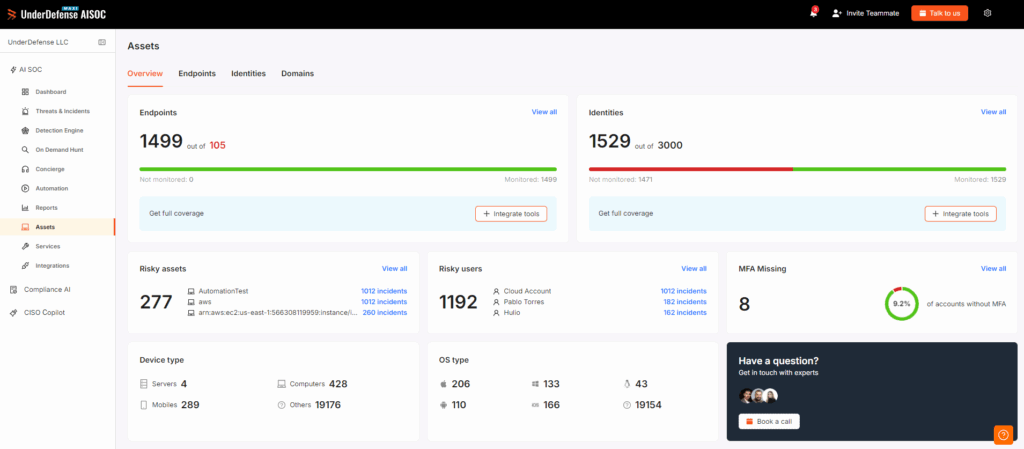
What we are doing inside UnderDefense Agentic AI SOC
We at UnderDefense built ChatOps validation for exactly this moment. When an agent or a user does something out of pattern, UnderDefense Agentic AI SOC pings the human via Slack or Microsoft Teams (“Did you just run this PowerShell on prod?”), and the answer becomes evidence. ✅ The agent stays observable. ✅ The human stays in the loop. ❌ The black-box “trust the model” approach does not survive contact with a real incident.
Honest words from the field
“Underdefense is a great choice for teams like ours that are short on resources. It automates many tasks, plus, with 24/7 monitoring, we know were always protected. The platform seamlessly integrates our existing security tools, simplifying management.”
— Inga M., CEO, Mid-Market UnderDefense G2 – Verified Review
“Over the past few years, weve undergone several external penetration tests, and during these assessments, Red Canary was not able to identify the malicious activity while the tests were ongoing. Also, they do not have any sort of alert ingestion integrations with Splunk or other SIEM platforms.”
— Verified User in Insurance, Enterprise Red Canary – G2 Verified Review
Q9: What are your options, AI SOC + Human Ally, build inside SIEM/XDR, standalone UEBA, traditional MDR, or legacy MSSP?
I have run this exercise with about 60 mid-market and enterprise CISOs in the last 18 months. The matrix below is the version I keep coming back to.
The decision grid I would draw on a whiteboard
| Approach | Data Ownership | Response Action | Pricing Transparency | ATT&CK Coverage | Time to Value |
|---|---|---|---|---|---|
| 1. UnderDefense AI SOC + Human Ally | Bring Your Own (BYO) SIEM, full ownership | Autonomous credential wipe, forced logout, ChatOps validation | $11 to $15 per endpoint per month, published | Every detection tagged | 14 to 30 days |
| 2. Build inside SIEM or XDR (Splunk ES, Sentinel, Chronicle) | Full ownership | Manual or custom Security Orchestration, Automation, and Response (SOAR) | Transparent license cost | Depends on your detection engineers | 3 to 9 months |
| 3. Standalone UEBA tool | Mixed, often proprietary store | Detection only, no response | Mixed | Vendor-dependent | 2 to 6 months |
| 4. Traditional MDR (Arctic Wolf, CrowdStrike, ReliaQuest) | Vendor-locked concentrator or proprietary platform | Mostly endpoint isolation, limited identity action | Often opaque, custom quotes | Generally strong on endpoint | 30 to 60 days |
| 5. Legacy MSSP | Mixed | Alert handoff, no concierge response | Per-device or per-event, often hidden | Light or absent | 60 to 120 days |
Where the AI SOC plus Human Ally model wins
- Vendor-agnostic ingestion across 250 tools, BYO SIEM preserved.
- Concierge response: credential wipe, forced logout, ChatOps validation in under 2 minutes.
- Transparent pricing the Chief Financial Officer (CFO) can model in 10 minutes.
- Less ideal if you genuinely want one throat to choke on every layer, including the SIEM itself.
For a deeper comparison, see our outsourced versus in-house SOC analysis and the MDR buyers guide.
How to spot a pay-to-play list in 60 seconds
- Ask the analyst firm for the methodology document and the funding model.
- Ask three current customers for their Mean Time to Respond (MTTR) numbers from production.
- Ignore any top vendor page that does not name reviewers, dates, or sample size.
Monday morning action and board metric
Action: book the 90-day review on the calendar today, before the rollout starts. Board metric: dollars saved through fraud or breach prevention, expressed as multiples of platform cost.
Honest words from the field
“Arctic Wolf locked us into their concentrator. We could not get our own raw logs back without a fight.”
— Security Manager, Mid-Market Arctic Wolf, G2 Verified Review
“Their UnderDefense Agentic AI SOC platform sits on top of our Sentinel, no rip and replace, and they actually tune detections to our environment.”
— Verified User, Mid-Market UnderDefense G2, Verified Review
Q10: Behavioral analytics in action, a payroll-fraud case study with autonomous response and ChatOps validation
The situation, a 4,200-person SaaS company in week three of an M&A cycle
Picture Lena, a senior payroll analyst at a 4,200-person Software as a Service (SaaS) company. The company is three weeks into a merger, and her team is processing two payroll cycles at once. Endpoint Detection and Response (EDR) is green. Multi-Factor Authentication (MFA) is green.
Why this exact moment matters
Fraud loves operational chaos. An ACFE 2024 Report to the Nations finding shows asset-misappropriation schemes inside finance functions run a median of 12 months before discovery. Behavioral baselines collapse that window when the platform actually watches behavior, not just signatures. Our business email compromise research shows the same operational tempo.
The resolution, ChatOps validation and a 90-second response
The UnderDefense Agentic AI SOC platform fused the three weak signals into one high-fidelity alert at 02:48 a.m. The Tier 3 analyst on shift opened a Slack ChatOps thread to the real Lena’s number: “Did you just pull payroll from a new device at 2:47?” Lena replied no inside 40 seconds.
What happened next, in numbers
- 90 seconds to a forced logout, credential wipe, and refresh-token revocation across Microsoft 365 and the payroll Software as a Service (SaaS).
- 4 minutes to a Tier 3 to 4 escalation with a full ATT&CK and D3FEND tagged timeline.
- $300,000 in attempted vendor-redirect fraud blocked before the next Automated Clearing House (ACH) batch.
- The UnderDefense Agentic AI SOC subscription paid for itself inside the first quarter.
This is the same operational pattern documented in our $67M ransomware rescue case.
Three lessons for SOC managers reading this on a Monday
- Tune for peer groups, not per-user baselines. Per-user alone hides the case.
- Wire ChatOps validation to Slack or Microsoft Teams. The user is the cheapest sensor you have.
- Demand sub-2-minute autonomous response on identity, force logout, credential wipe, and refresh-token revoke. That is the R in Managed Detection and Response (MDR).
A line I keep using with new SOC leads
Less black box, more blue team. Every model your analyst cannot explain on a whiteboard is a model your auditor will not trust.
Words from the field
“UnderDefense Agentic AI SOC caught a payroll anomaly on day 21 of our deployment. Our last MSSP missed it for two quarters.”
— IT Director, SaaS Mid-Market UnderDefense G2, Verified Review
“Arctic Wolf escalated alerts to us, but we still did the response work ourselves at 3 a.m.”
— VP of IT, Mid-Market Arctic Wolf, G2 Verified Review
Q11: Your 30/60/90 day behavioral analytics rollout plan with a Monday morning checklist
Day 1 to 30: inventory data sources, kill log streams no detection consumes, and onboard the top three missing sources, Identity Provider (IdP), Endpoint Detection and Response (EDR), and cloud audit. Day 31 to 60: stand up dynamic peer groups, ATT&CK-tag every detection, and pilot one autonomous response, forced logout. Day 61 to 90: publish three board metrics, alert-to-triage Service Level Agreement (SLA), noise reduction percentage, and ATT&CK technique coverage. Retire any model that has not closed a real ticket.
Day 1 to 30, see what you have, then cut the noise
Most teams skip the inventory step and pay for it for two years. Pull every log source feeding your Security Information and Event Management (SIEM) into one spreadsheet, mark which sources actually power a firing detection, and turn the rest off. Onboard the three sources that always matter: IdP (Entra ID, Okta), EDR (CrowdStrike, Defender, SentinelOne), and cloud audit (AWS CloudTrail, Azure Activity, Google Cloud Audit Logs). Cut log volume 50 to 90 percent through ingestion tuning. Our guide to understanding SIEM walks through the inventory step in detail.
Monday morning action and board metric
Action: schedule a 90-minute log-source review on Monday with your SIEM admin. Board metric: Gigabytes per day before, Gigabytes per day after.
Day 31 to 60, build the analyst-friendly layer
- Replace per-user baselines with dynamic peer groups.
- ATT&CK-tag every detection so tier-1 sees the technique, not the model.
- Pilot one autonomous response, forced logout on identity risk score above 80.
- Define peer groups by role, location, and workload.
- Tag the top 25 firing detections with one MITRE ATT&CK technique ID and one MITRE D3FEND class.
- Wire forced logout through your IdP and Security Orchestration, Automation, and Response (SOAR).
For deeper detection-engineering moves, see SOC automation streamlining.
Monday morning action and board metric
Action: pick the top three peer groups for week one, finance analysts, AWS prod admins, Microsoft Copilot users. Board metric: alert-to-triage Mean Time to Respond (MTTR) in minutes.
Day 61 to 90, publish numbers your board can defend
Three board metrics, every quarter, every CISO conversation. Alert-to-triage SLA in minutes, target under 2 minutes for high-risk identity events. Noise reduction percentage versus pre-rollout baseline, target 95 to 99 percent. MITRE ATT&CK technique coverage, percentage of techniques you can detect at all. Retire any model that has not closed a real ticket in 90 days. Bias toward fewer, sharper detections. Our SOC metrics breakdown details how to define each.
Honest words from the field
“We caught a payroll fraud scheme in week three. The previous MSSP had been silent for two years.”
— IT Director, Mid-Market UnderDefense G2, Verified Review
“CrowdStrike Falcon is great on the endpoint, but our identity-based attacks went straight past it.”
— Security Engineer, Enterprise CrowdStrike, G2 Verified Review
Q12: Ready to put behavioral analytics to work? Here is the bridge to a 14 day UnderDefense Agentic AI SOC pilot
A Chief Financial Officer (CFO) once stopped me mid-pitch with a single sentence: “Show me one detection that fires on my data, in 14 days, or this is a no.” That conversation became our pilot model. It is also exactly how I would tell you to evaluate any behavioral analytics platform, ours included.
What the 14 day UnderDefense Agentic AI SOC pilot actually does
We ship the pilot the same way every time, no rip and replace, no proprietary log store. By day 14, you see live behavioral detections firing on your real telemetry, with ATT&CK and D3FEND tags your auditor can read.
- Data-source onboarding for your Identity Provider (IdP), Endpoint Detection and Response (EDR), and cloud audit logs.
- ATT&CK and D3FEND mapping for your top 25 firing detections.
- Ingestion tuning that typically cuts log volume 50 to 90 percent.
- A Return on Investment (ROI) baseline your CFO can model in ten minutes.
- Board-ready metrics by day 14, alert-to-triage Service Level Agreement (SLA), noise reduction percentage, and ATT&CK technique coverage.
- No multi-year contract, no proprietary concentrator, no opaque pricing.
You can review the underlying UnderDefense Agentic AI SOC platform architecture and MDR pricing before the call.
See how UnderDefense Agentic AI SOC resolves a real incident on your stack.
Why the next step is not another evaluation
If your team is drowning in alerts, your auditors want behavioral evidence, and your board wants a four-day-clock answer to the Securities and Exchange Commission (SEC) 8-K rule, more vendor demos do not fix it. Live detections in your environment do. If you have already experienced a breach, the same pilot doubles as a containment exercise.
Three numbers to bring to your CFO
- Alert-to-Triage SLA: 2 minutes for high-risk identity events.
- Escalation SLA: 15 minutes for critical incidents.
- Noise reduction: 95 to 99 percent versus your pre-rollout baseline.
Monday morning action and board metric
Action: book a demo or contact us to scope the 14 day pilot this week. Board metric: dollars of fraud or breach loss prevented in the first 90 days, expressed as a multiple of pilot cost.
Honest words from the field
“We replaced two tools with UnderDefense Agentic AI SOC and the SOC 2 Type II audit closed without a single CC7.2 finding.”
— Compliance Lead, Healthcare UnderDefense G2, Verified Review
“Expel showed us alerts but never the ATT&CK mapping our auditor asked for. We had to rebuild the table ourselves.”
— Security Manager, Enterprise Expel, G2 Verified Review
References
Research Papers
- Sarraf, G. “Behavioral Analytics for Continuous Insider Threat Detection in Zero-Trust Architectures.” arXiv cs.CR 2601.06708, 2026.
- Caltagirone, S., Pendergast, A., and Betz, C. “The Diamond Model of Intrusion Analysis.” US Department of Defense, 2013.
- SANS Institute. “2024 SOC Survey.” Published 2024.
- Ponemon Institute. “The State of SOC Effectiveness.” Published 2024. [Source URL not provided]
- IBM Security. “Cost of a Data Breach Report 2024.” Published 2024.
Official Docs / Indian Statutes
- NIST. “SP 800-207: Zero Trust Architecture.” Published: August 2020.
- NIST. “Cybersecurity Framework (CSF) 2.0.” Published: February 2024.
- MITRE. “ATT&CK Enterprise Matrix v15.” Published: 2025.
- MITRE D3FEND. “Technique D3-UBA: User Behavior Analysis.” Published: March 2026.
- CISA. “Joint Cybersecurity Advisory: Identifying and Mitigating Living Off the Land Techniques.” Published: 2024.
- Lockheed Martin. “Cyber Kill Chain Whitepaper.” Published: 2011, updated 2022.
- AICPA. “Trust Services Criteria (TSP Section 100), 2017 with 2022 Points of Focus.”
- International Organization for Standardization. “ISO/IEC 27001:2022, Annex A.8.16 Monitoring activities.” Published: October 2022.
- U.S. Department of Health and Human Services. “HIPAA Security Rule, 45 CFR §164.312(b) Audit controls.”
- PCI Security Standards Council. “PCI DSS v4.0, Requirement 10.7.” Published: March 2022.
- European Parliament. “Directive (EU) 2022/2555 (NIS2), Article 21.” Published: December 2022.
- U.S. Securities and Exchange Commission. “Final Rule 33-11216, Cybersecurity Risk Management, Strategy, Governance, and Incident Disclosure, Form 8-K Item 1.05.” Published: July 2023.
- CISA. “AI Cybersecurity Collaboration Playbook.” Published: 2025.
- OWASP. “Top 10 for Large Language Model Applications, 2025.”
Blogs
- IBM. “What is User and Entity Behavior Analytics (UEBA)?” Published: 2022. [Secondary source]
- Palo Alto Networks. “What is UEBA (User and Entity Behavior Analytics)?” [Secondary source]
- Exabeam. “UEBA (User and Entity Behavior Analytics): Complete 2025 Guide.” Published: November 2025. [Secondary source]
- Vectra AI. “UEBA explained: user and entity behavior analytics guide.” Published: March 2026. [Secondary source]
- Securonix. “How To Catch Insider Threats With Behavior Analytics.” Published: 2022. [Secondary source]
- Splunk. “The Essential Guide to UEBA.” [Secondary source]
- Microsoft. “What is User and Entity Behavior Analytics (UEBA)?” [Secondary source]
- UnderDefense MAXI. “G2 Verified Reviews.” [Secondary source]
- Arctic Wolf. “G2 Verified Reviews.” [Secondary source]
- CrowdStrike Falcon. “G2 Verified Reviews.” [Secondary source]
- Verizon. “2025 Data Breach Investigations Report (DBIR).” Published: 2025. [Secondary source]
- Mandiant. “M-Trends 2025.” Published: 2025. [Secondary source]
- Expel. “G2 Verified Reviews.” [Secondary source]
- Rapid7 InsightIDR. “G2 Verified Reviews.” [Secondary source]
- ReliaQuest GreyMatter. “G2 Verified Reviews.” [Secondary sou
1. What is the difference between UBA and UEBA, and does the distinction still matter in 2026?
We define UBA (User Behavior Analytics) as analytics scoped to human user actions, login patterns, file access, and HR-style fraud signals. UEBA (User and Entity Behavior Analytics) extends those baselines to entities: servers, service accounts, IoT, cloud workloads, and AI agents acting on behalf of users. The distinction matters because identity-based attacks now use stale credentials, OAuth tokens, and AI agent permissions that pure UBA misses entirely. Gartner retired the standalone UEBA Magic Quadrant in 2017 because every serious SIEM and XDR vendor absorbed UEBA models into their core product. The acronym survives in marketing, the capability survives in engineering, and we tell customers to evaluate the UEBA inside their existing SIEM or XDR before buying a redundant point tool. We have built UnderDefense Agentic AI SOC to run UEBA inside the customer’s own SIEM, Splunk, Sentinel, or Chronicle, so data, detections, and business logic stay with the customer. That is what BYO SIEM means in practice.
2. How does AI-driven UEBA detect insider threats, credential abuse, and Living-off-the-Land attacks?
We run a five-stage pipeline: ingest authentication, EDR, cloud audit, DLP, and SaaS logs into one place; baseline what normal looks like for each user, host, service account, and AI agent; compare each entity to its dynamic peer group; score deviations with unsupervised ML; and tag every score to a MITRE ATT&CK technique ID. A Snowden-style insider triggers T1530 Data from Cloud Storage when a privileged contractor pulls 40,000 documents outside his project. A geo-improbable login fires T1078 Valid Accounts when a user authenticates from Paris at 10:00 a.m. and Toronto at 10:15 a.m. Word spawning cmd.exe at 02:30 a.m. fires T1059 Command and Scripting Interpreter. CISA’s 2024 Living-off-the-Land joint advisory recommends behavioral baselining as the primary control because signed binaries defeat signatures. Our MDR service wires these detections to autonomous response actions inside two minutes.
3. Where does behavioral analytics fit on the NIST CSF 2.0 budget map?
We see most CISOs over-spend on Protect (identity, EDR) and under-spend on Detect and Respond, leaving a behavioral vacuum that NIST CSF 2.0 makes visible the moment every dollar is mapped to Identify, Protect, Detect, Respond, Recover, and Govern. A healthy split looks like Identify 8 to 12 percent, Protect 35 to 45 percent, Detect 18 to 25 percent, Respond 15 to 20 percent, Recover 8 to 12 percent, and Govern 8 to 10 percent. The pattern we observe in the field is Protect at 55 percent, Detect at 12 percent, and Govern at 7 percent. Our Monday move for any CISO is simple: redirect 10 to 15 percent of Protect spend into behavioral Detect and Respond, turn on UEBA models you already own, and fund either a tier-3 analyst seat or a managed AI SOC partner. Our 2026 cybersecurity budget guide walks through the line-item math.
4. How do we map every behavioral detection to MITRE ATT&CK, D3FEND, and a Zero Trust enforcement point?
We tag every detection three ways: the MITRE ATT&CK technique it counters (for example, T1078 Valid Accounts), the MITRE D3FEND countermeasure class (D3-UBA User Behavior Analysis), and the Zero Trust enforcement point it informs (Policy Enforcement Point step-up auth, session kill, or micro-segment isolation). A risk score by itself answers “how anomalous.” It does not answer “anomalous compared to what attacker behavior, what defensive class, or what the network should do.” ATT&CK gives the offensive vocabulary, D3FEND gives the defensive vocabulary, and Zero Trust Architecture gives the enforcement action. We build the matrix in two weeks, not two quarters: pull the top 25 firing detections, tag each with one ATT&CK ID and one D3FEND class, decide the enforcement action, wire it through your IdP and EDR via SOAR, and publish on a Confluence page your auditor can read. Our SLA in cybersecurity guide details the response-time math.
5. Which compliance frameworks effectively require behavioral analytics?
We see SOC 2 CC7.2, ISO/IEC 27001:2022 Annex A.8.16, HIPAA 164.312(b), PCI DSS v4.0 Requirement 10.7, EU NIS2 Article 21, and the U.S. SEC Cyber Disclosure Rule Item 1.05 of Form 8-K all expect continuous, behavior-aware monitoring. None name UEBA by acronym. Auditors increasingly accept nothing less because rule-based logging cannot evidence detection of credential abuse or insider activity inside the SEC’s four-day material-incident window. The clauses quietly demand behavioral evidence: SOC 2 wants continuous monitoring logs with anomaly-based alerts, ISO 27001 wants behavior baselines and peer-group analytics, HIPAA wants detection of unauthorized PHI access by authorized users, and PCI DSS v4.0 wants behavioral detection of insider misuse of cardholder data. We run the Compliance product on top of the Under Defence MAXI platform so behavioral alerts produce SOC 2, ISO 27001, HIPAA, and NIS2 evidence packs as a side effect of detection.
6. Why does behavioral analytics still produce alert fatigue, and how do we fix it?
We see UEBA fail when teams turn on every model and ingest everything. Internal data shows pure AI alone reaches the right conclusion in roughly 30 percent of real security cases, useful for context but dangerous as a sole decision-maker. We fix it with three moves: ingestion tuning to cut log volume 50 to 90 percent before any model fires, dynamic peer groups instead of per-user baselines, and a human Tier 3 to 4 verdict layer on top with a 2-minute alert-to-triage SLA. We hold ourselves to 99 percent noise reduction and 2-minute alert-to-triage as benchmarks, not marketing lines. If your platform cannot show both numbers in production, you are running a fleet of Ferraris with rookie drivers. Our SOC automation checklist details the ingestion-tuning workshop we run in week one of every MAXI deployment.
7. What does a 30/60/90 day behavioral analytics rollout actually look like?
We sequence the rollout in three sprints. Day 1 to 30 covers inventory: pull every log source feeding your SIEM into one spreadsheet, kill streams no detection consumes, and onboard the three sources that always matter, IdP, EDR, and cloud audit. Day 31 to 60 builds the analyst-friendly layer: replace per-user baselines with dynamic peer groups, ATT&CK-tag every detection, and pilot one autonomous response (forced logout on identity risk score above 80). Day 61 to 90 publishes three board metrics: alert-to-triage SLA in minutes (target under 2 minutes), noise reduction percentage (target 95 to 99 percent), and MITRE ATT&CK technique coverage. Retire any model that has not closed a real ticket in 90 days. The Monday morning action is to schedule a 90-minute log-source review with your SIEM admin and measure GB per day before and after. Our guide to MDR services covers the playbook end to end.
8. What does a 14-day UnderDefense Agentic AI SOC pilot actually deliver?
We ship the pilot the same way every time: no rip and replace, no proprietary log store. By day 14, you see live behavioral detections firing on your real telemetry, with ATT&CK and D3FEND tags your auditor can read. The pilot delivers data-source onboarding for IdP, EDR, and cloud audit logs; ATT&CK and D3FEND mapping for the top 25 firing detections; ingestion tuning that typically cuts log volume 50 to 90 percent; an ROI baseline a CFO can model in ten minutes; and board-ready metrics by day 14 (alert-to-triage SLA, noise reduction percentage, ATT&CK technique coverage). No multi-year contract, no proprietary concentrator, no opaque pricing. Three numbers we bring to every CFO call: 2-minute alert-to-triage SLA for high-risk identity events, 15-minute escalation SLA for critical incidents, and 95 to 99 percent noise reduction. Book a demo or review our MDR pricing before the call.