





Q1. What Is AI Governance Documentation, and Why Is 2026 the Inflection Point?
Here’s a number that should keep every CISO up at night: 78% of enterprises have deployed AI, but only 25% have formal governance documentation in place. That’s not a gap but an open audit finding waiting to happen.
AI governance documentation is the operational system of policies, model records, risk assessments, audit evidence, and accountability structures that prove your AI is deployed responsibly. AI data governance, the parallel discipline covering data quality, lineage, access controls, and privacy protections for training and inference data, must converge with it. Siloed governance creates audit gaps. This resource is for CISOs, compliance officers, CTOs, CDOs, risk managers, and PE operating partners who need to close that gap before regulators close it for them. The framework is what I call the policy stack: Policy → Standards → Procedures → Evidence, where documentation connects every layer.
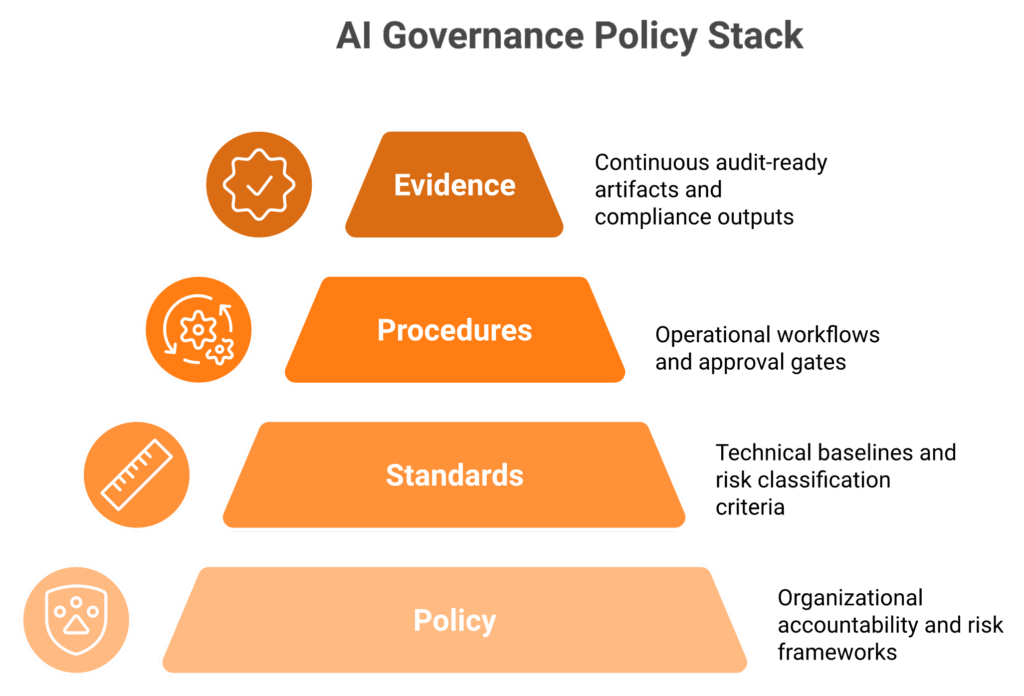
⚠️ “Governance Theater” Won’t Survive 2026
Most organizations confuse AI usage policy (acceptable employee behavior with AI tools, prompt restrictions, data handling rules) with AI governance policy (organizational accountability, risk frameworks, compliance obligations across all AI systems). Having a “don’t paste customer data into ChatGPT” Slack message is not governance.
Static PDF policies and annual reviews amount to governance theater: they look good on a shelf, but they won’t survive regulatory examination. Traditional MSSPs and compliance consultants deliver documentation templates disconnected from live security operations. You get a policy binder, but no evidence trail proving enforcement. The core principles, accountability, transparency, explainability, fairness, and security, are meaningless without operational evidence showing they’re actually enforced.
⏰ August 2026: Documentation Becomes a Legal Obligation
The critical shift for 2026 is this: governance documentation must be continuously generated from operational systems, not manually assembled before audits. EU AI Act full enforcement hits August 2, 2026. NIST AI RMF is becoming the de facto standard of care in liability disputes. ISO 42001 certification demands are accelerating. Smarsh has predicted 2026 will see the first major AI enforcement action, and organizations without continuous documentation will be the first targets.
The convergence of AI governance and data governance means every model card, risk assessment, and explainability record must trace back to the data lineage, access controls, and monitoring evidence that security operations produce daily. The “AI SOC + Human Ally” model is the architecture that inherently generates governance artifacts as a byproduct of operations, not as a separate project.
✅ Governance-Ready Security Operations
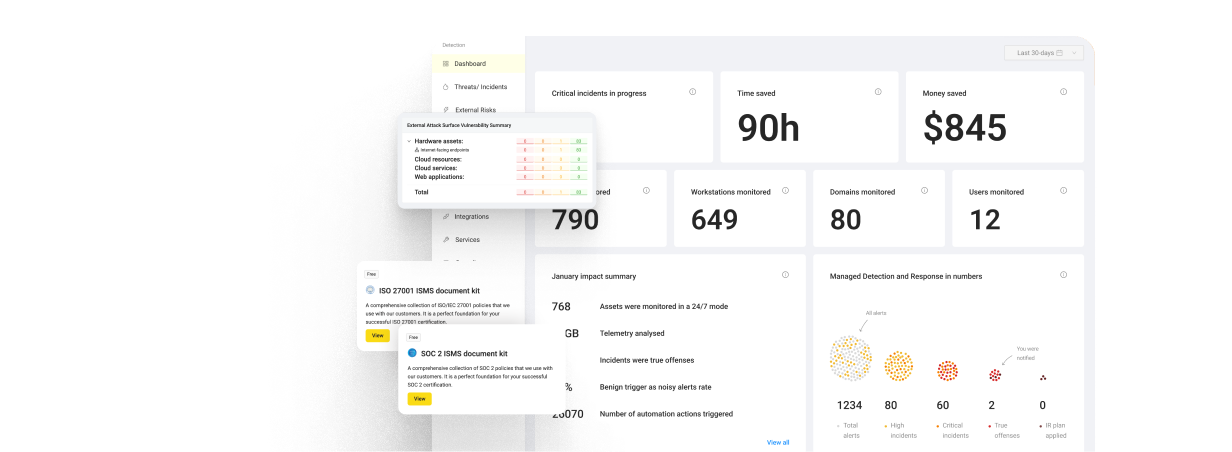
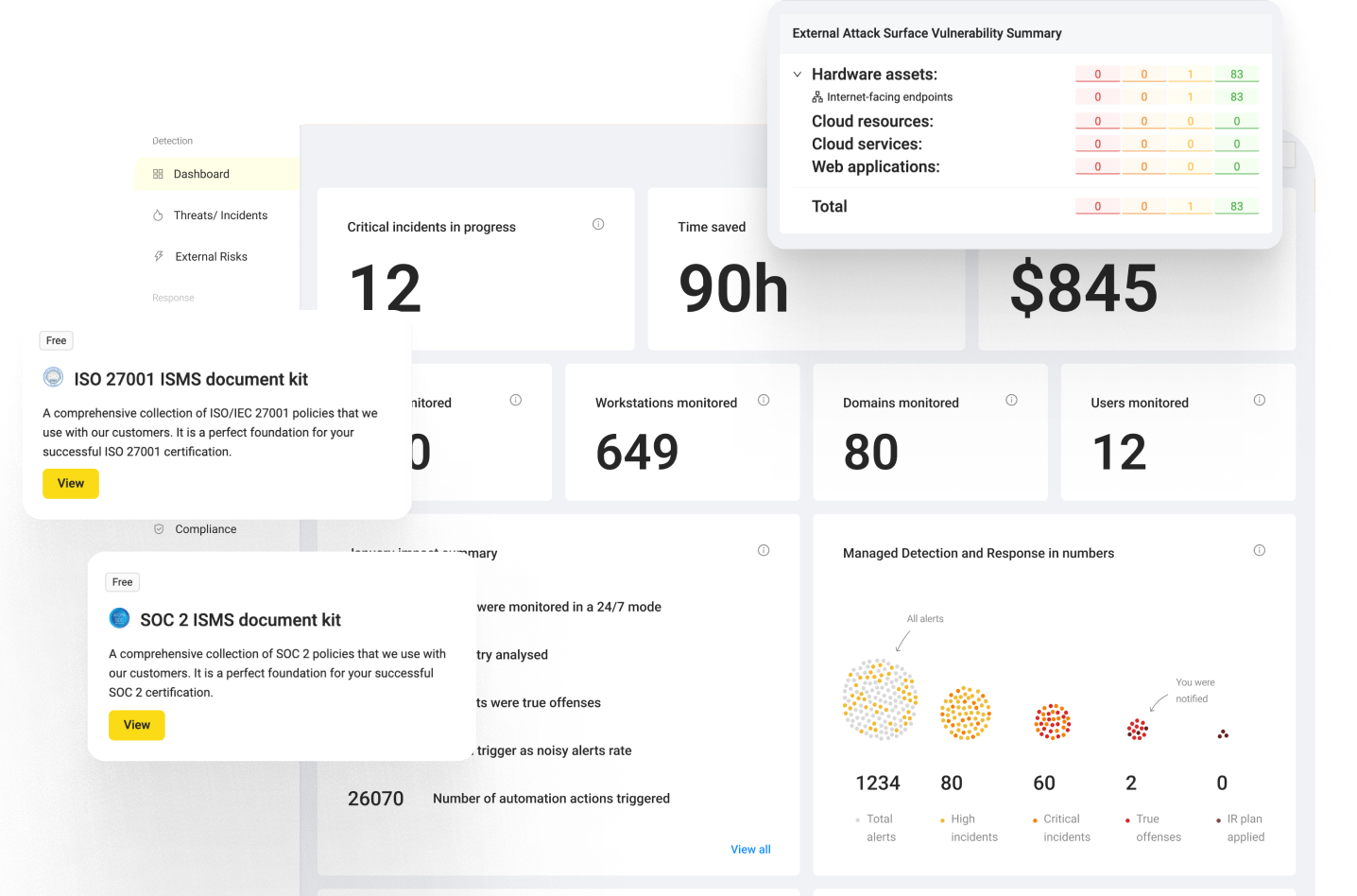
At UnderDefense, our UnderDefense MAXI platform generates audit-ready evidence as a byproduct of 24/7 threat monitoring. Every detection, investigation, containment action, and user verification is logged with full context. Vendor-agnostic integration across 250+ tools means governance documentation covers your entire AI attack surface, not just one vendor’s silo. Forever-free compliance kits (SOC 2, HIPAA, ISO 27001) map directly to AI governance evidence requirements. The policy stack model becomes operational: UnderDefense MAXI enforces the standards, executes the procedures, and auto-generates the evidence.
💰 The Stakes Are Real
UnderDefense clients achieve audit-ready security evidence within 30 days of onboarding, while organizations building governance documentation manually average 6 to 12 months. The EU AI Act’s penalty structure makes the math straightforward: up to €35M or 7% of global annual turnover for prohibited AI violations, and up to €15M or 3% for high-risk obligation breaches. Waiting is a decision, and it’s the most expensive one you can make.
Q2. Which Regulatory Frameworks Are Driving AI Governance Documentation in 2026?
Five major regulatory and standards frameworks are converging in 2026, each with specific documentation demands that overlap in ways you can exploit, or drown in, if you’re managing them separately. Here’s the complete mapping.
📋 Cross-Framework Documentation Matrix
| Framework | Scope/Applicability | Documentation Requirements | Risk Classification | Enforcement | Penalties |
|---|---|---|---|---|---|
| EU AI Act | Any AI impacting EU residents (extraterritorial) | Annex IV technical docs, conformity assessments, post-market monitoring | 4-tier: Unacceptable, High, Limited, Minimal | National regulators + EU AI Office; August 2, 2026 | €35M/7% (prohibited); €15M/3% (high-risk); €7.5M/1% (misleading info) |
| NIST AI RMF 1.0 | US federal agencies mandatory; voluntary for private sector | Govern/Map/Measure/Manage function artifacts | Context-dependent, proportional | Voluntary; increasingly used as standard of care in liability | None (but establishes duty of care) |
| ISO/IEC 42001 | Any organization seeking AI management system certification | AI management system policies, risk assessments, controls, audit evidence | Aligned with organizational risk appetite | Certification body audits | Loss of certification; contractual consequences |
| DAMA-DMBOK / COBIT | Data governance for AI training data quality, lineage, metadata | Data quality dimensions, lineage records, access controls, metadata management | Data criticality-based | Industry self-regulation; contractual | Contractual; indirect regulatory exposure |
| Singapore MGAF | All organizations deploying agentic AI in Singapore | Agent authority boundaries, autonomy classification, decision audit trails | Autonomy-level based | Voluntary; legal accountability for agent actions | Existing liability frameworks apply |
⚠️ EU AI Act Deep-Dive: Annex IV Requirements
For high-risk AI systems, Annex IV mandates the following technical documentation:
- Training data descriptions with provenance and demographics
- Model architecture and design methodology documentation
- Testing methodology and results (including bias testing)
- Human oversight measures and intervention mechanisms
- Post-market monitoring plans with continuous evidence
- Conformity assessment records and lifecycle change logs
The extraterritorial scope is critical: any organization deploying AI that impacts EU residents falls under jurisdiction, regardless of company headquarters. The graduated penalty structure applies from August 2, 2026: €35M or 7% for prohibited practices, €15M or 3% for obligation violations, and €7.5M or 1% for providing misleading information to authorities.
🔍 NIST AI RMF, ISO 42001, and Data Governance Standards
NIST’s four functions translate directly to documentation artifacts:
- Govern → governance policies, RACI assignment, risk appetite statements
- Map → AI inventory register, context analysis, stakeholder impact assessments
- Measure → testing protocols, bias metrics reports, performance benchmarks
- Manage → risk treatment plans, incident response logs, change control records
ISO 42001 adds certification auditability on top, requiring demonstrable management system controls. DAMA-DMBOK’s data quality dimensions and COBIT’s governance objectives map to AI-specific data governance documentation: training data lineage, metadata standards, and access controls scaled by risk tier. Singapore’s MGAF, unveiled January 22, 2026, is the world’s first framework addressing autonomous AI system documentation, requiring organizations to define agent authority boundaries, autonomy classifications, and decision audit trails.
✅ How UnderDefense Simplifies Multi-Framework Compliance
At UnderDefense, UnderDefense MAXI maps security monitoring outputs to framework-specific evidence requirements, generating the continuous documentation trail that EU AI Act conformity assessments, ISO 42001 audits, and NIST AI RMF Measure/Manage functions demand, without manual evidence assembly across multiple systems.
Q3. How Do You Build an AI Inventory and Classify Systems by Risk Tier?
Before you can govern AI, you need to know what AI you actually have. This sounds obvious. In practice, most organizations undercount by 40 to 60% because they exclude vendor-embedded AI, and if a vendor’s AI makes decisions affecting your operations, it belongs in your governance inventory.
📋 Defining Your Scope: What Qualifies as AI
Capture every category:
- Supervised/unsupervised ML models
- NLP/LLM systems (including internal copilots)
- Rule-based automation with adaptive logic
- Embedded vendor AI features (AI capabilities within your CRM, SIEM, EDR, HR platforms)
- Predictive analytics engines
- Agentic AI systems with autonomous decision-making
- GenAI copilots and assistants
For each system, record structured inventory fields:
| Field | Description |
|---|---|
| System Name | Unique identifier |
| Business Owner | Accountable executive |
| Model Owner | Technical RACI |
| Vendor | If third-party |
| Data Inputs/Outputs | What goes in, what comes out |
| Decision Impact | Advisory vs. autonomous |
| Deployment Context | Production, staging, internal |
| Risk Tier | Low / Medium / High |
| Regulatory Mapping | EU AI Act, NIST, ISO 42001 applicability |
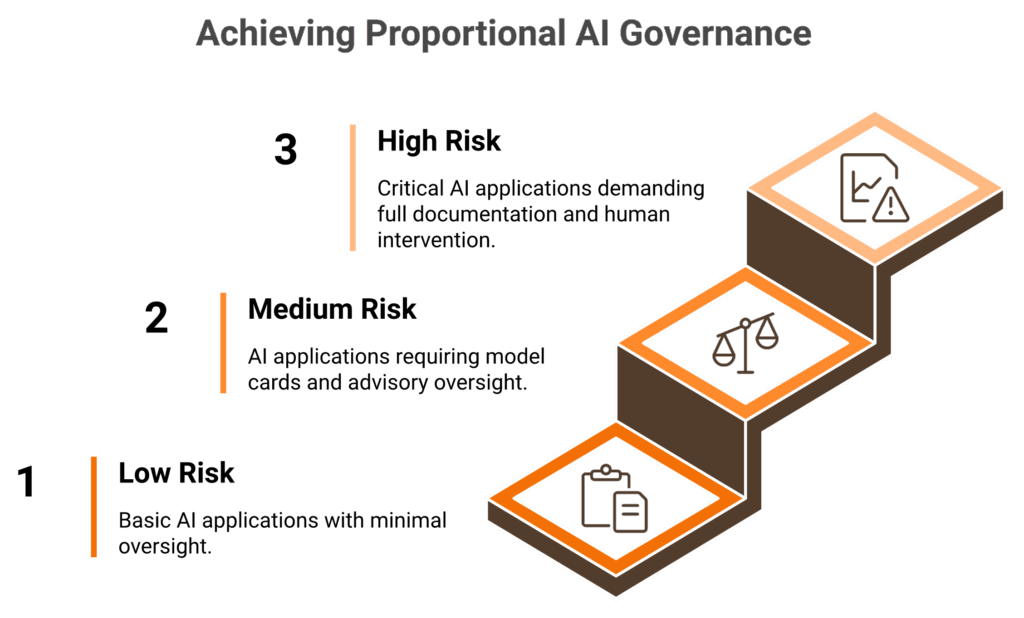
⚡ Three-Tier Risk Classification Model
Align with EU AI Act risk levels using proportional documentation controls:
| Risk Tier | Examples | Documentation Depth | Explainability | Monitoring | Human Oversight | Audit Cadence |
|---|---|---|---|---|---|---|
| 🟢 Low | Content recommendations, internal productivity tools | Basic inventory entry, purpose statement | Output description | Annual review | None required | Annual |
| 🟡 Medium | Fraud scoring, hiring assist, customer segmentation | Model card, data lineage, bias testing | Feature importance, business-level explanations | Quarterly review | Advisory review | Quarterly |
| 🔴 High | Medical diagnosis, autonomous threat response, credit decisions, biometric ID | Full Annex IV technical documentation, conformity assessment | SHAP/LIME + business-level for affected individuals | Continuous monitoring logs | Human-in-the-loop mandatory | Continuous |
The proportional controls principle matters here: over-documenting low-risk systems wastes resources; under-documenting high-risk systems creates regulatory exposure.
🔍 NIST AI RMF: Four Functions Mapped to Documentation Workflows
Each NIST function generates specific artifacts:
- Govern → Governance policies, risk appetite statements, RACI assignment
- Map → AI inventory register, context analysis, stakeholder impact assessment
- Measure → Testing protocols, bias metrics reports, performance benchmarks, fairness evaluations
- Manage → Risk treatment plans, incident response logs, change control records, continuous improvement documentation
On April 7, 2026, NIST released a concept note for an AI RMF Profile on Trustworthy AI in Critical Infrastructure, signaling that documentation rigor is only increasing.
✅ How UnderDefense Simplifies Inventory and Classification
At UnderDefense, our risk-aware monitoring automatically adjusts detection sensitivity and evidence-generation depth based on asset criticality. High-risk AI systems receive continuous behavioral monitoring with full audit trails, while low-risk systems get baseline coverage without alert noise. UnderDefense MAXI’s 250+ integrations ensure even vendor-embedded AI features are inventoried and monitored across your entire stack.
Q4. What Should AI Model Cards and Documentation Standards Include?
Model cards are the single most important governance artifact you’ll produce. They’re the document an auditor asks for first, the record a regulator examines for completeness, and the evidence that proves you actually understand the AI systems you’ve deployed. Here’s the complete template.
📋 Model Card Template: Complete 15-Field Structure
| # | Field | What to Document |
|---|---|---|
| 1 | Model Name & Version | Unique identifier with semantic versioning |
| 2 | Model Owner (RACI) | Accountable individual + responsible, consulted, informed parties |
| 3 | Business Purpose & Intended Use | What problem it solves, approved use cases, prohibited uses |
| 4 | Training Data Description | Provenance, volume, demographics, biases identified, allowed/prohibited data types |
| 5 | Architecture & Technical Specs | Model type, parameters, training methodology, infrastructure |
| 6 | Performance Metrics | Accuracy, precision, recall, F1, fairness metrics (demographic parity, equalized odds) |
| 7 | Known Limitations & Failure Modes | Documented edge cases, degradation conditions, known biases |
| 8 | Explainability Method & Outputs | SHAP, LIME, attention maps, counterfactual explanations |
| 9 | Risk Tier Classification | Mapping to Q3 three-tier model |
| 10 | Human Oversight Requirements | Review cadence, intervention triggers, escalation paths |
| 11 | Monitoring & Drift Detection Plan | Performance thresholds, data drift metrics, alert triggers |
| 12 | Incident Response Procedure | AI-specific response playbook, not generic IT IR |
| 13 | Regulatory Mapping | Which framework requirements this card satisfies |
| 14 | Version History & Change Log | Every retrain, algorithm change, vendor upgrade |
| 15 | Approval Signatures & Review Date | Governance sign-off with next review trigger |
🔍 Explainability Thresholds by Risk Tier
| Risk Tier | Technical Explainability | Business-Level Explainability |
|---|---|---|
| 🟢 Low | Not required | Basic purpose statement, output description |
| 🟡 Medium | Feature importance rankings | Plain-language explanations for business stakeholders |
| 🔴 High | SHAP/LIME values, attention maps, counterfactual explanations | Meaningful information for affected individuals (EU AI Act requirement) |
Both technical explainability (for model owners and auditors) and business-level explainability (for affected users and compliance officers) must be documented in the model card for high-risk systems.
✅ Worked Example: Threat Detection AI Model Card
Here’s what a real model card looks like for a cybersecurity use case:
- Model Name: UnderDefense MAXI Threat Detection Engine v4.2
- Business Purpose: Automated threat detection across endpoint, cloud, identity, and network telemetry
- Training Data: Anonymized attack telemetry from 500+ environments, MITRE ATT&CK-mapped
- Performance: 96% MITRE ATT&CK coverage, 99% alert noise reduction
- Explainability: SHAP-based feature importance for every detection
- Human Oversight: Tier 3 to 4 analyst verification for high-severity detections; concierge response for confirmed threats
- Vendor/Black-Box Documentation: When models are third-party, document observable inputs/outputs/performance and establish contractual requirements for vendor model cards
- Versioning: Model cards update with every retrain, algorithm change, or vendor upgrade. Treat as living documents with change-triggered review cycles
✅ How UnderDefense Maintains Living Model Cards
At UnderDefense, our AI-driven detection models within UnderDefense MAXI maintain continuously updated documentation, demonstrating the standard of living model cards that organizations should adopt. UnderDefense MAXI’s 2-minute alert-to-triage SLA is documented with full investigation context, creating the evidence chain that model cards reference. Every detection decision is traceable, auditable, and reproducible, because governance documentation you can’t verify is governance documentation that doesn’t count.
Q5. What Data Governance Foundations Does Responsible AI Require?
AI models are only as trustworthy as the data behind them. You can have a perfect model card, a rigorous risk classification, and a well-staffed governance committee, but if your training data has undocumented lineage, uncontrolled access, or hidden quality issues, your governance program collapses under audit scrutiny.
Data Quality: Six Dimensions That Determine Model Reliability
DAMA-DMBOK defines six data quality dimensions that directly affect AI system performance.
Each one feeds directly into Model Card Field 4, Training Data Description. If you can’t demonstrate data quality across these six dimensions, your model card is incomplete, and auditors know it.
| Dimension | What It Means for AI | Governance Documentation Required |
|---|---|---|
| Accuracy | Training data reflects real-world conditions | Validation methodology, error rate thresholds |
| Completeness | No critical gaps in training data coverage | Missing data analysis, imputation documentation |
| Consistency | Same rules applied across all data sources | Cross-source reconciliation records |
| Timeliness | Data current enough for model relevance | Refresh schedules, staleness thresholds |
| Validity | Data conforms to defined formats and rules | Schema validation logs, constraint documentation |
| Uniqueness | No unnecessary duplicates distorting training | Deduplication methodology, record matching rules |
Lineage, Provenance, and Single Source of Truth
Data lineage tracks the full chain: raw source → transformation → aggregation → feature engineering → model input. Organizations must document every step so an auditor can trace any model output back to its originating data. This is not optional under the EU AI Act. Annex IV requires training data descriptions with provenance.
The single-source-of-truth principle matters here. If your governance documentation references three different data catalogs with conflicting metadata, you’ve created an audit trap. Rationalize data silos so every AI governance artifact points to one authoritative catalog.
Sensitive, Synthetic, and Agent-Ready Data
Sensitive data categories, including PII, PHI, biometric data, and protected class attributes, require explicit documentation of legal basis, consent mechanisms, anonymization methods, and retention limits before they touch any AI system.
Synthetic data governance is the emerging blind spot. When organizations use AI-generated training data, they must document generation methodology, statistical fidelity validation, and potential biases inherited from the source model. Synthetic data doesn’t exempt you from governance. It adds a documentation layer.
Metadata Strategy: From Persona-Based to Agent-Ready
Traditional persona-based metadata answers “who needs this data.” Agent-ready metadata must be machine-readable, structured so AI agents can programmatically discover, evaluate, and use data assets within governance boundaries. DAMA-DMBOK’s 2024 revision now integrates AI governance and ethics directly into its framework, reflecting this exact shift.
Access Controls, Retention, and Data-in-Motion
Role-based access controls must scale with AI risk tier. High-risk systems demand audit-logged access, least-privilege enforcement, and separation of duties between model developers and data custodians.
Data-in-motion governance is frequently overlooked. API calls, streaming pipelines, and inference requests require encryption, logging, and documentation equivalent to data-at-rest protections. Data retention and deletion rules must align with GDPR’s right to erasure and EU AI Act requirements. ⚠️ Critical nuance: deleting training data may trigger model re-documentation if the deletion changes the data profile the model was trained on.
How UnderDefense Simplifies Data Governance Visibility
At UnderDefense, UnderDefense MAXI monitors data infrastructure across 250+ integrated tools, detecting unauthorized data access, anomalous data movement, and policy violations across AI-connected systems. This provides the converged security visibility layer that governance programs need to verify data controls are actually enforced, not just documented.
Q6. What Governance Roles, Accountability Structures, and Operational Workflows Are Required?
Governance without accountability is just documentation. The most comprehensive model cards and risk assessments are worthless if nobody owns the decisions, nobody signs the approvals, and nobody answers when an auditor asks “who was responsible for this?”
Five Core AI Governance Roles
Every AI governance program needs these roles explicitly assigned, even if one person holds multiple titles in smaller organizations.
| Role | Scope | Key Responsibilities |
|---|---|---|
| AI Governance Committee | Strategic oversight | Policy approval, risk appetite setting, escalation authority |
| Model Owner | Per-model accountability | Documentation currency, performance monitoring, single “A” in RACI |
| Data Steward | Training data governance | Data quality, lineage, access controls, metadata management |
| Compliance/GRC Officer | Regulatory alignment | Framework mapping, audit coordination, exception approval |
| CISO/Security Director | AI threat surface | Threat monitoring, incident response, adversarial robustness |
For high-risk systems, consider adding an Ethics Board with veto authority over deployment decisions. “Everyone is responsible” means nobody is responsible.
RACI Matrix Across the AI Lifecycle
Governance breaks down at handoff points. A RACI matrix eliminates ambiguity about who does what at every lifecycle phase.
| Lifecycle Phase | Governance Committee | Model Owner | Data Steward | Compliance | CISO |
|---|---|---|---|---|---|
| System Proposal & Risk Classification | A | R | C | C | C |
| Data Sourcing & Quality Validation | I | C | R | C | I |
| Model Development & Documentation | I | R/A | C | C | I |
| Testing, Validation & Bias Assessment | I | R | C | A | C |
| Pre-Deployment Approval Gate | A | R | C | R | R |
| Production Deployment | I | R | I | C | C |
| Continuous Monitoring & Drift Detection | I | R | C | I | R |
| Incident Response & Remediation | C | R | C | I | A |
| Change Control (retrain, upgrade) | C | R/A | C | C | C |
| Periodic Audit & Compliance Review | A | R | R | R | R |
R = Responsible, A = Accountable, C = Consulted, I = Informed
Pre-Deployment Gates, Change Control, and Exceptions
No AI system should enter production without a documented approval gate. The checklist: completed model card, risk assessment sign-off, data governance verification, explainability review, and monitoring plan confirmation.
Change control triggers requiring re-review: model retraining on new data, algorithm changes, vendor version upgrades, scope expansion, and performance threshold breaches. Treat every trigger as a mini-deployment decision.
Structured Exceptions Management
Structured exceptions are inevitable, from legacy vendor systems without explainability to emergency deployments. Document each with business justification, compensating controls, risk acceptance sign-off by the governance committee, and a review expiration date. ⚠️ Exceptions without expiration dates become permanent workarounds.
How UnderDefense Fills the 24/7 Accountability Gap
At UnderDefense, our concierge analyst model acts as the external “Responsible” party for continuous AI infrastructure monitoring, filling the 24/7 gap that internal CISO teams can’t cover alone. Every detection, investigation, and response is attributed to a named analyst with documented decision rationale. Our compliance kits automatically assign evidence to the appropriate governance role, so your RACI is not just a spreadsheet but an operational workflow.
Q7. How Should You Monitor AI Systems, Detect Drift, and Handle Incidents?
Your fraud detection model has been in production for nine months. Performance looked solid at deployment. But customer complaints spiked 40% in Q2, with legitimate transactions blocked and fraudulent ones approved. A compliance officer discovers the model’s accuracy has drifted 12 points below the documented threshold. There’s no monitoring log showing when the drift started. No AI-specific incident response procedure. And the EU AI Act conformity assessment is six weeks away.
Why This Happens: The “Deploy and Forget” Pattern
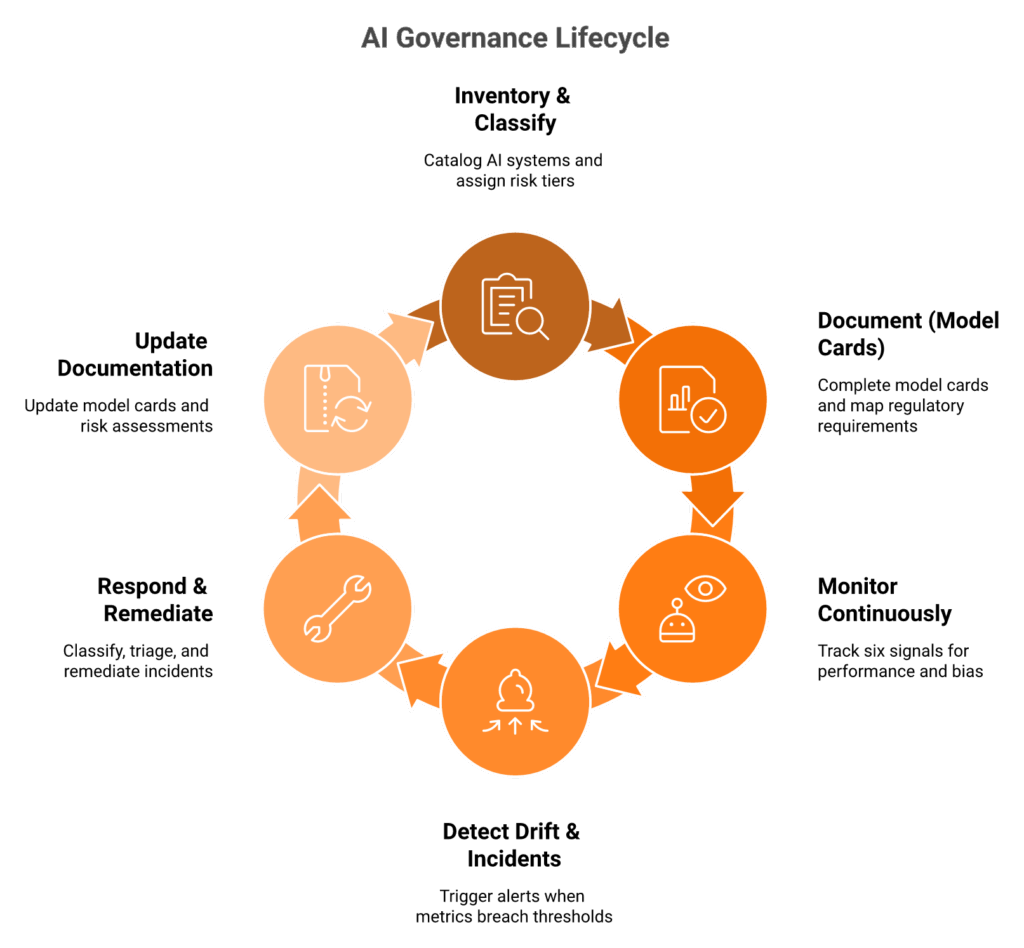
Most organizations treat AI deployment as “done.” Model card at launch. Performance reviewed at launch. Then nothing, until something breaks visibly enough that a human notices. ⏰ The average time to detect AI model drift without continuous monitoring exceeds eight months. By then, damage to customers, revenue, and compliance posture is already severe.
The root cause: monitoring signals are not collected, or are not connected to governance documentation workflows. The model drifts. The model card stays frozen. The gap grows invisible.
Six Monitoring Signals Every Governance Program Must Track
- Performance drift accuracy, precision, and recall against documented baselines
- Data distribution shift input data deviating from training distribution
- Bias metric movement fairness measures crossing documented thresholds
- Error rate escalation false positive/negative trend changes
- Complaint and feedback trends user-reported issues mapped to model behavior
- Explainability output changes feature importance rankings shifting significantly
Risk-Based Testing Cadence
| Risk Tier | Automated Monitoring | Human Review | Guardrail Threshold |
|---|---|---|---|
| ✅ High | Continuous | Monthly | Automated alerts + governance workflow trigger |
| Medium | Weekly | Quarterly | Automated alerts + documented review |
| Low | Monthly | Annual | Threshold logging only |
Guardrails are documented metric bounds that trigger automated alerts and governance workflows when breached. Without them, drift is invisible until it becomes a compliance incident.
AI-Specific Incident Response
AI incidents are not the same as IT incidents. Define what qualifies: performance threshold breach, bias metric violation, unauthorized model behavior, data governance failure, and adversarial attacks on AI infrastructure.
The incident lifecycle: Detection → Classification (severity by risk tier) → Triage → Investigation → Containment (rollback, output suppression, human override) → Remediation → Root Cause → Documentation Update.
⚠️ Critical rule: every AI incident must update the model card, risk assessment, and monitoring plan. Incidents that don’t improve documentation are wasted learning. Model owners attest quarterly that documentation is current. All governance roles complete annual training with documented evidence.
“It was refreshing to see a true cybersecurity partner that was just as committed to our success as we were.”
— Information Security Manager, Enterprise UnderDefense G2 – Verified Review
How UnderDefense Delivers Continuous AI Monitoring
At UnderDefense, UnderDefense MAXI provides continuous monitoring across 250+ tools, detecting anomalous AI behavior including unusual data access patterns, output distribution changes, and unauthorized model modifications. Our 2-minute alert-to-triage and 15-minute critical escalation mean governance events are investigated while actionable, not discovered months later.
Concierge analysts verify AI-related alerts with organizational context. Every investigation produces a documented decision chain feeding governance evidence. A US Government organization using our platform reduced threat response time to 9 minutes with fully documented evidence trails, continuous monitoring and governance-grade evidence at operational speed.
“The reports from their platform give us clear evidence of our security controls and incident response capabilities. When auditors or clients ask questions about our security posture, we can pull up exactly what they need to see.”
— Verified User, Mid-Market UnderDefense G2 – Verified Review
Q8. How Should Organizations Document Agentic AI and Generative AI Systems?
AI agents are being deployed across enterprises at a pace governance programs haven’t caught up with. Tool-using LLMs, autonomous workflow systems, multi-step reasoning chains, and GenAI copilots are in production, making decisions, accessing databases, calling APIs, and taking actions on behalf of users. The governance documentation designed for traditional supervised ML simply doesn’t capture what these systems do.
The Governance Gap Nobody Is Closing
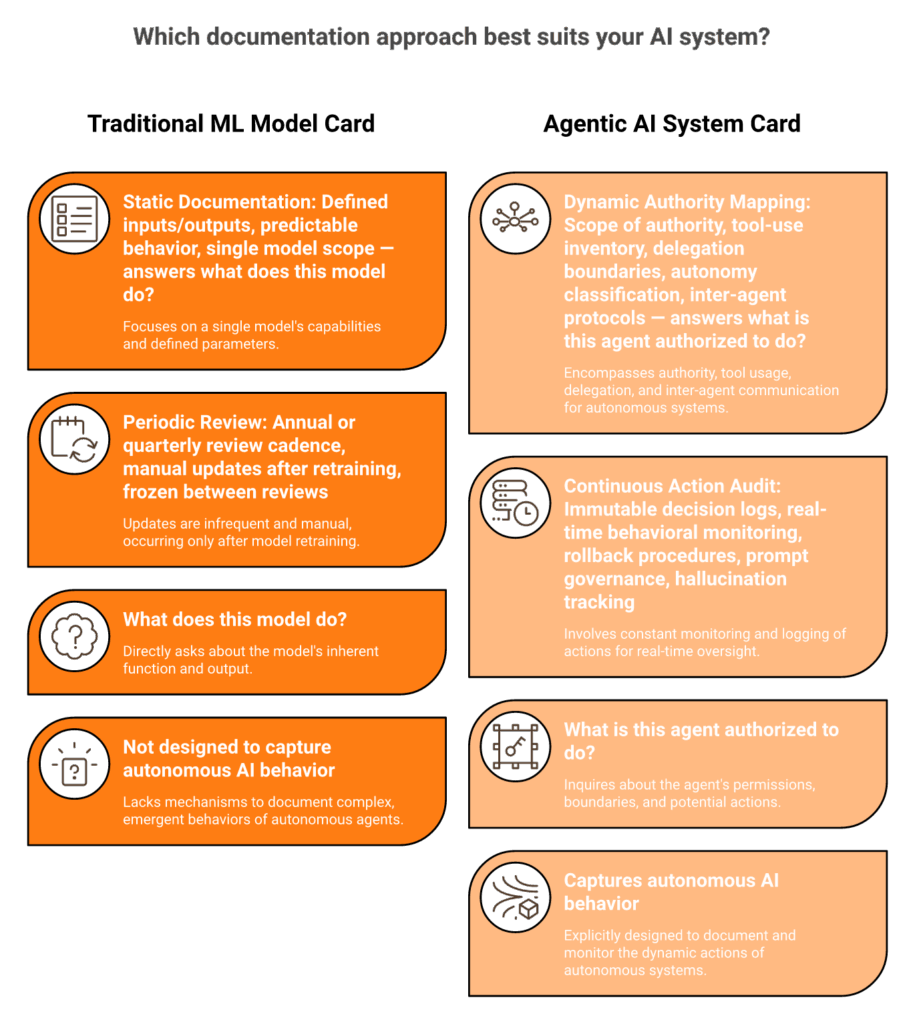
Traditional model cards were designed for supervised ML with defined inputs and predictable outputs. They answer “what does this model do?” But agentic AI demands different questions: What is this agent authorized to do? What did it actually do? Who is accountable when it acts incorrectly? Can we reproduce the decision chain?
Singapore recognized this gap first. The Model AI Governance Framework for Agentic AI, launched January 22, 2026, at the World Economic Forum is the world’s first framework explicitly addressing autonomous AI documentation, requiring organizations to assess risks, set limits on agent authority, ensure human accountability at critical decision points, and implement technical controls throughout the agent lifecycle.
Why Legacy Documentation Fails for Autonomous Systems
Agentic AI makes sequential decisions, calls external tools, and operates with delegated authority, an accountability chain a single model card can’t capture. GenAI adds output non-determinism, where the same prompt produces different outputs each time.
Traditional MDR providers and MSSPs have no framework for monitoring autonomous AI behavior. Documentation shifts from “what does this model do?” to “what is this agent authorized to do, what did it actually do, who is accountable, and can we reproduce the decision chain?” Meanwhile, threat actors have already weaponized agentic AI. Automated reconnaissance, adaptive malware, and AI-driven social engineering operate at machine speed.
Agentic AI System Card: New Fields Beyond Standard Model Cards
Extend the standard model card (Q4) with these additional fields:
- Agent Purpose & Scope of Authority what the agent is authorized to do and explicit boundaries
- Tool-Use Inventory which APIs, systems, and databases the agent can access
- Delegation Boundaries which decisions require human approval versus autonomous execution
- Autonomy Level Classification fully autonomous, human-in-the-loop, or human-on-the-loop
- Decision Log & Action Audit Trail immutable record of every action taken
- Rollback & Override Procedures how to reverse agent actions and activate human control
- Inter-Agent Communication Protocols for multi-agent systems, coordination and data sharing rules
GenAI-Specific Documentation Requirements
GenAI adds output non-determinism. Documentation must account for this:
- Prompt Governance Framework approved templates, prohibited patterns, injection defenses
- RAG Pipeline Records retrieval sources, chunking strategy, embedding model, grounding verification
- LLM Fine-Tuning Documentation fine-tuning data, RLHF methodology, evaluation benchmarks
- Output Logging & Hallucination Monitoring confidence thresholds, grounding checks, human review cadence
- Agent-Ready Metadata machine-readable metadata enabling agents to discover data within governance boundaries
How UnderDefense Monitors AI Agent Behavior
At UnderDefense, our MDR for AI service is purpose-built for monitoring AI agents and GenAI systems. UnderDefense MAXI detects anomalous tool-use patterns, unauthorized data access by agents, prompt injection attempts, and drift from autonomy boundaries. Concierge analysts verify agent behavior with organizational context, providing the human oversight layer agentic governance demands.
Organizations deploying agentic AI without behavioral monitoring face the same exposure as endpoints without EDR. First EU AI Act enforcement actions will likely target high-risk autonomous systems without conformity documentation. The documentation burden is real: expect 40–80 hours per high-risk model for initial documentation, and 8–15 hours per model per quarter for maintenance. The alternative is penalties reaching €35M or 7% of global revenue.
Q9. How Do You Build Audit-Ready AI Governance Evidence?
How do you know if your AI governance program will actually survive an audit? Not a theoretical assessment, but a real examiner sitting across from your compliance team, asking for evidence you may not have. Here’s a 10-item self-assessment to find out.
✅ AI Governance Evidence Readiness Checklist
- ☐ Centralized AI system inventory with current risk classifications?
- ☐ Each high-risk AI system has a versioned, reviewed model card?
- ☐ Data lineage producible for every AI training dataset within 24 hours?
- ☐ Monitoring systems generate continuous, timestamped AI behavior evidence?
- ☐ Human oversight interventions documented with full context?
- ☐ Explainability outputs documented per risk tier?
- ☐ AI-specific incident response procedures documented and tested?
- ☐ Security monitoring auto-generates compliance-mapped evidence?
- ☐ Change control records exist for every retrain, update, or vendor change?
- ☐ Governance KPIs (bias ratios, compliance rates, documentation currency, adoption %) tracked quarterly?
⭐ Score Interpretation
| Score | Rating | What It Means |
|---|---|---|
| 8–10 ✓ | Audit-ready | Governance is operational with optimization opportunities |
| 5–7 ✓ | Critical gaps | Examiners will find holes, and remediation is urgent |
| 0–4 ✓ | Will not withstand assessment | EU AI Act conformity or ISO 42001 audit will fail |
⚠️ What Examiners Ask First, and Where Teams Fail
Auditors open with three questions: Is your AI inventory complete? How did you classify risk? Show me evidence of ongoing monitoring. From there, the five most common documentation failures we see are: (1) model cards not updated since deployment, (2) risk assessments referencing outdated data, (3) no evidence human oversight actually occurs, (4) monitoring logs unmapped to governance requirements, and (5) incident response procedures that are generic IT, not AI-specific.
💰 The Documentation Burden, Quantified
The effort is real. Expect 40–80 hours per high-risk model for initial documentation, 8–15 hours per model per quarter for maintenance, and roughly 0.5–1.0 FTE per 10 high-risk models. Healthcare organizations face HIPAA plus EU AI Act intersections. Financial services teams navigate GDPR plus model risk management. Government agencies deal with sandbox programs and transparency mandates.
“The reports from their platform give us clear evidence of our security controls and incident response capabilities. When auditors or clients ask questions about our security posture, we can pull up exactly what they need to see.”
— Verified User, Mid-Market UnderDefense – G2 Verified Review
“UnderDefense MAXI has played a key role in protecting our infrastructure and improving our overall security, helping us spot the potential threats early. By the way, 30-day impact reports are super helpful these days.”
— Verified User in Marketing and Advertising UnderDefense – G2 Verified Review
How UnderDefense Closes Evidence Gaps
At UnderDefense, our 24/7 monitoring generates continuous timestamped evidence (checklist items 4, 5, and 8). Every detection, investigation, and response is logged with full decision context. Vendor-agnostic integration covers your full AI surface (item 1). Compliance kits map evidence to SOC 2, HIPAA, and ISO 27001 (item 8). Most teams go from 3–4 checks to 8+/10 within 30 days of onboarding.
📝 Five Core Evidence Templates
- AI System Inventory Register — system name, owner, vendor, risk tier, regulatory mapping, review date
- Risk Assessment & Classification Form — risk factors, impact scoring, proportional controls, approver
- Model Card Template — full 15 fields per Q4
- Continuous Monitoring Evidence Log — timestamp, signal type, threshold status, action taken, resolution
- AI Incident Response Report — classification, timeline, investigation steps, containment, root cause, documentation updates triggered
Each template maps to EU AI Act, NIST AI RMF, and ISO 42001 requirements. Build them once, maintain them continuously. A US Government organization using our platform achieved audit-ready evidence with a 9-minute threat response time, proving governance-grade evidence and operational speed coexist.
Q10. How Do You Measure and Advance AI Governance Maturity?
Most organizations know they need AI governance. What they lack is a way to measure where they are, what “good” looks like, and how to get there without a two-year roadmap that’s outdated before phase one completes.
Five-Stage AI Governance Maturity Model
| Level | Name | Key Characteristics |
|---|---|---|
| 1 | Ad Hoc | No AI inventory, reactive per-project documentation, no risk classification, governance absent or informal |
| 2 | Developing | Partial inventory, some model cards exist, policy drafted but inconsistently applied, initial governance discussions |
| 3 | Defined | Centralized inventory, model cards mandatory for medium/high risk, consistent classification, governance committee with regular cadence, framework mapping |
| 4 | Managed | All systems documented and classified, continuous automated monitoring with evidence, enforced RACI, regular audits with verifiable evidence, tested incident response |
| 5 | Strategic | Governance in CI/CD pipeline (auto-generated docs at deployment), real-time compliance dashboards, agentic/GenAI standards enforced, governance metrics drive deployment decisions, governance enables AI velocity |
⭐ What Each Level Means for Compliance
Level 1 ❌ = acute non-compliance risk, as first enforcement targets will come from here
Level 2 ⚠️ = minimum viable for August 2026 EU AI Act deadline, but vulnerable under examination
Level 3 ✅ = audit-ready and defensible
Level 4 ✅ = operational excellence with data-driven governance decisions
Level 5 ⭐ = competitive advantage, where governance enables faster AI deployment, not slower
Most organizations sit between Level 1 and 2. That’s the 78% adoption versus 25% governance gap in action.
Minimum Viable Governance for Fast-Moving Teams
Not every organization can staff a full governance program by August. Here’s the minimum viable path to Level 2 in 30–60 days: build an AI inventory covering your top 5 highest-impact systems, risk-classify each one, create model cards for those 5, implement basic monitoring, and assign a named governance owner. This won’t make you audit-proof; it will make you defensible.
🗺️ Phased Implementation Roadmap
- Phase 1 (Month 1–2): Awareness & Inventory — catalog AI systems, assign ownership, conduct initial risk classification
- Phase 2 (Month 2–4): Strategy & Policy — establish governance committee, define policies, create model card template, map regulatory requirements
- Phase 3 (Month 4–6): Deployment & Training — implement documentation workflows, deploy monitoring, conduct role-based training, establish audit evidence pipelines
- Phase 4 (Ongoing): Continuous Improvement — measure governance KPIs, refine based on audit findings, expand coverage, advance maturity level
Future Trends to Prepare For
The governance landscape is shifting fast. Evolving EU AI Act implementing regulations will add specificity through 2027. AI portfolio governance, managing documentation across hundreds of models, will require automation. Centers of excellence for agentic AI are emerging. Regulatory convergence across jurisdictions will simplify some requirements while raising the baseline. The governance-as-code movement will embed documentation generation directly into deployment pipelines.
How UnderDefense Accelerates Maturity
At UnderDefense, we accelerate organizations from Level 1–2 to Level 3–4 within 30 days. Continuous monitoring delivers Level 4 evidence infrastructure immediately. Vendor-agnostic integration covers the full AI surface without tool consolidation. Compliance kits provide the framework mapping Level 3 requires. Concierge analysts bridge automated evidence and governance-grade documentation, turning security operations into the engine that powers governance maturity.
Q11. How Can Security Operations Power Continuous AI Governance Compliance?
The organizations winning at AI governance in 2026 are those whose security operations produce audit evidence as a byproduct, not a project. The AI SOC + Human Ally architecture transforms monitoring telemetry into governance-grade documentation continuously, without requiring separate governance tooling or manual evidence assembly.
⚠️ Why Most Governance Programs Hit a Wall
AI governance demands three capabilities most organizations lack simultaneously: continuous evidence generation across all AI infrastructure, human-verified accountability records for every significant AI event, and automated compliance mapping to multiple frameworks at once.
Traditional MSSPs generate logs without governance context, producing volumes of raw data that prove monitoring happened but don’t prove governance controls were enforced. Traditional governance platforms document policies without operational evidence, creating beautiful policy libraries that can’t demonstrate real-time enforcement. The convergence point is security operations that understand both threat detection and compliance documentation.
✅ Six Selection Criteria for Governance-Ready Security Operations
- Vendor-agnostic integration covering all AI-connected systems (SIEM, EDR, cloud, identity, and data platforms), not one vendor’s silo
- Continuous evidence generation with timestamped, context-rich documentation of every detection, investigation, and response action
- Human analyst verification creating accountability records: who verified what, when, and with what outcome
- Automated compliance mapping to EU AI Act, NIST AI RMF, ISO 42001, SOC 2, and HIPAA simultaneously
- Transparent pricing and 30-day deployment, because governance programs can’t wait 6 months for security operations to come online
- Agentic AI monitoring capabilities, because security operations must govern AI agents alongside human users
❌ Where Traditional Providers Fall Short
Traditional MDR providers like Arctic Wolf force proprietary tool replacement, creating vendor lock-in that fragments your governance evidence across old and new systems. Endpoint-focused providers like CrowdStrike see threats but miss organizational context and the user verification that governance accountability demands. Neither architecture was designed to produce the continuous, cross-platform, compliance-mapped evidence that AI governance requires.
UnderDefense’s MDR for AI: Purpose-Built for This Convergence
At UnderDefense, our MDR for AI service delivers 24/7 behavioral monitoring across 250+ tools, concierge analyst verification that generates human-oversight evidence, and compliance automation that organizes everything for auditors. Whether you’re at Maturity Level 1 or Level 4, the gap between your governance program and audit readiness is continuous security operations that speak the language of compliance.
Credibility Anchor
These recommendations are based on documented response times (2-minute alert-to-triage, 15-minute critical escalation), 96% MITRE ATT&CK coverage, and operational outcomes across 500+ MDR deployments, including organizations actively preparing for EU AI Act conformity assessments.
Q12. FAQ: AI Governance Documentation and Data Governance
What is AI governance documentation?
AI governance documentation is the operational system of policies, model cards, risk assessments, audit evidence, and accountability records that prove your AI systems are deployed responsibly. It connects the policy stack, from high-level principles through standards and procedures to verifiable evidence, creating the audit trail regulators require.
How do you create an AI data governance policy?
Four steps: (1) assess your current data landscape and AI inventory, (2) define scope using the policy stack model (Policy → Standards → Procedures → Evidence), (3) map requirements to applicable regulatory frameworks (EU AI Act, NIST AI RMF, ISO 42001), and (4) establish roles, evidence workflows, and review cadences. Start with your top 5 highest-risk AI systems.
What documentation does the EU AI Act require?
For high-risk systems, Annex IV mandates technical documentation covering: general system description, design methodology, training data descriptions with provenance, monitoring and control information, risk management documentation, lifecycle change records, applied standards, conformity assessment records, and post-market monitoring plans. UnderDefense MAXI auto-generates the continuous monitoring evidence that Annex IV post-market surveillance requires.
How do you measure AI governance effectiveness?
Track five KPIs: bias/fairness deviation from baseline, model card review currency (% updated within required cadence), compliance audit pass rate, governance adoption percentage (AI systems with complete documentation), and mean time from AI incident to documentation update.
What is a model card?
A model card is a standardized documentation profile for an AI system covering 15 fields: model name and version, owner, business purpose, training data description, architecture, performance metrics, limitations, explainability method, risk tier, human oversight requirements, monitoring plan, incident response procedure, regulatory mapping, version history, and approval signatures. See Q4 for the complete template.
How does data governance support AI governance?
Data quality, lineage, and access controls are the foundation. Without documented data provenance, model cards are incomplete. Without access controls scaled by risk tier, governance evidence is unreliable. Data governance and AI governance must converge, as running them as separate programs creates the audit gaps examiners are trained to find. See Q5 for full requirements.
What is the difference between AI governance policy and AI usage policy?
AI governance policy establishes organizational accountability, risk classification, compliance mapping, and evidence requirements across all AI systems. AI usage policy defines employee behavioral rules for AI tools, including prompt restrictions, approved tools, and data handling. Most organizations only have usage policies and mistakenly call it governance.
What are the NIST AI RMF core functions?
Four functions: Govern (policies, roles, risk appetite), Map (AI inventory, context analysis, stakeholder impact), Measure (testing protocols, bias metrics, performance benchmarks), and Manage (risk treatment, incident response, change control). Each function generates specific documentation artifacts.
How do you govern agentic AI systems?
Extend the standard model card with an agentic AI system card: scope of authority, tool-use inventory, delegation boundaries, autonomy level classification, decision log and action audit trail, rollback procedures, and inter-agent communication protocols. UnderDefense’s MDR for AI provides the behavioral monitoring framework that agentic AI governance demands. See Q8 for the complete template.
What KPIs measure AI governance success?
Five metrics: bias/fairness deviation from documented baseline, model card review currency rate, mean time from AI incident to documentation update, percentage of AI systems with complete governance documentation, and audit finding resolution rate. Track quarterly at minimum.
1. What is the difference between AI governance documentation and an AI usage policy?
We see this confusion constantly across enterprises, and it’s the single most common governance failure we encounter. An AI usage policy defines employee behavioral rules — what tools are approved, what data can be entered into ChatGPT, and prompt restrictions. It’s an HR-style document.
AI governance documentation is fundamentally different. It establishes organizational accountability, risk classification frameworks, compliance mapping across regulations like the EU AI Act and NIST AI RMF, and continuous evidence requirements for every AI system in production. It includes model cards, risk assessments, RACI assignments, monitoring evidence, and incident response procedures.
The critical distinction: usage policies tell people what not to do. Governance documentation proves your controls actually work. Most organizations have only the former and mistakenly call it governance — what we call “governance theater.” Static PDF policies reviewed once a year, disconnected from live operations, will not survive an EU AI Act conformity assessment.
At UnderDefense, we help organizations move beyond checkbox governance through our cybersecurity compliance services that generate operational evidence as a byproduct of 24/7 security monitoring, not as a separate documentation project.
2. What documentation does the EU AI Act require for high-risk AI systems by August 2026?
The EU AI Act’s Annex IV mandates nine categories of technical documentation for high-risk AI systems, with full enforcement landing August 2, 2026:
-
General system description and intended purpose
-
Design and development methodology
-
Training data descriptions with full provenance
-
Monitoring and control information
-
Risk management documentation
-
Lifecycle change records
-
Applied standards and harmonized references
-
Conformity assessment records
-
Post-market monitoring plans
The extraterritorial scope catches many organizations off guard. If your AI impacts EU residents, your company’s headquarters location is irrelevant. Penalties reach €35M or 7% of global turnover for deploying prohibited AI, and €15M or 3% for failing documentation obligations.
We recommend starting with the CISOs’ compliance roadmap to map your current documentation gaps against these requirements. Organizations building governance documentation manually average 6–12 months to reach audit readiness; continuous evidence generation through security operations cuts that to 30 days.
3. How do you build an AI inventory and classify systems by risk tier?
The first operational step in any AI governance program is knowing what AI you actually have. Most organizations undercount by 40–60% because they exclude vendor-embedded AI — the intelligence baked into your CRM, SIEM, and EDR platforms.
We recommend a three-tier risk classification aligned with the EU AI Act:
-
Low Risk: Content recommendations, internal productivity tools — requiring inventory entry and annual review only
-
Medium Risk: Fraud scoring, hiring assists, customer segmentation — requiring model cards, data lineage documentation, bias testing, and quarterly review
-
High Risk: Medical diagnosis, autonomous threat response, credit decisions, biometric identification — requiring full Annex IV documentation, SHAP/LIME explainability, continuous monitoring, and human-in-the-loop oversight
Proportional governance is the principle. Over-documenting low-risk systems wastes resources and creates audit noise. Under-documenting high-risk systems creates regulatory exposure. For each system, capture structured fields: System Name, Business Owner, Model Owner, Vendor, Data Inputs/Outputs, Decision Impact, Deployment Context, Risk Tier, and Regulatory Mapping.
Our continuous security monitoring approach automatically adjusts detection sensitivity and evidence depth based on asset criticality across 250+ integrated tools.
4. What fields should an AI model card include in 2026?
A model card is the single most important governance artifact for any AI system — think of it as the nutrition label for your AI. We recommend 15 essential fields:
Model Name & Version, Model Owner (RACI), Business Purpose & Intended Use, Training Data Description (provenance, volume, biases), Architecture & Technical Specs, Performance Metrics (accuracy, precision, recall, fairness metrics), Known Limitations & Failure Modes, Explainability Method & Outputs, Risk Tier Classification, Human Oversight Requirements, Monitoring & Drift Detection Plan, Incident Response Procedure, Regulatory Mapping, Version History & Change Log, and Approval Signatures & Review Date.
Explainability requirements scale with risk tier. Low-risk systems need only basic output descriptions. Medium-risk systems require feature importance rankings. High-risk systems demand SHAP/LIME values plus non-technical explanations for affected individuals — an explicit EU AI Act requirement.
Model cards must update alongside every retrain, algorithm change, or vendor version upgrade. Treat them as living documents. At UnderDefense, our AI-driven detection models within MAXI maintain continuously updated documentation — every detection decision includes the full evidence chain, setting the standard for living model cards.
5. How should organizations document and govern agentic AI systems?
Agentic AI — tool-using LLMs, autonomous workflow systems, and multi-step reasoning chains — creates governance challenges that traditional model cards were never designed for. Traditional documentation answers “what does this model do?” Agentic AI demands: What is this agent authorized to do? What did it actually do? Who is accountable when it acts incorrectly?
We recommend extending the standard model card with an agentic AI system card containing these additional fields:
-
Agent Purpose & Scope of Authority with explicit boundaries
-
Tool-Use Inventory (APIs, systems, and databases accessible)
-
Delegation Boundaries (human approval vs. autonomous execution)
-
Autonomy Level Classification
-
Decision Log & Action Audit Trail (immutable records)
-
Rollback & Override Procedures
-
Inter-Agent Communication Protocols
Singapore’s Model AI Governance Framework for Agentic AI, launched January 22, 2026, is the first framework explicitly addressing autonomous AI documentation. Meanwhile, threat actors have already weaponized agentic AI for automated reconnaissance and adaptive malware.
Our MDR for AI service is purpose-built for monitoring AI agents, detecting anomalous tool-use patterns, unauthorized data access, prompt injection attempts, and drift from autonomy boundaries.
6. What governance roles and RACI accountability structures does an AI program need?
Governance without accountability is just documentation. We define five core roles every AI governance program must assign:
-
AI Governance Committee: Strategic oversight — policy approval, risk appetite setting, escalation authority
-
Model Owner: Per-model accountability — documentation currency, performance monitoring, the single “A” in RACI
-
Data Steward: Training data governance — data quality, lineage, access controls, metadata management
-
Compliance/GRC Officer: Regulatory alignment — framework mapping, audit coordination, exception approval
-
CISO/Security Director: AI threat surface — threat monitoring, incident response, adversarial robustness
The RACI matrix must span the full AI lifecycle: system proposal, data sourcing, model development, testing and validation, pre-deployment approval, production deployment, continuous monitoring, incident response, change control, and periodic audit review. Governance breaks down at handoff points between these phases.
For high-risk systems, consider adding an Ethics Board with veto authority. “Everyone is responsible” means nobody is responsible. Our concierge analyst model at UnderDefense fills the 24/7 accountability gap through documented incident response where every detection is attributed to a named analyst with full decision rationale.
7. How do you detect AI model drift and handle AI-specific incidents?
The average time to detect AI model drift without continuous monitoring exceeds eight months. By then, damage to customers, revenue, and compliance posture is already severe. We’ve seen fraud detection models drift 12 points below documented thresholds with no monitoring log showing when the degradation started.
Six monitoring signals every governance program must track:
-
Performance drift (accuracy, precision, recall vs. baselines)
-
Data distribution shift (input deviation from training distribution)
-
Bias metric movement (fairness measures crossing thresholds)
-
Error rate escalation (false positive/negative trend changes)
-
Complaint and feedback trends (user-reported issues mapped to model behavior)
-
Explainability output changes (feature importance rankings shifting)
AI incidents are not IT incidents. Define what qualifies: performance threshold breach, bias metric violation, unauthorized model behavior, data governance failure, and adversarial attacks. The lifecycle: Detection → Classification → Triage → Investigation → Containment → Remediation → Root Cause → Documentation Update. Every incident must update the model card and risk assessment.
At UnderDefense, our MAXI platform provides continuous monitoring with 2-minute alert-to-triage and 15-minute critical escalation, ensuring governance events are investigated while actionable — not discovered months later.
8. How do you measure AI governance maturity and advance through maturity levels?
We use a five-stage AI governance maturity model:
-
Level 1 – Ad Hoc: No formal governance; policies exist only in draft or scattered documents
-
Level 2 – Defined: Policies documented but inconsistently applied; model cards exist for some systems
-
Level 3 – Managed: Risk-tiered governance applied consistently; monitoring in place; RACI operational
-
Level 4 – Measured: KPIs tracked quarterly; continuous evidence generation; audit-ready documentation maintained
-
Level 5 – Optimized: Governance self-sustaining; automated evidence flows; governance improves operational performance
Five KPIs to track: bias/fairness deviation from baseline, model card review currency rate, mean time from AI incident to documentation update, percentage of AI systems with complete governance documentation, and audit finding resolution rate.
The gap between most organizations (Levels 1–2) and audit readiness (Level 4) is continuous security operations that speak the language of compliance. Traditional MSSPs generate logs without governance context. Traditional governance platforms document policies without operational evidence. The convergence of both is what organizations need.
Our SOC transformation guide details how to bridge this gap operationally, and most teams move from 3–4 evidence checklist items to 8+ within 30 days of onboarding with UnderDefense.