




Q1. Why Are SOC Teams Drowning in Alerts, and How Did Triage Evolve to This Breaking Point?
It’s 2:47 AM on a Tuesday. Your phone buzzes, the fourteenth “critical” alert this week. You log in, spend 45 minutes investigating, and discover it’s a developer running a legitimate PowerShell script. Again. Meanwhile, somewhere in that ocean of noise, a real threat may be sliding by unnoticed. If this sounds familiar, you’re not alone.
⚠️ The Numbers Behind the Noise
The average SOC receives over 11,000 alerts per day, and roughly 45% turn out to be false positives. Seventy percent of security teams admit that critical alerts get ignored because there’s simply too much volume to process. And with 3.4 million unfilled cybersecurity roles globally (ISC², 2024), you cannot hire your way out of this problem.
The root cause isn’t laziness or bad tooling but architectural. Your CrowdStrike sees endpoint behavior. Your Splunk ingests logs. Okta tracks identity. But none of these tools can reason across each other. You become the manual correlation layer, stitching context together at 3 AM with coffee and adrenaline.
⏰ How We Got Here: A Brief History of Triage Debt
Triage has evolved through five eras, and each solved the previous bottleneck while creating a new one:
- Manual triage (2005–2012): Analyst-driven, spreadsheet-tracked. Worked when alert volumes were manageable.
- SIEM correlation rules (2012–2017): Static thresholds generated volume without context, noisy, brittle, and hard to tune.
- SOAR playbook automation (2017–2022): Rigid if-then logic codified known workflows but couldn’t handle novelty. The result: “automation debt” as playbooks proliferated.
- ML-assisted triage (2022–2024): Pattern recognition improved classification, but models couldn’t reason across tools or verify context with humans.
- Agentic AI triage (2025+): Autonomous, multi-step investigation across SIEM, EDR, and identity, machines that reason, not just execute.
Today’s SOC sits at that fifth inflection point. The question isn’t whether AI triage is coming but whether your implementation will be deliberate or reactive.
💸 The Hidden Costs No One Budgets For
- 10–15 hours/week per analyst wasted on manual triage
- 18-month average tenure before burnout-driven analyst turnover
- $4.88M average breach cost when dwell time extends due to alert fatigue (IBM Cost of a Data Breach, 2024)
- 70% of critical alerts go uninvestigated in under-resourced SOCs
✅ What the Ideal State Actually Looks Like
The right system correlates alerts across all your tools, verifies suspicious activity directly with affected users, and only escalates confirmed threats that require your judgment. You’d wake up to: “Incident contained at 2:52 AM, here’s what happened and what we did,” not 47 unread alerts to triage.
At UnderDefense, we built the UnderDefense MAXI platform to deliver exactly this: AI-driven enrichment across 250+ integrated tools, ChatOps analyst verification via Slack and Teams, and confirmed threats contained before your team wakes up. Traditional MDR providers like Arctic Wolf and ReliaQuest stop at escalation, sending “please investigate” tickets back to your team at 3 AM. We own the outcome.
From 45-minute 2 AM investigations to morning incident summaries, that’s the shift from alert noise to managed response.
“Our IT team was overwhelmed by the sheer volume of security alerts and doesn’t have the resources for 24/7 monitoring.”
— Andriy H., Co-Founder and CTO UnderDefense G2 – Verified Review
“Analysts provide little context, and when asked for more information in the investigation nothing is ever provided or even communicated. Support incidents are not worked to completion and communication evaporates.”
— CISO, Manufacturing Enterprise Arctic Wolf – Gartner Verified Review
Q2. What Is AI-Enabled Incident Triage and How Does the End-to-End Pipeline Work?
Incident triage in cybersecurity is the process of evaluating, classifying, and prioritizing security alerts to determine which require immediate investigation, which can be auto-resolved, and which are noise.
AI-enabled incident triage applies machine learning, behavioral analysis, NLP, and contextual enrichment to perform this classification and prioritization autonomously, replacing static, rule-based triage that structurally cannot scale beyond thousands of daily alerts.
The distinction matters: rule-based triage uses static thresholds and keyword matching. AI-enabled triage uses adaptive pattern recognition that learns from analyst feedback and evolves with the threat landscape.
🔧 The 10-Step AI Triage Pipeline
Here’s how a mature AI triage pipeline works end-to-end, from raw alert to organizational learning:
- Data Ingestion — Collect alerts from SIEM, XDR, EDR, firewalls, cloud platforms, and identity providers into a single ingestion layer.
- Alert Normalization — Standardize heterogeneous formats (CEF, JSON, syslog, API payloads) into a unified schema so alerts from CrowdStrike, Splunk, and Okta speak the same language.
- Deduplication — Merge duplicate or overlapping alerts from multiple sources. A single login anomaly shouldn’t generate three separate tickets.
- Alert Correlation — Link related events across tools into unified incidents. That suspicious login + privilege escalation + lateral movement? One incident, not three alerts.
- AI-Driven Classification — Assign severity (critical/high/medium/low/informational) using trained models, not static rules.
- Contextual Enrichment — Layer in asset criticality, user behavior analytics, threat intel feeds, and historical incident patterns. A PowerShell execution on a developer laptop is very different from one on a domain controller.
- Risk Scoring & Dynamic Prioritization — Generate a composite risk score that replaces static severity. A “medium” alert on a crown-jewel asset outranks a “high” on a test server.
- Automated Escalation — Create tickets, notify teams, and route incidents based on SLA-aware logic. High-confidence threats trigger immediate workflows.
- Response Plan Generation — Select appropriate playbooks and surface one-click remediation options: isolate endpoint, revoke credentials, block domain.
- Feedback Loop — Analyst decisions feed back into model retraining. Every “this was a false positive” makes the system smarter. This is organizational memory.
🧠 The AI Technologies Powering Each Stage
| Technology | Role in Triage |
|---|---|
| Supervised ML | Trained on historical incident outcomes for alert classification |
| Unsupervised Anomaly Detection | Identifies zero-day and novel patterns without labeled data |
| NLP | Alert summarization, natural-language investigation queries |
| Generative AI | Investigation narrative generation, automated report drafting |
| Agentic AI | Autonomous multi-step investigation across tools; takes containment actions |
📐 Architecture at a Glance
Think of it in three layers: Detection Layer (SIEM/EDR/XDR/Cloud) → AI Triage Layer (Normalization → Correlation → Classification → Enrichment → Scoring) → Incident Response Layer (Escalation → Remediation → Feedback).
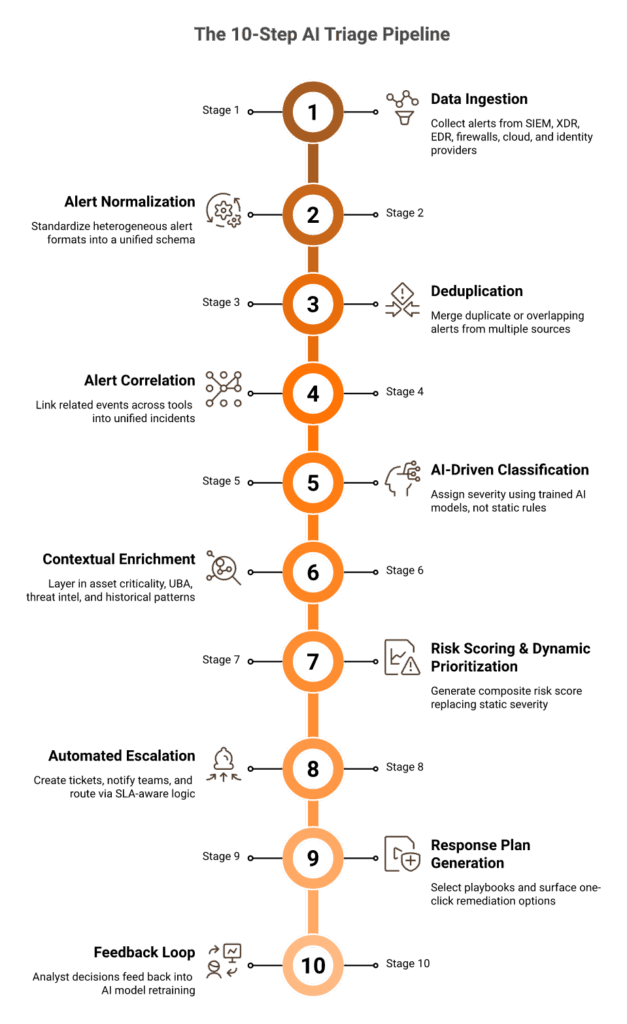
At UnderDefense, our UnderDefense MAXI platform operationalizes this entire 10-step pipeline across 250+ tool integrations with 96% MITRE ATT&CK coverage. But here’s what makes it different: we add human concierge analysts at Steps 6, 8, and 9, verifying context that pure AI cannot resolve. That’s the “AI SOC + Human Ally” architecture: machines handle volume and speed, while humans handle judgment and organizational context.
Q3. Agentic AI vs. Generative AI vs. Traditional SOAR: Which Triage Model Fits Your SOC?
Security leaders often conflate three architecturally distinct automation approaches. SOAR executes predefined if-then playbooks. Generative AI copilots augment human analysts with summaries and natural-language queries. Agentic AI autonomously investigates, reasons across tools, and takes actions with human-on-the-loop oversight. Each serves a different SOC maturity level, and understanding which model fits your current state is critical before you evaluate any vendor.
Traditional SOAR: The Playbook Engine
✅ Strengths: Excellent at codifying known, repeatable workflows. Phishing email → extract IOC → check threat intel → block domain. Fast, predictable, and auditable for compliance.
❌ Limitations: Brittle when facing novel attacks. Requires constant playbook maintenance. Cannot reason across unstructured data. Creates “automation debt” as playbooks proliferate, and 70–80% of SOAR deployments stall at less than 50% automation coverage. When the playbook doesn’t exist for an attack, SOAR has nothing to execute.
Generative AI Copilots: The Analyst Augmenter
✅ Strengths: Natural-language investigation queries (“summarize this alert chain and show related identity events”), automated report generation, and faster analyst onboarding. Makes your existing team more productive.
❌ Limitations: Still requires human action for every decision. Cannot autonomously contain threats. Accuracy depends on prompt quality and context provided. Hallucination risk in investigation narratives is real, and in security, a confidently wrong summary is worse than no summary at all. Best for SOCs at Maturity Level 1–2 looking to augment analysts, not replace triage.
Agentic AI Triage: The Autonomous Investigator
✅ Strengths: Autonomous multi-step investigation across SIEM, EDR, and identity. Behavioral reasoning, self-tuning detection logic, and dynamic containment actions. Can handle the unknown unknowns that SOAR playbooks can’t pre-script.
❌ Limitations: Requires robust data pipelines and well-normalized telemetry. Higher implementation complexity. EU AI Act compliance considerations for autonomous decisions. Best for SOCs at Maturity Level 2–3 with established data pipelines and clear escalation policies.
📊 Three-Way Comparison
| Capability | Traditional SOAR | Generative AI Copilot | Agentic AI Triage |
|---|---|---|---|
| Decision Logic | Static if-then rules | Human-prompted suggestions | Adaptive, multi-step reasoning |
| Novel Threat Handling | ❌ Fails without playbook | ⚠️ Suggests; human decides | ✅ Investigates autonomously |
| Maintenance Burden | High (playbook debt) | Low (prompt-based) | Medium (data pipeline upkeep) |
| Cross-Tool Reasoning | Limited to pre-built integrations | Depends on context window | ✅ Native multi-source correlation |
| Investigation Depth | Single-step execution | Summary and suggestion | Multi-step autonomous investigation |
| Human-in-the-Loop | Binary escalate/don’t | Always required | Human-on-the-loop (review after) |
| Scalability | Linear with playbook count | Scales with analyst count | Scales with data volume |
| Best-Fit SOC Maturity | Level 1–2 | Level 1–2 | Level 2–3 |
✅ Where UnderDefense Fits
Here’s what I’ve learned building security operations across hundreds of customer environments: no single paradigm handles everything. At UnderDefense, we combine all three layers, structured SOAR playbooks for known scenarios, generative AI for analyst augmentation and report drafting, and agentic AI reasoning for novel threats, plus human concierge analysts for the “last mile” of context that neither automation layer can resolve alone.
That multi-layer architecture is what separates the “AI SOC + Human Ally” model from single-paradigm tools. SOAR handles the repeatable. Agentic AI handles the novel. Humans handle the judgment calls. That’s the only combination I’ve seen work reliably at scale.
Q4. What Measurable Benefits Does AI Triage Deliver, and Which SOC KPIs Does It Transform?
If you’re building a business case for AI-enabled triage, you need hard numbers, not marketing claims. Here’s what the data actually shows, aggregated across multiple sources into one reference table.
📊 Aggregated MTTD/MTTR Benchmark Table
| Source | Metric | Before AI Triage | After AI Triage | Improvement |
|---|---|---|---|---|
| Microsoft Security Copilot | Phishing triage time | 30 min/alert | 3 min/alert | 90% reduction |
| Vectra AI (2025 study) | Investigation time | Baseline | 25–50% faster | For 60% of adopters |
| Torq HyperSOC | Analyst workload | Baseline | 90% reduction | Across triaged alerts |
| Industry Aggregate | False positive rate | 40–50% | 5–15% | 60–95% FP reduction |
| UnderDefense MAXI | Critical incident MTTR | Hours (industry avg) | 0.5 hours | Documented SLA |
✅ The 8 Core Benefits, Quantified
- MTTD reduction: 60–90% faster threat detection through automated correlation
- MTTR acceleration: Minutes-to-containment vs. hours-to-investigation for critical threats
- False-positive elimination: 60–95% FP reduction, depending on maturity and tuning
- Alert fatigue relief: Analysts review confirmed incidents, not raw alerts
- Scalability: Triage across hybrid, multi-cloud, and edge environments without linear headcount growth
- No alert left behind: 100% alert coverage vs. 30–40% in manual SOCs
- Resource reallocation: L1 analysts shift from triage to threat hunting and detection engineering
- Hiring-pressure relief: Junior analysts become productive in weeks, not months
📈 SOC KPIs Every Leader Should Track
If you’re implementing AI triage, measure these at baseline and monthly post-deployment:
- MTTD (Mean Time to Detect)
- MTTR (Mean Time to Respond)
- Escalation rate (% of alerts requiring human review)
- FP/TP accuracy ratio
- Average investigation time per alert
- Alert-to-incident conversion ratio
- Analyst utilization rate (triage vs. proactive work)
- Coverage percentage (alerts triaged ÷ total alerts received)
🔍 Five Real-World Use Cases
- Phishing alert triage at scale — AI classifies 5,000+ daily phishing alerts, auto-closes 80%, enriches 15% for analyst review, and escalates 5% with a full evidence chain. What used to consume three analysts’ entire day now takes one analyst an hour of review.
- EDR alert noise management — Behavioral baselines suppress legitimate admin activity (developers running scripts, IT admins using remote tools), reducing EDR noise by 70–85%.
- Ransomware early detection — AI correlates lateral movement signals across EDR + identity + network telemetry for sub-5-minute containment. The difference between a contained incident and a full-blown breach is often measured in single-digit minutes.
- Insider threat identification — Behavioral anomaly triage surfaces privilege escalations and data exfiltration patterns that rule-based systems miss entirely.
- Multi-cloud workload triage — Unified triage across AWS, Azure, and GCP eliminates cloud-specific alert silos that create blind spots.
How UnderDefense Delivers These Outcomes
We document 2-minute alert-to-triage and 15-minute escalation for critical incidents, 99% alert noise reduction, and detected threats 2 days faster than CrowdStrike OverWatch in head-to-head comparisons. That’s not because our AI is magic but because AI-driven detection combined with human concierge verification closes the context gap that technology alone cannot bridge. When CrowdStrike flags “suspicious PowerShell execution,” someone still needs to verify: was it your IT admin or an attacker? We handle that directly.
“Before MAXI, we were slightly overwhelmed with alerts and often unsure of how to prioritize or respond to them. Now, not only do we get alerts, but we also get clear guidance on how to handle them. False positives have become a rarity.”
— Valeriia D., Marketing Specialist UnderDefense G2 – Verified Review
“Red Canary detections could be more proactive… Red Canary is perhaps too reliant on CrowdStrike and less on our other sources which are important, Cloud, Identity, Email, etc.”
— Verified User, Computer Software Red Canary – G2 Verified Review
Q5. Which Tools Lead the AI-Powered Threat Detection and SOC Triage Market?
The leading AI-powered SOC triage and threat detection platforms in 2026 include UnderDefense MAXI, Swimlane Turbine, Radiant Security, Corelight Agentic Triage, Dropzone AI, Torq HyperSOC, and Stellar Cyber, each with distinct architectural approaches to alert classification, investigation automation, and response capabilities.
AI Triage Has Outgrown Point Solutions
The triage landscape has evolved faster than most security leaders expected. Two years ago, AI in the SOC meant a slightly smarter SIEM correlation rule. Today, we’re looking at fully agentic systems that can investigate, enrich, and, depending on the vendor, contain threats without a human touching a keyboard.
But here’s the operational reality: not all “AI-powered” triage is created equal. The key differentiators now are integration flexibility (vendor-agnostic vs. proprietary lock-in), triage autonomy level (copilot vs. fully agentic), response capability (detection-only vs. full containment), explainability (black-box vs. evidence-chain transparency), and pricing model (per-endpoint transparent vs. opaque enterprise quotes).
What Separates Top AI Triage Platforms
Before you evaluate any vendor demo, nail down these five criteria. They’ll save you months of wasted POCs:
- Vendor-agnostic integration vs. proprietary stack requirements — Does the tool work with your existing SIEM, EDR, and identity stack, or does it force a rip-and-replace?
- Triage autonomy level — Copilot augmentation, agentic investigation, or full autonomous response? Each has different operational implications at 2 AM when nobody’s watching.
- Evidence transparency — Can you audit why the AI made each triage decision? If you can’t reproduce the reasoning, you can’t trust the output.
- Human-in-the-loop design — When does AI escalate, and to whom? Configurable thresholds matter more than marketing claims about “autonomous SOC.”
- Documented outcomes — Published MTTD/MTTR benchmarks with named customer references, not just slide decks.
Where Each Platform Excels
Each platform fits different operational scenarios. UnderDefense MAXI suits organizations wanting vendor-agnostic integration across 250+ tools with human concierge analysts who own outcomes, not just alerts. Swimlane Turbine fits SOAR-native environments that need deep playbook customization. Corelight shines in network-first agentic triage where packet-level visibility drives investigations. Dropzone AI focuses on alert-volume reduction through autonomous investigation agents.
The right choice depends on your existing security stack, SOC maturity level, and whether you need detection-only or full containment with human-backed response.
This analysis is based on documented response times, MITRE ATT&CK coverage assessments, G2 reviews, and operational outcomes across 500+ MDR deployments.
Q6. How Do You Evaluate AI Triage Solutions? A Vendor-Neutral Comparison Framework
Every AI triage vendor in 2026 claims “autonomous investigation” and “90% alert reduction.” With 15+ vendors now marketing agentic SOC capabilities post-RSAC 2026, security leaders need a structured, vendor-neutral framework to cut through the noise and evaluate real capabilities.
❌ The Wrong Way to Decide
Most teams evaluate based on demo impressions, brand recognition, or feature-count checklists. This ignores the questions that determine operational success: Can the system explain its reasoning? Does it work with your existing stack without forced migration? What happens when the AI is wrong? How does it handle compliance documentation? What are the actual response SLAs?
I’ve watched too many organizations pick an AI triage tool because the demo looked impressive, only to discover six months later that the tool doesn’t integrate with their SIEM, can’t produce audit trails, and escalates everything back to their already-overwhelmed team.
✅ The Right Evaluation Framework
Score every vendor against these eight criteria. If a vendor can’t answer these questions with specifics, that tells you everything:
- Vendor-Agnostic Integration — Works with existing SIEM/EDR/XDR, or forces replacement? API extensibility? Data residency compliance?
- Explainability & Transparency — Evidence chains for every triage decision, or black-box verdicts?
- Human-in-the-Loop Design — Configurable escalation thresholds? Kill switch for containment?
- Response Capability — Detection-only, or full containment and remediation?
- Compliance Readiness — EU AI Act, NIST CSF 2.0, SOC 2 audit trail generation?
- Onboarding Speed — Weeks or months? Shadow-mode validation period?
- Pricing Transparency — Published per-endpoint rates, or opaque “contact sales”?
- Evidence of Outcomes — Documented MTTD/MTTR with named customer references?
Vendor Comparison Scorecard (0–2 per criterion)
| Criterion | UnderDefense MAXI | Swimlane Turbine | Radiant Security | MS Security Copilot | Dropzone AI | Prophet Security | Torq HyperSOC |
|---|---|---|---|---|---|---|---|
| Vendor-Agnostic Integration | ✅ 2 | 1 | 1 | 1 | 1 | 1 | 1 |
| Explainability & Transparency | ✅ 2 | 1 | 2 | 1 | 2 | 1 | 1 |
| Human-in-the-Loop Design | ✅ 2 | 1 | 1 | 2 | 1 | 1 | 1 |
| Response Capability | ✅ 2 | 2 | 1 | 1 | 1 | 1 | 2 |
| Compliance Readiness | ✅ 2 | 1 | 1 | 2 | 1 | 1 | 1 |
| Onboarding Speed | ✅ 2 | 1 | 2 | 1 | 2 | 1 | 1 |
| Pricing Transparency | ✅ 2 | 1 | 1 | 0 | 1 | 0 | 0 |
| Evidence of Outcomes | ✅ 2 | 1 | 1 | 1 | 1 | 1 | 1 |
| Total | 16/16 | 9/16 | 10/16 | 9/16 | 10/16 | 7/16 | 8/16 |
Providers scoring 12+ represent genuine operational partnership. Below 8 means you’re buying marketing, not managed detection.
Why UnderDefense Scores 16/16
UnderDefense MAXI integrates with 250+ existing tools without forcing replacement, publishes transparent pricing ($11–15/endpoint/month), delivers documented 2-minute alert-to-triage and 15-minute escalation for critical incidents, and includes forever-free compliance kits, all backed by concierge analysts who communicate directly with affected users via Slack, Teams, or email.
The real question isn’t which AI triage tool has the most features but which provider can respond to threats with the context of a dedicated security team. That’s the difference between an alert feed and an AI SOC with a Human Ally.
“UnderDefense is surprisingly affordable considering the level of protection we get. Their proactive threat hunting and rapid response have saved us from incidents that could have been incredibly costly.”
— Verified User, Program Development UnderDefense – G2 Verified Review
“Started out well but over the years the service has consistently not met expectations. The issues that we have experienced has greatly outweighed the benefits.”
— CISO, Manufacturing 3B–10B USD Arctic Wolf – Gartner Verified Review
Q7. How Do You Implement AI Triage in Phases? A 5-Stage Deployment Roadmap with Maturity Model
Deploying AI triage isn’t a switch you flip but a maturity curve you climb. Organizations that rush past shadow mode erode analyst trust, and those that skip baselining can never prove ROI. Here’s the 5-phase roadmap we’ve refined across hundreds of deployments, mapped to a practical SOC maturity model.
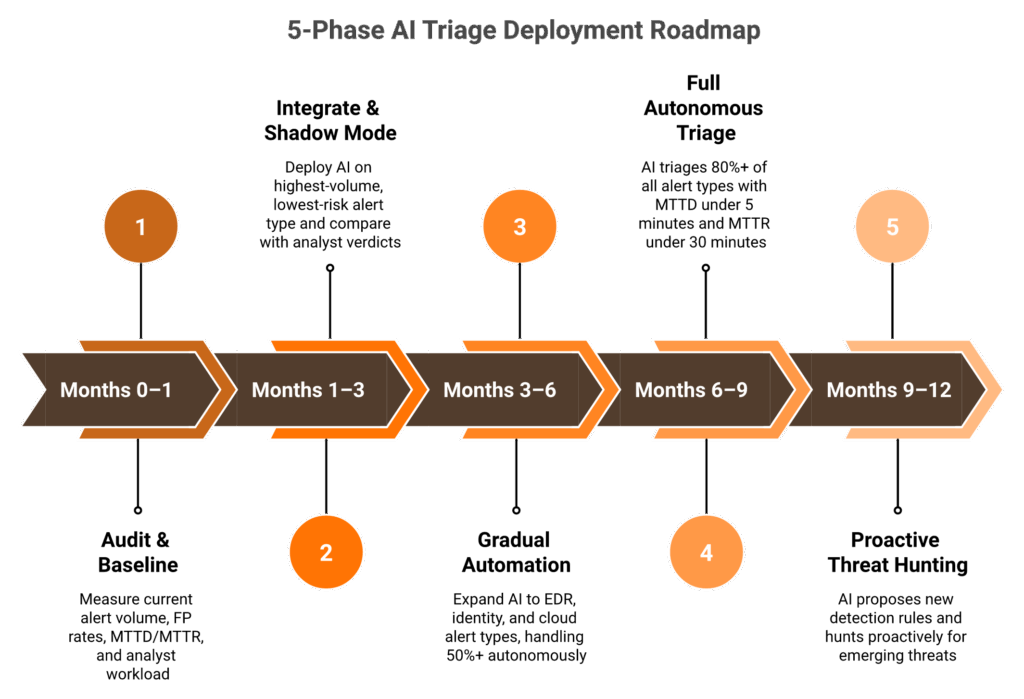
Phase 1 (Months 0–1): Audit & Baseline → Maturity Level 0 (Fully Manual)
Measure Before You Automate
Before any AI touches your alert pipeline, document your current state. Audit alert volume, false positive rates, MTTD/MTTR, analyst workload distribution, and tool coverage gaps. Identify quick-win triage use cases, such as phishing alerts, impossible travel, and brute force, where volume is high but complexity is low.
Prerequisites checklist: centralized log ingestion, documented alert classification taxonomy, executive sponsorship, and baseline KPIs for every metric you plan to improve. Skip this step, and you’ll never prove the investment was worth it.
Phase 2 (Months 1–3): Integrate & Shadow Mode → Maturity Level 1 (AI-Assisted)
Let the AI Prove Itself Before You Trust It
Deploy the AI triage solution on your highest-volume, lowest-risk alert type (typically phishing). Run in shadow mode: the AI triages alongside human analysts, with outputs compared but not actioned. Measure false positive reduction accuracy, time savings potential, and analyst feedback.
Tune detection rules based on shadow results. This is where you build trust, not through a vendor demo, but through observable, reproducible outcomes in your own environment.
⏰ Success criteria: AI triage agrees with analyst verdict >85% of the time before moving to Phase 3.
Phase 3 (Months 3–6): Gradual Automation Expansion → Maturity Level 2 (AI-Augmented)
Expand Only What Shadow Mode Validated
Enable automated triage for low-risk categories validated in Phase 2. Expand to EDR noise, identity alerts, and cloud workload alerts. Integrate cross-tool correlation (SIEM + EDR + identity). Implement agentic investigation for mid-tier alerts. Establish configurable human-in-the-loop escalation thresholds.
✅ Success criteria: 50%+ of total alert volume triaged autonomously with <2% false-negative rate.
Phase 4 (Months 6–9): Full Autonomous Triage → Maturity Level 3 (AI-Native)
Automation Handles Routine; Humans Handle Edge Cases
Enable autonomous containment for high-confidence threats: credential revocation, endpoint isolation, and domain blocking. Deploy self-tuning detection logic. Shift to human-on-the-loop oversight, reviewing after action rather than before.
Phase 5 (Months 9–12): Optimize & Hunt → Maturity Level 4 (Fully Autonomous)
Reinvest Freed Analyst Time into Proactive Security
Shift freed analyst capacity to proactive threat hunting and detection engineering. Implement predictive triage. Continuous model retraining. Measure full ROI against Phase 1 baseline.
⚠️ Common Pitfalls by Phase
- Phase 1 — Skipping baseline measurement makes ROI unprovable.
- Phase 2 — Rushing past shadow mode erodes analyst trust irreparably.
- Phase 3 — Automating high-risk categories too early causes business disruption.
- Phase 4 — Removing kill switches creates regulatory risk.
- Phase 5 — Failing to reinvest analyst time savings negates ROI entirely.
UnderDefense’s 30-day turnkey onboarding maps directly to Phases 1–2, with dedicated analysts handling shadow validation, tuning, and scale. Most customers achieve 99% alert noise reduction within the first month.
Q8. How Do You Build the ROI Business Case for AI-Enabled Incident Triage?
Every vendor says “positive ROI,” but none hand you a calculable framework with real inputs. Here’s the formula, the benchmarks, and a fully worked example you can take to your CFO tomorrow.
The ROI Formula
💰 From Abstract to Calculable
Annual ROI = [(Analyst Hours Saved × Fully Loaded Hourly Cost) + (Breach Probability Reduction × Average Breach Cost) + (Analyst Retention Savings)] − (AI Triage Platform Annual Cost + Implementation Cost).
Vectra’s industry-validated simplified version: (Time saved × Analyst hourly cost) + (Incidents prevented × Average incident cost) − Automation investment. IDC research validated this approach, documenting 391% three-year ROI for AI-driven detection and response platforms.
📊 Sample Input Variables
| Variable | Benchmark | Source |
|---|---|---|
| Average SOC analyst salary | $100K/year (~$67/hr fully loaded) | Glassdoor/Coursera 2026 |
| Alerts triaged manually per analyst/day | 100 | Industry average |
| Average minutes per manual triage | 15 min | SOC operational data |
| AI triage automation rate | 80% | Documented across mature deployments |
| Average breach cost | $4.88M | IBM Cost of a Data Breach 2024 |
| FP rate reduction (manual → AI-enabled) | 45% → 8% | AI-augmented SOC benchmarks |
| Analyst turnover replacement cost | 1.5–2× salary ($150K–$200K) | Industry standard |
Worked Example: 5-Analyst SOC
💸 The Math Your CFO Needs
Current state: 5 analysts, 500 alerts/day manual triage, 15 min each = 1,250 analyst-hours/week on triage alone.
With AI triage (80% automation): AI handles 400 alerts/day → saves ~1,000 analyst-hours/year on triage → $67K/year in direct labor savings from triage alone.
Add breach-cost avoidance: Reducing MTTD from days to minutes lowers breach probability. Even a 5% reduction in breach probability × $4.88M average breach cost = $244K in expected breach-cost avoidance.
Add retention savings: Reduced burnout extends average analyst tenure by 12+ months, avoiding one replacement cycle = $150K–$200K saved.
Total Year-1 benefit: $67K + $244K + $150K = ~$461K. Against an AI triage platform cost of $80K–$130K/year, that’s a Year-1 ROI of 250–475%.
Intangible ROI Factors
- Compliance audit time savings — Automated evidence trails reduce audit preparation by 40–60%, freeing weeks of staff time annually.
- Cyber insurance premium reduction — Documented MTTR SLAs and 24/7 coverage qualify for 15–25% premium discounts.
- Opportunity cost recaptured — Analysts freed from L1 triage perform proactive threat hunting, generating net-new security value.
- Analyst retention — Reduced burnout extends average tenure, avoiding $150K–$200K per replacement cycle.
How UnderDefense Makes the Business Case Easy
UnderDefense publishes transparent pricing ($11–15/endpoint/month) and documented SLAs (2-minute alert-to-triage and 15-minute escalation for critical incidents), enabling precise ROI modeling before commitment. Use the UnderDefense SOC Cost Calculator to model your specific scenario, versus opaque “contact sales” pricing from competitors that makes business case construction impossible.
Q9. What Are the Real Risks, Limitations, and Failure Modes of AI-Driven Triage?
The AI triage market is drowning in vendor claims: “90% automation,” “zero missed threats,” “autonomous SOC.” Here’s the uncomfortable truth: if you deploy AI triage without understanding its failure modes, you’re not reducing risk but shifting it into a blind spot you can’t see. Responsible implementation starts with an honest inventory of what can go wrong, because unearned trust in systems you can’t audit is more dangerous than the alert fatigue you’re trying to solve.
⚠️ The 7 Risk Categories You Need to Know
- Adversarial evasion. Attackers actively craft inputs designed to bypass ML classifiers, mimicking benign behavioral patterns to evade detection models. Sophisticated threat actors study how AI triages alerts and engineer their payloads to exploit those patterns.
- Model drift. Triage accuracy degrades as the threat landscape shifts. A model trained on last quarter’s attack techniques quietly becomes irrelevant if it isn’t retrained on current data, and most organizations don’t monitor for this.
- Over-automation. Auto-containing a legitimate admin action, such as isolating a production server during a scheduled maintenance window, causes business disruption. This is the AI equivalent of friendly fire, and it happens more often than vendors admit.
- False-negative danger. AI dismisses a genuine threat as low-priority, creating a false sense of security that’s worse than alert fatigue. At least with alert fatigue, your team knows they’re overwhelmed. False negatives let you sleep while the attacker moves laterally.
- Data-quality dependency. “Garbage in, garbage out.” Incomplete or misconfigured telemetry sources produce unreliable triage decisions. If your SIEM isn’t ingesting the right logs, your AI is making confident wrong decisions.
- Explainability gaps. AI closes 500 alerts overnight, but analysts can’t understand why. This creates audit nightmares and erodes trust, especially under frameworks like NIST CSF 2.0 and the EU AI Act that require documented decision rationale.
- Vendor lock-in and integration fragility. Proprietary models tied to a single vendor’s ecosystem create a single point of failure. If the vendor sunsets a feature or changes pricing, your entire triage pipeline breaks.
🔧 Architectural Safeguards That Actually Work
The answer isn’t less AI but AI with built-in guardrails. For each risk, there’s a structural mitigation:
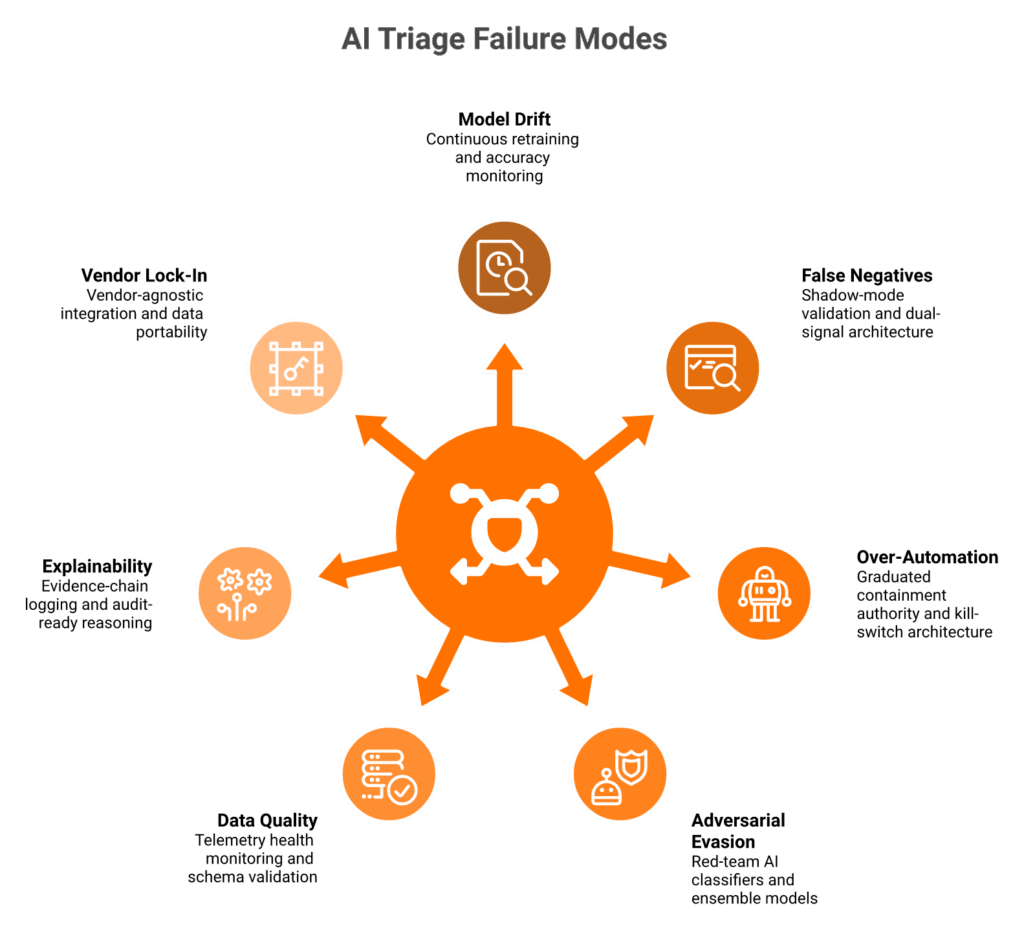
- Adversarial evasion → Quarterly adversarial testing and red-team validation of ML models.
- Model drift → Continuous retraining on current threat data with drift detection monitoring.
- Over-automation → Configurable automation boundaries with kill switches for containment actions.
- False negatives → Spot-check sampling and closed-loop analyst validation on dismissed alerts.
- Data quality → Data quality audit as a Phase 1 prerequisite before any AI deployment.
- Explainability → Evidence-chain logging for every triage decision, exportable for compliance audits.
- Vendor lock-in → Vendor-agnostic architecture that works across tools, not dependent on one ecosystem.
✅ How UnderDefense Addresses Each Failure Mode
Our “AI SOC + Human Ally” model exists precisely because of these failure modes. UnderDefense MAXI‘s AI handles volume and speed: enrichment, correlation, and contextual scoring across 250+ integrated tools. Concierge analysts handle judgment, verification, and the “last mile” of organizational context that prevents false negatives and over-automation. Every automated containment action is logged with an evidence chain reviewable by the customer. Vendor-agnostic integration eliminates lock-in. This isn’t AI replacing humans but AI handling the 95% that’s noise so humans can focus on the 5% that matters.
“UnderDefense proactive alerting saved us from a much more serious incident. We were able to rapidly revoke the unauthorized user accounts.”
— VP, Cybersecurity & DevOps UnderDefense – G2 Verified Review
UnderDefense maintains a 100% ransomware prevention record across 500+ MDR clients over 6 years, not because AI alone is perfect, but because human analysts catch what AI misses, verify what AI flags, and contain what AI detects. That’s the architectural advantage of human-in-the-loop by design, not as an afterthought.
Q10. How Does AI Triage Align with Compliance Frameworks and Regulatory Requirements?
AI-driven triage systems that make autonomous decisions about security incidents don’t operate in a regulatory vacuum. Under the EU AI Act, NIST CSF 2.0, SOC 2, HIPAA, PCI-DSS, and SOX, organizations deploying AI triage must satisfy all applicable frameworks simultaneously, and most vendors don’t even acknowledge this obligation.
⚠️ The Compliance Challenge
Agentic AI systems that autonomously contain threats, such as isolating endpoints and revoking credentials, may qualify as “high-risk AI” under the EU AI Act. Article 9 requires a documented risk management system for the AI itself, covering identification and evaluation of foreseeable risks throughout the entire lifecycle. Article 14 mandates human oversight capabilities, including the ability to override, interrupt, or reverse AI decisions through a “stop button” or similar procedure.
The rules for high-risk AI come into full effect in August 2026, meaning organizations deploying autonomous triage systems right now need to be building compliance infrastructure today, not after the deadline.
📋 Compliance Readiness Matrix
| Regulatory Requirement | What AI Triage Must Provide | Implementation Checklist |
|---|---|---|
| EU AI Act Art. 9, Risk management system | Documented, continuous risk assessment for the AI system itself | Lifecycle risk register; foreseeable misuse analysis; quarterly review |
| EU AI Act Art. 14, Human oversight | Ability for humans to override, interrupt, or reverse AI decisions | Kill-switch architecture; human review for high-impact actions |
| NIST CSF 2.0 DE.AE, Adverse event analysis | Anomalies and adverse events analyzed to characterize and detect incidents | Continuous monitoring with documented analysis workflows |
| NIST CSF 2.0 RS.AN, Incident analysis | Root cause identification, technique mapping, and evidence preservation | MITRE ATT&CK mapping; chain-of-custody protocols |
| GDPR Art. 22, Automated decision-making | Right to human review of automated decisions affecting individuals | Opt-out mechanism; human escalation path for impacted users |
| SOC 2 CC7.2–7.4, System monitoring & incident handling | Continuous monitoring with evidence chains; predefined incident triggers | Timestamped audit trails; measurable detection criteria |
| HIPAA §164.312, Audit controls & integrity | Audit trails for systems accessing PHI; integrity verification | Encrypted logging; access controls on triage decision data |
| PCI-DSS Req 12.10, Incident response plan | Documented triage procedures integrated with IR plan | Annual testing; clear escalation procedures for cardholder data incidents |
| SOX Section 404, Internal control evidence | Demonstrable controls over IT-dependent financial processes | Exportable audit reports; control testing documentation |
🔍 EU AI Act: What Most Vendors Ignore
Agentic AI systems with “untraceable behavioral drift” cannot currently satisfy the EU AI Act’s essential requirements. Article 15 additionally mandates that high-risk AI achieve appropriate levels of accuracy, robustness, and cybersecurity throughout their lifecycle, including resilience against adversarial attacks like data poisoning and model extraction.
This means any AI triage vendor claiming “autonomous SOC” capability must document model retraining schedules, establish kill-switch architecture for all autonomous actions, and maintain complete audit logs of every AI decision with an explainable evidence chain. If your vendor can’t show you how their AI makes decisions, they can’t help you pass an audit.
✅ UnderDefense’s Compliance-First Architecture
We include forever-free compliance kits (SOC 2, HIPAA, ISO 27001) with every MDR engagement, and every AI triage decision in UnderDefense MAXI is logged with an explainable evidence chain, purpose-built for audit readiness. Human concierge analysts serve as the Article 14 “human oversight” layer by design, not as a compliance afterthought. When auditors ask “who reviewed this containment action?”, the answer is documented, timestamped, and exportable.
Q11. Implementation Readiness Checklist: Is Your SOC Prepared for AI-Enabled Triage?
Before deploying AI triage, score your SOC against these 10 readiness criteria to identify prerequisites, quick wins, and potential blockers that will determine whether your implementation succeeds in months or stalls for quarters.
📋 The 10-Point SOC Readiness Audit
- ☐ (1) Do you have centralized alert ingestion from all critical sources (SIEM, EDR, identity, cloud, and network)?
- ☐ (2) Can you quantify your current false-positive rate and MTTD/MTTR baselines with data, not estimates?
- ☐ (3) Do your analysts have 10–15% bandwidth capacity for a shadow-mode pilot program?
- ☐ (4) Is your threat intelligence feed current, integrated, and auto-updating?
- ☐ (5) Do you have a defined, documented incident classification taxonomy (not ad hoc)?
- ☐ (6) Are your escalation thresholds and SLAs documented and enforced?
- ☐ (7) Can your team articulate “what good looks like” for automated triage decisions?
- ☐ (8) Do you have executive sponsorship and budget approval for AI in security operations?
- ☐ (9) Is your compliance/GRC team aligned on documentation requirements for AI-driven decisions?
- ☐ (10) Do you have a documented human-in-the-loop policy defining when AI can and cannot take autonomous containment actions?
⭐ Score Interpretation
✅ 8–10 checked → Deployment-ready. Your SOC has the foundations in place. Skip Phase 1 (Audit) and begin Phase 2 (Shadow Mode) immediately. Focus your energy on vendor selection and detection tuning.
⚠️ 5–7 checked → Readiness gaps exist. Start with Phase 1 (Audit & Baseline) to address unchecked items before selecting a vendor. Most mid-market SOCs land here. The gaps are fixable, but skipping them leads to shelfware.
❌ 0–4 checked → Foundational work needed. AI triage isn’t viable at this maturity level. Focus on data normalization, tool consolidation, baseline KPI measurement, and executive alignment first. Attempting AI triage here typically results in a tool that nobody trusts and nobody uses.
🔧 Turning Unchecked Boxes into ✅
Here’s what separates theory from practice: most readiness checklists assume you have to solve every gap before you engage a vendor. That’s backwards. UnderDefense’s 30-day turnkey onboarding is designed to turn unchecked boxes into ✅ as part of implementation, not as a prerequisite. The onboarding team handles tool integration (250+ connectors), baseline measurement, detection tuning, classification taxonomy setup, and compliance documentation.
We invest a full 30 days in high-quality onboarding, building customized detections to give you only confirmed, validated offenses and cutting 99% of noise. That’s not a sales pitch; it’s the operational reality of how we onboard every MDR client.
“We received little value from Arctic Wolf. The product offered little visibility when we were using it… Anything you want to look at or changes you need to make in the product must go through their engineering team.”
— Matt C., Manager, Cybersecurity Services Arctic Wolf – G2 Verified Review
“Started out well but over the years the service has consistently not met expectations. The issues that we have experienced has greatly outweighed the benefits… Analysts provide little context, and when asked for more information in the investigation nothing is ever provided.”
— CISO, Manufacturing ($3B–$10B) Arctic Wolf – Gartner Peer Review
⏰ Scored Below 5?
Book a 15-minute security gap assessment to see exactly where UnderDefense closes the holes. Your readiness score improves through deployment, not before it, because operational maturity isn’t something you build in isolation but something you build with a partner who understands your environment.
Q12. FAQ: What Security Leaders Ask Most About AI-Enabled Incident Triage
What is AI-enabled incident triage?
AI-enabled incident triage uses machine learning models to automatically classify, prioritize, and enrich security alerts based on contextual scoring, behavioral baselines, and cross-source correlation. Unlike static rule-based automation, AI triage adapts to your environment over time, learning what’s normal, flagging what’s anomalous, and reducing manual analyst workload by 60–95%.
How does AI reduce false positives in SOC alert triage?
AI triage applies contextual scoring against behavioral baselines, correlating user identity, device posture, geo-location, and historical activity to determine whether an alert represents genuine risk. Organizations deploying AI-enabled triage report false-positive reductions of 60–95%, with UnderDefense clients experiencing 99% noise reduction through custom detection tuning during onboarding.
What is the difference between automated triage and AI-enabled triage?
Automated triage applies static, predefined rules: “if source IP matches blocklist, escalate.” AI-enabled triage uses adaptive ML models that learn from analyst decisions, environmental context, and evolving threat patterns. Automated triage breaks when attackers change tactics; AI-enabled triage adapts, though it requires human-in-the-loop validation to prevent model drift.
How long does it take to implement AI incident triage?
Expect 30 days for Phase 1–2 (shadow mode deployment and baseline calibration). Full autonomous deployment, where AI takes containment actions with minimal human oversight, typically requires 6–9 months of tuning, validation, and trust-building. UnderDefense achieves shadow-mode results in 30 days through turnkey onboarding with 250+ tool connectors.
Can AI triage replace human SOC analysts?
No. AI handles volume, the 95% of alerts that are noise, duplicates, or known-benign activity. Humans handle judgment: organizational context, user verification, edge-case decisions, and the “last mile” of incident response that requires understanding your business. The best model is AI + Human Ally, where automation scales routine work and analysts handle what matters.
What SOC KPIs does AI triage improve?
Key metrics impacted: Mean Time to Detect (MTTD), Mean Time to Respond (MTTR), false-positive rate, escalation rate, investigation time per alert, and alert-to-incident ratio. UnderDefense documents 2-minute alert-to-triage with enrichment, 15-minute escalation for critical incidents, and 830% ROI over 3 years.
💰 How do you measure the ROI of AI triage?
Core formula: (analyst hours saved × hourly cost) + (breach cost avoided) − platform cost. For a 10-analyst SOC reclaiming 30% capacity, that’s roughly $250K–$400K in Year 1 labor savings alone. When you factor in breach prevention, UnderDefense has documented a case going from $67M in losses to zero ransom paid, and typical Year 1 ROI ranges from 300–500%.
What are the risks of using AI for incident triage?
Top three: model drift (accuracy degrades as threats evolve), false negatives (AI dismisses real threats), and over-automation (containing legitimate activity). Mitigation requires human-in-the-loop architecture, not as an afterthought but as a design principle. See Q9 for the full 7-risk breakdown with mitigation strategies.
Which AI triage solution is best for small SOC teams?
Small SOCs (1–5 analysts) benefit most from managed AI triage, meaning MDR with AI built in, rather than self-deployed platforms that require dedicated staff to tune, maintain, and validate. UnderDefense MAXI is designed for this exact scenario: AI handles enrichment and triage while concierge analysts handle response, so a 3-person team gets enterprise-grade coverage at $11–15/endpoint/month.
How does AI triage integrate with SIEM and SOAR platforms?
Via API connectors, syslog forwarding, and native integrations. The best solutions are vendor-agnostic. UnderDefense MAXI supports 250+ integrations across SIEM (Splunk, Elastic, and Sentinel), EDR (CrowdStrike, SentinelOne, and Defender), identity (Okta and Azure AD), and cloud (AWS, Azure, and GCP). Critically, your data stays in your SIEM. We don’t require you to abandon your existing investments.
🔮 What is the future of AI-enabled incident triage?
Convergence toward autonomous SOC operations (L4 maturity), predictive triage that anticipates attack paths before alerts fire, and cross-domain unification, where cybersecurity, IT operations, and DevOps incident management converge under a single AI triage layer. The organizations that build human-in-the-loop foundations today will be the ones capable of safely scaling to autonomous operations tomorrow.
1. How does AI-enabled incident triage differ from traditional SOAR playbook automation?
We get this question constantly because the terminology overlap creates real confusion during vendor evaluations. Traditional SOAR executes predefined if-then playbooks: static rules like “if source IP matches blocklist, escalate.” This works for known, repeatable scenarios but breaks the moment attackers change tactics. When the playbook doesn’t exist, SOAR has nothing to execute.
AI-enabled incident triage uses adaptive ML models that learn from analyst decisions, environmental context, and evolving threat patterns. Instead of rigid rule chains, agentic AI reasons across multiple data sources (SIEM, EDR, identity) in autonomous multi-step investigations.
The practical difference matters at 2 AM: SOAR can only follow scripts you’ve already written, while agentic AI investigates the unknown unknowns. At UnderDefense, we combine both layers within our MAXI platform: structured SOAR playbooks for known scenarios and agentic AI reasoning for novel threats, with human concierge analysts handling the judgment calls that neither automation layer can resolve alone.
The key architectural takeaway: 70–80% of SOAR deployments stall at less than 50% automation coverage because of playbook debt. Agentic AI triage scales with data volume, not playbook count.
2. What measurable SOC KPIs does AI-enabled triage actually improve?
We track eight core KPIs across every deployment, and the improvements are consistent across hundreds of engagements:
-
MTTD (Mean Time to Detect): 60–90% faster through automated cross-tool correlation.
-
MTTR (Mean Time to Respond): Minutes-to-containment vs. hours-to-investigation. We document 2-minute alert-to-triage and 15-minute escalation for critical incidents.
-
False-positive rate: 60–95% reduction, with our clients experiencing 99% noise reduction through custom detection tuning during onboarding.
-
Alert coverage: 100% of alerts triaged vs. 30–40% in manual SOCs.
-
Analyst utilization: L1 analysts shift from triage to proactive threat hunting and detection engineering.
We recommend measuring these at baseline and monthly post-deployment. Without Phase 1 baseline measurement, ROI becomes unprovable. The industry benchmark data shows AI triage delivering 391% three-year ROI (IDC-validated), and our own documented outcomes include 830% ROI over 3 years.
3. How long does it take to implement AI-enabled incident triage from scratch?
Deploying AI triage follows a maturity curve, not a single go-live date. Based on the 5-phase roadmap we’ve refined across hundreds of deployments:
-
Phase 1–2 (Months 0–3): Audit, baseline measurement, and shadow mode deployment. We achieve shadow-mode results within 30 days through turnkey onboarding with 250+ tool connectors.
-
Phase 3 (Months 3–6): Gradual automation expansion. AI handles 50%+ of alert volume autonomously with less than 2% false-negative rate.
-
Phase 4–5 (Months 6–12): Full autonomous triage and proactive threat hunting.
The critical success gate: AI triage must agree with analyst verdict at least 85% of the time in shadow mode before moving to automated action. Organizations that rush past shadow mode erode analyst trust irreparably.
Our 30-day turnkey onboarding maps directly to Phases 1–2, with dedicated analysts handling shadow validation, tuning, and scale. Most customers achieve 99% alert noise reduction within the first month, making the full 12-month maturity curve achievable without dedicated internal resources.
4. What are the biggest risks of deploying AI for SOC alert triage?
We identify seven failure modes that every security leader must understand before deployment:
-
Model drift: Triage accuracy degrades as threat patterns evolve. Without continuous retraining, last quarter’s model becomes irrelevant.
-
False negatives: AI dismisses genuine threats, creating a false sense of security worse than alert fatigue itself.
-
Over-automation: Containing legitimate admin actions (like isolating a production server during maintenance) causes business disruption.
-
Adversarial evasion: Attackers engineer payloads specifically to bypass ML classifiers.
-
Data-quality dependency: Misconfigured telemetry produces confident wrong decisions.
-
Explainability gaps: Black-box verdicts create audit nightmares under NIST CSF 2.0 and EU AI Act frameworks.
-
Vendor lock-in: Proprietary ecosystems create single points of failure.
Each risk has a structural mitigation. The architectural answer is human-in-the-loop by design: AI handles the 95% that’s noise, humans handle the 5% that requires judgment. That’s why we built the AI SOC + Human Ally model.
5. How does AI triage comply with the EU AI Act and other regulatory frameworks?
This is increasingly urgent because the EU AI Act’s high-risk AI rules take full effect in August 2026. Agentic AI systems that autonomously contain threats (isolating endpoints, revoking credentials) may qualify as “high-risk AI” under Article 9 and Article 14.
The compliance requirements span multiple frameworks simultaneously:
-
EU AI Act: Documented risk management system, human oversight with kill-switch architecture, and explainable evidence chains for every decision.
-
NIST CSF 2.0: Continuous monitoring with documented analysis workflows and MITRE ATT&CK mapping.
-
SOC 2 / HIPAA / PCI-DSS: Timestamped audit trails, encrypted logging, and documented triage procedures integrated with your incident response plan.
We include forever-free compliance kits (SOC 2, HIPAA, ISO 27001) with every MDR engagement. Every AI triage decision in MAXI is logged with an explainable evidence chain, purpose-built for audit readiness. When auditors ask “who reviewed this containment action?”, the answer is documented, timestamped, and exportable.
6. How do you calculate the ROI of AI-enabled incident triage for a mid-market SOC?
We use a calculable formula you can take directly to your CFO:
Annual ROI = (Analyst Hours Saved × Fully Loaded Hourly Cost) + (Breach Probability Reduction × Average Breach Cost) + (Analyst Retention Savings) − (Platform Annual Cost + Implementation Cost).
For a 5-analyst SOC handling 500 alerts/day at 15 minutes each:
-
Direct labor savings: AI automates 80% of triage, saving ~1,000 analyst-hours/year = $67K.
-
Breach-cost avoidance: 5% reduction in breach probability × $4.88M average breach cost = $244K.
-
Retention savings: Reduced burnout avoids one replacement cycle = $150K–$200K.
Total Year-1 benefit: ~$461K against a platform cost of $80K–$130K/year = 250–475% Year-1 ROI.
We publish transparent pricing ($11–15/endpoint/month) and documented SLAs, enabling precise ROI modeling before commitment. Use our SOC Cost Calculator to model your specific scenario.
7. Which AI-powered SOC triage platform is best for small security teams?
Small SOCs (1–5 analysts) benefit most from managed AI triage, meaning MDR with AI built in, rather than self-deployed platforms requiring dedicated staff to tune, maintain, and validate.
The evaluation criteria that matter most for small teams:
-
Vendor-agnostic integration: Works with your existing SIEM, EDR, and identity stack without forced migration.
-
Turnkey onboarding: 30 days to value, not 6 months of configuration.
-
Human-backed response: Concierge analysts who own containment outcomes, not just alert escalation.
-
Transparent pricing: Published per-endpoint rates so you can model costs accurately.
UnderDefense MAXI is designed for exactly this scenario: AI handles enrichment and triage while concierge analysts handle response, so a 3-person team gets enterprise-grade coverage at $11–15/endpoint/month. We integrate with 250+ tools without requiring you to abandon existing investments.
The right question isn’t “which AI tool has the most features” but “which provider responds with the context of a dedicated security team.”
8. How do you evaluate AI triage vendors without getting misled by marketing claims?
We’ve built an 8-criterion vendor-neutral evaluation framework after watching too many organizations pick tools based on impressive demos, only to discover integration failures and missing audit trails six months later.
Score every vendor (0–2 per criterion) against:
-
Vendor-agnostic integration: Works with existing stack, or forces replacement?
-
Explainability: Evidence chains for every decision, or black-box verdicts?
-
Human-in-the-loop design: Configurable escalation thresholds and kill switches?
-
Response capability: Detection-only, or full containment?
-
Compliance readiness: EU AI Act, NIST CSF 2.0, SOC 2 audit trail generation?
-
Onboarding speed: Weeks or months?
-
Pricing transparency: Published rates, or opaque “contact sales”?
-
Evidence of outcomes: Documented MTTD/MTTR with named customer references?
Providers scoring 12+ out of 16 represent genuine operational partnership. Below 8 means you’re buying marketing. If a vendor can’t answer with specifics, that tells you everything. Download our MDR Buyers Guide for the complete vendor comparison scorecard.