






MDR Built for SaaS Companies: Protect Your Product, Tenants, and Every Customer's Data.
24/7 human-led detection and response across your cloud, identity, and SaaS-to-SaaS integrations — on the tools you already own. We keep one compromised account from becoming every customer's breach, and produce the SOC 2 and ISO 27001 evidence that keeps enterprise deals moving.
500+ clients protected


















For a SaaS team, security is a product problem — and a sales problem.
Your customers' data lives in your product, and your biggest deals hinge on proving it is safe. At that point SaaS cyber security stops being a scanning problem and becomes a response problem — and that is exactly what MDR fixes.
A lean, engineering-heavy team and no 24/7 SOC
In a growth-stage SaaS team — Series B and beyond — your engineers ship product and nobody is watching the environment at 3 a.m., which is exactly when an attacker moves.
Enterprise deals stuck on the security questionnaire
A prospect's security review stalls the contract: their questionnaire lists SaaS security requirements your team cannot evidence fast enough, and SOC 2 or ISO 27001 proof takes weeks you do not have.
Multi-tenant blast radius
Whether you run a dev-tools, HR tech, martech, or e-commerce platform, one compromised account or a single misconfigured integration can expose many customers at once. The breach is not contained to one tenant unless someone contains it.
Alert overload from cloud-native tooling
CI/CD, SaaS-to-SaaS integrations, and identity providers each fire their own alerts, and no one is triaging them around the clock.
Detection without response
Your tools flag the issue, but no one closes the loop fast enough to meet an enterprise SLA. A notification isn't a response.
Security that has to scale with ARR, not headcount
Cybersecurity for SaaS companies has to scale with revenue: every new customer adds risk and audit scope, but from startup to scale-up you cannot hire a SOC analyst for every enterprise logo you land.
Why SaaS teams choose UnderDefense MDR
The things you can verify before you sign — and hand to your next enterprise reviewer.
One correlated picture across cloud, identity & SaaS
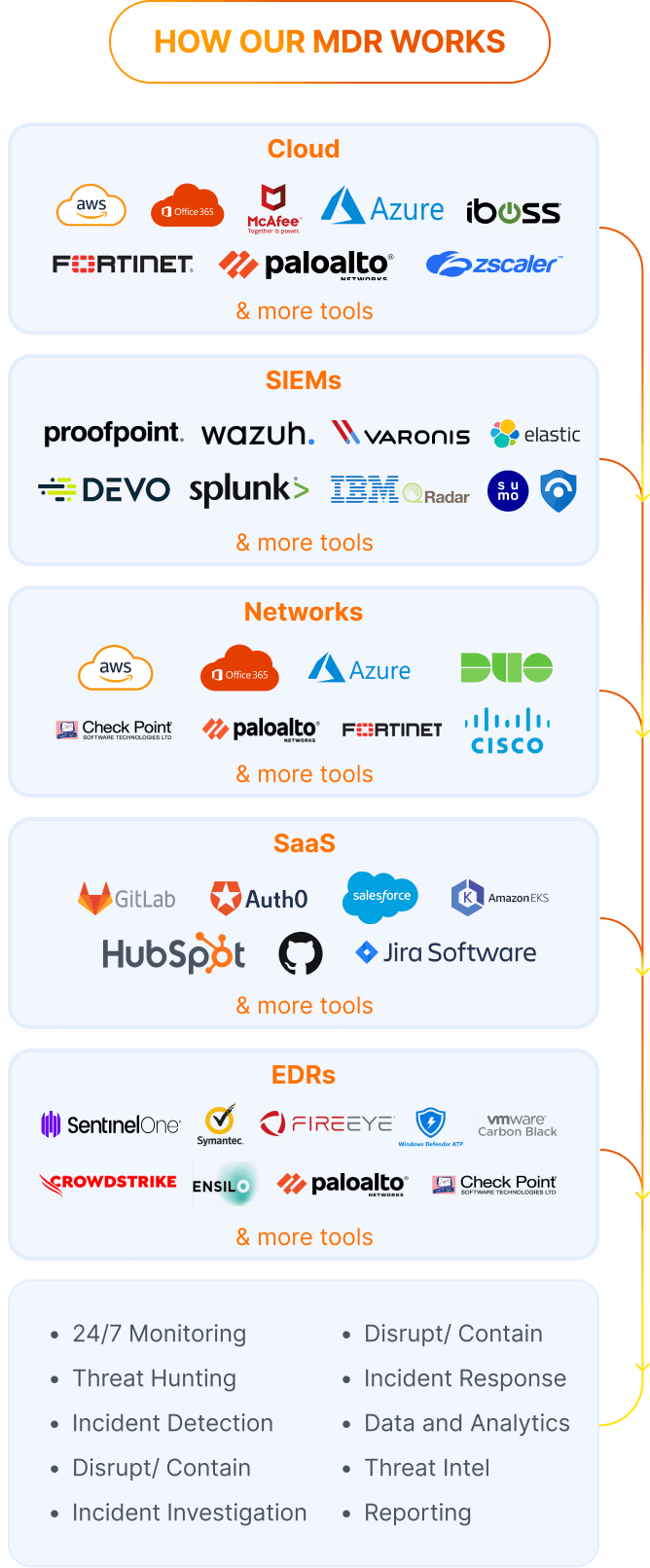
We connect your cloud, identity provider, and SaaS-to-SaaS integrations into a single view, so a threat moving between them can't hide.
We resolve, we don't escalate
AI gathers context; our analysts contain — disable the token, isolate the account — instead of forwarding a ticket to your on-call engineer.
Works on the tools you already own
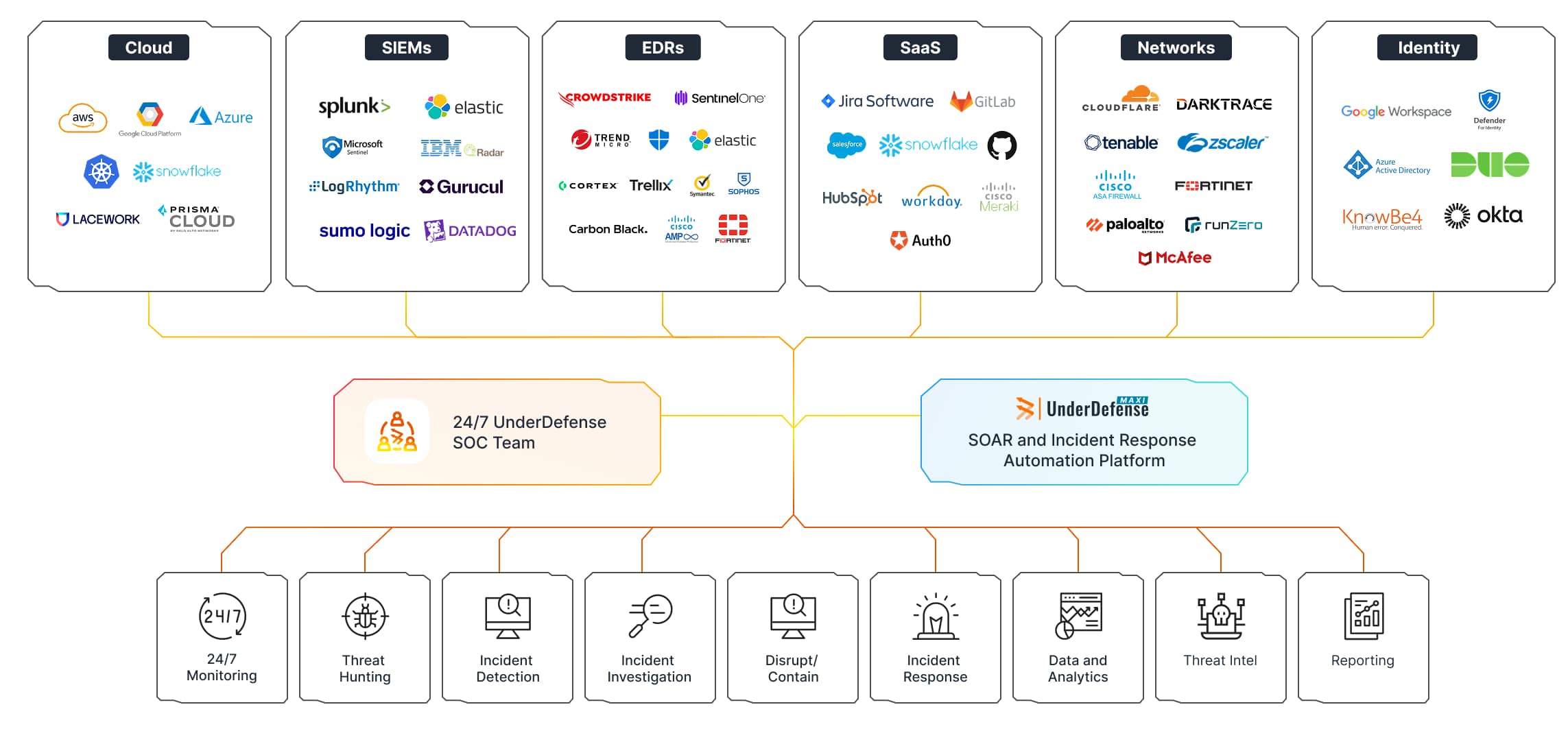
A SecOps layer on top of your existing cloud, EDR, and SaaS stack. No rip-and-replace, and you keep every integration if you leave.
Audit-ready evidence that unblocks deals
SOC 2 and ISO 27001 evidence produced as we monitor, so the enterprise security review that was stalling your contract moves.
Threat hunters that scale with ARR, not headcount
Seasoned hunters as an extension of your team, so security grows with revenue instead of another full-time hire per logo.
Human-led containment, 24/7
A round-the-clock SOC with a 15-minute critical-incident escalation — the coverage a lean SaaS team can't staff alone.
Trusted by Security Leaders
What our customers say

"We fully automated T1-T2 manual triage with UnderDefense. AI SOC filters the noise so my team can focus on complex hunt missions and strategic security. We scaled our capacity 10x overnight, not by hiring, but by making our analysts investigators again."

"Zero ransomware cases and a 2-minute triage SLA. Agentic AI mapped our VIPs and high-value assets with surgical precision. It transformed how our board views security, shifting from a cost center to a strategic enabler of business resilience."
Excellence.
Our minimum bar for client delivery.




UnderDefense MXDR vs. the field
Tap any row for the detail.


One partner for your whole security program
MDR is the broadest coverage. These services plug into the same 24/7 team and platform.
Managed Detection & Response (MDR)
24/7 human-led detection and response focused on your core endpoint and SIEM surface.
Learn more →Managed Extended Detection & Response (MXDR)
Extended detection and response across endpoints, network, cloud, email, and identity, run 24/7 by our SOC.
Learn more →MDR for FinTech
Detection and response built for financial platforms, with the compliance evidence regulators and partners require.
Learn more →MDR for Healthcare
HIPAA-aligned detection and response protecting PHI, EHR systems, and clinical operations around the clock.
Managed EDR
Your CrowdStrike, SentinelOne, or Microsoft Defender, expertly tuned and managed with 24/7 triage and response.
Learn more →MDR Integrations
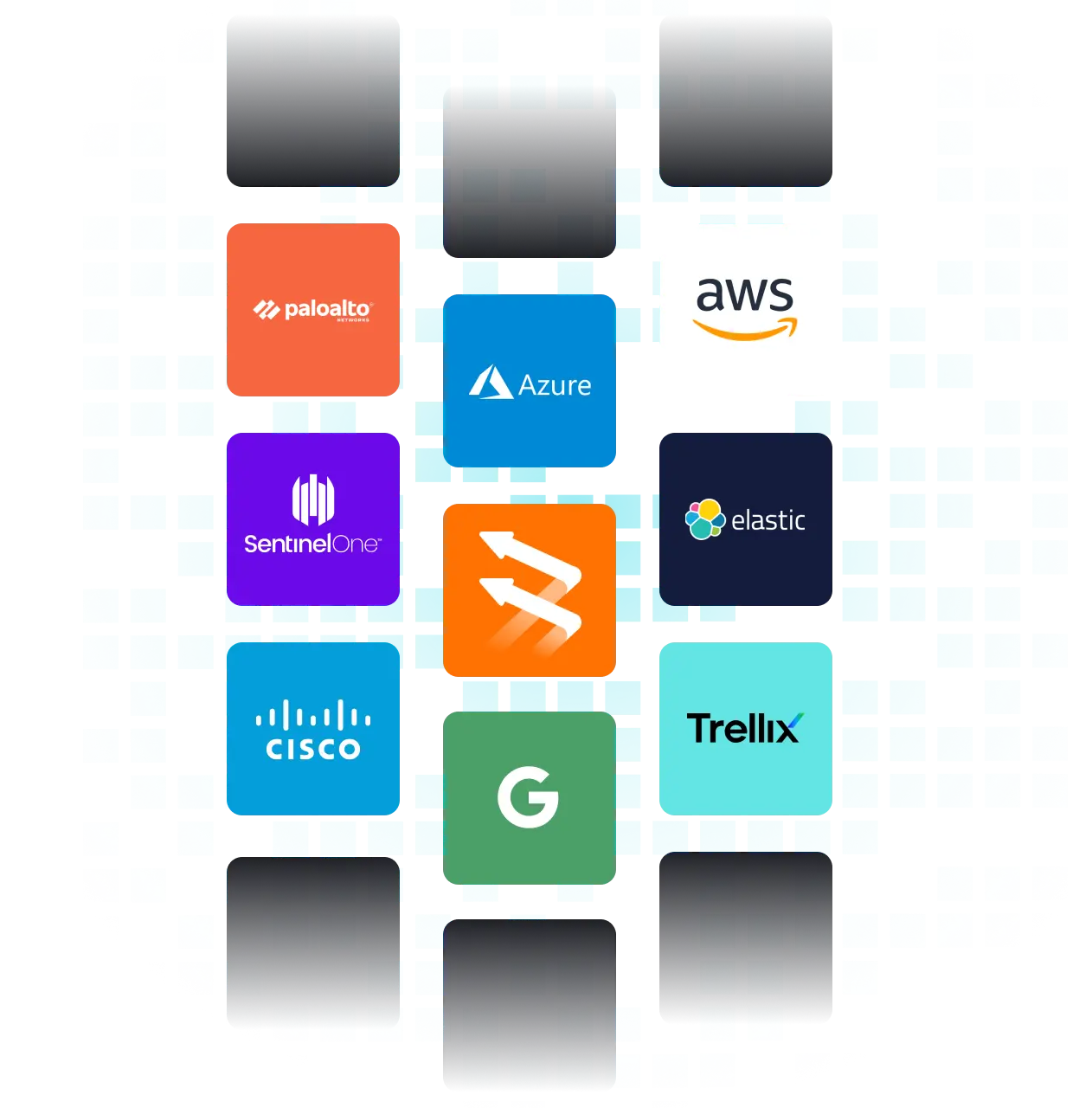
250+ integrations across your EDR, SIEM, cloud, and identity stack. See everything we connect to.
Six years. Zero client ransomware.
We fine-tune the tools you already run so they work smarter across your whole stack. Across six years, not one client has suffered a ransomware incident — and when a major operator did breach a client environment, our SOC contained it in under an hour.
Get your custom MDR quote
Tell us about your product and stack. We'll come back with a tailored proposal and a 30-day onboarding plan scoped to your environment.
- A clear proposal, not a sales gauntlet
- Full coverage live in days, not a quarter
- Start free with MAXI, no credit card
SaaS security, and the one distinction nobody explains
Most SaaS security solutions are posture tools: they scan configurations and hand you a list. Our SaaS security services put a 24/7 team behind every alert, so detection turns into containment.
| SSPM (posture) | MDR (detection & response) | |
|---|---|---|
| Question it answers | “What’s misconfigured or over-permissioned?” | “Is someone attacking us right now — and who stops them?” |
| What it does | Scans app settings via API; flags config drift and risky sharing | 24/7 humans + AI detect active threats and take containment action |
| When it matters | Continuous hygiene, before an incident | The moment an account, token, or integration is exploited |
| UnderDefense | Works alongside your existing posture tools | This is what we run — on the stack you already own |
What our SaaS security services cover
- SaaS security monitoring across your cloud, identity provider, and app layer, around the clock
- SaaS application security signals correlated with live runtime activity, not just scan output
- SaaS data security and tenant-isolation monitoring, so one account cannot reach another customer’s data
- SaaS cloud security across the infrastructure your product actually runs on
- SaaS compliance evidence for SOC 2 and ISO 27001, produced as we monitor
- A SaaS security assessment at onboarding, so you know what is exposed before day one
Building a SaaS and choosing MDR? Read this first.
How to choose MDR for a SaaS company in 2026: response, evidence, and multi-tenant containment
For a SaaS company, choosing MDR isn't the same decision an IT-heavy enterprise makes. Your risk lives inside a multi-tenant product, your buyers demand security evidence before they sign, and you probably can't staff a 24/7 SOC of your own. This guide walks through what actually matters when you evaluate MDR for a business that builds software.
What is SaaS security for a company that builds SaaS (not just one that uses it)?
Most "SaaS security" advice is about safely using apps like Microsoft 365. For a SaaS company it's the opposite problem: securing your own multi-tenant product and your customers' data, and proving it to enterprise buyers. That means 24/7 detection and response across your cloud, identity, and integrations — plus audit evidence — not just posture scanning.
What's the difference between SSPM and MDR — do we need both?
SSPM (SaaS Security Posture Management) scans app configurations and flags misconfigurations and risky permissions. MDR is the 24/7 team that detects and responds when something is actively being exploited. SSPM tells you the door is unlocked; MDR is who acts when someone walks through it. Most SaaS companies need both; we run the response layer on top of your posture tools.
If one customer account on our platform is compromised, how do you keep it from spreading to every tenant?
We correlate signals across your identity provider, cloud, and app layer to catch lateral movement early, then contain it — disabling the token or account and isolating the affected session — before a single-tenant compromise becomes a platform-wide breach. Containment is an action we take, not an alert we send.
How do we get real 24/7 detection and response without building an internal SOC?
That's exactly what MDR is: our 24/7 SOC and AI run detection and response on the tools you already own, so you get around-the-clock coverage and a defined response SLA without hiring analysts, standing up shifts, or buying a new platform.
Does MDR help produce SOC 2 or ISO 27001 evidence for enterprise security reviews?
Yes. We map monitoring and response activity to the controls your auditors and enterprise buyers ask about, and produce evidence continuously — so a security questionnaire becomes something you answer in a day, not a fire drill. (For SOC 2 policy groundwork, see our [SOC 2 policy templates guide].)
How do you monitor SaaS-to-SaaS integrations, OAuth grants, and API connections?
Those integrations are a top breach path — an over-scoped OAuth grant or a compromised connected app can reach your data without touching your login page. We monitor the grants and API connections into your environment for anomalous access and revoke or contain when one goes rogue.
What are the most common causes of SaaS breaches?
Overwhelmingly: misconfigurations, stolen or over-privileged credentials, and risky third-party/SaaS-to-SaaS integrations — not exotic zero-days. That's why detection has to span identity, configuration, and integration activity, and why a human needs to respond when the signals line up into a real attack.
Can a vendor-agnostic MDR cover SaaS apps we don't own the infrastructure for (Salesforce, Workday, Workspace)?
Yes. We connect to the apps and clouds you already run through their APIs and logs — including major SaaS platforms you don't host yourself — and correlate that telemetry into one detection-and-response operation, without forcing you onto a new agent or platform.
What are SaaS security best practices for a lean engineering team?
Start with the basics that scale: enforce MFA and least-privilege access, inventory every SaaS-to-SaaS integration and OAuth grant, centralise logging from your cloud and identity provider, and make sure someone is actually watching those logs 24/7. Most SaaS security best practices fail at that last step — detection without a responder is just a longer queue.
How fast is incident containment for a cloud-native SaaS environment?
Our defined SLA is roughly two minutes from alert to triage, with a 15-minute critical-incident escalation. In a cloud-native SaaS environment containment usually means revoking a token, disabling a compromised account, or isolating a workload — actions our analysts take directly, so the clock stops with us instead of starting with your on-call engineer.