






MXDR That Sees Every Layer and Stops the Threat, Not Just the Alert.
One 24/7 team correlating detection and response across your endpoint, network, cloud, identity, and SaaS — layered on the tools you already own. AI gathers the context; our analysts contain the threat.
500+ MDR clients protected



















The problem isn't too few tools. It's that no one is correlating them
If your telemetry lives in six consoles and no one connects the dots between them, an attacker only has to slip through one seam. That's the exact gap MXDR is built to close.
Signals scattered across six consoles
Your EDR sees the endpoint, your SIEM sees the logs, your cloud tool sees the workload — but nothing correlates a login anomaly with a process on the host with an egress spike. The attack lives in the gaps between them.
"XDR" that only works inside one vendor's walls
Single-vendor XDR unifies telemetry beautifully — as long as every tool is theirs. The moment you have a best-of-breed stack, coverage falls off a cliff, and switching later means a rip-and-replace you can't afford.
You can't staff a 24/7 SOC across every layer
Hiring analysts who can pivot across endpoint, cloud, identity, and Kubernetes — around the clock — isn't realistic on your budget. Attackers move on nights and weekends precisely because they know that.
"Detection and response" that only notifies
Plenty of providers extend detection across layers, then email you an alert and start the clock on you. Broader visibility with no one to act on it just means more tickets, faster.
Alert overload, now multiplied by every new data source
Add cloud, add identity, add SaaS — and the noise compounds. Without correlation and human triage, "extended" detection just means an even bigger queue nobody can clear.
A compliance deadline with no unified evidence
SOC 2, ISO 27001, HIPAA, DORA — auditors want one coherent trail across your whole environment, not six disconnected exports you have to stitch together by hand.
Why UnderDefense is among the best MXDR providers in 2026
Extending detection across every layer is table stakes now. Here's what actually separates us — the parts you can verify before you sign.
One correlated picture across every layer
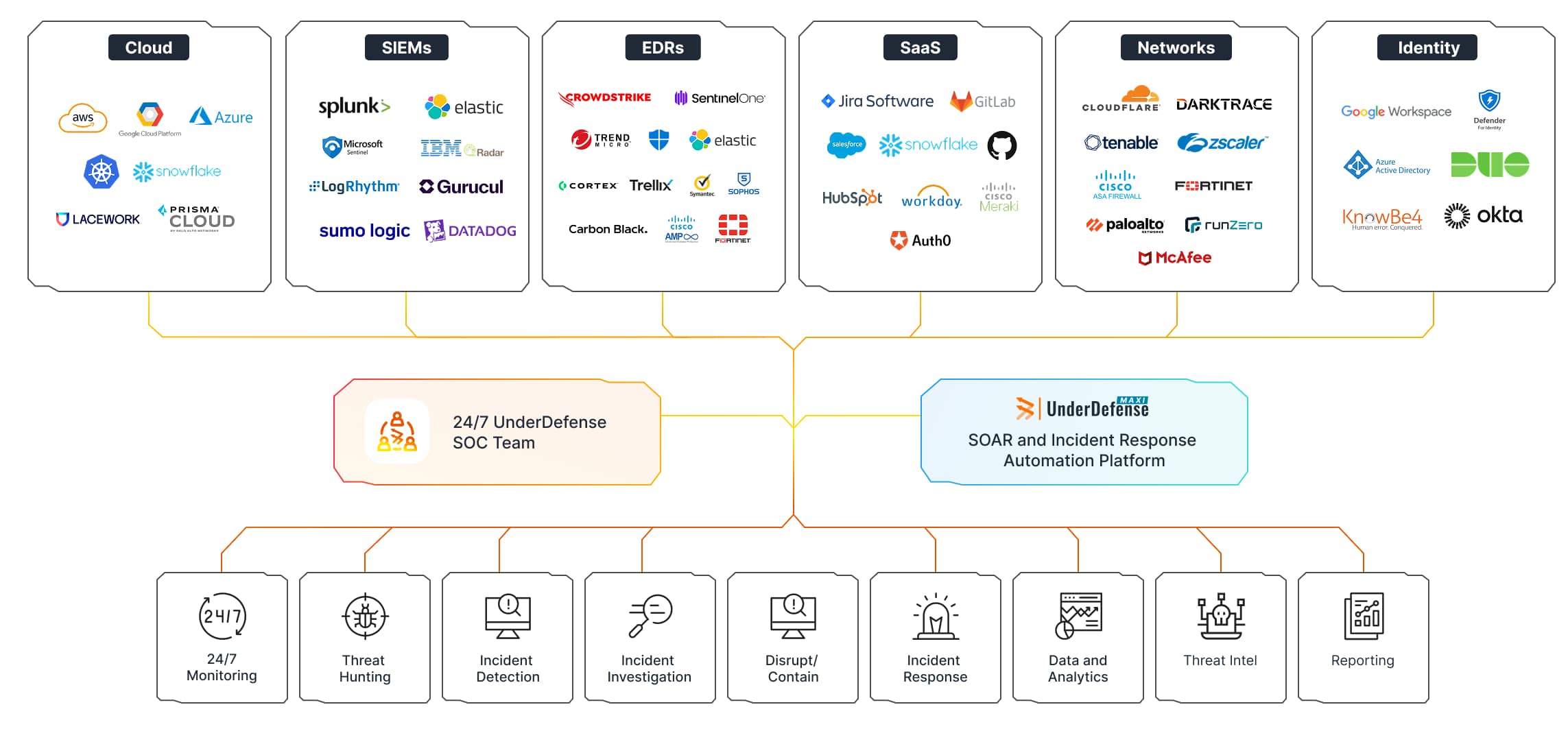
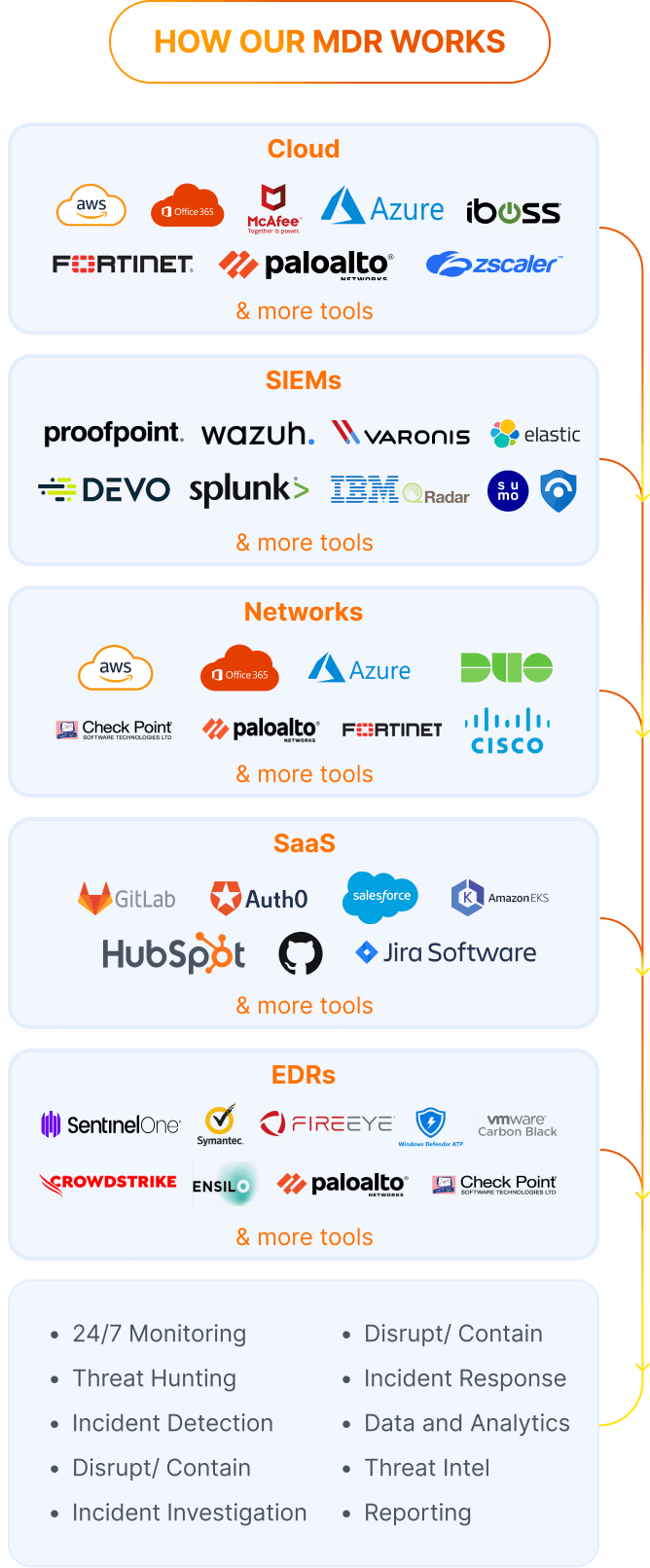
Endpoint, network, cloud, identity, SaaS, and Kubernetes — unified into a single detection-and-response operation. We correlate a suspicious login with a host process with an anomalous egress, so the threat that hides between tools has nowhere left to hide.
Layered on the stack you already own
Our MXDR is a SecOps layer on top of your existing SIEM, EDR, and cloud tools — not a platform you're forced to adopt. No rip-and-replace, and you keep ownership of every integration and rule if you ever leave.
We resolve alerts. We don't escalate them back.
AI does the routine T1–T2 context-gathering; our analysts make the call and take the action — isolating a host, disabling an account, talking to the affected user directly. You get outcomes, not a fuller inbox.
Human-led containment, day and night
A 24/7 SOC backed by a dedicated Tier 3–4 incident-response team, with a 15-minute critical-incident escalation. Broad coverage is only worth as much as the hands that act on it.
Detection engineered for your business
Custom Splunk/Elastic correlation rules, cloud-identity hardening, detection-as-code that's versioned and tested. Extended coverage tuned to your attack surface — not a generic ruleset pointed at everyone.
The agentic AI SOC underneath it all
Our MAXI platform runs continuous, observable, auditable detection and enrichment across your whole stack — the engine that lets a lean human team cover an enterprise-sized surface. Everything it does is visible and reversible.
Trusted by Security Leaders
What our customers say

"We fully automated T1-T2 manual triage with UnderDefense. AI SOC filters the noise so my team can focus on complex hunt missions and strategic security. We scaled our capacity 10x overnight, not by hiring, but by making our analysts investigators again."

"Zero ransomware cases and a 2-minute triage SLA. Agentic AI mapped our VIPs and high-value assets with surgical precision. It transformed how our board views security, shifting from a cost center to a strategic enabler of business resilience."
Excellence.
Our minimum bar for client delivery.




UnderDefense MXDR vs. the field
Tap any row for the detail. The points that decide an MXDR deal, at a glance.


One partner for your whole security program
MXDR is the broadest coverage. These services plug into the same 24/7 team and platform.
Managed Detection & Response (MDR)
24/7 human-led detection and response focused on your core endpoint and SIEM surface.
Learn more →Managed EDR
Your CrowdStrike, SentinelOne, or Microsoft Defender, expertly tuned and managed with 24/7 triage and response.
Learn more →MDR for SaaS
Cloud-native detection and response for SaaS companies, with the security evidence enterprise buyers expect.
Learn more →MDR for Healthcare
HIPAA-aligned detection and response protecting PHI, EHR systems, and clinical operations around the clock.
MDR for FinTech
Detection and response built for financial platforms, with the compliance evidence regulators and partners require.
Learn more →MDR Integrations
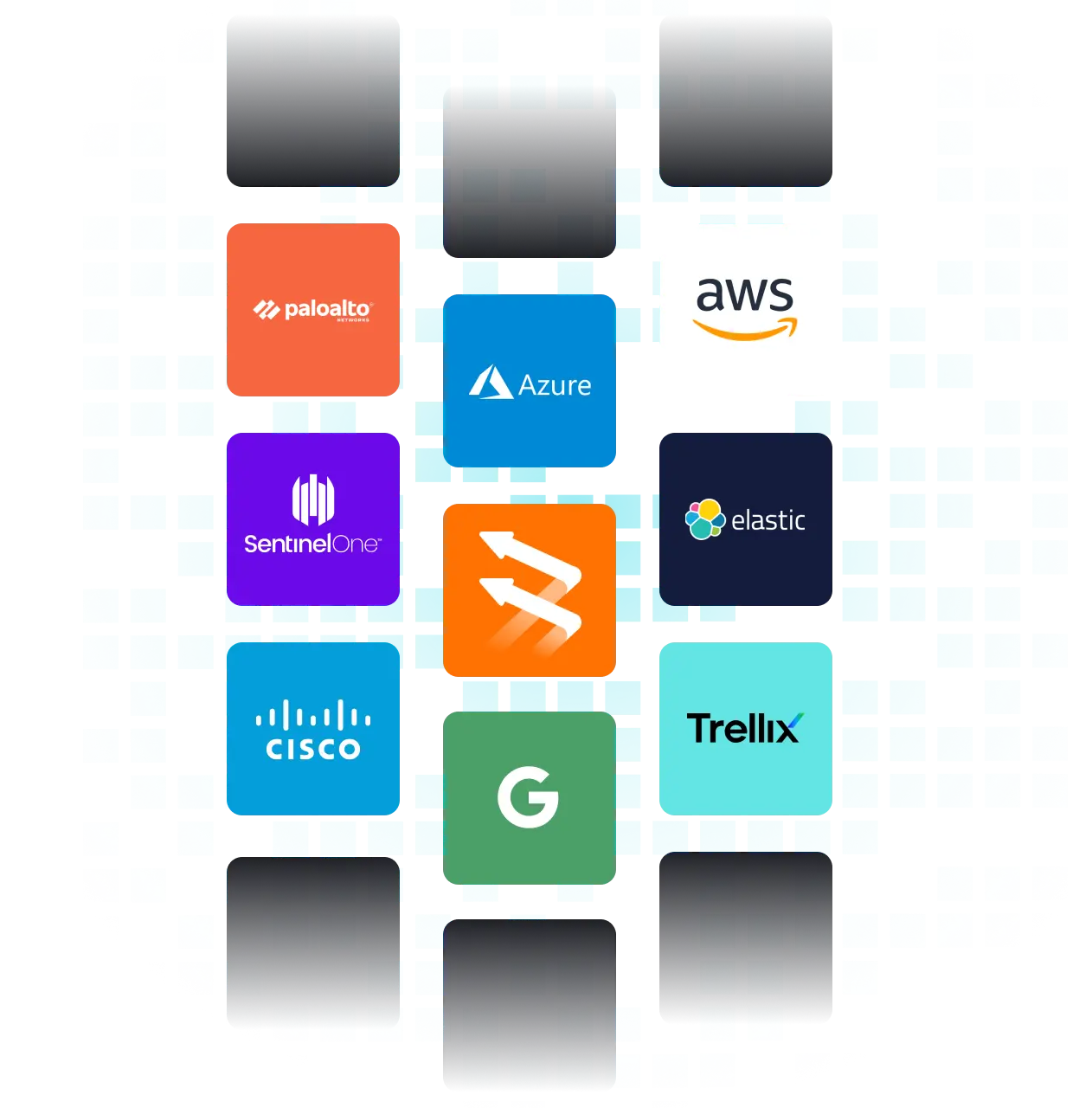
250+ integrations across your EDR, SIEM, cloud, and identity stack. See everything we connect to.
Six years. Zero client ransomware.
Our MXDR isn't one-size-fits-all — we fine-tune the tools you already own so they work smarter, not harder. The result is a track record we can point to by name: when Black Basta breached a client environment, our SOC contained it in 43 minutes and avoided an estimated $67M in losses. Across six years, not one MXDR or MDR client has suffered a ransomware incident.
Get your custom MXDR quote
Tell us about your environment. We'll come back with a tailored proposal and a 30-day onboarding plan, scoped to your stack.
- A clear proposal, not a sales gauntlet
- Full coverage live in days, not a quarter
- Start free with MAXI, no credit card
Not sure MXDR is the right call? Read this first.
How to choose an MXDR provider in 2026: the questions that separate real response from an alert forwarder
Choosing an MXDR provider is one of the highest-leverage security decisions you will make this year. The wrong choice buys you an expensive alert forwarder; the right one buys you a 24/7 team that actually contains threats. This guide walks through the questions that separate the two.
What does MXDR stand for?
MXDR stands for Managed Extended Detection and Response. It's a fully managed security service where a 24/7 team — supported by AI — owns detection, investigation, containment, and remediation across your entire environment: endpoint, network, cloud, identity, and email/SaaS. The "extended" means it spans every layer, not just endpoints; the "managed" means a provider runs it for you.
What is the difference between MDR and MXDR?
Both are managed services with a 24/7 team owning response. The difference is scope. MDR typically centers on endpoints and log/SIEM data. MXDR extends that same human-led model across the full attack surface — cloud, identity, network, SaaS, and containers — and correlates signals between those layers, so threats that move across environments can't hide in the seams.
What is the difference between XDR and MXDR?
XDR is a tool — a platform that unifies telemetry across layers into one console, which your team still has to operate 24/7. MXDR is the managed service wrapped around that capability: a provider's analysts and AI run the detection, make the decisions, and take the containment actions for you. XDR is technology; MXDR is technology plus the people who operate it.
What is the difference between EDR and XDR?
EDR (Endpoint Detection & Response) monitors and responds to threats on endpoints only — laptops, servers, workstations. XDR (Extended Detection & Response) widens that visibility beyond the endpoint to network, cloud, identity, and email, correlating signals across all of them in a single view. EDR is one layer; XDR is many layers unified. Both are tools your team still operates.
What is the difference between managed XDR and a SOC?
A SOC (Security Operations Center) is the team and facility that monitors and responds to threats — which you can build in-house or outsource. Managed XDR is a way to get a SOC's outcomes without building one: a provider delivers the 24/7 team, the extended-detection technology, and the response process as a single service, layered on the tools you already own.
Is XDR replacing SIEM?
Not entirely — they're converging. SIEM aggregates and retains logs for detection and compliance; XDR adds cross-layer correlation and response. Many teams now run XDR on top of their SIEM rather than ripping it out, keeping compliance-grade log retention while gaining faster detection. UnderDefense MXDR co-manages your existing SIEM rather than forcing a replacement, so you keep your data and rules.
What is Microsoft MXDR?
"Microsoft MXDR" usually refers to a managed service built around the Microsoft Defender XDR and Sentinel stack. It's powerful if you're all-in on Microsoft — but it's single-vendor by design. UnderDefense MXDR is vendor-agnostic: we run extended detection and response across Microsoft and your other EDR, SIEM, cloud, and identity tools, so a mixed environment gets one correlated picture, not two.
How do you choose an MXDR provider?
Look past "we cover every layer" — everyone claims it. Ask: Does the team take containment actions, or just notify you? Is there a written response SLA? Does it work with the tools you already own, or force a rip-and-replace? Who owns the data and rules if you leave? And can they point to a concrete track record — named incidents, not just abstract stats?