

Jun 23, 2026

Web Application Penetration Testing: 12 Core Practices Across Reconnaissance, Threat Modeling, Exploit Validation, and Remediation

Q1. What Is Web Application Penetration Testing, and Why Do SaaS Teams Treat It as a Sanity Check, Not a Checkbox?

Web application penetration testing is the authorized, manual-led simulation of real attacks against your web app to find exploitable flaws before adversaries do. Unlike a vulnerability scan, it validates whether weaknesses actually chain into a breach. For SaaS teams, it works as a sanity check on new architecture and a scorecard for whether your monitoring detects exploitation. It is not a box you tick for an auditor.

The definition that actually matters to your team

A pentest is a controlled break-in. A skilled tester acts like an attacker, with permission, against a defined target. They probe your login flows, APIs, and data paths to see what breaks.

The goal is proof, not paperwork. You learn which flaws a real attacker could chain into stolen data or hijacked accounts. That is the difference between “we passed” and “we are actually safe.”

Get a Pentest Quote from UnderDefense Then Decide

Pentest versus vuln scan versus DAST

Many teams confuse three things. Here is the clean split, grounded in the OWASP Web Security Testing Guide (WSTG), the field’s reference methodology.

  • A vulnerability scan lists known weaknesses automatically. It is fast and broad, but it does not prove exploitability.
  • DAST (Dynamic Application Security Testing) fires automated payloads at a running app. It finds patterns, not business logic.
  • A pentest uses a human to confirm what is truly exploitable and how far it reaches.

Scanners flag a door that looks unlocked. A pentester walks through it, finds the safe, and shows you what was inside. Our web app penetration testing approach starts from that exploit-first mindset.

Comparison of vulnerability scan, DAST, and manual web application penetration testing
A scanner flags an unlocked door; a pentester walks through it and proves what was inside.

The stone-thrower mindset

⭐ The best engagements start with a simple invitation: throw stones at our architecture. Try to break it on purpose.

I might be overstating this, but from what surfaces when you actually run these tests, passive checking misses the interesting flaws. You want a tester who critiques the design, not one who reads a tool’s output back to you. The standard “compliance pentest” gets this backwards.

This is why grey-box testing, where the tester gets some internal context, tends to surface deeper issues. One UnderDefense client put it plainly after a recent assessment.

“We did a greybox penetration test. Everything was quick and the depth of the test was impressive. The team is great.” Chief Engineering Officer, Software UnderDefense Gartner Verified Review

Another reviewer valued the plain-English walkthrough over a raw bug list.

“Under Defense security experts took the time to explain every discovered vulnerability as well as corresponding remediation steps.” CTO, IT Services UnderDefense Gartner Verified Review

What to do with this on Monday

✅ Before your next release, ask one question: would this test prove a breach, or just produce a PDF? If the answer is paperwork, you bought compliance theater. Treat the pentest as functional assurance, and let your testers try to break the thing for real. If you want a sense of the deliverable, our pentest report template shows what proof looks like.

Q2. How Does the 12-Practice Methodology Flow From Reconnaissance to Remediation, and Where Does the OWASP Top 10 Fit?

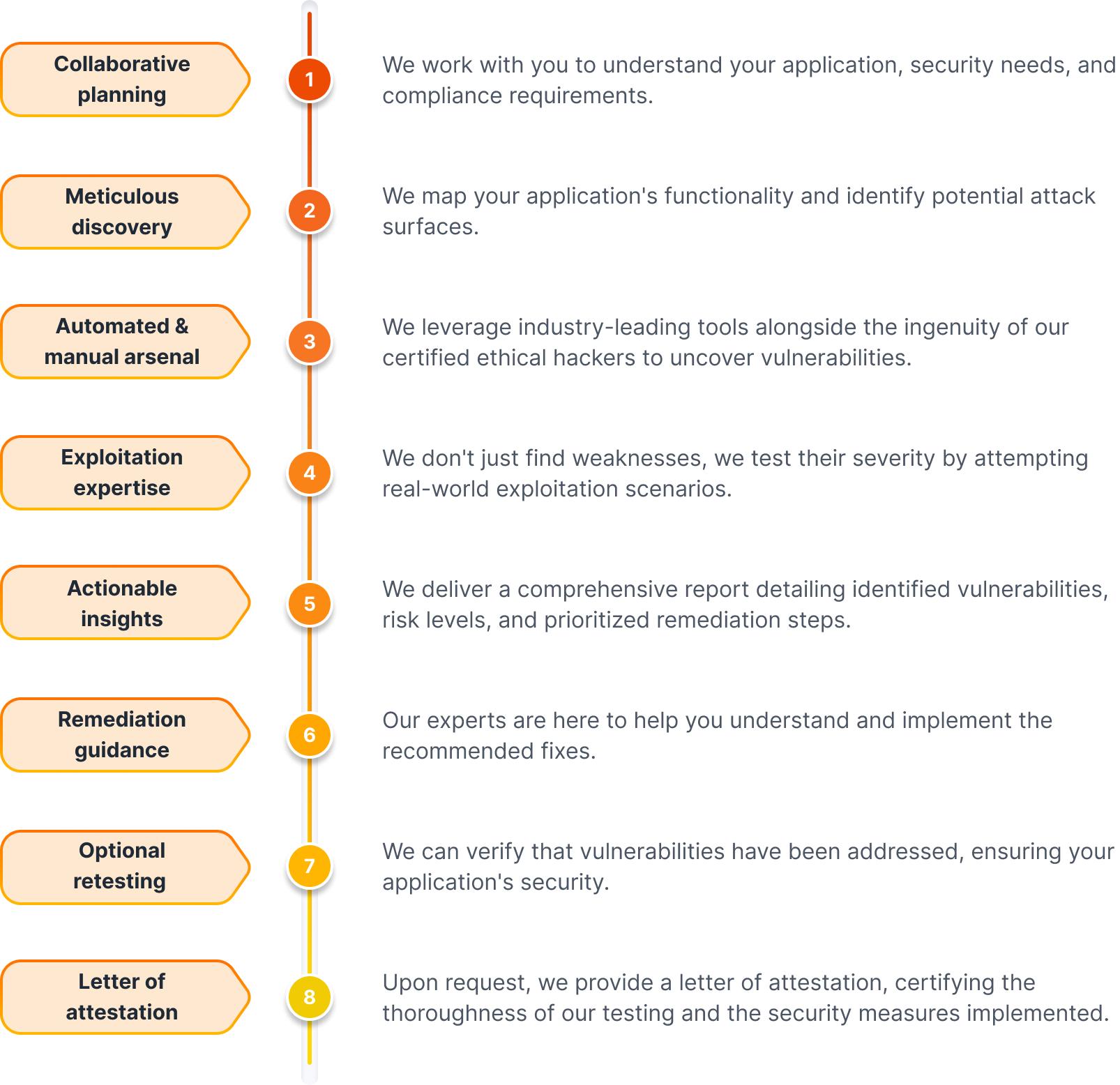
A complete web app pentest moves through 12 linked practices: scoping, reconnaissance, attack-surface mapping, threat modeling, automated scanning, manual exploitation, business-logic testing, API testing, post-exploitation, evidence and reporting, remediation guidance, and re-test validation. Each phase aligns to OWASP WSTG test cases and the OWASP Top 10 (2021), so your coverage is provable, not assumed.

Why the order matters

Many teams jump straight to scanning. That is like searching a house without first checking which doors exist. Recon shapes everything downstream.

Skip the early phases, and you get shallow findings. The strongest tests build context first, then attack with intent. The official NIST methodology, SP 800-115, lays out this same planning-to-execution discipline.

The 12 practices in sequence

  1. Scoping and rules of engagement. Define targets, limits, and timing.
  2. Reconnaissance. Gather public and technical detail on the app.
  3. Attack-surface mapping. List every endpoint, input, and entry point.
  4. Threat modeling. Decide where a real attacker would aim.
  5. Automated scanning. Run tools to flag known weaknesses fast.
  6. Manual exploitation. A human confirms what is truly exploitable.
  7. Business-logic testing. Abuse workflows like checkout or role changes.
  8. API testing. Probe REST and GraphQL endpoints directly.
  9. Post-exploitation. Test how far access spreads (lateral movement).
  10. Evidence and reporting. Document each finding with proof.
  11. Remediation guidance. Explain the fix, not just the flaw.
  12. Re-test validation. Confirm the fix actually closed the hole.
Twelve-step web application penetration testing process from reconnaissance to remediation
The full pentest pipeline runs from scoping through manual exploitation to a verified re-test.

Mapping the OWASP Top 10 to test cases

The OWASP Top 10 (2021) names the most critical web risks. The WSTG maps each one to concrete test cases across 12 categories. Here is how the highest-impact risks line up. Our penetration testing services tie every finding back to this map.

OWASP Top 10 (2021) Mapped to WSTG Test Focus
OWASP Top 10 (2021)What it means in plain termsWSTG test focus
A01 Broken Access ControlUsers reach data or actions they should notAuthorization, IDOR, privilege checks
A02 Cryptographic FailuresWeak or missing encryption exposes dataTransport security, secrets handling
A03 InjectionMalicious input runs as a commandSQL, command, and input validation tests
A05 Security MisconfigurationInsecure defaults or exposed settingsConfig and deployment testing
A07 Identification and Authentication FailuresWeak login or session handlingAuthentication, session management

The credibility check buyers miss

⚠️ A “scanner-only pentest” cannot prove this coverage. If a vendor cannot map findings to WSTG categories, they likely ran a tool and relabeled the output.

From what I have seen across engagements, the teams that map to the Business Layer (UI, business logic, data access) catch the flaws that matter to the business, not just the network. Clients consistently call out the report quality that comes from this rigor.

“UnderDefense delivered a clear detailed report with issues and how to fix them. I found their team very professional and effective in their pentest approach.” Manager of IT Services, IT Services UnderDefense Gartner Verified Review

Your Monday action

✅ Ask your next vendor to map their deliverables to OWASP WSTG categories before you sign. A repeatable, audit-defensible scorecard beats a vague promise of “thorough testing” every time.

Q3. Why Is Threat Modeling the Step Most Teams Skip, and How Do STRIDE, PASTA, and the Adversary Intelligence Trifecta Sharpen It?

Threat modeling decides where to aim a pentest before a single payload fires. STRIDE and PASTA structure the “what could go wrong” question. The Lockheed Martin Kill Chain (strategy), MITRE ATT&CK (operational vocabulary), and the Diamond Model (analyst method) turn “test everything” into “test what a real adversary would do.” That focus is why threat-modeled engagements surface higher-severity, business-relevant findings.

The claim: skipping it costs you depth

Most teams skip threat modeling because it feels like overhead. That choice quietly caps the value of the whole test.

Without a model, testers spread effort evenly across low and high-risk areas. You pay for breadth and miss the crown jewels. Threat modeling is the cheapest way to make an expensive test worth it.

The frameworks that structure “what could go wrong”

Two models help you reason about risk before testing. They are simple to apply.

  • STRIDE (a Microsoft model) checks six threat types: Spoofing, Tampering, Repudiation, Information disclosure, Denial of service, and Elevation of privilege.
  • PASTA (Process for Attack Simulation and Threat Analysis) ties threats to real business impact across seven stages.

Use STRIDE on a login flow, and “Elevation of privilege” instantly points testers at role checks and tenant boundaries. That is sharper than “test the app.”

The Adversary Intelligence Trifecta

Three more frameworks shift testing from generic to adversary-aware.

  • Lockheed Martin Cyber Kill Chain gives the strategy, the stages of an attack from recon to action.
  • MITRE ATT&CK gives the shared vocabulary, like T1190, Exploit Public-Facing Application.
  • The Diamond Model gives analysts a method to link adversary, capability, infrastructure, and victim.

Together, they answer one question: what would a real attacker actually do against this app? That beats testing in the dark. The same logic drives our ethical hacking engagements.

Why this is a premium deliverable

⭐ Mapping each finding to an ATT&CK technique gives CISOs a language boards understand. “We have a T1190 exposure” lands harder than “we found a bug.”

I could be wrong that every team needs this depth, but from what surfaces in real engagements, threat-modeled tests reduce the attack surface before an adversary finds it, which is the core promise of Zero Trust. Clients notice when testers hunt with intent rather than run a checklist.

“The issues they found were unique, so you know they were not just using tools to test, they were got in and really found some edge case issues that other penetration testers have not.” VP, Security and Compliance, Legal Tech Company UnderDefense Clutch Verified Review
“The team is always looking for new ways to find vulnerabilities in our systems.” VP, IT Security and Risk Management, Software UnderDefense Gartner Verified Review

Your Monday action

✅ Run a 30-minute STRIDE pass on your most sensitive workflow this week. Hand the output to your tester as a scope guide. You will get deeper findings for the same budget. A virtual CISO can run this pass with you if you lack the in-house bandwidth.

Q4. What Should You Put In Scope: APIs, Cloud Misconfigurations, and Multi-Tenant Logic?

For SaaS, scope must extend past the UI to the API layer (REST, GraphQL, OAuth and JWT), cloud-native attack paths like SSRF-to-IMDS and S3 enumeration, and multi-tenant business logic such as tenant isolation bypass and subscription abuse. These are where the highest-severity, hardest-to-scan flaws live. A scope that stops at “the website” leaves your most valuable, most-targeted surfaces untested.

The pain: APIs treated as an afterthought

Most generic pentests focus on the visible web app. They click buttons and fill forms. They barely touch the APIs underneath.

That is backwards for SaaS. Your app is mostly API. The UI is a thin layer over the endpoints that actually move data.

Four SaaS penetration testing scope areas: API, auth, cloud paths, and multi-tenant logic
For SaaS, scope must reach APIs, tokens, cloud paths, and multi-tenant logic, not just the website.

Proof: the API and token attacks that matter

APIs carry their own risk class, captured in the OWASP API Security Top 10. A few patterns cause most of the damage.

  • REST and GraphQL flaws. Over-fetching data, missing object-level checks, and exposed admin endpoints.
  • OAuth and JWT abuse. A JWT (JSON Web Token) is a signed login token. Weak signing or skipped checks let attackers forge access.
  • Broken object-level authorization. Changing an ID in a request to read another user’s data.

This maps straight to OWASP A01, Broken Access Control, the top web risk today. One client engagement found exactly these layered issues.

“Vulnerabilities were found during the penetration testing process, leading to two attack cases, a web application and application victim-user. Both of them potentially lead to business issues.” Lead DevOps Engineer, Insurance Tech Company UnderDefense Clutch Verified Review

Proof: the cloud path attackers love

Cloud-hosted apps add new doors. The classic one is SSRF-to-IMDS.

Here is the chain in plain terms. SSRF (Server-Side Request Forgery) tricks your server into making requests for the attacker. They aim it at the cloud metadata service (IMDS), which can hand back credentials. From there, they pivot into your cloud account. Our cloud security services harden these exact paths.

⏰ Time is the currency of the cloud. In that kind of breach, seconds are often enough to grab the most valuable data. S3 bucket enumeration adds another quiet path to exposed storage.

The payoff: multi-tenant logic is the crown jewel

💰 For SaaS, the highest-value finding is tenant isolation bypass: one customer reaching another customer’s data.

Generic guides ignore this. So do most commodity testers. Subscription abuse, where a user unlocks paid features for free, sits right beside it.

From what surfaces when you actually run these tests, the deepest SaaS flaws are logic flaws, not missing patches. A reviewer captured why manual depth beats tool output here.

“They were got in and really found some edge case issues that other penetration testers have not.” VP, Security and Compliance, Legal Tech Company UnderDefense Clutch Verified Review

Your SaaS scope checklist

✅ Put these on the next statement of work:

  • All REST and GraphQL endpoints, including internal ones.
  • OAuth flows and JWT signing and validation.
  • Cloud metadata exposure (SSRF-to-IMDS) and storage permissions.
  • Multi-tenant isolation and role-based access boundaries.
  • Subscription and entitlement logic.

If a vendor scopes only “the website,” push back. The surfaces you leave out are the ones attackers target first. When you are ready to scope a real engagement, you can contact us to map it against your stack.

Not Sure What Your Pentest Should Cost? Find Out

Q5. Which Tools and Testing Types Do Pentesters Use, Black-Box, Grey-Box, or White-Box, and Why Can’t Automation Replace a Human?

Pentests run as black-box (no internal knowledge), grey-box (partial access, like credentials, architecture, and API specs), or white-box (full source access). Grey-box usually gives the best coverage-to-cost ratio for SaaS. The core toolchain (Burp Suite Pro, OWASP ZAP, Nmap, SQLMap, Nikto, Metasploit, plus cloud and API fuzzers) handles breadth, not judgment. The XZ Utils backdoor was caught by a human, not a scanner.

Pick the right testing type first

The amount of access you give the tester changes everything. More context means deeper findings, faster.

Here is how I frame the three options for clients.

Black-Box vs Grey-Box vs White-Box Testing
TypeWhat the tester knowsSpeedCoverageBest for
Black-boxNothing internalSlowShallowMimicking an outside attacker
Grey-boxCredentials, architecture, API specsBalancedDeepMost SaaS apps ⭐
White-boxFull source codeFast on logicDeepestCritical or pre-launch systems

My current read is simple. For most SaaS teams, grey-box wins. You skip the slow guessing phase and spend the budget on real exploitation. This is the default we recommend for web app penetration testing.

The toolchain that does the heavy lifting

Tools are essential, but they are scaffolding, not the work. Here are the ones our testers reach for daily.

  • Burp Suite Pro and OWASP ZAP. Intercept and manipulate web traffic.
  • Nmap. Map open ports and services.
  • SQLMap. Automate SQL injection (tricking a database with malicious input).
  • Nikto and Metasploit. Scan for known issues and run exploits.
  • Cloud and API fuzzers. Hammer endpoints with malformed input to find cracks.

Why automation alone gives false confidence

Here is the contrarian part most vendors skip. Scanners are confidently wrong a lot of the time.

A foundational 2010 IEEE study by Bau and colleagues tested commercial scanners against real apps. It found recall as low as 25% for stored injection flaws. That means three out of four serious bugs walked right past the tool.

In our experience hardening SOCs at UnderDefense, the data lines up. AI gives a correct security answer in roughly 30% of cases. That is a dice roll, not a verdict. This is exactly why we pair automation with human analysts in our ethical hacking work.

The XZ Utils proof point

⚠️ Think about the XZ Utils backdoor, tracked as CVE-2024-3094. A developer caught it by noticing SSH logins ran a fraction of a second slow.

No scanner flags “this feels slightly off.” That intuition is human. Buying expensive tools without expert testers is like owning a fleet of Ferraris with rookie drivers.

This is why I push every buyer to demand proof of manual exploitation, not a scan report. Clients feel that difference.

“The issues they found were unique, so you know they were not just using tools to test, they got in and really found some edge case issues that other penetration testers have not.” VP, Security and Compliance, Legal Tech Company UnderDefense Clutch Verified Review

✅ Your move this week: ask your next vendor to show one finding a scanner could never have caught. The answer tells you who you are really hiring. If you need a benchmark, compare against the best pentest companies on the market.

Q6. How Do You Validate an Exploit Instead of Just Reporting a Vulnerability?

Exploit validation means proving a flaw is actually reachable and harmful, not just flagged by a scanner. A tester chains the weakness into real damage: data access, privilege escalation, or code execution. The Zimbra memcache CRLF-injection attack, which harvested credentials without touching an endpoint, shows why deep HTTP request manipulation, not a CVSS number on a dashboard, tells you your true exposure.

Flagging is a guess, validation is proof

A scanner says “this might be vulnerable.” A validated finding says “I walked through this door and here is what I took.” Those are not the same claim.

The gap matters because false positives drain your team. Chase enough phantom bugs, and people stop trusting the report. Validation cuts the noise to what is real, which is the core of strong penetration testing.

A real exploit, in plain terms

Consider the Zimbra attacks tracked by CISA. Attackers abused a memcache flaw using CRLF injection.

Here is the idea without the jargon. CRLF injection sneaks extra commands into a web request by faking line breaks. The attackers used it to poison the cache and quietly harvest login credentials.

The scary part: they never touched an endpoint device. No malware alert fired. This is exactly why deep HTTP request manipulation belongs in every serious test.

Turn validation into detection

Once you know what a real attack looks like, you can hunt for it. This maps to OWASP A03, Injection, the classic web risk. Feeding these signatures into a managed SIEM turns one finding into ongoing detection.

⏰ Practical signals to watch for in your logs:

  • SQL injection strings like XP_CMDSHELL, SELECT *, or OR 1=1 in web server logs.
  • The X-Forwarded-For header to find an attacker’s true IP behind a load balancer or WAF (web application firewall).
  • Unauthorized “Kali” Linux boot images on your network, a strong sign someone is running tools they should not.

I might be biased here, but from what surfaces when you actually run these tests, validation is where pentesting earns its fee. Clients tell us the proof-of-concept changes the conversation with their developers.

“They developed proof-of-concept scripts and code snippets that demonstrated how to practically exploit those weaknesses.” Reviewer, Ride-hailing Company UnderDefense Clutch Verified Review

✅ Ask for working proof, not a severity label. A finding you can reproduce is a finding you can fix. Our pentest report template shows how we document that proof.

Q7. Is a Quiet Dashboard During a Pentest Good News, or Your MDR Failing Silently?

Silence is not proof of safety. When a pentest performs lateral movement and your dashboard stays quiet, that is almost always a detection failure, not a strong perimeter. One UnderDefense client found their incumbent MDR raised zero alerts during a full pentest. That “silent pen test” became the last straw that triggered a switch. Treat every pentest as a live test of whether your monitoring actually sees attackers.

The comforting lie of a quiet screen

Most teams read a quiet dashboard as a win. No alerts, no problem, right?

The standard read gets this backwards. If a tester moved laterally through your network and nothing fired, your detection is blind. Silence during an attack is the alarm, not the all-clear. This is where a true MDR service proves its worth.

Quiet security dashboard during a pentest reframed as an MDR detection failure
A silent dashboard during a pentest is usually a detection failure, not proof you are safe.

The silent pen test

Let me share a pattern we see often. A client ran a full pentest with real lateral movement across their systems.

Their existing MDR (Managed Detection and Response) produced zero alerts. Not one. The attack walked the building, and the cameras saw nothing.

That moment turned abstract risk into a concrete failure they could not unsee. It became the last straw that pushed them to switch providers. You cannot argue with a dashboard that stayed dark while you got breached on purpose. We see this often among teams who later explore why businesses switch providers.

Malware can hide, but it must run

Here is the principle I keep coming back to. Malware can hide, but it must run. Attackers can mask files, but action leaves traces.

A pentest forces that action. So it doubles as a scorecard for your detection. If your tools miss a friendly attacker you invited, they will miss a real one too.

In our experience running MDR for global teams, the fix is not more dashboards. It is detection that produces context and a human who acts on it, which is what the UnderDefense Agentic AI SOC platform delivers. Buyers feel the gap clearly.

“Their SOC team is responsive and knows their stuff. When they escalate something, they include the context we need to understand the issue quickly. We’re not wasting time piecing together what happened.” Verified User in Marketing and Advertising UnderDefense G2 Verified Review
“We were quite surprised that they were able to find many vulnerabilities, the app quality also improved because of their testing efforts.” Reviewer, Outsourcing Company UnderDefense Clutch Verified Review

Make the test prove your detection

✅ Run your next pentest as a purple-team exercise. Have testers attack while your team watches the alerts.

Score it honestly. Which steps fired an alert? Which slipped through? That single exercise tells you more about your security than any vendor brochure. Track the result with hard SOC metrics like detection rate.

Q8. What Belongs in a Pentest Report, and How Do You Remediate Without Chasing the Bottom of the Pyramid of Pain?

A useful pentest report pairs an executive summary with CVSS-scored, reproducible findings, ATT&CK-mapped context, and prioritized remediation steps. Effective remediation targets the top of the Pyramid of Pain, the adversary tactics, techniques, and procedures (TTPs), not the trivial hashes and IPs attackers swap instantly. The report’s real job is to drive durable fixes and a verified re-test, not generate a PDF for the audit folder.

What a report must contain

A good report serves two readers at once: the executive and the engineer. It should give each what they need.

Here is the anatomy I expect on every engagement.

  • Executive summary. Business risk in plain language for the board.
  • CVSS-scored findings. A standard severity score (Common Vulnerability Scoring System) so you can prioritize.
  • Reproducible steps. Exact actions to recreate each finding.
  • ATT&CK mapping. Each finding tied to a MITRE technique, like T1190.
  • Remediation guidance. The fix, not just the flaw.

Fix the right layer

Now for the part most teams get wrong. Not all fixes are equal.

David Bianco’s Pyramid of Pain ranks how much it hurts an attacker when you block something. Block an IP address, and they switch it in seconds. Block their technique, and you force a real rebuild.

Picture a finding where an attacker abuses a stolen token to move laterally. You can blocklist that one token (easy for them to replace). Or you can fix the token validation logic and detection (painful for them to overcome). Always aim for the painful fix, and route durable changes through your DevSecOps services.

The loop most vendors skip

⚠️ Here is the gap I see across the market. Many providers hand over a PDF and vanish. A finding without a verified fix is just homework you graded yourself.

The loop matters. Remediate, then re-test to confirm the hole is actually closed. Then route the finding into your DevSecOps tickets so it does not return next release.

We bake this re-test into our engagements, because a report that does not close the loop is theater. A virtual CISO can own that loop end to end. Clients consistently call this out as the difference.

“In some time we were offered a 2nd fast test to identify if vulnerabilities were solved or not.” Reviewer, Charitable Organization UnderDefense Clutch Verified Review
“Following this security testing, we are better equipped to avoid data breaches, they delivered a report with all known issues.” Reviewer, Ride-hailing Company UnderDefense Clutch Verified Review

✅ Demand a re-test clause in your next contract. A pentest that ends at the report is only half a pentest. When you are ready to scope one, you can contact us to build that loop into the engagement.

Q9. How Much Does Web Application Penetration Testing Cost, and What Drives the Number Up or Down?

Web app pentest pricing scales with scope: application count, API complexity, user-role matrix, environment access, and the depth of manual testing. Point-in-time engagements commonly run from roughly $10,000 to $50,000 or more. PTaaS (Penetration Testing as a Service) spreads that cost across continuous testing. With the average breach now costing $4.88M (IBM, 2024), one validated pentest that prevents even a partial incident clears its ROI immediately.

Why most guides hide the number

Most pentest vendors dodge pricing on purpose. They want you on a sales call before they say a figure.

I find that backwards. A busy CISO deserves a range up front. The truth is, cost is not a mystery. It tracks directly to how much there is to test, as our pentest pricing page lays out.

What actually moves the price

The number rises and falls with a handful of clear variables. Here is what we weigh when we scope a job.

  • Application count. More apps means more surface to cover.
  • API complexity. Dozens of REST and GraphQL endpoints add real hours.
  • User-role matrix. Each role (admin, user, guest) needs its own access tests.
  • Environment access. Black-box guessing costs more time than grey-box context.
  • Depth of manual testing. Real exploitation costs more than a scan, and it is worth it.

⚠️ Watch for a quote that seems cheap. It usually means a scan with a fancy cover page, not a human breaking your app. To benchmark vendors, review the best pentest companies.

The ROI math your board will accept

💰 Here is the framing that lands in a board meeting. The 2024 IBM report puts the average breach at $4.88 million. A $30,000 pentest that stops one incident is not a cost. It is insurance with a receipt. Tie it into your cybersecurity budget planning early.

Let me share a story that stuck with me. During a proactive engagement, our team’s monitoring and testing accidentally surfaced an internal payroll fraud scheme. The recovery paid for the entire security contract within 90 days. That is the kind of return you cannot plan for, but it happens when humans actually look.

Stop guessing what a pentest will cost you.

Scope variables (apps, APIs, user roles, environments) move the number fast. Use the UnderDefense calculator to get a transparent estimate for your SaaS stack in minutes, no sales call required.

Estimate My Pentest Cost →

Clients consistently tell us the value-to-cost ratio is why they stay.

“It’s reassuring to know they’re always watching for threats, and it doesn’t cost a fortune. They catch and stop problems quickly.” Serhii B., Chief Information Security Officer UnderDefense G2 Verified Review
“UnderDefense is surprisingly affordable considering the level of protection we get. Their proactive threat hunting and rapid response have saved us from incidents that could have been incredibly costly.” Verified User in Program Development UnderDefense G2 Verified Review

Q10. What Should You Do Differently on Monday Morning: Compliance Triggers, Shadow AI, and Entitlements You Already Own?

Start Monday with three moves. Map your pentest cadence to the frameworks that require it (PCI DSS 11.4, SOC 2 CC7.1, ISO/IEC 27001 A.8.8, GDPR Article 32). Audit the M365 E5 security and logging features you already own before buying redundant tools. And govern AI-assisted code instead of banning it, because bans only push developers into unmanaged Shadow AI that removes your visibility.

Map your test to the rules that demand it

First, know what actually requires a pentest. Many teams test too rarely and fail audits for it.

Here is the quick mapping I hand to clients. Our compliance services align testing cadence to each framework.

Compliance Frameworks That Require Penetration Testing
FrameworkClausePentest requirement
PCI DSS v4.0Req 11.4Test annually and after significant changes
SOC 2CC7.1Detect and evaluate vulnerabilities
ISO/IEC 27001:2022Annex A 8.8Manage technical vulnerabilities
GDPRArticle 32Regularly test security measures

✅ Action: check the date of your last pentest against these triggers today. A new feature launch often resets the clock. A virtual CISO can own this mapping if you lack in-house bandwidth.

Audit what you already pay for

Second, stop buying tools you already own. So many mid-market teams run Microsoft 365 E5 and never turn on its security features.

There are often 12 or more logging and detection capabilities sitting unused in that license. From what I have seen, an entitlement audit beats a new purchase nine times out of ten. Find the value you already bought, then layer on MDR for Microsoft 365 to operationalize it.

Do not ban AI, govern it

Third, resist the urge to ban tools like ChatGPT or Cursor for your developers. I understand the fear, but the ban backfires.

⚠️ Banning AI does not remove it. It creates Shadow AI, where developers paste company code into tools on personal devices. Now you have zero visibility and more risk, not less.

The better move is governance. Monitor what AI-assisted code and autonomous agents actually do in production. That is the new frontier most legacy vendors still ignore, and it is where MDR for AI comes in.

“Honestly, some security tools are more complicated than the threats themselves. Underdefense isn’t just about catching bad stuff, they give proactive tips too.” Andriy H., Co-Founder and CTO UnderDefense G2 Verified Review

Q11. Pentest, Red Team, Bug Bounty, or Continuous Validation: How Do You Choose the Right Partner and Engagement Model?

Pentesting hunts any exploitable flaw in a scope. Red teaming emulates one specific adversary’s campaign. Bug bounty crowdsources continuous pay-per-find testing. PTaaS spreads structured testing across the year. An annual snapshot cannot keep up with weekly deploys, so the strongest model bakes purple-teaming and continuous validation into an MDR engagement, with manual depth and a human who responds, not just a PDF.

Match the engagement to your question

People mix these four up constantly. The right choice depends on the question you are actually asking.

Pentest vs Red Team vs Bug Bounty vs PTaaS
EngagementObjectiveScopeCadenceChoose when
PentestFind any exploitable flawDefined targetPeriodic“Where am I weak?”
Red teamEmulate one real adversaryGoal-basedAnnual or less“Would we catch group X?”
Bug bountyCrowdsource findsPublic scopeContinuous“I have mature triage capacity”
PTaaSStructured continuous testingDefined, recurringOngoing“My code ships weekly”

A red team is narrow on purpose. It might emulate a named actor, using only that group’s known techniques and tools. That is different from a pentest’s broad hunt, which our penetration testing covers end to end.

The snapshot problem

Here is the trap. You buy one pentest a year, but you deploy code every week. Fifty-one weeks of that report are stale.

The standard read gets this backwards. Security is not a yearly photo. It is a continuous habit that has to keep pace with your release cycle, which is why continuous security monitoring matters.

How to weigh a partner

⭐ When you pick a partner, the model matters more than the logo. Here is how the options compare on what counts.

Partner Models Compared on What Counts
CriteriaContinuous-validation partner (UnderDefense)Point-in-time pentest shopGRC dashboard (Vanta, Drata)Alert-only MDR
Manual exploit depth✅ Deep, human-led✅ Deep but once❌ Automated checks❌ Limited
Validates your detection✅ Purple-team built in⚠️ Sometimes❌ No⚠️ Partial
Vendor-agnostic integration✅ 250+ tools⚠️ Varies⚠️ Varies❌ Often locked
Transparent pricing✅ Published⚠️ Quote-only✅ Published❌ Opaque
Concierge analyst response✅ Acts on findings❌ Reports only❌ Dashboard only❌ Escalates alerts

I want to be fair here. GRC tools like Vanta and Drata are good at compliance dashboards. A dashboard does not break your app or pass a real technical audit, though. That depth comes from people, and from a true MDR service.

This is where our model differs. We bake continuous validation into the MDR engagement, so detection gets tested, not assumed. Clients feel that combination.

“I used to work with many MDR solutions in the past, and so far Underdefense is the best one. It automates many tasks, plus, with 24/7 monitoring, we know we’re always protected.” Inga M., CEO UnderDefense G2 Verified Review
“We chose them among 5 other vendors. They understood our needs and gave us a detailed pen test report. Their team was quick and professional.” Manager of IT Services UnderDefense Gartner Verified Review

Q12. How Do You Turn One Pentest Into a Continuous Defensible Posture, and Where Should You Start?

A single pentest is a snapshot. A defensible posture is a habit. Combine threat-modeled scope, human-validated exploits, ATT&CK-mapped reporting, a closed remediation loop, and continuous validation that doubles as a detection scorecard. The teams that stay ahead do not buy one annual test. They build testing into every meaningful release and verify that detection fires when it matters.

From snapshot to habit

Think about where you started this article. A pentest felt like a yearly event, a box to tick.

Now picture the shift. You threat-model the scope, validate real exploits by hand, map findings to attacker techniques, close the loop with a re-test, and feed it all into continuous validation. That is not a snapshot. That is a posture that improves every sprint, powered by the UnderDefense Agentic AI SOC platform.

What I am sitting with

Here is the question on my mind for the next 18 to 24 months. As more code gets written by AI assistants, who is testing what those agents actually push to production?

My current read is that the gap is widening fast. Most teams cannot see it yet. The habit of continuous, human-validated testing is how I think we close it, and our perspective on whether AI kills or saves the SOC digs deeper here.

If you are building something and wondering whether your detection would catch a real attacker, I would genuinely like to hear what you are working on. That conversation, not a sales pitch, is where good security starts. You can see how we run web app penetration testing and tell us where it hurts.

“We feel more confident with our security posture thanks to UnderDefense. The team is always looking for new ways to find vulnerabilities in our systems.” VP, IT Security and Risk Management UnderDefense Gartner Verified Review

Get a Pentest Quote from UnderDefense Then Decide

1. What is web application penetration testing, and how is it different from a vulnerability scan?

We define web application penetration testing as the authorized, manual-led simulation of real attacks against your web app to find exploitable flaws before adversaries do. The key difference is proof.

A vulnerability scan lists known weaknesses automatically; it is fast and broad, but it never confirms whether a flaw is actually exploitable. DAST fires automated payloads at a running app and catches patterns, not business logic. A pentest uses a human to confirm what is truly exploitable and how far it reaches.

We like the analogy that a scanner flags a door that looks unlocked, while a pentester walks through it, finds the safe, and shows you what was inside. That is the difference between “we passed” and “we are actually safe.”

For SaaS teams, this matters because compliance theater produces a PDF, not assurance. Our web app penetration testing approach starts from an exploit-first mindset, where we invite clients to throw stones at the architecture rather than passively read tool output back to them.

2. How does the 12-practice methodology flow, and where does the OWASP Top 10 fit?

We run a complete web app pentest through 12 linked practices: scoping, reconnaissance, attack-surface mapping, threat modeling, automated scanning, manual exploitation, business-logic testing, API testing, post-exploitation, evidence and reporting, remediation guidance, and re-test validation.

The order matters. Many teams jump straight to scanning, which is like searching a house without first checking which doors exist. Recon shapes everything downstream, so we build context first, then attack with intent.

Each phase aligns to OWASP WSTG test cases and the OWASP Top 10 (2021), so coverage is provable, not assumed. Broken Access Control (A01), Cryptographic Failures (A02), and Injection (A03) each map to concrete WSTG test categories.

A scanner-only pentest cannot prove this coverage. If a vendor cannot map findings to WSTG categories, they likely ran a tool and relabeled the output. Our penetration testing services tie every finding back to this map, giving you an audit-defensible scorecard.

3. Which testing type should we choose: black-box, grey-box, or white-box?

The amount of access you give the tester changes everything, since more context means deeper findings, faster.

Here is how we frame the three options:

  • Black-box: the tester knows nothing internal, which is slow and shallow but mimics an outside attacker.

  • Grey-box: the tester gets credentials, architecture, and API specs, which balances speed and depth and suits most SaaS apps.

  • White-box: the tester gets full source code, which is fastest on logic and deepest, best for critical or pre-launch systems.

Our current read is simple. For most SaaS teams, grey-box wins, because you skip the slow guessing phase and spend the budget on real exploitation. This is the default we recommend for our ethical hacking engagements.

Automation alone gives false confidence; a foundational IEEE study found scanner recall as low as 25% for stored injection flaws, meaning three of four serious bugs walked past the tool.

4. What should be in scope for a SaaS pentest: APIs, cloud, and multi-tenant logic?

For SaaS, we insist scope extend past the UI to the layers where the highest-severity flaws live.

Most generic pentests focus on the visible web app, clicking buttons and filling forms while barely touching the APIs underneath. That is backwards, because your app is mostly API and the UI is a thin layer over the endpoints that move data.

We scope these surfaces explicitly:

  • All REST and GraphQL endpoints, including internal ones.

  • OAuth flows and JWT signing and validation.

  • Cloud metadata exposure (SSRF-to-IMDS) and storage permissions.

  • Multi-tenant isolation and role-based access boundaries.

  • Subscription and entitlement logic.

For SaaS, the highest-value finding is tenant isolation bypass, where one customer reaches another customer’s data. Our cloud security services harden the exact SSRF-to-IMDS paths attackers love. If a vendor scopes only “the website,” push back, because the surfaces you leave out are the ones attackers target first.

5. How much does web application penetration testing cost, and what drives the price?

Pricing scales with scope. Point-in-time engagements commonly run from roughly $10,000 to $50,000 or more, while PTaaS spreads that cost across continuous testing.

The number rises and falls with a handful of clear variables:

  • Application count, since more apps means more surface.

  • API complexity, as dozens of REST and GraphQL endpoints add real hours.

  • User-role matrix, because each role needs its own access tests.

  • Environment access, since black-box guessing costs more time than grey-box context.

  • Depth of manual testing, as real exploitation costs more than a scan.

Watch for a quote that seems cheap, because it usually means a scan with a fancy cover page. With the average breach costing $4.88M in IBM’s 2024 report, a $30,000 pentest that stops one incident is insurance with a receipt. See our transparent pentest pricing to scope your stack without a sales call.

6. Is a quiet dashboard during a pentest good news or a silent MDR failure?

 Silence is not proof of safety. When a pentest performs lateral movement and your dashboard stays quiet, that is almost always a detection failure, not a strong perimeter.

Most teams read a quiet dashboard as a win, but the standard read gets this backwards. If a tester moved laterally through your network and nothing fired, your detection is blind, and silence during an attack is the alarm, not the all-clear.

One of our clients ran a full pentest with real lateral movement, and their existing MDR produced zero alerts; that silent pen test became the last straw that pushed them to switch providers. The principle we keep returning to is that malware can hide, but it must run, and that action leaves traces.

We recommend running your next pentest as a purple-team exercise, scoring which steps fired an alert and which slipped through. A true MDR service produces context and a human who acts on it, not just a dashboard.

7. What belongs in a pentest report, and how should we prioritize remediation?

A useful report serves two readers at once, the executive and the engineer. We expect this anatomy on every engagement:

  • An executive summary stating business risk in plain language.

  • CVSS-scored findings so you can prioritize.

  • Reproducible steps to recreate each finding.

  • ATT&CK mapping tying each finding to a MITRE technique.

  • Remediation guidance that explains the fix, not just the flaw.

For prioritization, we aim at the top of David Bianco’s Pyramid of Pain, targeting attacker techniques rather than trivial hashes and IPs they swap instantly. Block an IP and they switch it in seconds; fix the token validation logic and you force a real rebuild.

The loop most vendors skip is verification. A finding without a verified fix is just homework you graded yourself, so we bake a re-test into every engagement. Our pentest report template shows what defensible proof and a closed remediation loop look like.

8. Pentest, red team, bug bounty, or PTaaS: which engagement model fits us?

The right choice depends on the question you are actually asking.

  • A pentest finds any exploitable flaw in a defined scope, periodically; choose it when asking “where am I weak?”.

  • A red team emulates one specific adversary’s campaign, annually or less; choose it when asking “would we catch group X?”.

  • A bug bounty crowdsources continuous pay-per-find testing; choose it when you have mature triage capacity.

  • PTaaS spreads structured testing across the year; choose it when your code ships weekly.

Here is the trap we see. You buy one pentest a year but deploy code every week, so fifty-one weeks of that report are stale. Security is not a yearly photo but a continuous habit that keeps pace with your release cycle.

GRC tools like Vanta and Drata are good at compliance dashboards, but a dashboard does not break your app. We bake continuous security monitoring and purple-teaming into the engagement, so detection gets tested, not assumed.

Nazar Tymoshyk

Nazar Tymoshyk

CEO and the driving force behind UnderDefense

Nazar Tymoshyk is a visionary cybersecurity expert with extensive industry experience, holding a Ph.D. in Information Security, an MBA, and a degree in Computer/Information Technology Administration and Management.

Nazar’s contributions to cybersecurity have earned him recognition as a respected leader in the field. His insights have been featured in leading publications, including The Wall Street Journal, TechCrunch, and TechRepublic.

As the founder of UnderDefense, Nazar has demonstrated exceptional leadership, growing the company into a recognized provider of advanced cybersecurity solutions known for its innovative approach and strong commitment to client success. His mission is to transform how businesses approach cybersecurity by delivering tailored solutions for every stage of growth.

Nazar’s dedication to national cybersecurity also led him to serve in CERT-UA, where he played a key role in strengthening Ukraine’s cyber defense capabilities.

Ready to protect your company with Underdefense MDR?

Related Articles

See All Blog Posts