




Every SOC manager has been there: alerts are flooding in, the customer wants faster response times, and leadership just cut your. You’re expected to deliver perfect security outcomes with fewer resources, tighter deadlines, and an ever-expanding attack surface. Spoiler alert—physics still applies in cybersecurity. You can’t optimize everything simultaneously, but you can make smarter trade-offs when you understand the underlying economics of SOC operations.
Key Takeaways:
- The Iron Triangle framework (Scope, Time, Budget, Quality) provides a simple mental model for understanding SOC/MDR economics
- Every operational decision involves trade-offs—you can’t optimize all variables simultaneously
- Sustainable SOC operations require explicit choices about which constraints to prioritize
The SOC Manager’s Familiar Dance: When Everything Is a Priority
If you’re managing a SOC, you already feel the Iron Triangle in your bones—Scope, Time, Budget—with Quality as the area you’re desperately trying not to puncture.
The conversation goes something like this:
– “Hey, can you add this feature to the current sprint?”
– “Of course. Which part of the current scope should we drop so we still deliver on time?”
– “Drop? Nothing.”
– “Splendid. Then we have two doors: 1) increase the budget so we can hire extra hands and shepherd the scope creep into compliance, or 2) keep the same people and timeline, ram the extra scope through, and enjoy ‘artisanal’—you know—tolerable quality. Maybe.”
– “Can’t we just go faster?”
– “Absolutely—if we’re into confidently wrong decisions. Very on-brand.”
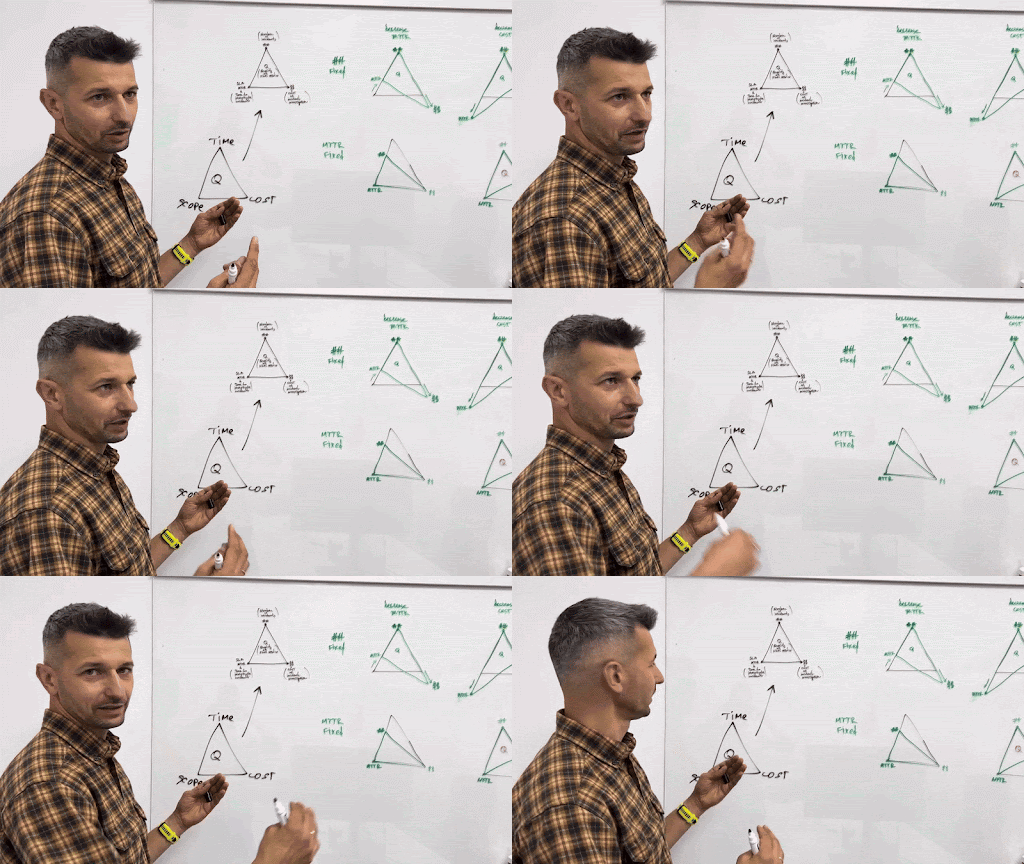
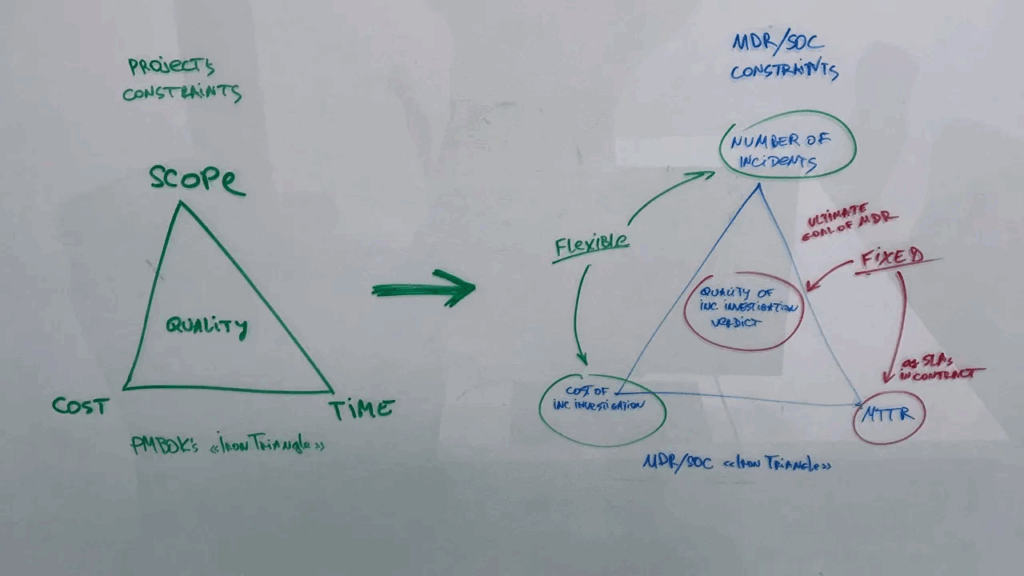
The Iron Triangle is the simplest way to explain SOC/MDR unit economics without inventing new jargon: swap project constraints for operational ones and you get an intuitive model for trade-offs.
Mapping the Iron Triangle to SOC Reality
Here’s how traditional project management constraints translate to SOC operations:
- Scope = incident throughput per shift
- Time = MTTR and MTTD, bound by SLAs
- Budget = cost per investigation (technology to prep signals + human time to reach a verdict)
- Quality = confidence in the final verdict (risk of missing or misclassifying an attack)
From here, you can reason about your SOC’s health, test hypotheses, and make decisions without magical thinking.
Understanding the Trade-Offs: Three Common Scenarios
Case 1: Scope Rockets to the Sky
Quality and Time are non-negotiable. So Budget becomes your only lever: hire more analysts immediately to stabilize response, then deliberately reduce Scope. Conduct the post-mortem, tune detections, suppress noisy alerts that don’t reduce visibility, and adjust telemetry. The point isn’t heroics—it’s restoring balance and preventing a repeat.
Case 2: The Customer Demands Faster Response on Critical True Positives
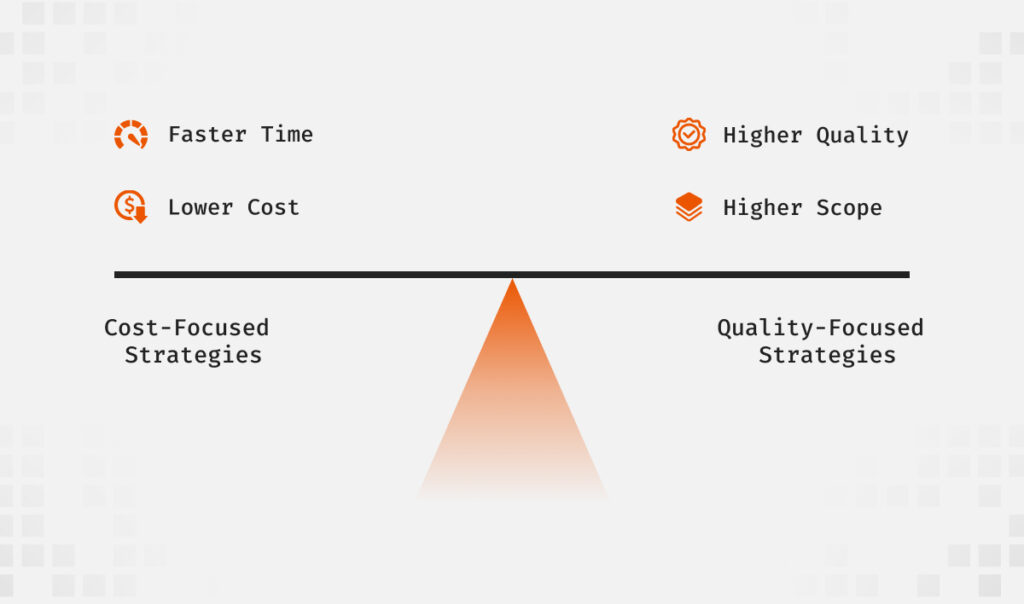
If Quality stays fixed, your choices are to increase Budget (more or more senior analysts, better automation, faster enrichment) or decrease Scope (fewer incidents reaching humans via better filtering and prioritization). Don’t pretend a third option exists—speed without resources is a Quality tax in disguise.
Case 3: The Customer Wants to Lower Budget Without Touching Quality
Reduce Scope. You might dream of shaving Time, but forcing analysts to use “thinking fast” when “thinking slow” is required increases cognitive error and raises risk. If you won’t pay more and won’t accept lower certainty, you must send fewer, better-prepared incidents to human review.
Want to Know What You’re Paying for?
Use this SOCaaS pricing guide to get smarter with numbers.
Breaking Down Each Constraint
Quality: The Non-Negotiable Foundation
The essence of investigation is a human final verdict—a cognitive, pattern-recognition act closer to Sherlock Holmes than spreadsheet math. Evidence volume doesn’t guarantee insight; wrong assumptions and misdirection do exist. A confident verdict is the first non-negotiable. That means experienced analysts, plus enough time and high-quality evidence to reason correctly.
Time: Your Operational Guardrail
The second non-negotiable. SLAs exist because attacks are live now, not in three days. MTTR and MTTD are both operational guardrails and self-defense mechanisms. A well-reasoned verdict that arrives too late is functionally a failure.
Budget: The Equilibrium Between Tech and Humans
Treat Budget as the sum of two parts:
- Technology costs: ingesting, normalizing, enriching signals to produce high-quality evidence
- Human costs: analysis time to reach a verdict
Humans must stay in the loop for critical decisions until Artificial General Intelligence (AGI) meaningfully exists (and is trustworthy). Senior analysts are expensive because they produce better, more reliable verdicts. Your job is to minimize their time-in-loop without degrading Quality. That pushes you to invest in automation that lifts evidence quality upfront—contextual enrichment, correlation, deduplication, triage scaffolding—not vanity dashboards.
Calibrate the tech-human equilibrium to your needs, and be explicit about the trade-off. There is always an equilibrium, never a free lunch.
Scope: Your Most Flexible Lever
Scope is your most flexible adjustment—if you manage it intentionally. As SOC lead, you—not the customer—decide which telemetry is necessary to meet visibility requirements. Onboarding and post-onboarding are continuous processes: verify sources, regulate throughput, and retire data that adds noise but no signal.
“Collect everything” is a proven path to alert fatigue and ballooning storage costs. What you actually want is “just enough, high-quality data” that helps an analyst reach a quick, correct verdict.
The Bottom Line: How to Use the Trade-Offs Framework
Here’s your decision matrix:
- When incidents spike: Lock Quality and Time, raise Budget fast, then train Scope back downward
- When speed matters: Either spend more (humans and automation) or send fewer incidents through the human layer
- When money gets tight but certainty can’t drop: Scope is your friend—cut the noise, not the signal
The metaphor isn’t perfect, but it’s good enough. PMBOK’s Iron Triangle is familiar territory, and it frames MDR/SOC trade-offs in a way managers instinctively understand. Use it to keep your monitoring system in balance and your verdicts both timely and right.
There’s no free lunch in SOC operations—only deliberate, informed trade-offs.
Let’s boost your SOC performance
Reduce the burden of tiresome alerts with SOC co-pilot and human-driven MDR.
Frequently Asked Questions
1. What is the Iron Triangle in the context of SOC and MDR?
The Iron Triangle is a concept adapted from project management—encompassing Scope, Time, and Budget, with Quality as the central element—to address security operations. In SOC and MDR environments, it underscores the inherent trade-offs: achieving everything simultaneously is impossible without concessions. Map it to operational elements such as incident volume (Scope), response speed (Time/MTTR), expenses (Budget), and verdict confidence (Quality) for a robust framework that promotes balance without relying on unrealistic expectations.
2. How should I manage a sudden increase in incidents?
Prioritize Quality and Time as non-negotiable priorities for maintaining effective security. Temporarily increase Budget (e.g., by onboarding additional analysts), then conduct a thorough postmortem to refine detections, eliminate noisy alerts, and optimize telemetry, thereby reducing Scope sustainably. Avoid reactive heroics; focus on restoring equilibrium to prevent recurrence.
3. What if a customer requires faster MTTR without additional investment?
In such cases, maintain transparency: With Quality held constant, options include elevating Budget (through advanced tools or experienced personnel) or contracting Scope (via improved filtering to direct fewer incidents to human review). Pursuing speed without resources inevitably erodes Quality, potentially leading to overlooked threats or inaccuracies.
4. Is it possible to reduce SOC costs without compromising quality?
Yes, by strategically managing Scope. Avoid accelerating verdicts, as this heightens error risks. Instead, prioritize essential, high-fidelity telemetry, suppress extraneous noise, and ensure only well-prepared incidents reach analysts. This approach emphasizes efficiency over hasty measures.
5. How does automation integrate into the Iron Triangle model?
Automation serves as a Budget optimization strategy: Allocate resources to technologies that enhance signal quality upfront (e.g., through correlation, enrichment, and triage) to reduce human involvement without diminishing Quality. Calibration is key—overdependence may introduce vulnerabilities, while underutilization inflates costs. Always articulate the associated trade-offs clearly.
6. Is Scope the most adaptable constraint?
Indeed, when approached methodically. As the SOC leader, you determine the telemetry essential for visibility, independent of customer input. Continuously validate sources, regulate volume, and eliminate low-value data that contributes to noise and inflated costs. Eschew a “collect everything” mindset, which fosters alert fatigue; instead, target precise, high-quality data to facilitate swift, accurate decisions.