




Q1. What Is AI-Powered Risk Management and Why Is 2026 Its Defining Year?
Every enterprise now runs dozens of AI-powered applications, and most have no structured way to manage the risks those systems create. AI-powered risk management is the discipline of using machine learning, NLP, predictive analytics, and agentic AI to identify, assess, predict, and mitigate enterprise risks in real time, while simultaneously governing the risks that AI systems themselves introduce.
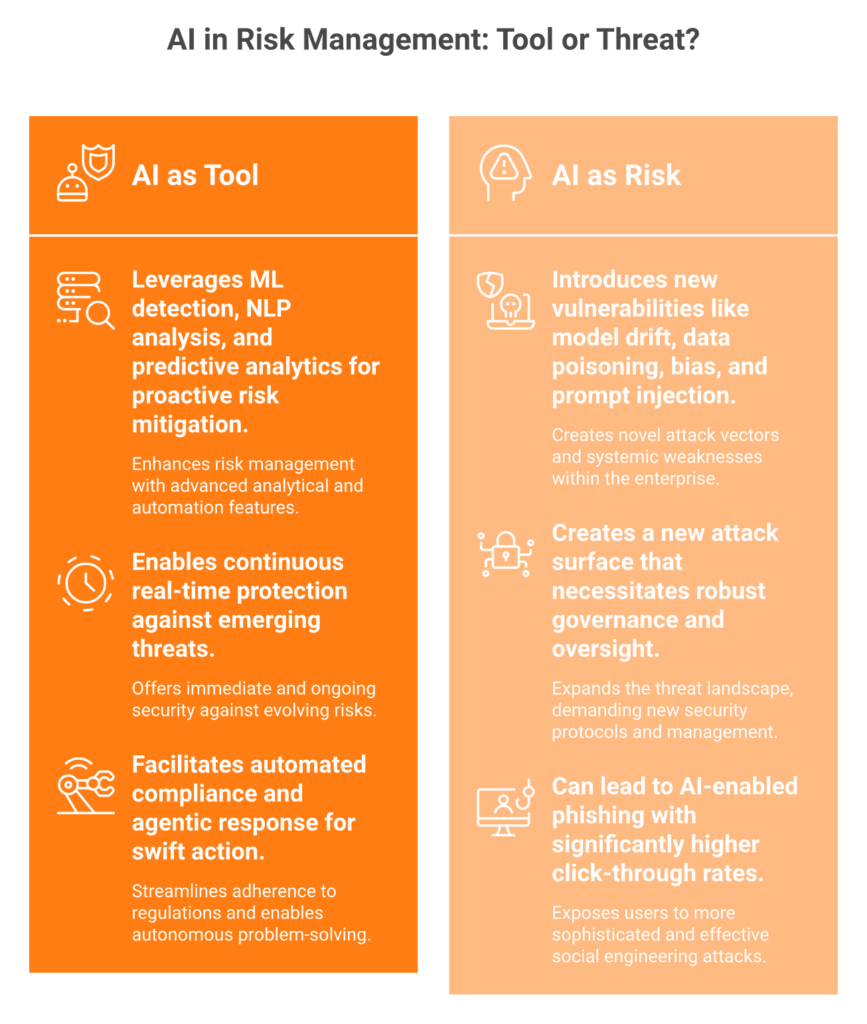
Here is the critical framing most articles miss: AI is both your most powerful risk management tool and your newest category of risk. You cannot separate those two realities. The EU AI Act’s full enforcement hits August 2, 2026. NIST released its AI RMF Critical Infrastructure profile concept note on April 7, 2026, targeting energy, water, healthcare, and financial services. Shadow AI is proliferating inside organizations faster than governance teams can inventory it. If your risk management program still runs on quarterly reviews and static spreadsheets, you are architecturally incapable of keeping pace.
⚠️ Why Legacy Risk Management Can’t Keep Up
AI-enabled phishing now achieves a 54% click-through rate compared to ~12% for traditional phishing, a 4.5x increase driven by AI’s ability to craft targeted, contextually convincing lures. That speed gap illustrates the core problem: traditional risk management detects what happened last quarter. AI-powered risk management detects what is happening now.
| Dimension | Traditional Risk Management | AI-Powered Risk Management |
|---|---|---|
| Review cadence | Quarterly or annual | Continuous, real-time |
| Detection method | Rule-based alerts, static thresholds | Behavioral anomaly detection, ML scoring |
| Risk registers | Manual spreadsheets, periodic updates | Dynamic, auto-populated from live telemetry |
| Compliance approach | Checkbox audits | Automated evidence generation mapped to frameworks |
| Incident response | Investigate after escalation | Predict, contain, and respond in parallel |
| Data processing | Structured data only | Structured + unstructured (NLP, computer vision) |
📊 The AI Risk Management Maturity Model: Where Does Your Organization Stand?
Most organizations operate at Level 2, where they have some automated alerts with static thresholds, but AI is not truly integrated into risk decisions. Here’s the 5-level diagnostic:
Level 1 (Manual): Spreadsheet-based risk registers, periodic audits, and compliance-checkbox mentality. Risk is assessed retroactively.
Level 2 (Rule-Based): Automated alerts using static thresholds and simple rule engines. SIEM generates volumes of alerts that overwhelm analysts.
Level 3 (AI-Assisted): ML models augment human analysts for anomaly detection and risk scoring. Humans still triage everything, but AI helps prioritize.
Level 4 (AI-Driven): AI handles most risk triage, classification, and enrichment autonomously. Human oversight focuses on escalations and strategic decisions.
Level 5 (Autonomous): Agentic AI systems conduct cross-domain risk intelligence, self-healing compliance, and prescriptive mitigation with minimal human intervention.
✅ Operating at Level 4: Detection + Response + Context
At UnderDefense, we built the UnderDefense MAXI platform to operate at Level 4, because that’s where the operational sweet spot lives today. AI handles the triage, classification, and enrichment across 250+ vendor-agnostic integrations with 96% MITRE ATT&CK coverage. Our concierge analysts provide the human judgment layer, verifying suspicious activity directly with affected users via Slack or Teams rather than just escalating tickets into a queue.
Detection without response is noise. Response without context is risk. The maturity model above tells you where you are. The gap between your current level and Level 4 is where breaches live, and 91% of ML models widen that gap over time without continuous monitoring.
Q2. What Core Technologies and Capabilities Power Modern AI Risk Management?
AI-powered risk management is not one technology. It is seven complementary pillars that, when orchestrated correctly, deliver nine measurable capabilities. The mistake most organizations make is adopting a single pillar (usually ML anomaly detection) and calling it “AI risk management.” That is like building a SOC with only an EDR and no SIEM, no identity telemetry, and no cloud visibility. You see fragments, not the full picture.
🔧 The 7 Technology Pillars
Machine Learning (ML) — Supervised and unsupervised models for pattern recognition and anomaly detection. This is the foundation: behavioral analytics detecting insider threats, credit scoring models identifying default risk, and clustering algorithms spotting unusual transaction patterns that rule-based systems miss entirely.
Natural Language Processing (NLP) — Processing unstructured data at scale: regulatory document scanning, contract risk clause extraction, threat intelligence parsing from dark web sources, and sentiment analysis on customer communications. NLP turns the 80% of enterprise data that’s unstructured into actionable risk signals.
Predictive Analytics — Risk forecasting, scenario modeling, and early warning systems. Rather than telling you what risk materialized, predictive models tell you what risk is likely to materialize based on converging signals.
Robotic Process Automation + AI (RPA+AI) — Automated compliance workflows, evidence collection, control testing, and audit trail generation. RPA handles the repetitive mechanics; AI handles the judgment calls within those workflows.
Advanced Pillars: Vision, GenAI, and Agentic Systems
Computer Vision — Document verification for KYC/AML, surveillance analysis, manufacturing quality inspection via image classification, and insurance claims photo analysis for fraud indicators.
Generative AI — Automated risk reporting, scenario simulation drafts, compliance documentation generation, and board-ready narrative summaries. GenAI turns raw data into human-consumable risk insights at speed.
Agentic AI & Multi-Agent Systems — This is the frontier. Autonomous agents that can conduct cross-domain risk intelligence, coordinate multi-step remediation workflows, and take containment actions without waiting for human approval on routine decisions. Multi-agent architectures use tool-use orchestration so one agent handles identity risk, another monitors network anomalies, and a coordination layer synthesizes their findings. The governance challenge is real: agents can compound errors faster than humans can intervene, which is why least-privilege permissions, kill switches, and immutable audit logs are non-negotiable.
⭐ The 9 Capabilities These Technologies Enable
| Capability | Primary Technology Pillars | Measurable Impact |
|---|---|---|
| Real-time risk detection | ML, Agentic AI | Continuous vs. quarterly monitoring |
| Predictive risk prevention | Predictive Analytics, ML | Early warnings before risk materializes |
| Unstructured data processing | NLP, Computer Vision | 80%+ of enterprise data now analyzable |
| Automated compliance | RPA+AI, GenAI | Audit evidence generated in hours, not weeks |
| Human error reduction | ML, RPA+AI | Consistent scoring without cognitive bias |
| Cost efficiency & ROI | All pillars combined | 4-8x ROI on platform investment |
| Cybersecurity threat detection | ML, NLP, Agentic AI | Behavioral anomaly detection across full stack |
| Scalability across business units | Cloud-native AI, RPA | Global deployment without proportional headcount |
| Fraud detection & financial crime prevention | ML, NLP, Computer Vision | 60-80% false positive reduction |
✅ How We Orchestrate the Stack
At UnderDefense, the UnderDefense MAXI platform integrates signals from EDR, SIEM, identity, cloud, and SaaS into a single AI-driven detection and response layer, combining ML anomaly detection, NLP threat intelligence extraction, and human analyst judgment. The real power is not individual technologies but their orchestration through a unified platform with analysts who understand your organizational context, because an anomaly without context is just another alert in the queue.
Q3. How Does AI Transform Each Phase of the Risk Management Lifecycle?
Most organizations manage risk at exactly one lifecycle point: either pre-deployment (assess and hope) or post-incident (investigate and blame). Neither approach works when AI-era threats move continuously and models degrade over time without anyone noticing. The real operational shift is from periodic to continuous, covering all six phases simultaneously with AI embedded at every step.
🔄 The 6-Phase AI-Powered Risk Lifecycle
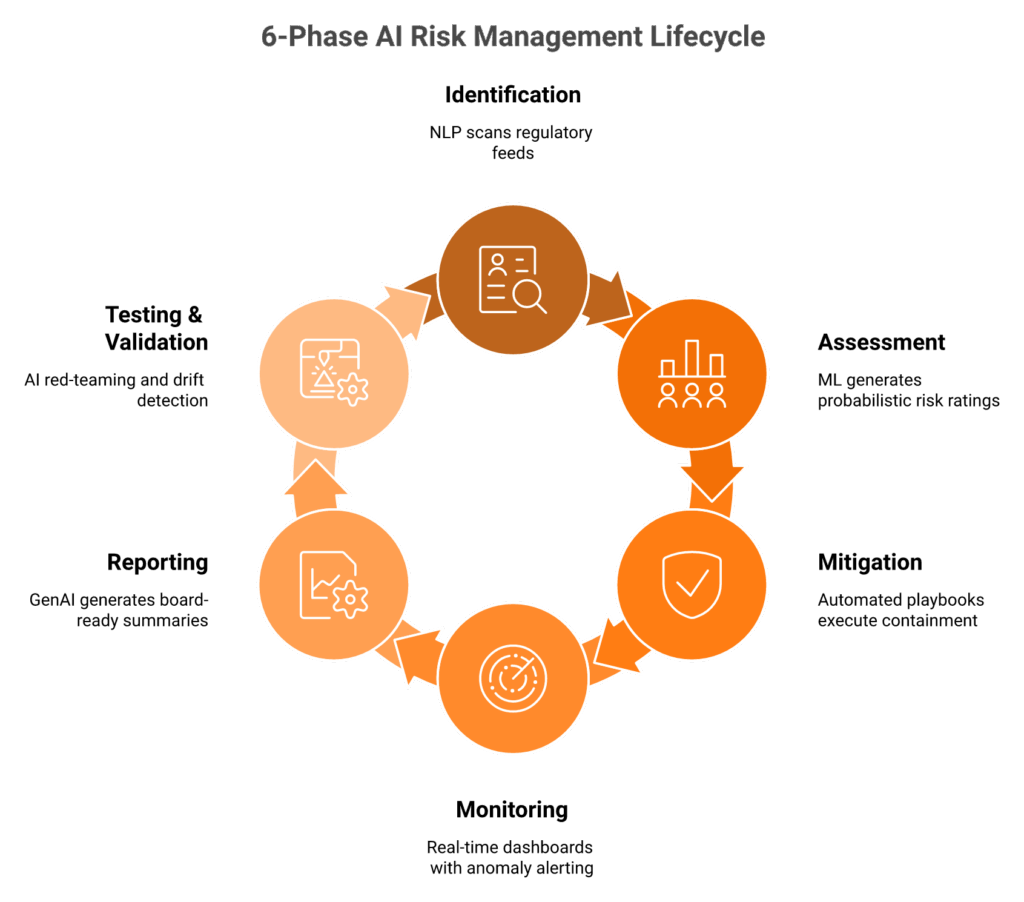
Phase 1: Risk Identification (NIST AI RMF → MAP)
AI-generated process flows scan the environment to surface emerging risks before humans even know to look. NLP crawls regulatory change feeds across jurisdictions to flag new compliance requirements automatically. Threat intelligence feeds populate risk registers dynamically rather than waiting for the quarterly review.
Phase 2: Risk Assessment (NIST AI RMF → MEASURE)
ML models generate probabilistic risk ratings with confidence scores, replacing the subjective “high-medium-low” matrices that provide false precision. Dynamic key risk indicators (KRIs) update as conditions change, and scenario-based impact modeling simulates how risks cascade across business units.
Phase 3: Risk Mitigation (NIST AI RMF → MANAGE)
Automated response playbooks execute containment actions within seconds of confirmed threats. Reinforcement learning optimizes control effectiveness over time, and AI recommends risk transfer strategies (insurance, contractual allocation) based on quantified residual risk.
Phases 4-6: Where Most Programs Fail
Phase 4: Risk Monitoring (NIST AI RMF → MEASURE)
Real-time dashboards with anomaly alerting replace periodic check-ins. Dynamic risk models update as telemetry shifts, not as analysts manually refresh reports. Continuous control effectiveness tracking ensures that the controls you deployed last month still work today.
Phase 5: Risk Reporting (NIST AI RMF → GOVERN)
GenAI generates board-ready executive summaries from raw incident data, performs thematic analysis across risk trends, and produces natural language narratives that non-technical stakeholders can actually act on.
Phase 6: Testing & Validation
AI-driven control effectiveness checks, red-teaming simulations, adversarial testing of ML models, and drift detection (concept drift, prediction drift, data drift) ensure your defenses evolve as threat actors adapt.
📋 Lifecycle-to-NIST AI RMF Mapping
| Lifecycle Phase | NIST AI RMF Function | Key AI Technologies | Example Deliverable |
|---|---|---|---|
| Identification | MAP | NLP, Threat Intel AI | Auto-populated risk register |
| Assessment | MEASURE | ML, Predictive Analytics | Probabilistic risk matrix with confidence scores |
| Mitigation | MANAGE | RPA+AI, Reinforcement Learning | Automated containment playbooks |
| Monitoring | MEASURE | ML Anomaly Detection, Agentic AI | Real-time anomaly dashboards |
| Reporting | GOVERN | GenAI, NLP | Board-ready risk narrative |
| Testing & Validation | (Cross-functional) | Adversarial ML, Drift Detection | Model drift report, red-team findings |
✅ Operationalizing Phases 4-6
Here is the operational truth: Phases 4 through 6 (monitoring, reporting, and testing) are where most organizations fail. Not because they lack the technology, but because these phases require 24/7 operational capacity that internal teams rarely sustain. At UnderDefense, we built the AI SOC + Human Ally model specifically for this gap. Continuous AI-driven monitoring with a documented 2-minute alert-to-triage and 15-minute escalation for critical incidents, automated incident reporting that maps directly to compliance frameworks, and ongoing detection tuning that validates controls in real time. Most organizations struggle here because they treat these phases as periodic projects rather than continuous operations.
Q4. Where Is AI Risk Management Delivering Real-World Results Across Industries?
💰 Financial Services: The Fraud Detection Deep Dive
Picture this scenario, because it happens more than you would think. A financial services CISO receives 3,400 fraud alerts per week from their rule-based system. Ninety-four percent are false positives. The real fraud, a $2.3M synthetic identity ring, sat buried in alert noise for 11 days before anyone noticed. By then, the funds had moved through three jurisdictions and vanished.
The AI fraud detection architecture that prevents this operates across five layers: real-time transaction scoring using ML models trained on behavioral baselines, behavioral biometrics (keystroke dynamics, device fingerprinting), graph neural networks mapping relationship patterns across accounts, NLP scanning for document fraud in KYC submissions, and ensemble models combining supervised and unsupervised approaches for adaptive detection. The operational outcome: AI reduces false positives by 60-80% and detects fraud patterns 50% faster than rule-based systems, while automating AML/KYC compliance workflows that previously consumed analyst hours.
🏥 Healthcare, Manufacturing & Supply Chain
Healthcare — Patient risk prediction models reduce hospital readmission rates by up to 25%. Claims fraud detection saves the U.S. healthcare system an estimated $8B+ annually. HIPAA compliance automation through AI-driven audit evidence generation transforms what used to be a multi-week audit prep into a continuous process.
Manufacturing — Predictive maintenance models reduce unplanned downtime by 30-50% by analyzing vibration, temperature, and operational telemetry. Computer vision systems inspect product quality at speeds impossible for human inspectors, catching defects that would otherwise reach customers.
Retail & Supply Chain — Disruption prediction using satellite imagery, weather data, and shipping telemetry gives procurement teams early warning. AI-driven inventory optimization correlates demand signals with risk signals, and vendor risk scoring continuously evaluates supplier cybersecurity and financial health.
🛡️ Insurance, Cybersecurity, Legal & Beyond
Insurance — AI claims analysis detects fraudulent patterns across submissions at scale. Dynamic underwriting models adjust premiums based on real-time risk signals, and geospatial AI models climate exposure for property portfolios.
Cybersecurity — AI-driven threat detection, insider threat behavioral analytics, vulnerability prioritization based on exploitability and business impact, and automated incident response are now operational necessities, not luxuries.
Legal & Compliance — NLP monitors regulatory changes across 190+ jurisdictions. Contract risk analysis extracts liability clauses automatically, and litigation outcome prediction models help legal teams allocate resources.
Reputation & Strategic Planning — Real-time sentiment analysis provides brand risk early warning, while scenario modeling supports M&A risk assessment and market entry decisions.
✅ How UnderDefense Delivers Across Verticals
We serve healthcare organizations (like the German Healthcare Leader that scaled its security team through our MDR), financial institutions (like the Merchant Bank that trusted us for incident response and post-breach recovery), and technology companies (like AirSlate), all through the same unified AI SOC + Human Ally model. The architecture does not change by industry. Vendor-agnostic integration, AI-driven anomaly detection, and concierge analysts who verify suspicious activity directly with affected users before escalation.
“Not having to worry about ransomware, alert overload and reporting. Getting a clear view of my security posture, where the threats are coming from and how they are handled. They literally took care of all our problems.”
— Arlin O., CIO, Enterprise UnderDefense G2 – Verified Review
“UnderDefense MAXI integrates well with our systems, specifically with our SIEM, Splunk. Their team is proactive in identifying and addressing threats, providing 24/7 oversight.”
— Oleg K., Director Information Security UnderDefense G2 – Verified Review
“Underdefense is a great choice for teams like ours that are short on resources. It automates many tasks, plus, with 24/7 monitoring, we know we’re always protected. I used to work with many MDR solutions in the past, and so far Underdefense is the best one!”
— Inga M., CEO UnderDefense G2 – Verified Review
We maintain a 100% ransomware prevention record across 500+ MDR clients spanning healthcare, financial services, and technology, because industry-specific risk management still requires the same architectural foundation: AI detection + human verification = confirmed threats, not alert fatigue.
Q5. Which Regulatory Frameworks and Compliance Standards Govern AI Risk in 2026?
The regulatory landscape for AI risk management in 2026 is no longer theoretical. It is enforceable. If you are running AI systems in any capacity and have not mapped your compliance obligations, the window is closing fast. Here is the practitioner’s breakdown of what actually matters, how the frameworks layer together, and where the real compliance gaps hide.
📋 NIST AI Risk Management Framework: The Operational Foundation
The NIST AI RMF 1.0, released in January 2023, remains the most widely referenced voluntary framework for managing AI risks in the United States. Its four core functions provide the structural backbone:
GOVERN — Establish AI risk policies, define roles and accountability structures, cultivate organizational risk culture, and set oversight mechanisms. GOVERN is unique because it applies across all lifecycle stages, not just deployment.
MAP — Contextualize AI systems within their operational environment, identify stakeholders, map potential impacts, and categorize systems by risk level. This is where most organizations discover shadow AI they did not know existed.
MEASURE — Quantify risks using metrics, benchmarks, and testing. Assess trustworthiness characteristics: validity, reliability, safety, security, resilience, accountability, transparency, explainability, privacy-enhancement, and fairness.
MANAGE — Prioritize, respond to, and monitor identified risks. Allocate resources and implement mitigation controls.
⚠️ On April 7, 2026, NIST released a new concept note for an AI RMF Profile specifically targeting trustworthy AI in critical infrastructure, covering energy, water, healthcare, and financial services. This is a significant expansion that no competitor content has covered yet, and it signals that sector-specific AI governance is accelerating.
🏛️ EU AI Act: The August 2026 Enforcement Deadline
The EU AI Act’s risk-based classification system creates four tiers: unacceptable risk (banned), high risk (strict requirements), limited risk (transparency obligations), and minimal risk (voluntary codes of conduct).
The critical date is August 2, 2026, when full obligations for high-risk AI systems under Annex III take effect. High-risk categories include AI used in biometrics, critical infrastructure, education, employment, credit scoring, law enforcement, migration, and administration of justice. The penalty structure exceeds even GDPR:
❌ Prohibited AI practices: Up to €35M or 7% of global turnover
❌ High-risk non-compliance: Up to €15M or 3% of global turnover
❌ Providing incorrect information: Up to €7.5M or 1.5% of global turnover
ISO/IEC 42001 layers on top as the certifiable AI management system standard. Where NIST provides prescriptive guidance, ISO 42001 provides a certifiable management system. Organizations pursuing both create the strongest governance posture: NIST tells you what to do, and ISO certifies that you did it.
🗺️ Industry-to-Regulation-to-Tool Mapping
| Industry | Primary Regulations | AI-Specific Requirements | Key Compliance Tool Capabilities |
|---|---|---|---|
| Financial Services | SOX, PCI-DSS, GLBA | AI credit scoring fairness, AML automation | Model monitoring, bias detection, audit trails |
| Healthcare | HIPAA, HITRUST | AI processing PHI, clinical decision support | Data encryption, access controls, consent tracking |
| Technology/SaaS | SOC 2, GDPR, CCPA | AI profiling rights, data training governance | Compliance evidence automation, data mapping |
| Insurance | State regulations, NAIC | AI underwriting models, claims automation | Explainability documentation, fairness testing |
| Manufacturing | EU Machinery Regulation | AI safety systems, predictive maintenance | Risk assessment documentation, testing evidence |
✅ Compliance Built Into Detection and Response
At UnderDefense, we build compliance automation into the same platform that detects and responds to threats. The UnderDefense MAXI platform generates audit evidence mapped to NIST AI RMF functions, EU AI Act documentation requirements, and sector-specific standards, with forever-free compliance kits covering SOC 2, HIPAA, and ISO 27001. Regulatory compliance should not require a separate tool, a separate team, or a separate budget line.
Q6. What Risks and Challenges Do AI Systems Introduce, and What Can We Learn from Failures?
Here is the uncomfortable truth that most AI risk management content avoids: AI systems introduce entirely new categories of risk that traditional security and GRC tools were never designed to handle. If you are treating AI risk the same way you treat IT risk, you are building on a foundation that will crack under pressure. Let me walk through the taxonomy, the implementation barriers, and the failures that teach us the most.
⚠️ The 5-Category AI Risk Taxonomy
| Risk Category | Specific Threats | Impact Level | Mitigation Approach |
|---|---|---|---|
| Data Risks | Training data poisoning, privacy violations, data integrity issues, unauthorized data access | Critical | Data governance frameworks, access controls, provenance tracking |
| Model Risks | Adversarial attacks, prompt injection, model drift (concept, prediction, data), hallucination, bias, overfitting | High-Critical | Continuous model monitoring, red-teaming, drift detection |
| Operational Risks | Integration failures, shadow AI proliferation, sustainability/energy costs, accountability gaps | High | AI inventory management, governance policies, integration testing |
| Ethical & Legal Risks | Algorithmic bias, transparency gaps, explainability failures, consent violations | High | XAI tooling, bias audits, fairness metrics, regulatory mapping |
| Supply Chain Attacks | Compromised model repositories, poisoned training datasets, malicious AI development tools | Critical | Supply chain verification, model provenance, code signing |
🤖 Agentic AI: The Frontier Risk Nobody Is Governing
Agentic AI represents the most consequential emerging risk category, and most organizations have zero governance around it. The specific dangers include cascading failure across multi-agent workflows where one agent’s error compounds through downstream agents, permission creep where agents accumulate access beyond their intended scope, prompt injection attacks that manipulate agent behavior, and fundamental accountability gaps when autonomous agents cause harm.
The governance requirements are non-negotiable: least-privilege permission models for every agent, explicit tool-use policies defining what agents can and cannot do, kill switches and circuit breakers that halt agent operations when thresholds are exceeded, immutable audit trails that log every agent decision and action, and human approval gates for any high-impact action.
❌ The 7 Implementation Barriers
- Data quality and governance — AI is only as accurate as its training data. Garbage in, garbage out is not a cliché. It is a daily operational reality.
- The black box problem — Explainable AI (XAI) is not optional when regulators require you to explain how decisions are made. The EU AI Act mandates transparency for high-risk systems.
- Algorithmic bias — If you cannot detect, measure, and mitigate bias continuously, you are one audit away from a regulatory action.
- Legacy system integration — Technical debt makes AI deployment exponentially harder when your infrastructure was built for a different era.
- High implementation costs — Mid-market companies struggle to justify AI risk management spend without clear ROI frameworks.
- Overreliance on AI — Human-in-the-loop oversight is not a luxury. It is a regulatory requirement and an operational necessity.
- Regulatory uncertainty — Frameworks are still evolving, creating compliance moving targets that consume legal and risk team bandwidth.
💡 Lessons from Real-World Failures
Consider the pattern: a financial institution deploys an ML-based fraud detection model that performs well in testing. Over six months, transaction patterns shift. The model’s precision degrades (concept drift) and false negatives increase by 40%. The $2.3M synthetic identity ring that the model should have caught passes through undetected for 11 days. The governance control that was missing? Continuous model monitoring with automated drift detection alerts.
Or take the credit scoring case: an AI model trained on historical lending data encodes decades of demographic bias. The model was technically accurate, as it predicted defaults well, but it systematically disadvantaged protected classes. The regulatory response was swift and expensive. The missing control? Bias testing integrated into the model validation pipeline, not added as an afterthought.
✅ Operational Mitigation Through AI SOC + Human Ally
The organizations that fail at AI risk management are not the ones that lack AI tools. They are the ones that lack the human judgment layer to interpret what the AI finds. At UnderDefense, our AI SOC addresses the top three implementation challenges simultaneously: vendor-agnostic integration solves legacy system barriers, AI-driven detection with human analyst verification eliminates overreliance risk, and continuous monitoring catches model drift before it becomes a breach.
Q7. What Are the Top AI Risk Management Platforms for 2026 and How Do You Choose the Right One?
With 30+ AI governance and risk management platforms available, the wrong choice creates more tool sprawl, which is exactly what AI risk management should solve. Most selection processes optimize for feature count or brand recognition rather than operational effectiveness. Here is a vendor-neutral evaluation methodology, followed by platform assessments that reveal which tools actually deliver.
🔍 The 8-Criteria Evaluation Scorecard
| Criterion | Weight | What to Evaluate |
|---|---|---|
| Integration breadth & vendor-agnosticism | 15% | How many existing tools it connects with natively |
| Real-time detection vs. periodic assessment | 15% | Continuous monitoring or scheduled scans? |
| Response capability (detection-only vs. full remediation) | 15% | Does it contain threats or just report them? |
| Compliance automation | 10% | Auto-generated evidence mapped to frameworks |
| Human analyst access & escalation model | 15% | Dedicated analysts or ticket-based support? |
| Pricing transparency & predictability | 10% | Published pricing or “contact sales”? |
| Time-to-value / onboarding speed | 10% | Days to operational, not months |
| AI governance depth (model monitoring, bias, XAI) | 10% | Does it govern AI systems themselves? |
⭐ Platform Deep Dives
1. UnderDefense MAXI — AI SOC + Human Ally platform combining AI-driven threat detection with 250+ vendor-agnostic integrations, 24/7 concierge analyst response, 2-minute alert-to-triage and 15-minute escalation for critical incidents, 96% MITRE ATT&CK coverage, and forever-free compliance automation (SOC 2, HIPAA, ISO 27001). Transparent pricing at $11–15/endpoint/month. 30-day onboarding. Best for: Organizations needing unified detection, response, AND compliance in one operational layer.
2. IBM OpenPages with Watson — Enterprise GRC platform with Watson-powered cognitive services for classifying unstructured risk and compliance data. Strong for large organizations managing multiple risk domains at scale. Limitation: Complex implementation, enterprise-only pricing, limited real-time threat detection.
3. SAS Risk Management — Advanced analytics platform built for financial institutions. Excels at credit risk modeling, scenario simulation, and regulatory capital calculation. Limitation: Narrow industry focus, steep learning curve, requires dedicated data science resources.
4. Palantir Foundry — Designed for complex data environments and systemic risk analysis. Strong at ingesting and correlating massive datasets across organizational silos. Limitation: High cost, government/enterprise positioning, significant implementation effort.
5. FICO AI — Financial crime prevention and real-time decisioning platform. Industry standard for credit scoring, fraud detection, and AML. Limitation: Financial services-focused, less applicable to broader enterprise risk management.
6. Microsoft Azure AI Risk Tools — Cloud-native AI governance for Microsoft ecosystem organizations. Integrates with Azure ML, Responsible AI dashboard, and Purview. Limitation: Ecosystem lock-in, limited value for multi-cloud or non-Microsoft environments.
7. AccuKnox AI-SPM — Zero-trust AI security with LLM prompt defense, AI red teaming, and 30+ compliance maps. Strong Kubernetes and cloud integration. Limitation: Narrowly focused on AI workload security, not full enterprise risk management.
8. Centraleyes — No-code AI risk registers with automated compliance mapping. Good for mid-market organizations seeking fast deployment. Limitation: Limited response capabilities, assessment-focused rather than operational.
9. LogicManager — Enterprise risk management with “ripple analytics” showing risk interdependencies. Strong for GRC programs needing board-level reporting. Limitation: Not a detection/response platform; requires separate security tooling.
10. Credo AI — Responsible AI governance with policy management, risk scoring, and fairness tools. Focused on ethical AI development and compliance tracking. Limitation: Governance-only, no threat detection or incident response capability.
📊 Master Comparison
| Platform | Focus Area | Response Capability | Pricing Model | Ideal Use Case |
|---|---|---|---|---|
| UnderDefense MAXI | Unified detection + response + compliance | ✅ Full containment + remediation | $11–15/endpoint/month | Mid-market to enterprise needing operational security |
| IBM OpenPages | Enterprise GRC | ❌ Assessment-only | Enterprise licensing | Large-scale multi-domain risk management |
| SAS Risk Management | Financial risk analytics | ❌ Assessment-only | Enterprise licensing | Financial institutions, credit risk |
| Palantir Foundry | Complex data analytics | ❌ Analysis-only | Custom enterprise | Government, defense, systemic risk |
| FICO AI | Financial crime prevention | ✅ Real-time decisioning | Per-transaction | Banking, fraud detection |
| Microsoft Azure AI | Cloud-native AI governance | ❌ Governance-only | Azure consumption-based | Microsoft-native environments |
| AccuKnox AI-SPM | AI workload security | ✅ Runtime blocking | Usage-based | AI/ML infrastructure security |
| Centraleyes | Risk registers + compliance | ❌ Assessment-only | Subscription | Mid-market GRC programs |
| LogicManager | Enterprise risk management | ❌ Assessment-only | Per-user licensing | Board-level risk reporting |
| Credo AI | Responsible AI governance | ❌ Policy-only | Subscription | Ethical AI compliance tracking |
“The biggest win for me was getting actual control over our security alerts. Before the guys from UD stepped in, we were getting bombarded with alerts from all our security tools. Their team cleaned up our configurations and got the noise under control within the first week.”
— Verified User, Marketing and Advertising UnderDefense G2 – Verified Review
“Started out well but over the years the service has consistently not met expectations. The issues that we have experienced has greatly outweighed the benefits.”
— CISO, Manufacturing Arctic Wolf – Gartner Verified Review
“Rapid7 is a tool that does the job, however lacks in several aspects such as integrations, default rule set and asset association.”
— Manager, Project Management Rapid7 – Gartner Verified Review
The real question is not which platform has the most AI governance features but which one can detect threats, respond operationally, and generate compliance evidence in real time without adding another dashboard for your team to monitor.
Q8. How Should Enterprises Design a Human-AI Operating Model for Risk Teams?
Most enterprises have deployed AI risk tools but have not defined decision authority. The result is predictable: alert fatigue, diffused accountability, and critical findings sitting in dashboards for days while nobody owns the response. When human-AI handoffs are undefined, dwell time increases dramatically, not because the technology failed, but because the operating model never existed.
❌ The Two Failing Extremes
“Full Automation” models where AI makes all risk decisions lack contextual judgment, create false-positive cascading, and face regulatory pushback. The EU AI Act mandates human oversight for high-risk AI systems, so full automation is not just risky but non-compliant.
“Human Override Everything” models bottleneck on analyst availability, recreating the manual burden AI was supposed to eliminate. When your SOC analyst has to manually approve every alert triage decision, you have not adopted AI. You have added a layer.
Neither extreme scales. The answer is a tiered model with explicit decision authority boundaries.
🏗️ The Tiered Decision Authority Model
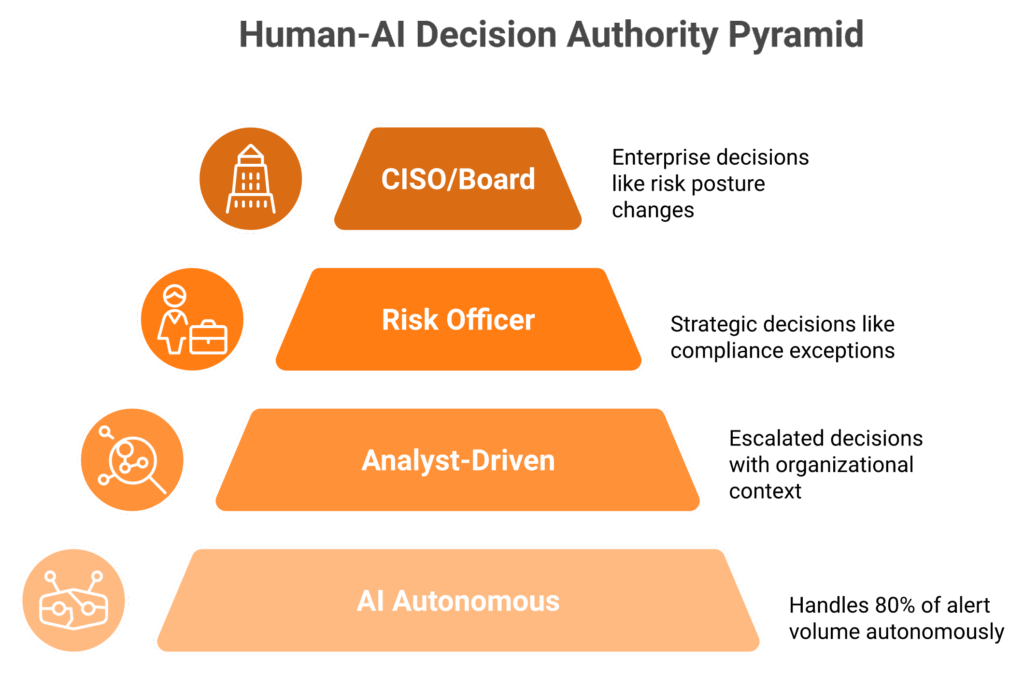
Tier 1 (AI Autonomous) — Routine risk triage, alert classification, enrichment, correlation, and known-pattern containment. AI handles 80%+ of alert volume without human intervention.
Tier 2 (Analyst-Driven) — Escalated decisions requiring organizational context: user verification, threat validation, and business impact assessment. This is where human judgment creates irreplaceable value.
Tier 3 (Senior Risk Officer) — Strategic decisions with regulatory or reputational impact: compliance exception approvals, model deployment decisions, and vendor risk acceptance.
Tier 4 (CISO/Board) — Enterprise risk posture decisions, policy changes, incident disclosure, and budget allocation.
📋 RACI Chart: Who Owns What
| Decision Type | AI System | SOC Analyst | Risk Officer | CISO | Board |
|---|---|---|---|---|---|
| Alert triage & classification | R/A | I | — | — | — |
| Threat containment | R | A | I | I | — |
| Compliance reporting | R | C | A | I | I |
| Policy changes | C | C | R | A | I |
| Vendor risk acceptance | C | — | R | A | I |
| Model deployment approval | C | — | R | A | — |
| Incident disclosure | I | C | R | R | A |
| Budget allocation | I | — | C | R | A |
R = Responsible, A = Accountable, C = Consulted, I = Informed
🎓 Reskilling + Prompt Engineering for Risk AI
The role evolution is already happening. Organizations need AI Risk Officers who understand both governance frameworks and model behavior, Model Risk Analysts who can evaluate drift and bias, and AI Ethics Leads who bridge compliance and engineering.
Practical prompt templates for risk management AI tools:
📝 “Model a supply chain disruption in Southeast Asia impacting our top 3 suppliers and score risk by revenue impact, probability, and time-to-recovery.”
📝 “Scan this policy document against NIST AI RMF GOVERN function requirements and identify compliance gaps with severity ratings.”
📝 “Evaluate this vendor’s AI system against EU AI Act high-risk classification criteria and generate a conformity assessment checklist.”
📝 “Analyze the last 90 days of access anomalies for privileged accounts and flag patterns consistent with insider threat indicators.”
📝 “Generate a board-ready risk summary from this quarter’s incident data, including trend analysis and recommended control improvements.”
✅ UnderDefense: The Operating Model in Practice
At UnderDefense, we have operationalized this tiered model. UnderDefense MAXI handles Tier 1 autonomously: triage, classification, enrichment, and known-pattern response. Dedicated concierge analysts handle Tier 2 with full organizational context via Slack and Teams, verifying directly with affected users. Your CISO reviews confirmed incidents, not alert queues.
“Underdefense act as an extension of our team, so we don’t need additional resources, ensuring 24/7 protection. It also solved our problem of having separate security tools that didn’t work well together. Now, everything is connected and easier to manage.”
— Inga M., CEO UnderDefense G2 – Verified Review
“We received little value from ArcticWolf. The product offered little visibility when we were using it… Anything you want to look at or changes you need to make in the product must go through their engineering team.”
— Matt C., Manager, Cybersecurity Services Arctic Wolf – G2 Verified Review
“Despite the capabilities of the technical platform and the strength of the analysts providing the service, there is still a limit to the environmental/organizational knowledge inherent in the service. This leads to a fairly frequent need for engagement with our internal team.”
— Verified User, Computer Software Expel – G2 Verified Review
Traditional MDR providers stop at detection and escalation, leaving Tier 2–4 decisions entirely to your team. The operating model that actually works, where AI handles the volume and humans handle the judgment, is not a theory. It is what we ship.
Q9. How Do You Calculate and Maximize ROI of AI-Powered Risk Management?
While 56% of CEOs report zero ROI from AI investments, the organizations that quantify returns rigorously are the ones that scale beyond pilot projects. The gap is not in the technology but in the measurement. Here is a practitioner’s framework for calculating AI risk management ROI that your CFO will actually approve.
💰 The 6-Dimension ROI Framework
Most ROI calculations focus on a single dimension: breach prevention. That misses five other categories where AI risk management creates measurable value. Here is the complete framework with formulas you can plug into a spreadsheet today:
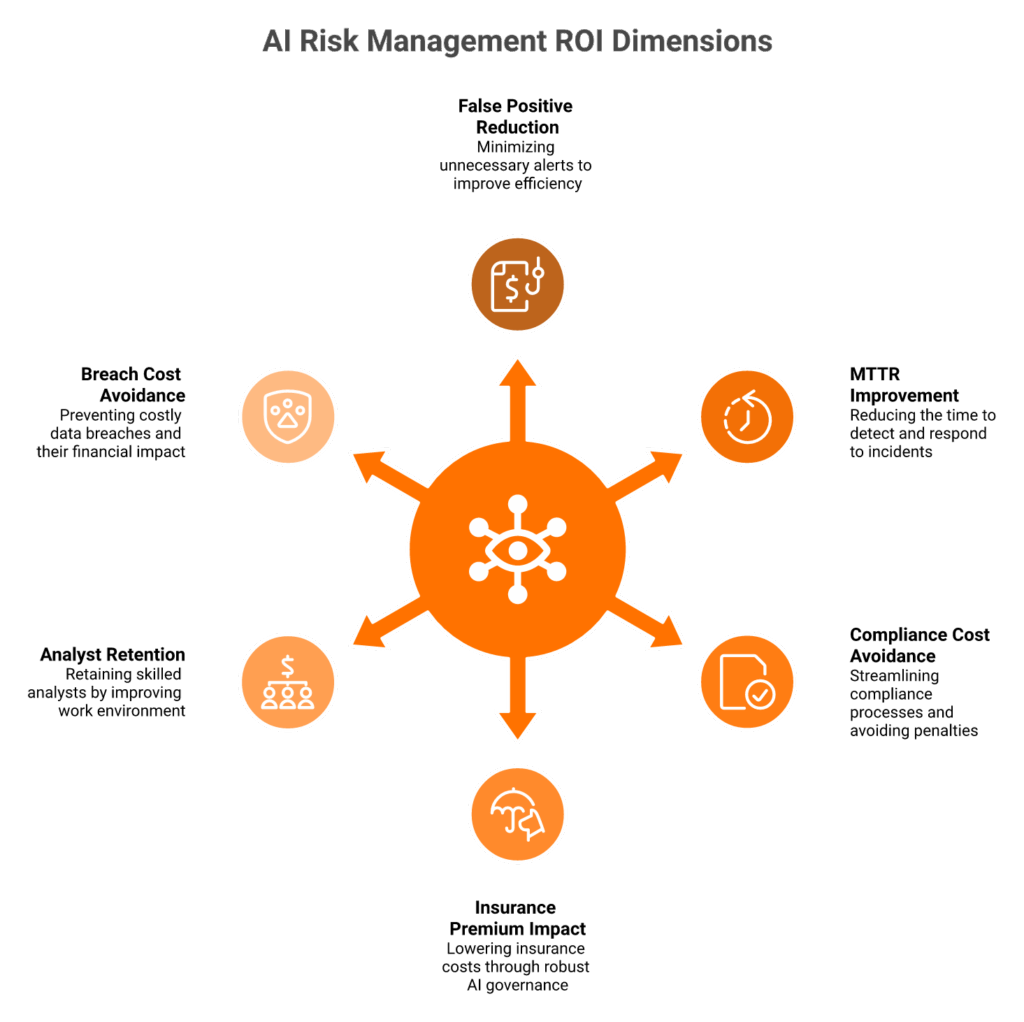
1. False Positive Reduction Savings
\(\text{Savings} = \text{Weekly alerts eliminated} \times \text{Avg analyst hours per alert} \times 52 \times \text{Fully loaded hourly cost}\)
Nearly 70% of security professionals admit to ignoring alerts due to fatigue, and organizations receive roughly 17,000 malware alerts per week, but only 19% are reliable. Eliminating noise has direct labor cost impact.
2. MTTR Improvement Value
\(\text{Value} = (\text{Baseline MTTR} – \text{AI-enabled MTTR}) \times \text{Cost per hour of exposure} \times \text{Annual incident count}\)
With the average breach lifecycle at 241 days in 2025, every hour shaved off response time reduces exposure cost.
3. Compliance Cost Avoidance
\(\text{Avoidance} = (\text{Manual audit hours eliminated} \times \text{Auditor hourly cost}) + (\text{Penalty probability reduction} \times \text{Expected penalty})\)
4. Insurance Premium Impact
\(\text{Savings} = \text{Annual premium} \times \text{Expected reduction from AI governance maturity}\)
5. Analyst Retention Value
\(\text{Value} = \text{Avoided annual turnover} \times \text{Full replacement cost per analyst}\)
Security analysts average 18-month tenure before burnout-driven turnover. Each replacement costs 1.5–2× annual salary.
6. Breach Cost Avoidance
\(\text{Avoidance} = (\text{Baseline breach probability} – \text{AI-reduced probability}) \times \text{Average breach cost}\)
The global average breach cost is $4.44M, while U.S. organizations face $10.22M average costs.
📊 Worked Example: 500-Endpoint Mid-Market Company
| ROI Dimension | Calculation | Annual Value |
|---|---|---|
| False positive reduction | 200 alerts/week eliminated × 0.5h × 52 × $75/h | $390,000 |
| MTTR improvement | (4h baseline − 0.5h) × $500/h exposure × 50 incidents | $87,500 |
| Compliance avoidance | 400 audit hours × $200/h + (15% reduction × $500K penalty) | $155,000 |
| Insurance premium impact | $300K premium × 15% reduction | $45,000 |
| Analyst retention | 1 avoided departure × $225K replacement cost | $225,000 |
| Breach cost avoidance | (8% − 3% probability) × $4.44M | $222,000 |
| Total Annual Value | $1,124,500 | |
| Platform Investment | 500 endpoints × $13/month × 12 | $78,000 |
| ROI Multiple | 14.4× |
📋 Board Reporting Template Structure
A board-ready AI risk management report should include five sections: (1) Risk Posture Summary, a red/amber/green heat map across AI systems, infrastructure, and compliance; (2) AI System Inventory & Classification, covering production models, risk tier, and last assessment date; (3) Incident & Response Metrics, including MTTR, false positive rate, containment rate, and trend lines; (4) Compliance Status by Framework, with NIST AI RMF, EU AI Act, SOC 2, and HIPAA mapped to completion percentage; (5) ROI Dashboard, showing cost savings against investment across all six dimensions.
✅ Operational Inputs That Drive ROI
UnderDefense’s documented metrics, including 99% alert noise reduction, 2-minute alert-to-triage and 15-minute escalation for critical incidents, and 100% ransomware prevention, are the operational inputs that drive ROI across all six dimensions. Transparent $11–15/endpoint/month pricing means you can calculate exact ROI before you commit, with no “contact sales” uncertainty.
Q10. What Does a Phased AI Risk Management Implementation Roadmap Look Like?
Before building your AI risk management program, score your readiness. Most organizations skip this step, deploy tools prematurely, and spend the next twelve months retrofitting governance around technology that is already running. Here is the assessment and roadmap that prevents that.
📋 AI Risk Management Readiness Checklist
- ☐ Have you inventoried all AI/ML models in production and shadow AI usage?
- ☐ Is there a designated AI Risk Officer or governance council?
- ☐ Do you have documented AI risk policies aligned to NIST AI RMF or ISO 42001?
- ☐ Can you detect model drift in real time?
- ☐ Do you have incident response procedures specific to AI failures?
- ☐ Are AI systems classified by EU AI Act risk tiers?
- ☐ Can you generate compliance evidence automatically?
- ☐ Is there a defined human escalation path for AI decisions with regulatory impact?
- ☐ Do you have a data architecture that supports AI model training and monitoring?
- ☐ Do you have agentic AI governance policies (kill switches, permission models, audit trails)?
⭐ Score Interpretation
| Score | Maturity Level | Recommended Action |
|---|---|---|
| 8–10 ✅ | Mature program | Focus on optimization, advanced threat hunting, and agentic AI governance |
| 4–7 ⚠️ | Critical gaps exist | Build targeted capabilities: prioritize real-time monitoring and compliance automation |
| 0–3 ❌ | Foundational investment needed | Reactive processes dominate: start with inventory, governance council, and framework selection |
🗺️ 4-Phase 12-Month Roadmap
Phase 1 (Months 1–3): Foundation
- Conduct AI asset inventory across all business units to surface shadow AI
- Form AI governance council with cross-functional representation (security, legal, engineering, and compliance)
- Select primary framework (NIST AI RMF, ISO 42001, or both)
- Perform data readiness audit and stakeholder alignment
Phase 2 (Months 4–6): Evaluation & Pilot
- Evaluate platforms using the 8-criteria scorecard from Q7
- Design pilot program with defined success metrics
- Develop AI risk policies, risk taxonomy, and classification criteria
- Run parallel testing against existing tools
Phase 3 (Months 7–9): Deployment & Integration
- Deploy selected platform with vendor-agnostic integrations across existing stack
- Tune detection rules and establish baselines
- Activate team reskilling program (ML literacy, AI governance frameworks)
- Begin compliance evidence automation
Phase 4 (Months 10–12+): Optimization & Future-Proofing
- Activate continuous model monitoring and drift detection
- Establish board reporting cadence using the Q9 template
- Prepare for agentic AI governance: least-privilege models, tool-use policies, and circuit breakers
- Evaluate emerging capabilities: AI + blockchain for tamper-proof audit trails, XAI as regulatory expectation, and prescriptive risk ecosystems
🏗️ Data Architecture Foundation
The technical infrastructure requires centralized data lakes for risk data aggregation, API integrations for real-time data flow between security tools, data quality governance ensuring training data integrity, feature stores for ML model inputs, and monitoring infrastructure for drift detection. Without this foundation, AI risk management tools operate on incomplete data, and incomplete data produces incomplete protection.
✅ Compressing the Timeline
UnderDefense’s 30-day turnkey onboarding compresses Phases 2–3 of this roadmap. Platform deployment, 250+ tool integration, custom detection tuning, and continuous monitoring activation happen in parallel, so your team focuses on governance, policy, and data architecture while operational AI risk management goes live immediately. Most clients move from checklist score 2–3 to 7+ within the first 60 days.
⏰ Scored below 5? Book a 15-minute AI risk readiness assessment to identify exactly where your gaps are and how fast you can close them.
Q11. Which AI-Powered Security Operations Platform Best Protects Your AI Investments?
The most effective AI risk management strategy combines AI-driven detection with human analyst response, what UnderDefense calls the AI SOC + Human Ally model. When AI is both your greatest risk management tool and your newest attack surface, you need a security operations platform that can monitor your AI systems the same way it monitors your human users.
🔍 Why MDR for AI Matters
Traditional risk management platforms (GRC tools, governance dashboards, and compliance trackers) handle policy and assessment. They cannot operationally detect and respond to AI-specific threats in real time. What organizations need is a security operations layer that treats AI systems as first-class assets: monitoring model behavior, detecting anomalous agent activity, and responding to AI-specific attack vectors (prompt injection, data poisoning, and model extraction) alongside traditional threats.
✅ What Separates Effective AI Security Operations
- Vendor-agnostic integration with existing AI/ML infrastructure and security stack, with no rip-and-replace
- Real-time monitoring of AI model behavior and agentic AI activity patterns
- Human analyst access for contextual verification of AI-flagged risks, not ticket-based escalation
- Automated compliance evidence mapped to NIST AI RMF and EU AI Act requirements
- Published pricing and rapid onboarding, not 6-month enterprise deployments with hidden costs
🎯 The Operational Layer for AI Risk
UnderDefense’s MDR for AI is purpose-built for this exact challenge: monitoring AI workloads, detecting model manipulation attempts, and providing concierge analyst response when your AI systems behave unexpectedly. Whether you are deploying LLMs, managing agentic AI workflows, or scaling ML models in production, the operational security layer determines whether your AI investments create value or create risk.
This analysis is informed by documented case studies across 500+ MDR deployments, NIST AI RMF operational mapping, and 6 years of 100% ransomware prevention, because AI risk management only works when detection meets response.
Q12. FAQ: AI Risk Management Questions Enterprise Leaders Ask Most
What is AI risk management?
AI risk management is the discipline of identifying, assessing, mitigating, and monitoring risks associated with artificial intelligence systems, both using AI as a defensive tool and governing the risks AI itself introduces. It encompasses data risks, model risks, operational risks, ethical risks, and supply chain attacks across the full AI lifecycle.
What is the NIST AI Risk Management Framework?
The NIST AI RMF 1.0 is a voluntary framework with four core functions: GOVERN (establish AI risk policies and accountability), MAP (contextualize AI systems and stakeholders), MEASURE (quantify risks with metrics and testing), and MANAGE (prioritize and monitor identified risks). It is the most widely adopted U.S. framework for AI governance.
How does AI detect fraud in real time?
AI fraud detection uses a multi-layer architecture: transaction scoring engines apply ML models to evaluate risk in milliseconds, behavioral analytics establish baseline patterns per user, network analysis maps connections between entities to uncover rings, and adaptive learning continuously retrains models as fraud patterns evolve.
What are the biggest risks of using AI in business?
The five primary risk categories are: data risks (poisoning, privacy violations), model risks (drift, hallucination, bias), operational risks (shadow AI, integration failures), ethical/legal risks (algorithmic bias, transparency gaps), and supply chain attacks targeting AI development pipelines and model repositories.
How much does AI risk management cost?
Platform costs range from $11–15/endpoint/month for operational AI security (UnderDefense) to six-figure enterprise licenses for GRC platforms (IBM OpenPages, Palantir). Mid-market organizations typically achieve 4–14× ROI within the first year when measuring across all six value dimensions: false positive reduction, MTTR improvement, compliance avoidance, insurance impact, analyst retention, and breach cost avoidance.
What is the EU AI Act and when does it take effect?
The EU AI Act is the world’s first comprehensive AI regulation, using a risk-based classification system (unacceptable, high, limited, and minimal risk). Full obligations for high-risk AI systems take effect August 2, 2026, with penalties up to €35M or 7% of global turnover for prohibited practices.
What is agentic AI risk?
Agentic AI risk refers to dangers specific to autonomous AI agents: cascading failures across multi-agent workflows, permission creep beyond intended scope, prompt injection attacks manipulating agent behavior, and accountability gaps when autonomous agents cause harm. Governance requires kill switches, audit trails, and human approval gates for high-impact actions.
How do you build a human-AI operating model?
Use a tiered decision authority framework: Tier 1 (AI autonomous, for routine triage and classification), Tier 2 (analyst-driven, for contextual verification), Tier 3 (risk officer, for regulatory/reputational decisions), and Tier 4 (CISO/Board, for enterprise risk posture and policy changes). Define RACI charts and escalation triggers for each tier.
What are the best AI risk management platforms in 2026?
The top platforms for 2026 are: (1) UnderDefense MAXI, offering unified AI-driven detection, response, and compliance automation at $11–15/endpoint/month; (2) IBM OpenPages, for enterprise GRC with Watson AI; (3) SAS Risk Management, for financial analytics; (4) Palantir Foundry, for complex data environments; (5) AccuKnox, for zero-trust AI workload security.
How long does it take to implement AI risk management?
A comprehensive AI risk management program follows a 12-month phased roadmap: Phase 1 (months 1–3), data readiness and governance foundation; Phase 2 (months 4–6), vendor evaluation and pilot; Phase 3 (months 7–9), deployment and integration; Phase 4 (months 10–12+), continuous optimization. UnderDefense compresses Phases 2–3 to 30 days through turnkey onboarding.
1. How does AI-powered risk management differ from traditional GRC approaches?
Traditional GRC programs run on quarterly reviews, static spreadsheets, and rule-based alerts with fixed thresholds. AI-powered risk management replaces that cadence with continuous, real-time detection and response. Here is how they diverge operationally:
– Review cadence: Quarterly or annual audits versus continuous, real-time monitoring across all risk domains.
– Detection method: Static threshold alerts that generate massive false-positive volumes versus behavioral anomaly detection and ML scoring that reduces false positives by 60–80%.
– Compliance approach: Checkbox audits requiring weeks of manual evidence collection versus automated evidence generation mapped directly to NIST AI RMF, EU AI Act, and sector-specific frameworks.
– Incident response: Investigate-after-escalation models versus predict, contain, and respond in parallel.
The critical framing is that AI is both your most powerful risk management tool and your newest category of risk. You cannot separate those two realities. At UnderDefense, we operationalize this through the AI SOC + Human Ally model, where AI handles triage and classification autonomously while concierge analysts provide the contextual judgment layer that pure automation cannot replicate.
2. What is the NIST AI Risk Management Framework and how does it apply in 2026?
The NIST AI RMF 1.0, released January 2023, is the most widely adopted voluntary framework for managing AI risks in the United States. It is organized around four core functions:
– GOVERN: Establish AI risk policies, define accountability structures, and set oversight mechanisms across all lifecycle stages.
– MAP: Contextualize AI systems, identify stakeholders, and categorize systems by risk level — this is where most organizations discover shadow AI they did not know existed.
– MEASURE: Quantify risks using metrics, benchmarks, and testing against trustworthiness characteristics including validity, reliability, safety, security, and fairness.
– MANAGE: Prioritize, respond to, and monitor identified risks with allocated resources and mitigation controls.
On April 7, 2026, NIST released a concept note for an AI RMF Profile targeting trustworthy AI in critical infrastructure — covering energy, water, healthcare, and financial services. This expansion signals that sector-specific AI governance is accelerating. We build compliance automation directly into the same platform that detects and responds to threats, generating audit evidence mapped to NIST AI RMF functions without requiring a separate compliance tool or team.
3. How does AI detect and prevent fraud in real time for financial services?
AI fraud detection operates across a multi-layer architecture that eliminates the rule-based bottlenecks legacy systems create. The five operational layers include:
– Real-time transaction scoring: ML models evaluate risk in milliseconds against behavioral baselines.
– Behavioral biometrics: Keystroke dynamics, device fingerprinting, and session-level patterns establish legitimate user profiles.
– Graph neural networks: Relationship mapping across accounts uncovers synthetic identity rings and coordinated fraud campaigns.
– NLP document analysis: Automated scanning for document fraud in KYC/AML submissions.
– Ensemble models: Supervised and unsupervised approaches combine for adaptive detection that evolves as fraud tactics shift.
The operational outcome is measurable — AI reduces false positives by 60–80% and detects fraud patterns 50% faster than rule-based systems. For financial institutions managing thousands of weekly alerts where 94% are false positives, this architecture directly recovers analyst capacity. We deliver this through MDR for Financial Services, where AI-driven detection combines with human analyst verification to ensure confirmed threats get contained, not just escalated.
4. What are the biggest risks and challenges of deploying AI in enterprise environments?
AI introduces five distinct risk categories that traditional IT security tools were never designed to handle:
– Data risks: Training data poisoning, privacy violations, data integrity issues, and unauthorized access to training datasets.
– Model risks: Adversarial attacks, prompt injection, model drift (concept, prediction, and data), hallucination, bias, and overfitting — 91% of ML models degrade over time without continuous monitoring.
– Operational risks: Shadow AI proliferation, integration failures, sustainability costs, and accountability gaps where nobody owns AI-specific incident response.
– Ethical and legal risks: Algorithmic bias, transparency gaps, explainability failures, and consent violations now carry regulatory penalties.
– Supply chain attacks: Compromised model repositories, poisoned datasets, and malicious AI development tools represent a critical and emerging category.
The implementation barriers compound these risks — data quality challenges, the black box problem, legacy system integration debt, and overreliance on automation without human oversight. We address the top three barriers simultaneously through the UnderDefense MAXI platform: vendor-agnostic integration solves legacy system challenges, AI-driven detection with human verification eliminates overreliance risk, and continuous monitoring catches model drift before it becomes a breach.
5. How should enterprises design a human-AI operating model for risk and security teams?
Most enterprises deploy AI risk tools but never define decision authority, which creates alert fatigue, diffused accountability, and critical findings sitting in dashboards for days. The solution is a tiered decision authority model:
– Tier 1 — AI Autonomous: Routine triage, alert classification, enrichment, correlation, and known-pattern containment. AI handles approximately 80% of alert volume without human intervention.
– Tier 2 — Analyst-Driven: Escalated decisions requiring organizational context — user verification, threat validation, and business impact assessment.
– Tier 3 — Senior Risk Officer: Strategic decisions with regulatory or reputational impact, including compliance exception approvals and model deployment decisions.
– Tier 4 — CISO/Board: Enterprise risk posture decisions, policy changes, incident disclosure, and budget allocation.
Each tier requires an explicit RACI chart defining who is Responsible, Accountable, Consulted, and Informed. The EU AI Act mandates human oversight for high-risk AI systems, making full automation non-compliant. We operationalize this model daily — UnderDefense MAXI handles Tier 1 autonomously while dedicated concierge analysts handle Tier 2 via Slack and Teams, verifying suspicious activity directly with affected users so your CISO reviews confirmed incidents, not alert queues.
6. What does a realistic AI risk management implementation roadmap look like?
A comprehensive program follows a 12-month, four-phase roadmap, but most organizations skip the readiness assessment and deploy tools prematurely:
– Phase 1 (Months 1–3) — Foundation: Conduct AI asset inventory across all business units to surface shadow AI, form a cross-functional governance council, select your primary framework (NIST AI RMF, ISO 42001, or both), and perform a data readiness audit.
– Phase 2 (Months 4–6) — Evaluation & Pilot: Evaluate platforms using an 8-criteria scorecard, design a pilot program with defined success metrics, and develop AI risk policies and classification criteria.
– Phase 3 (Months 7–9) — Deployment & Integration: Deploy with vendor-agnostic integrations across your existing stack, tune detection rules, establish baselines, and begin team reskilling.
– Phase 4 (Months 10–12) — Optimization: Activate continuous model monitoring, establish board reporting cadence, and prepare agentic AI governance policies with kill switches and circuit breakers.
Our 30-day turnkey onboarding compresses Phases 2–3, so operational AI risk management goes live while your team focuses on governance and policy. Most clients move from a readiness score of 2–3 to 7+ within 60 days.
7. How do you calculate the ROI of AI-powered risk management?
Most ROI calculations focus only on breach prevention, missing five other dimensions where AI risk management creates measurable value. Here is the 6-dimension framework:
– False positive reduction savings: Weekly alerts eliminated × average analyst hours per alert × 52 weeks × fully loaded hourly cost.
– MTTR improvement value: (Baseline MTTR − AI-enabled MTTR) × cost per hour of exposure × annual incident count.
– Compliance cost avoidance: Manual audit hours eliminated × auditor cost + penalty probability reduction × expected penalty amount.
– Insurance premium impact: Annual premium × expected reduction percentage from demonstrable AI governance maturity.
– Analyst retention value: Avoided annual turnover × full replacement cost per analyst (1.5–2× salary).
– Breach cost avoidance: Baseline breach probability reduction × $4.44M global average breach cost.
For a 500-endpoint mid-market company, this framework produces approximately $1.12M in annual value against a $78K platform investment — a 14.4× ROI multiple. We publish transparent pricing at $11–15/endpoint/month so you can calculate exact ROI before committing, with no “contact sales” uncertainty.
8. What are the top AI risk management platforms to evaluate in 2026?
With over 30 AI governance and risk management platforms available, selection should optimize for operational effectiveness rather than feature count. The top platforms by category include:
– UnderDefense MAXI — Unified AI-driven detection, response, and compliance automation with 250 vendor-agnostic integrations, 24/7 concierge analysts, 96% MITRE ATT&CK coverage, and transparent $11–15/endpoint/month pricing. Best for organizations needing operational security and compliance in one layer.
– IBM OpenPages with Watson — Enterprise GRC with cognitive risk classification. Best for large-scale, multi-domain risk management. Limitation: complex implementation, enterprise-only pricing.
– SAS Risk Management — Advanced analytics for financial institutions. Strong on credit risk modeling and scenario simulation. Limitation: narrow industry focus.
– Palantir Foundry — Complex data environments and systemic risk analysis. Limitation: high cost, government/enterprise positioning.
– AccuKnox AI-SPM — Zero-trust AI workload security with LLM prompt defense. Limitation: focused on AI infrastructure security, not full enterprise risk management.
The real evaluation question is not which platform has the most features, but which one can detect threats, respond operationally, and generate compliance evidence in real time without adding another dashboard to monitor.