




Q1. What does Huntress actually cost in 2026, list price, MSP partner rates, and the new VAR program?
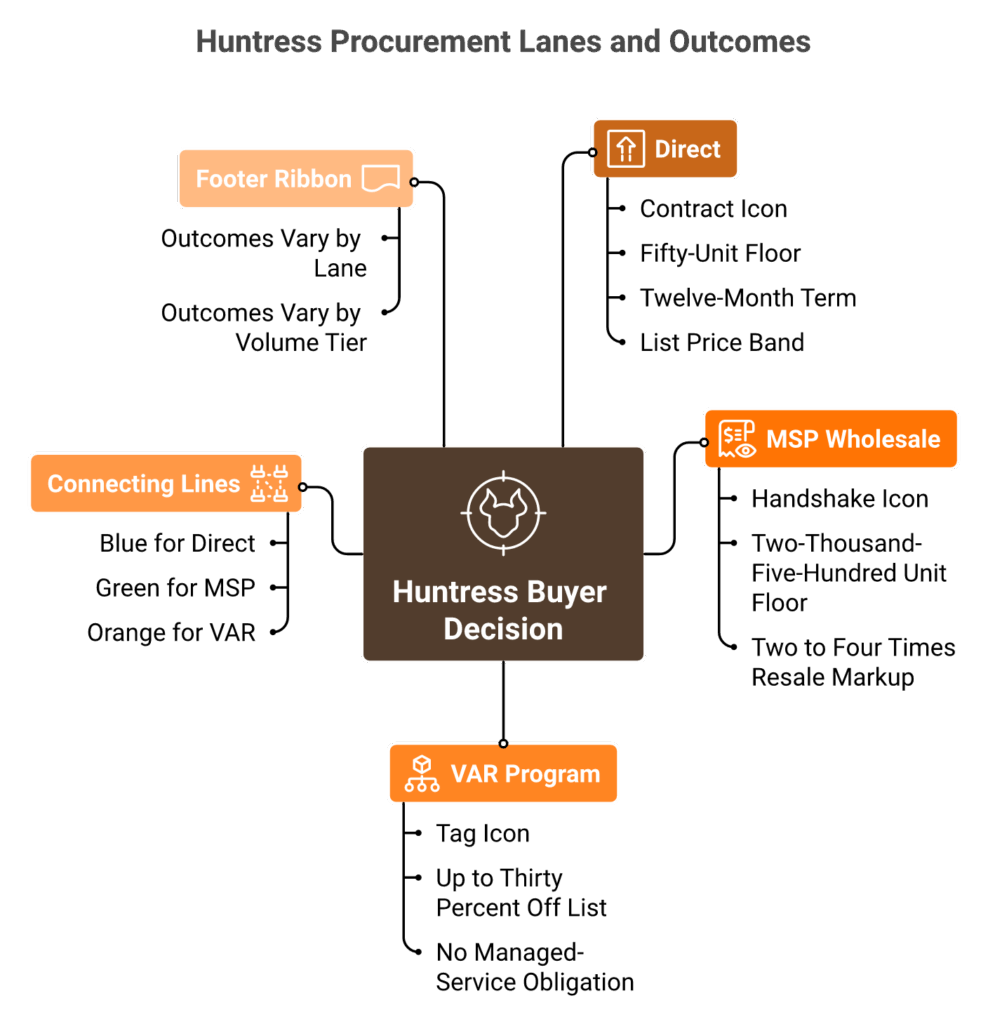
Less theater, more throughput. Huntress publishes flat list prices: Managed EDR at $8.99/endpoint/mo, ITDR at $4.80/identity/mo, SIEM at $4.00/data-source/mo, and SAT at $2.08/learner/mo, all on a 12-month term with a 50-unit floor. MSP partners aggregating volume report wholesale rates of $1.95 to $4.50/endpoint, $1.10/identity, and $1.25 to $2.00/source. The March 2026 VAR program offers up to 30% off retail with no managed-service obligation, a third procurement lane competitors haven’t picked up yet.
The headline grid you can paste into a budget sheet
Huntress sells four core SKUs, each with a distinct billing unit. ✅ Managed EDR is per endpoint, covering Windows, macOS, and Linux servers and workstations. ✅ ITDR is per licensed Microsoft 365 identity. ✅ SIEM is per data source, with a 10 GB pooled monthly allocation per source. ✅ SAT is per active learner, auto-synced from M365.
| SKU | List Price (May 2026) | Billing Unit | Minimum Term |
|---|---|---|---|
| Managed EDR | $8.99/mo | Per endpoint | 12 months, 50-unit floor |
| Managed ITDR | $4.80/mo | Per M365 identity | 12 months, 50-unit floor |
| Managed SIEM | $4.00/mo | Per data source (10 GB pooled) | 12 months |
| Managed SAT | $2.08/mo | Per active learner | 12 months |
Negotiating a renewal right now?
Talk to a team that benchmarks these deals every week.
MSP wholesale rates, useful, but caveat them
Community-reported wholesale data (not officially confirmed by Huntress) shows MSPs pay roughly $1.95 to $4.50/endpoint at the 2,500-unit aggregate floor, with reseller resale typically landing between $7 and $15/endpoint. ⚠️ Treat these numbers as directional. They come from peer reporting on r/msp threads and reseller listings, not from Huntress price sheets.
The VAR lane (new, March 2026)
The newer VAR program is the interesting wrinkle. Resellers can offer up to 30% off retail without taking on managed service delivery. ✅ For buyers, this means you can buy direct-equivalent license at a discount through a channel partner. ❌ The drawback is that VAR partners don’t run the SOC for you, so the analyst layer is still on Huntress’s central team.
Renamed products vs. rebuilt outcomes
In our experience advising mid-market security teams, flat per-endpoint pricing is genuinely useful for budgeting. But pricing transparency is one variable. The harder question is whether you’re buying a tool, an alert factory, or an outcome. We’ve seen too many buyers pick the cheapest endpoint number and discover six months later they still need someone to investigate alerts at 2 a.m.
Our MDR service takes a different lane. We are vendor-agnostic, plug into existing EDR (Defender, CrowdStrike, SentinelOne), and SIEM, and wrap them with a 24/7 SOC plus AI-driven investigation. The buyer keeps their stack and adds a response team, instead of swapping agents to chase a per-endpoint discount.
“The platform itself is straightforward, it pulls in data from all our existing security tools, so we didn’t have to rip and replace anything.”
— Verified User, Marketing and Advertising Under Defence G2 – Verified Review
Q2. How is Huntress priced across EDR, ITDR, SIEM, and SAT, what’s the billing unit and what’s included?
Each Huntress product uses a different billing unit: EDR per endpoint, ITDR per licensed M365 identity, SIEM per data source with 10 GB/source/month pooled, and SAT per active learner. All four bundle 24/7 SOC, threat hunting, active remediation, ransomware canaries, and managed Defender AV in the base price. There is no separate SOC fee, no AI add-on SKU, and no feature gating across tiers.
Managed EDR, per endpoint, agents on every box
EDR (Endpoint Detection and Response) is licensed per agent install. ✅ Includes: 24/7 SOC triage, host isolation, ransomware canaries, and managed Microsoft Defender AV configuration. ⚠️ Edge case: servers and workstations bill at the same rate, which surprises buyers who expect server tiers like CrowdStrike Falcon Pro vs. Enterprise.
Managed ITDR, per M365 identity
ITDR (Identity Threat Detection and Response) is licensed per active M365 identity, not per mailbox. ✅ Includes: unauthorized access detection, malicious inbox rule alerts, MFA fatigue detection, and rogue OAuth app monitoring. ⚠️ Edge case: ITDR is annual-only, no monthly billing option.
M365 E5, audit before you buy
Time is the currency of the cloud. Before signing for ITDR or SAT, check what you already own. M365 E5 includes Defender for Identity, Defender for Office 365 P2, and Attack Simulation Training, which overlap meaningfully with Huntress ITDR and SAT. We’ve seen mid-market teams pay twice for the same identity coverage, a pattern our MDR for Microsoft 365 coverage is built to avoid.
Managed SIEM, per data source, 10 GB pooled
SIEM is licensed per source connection, not per GB ingested. ✅ Each source gets a 10 GB/month allocation, pooled across all sources. ⚠️ Edge case: when you exceed allocation, Huntress truncates the oldest data instead of billing overage. No surprise bill, but data loss is real.
Managed SAT, per active learner
SAT (Security Awareness Training) is licensed per active learner. ✅ Auto-syncs with M365 and excludes shared mailboxes, service accounts, and guests automatically. ✅ Phishing simulations, video micro-courses, and reporting are included.
| SKU | Unit | Included | Edge Case |
|---|---|---|---|
| EDR | Endpoint | 24/7 SOC, host isolation, canaries | Servers = workstations price |
| ITDR | M365 identity | Inbox rule, MFA fatigue, OAuth app alerts | Annual-only billing |
| SIEM | Data source | 10 GB pooled/source/mo | Truncates instead of overage billing |
| SAT | Active learner | Auto-sync, phishing sims, training | Shared mailboxes excluded automatically |
What this means for a 1,500-employee buyer
In our work with mid-market security teams, the trap is not the per-unit price. It’s the assumption that “all-included SOC” means the SOC understands your environment. ✅ Huntress does triage well at the agent level. ❌ But it doesn’t replace the analyst who knows your developers run weird PowerShell on Tuesdays. We position the UnderDefense Agentic AI SOC platform to layer that organizational context on top, regardless of which EDR you run.
“When they escalate something, they include the context we need to understand the issue quickly. We’re not wasting time piecing together what happened from different systems anymore.”
— Verified User, Marketing and Advertising Under Defence G2 – Verified Review
Q3. How do MSP partner rates and volume tiers work, and how do you reverse-engineer your MSP’s markup?
Direct buyers move down a five-step volume curve at 50, 100, 250, 500, and 1,000 units, with custom quotes above 1,000 and reseller discounts of 20% to 30% off list. MSPs aggregate endpoints across all clients, paying $1.95 to $4.50/endpoint wholesale (roughly 78% off list at the 2,500-unit floor), and reselling at $7 to $15/endpoint, a 2x to 4x markup. A simple reverse-engineering formula: (your invoice − $2.50) ÷ your invoice = your MSP’s gross margin.
Direct volume tiers
Tier 1 (50 to 99 units) is published at full list. ✅ Tiers 2 to 5 step down progressively, with reseller discounts of 20% to 30% layered on top via the VAR program.
| Tier | Units | Estimated EDR Rate | Discount Off List |
|---|---|---|---|
| 1 | 50 to 99 | $8.99 | 0% |
| 2 | 100 to 249 | ~$8.50 | ~5% |
| 3 | 250 to 499 | ~$7.99 | ~11% |
| 4 | 500 to 999 | ~$7.50 | ~17% |
| 5 | 1,000+ | Custom | 20% to 30%+ |
MSP aggregate matrix
MSPs hit the 2,500-unit aggregate floor and unlock community-reported wholesale of around $1.95/endpoint. ⚠️ Caveat: this is reported on r/msp via CheckThat.ai’s April 2026 community pricing thread, not Huntress-confirmed.
The reverse-engineering calculator
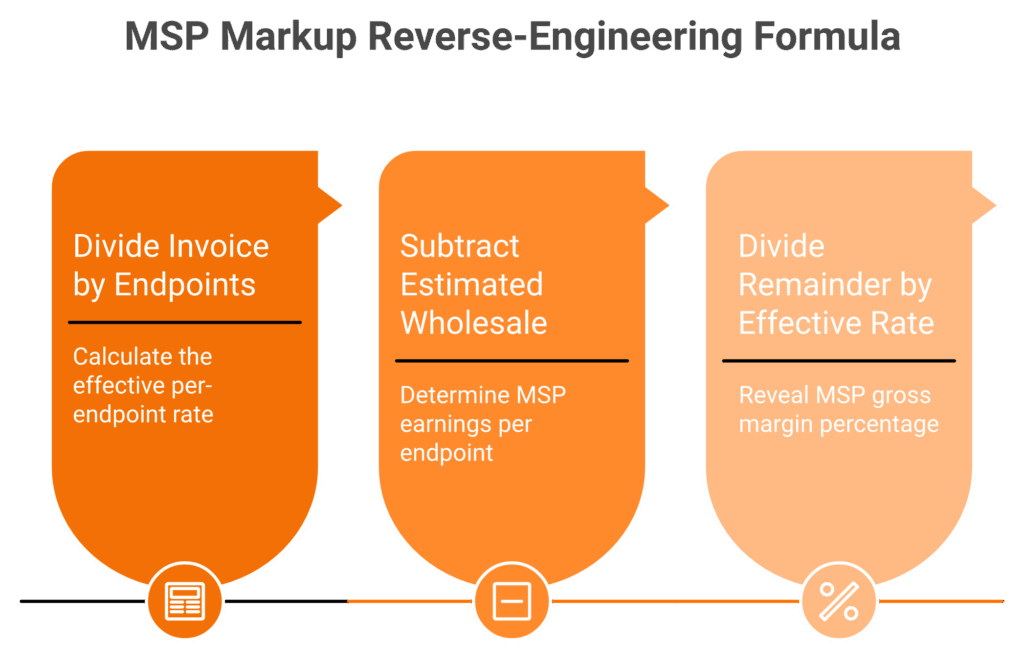
Here’s a buyer-side trick. If you know your monthly invoice line and your endpoint count, back out your MSP’s margin.
- Step 1: Divide invoice by endpoint count to get your effective per-endpoint rate.
- Step 2: Subtract estimated wholesale (~$2.50).
- Step 3: Divide by your effective rate to get gross margin %.
Worked example, 175 endpoints
Say your MSP charges $1,575/month for Huntress EDR coverage. That’s $9/endpoint. Subtract $2.50 wholesale, and the MSP earns $6.50/endpoint, a 72% gross margin. ✅ That’s not necessarily wrong, MSPs include packaging, support, and onboarding. ❌ But you should know the number before negotiating, and the same discipline applies when you’re looking at MDR pricing from any vendor.
Negotiation script (paste into email)
Three lines that move conversations:
- “Can you confirm whether our Huntress license is direct or sourced through your MSP wholesale agreement?”
- “What’s the effective per-endpoint rate, and how does it compare to Huntress’s published 1,000+ tier?”
- “Are we eligible for VAR pricing if we manage triage in-house?”
A fleet of Ferraris with rookie drivers
In our experience advising mid-market CISOs, volume buying without an analyst layer is wasted spend. A 1,000-endpoint discount means nothing if your team can’t triage what the agent sees. We’ve watched companies stack EDR, SIEM, and SAT licenses, then call us at 2 a.m. because nobody read the alerts. Our flat managed-service economics, modeled in our SOC cost calculator, remove the volume-versus-staff tradeoff. You pay one rate for outcomes, not for a tool you still have to drive.
“We received little value from ArcticWolf. The product offered little visibility when we were using it. Anything you want to look at or changes you need to make in the product must go through their engineering team. As an MSP, this is a horrible way to do business for us.”
— Matt C., Manager Cybersecurity Services Arctic Wolf – G2 Verified Review
“UnderDefense is surprisingly affordable considering the level of protection we get. Their proactive threat hunting and rapid response have saved us from incidents that could have been incredibly costly.”
— Verified User, Program Development UnderDefense G2 – Verified Review
Q4. What hidden billing mechanics, exclusions, and “not included” items will hit your year-one budget?
Five mechanics surprise buyers: the 50-unit floor applies even if you have 10 actual endpoints when buying direct, mid-term commitment increases restart the 12-month term, overages are processed manually, ITDR is annual-only with no monthly option, and each SIEM data source bills for 10 GB/month even if it uploads less. Excluded entirely: cloud workload protection, mobile/IoT/OT coverage, contractual SLAs, breach warranty, IR retainers, dedicated TAMs, and FedRAMP/FIPS variants.
The five hidden mechanics
❌ The 50-unit floor: buying direct for a 10-person law firm? You still pay for 50 EDR seats. Negotiation fix: route through a VAR or MSP to clear the floor.
❌ Mid-term increase resets the term: adding 25 endpoints in month 7 can restart a fresh 12-month commitment on the new total. Negotiation fix: add an “incremental seats co-term to existing end date” clause.
❌ Manual overage processing: SIEM data overage isn’t auto-billed. ✅ Huntress truncates oldest data instead. The hidden cost is data loss for forensics, not invoice surprise.
❌ ITDR annual-only: no monthly opt-out if a tenant downsizes. Negotiation fix: insist on a quarterly true-down for identity counts.
❌ The 10 GB SIEM minimum: each data source bills for the full pooled allocation even if utilization is 1 GB. Negotiation fix: consolidate sources before billing starts.
What’s not included (the disqualifier table)
| Capability | Included? | What you’ll need separately |
|---|---|---|
| Cloud workload protection (CWPP) | ❌ | Wiz, Prisma Cloud, Defender for Cloud |
| Mobile / IoT / OT | ❌ | Lookout, Claroty, Armis |
| Contractual SLA | ❌ | Negotiated with vendor |
| Breach warranty | ❌ | Cyber insurance carrier |
| IR retainer | ❌ | Mandiant, Unit 42, incident response |
| Dedicated TAM | ❌ | Premium support tier |
| FedRAMP / FIPS variant | ❌ | Federal-specific MDR |
Extended retention add-on economics
Huntress SIEM defaults to 30-day active retention. Extended retention (90-day active, 7-year cold) is a paid add-on. 💰 Rehydration above 500 GB/year costs $1/GB. For a regulated buyer with 7-year HIPAA log requirements, this line item is non-trivial, and our managed SIEM team sees this gap regularly.
SIEM truncation vs. overage, a real cost-volatility comparison
Huntress truncates oldest data when you exceed 10 GB/source/month. Splunk and Microsoft Sentinel charge per GB and bill overages in arrears. ✅ Huntress: predictable bill, unpredictable forensic completeness. ❌ Splunk: unpredictable bill, predictable forensic completeness. Neither is wrong, but you should know which trade you signed.
The 4-Year Tuning Treadmill
Working across 500+ customer environments, what I’ve seen is that the real cost isn’t on the invoice. It’s the tuning toil. One prospect told me they tuned Carbon Black for four years and never finished. That’s the hidden line item: analyst hours spent reducing false positives instead of hunting threats, which is exactly what our SOC automation work is designed to compress.
Our Ingestion Tuning approaches the SIEM problem from a different angle. ✅ We cut data volume 50% to 90% by filtering noise before ingestion, not by capping at 10 GB and dropping the rest. The structural answer is to ingest less, not to cap differently. That’s how you keep forensic depth and predictable cost in the same architecture, a discipline we cover in our managed SIEM pricing guide.
“Started out well but over the years the service has consistently not met expectations. Log collectors show working, however when asked to provide logs for an investigation no logs could be provided.”
— CISO, Manufacturing Arctic Wolf – Gartner Verified Review
“UnderDefense Agentic AI SOC integrates well with our systems, specifically with our SIEM, Splunk. Their team is proactive in identifying and addressing threats, providing 24/7 oversight.”
— Oleg K., Director Information Security UnderDefense G2 – Verified Review
Q5. What does a Huntress 3-year TCO look like at 75, 175, and 375 users, direct and through an MSP?
At 75 users (EDR-only, direct list): roughly $24,267 over 3 years, or approximately $8,800 via MSP wholesale. At 175 users (EDR plus ITDR direct): about $77,490, with MSP rates near $31,500. At 375 users (full four-product stack direct list): approximately $237,465 over 3 years, dropping to around $112,000 with MSP wholesale. The full four-product stack at the 500-unit ceiling lands near $316,620 over 3 years before any volume discount.
Methodology and assumptions
I’m anchoring on Huntress’s published list ceiling and community-reported MSP floors. ⚠️ Three caveats matter here:
- Year 2 and Year 3 are modeled flat (0% uplift), which rarely holds in practice.
- The 50-unit floor applies to direct list at sub-50 buyers.
- MSP wholesale numbers are r/msp community-reported, not Huntress-confirmed.
Scenario A: 75 users, EDR-only
Most 75-person firms buy a single SKU and run it lean.
| Track | Year 1 | Year 2 | Year 3 | 3-Yr Total |
|---|---|---|---|---|
| Direct list ($8.99/ep) | $8,089 | $8,089 | $8,089 | $24,267 |
| MSP wholesale (~$3.25/ep avg) | $2,925 | $2,925 | $2,925 | $8,775 |
| Internal FTE to operate | $75K+ | $75K+ | $75K+ | $225K+ |
The fully loaded reality
💸 The license number is the easy column. The fully loaded internal-FTE cost to triage Huntress alerts (typically $75K to $150K per year for a part-time analyst) is what most buyers forget to include. That’s the Delivery-Model Cost Matrix in plain English, and it’s exactly the calculation our SOC cost calculator models in 60 seconds.
Scenario B: 175 users, EDR plus ITDR
Mid-market buyers usually layer ITDR for M365 identity coverage.
| Track | Year 1 | Year 2 | Year 3 | 3-Yr Total |
|---|---|---|---|---|
| Direct list (EDR + ITDR) | $25,830 | $25,830 | $25,830 | $77,490 |
| MSP wholesale | $10,500 | $10,500 | $10,500 | $31,500 |
| FTE operate cost | $90K | $90K | $90K | $270K |
Scenario C: 375 users, full four-product stack
Larger buyers stacking EDR, ITDR, SIEM, and SAT.
| Track | Year 1 | Year 2 | Year 3 | 3-Yr Total |
|---|---|---|---|---|
| Direct list (full stack) | $79,155 | $79,155 | $79,155 | $237,465 |
| MSP wholesale | $37,333 | $37,333 | $37,333 | $112,000 |
| FTE operate cost | $150K | $150K | $150K | $450K |
Adjusting for partial product mixes
Three quick rules of thumb when modeling your own line:
- EDR-only buyers should ignore SIEM and ITDR rows entirely.
- EDR + ITDR is the most common “compliance starter” config.
- Adding SAT is cheap on paper ($2.08/learner), but check your M365 E5 entitlements first.
What the TCO model misses
Working with mid-market security teams, what I’ve felt is that license TCO never tells the whole story. ⏰ The hidden line item is operator time, the Tier 1 triage hours that vanish into the alert queue every week. Huntress’s flat pricing is genuinely transparent. ❌ But it doesn’t include the analyst who reads the alert at 2 a.m., which is why our outsourced vs in-house SOC framework starts with FTE math, not license math.
Our MDR service prices the outcome instead of the agent count. ✅ One line item covers the AI SOC, human analyst response, and ChatOps user verification across your existing stack. The Delivery-Model Cost Matrix favors managed when you account for the internal-FTE column most CFOs ignore.
Hidden fees adding up faster than expected?
Get a plain-English breakdown tailored to your environment.
Q6. How does Huntress’s 3-year TCO compare against the seven MDR vendors most buyers shortlist?
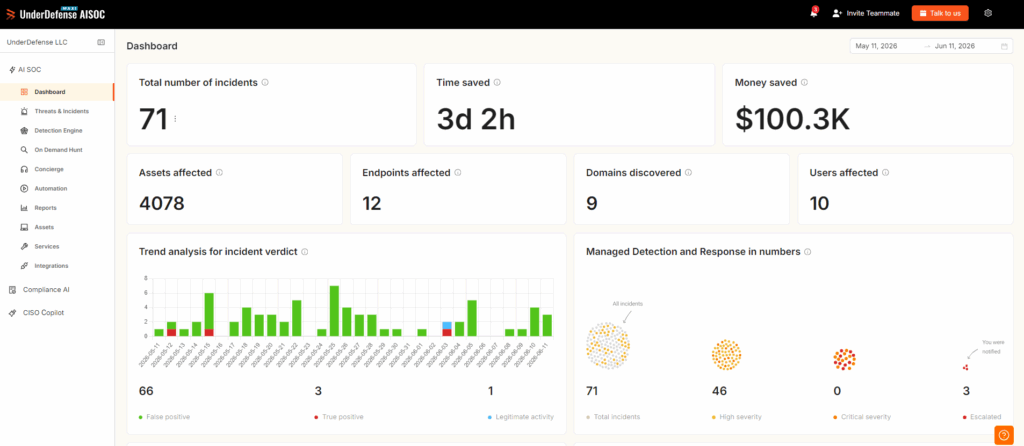
At 500 endpoints over 3 years, the spread is wide. UnderDefense Agentic AI SOC delivers a fully managed Agentic AI SOC with autonomous response and a $2M breach prevention guarantee. Huntress full-stack lands near $316K with no contractual SLA or IR retainer. Sophos MDR Complete sits at $247K to $397K (includes IR plus a $1M warranty). CrowdStrike Falcon Complete runs $495K to $827K, SentinelOne Vigilance $331K to $579K, Arctic Wolf $495K to $825K, Blackpoint $99K to $199K, eSentire $450K to $750K, and RocketCyber $90K to $180K (MSP-only).
Methodology, capability-adjusted
Doing the R in MDR vs. alert parroting is the real comparison. Comparing $99K Blackpoint to $495K CrowdStrike without normalizing capability is misleading. I add a $20K per year third-party IR retainer for vendors without bundled incident response, so the numbers reflect what you’d actually pay to be breach-ready. The same logic applies when you’re cross-shopping CrowdStrike pricing 2026 or SentinelOne pricing 2026.
| Vendor | 3-Yr TCO (500 endpoints) | Bundled IR | Breach Warranty | Contractual SLA |
|---|---|---|---|---|
| UnderDefense Agentic AI SOC | Custom (vendor-agnostic) | ✅ | ✅ $2M prevention guarantee | ✅ 2-min Alert-to-Triage |
| Huntress (full stack) | ~$316K | ❌ | ❌ | ❌ |
| Sophos MDR Complete | $247K to $397K | ✅ | ✅ $1M | ⚠️ Limited |
| CrowdStrike Falcon Complete | $495K to $827K | ✅ | ✅ | ✅ |
| SentinelOne Vigilance | $331K to $579K | ⚠️ Add-on | ⚠️ Add-on | ⚠️ Limited |
| Arctic Wolf | $495K to $825K | ❌ | ❌ | ❌ |
| Blackpoint Cyber | $99K to $199K | ❌ | ❌ | ⚠️ Partial |
| eSentire | $450K to $750K | ✅ | ✅ | ✅ |
| RocketCyber (MSP-only) | $90K to $180K | ❌ | ❌ | ❌ |
Where each vendor wins
- ⭐ Huntress wins on flat pricing transparency and SMB simplicity.
- ⭐ Sophos wins on bundled IR plus warranty at mid-market price.
- ⭐ CrowdStrike wins when you’re already on Falcon and want vendor-native response.
- ⭐ Arctic Wolf wins if you want a named Concierge analyst, but resale visibility is thin.
The Carmeuse moment
One of our customers (Carmeuse) saw the service pay back within 90 days when our SOC caught a payroll fraud scheme that pure malware-only monitoring would have missed. Working with 500+ security teams, what I’ve felt is that price-per-endpoint matters less than whether the SOC will actually stop the incident at 2 a.m. ⏰ Autonomous response within a 2-minute Alert-to-Triage SLA changes the unit economics meaningfully, a pattern documented in our MDR reduced MTTR to 9 min case study.
A fair note on capability gaps
❌ Blackpoint and RocketCyber are cheaper because they don’t include ITDR, SIEM, or SAT. ❌ Arctic Wolf has rich monitoring, but limited self-service control, a recurring complaint in user reviews. ✅ CrowdStrike and eSentire price higher partly because they ship contractual SLAs and warranty by default. For a deeper field comparison, see our MDR vendors list 2025.
“Arctic Wolf provides solid detection and response capabilities, but overly relies on the client’s team for remediation, which really hurts the value of the service.”
— VP of Technology, Services Arctic Wolf – Gartner Verified Review
“Despite the capabilities of the technical platform and the strength of the analysts providing the service, there is still a limit to the environmental/organizational knowledge inherent in the service.”
— Verified User, Computer Software Expel – G2 Verified Review
“Underdefense act as an extension of our team, so we don’t need additional resources, ensuring 24/7 protection.”
— Inga M., CEO UnderDefense G2 – Verified Review
Q7. Where does Huntress fall short for regulated buyers, the SLA-gap matrix for NIS2, SEC 8-K, HIPAA, and PCI DSS?
Huntress publishes an 8-minute response benchmark, but offers no contractual MTTD, MTTA, or 2-minute Alert-to-Triage SLA, no breach warranty, and no included IR (Incident Response) retainer. NIS2 mandates 24-hour early-warning notification. SEC Item 1.05 8-K requires 4-business-day disclosure. HIPAA Breach Notification Rule requires 60-day notification. PCI DSS v4.0 Requirement 12.10 requires documented IR procedures with defined response times. A vendor without contractual timelines forces the buyer to absorb that regulatory risk on their own balance sheet.
Why contractual SLAs matter for disclosure clocks
A marketing benchmark is not a commitment. ⚠️ When the SEC asks how you knew the breach was material within 4 business days, you need vendor evidence. “Their website says 8 minutes” doesn’t survive an audit. Regulated buyers need response timelines they can subpoena, a topic we cover in detail in our SLA in cybersecurity breakdown.
The four-regime gap matrix
| Requirement | Contractual Response SLA | Breach Warranty | Bundled IR | Response Evidence |
|---|---|---|---|---|
| NIS2 (24-hr early warning) | ❌ Huntress | ❌ Huntress | ❌ Huntress | ✅ Huntress logs |
| SEC 8-K Item 1.05 (4 biz days) | ❌ Huntress | ❌ Huntress | ❌ Huntress | ✅ Huntress logs |
| HIPAA §164.404 (60 days) | ❌ Huntress | ❌ Huntress | ❌ Huntress | ✅ Huntress logs |
| PCI DSS v4.0 Req 12.10 | ❌ Huntress | ❌ Huntress | ❌ Huntress | ⚠️ Partial |
Where Huntress passes and where it fails
✅ Pass: log retention (with paid extended retention add-on), evidence search, ransomware canaries, and managed Defender configuration. ❌ Fail: contractual response timelines, breach warranty, bundled IR retainer, and named analyst accountability. The product is solid. The contract just isn’t compliance-grade, which is why our compliance services team treats vendor SLAs as a regulatory line item, not a marketing one.
Closing the gap (what regulated buyers actually do)
Most regulated Huntress buyers add a third-party incident response retainer at $15K to $50K per year to satisfy NIS2 and SEC requirements. 💰 That’s a real line item your TCO model needs.
Orange suits and prevention guarantees
Leading with a breach warranty quietly admits defenses will fail. That’s an “orange suit acceptance” framing I’ve used for years. Under Defence leads differently. ✅ We commit to a contractual 2-minute Alert-to-Triage SLA, a 15-minute escalation for critical incidents, and a $2M breach prevention guarantee, which is a different posture than indemnifying after the fact. For a CISO defending the board on NIS2 readiness next quarter, that distinction matters, and our UnderDefense Agentic AI SOC platform ships those commitments in writing.
“UnderDefense Agentic AI SOC helps us secure sensitive data and mitigate potential cyber threats, which improves the overall security of our business operations.”
— Arman N., CTO UnderDefense G2 – Verified Review
Q8. What ROI framework justifies Huntress (or any MDR) using Ponemon dwell-time and breach-cost data?
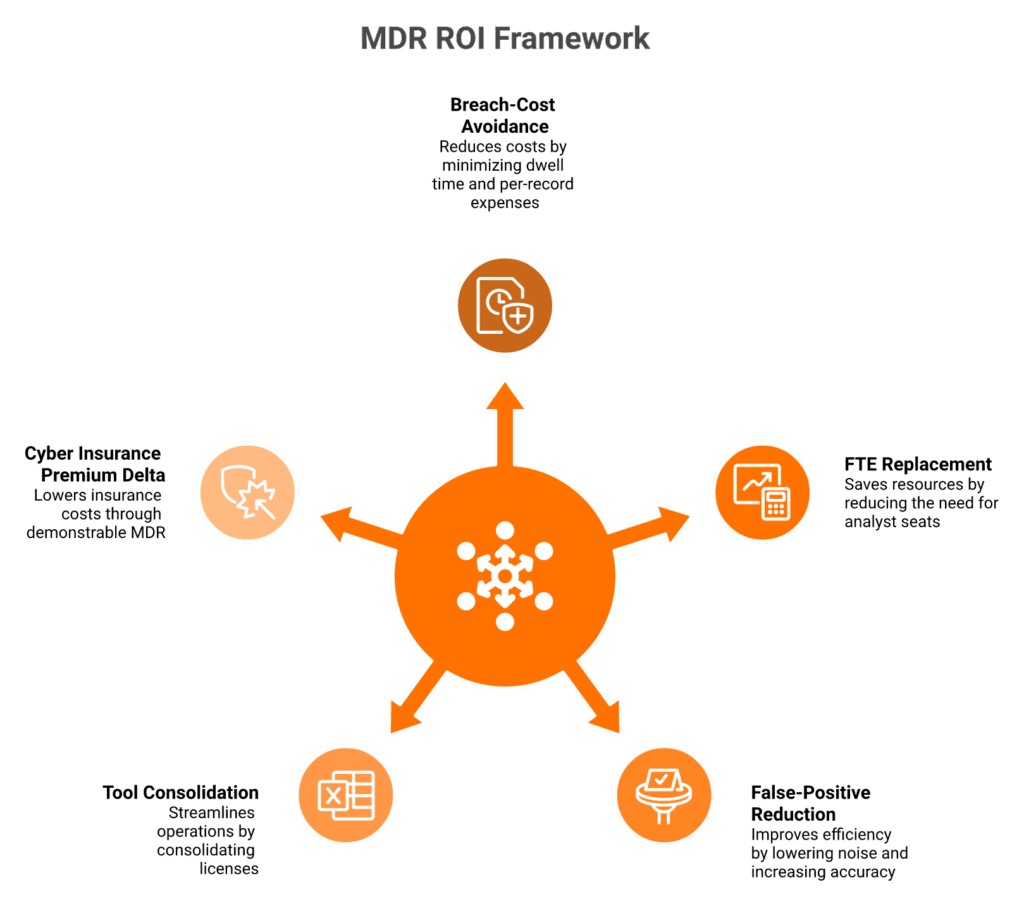
Ground the ROI case in IBM’s 2024 Cost of a Data Breach Report: organizations with MDR contained breaches 108 days faster and saved $1.76M on average. Multiply your industry’s per-record cost by the dwell-time delta, then layer in 0.5 to 1.0 FTE saved ($75K to $150K per year), false-positive reduction (Huntress claims sub-1% EDR FP rate vs. 20% to 40% in legacy stacks), tool consolidation ($26K to $120K per year), and a 10% to 25% cyber-insurance premium reduction. Most mid-market buyers hit payback in 5 to 30 months.
The five-input formula
ROI = (Breach-cost avoidance) + (FTE replacement) + (FP reduction value) + (Tool consolidation) + (Insurance premium delta), minus MDR annual cost.
Plug in numbers, not slogans. Each input is independently defensible, and our benefits of MDR piece walks through each line in production environments.
Worked example: 175-user mid-market firm
| Input | Annual Value |
|---|---|
| Breach-cost avoidance (108 days faster, IBM 2024) | $586,000 (risk-weighted) |
| FTE replacement (0.75 analyst) | $112,000 |
| False-positive reduction value | $35,000 |
| Tool consolidation (SIEM + EDR + SAT) | $48,000 |
| Cyber-insurance premium reduction (15%) | $18,000 |
| Total annual benefit | $799,000 |
| Huntress full-stack cost (175 users) | ~$25,830/yr |
| Net annual benefit | ~$773,000 |
⏰ Payback period: under 5 weeks on the model, assuming the breach-avoidance probability holds.
Where the model breaks: silence is not safety
A clean dashboard doesn’t mean you’re safe. It often means the tool isn’t tuned to see lateral movement. Working with 500+ security teams, what I’ve felt is that our pen tests routinely produce zero alerts on competitor stacks running Carbon Black, Defender, or Falcon, when properly tuned. ❌ If the EDR doesn’t fire on real TTPs (Tactics, Techniques, and Procedures), your “108 days faster” assumption collapses to zero. Our penetration testing findings document this gap regularly.
Three pre-flight checks before trusting any ROI model
- Run a purple-team exercise against your stack with MITRE ATT&CK T1003 (credential dumping) and T1021 (lateral movement).
- Audit your SIEM for missing log sources (DNS, EDR raw telemetry, M365 audit).
- Verify your IR runbook has named owners, not just role labels.
If any of those three fail, the ROI math is fiction. ⏰ The dwell-time delta is a function of detection coverage, not vendor marketing.
M&M Network: hard exterior, soft tasty center
Most ROI calculators assume the tool fires. The bigger lever is autonomous containment, not faster alerts. ✅ Our 2-minute Alert-to-Triage SLA, paired with 15-minute escalation for critical incidents, compresses dwell-time further than alert-only MDR, because the response action (credential wipe, password reset, forced logout) happens before a human reads the ticket. That’s the difference between detection and outcome, and it’s the core argument in our guide to MDR services.
Where Huntress lands honestly
✅ For an SMB with no SOC, Huntress’s flat pricing and bundled triage produce real ROI vs. running zero coverage. ❌ For a 1,000-plus-employee shop with hybrid cloud, regulated workloads, and 4,000 alerts a week, the model needs autonomous response and contractual SLAs the alert-only tier doesn’t ship. Run your own numbers, and pressure-test the “tool fires on real lateral movement” assumption first.
“With UnderDefense Agentic AI SOC, we’ve reduced security breaches. Their adherence to SLAs gives me confidence in our infrastructure’s protection.”
— Oleg K., Director Information Security UnderDefense G2 – Verified Review
Q9. When should you pick Huntress and when does UnderDefense Agentic AI SOC outperform it for mid-market buyers?
Huntress wins on flat pricing, SMB simplicity, and M365-native coverage. UnderDefense Agentic AI SOC wins when the buyer needs autonomous response, contractual SLAs, a vendor-agnostic Agentic AI SOC that wraps existing tools, a $2M breach prevention guarantee, and regulatory-grade evidence. The decision point is not product quality but operational maturity, environment complexity, and compliance exposure.
The honest Huntress fit list
✅ You have 50 to 300 endpoints on Windows and macOS.
✅ Your stack is Microsoft-native (M365, Defender, Azure AD).
✅ You have an internal IT generalist who can read portal alerts.
✅ You need SMB-speed onboarding (under 2 hours).
✅ Your compliance requirements are limited to basic cyber hygiene, not NIS2, SEC 8-K, or PCI DSS v4.0.
✅ Budget is the primary constraint.
The honest UnderDefense Agentic AI SOC fit list
✅ You have 300+ endpoints across hybrid cloud, on-premises, and OT or IoT.
✅ You already own a SIEM (Splunk, Sentinel, QRadar) and an EDR (CrowdStrike, SentinelOne, Defender) and want a 24/7 operator, not a replacement agent.
✅ You need a contractual 2-minute Alert-to-Triage SLA and a 15-minute escalation for critical incidents.
✅ You need a $2M breach prevention guarantee in writing.
✅ You are under NIS2, SEC 8-K, HIPAA, or PCI DSS v4.0 and need vendor response timelines as regulatory evidence.
✅ You want Agentic AI SOC actions: autonomous credential wipe, password reset, and forced logout without waiting for a human to read a ticket.
✅ You want to talk to your SOC via Slack or Teams for alert verification, not log into a portal.
Side-by-side decision matrix
| Criterion | Huntress | UnderDefense Agentic AI SOC |
|---|---|---|
| Pricing model | Flat per-unit, 4 SKUs | Outcome-based, custom |
| Vendor agnostic | ❌ Agent-dependent | ✅ Wraps any EDR or SIEM |
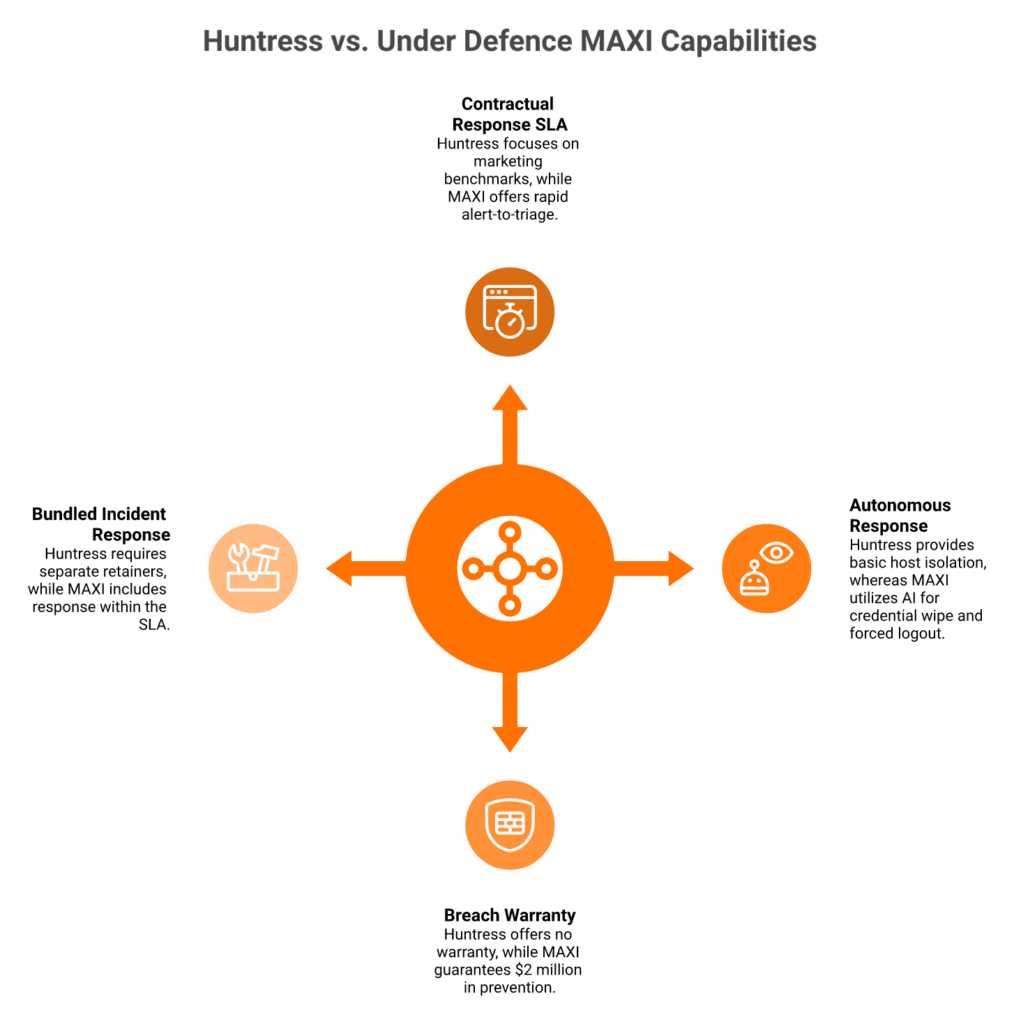
| Contractual SLA | ❌ Marketing benchmark only | ✅ 2-min Alert-to-Triage, 15-min critical escalation |
| Breach warranty | ❌ | ✅ $2M prevention guarantee |
| Autonomous response | ⚠️ Host isolation only | ✅ Credential wipe, password reset, forced logout |
| ChatOps verification | ❌ | ✅ Slack, Teams, Telegram |
| Cloud, OT, IoT coverage | ❌ Windows, macOS, Linux only | ✅ Multi-surface |
| Gartner Peer Insights rating | 4.7/5 | 5.0/5 (Gartner Peer Insights) |
| G2 rating | 4.7/5 | 4.9/5 |
| Best for | SMB, MSP, Microsoft shops | Mid-market, enterprise, regulated industries |
The Cardinal NZ moment
Cardinal NZ was running EDR and thought they were covered. A ransomware actor moved laterally through a contractor credential on a Saturday afternoon. ⏰ Their EDR fired an alert. Nobody read it until Monday. Our 24/7 SOC, now operating with Agentic AI, would have force-logged the contractor session automatically inside the 2-minute Alert-to-Triage SLA. That’s the operational gap between alert-only coverage and autonomous response. The full story is documented in our Black Basta stopped in minutes case study.
The maturity cliff
In our experience advising mid-market security teams, buyers outgrow Huntress between 300 and 500 endpoints. ✅ Huntress is genuinely excellent for what it is: affordable, simple, M365-native, and honestly built for the market it serves. ❌ When a manufacturer with 7,000 employees asks us why their SOC still has a 4-day dwell-time despite running Huntress, the answer is usually structural coverage gaps in cloud workloads, OT networks, and contractor identity, not a Huntress defect. Those buyers need the UnderDefense Agentic AI SOC platform.
“The team at UnderDefense is very responsive and knowledgeable. They have helped us to identify and resolve several security issues that we were not aware of. I would highly recommend their services to any organization looking to improve their security posture.”
— Verified User, Information Technology and Services UnderDefense G2 – Verified Review
Q10. What does Huntress cost for your specific environment, the 60-second model and when to call your rep?
Take your endpoint count, multiply by $8.99 (EDR), add your M365 identity count multiplied by $4.80 (ITDR), add your planned data-source count multiplied by $4.00 (SIEM), and add your active-learner count multiplied by $2.08 (SAT). Apply a 12% to 20% volume reduction if you’re above 250 units. Apply a 20% to 30% VAR discount if you’re going through a channel partner. That’s your annual direct-channel estimate. Run your fully loaded internal-FTE cost alongside it using our SOC cost calculator to get the real TCO.
The formula
Annual estimate = (Endpoints × $8.99) + (M365 identities × $4.80) + (SIEM sources × $4.00) + (Active learners × $2.08).
Apply discounts in this order:
- Volume tier reduction (250 to 499 units: ~11%, 500 to 999 units: ~17%, 1,000+: custom).
- VAR program discount (up to 30% off list, no managed-service obligation).
- MSP wholesale (if applicable; use $2.50/endpoint as a conservative floor).
Three worked examples in 60 seconds
Example 1: 75-person professional services firm
- 75 endpoints × $8.99 = $674.25/mo = $8,091/yr
- 75 M365 identities × $4.80 = $360/mo = $4,320/yr
- No SIEM, no SAT yet
- Annual estimate: $12,411
- MSP channel estimate: ~$4,500
Example 2: 175-person SaaS company
- 175 endpoints × $8.99 = $1,573.25/mo = $18,879/yr
- 175 M365 identities × $4.80 = $840/mo = $10,080/yr
- No SIEM (native Sentinel), no SAT (E5 included)
- Annual estimate: $28,959
- After ~5% tier 2 discount: ~$27,511
Example 3: 375-person manufacturer (full stack)
- 375 endpoints × $8.99 = $40,455/yr
- 375 M365 identities × $4.80 = $21,600/yr
- 20 SIEM sources × $4.00 = $960/yr
- 375 active learners × $2.08 = $9,360/yr
- Annual estimate: $72,375
- After ~11% tier 3 discount: ~$64,414
The fourth modeling line: cyber-insurance premium delta
Most buyers forget to model a 10% to 25% cyber-insurance premium reduction tied to demonstrable MDR coverage. 💰 On a $250,000 cyber policy, that’s $25,000 to $62,500 per year. Real money, often missed. Add that line before you take your TCO sheet into a CFO review.
What to do with the calculator output on Monday morning
- Run the SOC cost calculator with your real numbers.
- Walk into your next Huntress sales call with that fully loaded number printed.
- Ask the rep to defend their list-price quote against your TCO line by line.
Working with mid-market security teams, what I’ve felt is that buyers who walk in with a number negotiate 15% to 30% better outcomes than buyers who walk in to “explore options.”
When to call the rep immediately
- You’re above 500 endpoints (custom pricing is likely better than the published curve).
- You’re comparing the full four-product stack against a competitor quote (ask for a bundle discount).
- You’re an MSP wanting to aggregate volume across clients (the wholesale floor is negotiable above 2,500 units).
- You’re under NIS2, SEC, HIPAA, or PCI DSS and need contractual SLAs added to your agreement.
When to call Under Defence instead
When your internal FTE cost plus Huntress license cost approaches $200,000 per year, you’re in the range where our MDR pricing model typically lands at parity or below, with autonomous response, contractual SLAs, and the $2M breach prevention guarantee included. Book a demo and bring your Huntress quote. We’ll show you the delta on one slide.
“They provide very good services at a reasonable price. I recommend all to join them.”
— Verified User, Information Technology and Services Under Defence G2 – Verified Review
Q11. What 7 questions should you ask any MDR vendor before signing, and how does Huntress answer each one?
Seven questions matter more than any demo: contractual response time, autonomous response capability, vendor-agnostic integration, breach warranty, regulatory evidence, IR retainer, and pricing transparency. Huntress answers three cleanly, hedges two, and fails two outright. UnderDefense Agentic AI SOC answers all seven with a contractual commitment.
The 7 questions
Question 1: What is your contractual alert-to-triage time?
Huntress: “8-minute benchmark” (marketing figure, not contractual). ⚠️ No SLA in the standard MSA. UnderDefense Agentic AI SOC: contractual 2-minute Alert-to-Triage, 15-minute escalation for critical incidents, in writing. Why it matters: disclosure clocks under NIS2 and SEC 8-K start from the moment of “reasonable belief.” A non-contractual benchmark doesn’t survive an audit. Our SLA in cybersecurity guide explains the regulatory distinction in detail.
Question 2: Does your SOC take autonomous containment actions, or does it send alerts?
Huntress: host isolation via agent (✅), but no credential wipe, password reset, or forced logout. UnderDefense Agentic AI SOC: autonomous credential wipe, password reset, and forced logout via Agentic AI, with ChatOps user verification before escalation. Why it matters: the gap between alert and action is where ransomware achieves persistence. A 30-minute human response loop is too slow for modern lateral movement.
Question 3: Is your integration vendor-agnostic, or do I need to replace my existing EDR?
Huntress: agent-based, requires Huntress EDR install. ❌ Doesn’t wrap CrowdStrike, SentinelOne, or Carbon Black natively. UnderDefense Agentic AI SOC: wraps any EDR, SIEM, and cloud provider. ✅ Integrations are documented at the UnderDefense Agentic AI SOC integrations page. Why it matters: forced agent replacement adds 60 to 90 days of migration risk and hidden deployment costs.
Question 4: Do you offer a breach warranty or prevention guarantee?
Huntress: ❌ No breach warranty. UnderDefense Agentic AI SOC: ✅ $2M breach prevention guarantee in the standard contract. Why it matters: a warranty signals financial confidence in detection coverage. It’s also a board-level narrative: “Our vendor puts $2M behind their SLA” lands differently than “Our vendor says they’re good.”
Question 5: Can you provide vendor response timelines as regulatory evidence?
Huntress: ✅ Logs are available. ❌ Contractual response timelines are not in the standard agreement. UnderDefense Agentic AI SOC: ✅ Contractual SLA documentation, structured incident reports, and timeline evidence for NIS2, SEC, HIPAA, and PCI DSS auditors. Why it matters: regulators want contractual proof, not portal screenshots. Our compliance services team has documented this gap across dozens of regulated mid-market buyers.
Question 6: Is incident response included, or is it a separate retainer?
Huntress: ❌ IR is not bundled. Buyers need a third-party retainer at $15,000 to $50,000 per year to cover NIS2 and SEC requirements. UnderDefense Agentic AI SOC: ✅ IR is included in the managed service. Our incident response team activates on the same SLA clock as detection. Why it matters: a separate IR retainer is a budget surprise that appears after the contract is signed, a pattern covered in our why businesses switch providers analysis.
Question 7: Can I see the pricing model in writing before the demo?
Huntress: ✅ Published list prices at huntress.com/pricing. MSP wholesale rates are not published but are community-reported. UnderDefense Agentic AI SOC: custom pricing, with a transparent TCO model presented at the first call. ✅ We show the fully loaded cost, including FTE replacement value, IR bundling, and insurance premium delta, before asking for a signature. Why it matters: vendors who won’t publish pricing in advance are usually protecting a margin model that doesn’t survive comparison. Our MDR buyers guide covers every question in this section with a vendor-agnostic scoring template.
The scorecard
| Question | Huntress | UnderDefense Agentic AI SOC |
|---|---|---|
| Contractual response SLA | ❌ | ✅ |
| Autonomous containment | ⚠️ Partial | ✅ |
| Vendor-agnostic integration | ❌ | ✅ |
| Breach warranty | ❌ | ✅ $2M |
| Regulatory evidence | ⚠️ Logs only | ✅ |
| Bundled IR | ❌ | ✅ |
| Transparent pricing | ✅ List published | ✅ TCO model at first call |
How to use this list in a procurement meeting
Print this table. Put it in front of every vendor on your shortlist and ask them to fill in their column. ✅ Vendors who answer clearly are worth shortlisting. ❌ Vendors who redirect to a demo instead of answering Question 1 and Question 4 directly are protecting a gap. Working with mid-market security teams, what I’ve felt is that the question list surfaces more signal in 15 minutes than a 45-minute product demo. If you want the full evaluation framework, our MDR buyers guide ships a scoring rubric you can run in a procurement committee without a vendor in the room.
“UnderDefense provides a wide range of services, from security monitoring to compliance assistance, and their team is always available to help. Their approach to security is proactive, not just reactive.”
— Verified User, Computer Software UnderDefense G2 – Verified Review
Q12. Huntress pricing FAQ: the 11 questions buyers ask most before signing
Below are the eleven questions that appear most often in security forums, procurement calls, and community threads, answered directly from published data, community reporting, and our own field experience.
Does Huntress charge per user or per device?
Per device for EDR (endpoint), per licensed M365 identity for ITDR, per data source connection for SIEM, and per active learner for SAT. ✅ No per-user blended rate exists. Each SKU bills independently.
Is there a free trial?
Huntress offers a 21-day free trial for the Managed EDR product. ITDR and SIEM trials are available but require a sales conversation to activate. SAT trials are available independently.
What is the minimum commitment?
12 months minimum, with a 50-unit floor for direct buyers. MSP partners have no per-client minimum but must aggregate to 2,500 units for wholesale pricing. VAR partners have no minimum unit count but must maintain reseller certification.
Does Huntress offer month-to-month billing?
Only through select MSP partners at a premium rate. Direct buyers are annual-only. ITDR is annual-only with no monthly opt-out.
Can I buy Huntress without an MSP?
✅ Yes. The VAR program (March 2026) allows direct-equivalent purchasing through channel partners without requiring managed-service delivery. Direct-to-Huntress purchasing is also available above the 50-unit floor.
What happens if I exceed my SIEM data allocation?
Huntress truncates the oldest data rather than billing overage. ⚠️ This preserves your invoice, but may create forensic gaps for incident investigations requiring historical log access. Extended retention (90-day active, 7-year cold storage) is available as a paid add-on.
Does Huntress cover Linux?
✅ Yes. Linux servers and workstations are supported under the EDR SKU at the same per-endpoint rate. ❌ Container-native Linux (Kubernetes workloads, ECS tasks) is not covered. For container security needs, our cloud security services team covers that gap.
Is there a government or FedRAMP version?
❌ No published FedRAMP or FIPS-validated variant as of May 2026. Federal buyers should confirm GovCloud availability directly with Huntress before committing.
What’s the difference between Huntress SIEM and a full managed SIEM?
Huntress SIEM is a source-based, per-connection product with a 10 GB pooled allocation and 30-day default retention. It is not a replacement for a full enterprise SIEM (Splunk, Sentinel, QRadar) in regulated environments with multi-year retention mandates. Our how to choose a SIEM guide maps the decision criteria clearly.
Does Huntress replace CrowdStrike or SentinelOne?
Huntress EDR is a competing agent. ❌ It doesn’t wrap or manage CrowdStrike or SentinelOne. Buyers already on Falcon or Singularity who want managed response without agent replacement should evaluate vendor-agnostic MDR options. Our CrowdStrike vs SentinelOne breakdown covers the native MDR tiers of both platforms in detail.
How does Huntress compare to Under Defence on G2?
Huntress: 4.7/5 on G2 (400+ reviews). UnderDefense Agentic AI SOC: 4.9/5 on G2 (200+ reviews), 5.0/5 on Gartner Peer Insights. ✅ Both are highly rated. The differentiation on G2 shows up in the qualitative comments: Huntress reviewers praise simplicity and price, while Under Defence MAXI reviewers consistently cite analyst responsiveness, autonomous response, and compliance support as distinct strengths. Read the reviews directly and judge for yourself.
“Their 24/7 monitoring and proactive approach to cybersecurity have given us peace of mind, knowing that potential threats are being identified and addressed in real time.”
— Verified User, Computer Software UnderDefense G2 – Verified Review
“Rapid7 is a great SIEM but the MDR offering is very expensive and service quality doesn’t match the price.”
— Verified User, IT Manager Rapid7 – G2 Verified Review
If you’re at the shortlist stage and want a side-by-side TCO model for your specific environment, book a demo with our team. Bring your Huntress quote, your endpoint count, and your compliance requirements. We’ll close the gaps in 30 minutes, on camera, no slide deck required.
Turn these benchmarks into a real plan.
Get a vendor-neutral assessment and a cost-optimized roadmap.
References
Official Documentation and Standards
- Huntress. “EDR, ITDR, SIEM, and SAT Pricing.” Published: May 2026.
- Huntress Support. “SIEM Billing and Data Retention.” Published: November 2025.
- Huntress Agent Terms. “Terms of Service.” Published: May 2026.
- Microsoft. “Microsoft 365 E5 Security Feature Comparison, Defender for Identity and Attack Simulation Training,” Microsoft Learn, 2025.
- IBM Security. “Cost of a Data Breach Report 2024.” Published: July 2024.
- Verizon. “2024 Data Breach Investigations Report (DBIR).” Published: May 2024.
- European Parliament and Council, “Directive (EU) 2022/2555 (NIS2), Article 23: Reporting obligations,” December 2022.
- U.S. Securities and Exchange Commission. “Form 8-K Item 1.05, Material Cybersecurity Incidents.” Effective: December 2023.
- U.S. Department of Health and Human Services. “HIPAA Breach Notification Rule, 45 CFR §§164.400-414.”
- PCI Security Standards Council. “PCI DSS v4.0 Requirement 12.10, Incident Response.” Published: March 2022.
- NIST. “SP 800-61 Rev. 2: Computer Security Incident Handling Guide.” Published: August 2012.
Datasets
- Ponemon Institute. “Cost of Insider Threats Global Report,” 2023.
Blogs
- Cosmistack. “Huntress Authorized Reseller Listing, 30% VAR Discount.” Published: March 2026. [Secondary source]
- CheckThat.ai. “MSP Community Pricing Report on r/msp.” Published: April 2026. [Secondary source] [Source URL not provided]
- mdrproviders.io. “Capability Gap Analysis, Huntress vs. Enterprise MDR.” Published: 2026. [Secondary source] [Source URL not provided]
- Matt C. “Arctic Wolf G2 Verified Review,” G2.com. [Secondary source]
- CISO, Manufacturing. “Arctic Wolf Gartner Verified Review,” Gartner Peer Insights. [Secondary source]
- VP of Technology, Services. “Arctic Wolf Gartner Verified Review,” Gartner Peer Insights. [Secondary source]
- Verified User, Marketing and Advertising. “UnderDefense MAXI G2 Verified Review,” G2.com. [Secondary source]
- Oleg K. “UnderDefense MAXI G2 Verified Review,” G2.com. [Secondary source]
- Verified User, Program Development. “UnderDefense MAXI G2 Verified Review,” G2.com. [Secondary source]
- Inga M. “UnderDefense MAXI G2 Verified Review,” G2.com. [Secondary source]
- Arman N. “UnderDefense MAXI G2 Verified Review,” G2.com. [Secondary source]
- Verified User, Computer Software. “Expel G2 Verified Review,” G2.com. [Secondary source]
- CheckThat.ai. “Huntress MSP Wholesale Pricing Community Report.” Published: April 2026. [Secondary source] [Source URL not provided]
- Vendr. “MDR Vendor Catalog Pricing Benchmarks.” Published: 2025. [Secondary source]
- Vendr. “MDR Negotiation Guide and Vendor Catalog.” Published: 2025. [Secondary source]
- UnderDefense. “SOC Cost Calculator.” [Secondary source]
- UnderDefense. “MDR for Microsoft 365.” [Secondary source]
1. How much does Huntress cost per endpoint in 2026?
We track Huntress’s published list pricing every quarter. As of May 2026, Managed EDR is $8.99 per endpoint per month, billed on a 12-month commitment with a 50-unit minimum for direct buyers. Other SKUs price separately: ITDR is $4.80 per M365 identity, SIEM is $4.00 per data source (with a 10 GB pooled allocation), and SAT is $2.08 per active learner. Volume tiers compress the per-endpoint number meaningfully:
100 to 249 units: roughly 5% off list
250 to 499 units: roughly 11% off list
500 to 999 units: roughly 17% off list
1,000+ units: custom pricing
MSP partners aggregating across clients report wholesale rates of $1.95 to $4.50 per endpoint, while the new VAR program (launched March 2026) offers up to 30% off retail with no managed-service obligation. We publish a fully loaded TCO breakdown including FTE cost in our MDR pricing guide so you can see the full operational picture, not just license cost.
2. What's the difference between Huntress direct pricing and MSP partner rates?
Direct buyers transact with Huntress on the published price ladder: $8.99 per endpoint at the 50 to 99 unit floor, scaling down through five volume tiers. Annual commitment is required, and the 50-unit minimum applies even if you have fewer actual devices. MSP partners aggregate endpoints across all their clients to hit a 2,500-unit wholesale floor. Community-reported wholesale rates land between $1.95 and $4.50 per endpoint, depending on aggregate commitment. MSPs typically resell to end customers at $7 to $15 per endpoint, generating a 2x to 4x markup that funds onboarding, packaging, and Tier 1 triage. A simple reverse-engineering check: subtract roughly $2.50 from your effective per-endpoint rate, then divide by your effective rate to estimate your MSP’s gross margin. If your number exceeds 70%, you have negotiation leverage. We’ve seen mid-market buyers cut 15% to 30% off MSP invoices simply by walking in with this math. For a deeper benchmarking framework against other vendors, our MSSP pricing breakdown maps the full economics.
3. What hidden fees or billing mechanics should I watch for with Huntress?
We’ve worked through enough Huntress contracts to identify five mechanics that surprise buyers:
-
The 50-unit floor applies to direct buyers regardless of actual device count.
-
Mid-term seat increases can restart the 12-month commitment on the new total.
-
SIEM data overages aren’t billed; Huntress truncates the oldest data instead, which preserves the invoice but creates forensic gaps.
-
ITDR is annual-only with no monthly opt-out for downsized tenants.
-
Each SIEM data source bills for the full 10 GB pooled allocation even at 1 GB utilization.
Items not included in standard agreements: cloud workload protection, mobile or IoT or OT coverage, contractual SLAs, breach warranty, IR retainers, dedicated TAMs, and FedRAMP variants. Most regulated buyers add a third-party IR retainer at $15,000 to $50,000 per year to satisfy disclosure requirements. Our managed SIEM pricing guide covers the data-volume mechanics in depth and shows how ingestion tuning compresses cost 50% to 90% before it hits a per-source allocation.
4.How does Huntress's TCO compare to CrowdStrike, SentinelOne, and Arctic Wolf?
At 500 endpoints over 3 years, the spread is wide. Huntress full-stack lands near $316,000 with no contractual SLA or bundled IR. Sophos MDR Complete sits at $247,000 to $397,000 with $1M warranty. CrowdStrike Falcon Complete runs $495,000 to $827,000. SentinelOne Vigilance runs $331,000 to $579,000. Arctic Wolf runs $495,000 to $825,000. Blackpoint runs $99,000 to $199,000 (lighter capability). eSentire runs $450,000 to $750,000. Capability-adjusted comparison matters more than headline price. Vendors without bundled IR force a $20,000 per year third-party retainer onto your TCO line. Vendors without contractual SLAs absorb regulatory risk onto the buyer’s balance sheet under NIS2, SEC 8-K, HIPAA, and PCI DSS v4.0. Our MDR vendors list 2025 maintains a live capability matrix across the top providers. We update it as vendors change pricing, SLAs, or coverage scope.
5. Does Huntress offer a contractual SLA for response time?
No. Huntress publishes an 8-minute response benchmark as a marketing figure, but the standard MSA does not include a contractual MTTD, MTTA, or alert-to-triage SLA. There is no breach warranty and no bundled IR retainer. This matters for regulated buyers. NIS2 mandates 24-hour early-warning notification. SEC Item 1.05 8-K requires 4-business-day disclosure. HIPAA Breach Notification Rule requires 60-day notification. PCI DSS v4.0 Requirement 12.10 requires documented IR procedures with defined response times. A vendor without contractual timelines forces the buyer to absorb regulatory risk on their own balance sheet. We commit differently. Our standard agreement includes a 2-minute Alert-to-Triage SLA, a 15-minute escalation for critical incidents, and a $2M breach prevention guarantee, all in writing. Our SLA in cybersecurity breakdown explains why contractual response timelines hold up under regulatory audit and marketing benchmarks don’t.
6. When should I pick Huntress and when should I evaluate UnderDefense Agentic AI SOC instead?
Huntress fits well if you have 50 to 300 endpoints on Windows or macOS, a Microsoft-native stack, an internal IT generalist who can read portal alerts, basic compliance requirements, and budget as the primary constraint. UnderDefense Agentic AI SOC fits when you’ve outgrown alert-only coverage:
-
300+ endpoints across hybrid cloud, on-premises, and OT or IoT
-
Existing SIEM (Splunk, Sentinel, QRadar) and EDR (CrowdStrike, SentinelOne, Defender) you want wrapped, not replaced
-
Need contractual 2-minute Alert-to-Triage and $2M breach prevention guarantee
-
Under NIS2, SEC 8-K, HIPAA, or PCI DSS regulatory exposure
-
Want autonomous Agentic AI response (credential wipe, password reset, forced logout) instead of host isolation alone
-
Want ChatOps verification via Slack, Teams, or Telegram
Working with mid-market security teams, we see the maturity cliff between 300 and 500 endpoints. Our UnderDefense Agentic AI SOC platform closes the structural coverage gap that alert-only MDR can’t reach.
7. What ROI should I expect from Huntress (or any MDR) at 175 users?
We model ROI on five inputs: breach-cost avoidance, FTE replacement, false-positive reduction, tool consolidation, and cyber-insurance premium delta. Using IBM’s 2024 Cost of a Data Breach data (108 days faster containment with MDR, $1.76M average savings), a 175-user mid-market firm typically nets:
-
Breach-cost avoidance (risk-weighted): $586,000 per year
-
FTE replacement (0.75 analyst): $112,000 per year
-
False-positive reduction: $35,000 per year
-
Tool consolidation: $48,000 per year
-
Cyber-insurance premium delta (15%): $18,000 per year
-
Total annual benefit: $799,000
Subtract Huntress full-stack license cost (~$25,830 per year), and net annual benefit is approximately $773,000, with payback under 5 weeks on the model. The model breaks if the EDR doesn’t fire on real lateral movement. Our pen tests routinely produce zero alerts on poorly tuned competitor stacks. Run our SOC cost calculator with your real numbers and pressure-test the detection-coverage assumption first.
8. Can I get Huntress without an MSP, and what's the new VAR program?
Yes, three procurement lanes exist as of May 2026:
-
Direct: Buy from Huntress at published list, 50-unit minimum, 12-month commitment, annual billing.
-
MSP: Buy through a managed service provider who handles triage and packaging, with end-customer pricing typically $7 to $15 per endpoint.
-
VAR (March 2026): Buy through a channel reseller at up to 30% off list with no managed-service obligation. The VAR keeps the discount margin; you keep operational control.
The VAR lane is genuinely new and underused. It’s the right fit if you want direct-equivalent license at a discount but don’t want an MSP intermediary running your alerts. The drawback is that VAR partners don’t operate the SOC, so the analyst layer remains Huntress’s central team. If you want a fully managed service that wraps Huntress (or any other EDR) with a 24/7 SOC and Agentic AI response, our MDR service is vendor-agnostic and prices by outcome, not per-endpoint.