




If Huntress is up for renewal, or your stack has changed since you bought it, the question is which provider fits better now. Big-name Huntress alternatives such as CrowdStrike, Microsoft Defender XDR and SentinelOne are powerful, and they are often priced and sized for large enterprises. This guide focuses on Huntress competitors built around SMB realities, such as Blackpoint Cyber, UnderDefense, Cynet 360 AutoXDR, Blumira and ThreatDown (Malwarebytes).
Organizations usually look at Huntress alternatives for one of these reasons:
- A different stack. You now run CrowdStrike, SentinelOne or Microsoft Defender and want a provider that works on top of it.
- Wider coverage in one place. You want endpoints, identity, email, firewall and cloud logs watched by one team.
- Size fit. Enterprise platforms feel oversized for a 100 to 300 endpoint estate, and you want terms built for that size.
- A different pricing unit. Vendors charge per endpoint, per user or per employee, so the same estate costs different amounts.
- Retention and reporting. An audit or a cyber insurance renewal asks for longer log retention or clearer reports.
The table right after the vendor list puts all ten side by side on price, coverage and the main caveat.
What You’ll Take Away
- 10 Huntress alternatives that offer 24/7 monitoring and response without asking you to build a full SOC in-house.
- How each vendor fits SMBs and MSPs: what it monitors, where it is strong, and what to check in a PoC.
- Which vendors publish prices and which quote only, so you can budget before talking to sales.
- Whether to replace Huntress or add a provider on top of the tools you keep.
Each entry ends with its price and the source behind it.
10 Huntress Alternatives in 2026
Disclosure: UnderDefense publishes this article and is entry 1. The order is this article’s own assessment, and every vendor, entry 1 included, is described with the same fields: coverage, field notes, what to watch out for and price.
- UnderDefense Agentic AI SOC
- Blackpoint Cyber
- Cynet 360 AutoXDR + SOC
- Blumira: AI-enabled SOC
- ConnectWise Managed EDR (formerly ConnectWise MDR)
- ThreatDown (Malwarebytes)
- Barracuda Managed XDR (formerly SKOUT)
- Guardz
- Arctic Wolf SOC-as-a-Service
- Sophos MDR
Huntress Alternatives at a Glance
Prices were checked on each vendor’s own site, or the listing named in the entry, on October 19, 2026. “Quote only” means the vendor publishes no price, so the figure comes from a partner or sales quote.
| Vendor | Price (checked October 2026) | Coverage | Key caveat |
|---|---|---|---|
| UnderDefense | From $11 per device per month | Endpoints, identity, cloud, SaaS, email, network | Runs on your existing tools; no own EDR agent |
| Blackpoint Cyber | Quote only | Endpoint agent, managed EDR, Microsoft 365, cloud | Confirm firewall and network log coverage |
| Cynet 360 AutoXDR | Quote only | Endpoint, network, user, SaaS, cloud, email | 24/7 MDR from the Elite package up |
| Blumira | $12, $16 or $21 per employee per month | SIEM logs, endpoint agent, identity, cloud | 24/7 incident support from Respond edition up |
| ConnectWise Managed EDR | Quote only | Endpoints, some Microsoft 365 | SIEM and log retention are a separate product |
| ThreatDown | Elite MDR about €96 per device per year | Endpoints; email and DNS filtering as add-ons | 24/7 MDR only in Elite and Ultimate bundles |
| Barracuda Managed XDR | Quote only (online configurator) | Endpoints, servers, network, email, cloud | Plan and test a tuning period |
| Guardz | Quote only; per user | Endpoints, identity, email, cloud data, external exposure | 24/7 MDR included in Ultimate and Elite |
| Arctic Wolf | Quote only | Endpoints, network, cloud, SaaS | 90-day log retention unless you buy more |
| Sophos MDR | $239.69 per endpoint per year (reseller listing) | Sophos endpoint and XDR; other tools via packs | Third-party integration packs cost extra |
Each entry below explains the coverage and the caveat in more detail, with the source for every price.
1. UnderDefense Agentic AI SOC
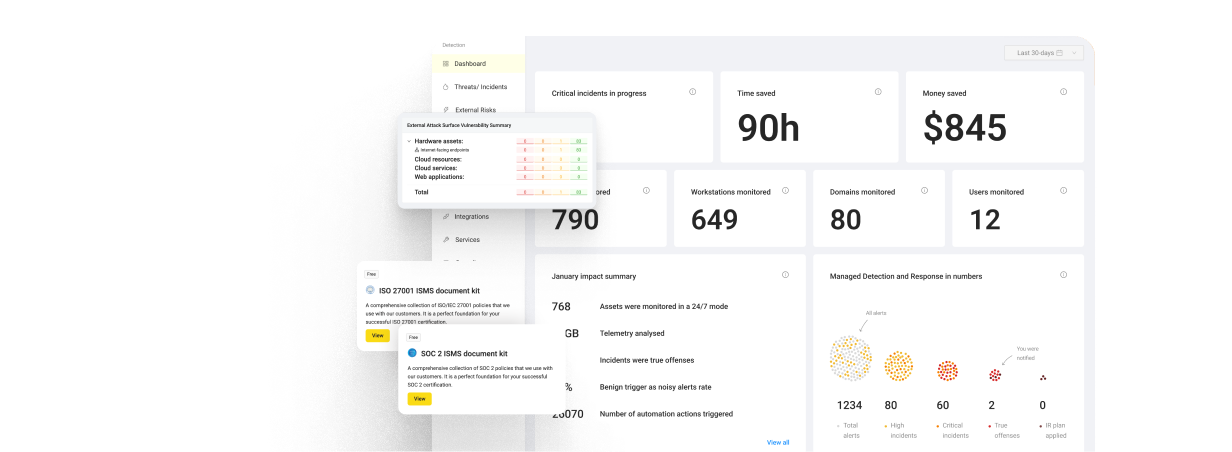
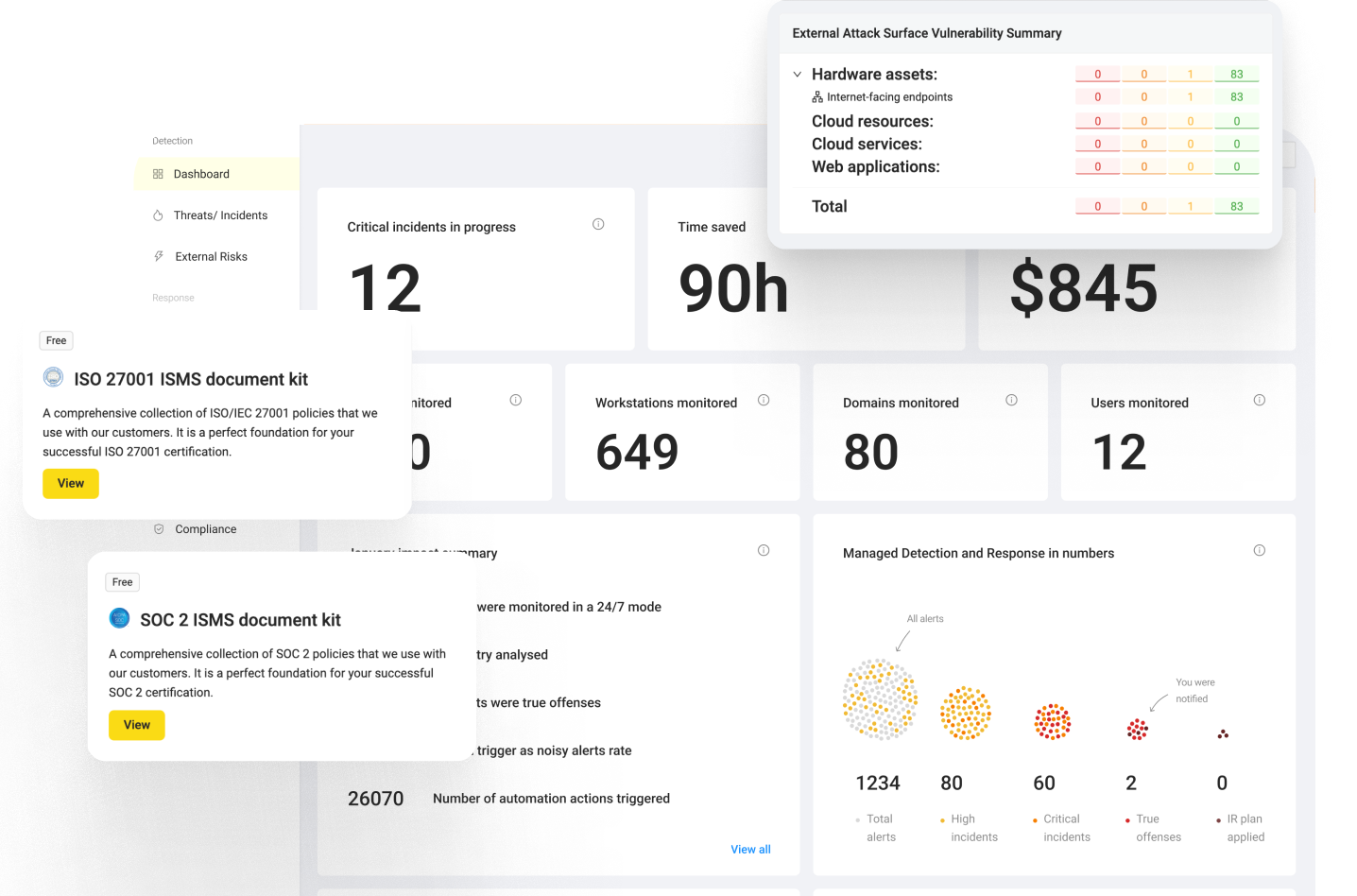
If your team runs CrowdStrike, Microsoft Defender or SentinelOne and nobody watches the alerts at night, the UnderDefense Agentic AI SOC works on top of those tools without replacing them. AI agents triage every alert in about 2 minutes from alert to triage, and 24/7 analysts make the response decision, with a 20-minute SLA response time for critical alerts. Your team wakes up to the investigation.
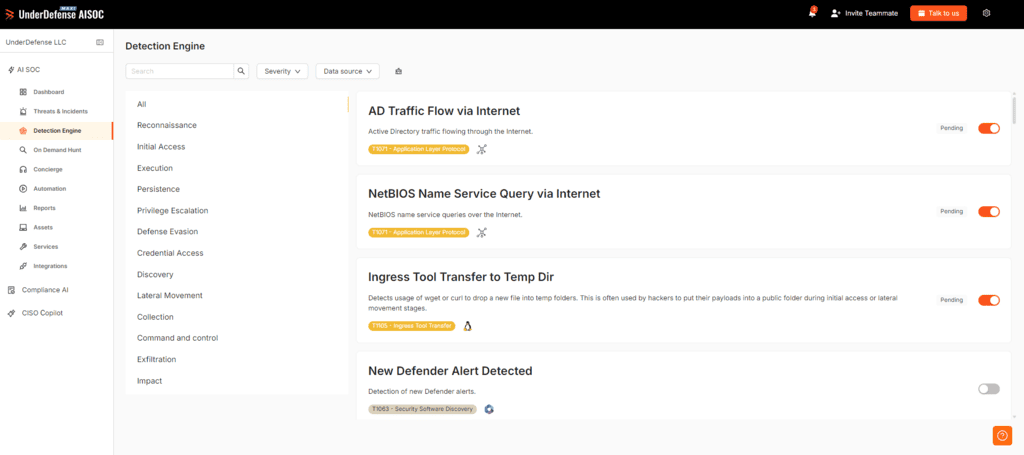
- 24/7 monitoring and response across endpoints, identities, cloud, SaaS, email, and network.
- Analysts confirm suspicious activity with the affected user over Slack, Microsoft Teams, email or SMS before escalating, so a legitimate login does not turn into an incident.
- 250+ integrations, including CrowdStrike, Microsoft Defender, SentinelOne, Elastic and Splunk, so you keep the tools you already pay for.
UnderDefense field notes:
- In a December 2024 Black Basta ransomware attempt, UnderDefense spotted DarkGate and Cobalt Strike activity, acknowledged it in 5 minutes and resolved it in 43 minutes.
- In another case, the team found 11 servers already beaconing Cobalt Strike during onboarding and cleaned them in under 24 hours, avoiding a potential $650K loss.
What to watch out for:
- It does not sell an endpoint agent, so it needs an EDR or SIEM you already run, such as CrowdStrike, Microsoft Defender or Splunk.
- Paid tiers are quoted, so confirm which data sources and response actions a quote covers.
UnderDefense 24/7 monitoring starts from $11 per device per month, and paid tiers are quoted to your coverage and asset count. You can test it on your own stack with a 14-day free trial, and the cost calculator gives a first estimate.
Get 360° Protection with a 24/7 AI-fueled SOC
An Agentic AI SOC that detects, investigates and responds to threats in under 5 minutes, 24/7, on top of your stack.
2. Blackpoint Cyber
Blackpoint Cyber is a 24/7 SOC platform built for MSPs and small/mid-sized businesses. You get an endpoint agent, managed EDR, Microsoft 365/cloud monitoring, and a human-led SOC that watches, investigates, and contains threats.
Blackpoint Cyber field notes:
- G2 reviews emphasize a responsive SOC and easy deployment.
What to watch out for:
- Ask how firewall and network logs are covered, since the core offer centers on the endpoint agent, managed EDR and Microsoft 365.
Blackpoint Cyber does not publish prices: its Capterra listing shows “Contact vendor” for pricing as of October 2026. Budget from a partner quote, and ask for the per-endpoint rate, the contract term and which add-ons are included.
3. Cynet 360 AutoXDR + SOC
Cynet 360 AutoXDR is an all-in-one XDR + SOC stack aimed at lean IT and SMB teams: one agent, one console, and 24/7 CyOps MDR bundled in for endpoint, network, user, SaaS/cloud, and email protection. It’s pitched as “security that doesn’t need a big security team,” with automated detection/response and a managed SOC on top.
Cynet field notes:
- Admins like that Cynet consolidates EDR, XDR, automation, and MDR into a single stack.
- Cynet markets itself as “purpose-built” for SMEs and MSPs to replace a tool pile with a single multi-tenant platform.
What to watch out for:
- Every package runs on the Cynet agent, so plan the switch from your current endpoint tool and test it on your busiest machines in the PoC.
- Email security is included only in the All-in-One package, so check which package a quote assumes.
Cynet does not publish prices: its packages page routes every buyer to a quote for the Protect, Elite and All-in-One packages. Ask for an Elite quote when you compare with Huntress, since Protect does not include the 24/7 CyOps MDR team.
4. Blumira: AI-enabled SOC
Blumira is a cloud SIEM + XDR platform “purpose-built with smaller teams in mind”. It combines log collection, detections, endpoint visibility, and automated response in one platform, with options to add 24/7 SecOps-style support on higher tiers.
Blumira field notes:
- Built for small teams: Blumira markets itself as a cloud SIEM/XDR designed for “resource-strapped IT teams.” Some users call out easy implementation and setup.
- Their content leans hard into Microsoft 365 and general SMB security. G2 reviews stress fast O365 and cloud integrations for fully SaaS-based companies.
- Reviews say deployment is quick, detections are filtered to reduce noise, and support steps in to fine-tune rules.
What to watch out for:
- Round-the-clock help depends on the edition: 24/7 incident support starts at Respond, while Detect includes concierge support from 9 a.m. to 8 p.m. ET.
- You’ll likely need at least one on-prem sensor/collector VM to pull AD and other on-prem logs. It’s not 100% “no infra” for hybrid estates. This comes up in reviews referencing the deployment of sensors and hybrid log collection.
Blumira pricing is published: $12 per employee per month for Detect, $16 for Respond and $21 for Automate, counted by knowledge workers, meaning people with a corporate email address and a device.
For a 200-employee company, Respond or Automate comes to $3,200 to $4,200 a month. Blumira also charges a one-time onboarding fee of $500 on Detect and $250 on Respond; it is included with Automate.
5. ConnectWise Managed EDR (Formerly ConnectWise MDR)
ConnectWise MDR, now sold as ConnectWise Managed EDR, is a 24/7 managed detection and response service built for MSPs that secure small and mid-sized businesses. It runs on top of EDR tools like Bitdefender, Microsoft Defender for Business, or SentinelOne: those agents collect endpoint telemetry, while the ConnectWise SOC watches alerts 24/7 and handles responses.
ConnectWise MDR field notes:
- There are dedicated SKUs like ConnectWise MDR with Microsoft Defender for Business and ConnectWise MDR for Microsoft 365 that plug directly into Microsoft’s SMB security stack.
- ConnectWise and Microsoft both market this as a way to extend MSP teams with a 24/7 SOC and a cyber research unit (CRU), without adding headcount.
What to watch out for:
- ConnectWise MDR focuses on managed endpoint defense and some Microsoft 365 coverage. Broader log/XDR correlation and long-term retention live in ConnectWise SIEM (former Perch) and related offerings, which is a separate adoption and cost line item.
ConnectWise pricing is not published: the pricing page routes buyers to a quote form. Ask whether ConnectWise SIEM is in the quote, since log correlation and long-term retention sit in that separate product.
12 Questions Every AI SOC Vendor Hates to Hear
Learn questions that force evidence and accountability.
6. ThreatDown (Malwarebytes)
ThreatDown (powered by Malwarebytes) is an all-in-one endpoint security + MDR platform aimed at resource-constrained IT teams and MSPs. Malwarebytes explicitly pitches ThreatDown as a platform for “IT-constrained organizations” with bundled EDR, MDR, and email/DNS protection so smaller teams don’t have to stitch tools together. You get EDR, ransomware rollback, vulnerability assessment, firewall management, and 24/7 MDR on the Elite and Ultimate tiers, with DNS filtering and email security sold as add-ons.
ThreatDown field notes:
- In G2’s Winter 2024 reports, ThreatDown EDR and ThreatDown MDR both picked up “Leader” in ease-of-use.
- G2 reviewers highlight an intuitive interface, strong protection against infections and data leaks, and quick issue resolution from the console.
What to watch out for:
- ThreatDown MDR is still EDR-centric. If you need heavy SIEM-style ingestion and broad third-party log correlation, you may find limits compared to larger XDR/SIEM platforms.
- You’ll want to model device counts and tier choice carefully. Elite and Ultimate with MDR, plus DNS and email add-ons, are positioned for organizations that need 24/7 analyst coverage and can push you into mid-tier MDR pricing.
ThreatDown pricing is published per bundle and shown in the visitor’s local currency. Viewed from Europe on October 19, 2026, a 12-month Elite MDR bundle for five devices listed at €481.15, about €96 per device, and the Core bundle at €335.35. Check the price in your own currency before you compare.
7. Barracuda Managed XDR (Formerly SKOUT)
Barracuda SKOUT Managed XDR is Barracuda’s MSP-first managed XDR + 24/7 SOC service, built to give real-time monitoring and response across endpoints, email, cloud, and network for SMB and mid-market clients. Barracuda entered this space by acquiring SKOUT Cybersecurity.
Barracuda SKOUT Managed XDR field notes:
- Barracuda leans into gateway-style email + firewall + endpoint, whereas Huntress focuses on endpoints and Microsoft 365 identity/email (BEC, account takeover) via Managed ITDR.
- Users say Barracuda Managed XDR is easy to deploy, affordable, and SMB-friendly, which makes it easier to roll out to smaller customers and keep them well-protected.
- Reviews highlight 24/7 traffic monitoring, fast and detailed security alerts, and a SOC that can isolate suspicious machines and guide remediation.
What to watch out for:
- Plan a tuning period after rollout, and ask Barracuda how long it took for customers of your size and stack.
- Ask how much of the raw alert data your team can query on its own, and how the SOC shares its investigations.
Barracuda does not publish a Managed XDR list price: its build-and-price page configures a quote through sales or a partner. Ask each partner to price the same user or endpoint count and the same data sources.
8. Guardz
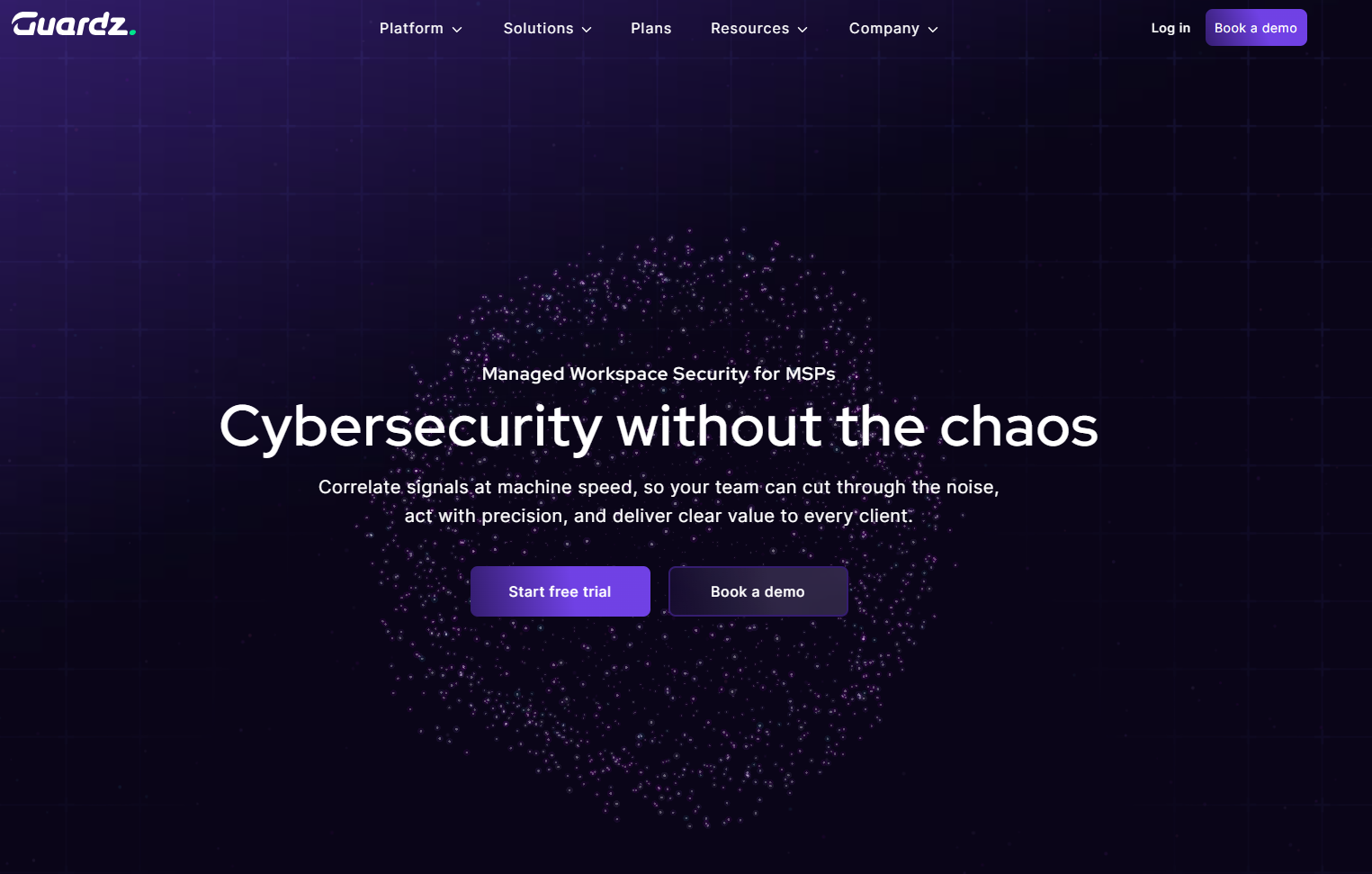
Guardz is a unified cybersecurity platform built for MSPs protecting small and mid-sized businesses. It brings endpoint, identity, email, and external exposure protection into one multi-tenant console, alongside security awareness training. Ultimate and Elite add 24/7 MDR, combining AI-assisted investigation with human analysts who investigate and contain threats across client environments.
Guardz field notes:
- Its identity threat detection and response connects identity, email, and endpoint signals to uncover compromised accounts, with support for Microsoft 365 and Google Workspace. MSPs can investigate incidents and take containment actions from the same console.
- Ultimate and Elite bundle SentinelOne EDR and Check Point email security, giving MSPs a way to consolidate protection across multiple SMB clients.
What to watch out for:
- Pro does not include the 24/7 MDR service, so compare Ultimate or Elite with Huntress when you need ongoing monitoring and managed response.
- Endpoint and email capabilities differ by plan. Elite includes deeper endpoint telemetry, forensic investigations, and outbound email DLP, so confirm which capabilities your quote includes.
Guardz pricing is quote-based, per user, with no public list price. A 14-day free trial is available. Ask for the plan, endpoint allowance, and managed response coverage to be specified when comparing quotes.
9. Arctic Wolf SOC-as-a-Service
Arctic Wolf offers SOC-as-a-service, now sold as Aurora Managed Detection and Response, with a Concierge team of security experts that plugs into your environment. You get 24/7 monitoring and guided response across endpoints, network, cloud, and SaaS, delivered from their Security Operations Cloud and positioned very explicitly at mid-market and SME customers.
Arctic Wolf field notes:
- Arctic Wolf pitches its Concierge team as “your” security team: analysts tune detections, investigate incidents, and coach you on hardening and cloud posture over time.
- In June 2024, Arctic Wolf MDR won “Best SME Security Solution” at the SC Awards Europe, reinforcing that they’re seen as an SME-centric MDR platform.
What to watch out for:
- Agree on noise targets with your Concierge team for the first weeks, since detection tuning shapes how many tickets reach you.
- By default, Arctic Wolf retains logs for 90 days; longer retention is purchased separately, according to its 2026 MDR terms.
Arctic Wolf does not publish prices, so quotes come through sales and partners. When you compare Arctic Wolf pricing with other quotes, check the retention term first, since anything beyond 90 days is an extra line.
10. Sophos MDR
Sophos MDR is a 24/7 managed detection and response service that puts a human SOC on top of Sophos Intercept X endpoint/XDR and can also monitor parts of your existing stack (firewall, email, cloud, identity) via integration packs. It’s a common “one vendor for AV + MDR” choice for SMBs that don’t want to run their own SOC.
Sophos MDR field notes:
- Recent small-business reviews say it’s easy to set up, with support that feels like an extension of their team.
- Sophos lists two MDR tiers, Sophos MDR and Sophos MDR Plus, each with 90 days of data storage; one-year storage is an add-on license.
- Sophos also sells integration packs (for third-party firewall, network, email, cloud, identity) as extra licenses, which can add to TCO if you want broad cross-vendor coverage.
Sophos does not publish MDR prices, and Sophos pricing varies by reseller. A Carahsoft listing on AWS Marketplace, checked on October 19, 2026, shows Central MDR Complete at $239.69 per endpoint for 12 months, about $20 a month, with Intercept X and XDR included. Third-party integration packs are licensed per user on top.
What Drives MDR Costs? Get the MDR Pricing Guide
See how data volume, retention, and coverage hours swing cost.
Which Huntress Alternatives Should You Shortlist?
You don’t need ten vendors in a spreadsheet. You need 3–4 that fit your stack and budget. A simple approach is:
- Pick one endpoint-centric MDR/XDR: e.g., Blackpoint Cyber or ThreatDown/Cynet.
- Pick one provider that works on top of your tools: for example, UnderDefense or Arctic Wolf.
- Optionally add one SIEM/XDR-first option: for example, Blumira, ConnectWise or Barracuda Managed XDR.
Then put all of them through the same PoC scorecard and see who wins on outcomes.
Should You Replace Huntress or Add to It?
Replace Huntress if you want one agent, one console and one contract; add a provider next to it if its endpoint coverage works for you and the gap sits elsewhere. The choice changes which vendors in this list fit:
- Replace: Cynet, ThreatDown, Blackpoint Cyber and Sophos MDR bring their own endpoint agent and SOC, so plan the agent swap and an overlap period.
- Add: when the gap sits in firewall, cloud or SaaS logs, a provider that works on top of existing tools, such as UnderDefense, or a SIEM such as Blumira can cover those sources. Ask each one whether Huntress is on its integration list.
Either way, ask how long the overlap runs, who owns response during it, and whether your Huntress term ends before the new contract starts.
Run Every Huntress Alternative Through This PoC Checklist
You can literally turn this table into a one-page scorecard, run the same tests for Huntress and each alternative, and let the PoC results decide your shortlist.
What to test | How to test it |
Coverage on your real stack | Integrate your endpoint security, email, and identity platform, core directory/SSO, firewall/VPN, and 1–2 critical SaaS apps. Ask them to show exactly what they ingest and correlate. |
Detection & response speed | Simulate or replay known test incidents (malicious login, ransomware simulation, suspicious PowerShell, risky OAuth app). Measure time from the event to the human action. |
Noise vs. signal | Run the PoC for 2–4 weeks during “normal” operations. Count the tickets/alerts you get and how many are actually useful. |
Quality of investigations | Review 5–10 real incidents they handled during PoC. Look at narratives, evidence, and recommendations. |
Containment and authority | Ask what they’re allowed to do automatically (isolate host, kill process, disable account) and what requires approval. Test at least one live containment action. |
Impact on your team | Track how many hours your staff spend on setup, tuning, and weekly operations during the PoC. |
Reporting & exec views | Ask for their standard monthly/quarterly reports and dashboards. Can you slice by customer/site (for MSPs) or by business unit (for SMBs)? |
Pricing & TCO clarity | Get a real quote for your current size + 1–2 growth scenarios. Ask exactly what happens to pricing as you add endpoints/log sources. |
Score Huntress on the same rows, so every vendor, the incumbent included, is judged on the same evidence.
How Do You Ensure 360° Protection?
Whichever provider you pick, the first weeks decide the outcome. Someone on your side still has to connect log sources, set what the SOC may do on its own, validate detections and keep tuning until the alerts that reach you are the ones that matter.
Those weeks carry real risk: Verizon’s 2026 DBIR found ransomware in 48% of breaches, and a breach averaged $4.99 million worldwide in IBM’s 2026 Cost of a Data Breach study.
If your team would rather spend those weeks on its own projects, UnderDefense handles that work. It builds an agentic AI platform that unifies security operations and compliance on top of the stack you already own:
- Keep your stack. The Agentic AI SOC works on your existing EDR, identity provider, SIEM and key SaaS and cloud platforms, with no rip-and-replace project.
- AI triage, human decisions. AI agents triage and enrich alerts, and analysts take the calls that are risky or legally sensitive.
- Tuning handled. The team owns the tuning loop during onboarding and after, so your team is spared rewriting rules to keep alert volume down.
- Auditable work. Every investigative step is visible, so you can check minutes to action on your own incidents.
Comparing Huntress with the providers above? Bring one noisy alert from your current setup and book a triage demo.
Get a 24/7 SOC That Augments Your Team
Analysts investigate every alert and watch your stack 24/7.