






Key takeaways:
- Fourteen events remain on the cybersecurity events calendar 2026, running September 22 to December 19, from Gartner’s London summit to the SANS training week in Washington that closes the year.
- Every date and venue below was checked against the organizer’s own page. Aggregator listings are unreliable: three separate sites place the Gartner Identity & Access Management Summit in Grapevine, Texas, when Gartner’s own page says Las Vegas, December 7 to 9.
- AI risk has become the organizing theme of the fall calendar. SecTor, Microsoft Ignite, AWS re:Invent and the NYC Security Leadership Summit all built agenda time around what agentic tools do inside a production environment.
- AI now tops the list of skills practitioners say they need, at 41% in ISC2’s 2025 workforce study, which makes conference selection a training decision as much as a networking one.
The last quarter of the year is when the conference budget either gets spent or gets clawed back, and the calendar between now and New Year is tighter than most people expect. Search for cybersecurity events 2026 and most of what comes back is an annual calendar whose best entries are already behind you. What is left is roughly thirteen weeks and fourteen credible events, several of them stacked into the same week.
This is the working calendar for a security leader deciding where to spend two or three days. Each entry carries the dates and venue exactly as the organizer publishes them, who the room is actually built for, and what is on the agenda that justifies the travel. Events are listed in date order, September through December.
The whole list was compiled and date-checked in September 2026 by the security team at UnderDefense, a cybersecurity company, rated 4.9 out of 5 across 66 reviews on Clutch.
What Makes a Cybersecurity Event Worth a Calendar Slot in 2026
A conference earns three days of a security leader’s time when it does something a webinar cannot. That usually means one of three things: access to practitioners who have already solved the problem you are working on, structured time with analysts or regulators who set the rules you have to follow, or hands-on training that converts into a capability your team keeps.
The fall 2026 calendar splits cleanly along those lines. Analyst-run summits like Gartner’s sell research access and peer benchmarking. Vendor conferences like Microsoft Ignite and AWS re:Invent sell roadmap visibility, which matters if your detection stack sits on their platform. Practitioner conferences like SecTor and Wild West Hackin’ Fest sell technical depth. Executive summits sell the room itself.
Treating all four as interchangeable is the expensive mistake. A CISO who needs to justify a detection rebuild to a board gets more from an analyst summit than from a technical conference, and a team that needs to close a specific coverage gap gets more from training week than from either. The operational shifts these agendas are responding to are mapped in more detail across AI SOC trends.
Cybersecurity Events 2026: The Complete Fall Calendar
The cybersecurity events calendar 2026 closes with fourteen entries between September 22 and December 19, with dates and venues taken from each organizer’s own site in September 2026.
| Event | Dates | Location | Format | Built for |
| Gartner Security & Risk Management Summit | Sep 22–24 | ExCeL, London, U.K. | In person | CISOs, security leaders |
| NYC Security Leadership Summit | Sep 28 | Midtown Manhattan, NYC | In person | Security leaders managing AI risk |
| Cyber Security Summit (series) | Sep 30 to Dec 2 | 12 US and Canadian cities | In person and online | Regional security executives |
| SecTor | Oct 6–8 | Metro Toronto Convention Centre | In person | Practitioners and executives |
| Wild West Hackin’ Fest | Oct 7–9 | Deadwood, South Dakota | In person and virtual | Hands-on practitioners |
| InfoSec World | Oct 11–15 | Gaylord Palms, Orlando, FL | In person | Directors through C-level |
| GovWare | Oct 13–15 | Sands Expo, Singapore | In person | Government and APAC enterprise |
| ISC2 Security Congress | Oct 24–28 | Gaylord Rockies, Aurora, CO | In person and virtual | Certified professionals, GRC |
| Microsoft Ignite | Nov 17–20 | Moscone Center, San Francisco | In person and digital | Microsoft-stack security leaders |
| ISC2 SECURE London | Nov 19 | London, U.K. | In person | Regional practitioners |
| AWS re:Invent | Nov 30 to Dec 4 | Las Vegas, NV | In person | Cloud security architects |
| Gartner Identity & Access Management Summit | Dec 7–9 | Las Vegas, NV | In person | Identity and access leaders |
| Black Hat Europe | Dec 7–10 | ExCeL, London, U.K. | In person | Researchers and practitioners |
| SANS Cyber Defense Initiative | Dec 14–19 | Grand Hyatt Washington, DC | In person and online | Teams buying training |
Three of those fourteen sit in the first ten days of December, so anyone planning end-of-year travel is choosing between London, Las Vegas and Washington.
1. Gartner Security & Risk Management Summit
Gartner’s European flagship is the closest thing the calendar has to a benchmarking exercise, and it opens first on this list.
When: September 22 to 24, 2026 Where: ExCeL, London, U.K. Built for: CISOs, cybersecurity leaders, Gartner analysts and service providers
The draw is analyst access more than the session catalog. One-on-one time with the analysts who write the research your board reads is the part that does not replicate anywhere else, and the peer roundtables put you in a room with people carrying the same regulatory load.
The 2026 agenda runs on AI, cyber resilience, security operations, cloud security, identity and data protection, with the European regulatory set (NIS2, DORA, the EU AI Act) threaded through. For a security leader with European operations, that regulatory track alone can justify the trip.
2. NYC Security Leadership Summit
A single-day summit built around one question: what actually happens when agentic AI tools operate inside a production environment.
NYC Security Leadership Summit among cybersecurity events 2026
When: September 28, 2026 Where: Midtown Manhattan, New York City Built for: Security leaders actively managing AI risk in production
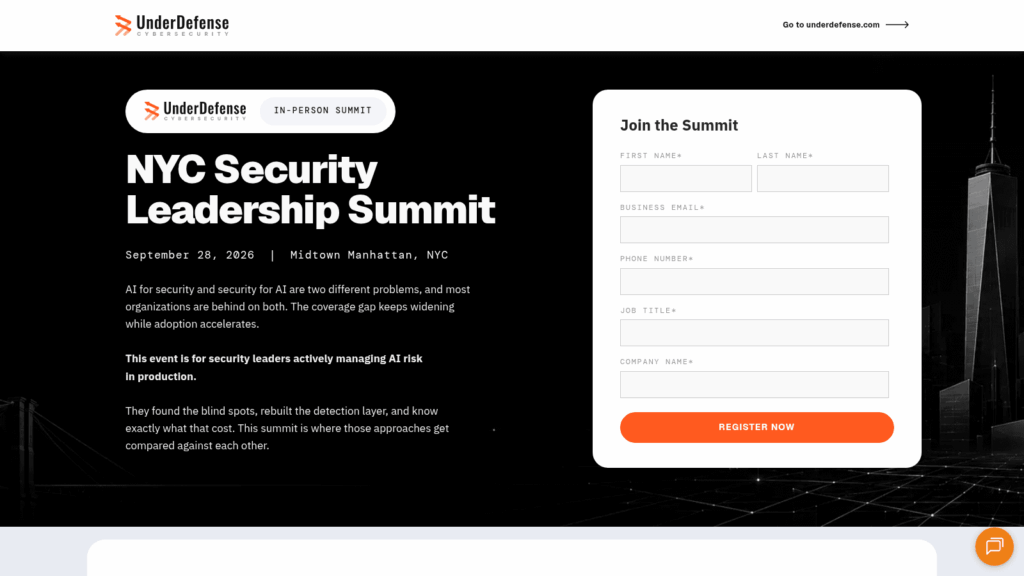
The framing separates AI for security from security for AI and argues most organizations are behind on both. The agenda is short and speaker-led: an opening keynote from UnderDefense CEO Nazar Tymoshyk, a featured session from Andrew Hural on rebuilding zero trust for an AI-heavy environment and what the rebuild cost, then Travis Farral, VP and CISO at Archaea Energy, on Microsoft-specific controls for modern SecOps.
The afternoon runs a boardroom session with Alex Waintraub of Waintraub Cyber Solutions on adversarial use of AI, and a session from Arlin Ohmes, CISO at Helpware, on containing blast radius when engineering teams adopt agentic tooling. Peer-to-peer meetings are matched by shared priorities, so the introductions are deliberate.
Registration and the full agenda sit on the summit page, and the venue is shared with confirmed attendees. Breakfast, lunch and direct speaker access are included, which is the practical difference between a working day and a trade show.
3. Cyber Security Summit (Series)
Not one event but twelve, running city by city from the end of September through early December, each a single day.
When: September 30 (Atlanta) through December 2 (Jacksonville) Where: Atlanta, Bellevue, Boston, Silicon Valley, Los Angeles, Charlotte, Dallas, Houston, New York, Vancouver, Scottsdale and Jacksonville, plus online editions Built for: Regional security executives who cannot justify a week away
The value here is proximity. A one-day summit at the Sheraton in Times Square on November 17 costs a security director in New Jersey a single day, where a multi-day conference costs a week plus a flight. The tradeoff is depth: these are executive-briefing days with a heavy vendor presence, so the agenda moves faster and goes shallower than a multi-day conference.
The series also runs themed online editions, including an AI Exposure Summit on October 21 and a Cloud Security edition on December 2. Those are worth a calendar hold for team members who cannot travel at all.
4. SecTor
Canada’s principal security conference, now part of the Black Hat family, and the one on this list where the AI agenda is most explicitly about governance.
SecTor among cybersecurity events 2026
When: October 6 to 8, 2026 Where: Metro Toronto Convention Centre Built for: Practitioners and executives, with separate tracks for each
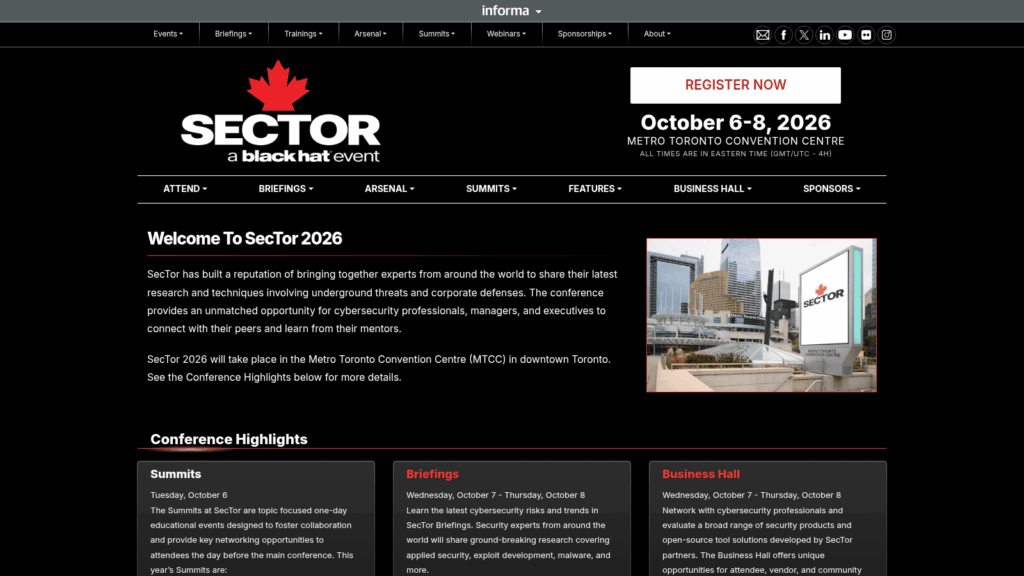
SecTor front-loads its Summits onto Tuesday October 6, including an Executive Summit and an AI x Cloud Security Summit, then runs the technical Briefings across October 7 and 8. A CISO can take the Tuesday and send two engineers for the back half. The 2026 keynote list includes Helen Oakley on who gets to decide security in the agentic enterprise, and Ronald J. Deibert on counterintelligence for civil society.
For US-based teams, Toronto is a cheap flight and a genuine change of peer group. The Canadian regulatory and threat picture differs enough from the US one that the hallway conversations are not the same conversations you had in Las Vegas in August.
5. Wild West Hackin’ Fest
The most hands-on event on the fall calendar, and the one least likely to appear in a corporate travel request.
Wild West Hackin Fest among cybersecurity events 2026
When: Conference October 7 to 9, 2026, with pre-conference training October 6 to 7 Where: Deadwood, South Dakota, in person and virtual Built for: Practitioners who want to come home able to do something new
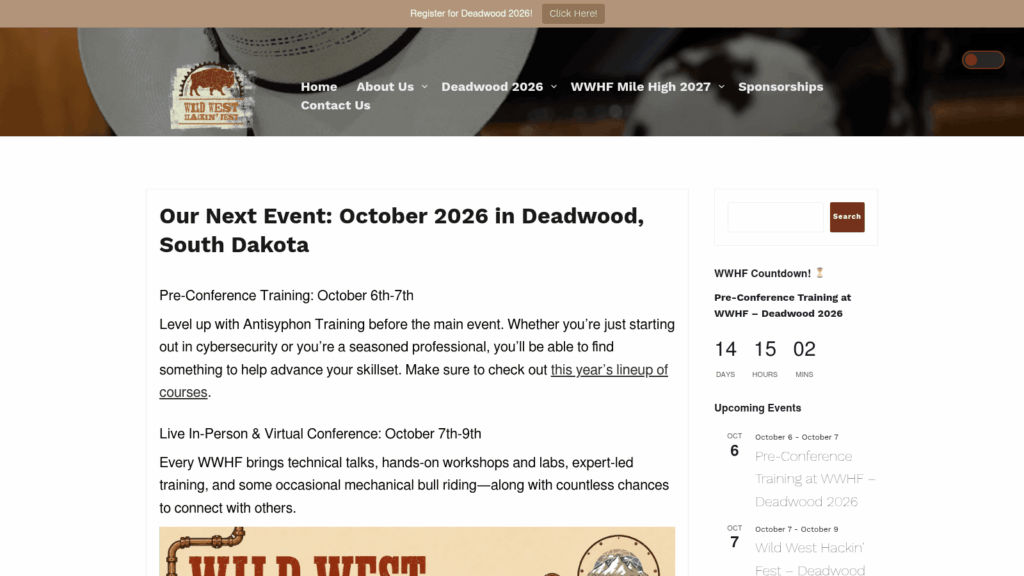
Two days of pre-conference training run before the three conference days, which makes this the best value on the list for a team that needs a specific skill. The virtual option is properly supported, so a lead can attend in person while the rest of the team follows remotely.
Send the people who will implement. Approvers get the write-up afterward. This is where an engineer comes back with a detection they wrote themselves.
6. InfoSec World
One of North America’s larger security conferences, and the one with the most leadership-heavy attendee mix on this list.
InfoSec World among cybersecurity events 2026
When: October 11 to 15, 2026 Where: Gaylord Palms Resort & Convention Center, Orlando, Florida Built for: Directors through C-level, with practitioner tracks alongside
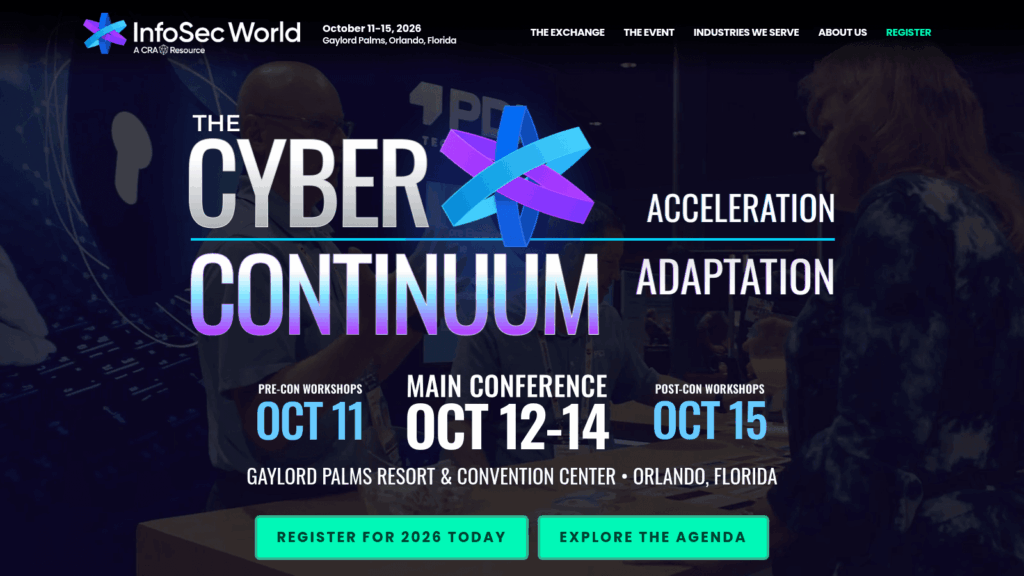
The organizer publishes its attendee breakdown, which is more than most events do: 30% directors, 23% practitioners, 20% managers, 11% VP or SVP level and 11% C-level, drawn from more than 400 organizations and over 2,500 security professionals. That mix means the peer conversations happen at roughly your altitude.
Five days is a long commitment. The workshops and summits sit at the front and back of the week, so a leader who only wants the main conference can fly in for the middle three days and still get the substance.
7. GovWare
Singapore’s flagship security event and the anchor of Singapore International Cyber Week.
When: October 13 to 15, 2026 Where: Sands Expo and Convention Centre, Singapore Built for: Government, critical infrastructure and APAC enterprise security leaders
If your organization has operations, customers or data residency obligations in the Asia-Pacific region, this is the event where the regional regulatory direction gets discussed in the open. The government presence is substantive, with regulators speaking on the record.
For a US-headquartered company with no APAC footprint, this one is skippable. For anyone building out in the region, it replaces a quarter of scheduled meetings.
8. ISC2 Security Congress
The certification body’s annual conference, built around CPE credits and career development as much as content.
When: October 24 to 28, 2026 Where: Gaylord Rockies Resort & Convention Center, Aurora, Colorado, plus virtual Built for: Certified professionals, GRC leads and cyber leadership tracks
The agenda spans GRC, cyber leadership, cloud security, SecOps, software security and career development, drawing several thousand professionals. The CPE economics matter here: ISC2 members can earn up to 81.5 credits depending on pass type, with up to eight credits per one-day workshop.
If you have certified staff whose credits are due, the arithmetic of sending them here is usually straightforward. ISC2 also runs two shorter regional days later in the year, SECURE London on November 19 and SECURE Los Angeles on December 10, both single-day and both a fraction of the travel cost.
9. Microsoft Ignite
Microsoft’s flagship technical conference, and unavoidable if your detection stack runs on Defender, Sentinel or Entra.
Microsoft Ignite among cybersecurity events 2026
When: November 17 to 20, 2026 Where: Moscone Center, San Francisco, plus a free digital experience Built for: Business leaders, security leaders, IT professionals and developers
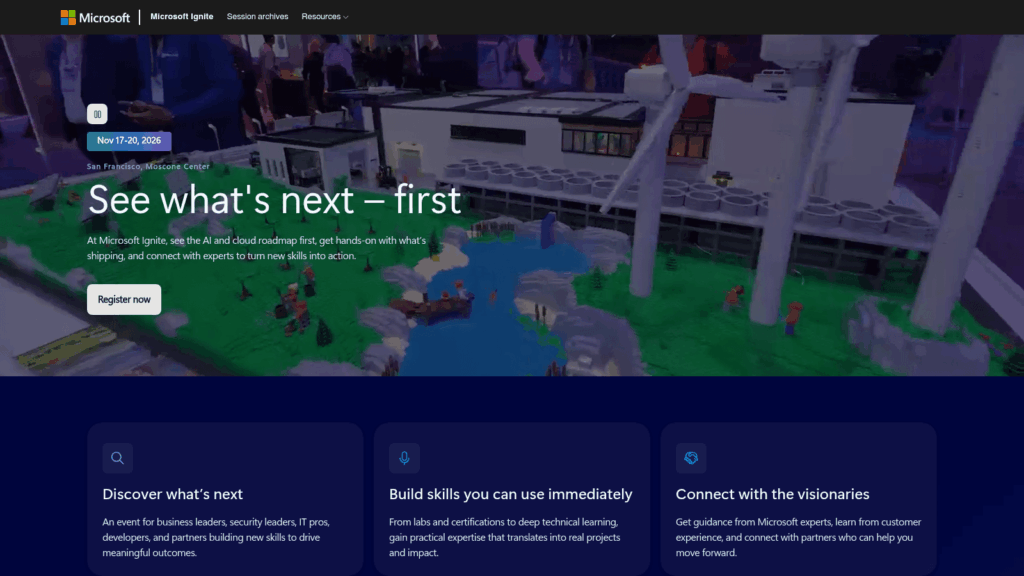
Microsoft names security leaders explicitly in its own audience description, which reflects how much of the security roadmap now ships through Ignite, with no separate Microsoft security event to wait for. If a Microsoft product decision will shape your 2027 architecture, this is where it gets announced.
The digital experience streams keynotes and much of the session catalog at no cost, so the real decision is whether the hallway access and engineering office hours justify the trip. For teams with an open Sentinel migration or a Defender consolidation underway, they usually do.
10. AWS re:Invent
The largest cloud conference of the year, with a security track substantial enough to justify attendance on its own.
When: November 30 to December 4, 2026 Where: Las Vegas, Nevada Built for: Cloud security architects and engineering leaders
AWS positions the week around cloud and AI, and the security sessions have grown alongside the AI services, so the material tracks what actually shipped. For a security team responsible for AWS workloads, the value is in the detail sessions and the direct access to service teams.
Las Vegas the week after Thanksgiving is expensive and crowded. Book early or accept a long walk between venues.
11. Gartner Identity & Access Management Summit
The one event on this list where the published date is most often reported wrong.
Gartner Identity and Access Management Summit among cybersecurity events 2026
When: December 7 to 9, 2026 Where: Las Vegas, Nevada Built for: Identity, access and security leaders
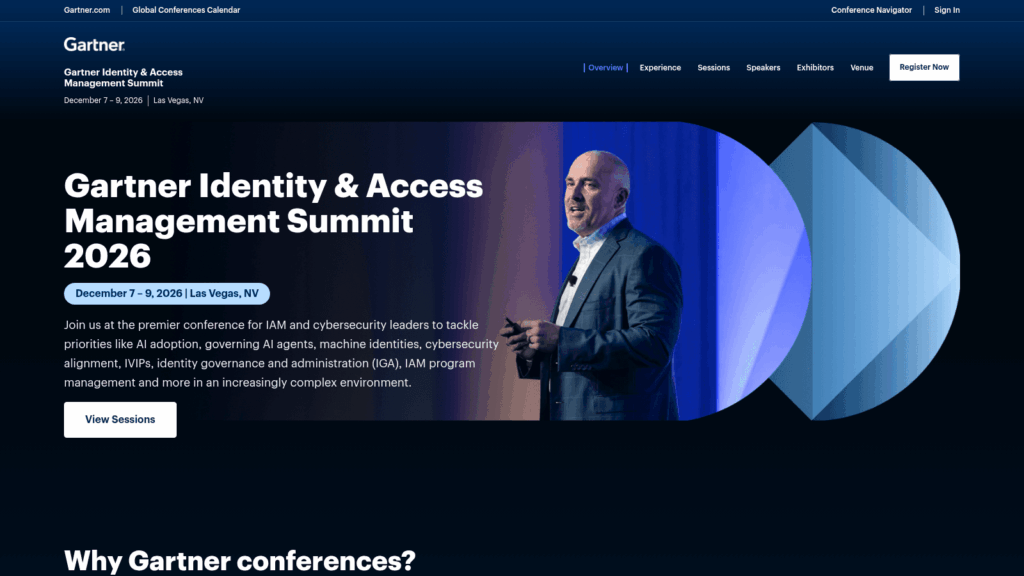
Multiple vendor and aggregator pages place this summit in Grapevine, Texas, on December 8 to 10 or December 9 to 11. Gartner’s own conference page says Las Vegas, December 7 to 9. Check the organizer’s page before booking anything, on this event especially.
Identity has become the practical control point for agentic AI, since an autonomous tool acting in your environment is acting as some identity with some set of entitlements. That connection makes an identity summit more relevant to the AI risk conversation than the name suggests, a link worked through in this analysis of AI risk management.
12. Black Hat Europe
The European edition of the research conference, four days at the same venue Gartner used in September.
When: December 7 to 10, 2026 Where: ExCeL, London, U.K. Built for: Researchers, practitioners and technical security leaders
Black Hat Europe runs trainings, briefings, Arsenal tool demonstrations and the business hall across four days. The briefings are original research, which is a different proposition from the vendor-led sessions that dominate most of the fall calendar.
Black Hat Europe collides directly with the Gartner IAM Summit. A security organization sending people to both is sending different people.
13. SANS Cyber Defense Initiative
A training week, and the last significant event of 2026.
When: December 14 to 19, 2026 Where: Grand Hyatt Washington, Washington, DC, in person and online Built for: Teams spending remaining training budget before the year closes
Six days of course-based instruction, with the refund deadline on November 27 and the hotel group rate closing November 23. Those two dates matter more than the event date if you are still waiting on approval.
This is where unspent Q4 training budget goes to become a capability. ISC2’s 2025 workforce study, published in December 2025, found 95% of respondents reporting at least one skill need and 59% citing critical or significant needs, which makes a week of structured training an easier business case to write than it was two years ago.
14. The Regional and Online Editions
Worth a separate line because they solve a different problem: coverage for people who cannot travel.
When: Throughout October, November and December Where: Online, plus single-day regional events Built for: Team members who need content without a week of travel
The Cyber Security Summit series runs online editions on themed topics including identity, financial sector security, AI exposure and network security. Wild West Hackin’ Fest, ISC2 Security Congress and SANS all offer virtual attendance alongside the in-person program.
A sensible pattern for a small team is one person in the room and the rest online. Your on-call rotation does not pause because there is a conference.
How This Calendar Was Built and Checked
Most cybersecurity conferences 2026 roundups take their dates from the same handful of directories. Every date and venue above came from the organizer’s own website in September 2026, and none of it came from a conference aggregator. That distinction turned out to matter more than expected.
The selection criteria were narrow on purpose:
- The event runs between September 21 and December 31, 2026.
- The dates and venue come from the organizer’s own page, with directory listings treated as a lead to follow up.
- The agenda is relevant to a security leader with budget authority, beyond the specialist audience.
- The event is open to public registration.
Three well-known aggregator sites put the Gartner Identity & Access Management Summit in the wrong state across two different date ranges, and entry 11 above carries the correction. One Australian conference page was still displaying its 2025 dates in September 2026.
The practical lesson is to book against the organizer’s page, always. A directory entry is a starting point for finding an event, and it is not evidence of when that event happens.
How to Choose Between Two Events in the Same Week
December forces the choice. Black Hat Europe and the Gartner IAM Summit run December 7 to 10 and December 7 to 9 respectively, on two continents, and no one attends both.
The question that resolves it is what you need to bring back. The table below is our own framing, and the organizers publish nothing like it:
| If you need to… | Go to | Because |
| Justify a budget request to a board | Analyst summit (Gartner) | Research citations and peer benchmarks travel into a board deck |
| Close a specific technical gap | Training week (SANS, Wild West Hackin’ Fest) | Your team comes back able to do the thing |
| Understand a platform roadmap | Vendor conference (Ignite, re:Invent) | Roadmap detail is not published anywhere else |
| Pressure-test an architecture decision | Practitioner summit (NYC Security Leadership Summit) | Peers who made the same decision will tell you what it cost |
| Renew certifications economically | ISC2 Security Congress | CPE credits at volume |
The framing that fails is sending the same two people to everything. A director who attends four conferences a year and implements nothing from any of them has spent twelve days and a travel budget on a networking habit. Leaders carrying the security remit without a full security organization behind them face this sharpest, which is part of why fractional models like a virtual CISO exist at all.
What the 2026 Agendas Have in Common
Read the fall session lists side by side and the same subject keeps appearing under different names: what happens when software that acts on its own gets access to production systems.
SecTor hands a keynote slot to the governance question of who signs off on autonomous tooling. The NYC summit’s stated premise is that agentic tools move autonomously, access resources and bypass controls by design. Ignite and re:Invent both organize their security content around AI services. Even the identity summit is, in practice, about which entitlements an autonomous process inherits.
That convergence is not marketing. The ENISA Threat Landscape 2025, published in October 2025 as the agency’s thirteenth edition, analyzed 4,875 incidents between July 2024 and June 2025 and described a maturing threat environment defined by rapid exploitation of vulnerabilities and growing complexity in attribution.
Attackers adopted automation faster than most defenders rebuilt detection coverage for it. The gap between adoption and coverage is what most of these agendas are really addressing, a problem examined from the defender’s side in this work on AI integration exploits.
Questions Worth Asking on the Expo Floor
The vendor hall is the part of any conference with the worst signal-to-noise ratio, and a short list of questions fixes most of that. Ask each one and listen for whether the answer contains a number.
- Which log sources does this need, and what happens to detection quality when one of them is missing?
- Show me an investigation this ran end to end last week, including the ones it got wrong.
- What is the escalation path when the automation is uncertain, and who is on the other end of it?
- How long from contract to tuned detections? First login is a different number, so give me both.
- What does this cost at twice our current endpoint count?
- Which of your integrations are native, and which are a webhook and a support ticket?
- If we leave in eighteen months, what do we keep?
The gap between a live demonstration and a slide is the single most useful thing you can measure on an expo floor. A vendor who will show you a failed investigation is more trustworthy than one who only shows wins, a pattern examined further in these AI SOC red flags.
Write the answers down at the booth. Nobody remembers which of six vendors gave the good answer by the time they land.
Turning Conference Notes Into Something That Ships
The failure mode is well known: three days of sessions, forty pages of notes, and nothing different in the environment by February.
What breaks the pattern is deciding the question before you go. A team that walks into SecTor asking “can we see an agent moving laterally in our own telemetry” comes back with an answer. A team that walks in to learn about AI security comes back with a tote bag.
A useful illustration of the scale involved sits in this credit union case study: an IT team of four covering 200 endpoints, which expanded coverage from 8×5 to 24×7 including weekends and public holidays, and found a firewall misconfiguration before anyone exploited it. A team that size cannot send three people to Orlando for a week. It can send one person with two specific questions.
So write the two questions down before you book. Give whoever goes a week afterward to write up what changes, and put that write-up on the same agenda as everything else competing for Q1 engineering time.
Who Should Go to What, by Team Size
Team size changes the answer more than industry does, because it changes how many days you can lose and how much of the follow-up work you can absorb.
A security organization of twenty can staff an executive summit and a training week in the same quarter. A team of four running 8×5 coverage in-house cannot lose a person for six days in December without dropping something, which is usually the argument that gets 24/7 coverage outsourced in the first place, whether to a managed SOC or to an internal rotation that finally gets funded.
For the four-person team, the honest plan is one regional single-day event within driving distance, one virtual attendance at a larger conference, and no December travel at all. For the twenty-person organization, the plan is one analyst summit for the leader, one training week for two engineers, and a written debrief from each.
What to Book Before the Year Closes
The cybersecurity conferences 2026 has left will not all repay the travel. Book the one that answers a question you already have. The fall 2026 calendar is unusually concentrated around AI risk in production, which means the peer conversations are available this quarter in a way they were not last year.
The near-term decisions are the September 28 summit in New York for anyone working the AI visibility problem now, SecTor in early October for teams that want technical depth without a US flight, and the SANS week in December for training budget that expires. The December 7 collision between London and Las Vegas needs resolving in October, and not in November.
Spring planning starts in January, and our RSAC networking guide covers the other half of the year for anyone building a full 2027 calendar now.
Across the security conferences 2026 has left, security leadership is mostly the work of deciding what to skip. Fourteen events, thirteen weeks, and one or two of them that will actually change something.
See how UnderDefense Agentic AI SOC resolves a real incident on your stack.
1. What are the biggest cybersecurity events in 2026 still to come?
By raw attendance the two general technology conferences dwarf the rest: AWS re:Invent in Las Vegas from November 30 to December 4, and Microsoft Ignite in San Francisco from November 17 to 20.
Among the security-specific events, InfoSec World in Orlando from October 11 to 15 draws more than 2,500 security professionals from over 400 organizations, which is the only attendance figure any organizer on this list publishes. Black Hat Europe at ExCeL London from December 7 to 10 is the last major research-led conference of the year.
Size is a poor proxy for value. A single-day regional summit often produces more usable output than a week in Las Vegas, because you come home the same day and act on it.
2. Which cybersecurity conferences in 2026 are best for CISOs specifically?
Four of the security conferences 2026 has left are built for a leadership audience. The Gartner Security & Risk Management Summit in London from September 22 to 24 is built for CISOs and offers one-on-one analyst access. InfoSec World publishes an attendee mix where 11% are C-level and 11% are VP or SVP, which is unusually senior for a large conference.
The NYC Security Leadership Summit on September 28 is scoped to security leaders managing AI risk in production. For identity specifically, the Gartner Identity & Access Management Summit runs December 7 to 9 in Las Vegas.
3. Are virtual cybersecurity events worth attending in 2026?
Virtual attendance is worth it for content and worthless for the thing most people actually go for. Wild West Hackin’ Fest, ISC2 Security Congress, SANS Cyber Defense Initiative and Microsoft Ignite all offer virtual options, and Microsoft’s digital experience is free.
What you lose is the hallway conversation and the ability to ask a peer what something really cost them. If you can only free up one person, send them and put everyone else on the stream.
4. How much of the 2026 fall conference agenda is about AI?
Most of it, under various names. Four of the fourteen events on this list carry AI risk as a headline theme, and the December identity summit is the same problem wearing a different label, since an autonomous agent acts under some identity’s entitlements.
ISC2’s 2025 workforce study found 41% of respondents naming AI as their top skill need, ahead of cloud security at 36%, so the agenda convergence tracks what practitioners say they need.
5. How do I verify a cybersecurity event's dates before booking travel?
Go to the organizer’s own website and read the date from the event page. Directory listings for cybersecurity events 2026 are unusually unreliable, and a vendor’s promotional page is no better.
The December identity summit on this list is the worked example: three directories had the host city and the dates wrong at the same time. Check the refund and hotel deadlines while you are on the organizer’s page, since those usually fall three to four weeks ahead of the event itself.