




Q1. What Are the 9 Best AI SOC Providers for Enterprise (10,000+ Employees) in 2026?
Enterprise Security Operations Centers are being fundamentally reshaped by AI. Adversaries now weaponize agentic AI to launch attacks at machine speed, with breakout times measured in minutes, not hours, and large organizations need AI SOC platforms that match that speed, handle petabyte-scale telemetry, and integrate into complex, multi-vendor stacks without forcing rip-and-replace scenarios. The nine providers below were selected through multi-source cross-validation across G2, Gartner Peer Insights, Clutch, analyst reports, and confirmed active operations as of March 2026.
Our Evaluation Criteria
Each provider included in this list was assessed across five key areas:
- Client Quantity and Quality — Verifiable enterprise customer bases, named references from Fortune 500/Global 2000 organizations, and logos from regulated industries (finance, healthcare, and manufacturing) indicating battle-tested deployments at scale
- Review Depth Across Platforms — Volume and quality of reviews on G2, Gartner Peer Insights, Clutch, PeerSpot, and AWS Marketplace; higher review counts with consistent ratings indicate genuine market traction rather than marketing-driven spikes
- Unique Technical Differentiation — Each provider had to offer something materially different from competitors, whether forensic-grade analysis, multi-model AI architecture, zero-config autonomous investigation, or existing-stack integration philosophy
- Enterprise Governance Readiness — Explainability, auditability, bounded autonomy, RBAC controls, multi-region compliance support, and deployment flexibility (SaaS, self-hosted, and hybrid)
- Active Market Presence — Every company’s website was verified as active in March 2026, and every company was confirmed to be operating independently
Who This Guide Is For
This shortlist is designed specifically for:
- CISOs and Security Directors at enterprises with 10,000+ employees evaluating AI-augmented SOC operations
- CTOs and IT Directors seeking to consolidate security tool sprawl without sacrificing detection fidelity
- PE Operating Partners and GRC leads conducting vendor assessments for portfolio companies with complex compliance obligations
- Organizations preparing RFPs for AI SOC platforms that can process petabyte-scale telemetry across multi-region environments
If your organization is moving toward AI SOC vendor evaluation or preparing an RFP, the providers below represent the most validated options in this category as of 2026.
✅ The 9 Best AI SOC Providers for Enterprise (10,000+ Employees)
- UnderDefense MAXI AI SOC
- Palo Alto Networks Cortex XSIAM
- CrowdStrike Charlotte AI
- Stellar Cyber Open XDR Platform
- Torq HyperSOC
- Intezer Autonomous SOC
- Swimlane Turbine AI SOC
- Dropzone AI
- Exaforce Agentic SOC Platform
| Provider | Best For | Key Strength | Compliance |
|---|---|---|---|
| UnderDefense MAXI ⭐ 4.9/5 (26 reviews) | Enterprises with existing SIEM seeking AI augmentation + human concierge response | Vendor-agnostic AI SOC + Human Ally; 45+ integrations; 2-min alert-to-triage | SOC 2, ISO 27001, HIPAA, GDPR, PCI DSS |
| Palo Alto Cortex XSIAM ⭐ 4.4/5 (473 reviews) | Organizations standardized on the Palo Alto ecosystem | Deepest platform consolidation; 1.2B playbook executions; AgentiX framework | SOC 2, HIPAA, PCI DSS, FedRAMP |
| CrowdStrike Charlotte AI ⭐ N/A (platform-level) | Endpoint-led organizations expanding into broader SIEM scope | 98%+ accuracy multi-AI triage; trained on real MDR analyst decisions | SOC 2, FedRAMP, HIPAA, PCI DSS |
| Stellar Cyber Open XDR ⭐ 4.7/5 (120 reviews) | Organizations consolidating bloated security stacks without vendor lock-in | 14,000 customers; Multi-Layer AI; 90%+ false positive reduction | SOC 2, HIPAA, GDPR |
| Torq HyperSOC ⭐ High (95–129 reviews) | Large enterprises needing no-code security hyperautomation | Broadest named enterprise customer base; NLP-driven workflows; $192M raised | SOC 2, HIPAA, GDPR |
| Intezer Autonomous SOC ⭐ 4.5/5 (193 reviews) | Enterprises facing APTs and nation-state threats | Forensic-grade AI: code analysis, memory forensics, reverse engineering | SOC 2, HIPAA, GDPR |
| Swimlane Turbine ⭐ 4.5/5 (45 reviews) | Enterprises with strict governance and high-throughput automation needs | 25M actions/day at 75K/min; explainable + auditable AI decisions | SOC 2, HIPAA, GDPR, FedRAMP |
| Dropzone AI ⭐ Emerging | Enterprises wanting fastest time-to-value AI SOC deployment | 30-minute deploy; CSA-validated benchmark; $36K/year entry point | SOC 2, HIPAA |
| Exaforce Agentic SOC ⭐ 5.0/5 (3 reviews) | Enterprises needing advanced multi-model AI to avoid LLM hallucination risks | Multi-model AI engine; 79B events processed; Tier 1–3 reasoning | SOC 2, HIPAA, GDPR |
1. UnderDefense MAXI AI SOC — Best for Enterprises with Existing SIEM Seeking AI Augmentation Without Rip-and-Replace
📋 Overview
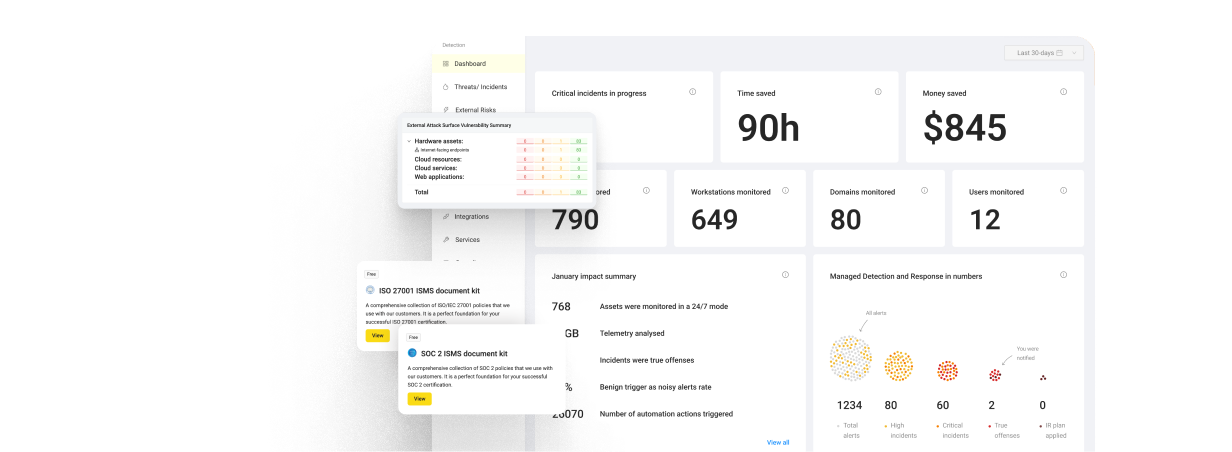
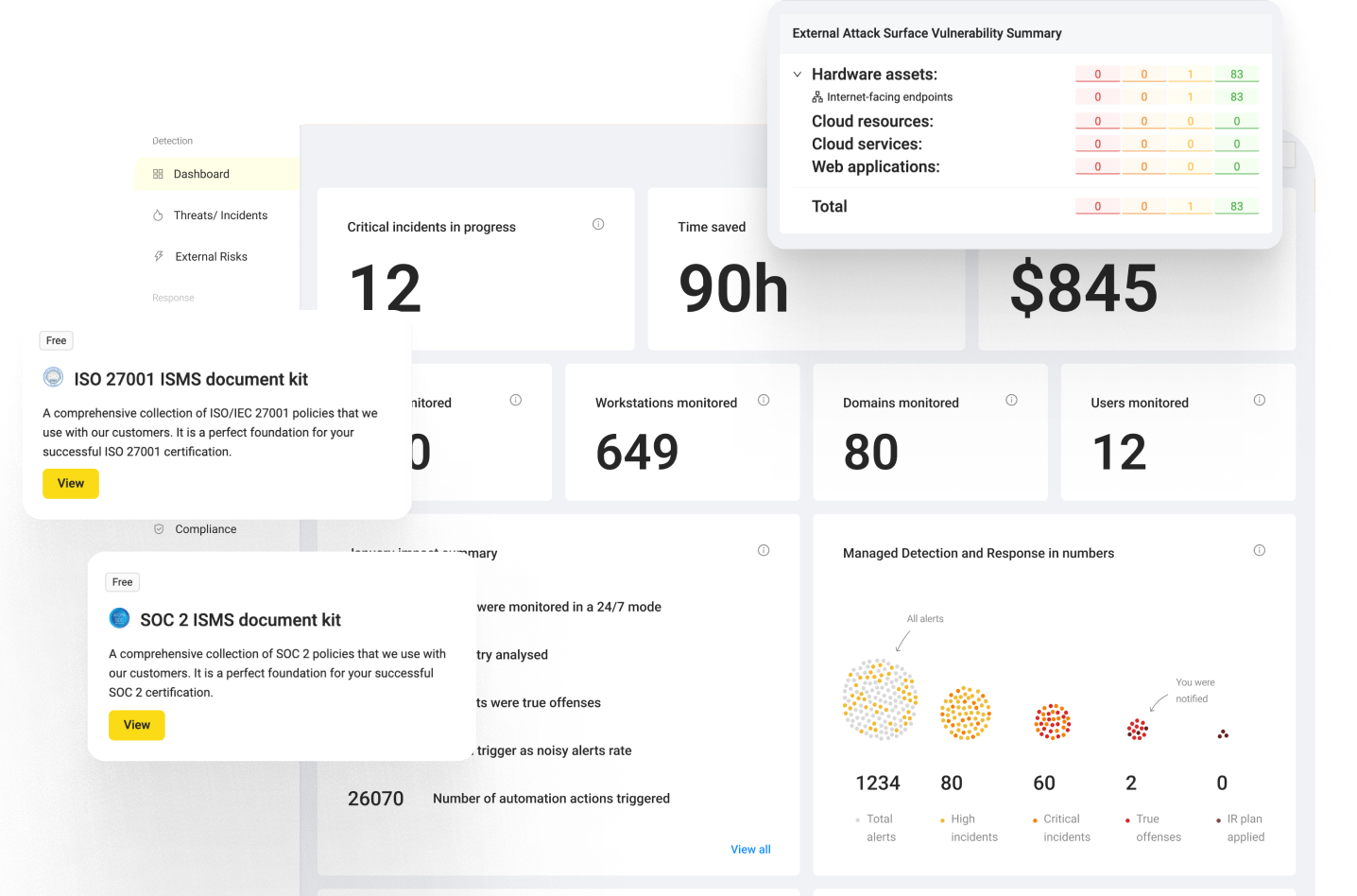
UnderDefense is a cybersecurity company founded in 2016, headquartered in New York with a team of 120 security engineers. The company protects over 65,000 endpoints and processes billions of security events monthly with a 20-minute mean time to detect (MTTD) for critical alerts.
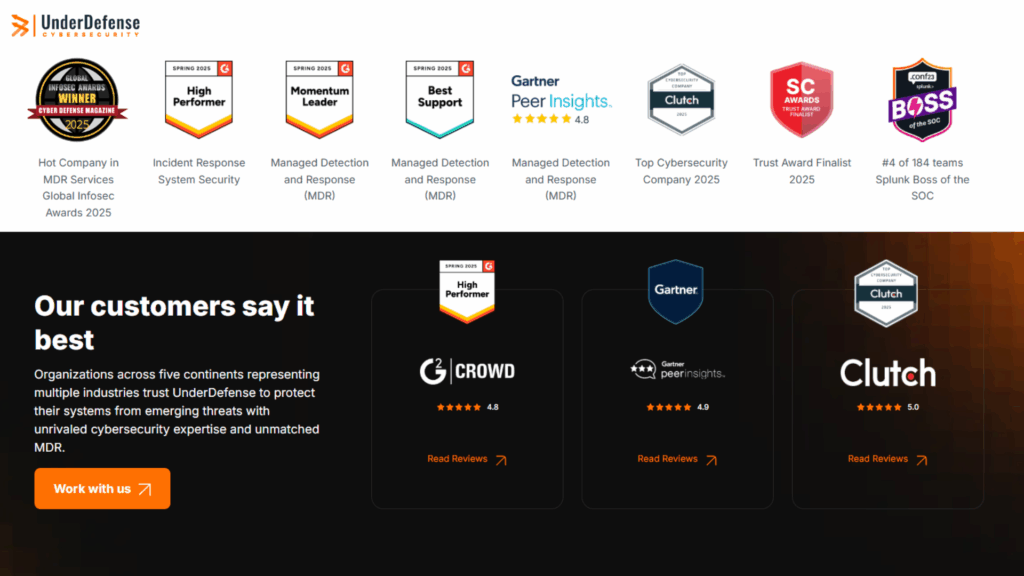
UnderDefense has earned consecutive Clutch awards since 2021, placing in the top 10 of all companies on the platform, was ranked #21 on Gartner Peer Insights for MDR services, and was named #1 in Managed SIEM services by Comparitech. On G2, UnderDefense MAXI holds a 4.9/5 rating across 26 verified reviews, with enterprise clients including ARX Insurance Company (501–1,000 employees) calling it “an extension of our team.”
✅ Core Services
- 24/7 AI-powered Managed Detection & Response (MDR) with concierge analyst support
- Vendor-agnostic SIEM integration (Splunk, Microsoft Sentinel, Google Chronicle, 45+ tools)
- AI SOC investigation automation with 2-minute alert-to-triage and 15-minute critical escalation
- Compliance automation with pre-built policy templates (SOC 2, ISO 27001, HIPAA, GDPR, and PCI DSS)
- ChatOps-driven user verification and remediation via Slack/Teams (“breaking the fourth wall”)
🤔 Why Companies Consider UnderDefense MAXI
Many enterprise security teams already have a SIEM, a stack of EDR and cloud security tools, and an internal team that’s stretched thin. The last thing they need is another vendor forcing them to rip out what works. UnderDefense MAXI works with the tools you already own. The AI SOC augments analysts with machine-speed investigation (automated context collection, multi-system correlation, and structured investigation reports in seconds) rather than replacing them. For enterprises with 5,000+ employees that have an internal SOC and don’t want a third party managing their systems, this fills a gap that pure MDR vendors and pure-play AI tools cannot.
🎯 Ideal Customer Profile
- Enterprises with 10,000+ employees and an existing SIEM investment they want to preserve
- Security-lean teams needing 24/7 concierge analyst coverage without building an in-house SOC
- Organizations under multi-framework compliance obligations (SOC 2, HIPAA, PCI DSS, and GDPR)
- PE portfolio companies seeking rapid security posture improvement with transparent pricing ($11–15/endpoint/month)
- Companies tired of black-box MDR providers that escalate alerts without context
💰 Commercial Model
UnderDefense operates on transparent, per-endpoint pricing ($11–15/endpoint/month) with a freemium model for its platform, making it accessible to evaluate before committing. Engagements include onboarding support, continuous 24/7 monitoring, dedicated concierge analyst teams, and compliance automation. No hidden data-ingest fees, no proprietary agent requirements.
⏰ When to Shortlist
Organizations that want AI-augmented SOC operations without replacing their existing security investments, particularly those planning compliance certification, reducing alert fatigue, or needing 24/7 expert coverage that communicates directly with affected users, should include UnderDefense during the RFP stage.
💬 Customer Reviews
“It’s reassuring to know they’re always watching for threats, and it doesn’t cost a fortune. They catch and stop problems quickly, which is a huge relief. The platform works really well with our other security tools, which makes things much simpler.”— Serhii B., Chief Information Security Officer UnderDefense G2 — Verified Review
“Honestly, some security tools are more complicated than the threats themselves. UnderDefense isn’t just about catching bad stuff; they give proactive tips too. Feels like my IT department suddenly got way smarter.”— Andriy H., Co-Founder and CTO at Contora Inc. UnderDefense G2 — Verified Review
2. Palo Alto Networks Cortex XSIAM — Best for Organizations Standardized on the Palo Alto Ecosystem
📋 Overview
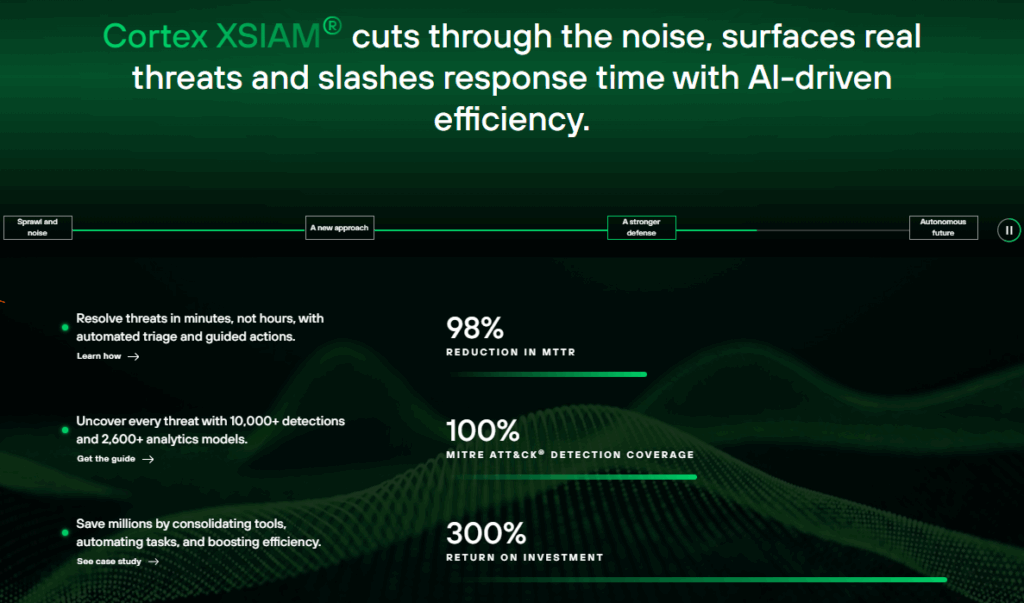
Cortex XSIAM is Palo Alto Networks’ AI-driven security operations platform that unifies SIEM, SOAR, ASM, and XDR into a single console. Revenue for Palo Alto Networks exceeded $1.66B as of December 2024. XSIAM swept all three subcategories (technology, revenue, and customer need) to earn CRN’s 2025 Product of the Year for Security Operations Platform/SIEM, voted entirely by solution providers.
On G2, Cortex XSIAM has 473 reviews, with enterprise users praising its intuitive interface (49 mentions), exceptional threat detection (37 mentions), and easy integration (28 mentions). Named customers include Colgate-Palmolive, ADT, Grupo Bimbo, Fortune 10 companies, and major U.S. banks.
✅ Core Services
- Unified SIEM + SOAR + ASM + XDR in a single platform console
- ML-driven analytics with 1.2 billion playbook executions across endpoints, network, cloud, and identity sources
- AgentiX framework for agentic AI autonomous triage and response
- Automated alert resolution (ADT achieved 92% automatic resolution)
- Deep Palo Alto ecosystem consolidation (firewalls, Prisma Cloud, and Cortex XDR)
🤔 Why Companies Consider Cortex XSIAM
For enterprises already standardized on Palo Alto firewalls, Prisma Cloud, and Cortex XDR, XSIAM offers unmatched consolidation efficiency. Colgate-Palmolive consolidated six security tools into a single console and reduced threat response times from days to 3.3 hours. The platformization approach ingests data from every layer and orchestrates automated responses at scale.
🎯 Ideal Customer Profile
- Large enterprises already invested in the Palo Alto ecosystem
- Organizations seeking maximum platform consolidation to reduce tool sprawl
- Security teams with budget for premium pricing and dedicated Palo Alto engineering support
- Enterprises comfortable with deeper vendor lock-in in exchange for tighter integration
💰 Commercial Model
XSIAM operates on enterprise subscription pricing aligned with data ingestion volume and organizational scale. ⚠️ Premium pricing is noted as a frequent concern in G2 reviews. Budget accordingly and negotiate data-ingest tiers early.
⏰ When to Shortlist
If your enterprise is already running Palo Alto across the stack and you want to collapse multiple security tools into one console, XSIAM should be on your shortlist. ❌ If you’re running a mixed-vendor environment and want to preserve flexibility, the vendor lock-in tradeoff is significant.
3. CrowdStrike Charlotte AI — Best for Endpoint-Led Organizations Expanding into Broader SIEM Scope
📋 Overview
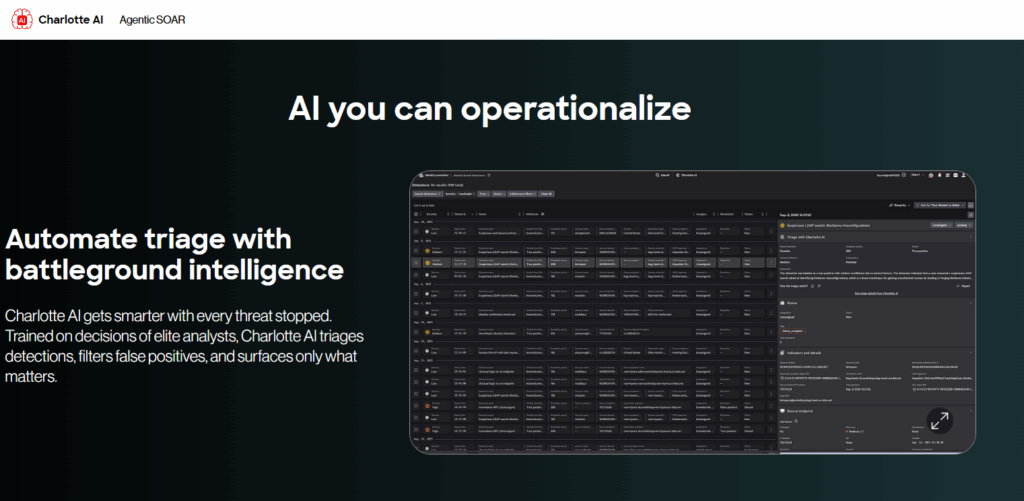
CrowdStrike’s Charlotte AI Detection Triage, generally available since early 2025, represents a breakthrough in agentic AI-driven SOC automation. Trained on millions of real-world triage decisions from the Falcon Complete Next-Gen MDR team, processing millions of decisions monthly, Charlotte AI achieves over 98% accuracy and eliminates more than 40 hours of manual triage work per week on average.
CrowdStrike serves thousands of organizations globally. Blackstone’s Senior VP of Cybersecurity Kevin Kennedy noted that “through one simple integration, completed in just a single day, we were able to add over 50 new threat detections.” CrowdStrike has over a decade of expertly labeled security data, giving it a proprietary training dataset that no competitor can replicate.
✅ Core Services
- Multi-AI architecture that dynamically selects the best series of AI agents for each task
- Bounded autonomy model where security teams define when and how automated actions occur
- Falcon Fusion integration for autonomous response (triage, ticketing, routing, and containment)
- Entity enrichment, answer planning, validation, and summarization, all at machine speed
- Proprietary training dataset built on years of curated Falcon Complete decisions
🤔 Why Companies Consider CrowdStrike Charlotte AI
If your enterprise already runs CrowdStrike Falcon for endpoint protection, Charlotte AI is the natural escalation. It turns your existing endpoint investment into an AI-powered SOC capability. The multi-AI architecture, trained on elite human analyst decisions, delivers the closest thing to replicating expert-level SOC triage at machine speed.
🎯 Ideal Customer Profile
- Enterprises with CrowdStrike Falcon deployed across endpoints
- Organizations scaling from endpoint detection into broader SIEM and SOC automation
- Security teams that need measurable triage time reduction (40+ hours/week saved)
- Companies comfortable operating within the CrowdStrike ecosystem
💰 Commercial Model
Charlotte AI is available as part of CrowdStrike’s Falcon platform licensing. Enterprise pricing scales with the number of endpoints and modules deployed. Expect multi-year enterprise agreements with tiered pricing.
⏰ When to Shortlist
CrowdStrike belongs on the shortlist for endpoint-led enterprises that want AI-driven triage accuracy validated by real-world MDR data. ❌ If your priority is vendor-agnostic integration across a diverse security stack, the CrowdStrike-centric ecosystem may limit cross-platform flexibility.
4. Stellar Cyber Open XDR Platform — Best for Organizations Consolidating Bloated Security Stacks Without Vendor Lock-In
📋 Overview
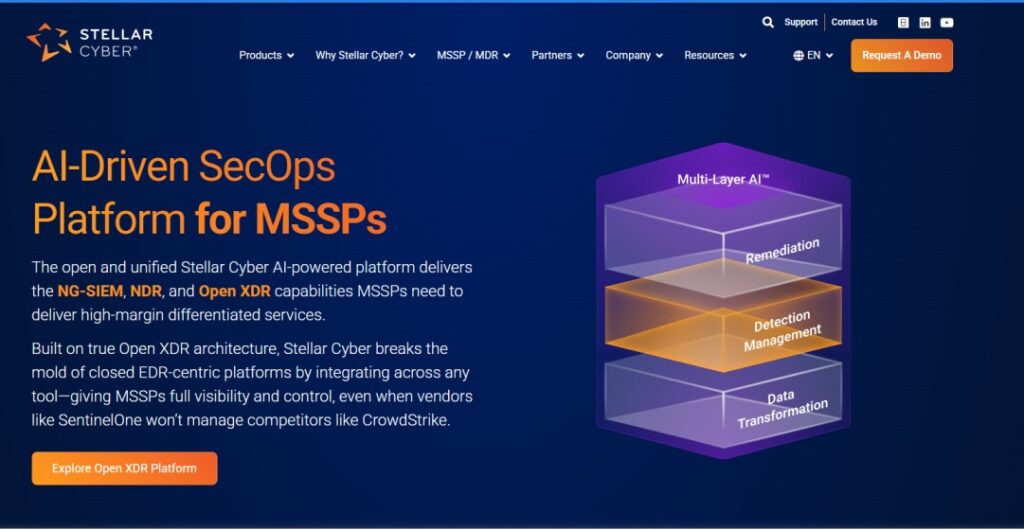
Stellar Cyber operates the only AI-native SecOps platform that unifies AI SIEM, NDR, UEBA, ITDR, and Open XDR in a single console. The company serves over 14,000 customers across 50+ countries, including approximately one-third of the top 250 MSSPs globally. Stellar Cyber was ranked #8 on The Software Report’s Top 50 Software Companies of 2025, the only cybersecurity company in the top ten, and won the 2025 Cybersecurity Breakthrough Award for Security Automation Solution of the Year.
On G2, Stellar Cyber maintains a consistent 4.7–4.8 star rating across 120 verified reviews, a remarkably narrow range across G2, TrustRadius, Gartner Peer Insights, and Capterra that indicates genuine, broad-based satisfaction.
✅ Core Services
- Unified AI SIEM + NDR + UEBA + ITDR + Open XDR in a single console
- Patented Multi-Layer AI combining ML anomaly detection, agentic AI response guidance, and human-augmented decision-making
- Open architecture that works with any EDR and any data source
- Analyst productivity improved by 80%+, false positives reduced by 90%+
- MSSP-friendly multi-tenancy for managed service providers
🤔 Why Companies Consider Stellar Cyber
Tool sprawl is a real operational problem at 10,000+ employee organizations: five, six, seven separate point solutions that each have their own console, their own alert format, and their own blind spots. Stellar Cyber replaces multiple point solutions (SIEM, NDR, UEBA, SOAR, and threat intelligence) with unified licensing. Todd Willoughby, Director of Security & Privacy at RSM US, credits the platform’s AI for delivering “a complete view of security events across our clients’ global infrastructure under one pane of glass.”
🎯 Ideal Customer Profile
- Enterprises with 10,000+ employees looking to consolidate 3+ security point solutions
- MSSPs and managed security providers serving enterprise clients
- Organizations wanting Open XDR without being locked into a single vendor ecosystem
- Security teams that need 80%+ analyst productivity improvement with measurable ROI
💰 Commercial Model
Stellar Cyber operates on unified subscription licensing that replaces multiple point-solution contracts. Pricing aligns with organizational scale and data volume. The open architecture model means no forced proprietary agent requirements.
⏰ When to Shortlist
Include Stellar Cyber if you’re drowning in point-solution sprawl and want a single, vendor-agnostic platform that doesn’t force you to pick one EDR vendor. The 14,000-customer base and MSSP-friendly multi-tenancy give it unparalleled market validation at scale.
5. Torq HyperSOC — Best for Large Enterprises Needing No-Code Security Hyperautomation
📋 Overview
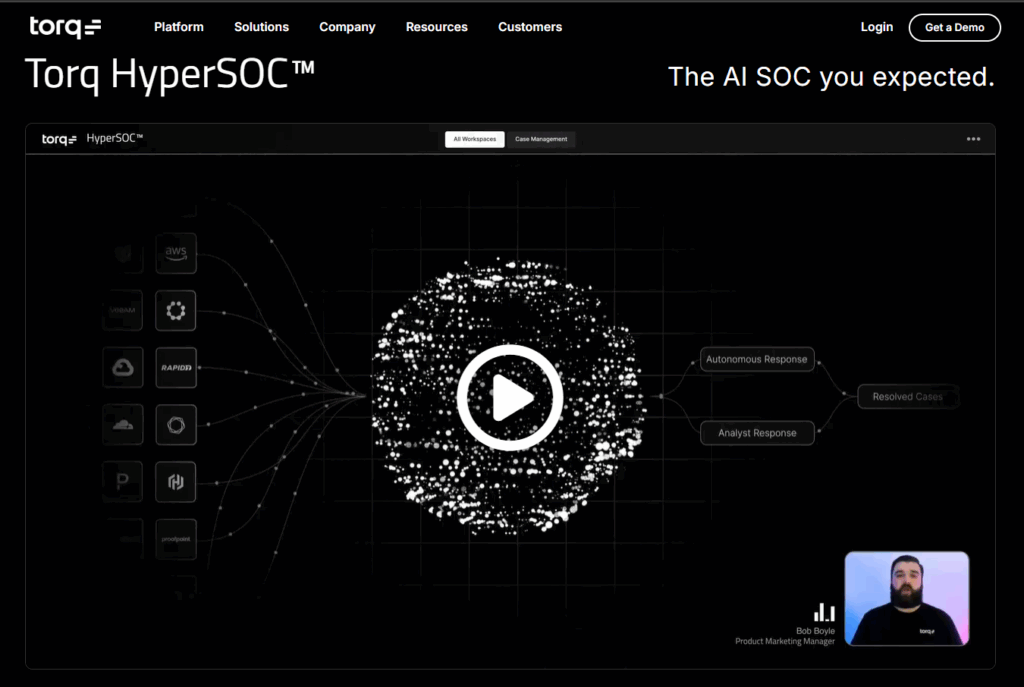
Torq is the AI-first security hyperautomation company that has raised $192M in total funding, including a $140M Series D, with an aggressive 2026 ARR target of $100M. The company more than tripled its revenue and customer growth for two consecutive years. Forbes has called Torq “the de facto leader of the AI SOC space.” GigaOm named Torq a Leader in SecOps Automation, rating it 5 stars for AI guardrails, case management, and integrations.
The customer roster reads like a who’s-who of high-growth enterprises: Blackstone, Carvana, Chipotle, Rivian, Nubank, Telefonica, SentinelOne, Wiz, ZoomInfo, Abnormal Security, Armis, Check Point, Lemonade, Lennar, Deepwatch, and multiple Fortune 100 companies.
✅ Core Services
- No-code, low-code, and full-code security automation with NLP-driven workflows
- Multi-Agent System using natural language prompts to generate integrations across thousands of vendors
- MTTD reduced by half; 90% of responses automated; 35% reduction in breach probability (per IDC)
- Agentic AI for parsing, enrichment, and case auto-closure (one customer auto-closed 511 cases in Q4)
- Broadest enterprise customer base of any AI SOC startup
🤔 Why Companies Consider Torq
Here’s the operational reality: most security teams can’t code, and most SOAR platforms require engineering resources to build and maintain playbooks. Torq’s no-code approach means security teams can build and deploy agentic automations in minutes without depending on engineering. IDC’s analysis validates real outcomes, not just promises.
🎯 Ideal Customer Profile
- Large enterprises (10,000+ employees) with cross-functional security automation needs
- Organizations spanning financial services, manufacturing, tech, telecom, and hospitality
- Security teams frustrated by rigid, playbook-based SOAR tools that require developer support
- Companies seeking demonstrable ROI reduction in breach probability and response time
💰 Commercial Model
Torq operates on enterprise subscription pricing with scalable tiers. The $192M in total funding signals long-term viability. Available on AWS Marketplace for procurement flexibility. 💸 Pricing details are custom; expect enterprise agreement negotiations.
⏰ When to Shortlist
If your security team needs automation they can build themselves, without waiting on engineering sprints, Torq belongs on your shortlist. The named Fortune 100 customer base across regulated industries provides the social proof that large enterprises demand.
6. Intezer Autonomous SOC — Best for Enterprises Facing Advanced Persistent Threats and Nation-State Actors
📋 Overview
Intezer describes itself as the “Forensic AI SOC for Enterprises,” serving over 150 of the world’s most targeted organizations. The platform investigates 100% of alerts, including low-severity alerts where real threats often hide, in under two minutes with 98% accuracy, and escalates only 2% of alerts to human analysts.
On G2, Intezer has 193 verified reviews at a 4.5/5 rating, the largest review base of any pure-play AI SOC vendor. Named customers include NVIDIA, Salesforce, MGM Resorts International, Equifax, and Ferguson.
✅ Core Services
- AI agents fused with proprietary forensic toolset (endpoint analysis, memory scanning, file reverse engineering, and sandboxing)
- 100% alert investigation including low-severity alerts, with sub-one-minute median triage times
- Endpoint-based pricing model (no alert tax from data-ingest pricing)
- One-click integration with 100+ security tools, no playbook building or rule tuning required
- Built-in threat intelligence to avoid LLM hallucination risks
🤔 Why Companies Consider Intezer
Most AI SOC platforms rely solely on LLM-generated heuristics. Intezer takes a fundamentally different approach by fusing AI agents with forensic-grade analysis: code analysis, memory forensics, and reverse engineering. The CTO of MGM Resorts, Branden Newman, stated: “I’ve looked at a lot of security solutions over the years and the results from Intezer’s AI-driven alert triage are actually amazing.” That kind of endorsement from a company that’s been in the crosshairs of nation-state-level attacks tells you something about the forensic depth here.
🎯 Ideal Customer Profile
- Enterprises with 10,000+ employees facing advanced persistent threats or nation-state adversaries
- Security teams that need forensic-grade triage (code analysis, memory forensics), not just LLM summaries
- Organizations looking for predictable pricing without alert-volume surcharges
- Teams that want one-click deployment with no playbook building or rule tuning
💰 Commercial Model
Intezer uses endpoint-based pricing, which removes the “alert tax” of data-ingest pricing models. Costs remain predictable regardless of how many alerts your environment generates, a critical distinction for enterprises processing petabyte-scale telemetry where volume-based pricing can spiral.
⏰ When to Shortlist
Include Intezer if your enterprise faces sophisticated adversaries and you need investigation depth that goes beyond LLM-generated summaries. The forensic toolset (code analysis, memory forensics, and reverse engineering) integrated into automated triage is something LLM-only platforms simply cannot replicate. ❌ If your primary need is hyperautomation of SOAR workflows rather than deep alert investigation, other platforms may be a better fit.
7. Swimlane Turbine AI SOC — Best for Enterprises with Strict Governance and High-Throughput Automation Needs
📋 Overview
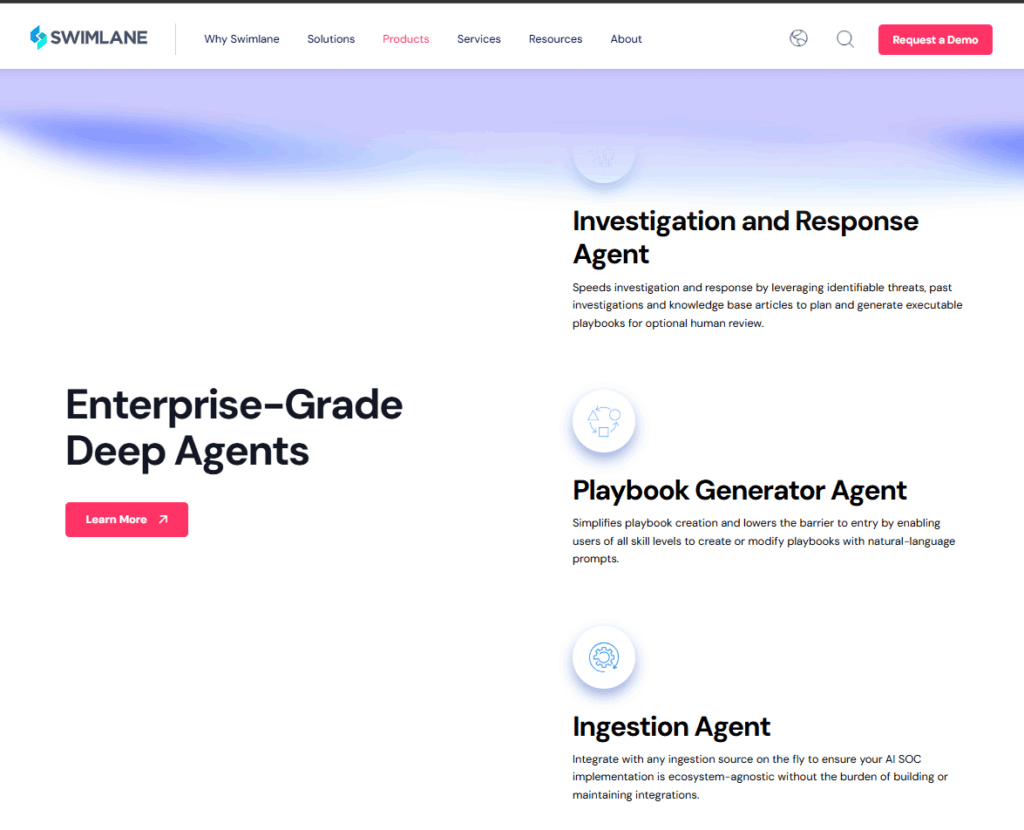
Swimlane Turbine is an agentic AI automation platform purpose-built for security operations, recognized as a Leader in the 2024 PeMa Quadrant for GenAI-Powered SOC Analyst Platforms by AIM Research. Of the 15 vendors evaluated, Swimlane rivaled industry giants and exceeded legacy hyperautomation solutions. The platform achieves a 240% return on investment in the first year with deployment in two to four weeks, and a 20% efficiency increase when using Hero AI.
On G2, Swimlane has 45 reviews with users praising its robust automation and customizable workflows for incident response. On SoftwareReviews (Info-Tech Research Group), Swimlane earned a Gold Medal with an 8.6/10 composite score, a 94% rating on integrity and client-friendly policies, and a 95% plan-to-renew rate.
✅ Core Services
- Cloud-scale execution: 25 million daily actions for a single customer at 75,000 actions per minute
- Hero AI Playbook Generator Agent for instant enterprise-grade playbook creation
- Expert AI agents with full context and deterministic guardrails deployed across the SOC
- Ecosystem-agnostic open marketplace of connectors built on demand at no cost
- Explainable and auditable AI: every decision is transparent, every action is logged
🤔 Why Companies Consider Swimlane Turbine
Here’s the throughput reality that most SOAR platforms won’t talk about: when you’re running 25 million actions per day at 75,000 actions per minute, you’re operating at an order of magnitude beyond what traditional SOAR can handle. For enterprises with strict governance requirements (think financial services, healthcare, and government), Swimlane’s emphasis on explainability and auditability means every AI decision can be reviewed, audited, and defended during a compliance review.
Named customers include Toshiba Corporation (Kenji Kojima, Chief Specialist in Cyber Security Center), Global Data Systems (Tracey Webb, Director of Cybersecurity Operations), and NTT DATA. Global Data Systems reported that “Turbine helped us close over 5,000 cases and effectively added the equivalent of 20 virtual SOC analysts to our team.”
🎯 Ideal Customer Profile
- Enterprises with 10,000+ employees and high-volume SOC environments requiring massive automation throughput
- Organizations in regulated industries needing explainable, auditable AI decision-making
- Security teams frustrated by low-throughput SOAR platforms that bottleneck at scale
- Companies wanting ecosystem-agnostic connectors without vendor lock-in
💰 Commercial Model
Swimlane operates on enterprise subscription pricing with deployment in two to four weeks. The 240% first-year ROI figure (per Swimlane’s published data) and 95% plan-to-renew rate signal strong customer retention. 💸 Pricing details are custom-quoted based on organizational scale and automation volume.
⏰ When to Shortlist
If your SOC needs the highest-throughput automation engine in the market, combined with the governance controls that regulated industries demand, Swimlane Turbine belongs on your shortlist. ❌ If you’re looking for a managed SOC service with human analyst concierge support rather than a pure automation platform, you’ll need to complement Swimlane with dedicated analyst coverage.
8. Dropzone AI — Best for Enterprises Wanting Fastest Time-to-Value AI SOC Deployment
📋 Overview
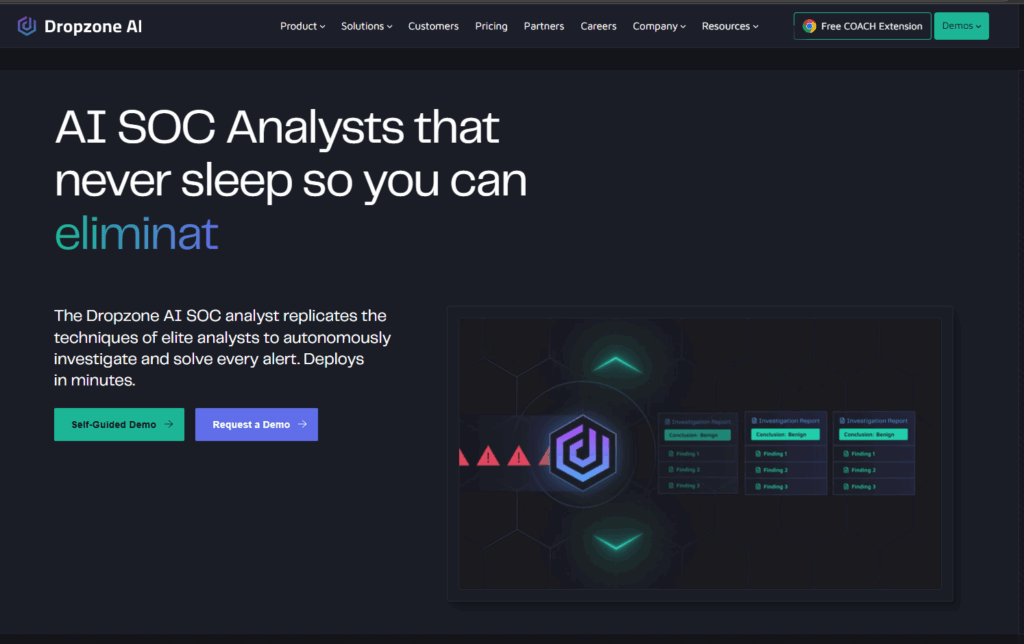
Dropzone AI bills itself as the “World’s First AI SOC Analyst,” an autonomous, LLM-powered agent that replicates the techniques of elite human analysts to investigate every alert without playbooks, code, or human prompts. The company raised $37M in Series B funding in July 2025, led by Theory Ventures with participation from Madrona, Decibel Ventures, Pioneer Square Labs, and IQT (the CIA’s venture arm). Dropzone AI was named a Sample Vendor for AI SOC Agents in the 2025 Gartner Hype Cycle for Security Operations.
✅ Core Services
- Zero-configuration autonomous alert investigation, deploying in 30 minutes via API connections
- Recursive reasoning with pre-trained agents that remember your environment details
- Integration with 85+ security tools (CrowdStrike, Microsoft Sentinel, Splunk, Google Workspace, and AWS)
- Transparent pricing starting at $36,000 annually for 4,000 investigations
- Full audit trail: the AI always shows its work, building trust through transparency
🤔 Why Companies Consider Dropzone AI
Thirty minutes to deploy. No playbooks. No coding. No human prompts to begin investigating. That’s the value proposition, and it’s validated by independent data: the Cloud Security Alliance (CSA) conducted the first-ever independent AI SOC benchmark study testing 148 security professionals. The results showed AI-assisted analysts using Dropzone were 29% more accurate and 61% faster than manual analysts, and quality remained consistent while manual analysts’ quality dropped 27% over time.
Jonathan Jaffe, CISO of Lemonade, stated: “Dropzone gives you more accurate, more complete analyses of investigation data. It leads to issue resolution in 10% of the time.” CBTS reported generating $1M in additional analytical capacity.
🎯 Ideal Customer Profile
- Enterprises that want to prove AI SOC value quickly without a multi-month implementation cycle
- Security teams needing to augment (not replace) existing analysts with autonomous investigation
- Organizations evaluating AI SOC tools for the first time and needing a low-risk entry point
- Companies with budget constraints seeking enterprise-grade AI SOC at an accessible price point ($36K/year)
💰 Commercial Model
Dropzone AI starts at $36,000 annually for 4,000 investigations, the most accessible enterprise AI SOC entry point by far. This transparent, investigation-based pricing model means you know exactly what you’re paying for. No hidden data-ingest fees, no per-endpoint surcharges.
⏰ When to Shortlist
If time-to-value is your top priority and you want independently validated results (the CSA benchmark is the only third-party AI SOC study of its kind), Dropzone AI deserves a spot on your shortlist. ❌ If you need a full managed SOC service with human analyst response and compliance automation built in, Dropzone AI’s pure-play autonomous investigation model will need to be paired with additional services.
9. Exaforce Agentic SOC Platform — Best for Enterprises Needing Advanced Multi-Model AI to Avoid LLM Hallucination Risks
📋 Overview
Exaforce is the newest entrant on this list, founded in 2023 by executives from Google, F5, and Palo Alto Networks. The company secured a massive $75M Series A in April 2025 from Khosla Ventures, Mayfield, and Thomvest Ventures, one of the largest Series A rounds in cybersecurity history. In the 2025 GigaOm Radar for SecOps Automation (comparing 19 vendors), Exaforce was recognized as a Leader and Outperformer, with strengths in threat correlations, multi-model detection, and a pre-LLM data layer.
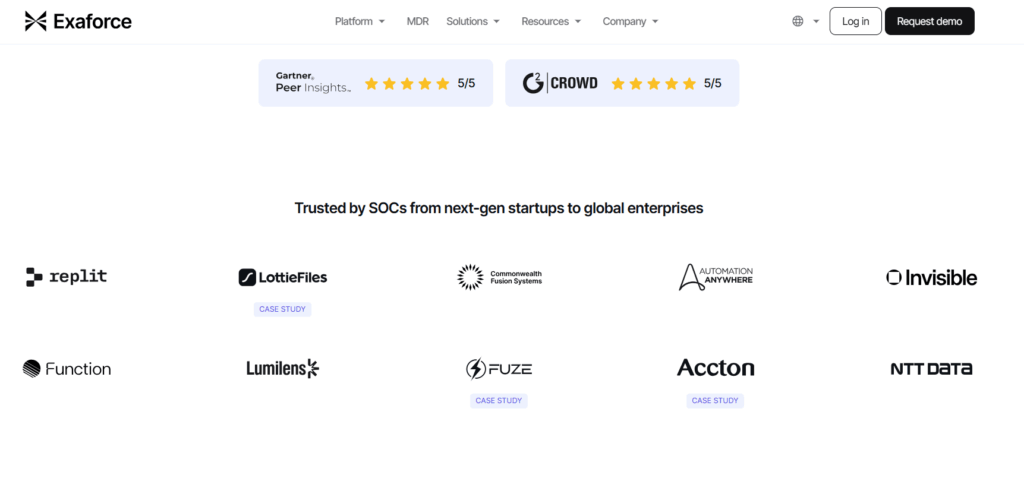
On G2, Exaforce holds a perfect 5.0/5 rating (albeit from 3 verified reviews as of early 2026). Named customers include NTT Data, Commonwealth Fusion Systems, Automation Anywhere, LottieFiles, Fuze, Accton, Function Health, and Invisible. In 2025, the platform processed 79 billion events.
✅ Core Services
- Multi-model AI engine combining semantic models, statistical ML, behavioral models, and LLMs
- Exabots: specialized AI agents for Detect, Triage, Investigate, and Respond (Tier 1–3 capabilities)
- Pre-LLM data normalization layer that enriches data before any LLM reasoning occurs
- Deployment flexibility: hosted SaaS, self-hosted SaaS, or fully managed MDR service
- 94% reduction in MTTI reported by customers; 50% reduction in investigation times
🤔 Why Companies Consider Exaforce
Here’s the technical distinction that matters: most AI SOC platforms rely solely on LLMs, which can hallucinate and review only a fraction of data. Exaforce takes a fundamentally different approach by combining semantic models, statistical ML models, behavioral models, and large language models into a purpose-built security AI. The structured approach starts with normalizing and enriching data before any LLM reasoning occurs, which avoids the blind spots that LLM-only platforms create.
NTT Data Vice President Pranay Anand calls the multi-model approach “unique in the industry.” Automation Anywhere’s Head of Engineering reports a 50% reduction in investigation times. LottieFiles saved 6 days and 4 hours per month, and Fuze achieved a 94% reduction in MTTI.
🎯 Ideal Customer Profile
- Enterprises concerned about LLM hallucination risks in security-critical decision-making
- Organizations processing massive event volumes (Exaforce handled 79B events in 2025)
- Security teams wanting Tier 1 through Tier 3 analyst reasoning capabilities in AI agents
- Companies requiring deployment flexibility (SaaS, self-hosted, or fully managed MDR)
💰 Commercial Model
Exaforce is backed by $75M in Series A funding from tier-one VCs (Khosla Ventures and Mayfield). Pricing details are custom-quoted. The availability of hosted SaaS, self-hosted SaaS, and fully managed MDR gives enterprises deployment flexibility that most competitors lack. 💸 Given the early stage (founded 2023), negotiate carefully on contract terms and SLAs.
⏰ When to Shortlist
If you’re evaluating AI SOC platforms and the hallucination risk of LLM-only approaches concerns you, Exaforce’s multi-model architecture addresses that problem head-on. The $75M backing and leadership from Google/Palo Alto alumni signal serious enterprise ambition. ❌ With only 3 G2 reviews, the market validation is still early-stage. Enterprises with conservative procurement standards may want to wait for broader peer validation.
🏁 Why UnderDefense Fills a Gap Others Can’t
Across these nine providers, one pattern emerges: most AI SOC platforms are either pure-play automation tools (Dropzone, Intezer, and Exaforce), hyperautomation engines (Torq and Swimlane), or ecosystem-locked platforms (Palo Alto XSIAM and CrowdStrike Charlotte AI). What we built at UnderDefense is different: a vendor-agnostic AI SOC that integrates with 45+ tools you already own, augments (rather than replaces) your analysts with AI-speed investigation, and backs it with a 24/7 concierge human team that communicates directly with affected users. The freemium model means you can see the workflows, audit the decisions, and prove value before committing a dollar.
In a market where most providers ask you to trust a black box, we show you the work. That’s the approach: people, process, and tools working together, with AI handling the grunt work and humans handling the edge cases that matter.
Q2. How Were These 9 Enterprise AI SOC Providers Evaluated and Scored?
Evaluating AI SOC platforms for enterprise environments is not something you can do by reading a feature matrix. When you’re dealing with 10,000+ employees, petabyte-scale telemetry, and multi-region compliance, the stakes demand structured rigor. Here’s the methodology we applied, and why each criterion is weighted the way it is.
⚙️ Five Weighted Criteria for Enterprise-Scale Evaluation
Each provider was scored against five enterprise-specific criteria, weighted for organizations managing massive telemetry volumes and overlapping regulatory demands. These aren’t theoretical. They reflect what actually matters when something breaks at 2 AM across three continents.
| # | Criterion | Weight | What It Measures |
|---|---|---|---|
| 1 | Enterprise Client Quality & Scale | 20% | Verifiable Fortune 500/Global 2000 deployments in regulated industries. Proof of operating at enterprise headcount, not just marketing claims. |
| 2 | Review Depth & Cross-Platform Consistency | 15% | Volume and quality of verified reviews across G2, Gartner, Clutch, and PeerSpot. Consistency across platforms: one good G2 profile with silence elsewhere raises flags. |
| 3 | Integration Flexibility & Stack Compatibility | 25% | Can it work with your existing SIEM, EDR, SOAR, and cloud tools without rip-and-replace? Highest-weighted because forcing proprietary tool replacement at enterprise scale is a non-starter. |
| 4 | AI Architecture & Detection Sophistication | 20% | Agentic AI maturity, documented MTTD/MTTR benchmarks, accuracy, and false positive reduction. Observable, auditable AI, not black-box claims. |
| 5 | Governance, Compliance & Pricing Transparency | 20% | RBAC granularity, audit trails, multi-region compliance support (GDPR, HIPAA, NIS2, and DORA), and published pricing. If you can’t show the number before a procurement call, that’s a signal. |
Total = 100%
⭐ Composite Star Ratings
Based on weighted composite scoring, here’s how each provider ranked:
| Provider | Rating | Rationale |
|---|---|---|
| UnderDefense MAXI | ⭐⭐⭐⭐⭐ (5) | Vendor-agnostic across 250+ tools, published pricing ($11–15/endpoint/month), 4.9/5 G2 rating, native compliance templates, and 96% MITRE ATT&CK coverage. Full-spectrum strength across all five criteria. |
| Palo Alto Cortex XSIAM | ⭐⭐⭐⭐ (4) | Powerful AI-driven consolidation with 85% alert reduction and flexible GB/day ingestion. Loses a point on pricing transparency ($1.8M/3 years for 10K endpoints) and Palo Alto ecosystem lock-in. |
| CrowdStrike Charlotte AI | ⭐⭐⭐⭐ (4) | Strong endpoint-native AI with deep Falcon telemetry. Deducted for ecosystem dependency, as best results require full Falcon stack, and opaque enterprise pricing. |
| Stellar Cyber | ⭐⭐⭐⭐ (4) | Open XDR approach with solid multi-source ingestion. Strong on integration flexibility, but governance controls and enterprise compliance documentation lag behind. |
| Torq HyperSOC | ⭐⭐⭐⭐ (4) | Excellent hyperautomation and agentic workflow orchestration. Scores high on AI architecture but lower on native detection, as it functions as an orchestration layer, not a full detection engine. |
| Intezer | ⭐⭐⭐⭐ (4) | Unique code-based threat analysis with strong automated triage. Limited enterprise compliance tooling and narrower integration surface reduce the overall score. |
| Swimlane Turbine | ⭐⭐⭐ (3) | Executes 25 million daily actions at 17× speed, which is impressive automation scale. But SOAR-first, not unified AI SOC; detection and response require additional tooling. |
| Dropzone AI | ⭐⭐⭐ (3) | Promising autonomous investigation capabilities. Early enterprise footprint and limited verified reviews reduce confidence for 10,000+ employee deployments. |
| Exaforce | ⭐⭐⭐ (3) | Processed 79B events in 2025 with multi-model AI (LLM + semantic + behavioral). Strong technical foundation but limited production track record. The $75M Series A signals potential, not proven maturity. |
📋 Methodology Note
Scoring derived through multi-source cross-validation: official vendor documentation, verified user reviews (G2, Gartner Peer Insights, and Clutch), analyst reports (GigaOm, IDC, Forrester, and AIM Research), funding data, and independent benchmarks. Named testimonials were prioritized over anonymous reviews. All vendor websites confirmed active as of March 2026. Where claims couldn’t be independently verified, scores were adjusted downward, because in security, “trust but verify” isn’t optional.
Q3. What Changes When Your SOC Serves 10,000+ Employees and Processes Petabyte-Scale Telemetry?
Everything. And I don’t say that for dramatic effect. At 10,000+ employees, security operations fundamentally changes in ways that most mid-market tools and traditional MDR providers simply weren’t designed to handle.
📊 The Telemetry Explosion Is Real
When an organization crosses the 10,000-employee threshold, telemetry doesn’t grow linearly. It explodes. Daily data volumes jump from gigabytes to petabytes. Alert counts can exceed millions per day. Compliance requirements become multi-jurisdictional, with GDPR, HIPAA, NIS2, DORA, and PCI DSS overlapping simultaneously.
Then there’s the legacy debt nobody talks about: dual-SIEM environments where Splunk handles on-prem and Sentinel covers cloud, hybrid architectures with on-premises Active Directory federated to Azure AD, and three generations of EDR agents still running across different business units. The telemetry capacity differences across platforms tell the story. Exaforce processed 79 billion events in 2025, Swimlane Turbine executes 25 million daily actions per customer, and Cortex XSIAM handles terabytes-to-petabytes daily with its flexible GB/day ingestion model.
❌ The Black-Box Trap at Scale
Here’s what breaks: traditional MDR providers and legacy MSSPs were built for a simpler world. Arctic Wolf sees alerts but forces proprietary tool replacement. At enterprise scale, that means abandoning years of SIEM investment and historical context. CrowdStrike sees endpoint threats with precision but misses organizational context: Was that PowerShell execution your IT admin or an attacker? They can’t ask. They escalate.
“This is not an extension of our security team as was originally sold.”
— Sr Cybersecurity Engineer, Manufacturing Arctic Wolf – Gartner Peer Insights Review
“Analysts provide little context, and when asked for more information in the investigation nothing is ever provided or even communicated. Support incidents are not worked to completion.”
— CISO, Manufacturing ($3B–$10B) Arctic Wolf – Gartner Peer Insights Review
At enterprise scale, alert volume without organizational context isn’t monitoring. It’s noise with a dashboard attached.
🔄 The Synthesis Thesis
Detection without response is noise; response without context is risk. The competitive advantage at 10,000+ employees isn’t more tools but a system that reasons across all of them, correlating user behavior, threat indicators, network telemetry, and organizational context into a unified picture. The question isn’t “Did the SIEM fire an alert?” but “Does this alert matter, given who this user is, what they normally do, and what’s happening across the rest of the environment right now?”
✅ MAXI: Built for This Reality
We designed UnderDefense MAXI to integrate with existing SIEM/EDR (Splunk, Sentinel, CrowdStrike, SentinelOne, and 45+ tools) without forcing data migration. No doubled storage costs, no lost historical context. The platform delivers 2-minute alert-to-triage, 24/7 concierge analysts who communicate directly with affected users via ChatOps (Slack, Teams, and email), and compliance automation for SOC 2, ISO 27001, HIPAA, GDPR, and PCI DSS.
“UnderDefense act as an extension of our team, so we don’t need additional resources, ensuring 24/7 protection. It also solved our problem of having separate security tools that didn’t work well together. Now, everything is connected and easier to manage.”
— Inga M., CEO UnderDefense – G2 Verified Review
“Their expert management of our SIEM has added to the value of our security investments and tools… they keep us informed, suggesting relevant and cost-effective security improvements.”
— Yaroslava K., IT Project Manager UnderDefense – G2 Verified Review
A 4.9/5 G2 rating and 20-minute MTTD for critical alerts aren’t vanity metrics. They’re the observable outcomes of an architecture built to reason across your entire stack, not just monitor one slice of it.
Q4. How Do Enterprise AI SOC Platforms Handle Multi-Region Compliance, Custom Detection Engineering, and Governance Controls?
At the enterprise tier, compliance isn’t a checkbox but an ongoing operational obligation spanning jurisdictions, auditors, and board reporting cycles. The same applies to detection engineering and governance. Here’s what to evaluate and how leading platforms compare.
🌍 Multi-Region Compliance Mapping
Enterprises with 10,000+ employees rarely operate in a single jurisdiction. The question isn’t whether your AI SOC supports compliance but whether evidence generation is native to the detection workflow or bolted on after the fact.
| Provider | GDPR | HIPAA | SOC 2 | ISO 27001 | NIS2 | DORA | PCI DSS |
|---|---|---|---|---|---|---|---|
| UnderDefense MAXI | ✅ | ✅ | ✅ | ✅ | ✅ | ✅ | ✅ |
| Palo Alto XSIAM | ✅ | ✅ | ✅ | ✅ | ⚠️ | ⚠️ | ✅ |
| CrowdStrike Charlotte AI | ✅ | ✅ | ✅ | ✅ | ⚠️ | ⚠️ | ✅ |
| Stellar Cyber | ✅ | ⚠️ | ✅ | ✅ | ⚠️ | ❌ | ⚠️ |
| Torq HyperSOC | ⚠️ | ⚠️ | ⚠️ | ⚠️ | ❌ | ❌ | ⚠️ |
| Swimlane Turbine | ✅ | ✅ | ✅ | ⚠️ | ⚠️ | ⚠️ | ✅ |
| Dropzone AI | ⚠️ | ⚠️ | ⚠️ | ⚠️ | ❌ | ❌ | ⚠️ |
| Exaforce | ⚠️ | ⚠️ | ✅ | ⚠️ | ❌ | ❌ | ⚠️ |
✅ = Native support | ⚠️ = Partial or add-on required | ❌ = Limited/unavailable
🔧 Custom Detection Engineering
Generic detection rules catch generic threats. At enterprise scale, the threats that matter most are organization-specific. Evaluate providers on these dimensions:
- Custom rule authoring: Can you deploy organization-specific detection logic, or are you limited to vendor-supplied packs?
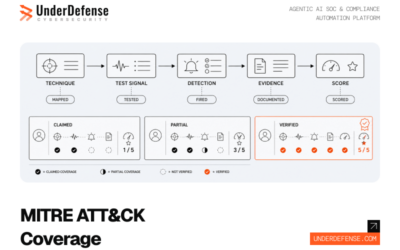
- MITRE ATT&CK coverage: UnderDefense covers 96% of techniques. Ask every vendor for their documented number, tested, not theoretical.
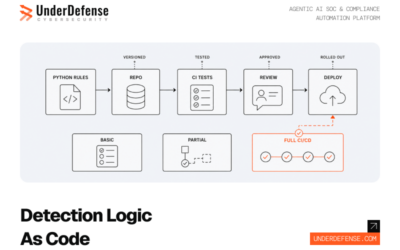
- Detection-as-code: Can rules be version-controlled and deployed through CI/CD pipelines for proper audit trails and change management?
- False positive tuning: UnderDefense achieves 99% noise reduction through onboarding tuning and continuous refinement.
- Industry-specific models: Pre-built detections for healthcare, financial services, and manufacturing environments.
- Institutional knowledge encoding: Can the platform learn your “normal” and bake it into detection logic?
🛡️ Governance Controls Checklist
| # | Criterion | Mature Standard |
|---|---|---|
| 1 | RBAC Granularity | Team-, region-, and function-level permissions, not just “admin” and “viewer.” |
| 2 | AI Decision Audit Trails | Every automated action logged with reasoning chain. Explainable AI, not black-box verdicts. |
| 3 | Bounded Autonomy Controls | Configurable thresholds for AI auto-actions vs. human approval. Critical for regulated industries. |
| 4 | Change Approval Workflows | Rule changes and playbook modifications through documented approval processes. |
| 5 | Data Retention & Residency | Configurable retention and residency guarantees (EU data stays in EU). Non-negotiable for GDPR/NIS2. |
| 6 | Board-Level Reporting | Executive dashboards for risk posture, incident metrics, and compliance status, not analyst views repurposed. |
| 7 | Third-Party Certifications | SOC 2 Type II and ISO 27001. Ask for certificates, not claims. |
| 8 | Incident Documentation | Timelines, response actions, and evidence chains generated automatically for regulatory review. |
Score interpretation: ✅ 6–8 = governance-mature | ⚠️ 3–5 = critical gaps | ❌ 0–2 = governance debt creating audit exposure
✅ UnderDefense’s Governance Edge
We built governance into UnderDefense MAXI from the start, not as an afterthought. Pre-built compliance templates for SOC 2, ISO 27001, HIPAA, GDPR, and PCI DSS are native to the platform. Custom detection tuning begins during onboarding, achieving 96% MITRE ATT&CK coverage and 99% alert noise reduction. Every AI-driven decision is explainable and auditable. You can trace exactly why an alert was generated, what enrichment was applied, and what action was recommended. Combined with transparent pricing ($11–15/endpoint/month), GRC leaders and procurement teams get the visibility they need without ambiguity.
Q5. Can an AI SOC Integrate With Your Existing SIEM Without Forcing Rip-and-Replace?
Here is a scenario most enterprise CISOs know too well. You run Splunk on-prem for compliance logging, Microsoft Sentinel for cloud workloads, CrowdStrike Falcon for endpoint detection, and Okta for identity. Years of custom detection rules, tuned alert thresholds, and compliance audit trails live inside that stack. Then a vendor walks in and says, “Replace your SIEM.”
⚠️ The Real Cost of “Integration” Claims
That three-year investment, including custom correlations, regulatory evidence chains, and institutional detection logic, is suddenly at risk. And the gap between a vendor listing “250+ integrations” on a slide deck and actually operationalizing those integrations across multi-region, hybrid on-prem/cloud deployments is enormous.
Vendors like Palo Alto (XSIAM) optimize for their own ecosystem. XSIAM offers unmatched consolidation if you are already standardized on Palo Alto firewalls, Prisma Cloud, and Cortex XDR. But integration breadth outside that core ecosystem is limited, and premium pricing is a frequent concern in G2 reviews. One Reddit user shared the reality plainly:
“We just signed a deal for 6 million and I have some real reservations about it. Our POC didn’t go great, and Palo was kind of clueless about their own product.”
— u/Mcb2139, r/paloaltonetworks Reddit Thread
Arctic Wolf takes a different but equally restrictive approach, mandating proprietary SIEM replacement and offering limited transparency into the underlying detection logic. As one cybersecurity professional noted:
“My big concern is the lack of transparency with their SIEM and lack of remediation actions other than isolating a device.”
— u/kiakosan, r/cybersecurity Reddit Thread
💸 Hidden Migration Costs Nobody Warns You About
SIEM migration is not just a technical lift but an organizational disruption. Months of parallel running, doubled data ingestion costs, lost institutional detection logic, and compliance gaps during transition. A Reddit thread on replacing SIEMs captured the consensus:
“Transitioning between SIEM platforms is typically a challenging task, and most organizations prefer to avoid it unless absolutely necessary. I’ve participated in several migrations, and the common sentiment afterward is always: ‘We’re glad that’s over; let’s hope we don’t have to do it again.'”
— u/endmost_, r/cybersecurity Reddit Thread
✅ Augmentation, Not Replacement: How It Should Work
The right AI SOC augments your existing investments, ingesting from your SIEM, enriching with EDR telemetry, and correlating across your identity stack without requiring migration or consolidation. Your detection rules stay. Your compliance audit trail stays. AI layers investigation on top.
We built UnderDefense MAXI around this augmentation philosophy. It integrates with Splunk, Microsoft Sentinel, Google Chronicle, and 45+ other tools, not by replacing them, but by sitting alongside them. The AI automates context collection and multi-system correlation while your existing SIEM continues doing what it does best.
One G2 reviewer captured this exactly:
“The platform pulls in data from all our existing security tools, so we didn’t have to rip and replace anything. Their SOC team is responsive and knows their stuff.”
— Verified User, Marketing and Advertising UnderDefense – G2 Verified Review
And for enterprises with mature security stacks, this approach preserves what matters most:
“Their expert management of our SIEM has added to the value of our security investments and tools.”
— Yaroslava K., IT Project Manager UnderDefense – G2 Verified Review
❌ XSIAM requires Palo Alto standardization. ❌ Arctic Wolf mandates proprietary SIEM replacement. ✅ UnderDefense protects existing security investments, and makes them work harder.
Q6. How Should Enterprise CISOs Evaluate AI SOC Vendors? (Decision Framework + FAQ)
Committing to an AI SOC at 10,000+ employees touches every team, every region, and every compliance obligation. The wrong decision locks you into vendor-specific tools for years or leaves you with alert noise your team still investigates manually.
⚠️ The Wrong Way to Choose
Picking by brand name (Palo Alto), by integration count (ReliaQuest), or by cheapest entry price (Dropzone) ignores the critical enterprise question: Can this vendor respond with context, integrate without replacing your stack, and govern at scale?
Here is the framework we use when advising enterprises, with seven weighted criteria, scored 0–2 each, for a maximum of 14 points.
📋 The 7-Criteria AI SOC Evaluation Scorecard
| Criterion | What to Evaluate | UnderDefense Score |
|---|---|---|
| Vendor-Agnostic Integration | Works with your existing SIEM, EDR, and identity stack, with no forced migration | ✅ 2/2 |
| Human Analyst Access | Dedicated concierge analysts, not just ticket-based escalation | ✅ 2/2 |
| Response Capability | Can the vendor act on threats, or only alert you? | ✅ 2/2 |
| ChatOps User Verification | Direct Slack/Teams communication with affected users for real-time validation | ✅ 2/2 |
| Pricing Transparency | Published, predictable pricing, with no hidden data-ingest surcharges | ✅ 2/2 |
| Compliance Integration | Pre-built templates for SOC 2, ISO 27001, HIPAA, GDPR, PCI DSS, NIS2, and DORA | ✅ 2/2 |
| Onboarding Speed | Time from signed contract to operational detection | ✅ 2/2 |
UnderDefense total: 14/14. The combination of vendor-agnostic integration across 45+ tools, 24/7 concierge analyst support, ChatOps-driven user verification, and transparent pricing ($11–15/endpoint/month) covers every criterion that matters at enterprise scale.
“UnderDefense is surprisingly affordable considering the level of protection we get. Their proactive threat hunting and rapid response have saved us from incidents that could have been incredibly costly.”
— Verified User, Program Development UnderDefense – G2 Verified Review
“It’s reassuring to know they’re always watching for threats, and it doesn’t cost a fortune. The platform works really well with our other security tools, which makes things much simpler.”
— Serhii B., CISO, Mid-Market UnderDefense – G2 Verified Review
❓ Frequently Asked Questions
AI SOC vs. Traditional SIEM?
A traditional SIEM collects and correlates logs, but someone still needs to investigate every alert. An AI SOC automates that investigation at machine speed while human analysts handle edge cases and response actions. They are complementary, not competing.
What does an enterprise AI SOC cost?
Ranges vary widely: Dropzone AI starts at $36,000/year for 4,000 investigations; UnderDefense runs $11–15/endpoint/month; XSIAM contracts can reach $6–10 million for large enterprises.
Can AI replace human analysts?
No. Automation scales routine triage work. Humans handle ambiguity, context, and adversary creativity. The resilient model is human + automation working together.
How fast can an AI SOC deploy?
Ranges from 30 minutes (Dropzone AI’s zero-config approach) to several months for complex XSIAM implementations. UnderDefense typically achieves operational detection within weeks, not months.
What is agentic AI in a SOC?
Agentic AI refers to autonomous AI agents that can independently triage, investigate, and recommend actions, operating within bounded guardrails set by your security team.
⏰ The real question is not which AI SOC has the best AI. It is which provider operates as your security team’s ally at enterprise scale, without forcing a stack rebuild.
Q7. Ready to Evaluate AI SOC Providers for Your Enterprise?
For enterprises with 10,000+ employees evaluating AI SOC platforms, the decision comes down to five dimensions: integration flexibility, AI architecture maturity, compliance coverage, governance controls, and whether the vendor operates as a partner or just another dashboard in your browser tabs.
🔍 What Your Selection Criteria Should Look Like
- Vendor-agnostic integration vs. proprietary lock-in: Does the platform work with Splunk, Sentinel, Chronicle, and your existing EDR, or does it require you to replace them?
- Human analyst access (concierge vs. ticket-based): When a critical alert fires at 2 AM, do you get a dedicated analyst who knows your environment, or a support ticket queue?
- Published response time SLAs and documented outcomes: Can the vendor show you 20-minute MTTD and 15-minute escalation times backed by verifiable data, not marketing claims?
- Multi-region compliance support (GDPR + HIPAA + NIS2 + DORA): Pre-built policy templates and audit-ready reporting that scale across jurisdictions, not compliance as an afterthought.
- Governance readiness (RBAC, audit trails, and bounded autonomy): Every AI decision should be explainable and every action auditable, a requirement most AI SOC tools still fail to meet.
🚀 Why Enterprises Choose MAXI
We built UnderDefense MAXI for enterprises that already have a SIEM and a SOC team and do not want a third party managing their systems. They want an AI SOC ally that augments their existing investments, detecting threats across the full stack while dedicated analysts communicate directly with affected users to own outcomes, not just escalate alerts.
“UnderDefense has changed our approach to cybersecurity. At first, we hired them for managed SIEM service, but after they demonstrated the value of MDR, our management was motivated to act on it.”
— Yaroslava K., IT Project Manager UnderDefense – G2 Verified Review
“UnderDefense impressed us with their ability to tailor their services to our unique needs and challenges. Their commitment to open communication and collaboration made them feel like a true extension of our team.”
— CIO of Security, ARX Insurance Company UnderDefense – Clutch Verified Review
The next step is a personalized evaluation against your specific stack, compliance requirements, and scale. No generic demo, but a tailored assessment of how MAXI fits your environment.
⭐ This analysis is based on documented response times, G2/Gartner/Clutch verified reviews, published pricing, and operational outcomes across 500+ MDR deployments protecting 65,000+ endpoints.
1. What makes an AI SOC "enterprise-grade" compared to mid-market solutions?
An enterprise-grade AI SOC is built to handle operational realities that mid-market tools simply weren’t designed for. At 10,000+ employees, we see three defining factors:
- Telemetry scale: Daily data volumes jump from gigabytes to petabytes. Alert counts can exceed millions per day. The platform must ingest, correlate, and reason across this volume without performance degradation.
- Multi-region compliance: Enterprises rarely operate in a single jurisdiction. Native support for GDPR, HIPAA, NIS2, DORA, SOC 2, and PCI DSS, with evidence generation built into the detection workflow, is non-negotiable.
- Governance controls: RBAC at team, region, and function levels; AI decision audit trails; bounded autonomy controls; and board-level reporting distinguish enterprise platforms from scaled-up SMB tools.
We built UnderDefense MAXI around these requirements, delivering 96% MITRE ATT&CK coverage, 99% alert noise reduction, and pre-built compliance templates across seven frameworks.
2. Can an AI SOC integrate with my existing SIEM without forcing a rip-and-replace migration?
Yes, but most vendors don’t deliver on this promise. The gap between listing “250+ integrations” on a slide deck and actually operationalizing those integrations across multi-region, hybrid deployments is enormous.
Vendors like Palo Alto (XSIAM) optimize for their own ecosystem, and Arctic Wolf mandates proprietary SIEM replacement. Both approaches force enterprises to abandon years of custom detection rules, tuned thresholds, and compliance audit trails.
We built UnderDefense MAXI around the augmentation philosophy. It integrates with Splunk, Microsoft Sentinel, Google Chronicle, and 45+ other tools by sitting alongside them. Your detection rules stay. Your compliance audit trail stays. The AI layers investigation on top without requiring migration, doubled data-ingest costs, or lost institutional logic.
3. How much does an enterprise AI SOC cost in 2026?
Enterprise AI SOC pricing varies dramatically across the market:
- Dropzone AI starts at $36,000/year for 4,000 investigations, the most accessible entry point.
- UnderDefense MAXI operates on transparent per-endpoint pricing at $11–15/endpoint/month, with no hidden data-ingest fees.
- Palo Alto Cortex XSIAM contracts can reach $1.8M over three years for 10,000 endpoints, with costs scaling by data-ingestion volume.
- CrowdStrike Charlotte AI pricing is opaque and tied to multi-year Falcon platform licensing agreements.
We publish our MDR pricing transparently because, in our experience, if a vendor can’t show you numbers before a procurement call, that’s a signal. The SOC cost calculator can help you benchmark your specific scenario.
4. What is the difference between an AI SOC and traditional managed detection and response (MDR)?
Traditional MDR services provide outsourced threat monitoring, detection, and response, typically with human analysts reviewing alerts from your security stack. An AI SOC adds agentic AI that automates the investigation grunt work (context collection, multi-system correlation, and structured investigation reports) at machine speed.
The key distinction: MDR is a service model. An AI SOC is an architecture that uses autonomous AI agents to triage, investigate, and recommend actions within bounded guardrails. The best implementations combine both, using AI to handle routine triage at scale while human analysts focus on ambiguity, adversary creativity, and response actions that require organizational context.
At UnderDefense, we combine AI-powered investigation (2-minute alert-to-triage) with 24/7 concierge analyst support, so enterprises get automation speed without losing human judgment on the edge cases that matter most.
5. How do enterprise AI SOC platforms handle multi-region compliance like GDPR, HIPAA, and NIS2?
The critical question isn’t whether your AI SOC “supports” compliance but whether evidence generation is native to the detection workflow or bolted on after the fact. At enterprise scale, compliance is an ongoing operational obligation spanning jurisdictions, auditors, and board reporting cycles.
Evaluate platforms on these dimensions:
- Pre-built compliance templates that map detection events directly to regulatory controls
- Configurable data retention and residency guarantees (EU data stays in EU)
- Automated incident documentation with timelines, response actions, and evidence chains
- Board-level reporting dashboards, not analyst views repurposed for executives
UnderDefense MAXI provides native support across seven frameworks: GDPR, HIPAA, SOC 2, ISO 27001, NIS2, DORA, and PCI DSS. Many competitors offer partial support or require add-ons for newer regulations like NIS2 and DORA.
6. What should a CISO include in an AI SOC vendor evaluation scorecard?
We use a seven-criteria framework when advising enterprises, scored 0–2 each for a maximum of 14 points:
- Vendor-agnostic integration: Works with existing SIEM, EDR, and identity stack without forced migration
- Human analyst access: Dedicated concierge analysts, not just ticket-based escalation
- Response capability: Can the vendor act on threats, or only alert you?
- ChatOps user verification: Direct Slack/Teams communication with affected users
- Pricing transparency: Published, predictable pricing without hidden data-ingest surcharges
- Compliance integration: Pre-built templates for SOC 2, ISO 27001, HIPAA, GDPR, PCI DSS, NIS2, and DORA
- Onboarding speed: Time from signed contract to operational detection
This framework is available in more detail in our MDR buyers guide, which includes evaluation templates specifically designed for enterprise SOC procurement.
7. Can AI replace human SOC analysts entirely?
No. Automation scales routine triage work, but humans handle ambiguity, organizational context, and adversary creativity. The resilient model is human + automation working together.
Here’s why this matters at enterprise scale: when a PowerShell execution fires an alert, the AI can determine whether it matches known attack patterns, correlate it against network telemetry, and enrich it with identity data. But determining whether that execution was your IT admin running a legitimate script or an attacker exploiting compromised credentials requires organizational context that only a human analyst with environment knowledge can provide.
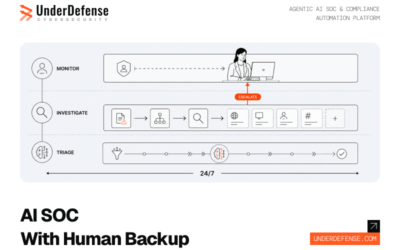
We designed UnderDefense MAXI around this principle. The AI handles investigation grunt work at machine speed (2-minute alert-to-triage), while dedicated concierge analysts handle the edge cases, communicate directly with affected users via ChatOps, and own response outcomes.
8. How fast can an enterprise AI SOC be deployed?
Deployment timelines vary dramatically across the market:
- Dropzone AI: 30 minutes via zero-configuration API connections (fastest time-to-value)
- UnderDefense MAXI: Operational detection within weeks, including onboarding tuning for 96% MITRE ATT&CK coverage and 99% noise reduction
- Swimlane Turbine: Two to four weeks deployment with 240% first-year ROI
- Palo Alto Cortex XSIAM: Several months for complex enterprise implementations
The critical distinction is the difference between “deployed” and “operationally effective.” A 30-minute deployment is impressive, but enterprise-grade detection tuning, custom rule authoring, and compliance template configuration require dedicated onboarding time. We prioritize operational effectiveness over speed metrics, ensuring your SLAs are backed by tuned detection logic from day one, not generic out-of-box rules that generate noise.