






On Monday morning your team finds an alert that fired at 11 p.m. on Saturday, and nobody can yet say whether that sign-in was a user or an attacker with a two-day head start. Your cyber insurance renewal form asks who monitors the environment 24/7, and today the honest answer is nobody on weekends.
Here is which security work to hand over, which decisions to keep, and what drives the price.
TL;DR
- Cybersecurity outsourcing hands over functions such as monitoring, triage, response surge, and testing, while accountability stays with you.
- Risk acceptance, priorities, policy, vendor choice, and board communication stay in-house.
- A provider checklist separates responders from providers that only notify.
- The guide explains the pricing models and the drivers that move a quote, from coverage hours to response authority.
Table of contents
- What Cybersecurity Outsourcing Covers
- How Many Companies Already Outsource Security, by Size
- What to Hand Over: Work That Runs Around the Clock or Needs Skills You Cannot Hire
- What to Keep: Decisions That Need Your Business Context
- How to Choose a Provider: Questions That Separate Responders From Notifiers
- What Cybersecurity Outsourcing Costs and What Drives the Price
- UnderDefense Agentic AI SOC: 24/7 Analysts on Top of the Stack You Already Run
- A Handover Plan in Five Steps
- Frequently Asked Questions
The question that follows a weekend like that is usually whether to outsource security at all. A more useful question is which functions to hand over, which to keep, and how to test a provider before you sign.

This guide gives you that split for a typical stack: an identity provider, EDR, and a SIEM such as Sentinel, Splunk, or Elastic. You’ll finish with a written list of what goes out, what stays, the questions to ask during a demo, and what moves the price.
See how one weekend alert gets investigated and escalated
What Cybersecurity Outsourcing Covers
Cybersecurity outsourcing is the decision to let an outside provider run specific security functions for you. Your program, its risk decisions, and its accountability stay with your company, whatever the contract says.
That distinction matters because most providers sell a bundle, and the bundle hides the split. When you list the functions one by one, outsourcing cybersecurity becomes a smaller decision, easier to defend to your CFO and your board.
Here are the functions companies commonly hand to an outside provider, with the types of managed security that usually sell each one:
- 24/7 monitoring and alert triage, sold by MDR providers and SOC-as-a-service providers
- First response and containment on endpoints, identities, and cloud accounts
- Incident response surge, usually under a retainer with a response firm
- Penetration testing and red team exercises
- Compliance work, such as evidence collection for SOC 2 or ISO 27001 audits
Two things never leave the building: accountability for the outcome, and the decision to accept a risk. A regulator, an auditor, or a customer will hold your company responsible after an incident, even when a provider ran the console that night.
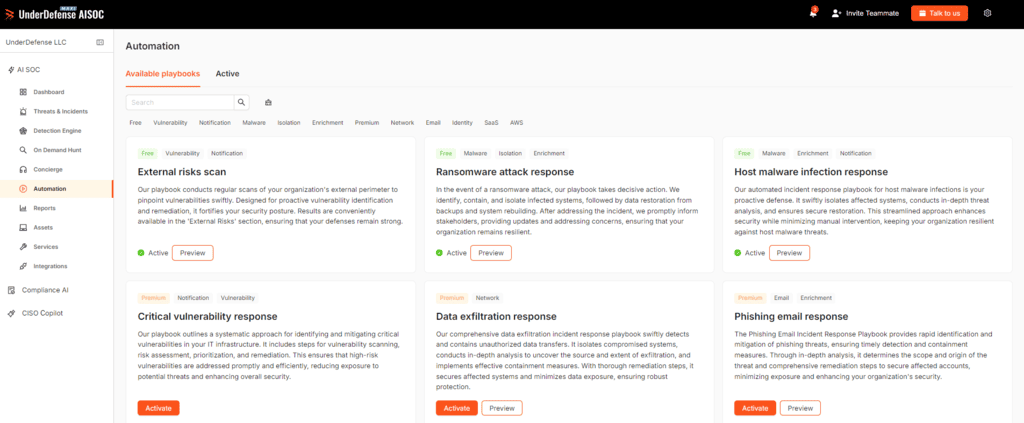
The model that fits most small security teams is coverage that sits on top of the tools you already own. UnderDefense Agentic AI SOC works this way: AI agents investigate every alert inside the customer’s existing SIEM and EDR, and analysts decide on escalation.
Before you call any provider, write your own list. The outsourced vs in-house SOC decision is only one line on it, and the rest of this guide fills in the others.
How Many Companies Already Outsource Security, by Size
The UK Government’s Cyber Security Breaches Survey 2025/2026, published on April 30, 2026, is UK data, but it is the clearest public count of cyber security outsourcing by company size. The survey reports that “Around half of businesses (48%) and a quarter of charities (25%) had an external cyber security provider.”
For you, that 48% means you can skip the debate about whether to outsource and spend the time on which functions to hand over.
The split by size is where it gets useful. The survey found outsourcing “substantially higher among small (64%) and medium (70%) businesses,” while 42% of large businesses and 44% of micro businesses had an external provider.
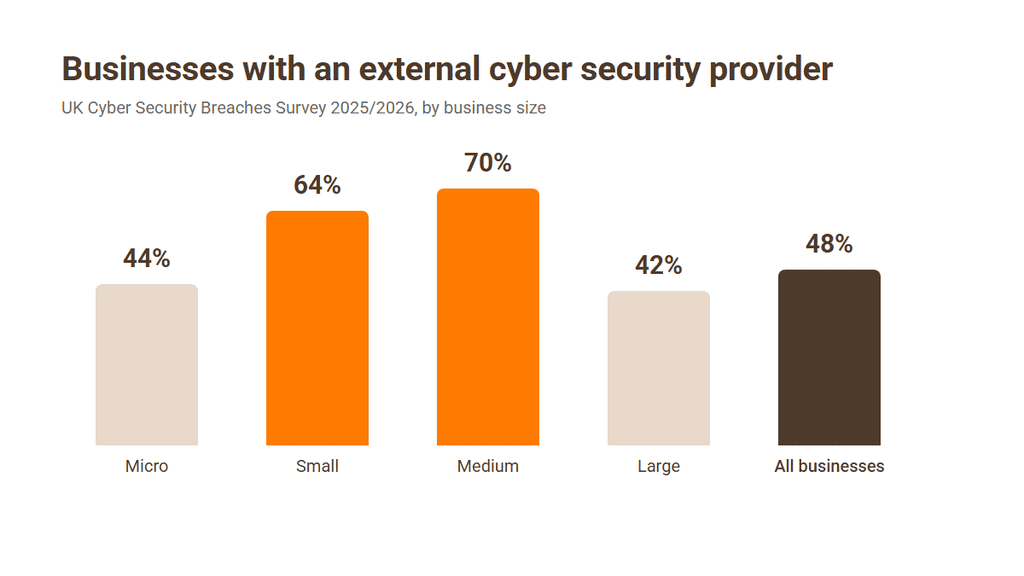
The survey groups companies by headcount, with large meaning 250 or more employees, and suggests large firms may rely more on internal expertise. If you run a company of several hundred people with a small security team, you sit in that group without the in-house depth to cover every hour.
Across all businesses, the same survey calls the share “broadly consistent” with the previous four years: outsourcing part of security is settled practice, and your question is only which part.
What to Hand Over: Work That Runs Around the Clock or Needs Skills You Cannot Hire
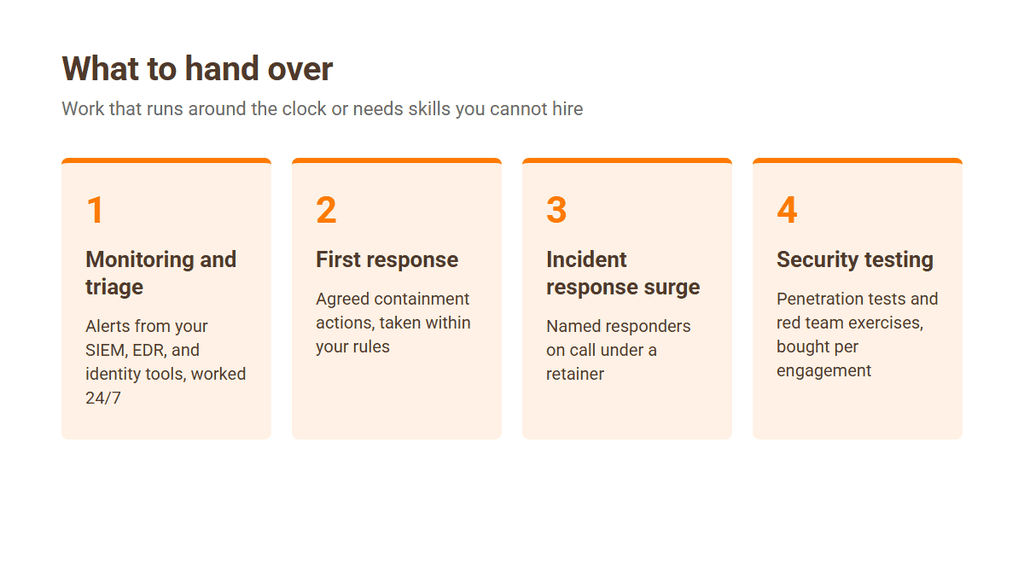
Hand over the work that has to happen at 3 a.m. on a Sunday, and the work that needs skills you would use a few weeks a year. Both are expensive to staff in-house and costly to get wrong.
Monitoring and Triage
Round-the-clock monitoring is the clearest case for outsourcing. Covering every hour of the week in-house means several analysts on rotation, and a team of one to four people cannot do that without leaving gaps.
A provider works your Sentinel, Splunk, or Elastic alerts, plus CrowdStrike or SentinelOne detections and Entra ID sign-in events. Ask whether the provider works inside your SIEM or copies your logs into its own platform, because that answer decides who owns the data later.
Triage is the part that saves your team’s time. A good provider closes the false positives, groups related alerts into one case, and checks context such as a user’s usual sign-in location before anything reaches you.
Ask how the provider confirms suspicious activity with the affected user. A quick check with the employee over Teams or Slack can settle an odd Microsoft 365 sign-in quickly, where a ticket waits until Monday.
First Response and Containment
Triage without response leaves your team with a to-do list on Monday. The useful handover includes agreed first actions: isolate a host in your EDR, disable an Entra ID account, revoke sessions, or block an indicator.
Write down which actions the provider may take alone and which need your approval first. A provider that can isolate a laptop at 2 a.m. under a pre-agreed rule closes the window an attacker needs, while you keep the call on anything that touches production.
Incident Response Surge
A serious incident needs forensics, containment planning, and recovery work for days or weeks. Few companies keep that capacity on staff, so an incident response retainer puts named responders on call before you need them.
💡 Agree the retainer terms and the evidence-handling process before an incident. Negotiating scope while systems are encrypted costs you the hours that matter most.
Security Testing
Penetration testing and red team exercises need offensive skills that most defensive teams use a few times a year. Buying them per engagement keeps the skill sharp and gives you an outside view of your own controls.
Testing also feeds the rest of the handover. Findings from a test tell your monitoring provider which attack paths to watch. Ask how the two will share results if they come from different firms.
Compliance evidence work is the last common handover. Collecting screenshots and logs for a SOC 2 or ISO 27001 audit is repetitive, and an outside team or platform can keep it current between audits so your engineers aren’t pulled off projects in audit month.
What to Keep: Decisions That Need Your Business Context
Keep every decision that depends on knowing your business: what you sell, what you can afford to lose, and who you answer to. A provider can advise on these, but it cannot own them.
Risk acceptance is the first one. When a finding can’t be fixed this quarter, someone with authority decides to live with it, and that person must work for your company.
Priorities, policy, and vendor choice follow the same logic. Your provider sees alerts; your team knows that the finance close runs in the last week of each month and that one legacy server cannot be patched until a contract ends.
The table below turns that into a split you can copy into your own plan.
| Function | Keep or hand over | Why |
|---|---|---|
| 24/7 monitoring and triage | Hand over | Needs round-the-clock staffing |
| First containment actions | Hand over, within agreed rules | Speed matters at night |
| Incident response surge | Hand over, under a retainer | Rare, specialist skills |
| Penetration testing | Hand over | Offensive skills used periodically |
| Compliance evidence collection | Hand over | Repetitive work all year |
| Risk acceptance | Keep | Needs authority and business context |
| Security priorities and budget | Keep | Tied to business plans |
| Policy and standards | Keep | Sets rules the provider follows |
| Vendor and tool choice | Keep | You own the stack and contracts |
| Access approvals | Keep | Needs knowledge of roles |
| Board and regulator communication | Keep | Accountability stays with you |
Access approvals sit on the keep side because only your team knows whether a new admin account in Entra ID is a planned change or a warning sign. The provider should flag it fast, and your team should decide.
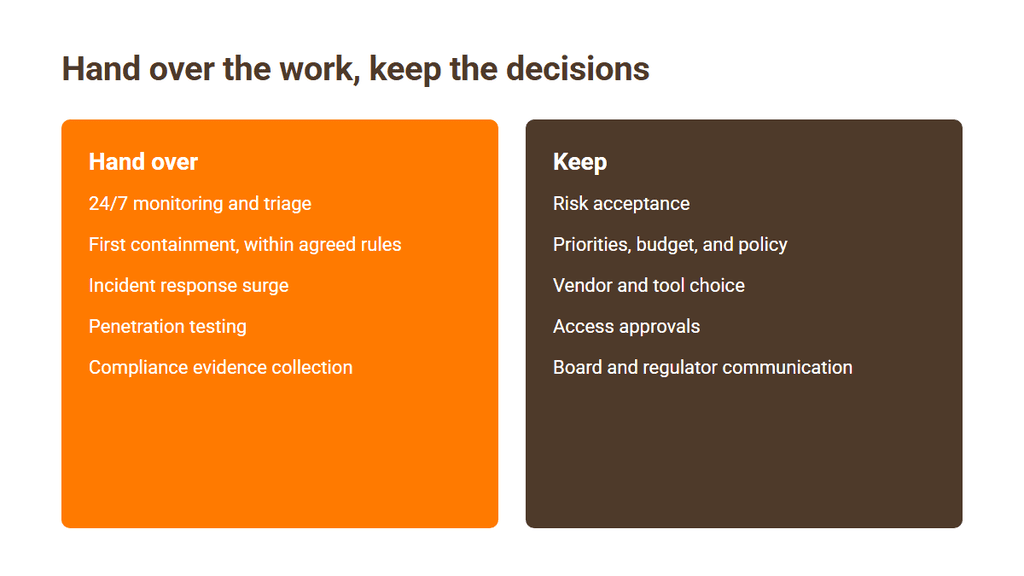
⚠️ Communication with the board and regulators stays with you even when a provider wrote the incident report. Signing off on what you tell them is part of the accountability that never moves.
How to Choose a Provider: Questions That Separate Responders From Notifiers
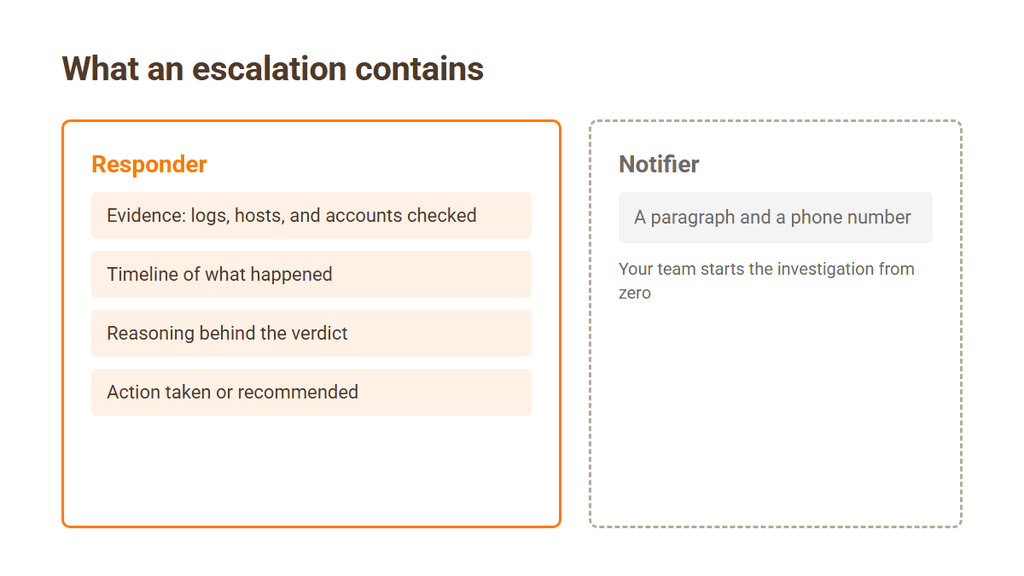
A responder investigates, acts within agreed limits, and hands you the evidence. A notifier forwards an alert with a short note and a phone number, and your team starts the investigation from zero.
The difference rarely shows on a pricing page, but it shows quickly in a demo. Use these questions during a demo, and ask to see real artifacts with customer details removed:
- Can you show one real escalation, with the evidence, timeline, and reasoning it contained?
- Which containment actions can your analysts take alone, and which need the customer’s approval?
- Where does the data live, who owns it, and can it be exported at any time?
- Do you work inside the customer’s SIEM and EDR, or must logs move to your platform?
- How does your SLA define response: an acknowledgment, an investigation, or an action?
- What does the monthly report show, and who reviews it with the customer?
- What happens to the data, detections, and runbooks when the contract ends?
A good answer comes with an artifact you can inspect, such as a redacted escalation, a written list of allowed actions, or a sample monthly report. A provider that answers only in general terms is likely a notifier.
The SLA question deserves the most time. A promise to “respond” can mean an automated acknowledgment. Ask the provider to show which clock its SLA measures and what your team receives when that clock stops.
Exit terms are the question buyers skip most often. If your detection rules and investigation history stay with the provider, switching later means rebuilding them, and that cost belongs in today’s comparison.
ENISA’s annual threat report for 2026, published in September 2026, adds a reason to check the provider itself. ENISA reports that “Cybercriminals increasingly targeted third-party providers, such as digital services,” and that “A major trend involved the compromise of shared platforms and service providers,” with one breach reaching many customers at once.
For your selection, that means the provider’s own access to your environment is an attack path. Ask how its analysts authenticate, how their access is logged, and how you can review it. A provider you can’t inspect becomes one more risk your team inherits.
Ask a provider to show one real escalation before you sign
What Cybersecurity Outsourcing Costs and What Drives the Price
Outsourced cybersecurity is priced on a few common models, and the quote moves with a handful of drivers. Knowing both lets you compare two proposals line by line, even when providers present them differently.
Most providers price on one of four models. The table names each one and what usually sits behind it.
| Pricing model | What you pay for | Watch for |
|---|---|---|
| Per device or asset | Each monitored endpoint, server, or cloud asset | How assets are counted |
| Per user | Each employee identity covered | Service accounts and contractors |
| Tiered package | A bundle of hours, features, and response scope | What sits outside each tier |
| Retainer | Reserved incident response hours | Unused hours and renewal terms |
Several drivers then move the quote within any model. Coverage hours come first: full 24/7 coverage costs more than business-hours monitoring, and a nights-and-weekends scope sits between the two.
Log volume is the second driver, especially when the provider ingests your SIEM data into its own platform. Ask whether the price changes as volume grows, because a new cloud workload can raise next year’s bill without anyone signing anything.
Response authority is the third. A provider that may contain threats alone carries more responsibility than one that only notifies, and the quote usually reflects that difference.
Compliance reporting is the fourth. If you need reports mapped to SOC 2 or ISO 27001 controls, ask whether they are included or billed as extra work. The hidden SOCaaS costs that surprise buyers usually sit in these lines.
When two quotes differ, put them side by side against these four drivers. The cheaper one often covers fewer hours, ingests less data, or leaves containment to your team.
Contract terms move the real cost as well. Ask about onboarding fees, minimum terms, how the price changes when you add devices mid-year, and what an incident outside the normal scope costs. Those answers belong in the comparison, because they decide what you pay in year two.
The last check is what you would spend without the provider. Write down the hours your own team spends on alert review, after-hours callouts, and audit evidence today. That number is the honest baseline for every quote. As a reference point, UnderDefense’s published price for 24/7 coverage starts at $11 per asset per month.
UnderDefense Agentic AI SOC: 24/7 Analysts on Top of the Stack You Already Run
If your worry is handing a vendor your data and your decisions, the UnderDefense Agentic AI SOC is built to cover the night shift while you keep both. Your Sentinel or Splunk and your CrowdStrike or SentinelOne keep running, your data stays yours, and the Agentic AI SOC works on top of them.
UnderDefense is rated 5.0 out of 5 from 83 reviews on G2 as of November 2026.
Measured against the questions above: alert-to-triage takes about 2 minutes, and critical incidents are escalated to your team within 15 minutes with the evidence, timeline, and reasoning attached. Analysts confirm odd activity with the affected employee over Slack or Teams and decide on escalation and containment under the rules you agree.
UnderDefense is ISO 27001 certified, and every investigative step its agents and analysts take is visible and auditable, which lets you check the work before you act on it.
One reviewer describes the change from a provider that only notified:
“We shifted from a provider whose escalations were just a brief paragraph and a phone number” Valeriia K., Chief Business Development Officer, 51-1000 employees, G2, August 2026
AirSlate, a technology company with 1,000 to 5,000 employees, shows what handing over the work can return. AirSlate’s case study covers a CrowdStrike EDR rollout: “The core deployment to 1200 endpoints took only 23 business days.” It also reports 35 hours a week saved for the IT team.
Those 35 hours are close to a full working week given back to a small team. Going live and being tuned are two stages: coverage goes live within 10 days, and full onboarding with customized detections takes 30 days.
UnderDefense publishes a starting price for 24/7 coverage: from $11 per asset per month. Larger environments get a quote scoped to device count and coverage, and the 40-hour incident response retainer is included from the Standard tier.
Deployment can be SaaS, hybrid, on-premises, or air-gapped, which lets the setup follow wherever your data has to stay. Ask which mode fits your data rules when you review the Agentic AI SOC with your team.
Talk to an expert about covering your nights and weekends
A Handover Plan in Five Steps
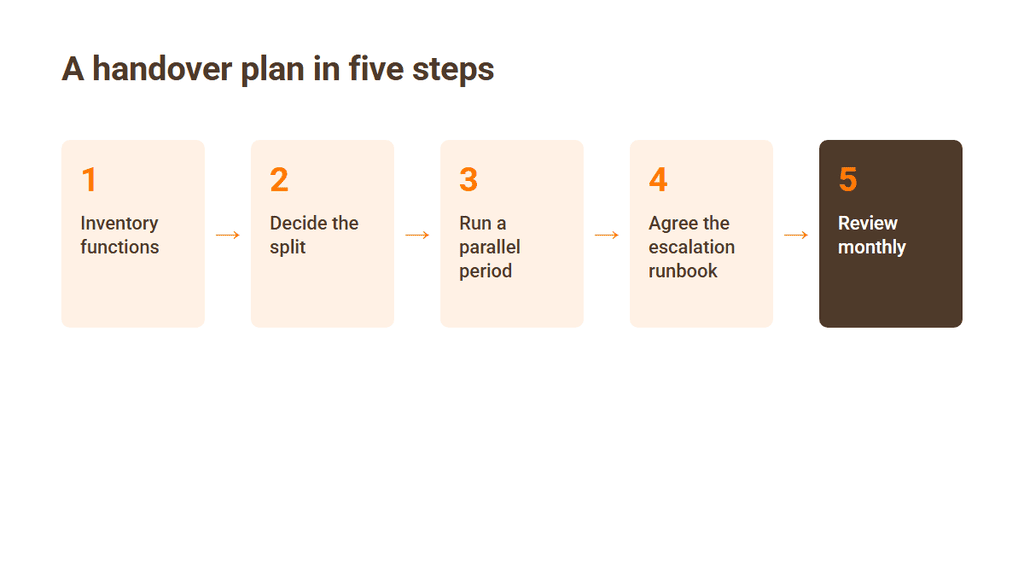
A handover works best when you plan it as a sequence. The five steps below keep control with your team while the provider takes on the work.
- Inventory every security function you run today, and who runs it.
- Decide the split, using the keep and hand-over table above.
- Run a parallel period in which your team and the provider both watch the same alerts.
- Agree the escalation runbook: who is called, for what, and which actions need approval.
- Review the work monthly, using real escalations and the provider’s report.
💡 The parallel period is where you learn the most. Compare the provider’s escalations with what your team would have done, and adjust the runbook before you stop watching yourself.
Inventory and the split come first because they set the scope you’ll ask providers to quote. A provider quoting against your own list of functions gives you a proposal you can compare with the next one.
The escalation runbook is the document you’ll use at 2 a.m., so write it with the provider. Name the people to call, the order to call them, and the actions that need a yes from your team before anyone touches production.
The monthly review keeps the split honest. Bring one real escalation to every review, check it against the checklist above, and use continuous security monitoring data to decide whether any function should move back in-house.
Once the runbook is agreed, your team stops guarding the night shift and goes back to the projects only it can run. The weekend alert from the opening becomes a Monday report with the investigation already done: 24/7 monitoring without hiring is the outcome the handover exists to deliver.
Hand over the night shift and keep the decisions
- Walk through one real escalation, with its evidence, timeline, and reasoning
- Watch AI agents investigate an alert while an analyst decides on escalation
- Get a rollout plan for your stack: SaaS, hybrid, on-premises, or air-gapped
Frequently Asked Questions
Is it safe to outsource cybersecurity?
Yes, when you keep the decisions and can inspect the provider’s work. Choose a provider that works inside your own tools, logs its own access, and hands escalations back with evidence. Accountability stays with your company, so contract terms on data ownership and exit matter as much as detection quality.
Which cybersecurity functions should never be outsourced?
Risk acceptance and accountability should never be outsourced. Keep security priorities, policy, vendor choice, access approvals, and communication with your board and regulators in-house too. A provider can advise on each one, but the decision needs someone who knows the business and answers for it.
How much does it cost to outsource cybersecurity?
The cost depends on the pricing model and four drivers. Providers charge per device, per user, through tiered packages, or through retainers, and coverage hours, log volume, response authority, and compliance reporting then move the quote. As a reference point, UnderDefense’s published price for 24/7 coverage starts at $11 per asset per month.
Can a small team outsource only nights and weekends?
Yes, many providers offer after-hours coverage, and it can fit a small team that works business hours. Agree a clear handoff each morning and evening, and make sure the provider can contain an urgent threat under pre-agreed rules while your team is offline.
What is the difference between an MSSP and an MDR provider?
An MSSP usually manages security tools and forwards alerts, while an MDR provider investigates threats and responds to them. Labels vary between providers. Judge each one by what its escalations contain and which actions it can take, and ask for one real escalation before you decide.