








Your sponsor bank’s annual review asks for the SOC 2 report, the card program wants this year’s PCI DSS attestation, and an EU bank customer sends Digital Operational Resilience Act (DORA) clauses with its renewal draft. Each becomes its own evidence pull, and a thin answer can stall the bank review or the EU renewal.
Here is how to answer their shared control questions from one evidence set.
TL;DR
- Fintech compliance means answering banks, card programs, enterprise buyers, and EU customers with overlapping frameworks.
- A five-question check shows which rules apply to your company.
- Access, logging, incident response, asset, and third-party controls repeat across PCI DSS, SOC 2, and DORA.
- One evidence set with owners and a review schedule answers the shared control questions; contract terms stay with legal.
Table of contents
- Fintech Compliance Means Answering Several Requesters at Once
- Which Rules Apply to Your Fintech: A Five-Question Check
- Where PCI DSS, SOC 2, and DORA Ask for the Same Controls
- What DORA Changes for Fintechs That Sell to EU Banks
- Build One Evidence Set and Keep It Current Between Audits
- UnderDefense: One Evidence Set for Your Bank Partner, Card Program, and EU Customers
- Frequently Asked Questions
Regulatory compliance for fintech arrives as a stack of requests from parties who each picked a framework, set a deadline, and expect proof from your systems in their own format.
This guide is for the compliance lead, Head of Security, or CTO at a payments, lending, neobank, or B2B finance software company that sells to banks and enterprises. The examples use common stacks (a cloud provider, an identity provider, a security information and event management (SIEM) system, and an endpoint detection and response (EDR) tool), and the control map works with any of them.
You’ll see who asks for what, which rules apply to you, and where the control sets overlap. The last sections show how to build one evidence set that keeps those answers current between audits. It covers security-control frameworks; anti-money laundering (AML), know-your-customer (KYC), and consumer-finance rules sit with your counsel.
Map bank, card program, and EU customer requests to one evidence set
Fintech Compliance Means Answering Several Requesters at Once
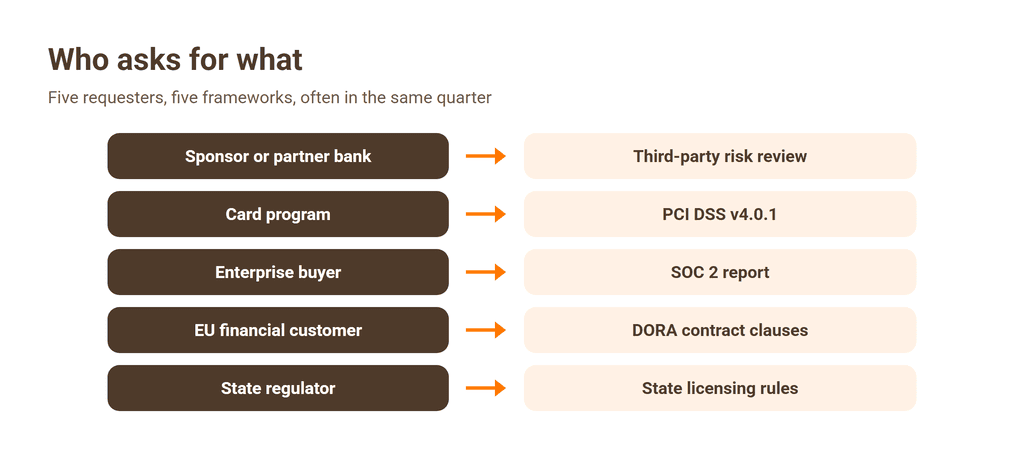
Fintech regulatory compliance starts with the people asking, because each requester owns a framework and a deadline. A sponsor bank, a card program, an enterprise buyer, and an EU financial customer can all land in the same quarter, and none of them coordinates with the others.
The table maps each requester to the framework it uses and the evidence it usually accepts. The framework names come from the standards themselves; the evidence column describes the documents each framework produces.
| Requester | Framework | What they ask for | Evidence they accept |
|---|---|---|---|
| Sponsor or partner bank | Its own third-party risk program | Due diligence questionnaire, security controls | SOC 2 report, policies, test results |
| Card program | PCI DSS v4.0.1 | Annual validation | Attestation of Compliance (AOC) |
| Enterprise buyer | SOC 2 | Independent auditor’s report | SOC 2 report from a CPA firm |
| EU financial customer | DORA (Regulation (EU) 2022/2554) | Contract clauses, audit and access rights | Signed contract terms, control evidence |
| State regulator | Licensing rules in that state | Conditions of the license | Filings the state requires, such as annual certification |
Most of these requests ask about the same handful of controls in different words. The bank’s questionnaire asks who can reach production, the PCI DSS assessment tests it, and the EU customer’s contract gives it audit rights over it.
Each requester also runs on its own clock. PCI DSS validation repeats every year, a SOC 2 report covers the period your auditor agrees with you, and EU customers add DORA clauses at signing, renewal, or amendment.
The signers differ too. CPA firms (licensed accounting firms) issue SOC 2 reports, assessors sign PCI DSS reports, and DORA has no certificate at all: your EU customer checks your controls under its contract, so the evidence you hold is what it checks.
That overlap is where the work can shrink. UnderDefense MAXI Compliance AI collects that evidence once from the tools you already run and maps it to each framework.
Which Rules Apply to Your Fintech: A Five-Question Check
Fintech compliance regulations depend on what you touch and who you sell to, so five questions settle most of the scope. Answer them before you buy a tool or hire a firm, because each yes adds a requester and a deadline.
| Question | If yes | What it adds |
|---|---|---|
| 1. Do you store, process, or transmit card data? | PCI DSS v4.0.1 applies | Annual validation to your acquirer (the bank that processes your card payments) or card program |
| 2. Do you sell to EU banks, insurers, or payment institutions? | DORA reaches you through contracts | Article 30 clauses and audits by the customer |
| 3. Do you hold a license from a state financial regulator? | That state’s rules apply | Licensing conditions set by that state |
| 4. Do enterprise buyers send security questionnaires? | SOC 2 is the usual answer | A report from an independent CPA firm |
| 5. Does a bank sponsor your program or hold your accounts? | The bank’s third-party risk review applies | Questionnaires, reports, and audit rights |
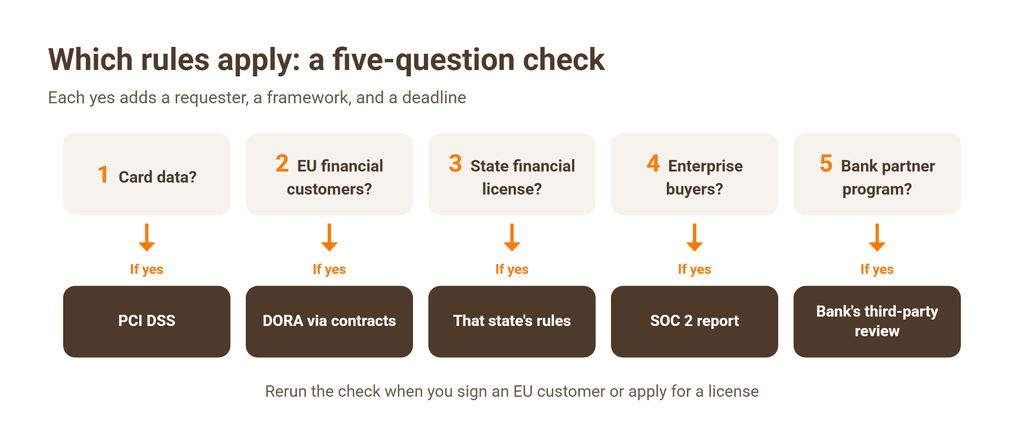
Three or more yes answers mean several requesters testing the same controls, which is where shared evidence starts to save whole projects. Each yes also brings its own calendar, so write the next deadline next to every framework.
The EU question is broader than banks. Article 2 of DORA lists credit institutions, payment institutions, electronic money institutions, investment firms, crypto-asset service providers, and insurance undertakings among the entities in scope, so a European payments partner counts as well.
The card data question decides how much of your estate the PCI DSS assessment covers. If a processor handles card data end to end, the requirements shrink, and the FAQ below covers what still applies.
If you hold a New York license, the New York Department of Financial Services cybersecurity regulation (23 NYCRR Part 500) adds its own multi-factor authentication (MFA), asset inventory, and 72-hour incident notice rules on top of the shared controls below.
A no can still change. Signing your first EU bank customer or applying for a state license moves a framework from “later” to “this quarter”, so rerun the check whenever sales or licensing plans change.
Where PCI DSS, SOC 2, and DORA Ask for the Same Controls
The overlap is clearest at the control level. Five control families show up in every framework a fintech meets, and each one can be evidenced once from the system that produces it.
The table cites the requirement in each source text: PCI DSS v4.0.1, the 2017 Trust Services Criteria (revised points of focus, 2022) from the American Institute of Certified Public Accountants (AICPA) for SOC 2, and Regulation (EU) 2022/2554 (2022) for DORA.
SOC 2 codes such as CC6.1 come from those Trust Services Criteria (TSC), the points your CPA auditor tests.
| Control family | PCI DSS v4.0.1 | SOC 2 (TSC 2017) | DORA |
|---|---|---|---|
| Access and MFA | Req. 7.2, 8.4.2 | CC6.1, CC6.2, CC6.3 | Art. 9(4)(c), 9(4)(d) |
| Logging and monitoring | Req. 10.2, 10.4.1 | CC7.2 | Art. 10(1) |
| Incident response | Req. 12.10.1 | CC7.3, CC7.4, CC7.5 | Art. 17, 19 |
| Asset inventory | Req. 12.5.1 | CC6.1 (point of focus) | Art. 8(1), 8(4) |
| Third-party risk | Req. 12.8 | CC9.2 | Art. 28, 30 |
Read across a row and the work becomes one task. An access review exported from Okta or Entra ID gives PCI DSS Requirement 7.2.4, SOC 2 CC6.3, and DORA Article 9(4)(c) the same evidence, so one review replaces three separate evidence pulls.
Logging, Incidents, Assets, and Vendors
Logging works the same way. PCI DSS Requirement 10.4.1 asks for audit log review at least once daily, and DORA Article 10(1) asks for mechanisms to “promptly detect anomalous activities”. One SIEM can serve both, because a SIEM for financial services produces the daily review records each one asks about.
Incident response is the row where each requester’s reporting duties meet. PCI DSS Requirement 12.10.1 asks for an incident response plan, and DORA customers expect your help with the major-incident reports Article 19 makes them file. A single plan with a notification list per requester keeps those clocks from colliding during an incident.
Asset inventory feeds every other row. DORA Article 8(4) asks financial entities to identify all information and ICT assets, including remote sites, network resources, and hardware. Build that inventory once from your cloud accounts and EDR console.
Third-party risk closes the map. PCI DSS Requirement 12.8 asks you to keep a list of third-party service providers, DORA Article 28 makes your EU customer keep a register of its own, and SOC 2 CC9.2 tests how you manage vendor risk, so one vendor register serves all three.
The frameworks still differ in depth. PCI DSS limits most requirements to the cardholder data environment, SOC 2 follows the scope your auditor agrees with you, and DORA reaches the ICT services your EU customer relies on. 💡 Map scope once per framework, then reuse the control evidence inside each scope.
The SOC 2 column lists criteria your auditor tests, and the SOC 2 compliance requirements behind them leave the control design to you. For a fintech, the third-party row deserves the most attention, because DORA turns it into contract terms.
What DORA Changes for Fintechs That Sell to EU Banks
DORA has applied since January 17, 2025, under Article 64, to EU financial entities such as banks, payment institutions, and insurers. A fintech outside the EU usually meets it as an information and communication technology (ICT) third-party service provider to one of those customers.
If your company also holds an EU license, for example as a payment or electronic money institution, it’s a financial entity under Article 2 and DORA applies to it directly. The rest of this section covers the more common case: a provider reached through contracts.
The obligation stays with the customer. Article 28(1)(a) says financial entities “remain fully responsible” for compliance when they use ICT services, so your EU customer must push the requirements into your contract and check that you meet them.
That push happens in two places. Article 28(3) requires the customer to keep a register of information on all contractual arrangements with ICT third-party service providers, and Article 30 lists the clauses those contracts must contain.
Article 30(2) clauses apply to every ICT contract: a full description of the services, the locations where data is processed, data protection provisions, and assistance with ICT incidents at no extra cost or a cost set in advance. They also cover cooperation with the customer’s regulators and termination rights.
For services that support a critical or important function, Article 30(3) adds more. It asks for full service level descriptions with quantitative targets, notice of developments that could affect the service, tested contingency plans, and unrestricted rights of access, inspection, and audit for the customer and its regulator.
The table turns the clauses this section cites into the requests your EU customer will make.
| Clause | What your EU customer will ask you for | Evidence or contract term |
|---|---|---|
| Art. 30(2)(b) | The regions or countries where you provide the service and process data | A data location list and a duty to notify before you change it |
| Art. 30(2)(f) | Help when an ICT incident hits the service | Incident assistance at no extra cost or a cost set in advance |
| Art. 30(3)(a) | Service levels with quantitative and qualitative targets | A service level agreement with measurable targets |
| Art. 30(3)(c) | Business contingency plans you implement and test | The contingency plan and its latest test record |
| Art. 30(3)(d) | Participation in its threat-led penetration testing (TLPT) | A clause committing you to take part and cooperate |
| Art. 30(3)(e) | Access, inspection, and audit rights | Current control evidence you can hand over during the contract |
The 30(3) rows apply only when your service supports a critical or important function, so ask your customer how it classifies the service before you negotiate.
⚠️ The audit rights in Article 30(3)(e) mean the customer’s team, or a third party it appoints, can ask for your control evidence at any time during the contract. A fintech that keeps evidence current answers that request from its existing records, while one that rebuilds evidence per audit starts a new project each time.
Incident reporting follows the same path. Article 19 makes the EU customer report major ICT-related incidents to its regulator, and Article 30(2)(f) obliges you to assist, so your incident response plan needs a step for notifying each EU customer.
Every notice to an EU customer depends on spotting the incident in the first place, at any hour. Round-the-clock monitoring, the core of security for fintech teams, gives your plan the detection record and investigation each notice draws on.
Article 30(3)(d) also asks providers to take part in the customer’s threat-led penetration testing, the part of DORA resilience testing that reaches outside the financial entity. Read your EU contracts for these clauses, and check each renewal or amendment for them.
Find the DORA contract questions your current records already answer
Build One Evidence Set and Keep It Current Between Audits
A fintech compliance checklist only works if the evidence behind it stays current. Collected once per audit, evidence goes stale as soon as systems change after the audit, while kept current it answers most control questions on the day they arrive.
The steps below turn the control map into a working evidence set:
- Map each control once to every framework that asks for it
- Name one owner per control, by role
- Collect evidence from the system that produces it, such as Okta, the SIEM, or the EDR
- Set a review schedule that matches the strictest framework for each control
- Keep the vendor and contract records for your EU customers’ registers
- Share the evidence through one link for questionnaires and audits
The strictest framework sets each schedule. PCI DSS sets the tightest access cadence, with user account reviews every six months under Requirement 7.2.4, so set that cadence once and reuse the same records for the other frameworks.
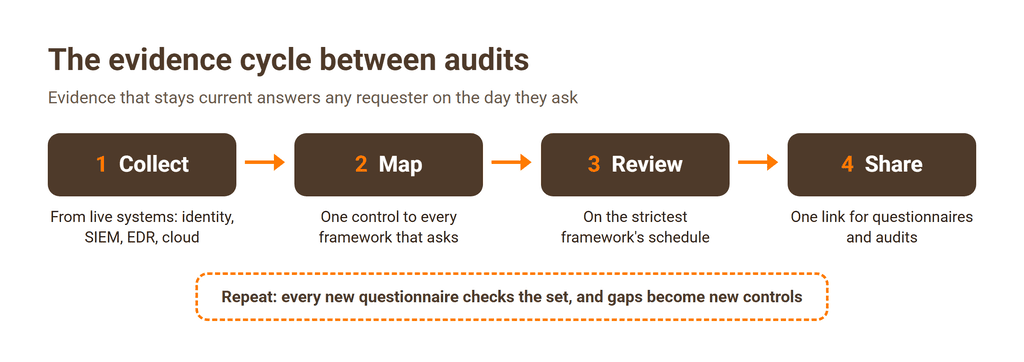
Owners keep the set alive. When the identity team owns access reviews and the security operations lead owns log review, a requester’s question goes to one person who already has the record, and nobody chases evidence across departments right before an audit.
Sharing matters as much as collecting. With a shared Trust Center, a bank partner or enterprise buyer reads your current posture, and most of each new questionnaire is answered from records you already hold.
Data controls follow the same model. When a bank partner asks how customer data is classified and retained, the answer comes from your data classification records, and they join the same evidence set. 💡 Treat every new questionnaire as a check of the set: any question you can’t answer from it names a control to add.
Some fintechs bring in outside help to set up the first map. Compliance consulting can build the control map and the owner list, and your team then keeps it current between audits.
UnderDefense: One Evidence Set for Your Bank Partner, Card Program, and EU Customers
UnderDefense MAXI Compliance AI keeps your evidence current when a bank partner, card program, or EU customer asks for it. It collects evidence from the tools you already run and maps it once to every framework it supports, so each requester draws on the same records.
UnderDefense is rated 5.0 out of 5 from 83 reviews on G2 as of November 2026. UnderDefense is itself ISO 27001 certified, and prepared for that audit on MAXI Compliance AI.
The Certified package adds security questionnaire automation for up to 24 questionnaires a month, so a bank’s due diligence request starts from answers your evidence already supports. A partner audit firm is matched within one business day, or you bring your own, and your auditor works with the evidence in the platform, with the access you grant.
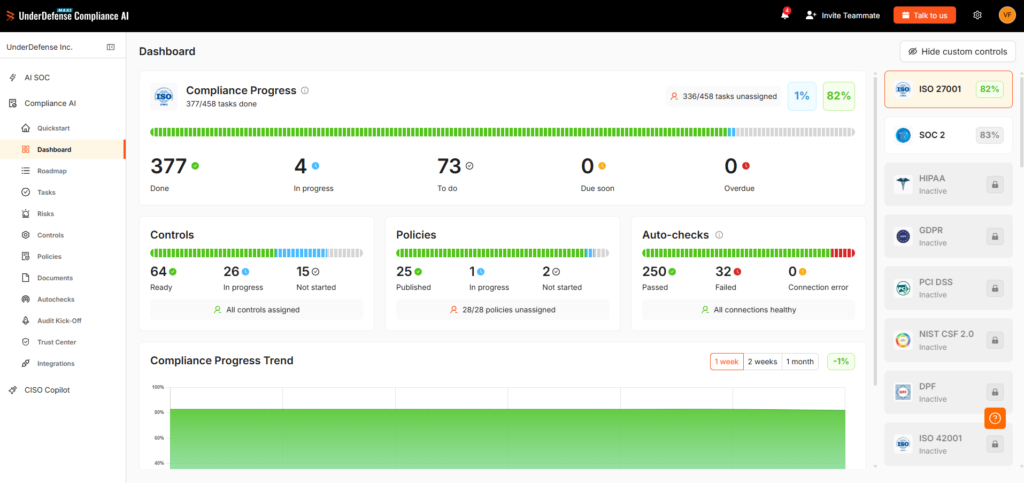
Your team shares that evidence through one Trust Center link, so the bank’s questionnaire and the EU customer’s audit request draw on the same records. MAXI Compliance AI prepares the evidence and supports the audit, and the SOC 2 report itself still comes from an independent CPA firm.
MAXI Compliance AI supports DORA alongside SOC 2, ISO 27001, HIPAA, GDPR, and PCI DSS. An EU customer’s DORA questions and a card program’s PCI DSS questions then draw on one evidence set. MAXI Compliance AI is not a PCI Approved Scanning Vendor (ASV), so the Certified package’s vulnerability scans don’t replace the quarterly ASV scans PCI DSS requires.
The published compliance packages start with Free ($0), then Starter from $499, Essential from $1,299, and Certified from $1,899 per month.
Each paid package also includes 24, 48, or 90 hours a year with UnderDefense compliance consultants, depending on the package, and the platform runs as SaaS, hybrid, on-premises, or air-gapped when financial data has to stay on your own systems.
Helpware, a global business process outsourcing (BPO) company, runs its SOC 2 and ISO 27001 program across eight countries on MAXI Compliance AI. Its case study reports “2× faster audit readiness” and “50+ automated checks running 24/7,” and the company “kept the same compliance team while the business doubled.”
Plan your fintech evidence set with a compliance expert
The same platform runs UnderDefense Agentic AI SOC, so the logging and incident evidence in your control map comes from one system working on the same data.
Bring your last bank questionnaire and see which answers your records cover
- See how one evidence set maps to PCI DSS, SOC 2, and DORA
- Get 24, 48, or 90 consulting hours a year, by package
- Share current evidence through one Trust Center link
Frequently Asked Questions
Does DORA apply to US fintechs?
Not directly. DORA applies to EU financial entities, but its Article 30 requires them to put specific clauses into contracts with ICT providers, including incident assistance and, for critical or important functions, audit rights. A fintech based outside the EU that sells to EU banks or payment institutions meets DORA through those contracts.
Is SOC 2 required for fintech companies?
No law requires SOC 2. Enterprise buyers and bank partners commonly ask for a SOC 2 report during due diligence, so it often becomes a condition of the deal. The report comes from an independent CPA firm after it tests your controls.
Does a fintech need PCI DSS if a payment processor handles card data?
Usually yes, with a smaller scope. Outsourcing card handling reduces the requirements that apply, but your acquirer or card program still expects you to validate, often with a shorter Self-Assessment Questionnaire. Ask your acquirer which validation it requires.
What does a bank's due diligence questionnaire ask a fintech for?
Most questions map to the shared controls in this guide: access reviews and MFA, logging and monitoring, an incident response plan with a notification list, an asset inventory, and a vendor register. Banks usually accept a SOC 2 report, policies, and test results as evidence, so answers drawn from one current evidence set cover most of the questionnaire.
Can one compliance platform cover PCI DSS, SOC 2, and DORA?
A platform can map one evidence set to PCI DSS, SOC 2, and the shared security controls DORA contracts ask about. DORA’s specific contract terms and your customer’s register of information remain your own legal and vendor-management work.