







MDR For FinTech That Covers Every Corner — Banking, Payments, Crypto, And More
One 24/7 team detecting and containing threats across your core-banking, cloud, payment, and crypto-custody stacks — on the tools you already own. Built for digital banks, payment platforms, crypto exchanges, insurtech, and lending, with PCI DSS, DORA, and SOC 2 evidence produced as we go.
500+ clients protected






















In fintech, the alert you miss at 3 a.m. is someone's money.
Payments, deposits, and crypto move around the clock — and so do the attacks. If your team can't watch every stack every hour, or can't hand an examiner clean evidence on demand, that's a response problem, and it's exactly what MDR fixes.
Fraud and transaction alerts burying the SOC
Payment, login, and on-chain events fire at volumes a lean team can't triage. The real account-takeover hides inside thousands of benign anomalies.
24/7 coverage regulators expect, staffing you can't
PCI DSS, NYDFS, and DORA all assume someone is watching continuously. Hiring an around-the-clock SOC across banking and crypto isn't realistic on a fintech budget.
No audit-ready evidence when the examiner asks
You have logs; you don't have evidence mapped to PCI DSS, DORA, or SOC 2. Audits stall while your engineers hand-assemble exports.
Detection without response, on threats measured in seconds
Account-takeover and real-time-payment fraud don't wait for a ticket. A tool that only notifies misses the SLA that matters.
Security fragmented across core-banking, cloud, and crypto custody
Different tools for the ledger, the cloud, the SaaS stack, and the wallet infrastructure, with no one correlating them into a single picture.
Vendor lock-in and duplicated spend across stacks
Point tools bolted onto banking, payments, and crypto separately, each with its own contract, none of them talking to each other.
Built for all of fintech — not just the bank
Traditional MDR stops at banks and credit unions. Crypto security shops sell a one-time audit and walk away. We do neither: continuous, human-led detection and response tuned to how your corner of fintech actually gets attacked.
Digital banking & neobanks
Account-takeover, credential stuffing, and real-time fraud at scale — detection tuned to auth anomalies and session hijacking across your app, cloud, and identity provider.
Payments & paytech
API abuse, transaction fraud, and PCI DSS scope creep — we watch the cardholder-data environment and payment APIs, and produce PCI evidence as we monitor.
Crypto & Web3
Hot-wallet compromise, key-management attacks, and blended on-chain/off-chain intrusions — continuous detection across custody infrastructure and cloud, not a point-in-time audit.
Insurtech
Sensitive PII and claims data spread across third-party integrations — we monitor the data flows and the SaaS/identity sprawl that carry them.
Lending & BNPL
Identity fraud and API abuse against platforms holding PII and payment credentials — detection tuned to onboarding fraud and account abuse.
From neobanks to credit unions
Wherever you sit on the fintech spectrum, one 24/7 team correlates every stack — so the threat that moves between them has nowhere to hide.
Why fintechs choose UnderDefense MDR
The things you can verify before you sign, not after.
24/7 human-led coverage
Round-the-clock monitoring and response across banking, cloud, payments, and crypto stacks — expert hands on the threat, not just a dashboard.
We resolve, we don't escalate
AI gathers the context; our analysts contain the threat — isolate a host, freeze an account — instead of forwarding you a ticket.
Works on the stack you already own
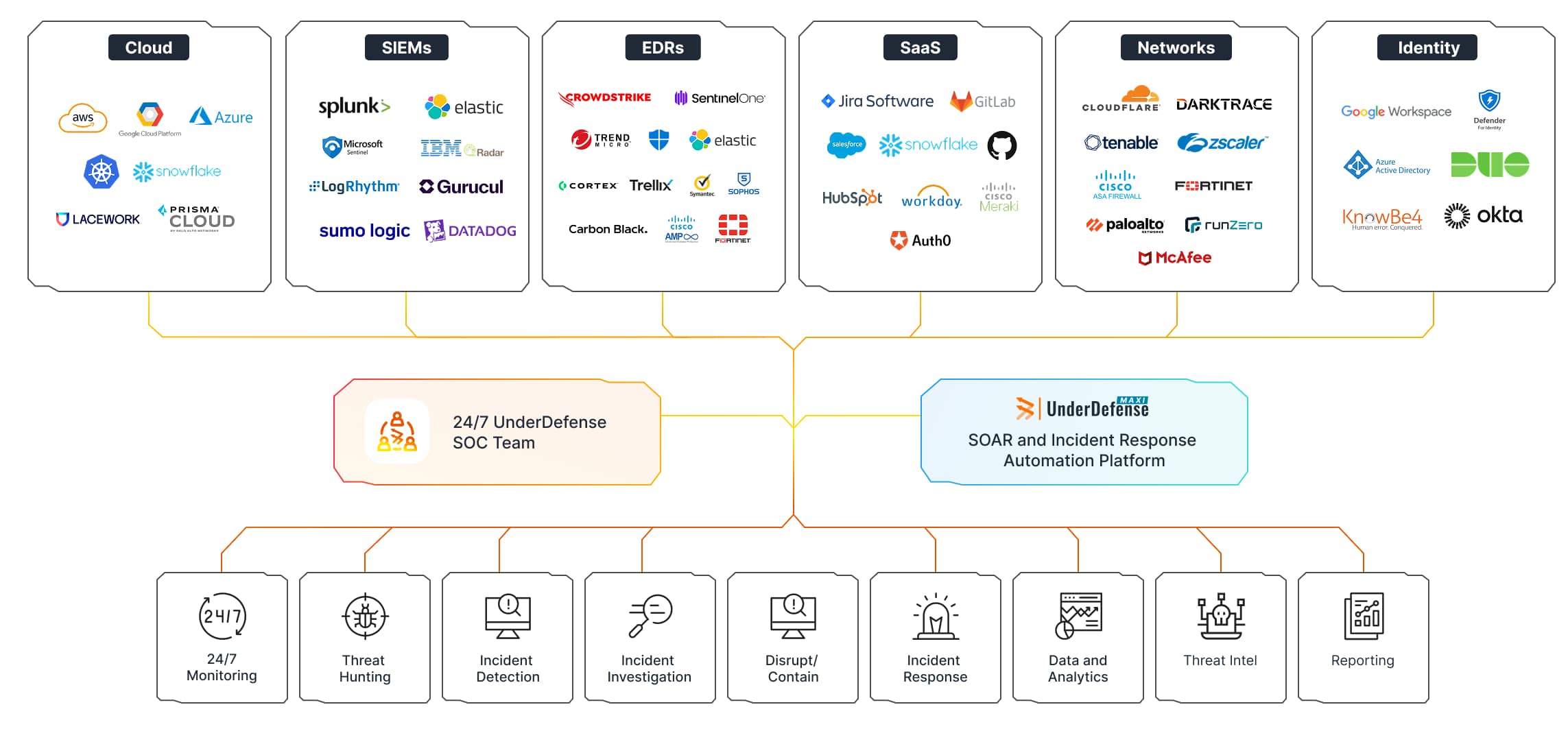
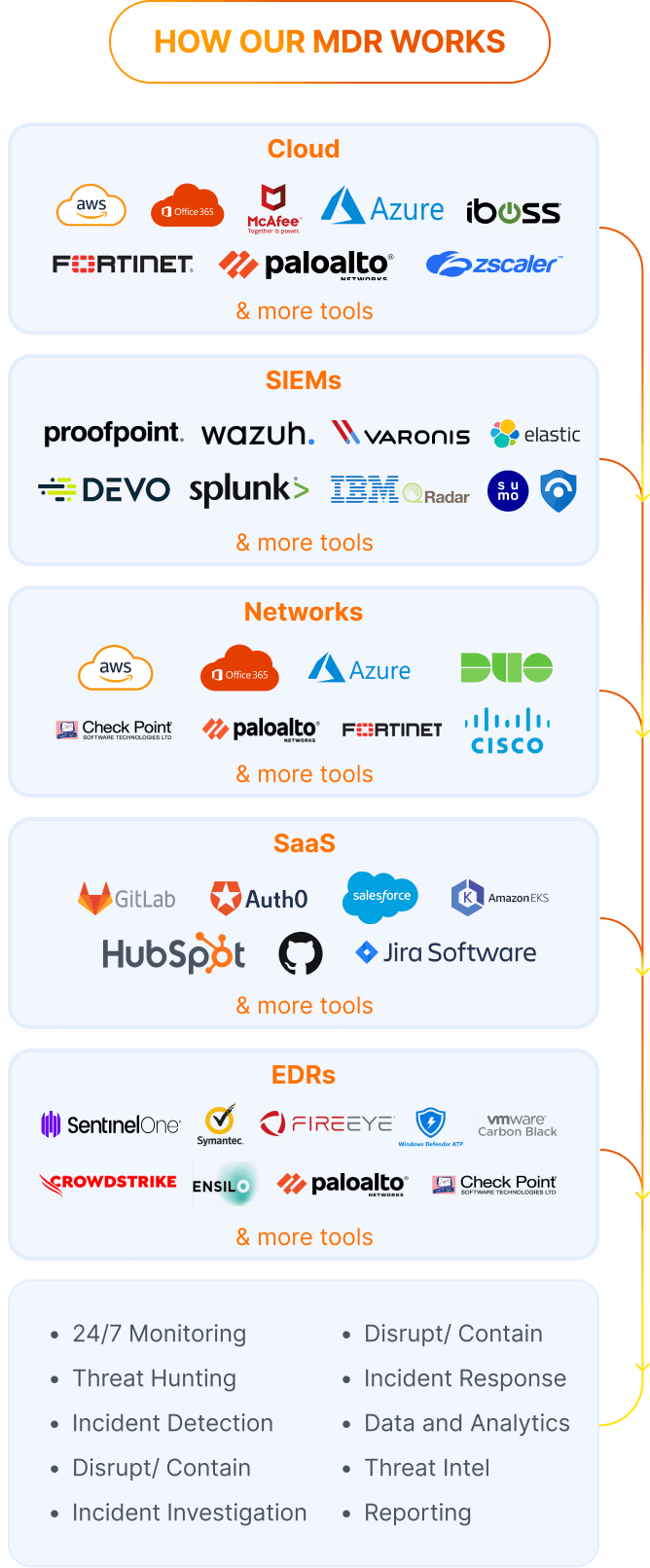
A SecOps layer on top of your core-banking, cloud, SIEM, and crypto-custody tools. No rip-and-replace, no duplicated spend.
Compliance evidence built in
PCI DSS, GLBA, NYDFS 500, FFIEC, SOX, DORA, PSD2, GDPR, FCA, NIS 2, SOC 2, ISO 27001, and CIS v8 evidence produced as we monitor — audits get shorter, not longer.
Threat hunters as an extension of your team
Seasoned hunters covering banking and crypto attack surfaces, scaling with your ARR instead of your headcount.
One correlated picture, every stack
Core-banking, cloud, SaaS, identity, and crypto custody unified into a single view, so the threat that moves between them can't hide.
Trusted by Security Leaders
What our customers say

"We fully automated T1-T2 manual triage with UnderDefense. AI SOC filters the noise so my team can focus on complex hunt missions and strategic security. We scaled our capacity 10x overnight, not by hiring, but by making our analysts investigators again."

"Zero ransomware cases and a 2-minute triage SLA. Agentic AI mapped our VIPs and high-value assets with surgical precision. It transformed how our board views security, shifting from a cost center to a strategic enabler of business resilience."
Excellence.
Our minimum bar for client delivery.




UnderDefense vs. the field for fintech
Tap any row for the detail. Where a fintech deal is actually won or lost.


One partner for your whole security program
MDR is the broadest coverage. These services plug into the same 24/7 team and platform.
Managed Detection & Response (MDR)
24/7 human-led detection and response focused on your core endpoint and SIEM surface.
Learn more →Managed Extended Detection & Response (MXDR)
Extended detection and response across endpoints, network, cloud, email, and identity, run 24/7 by our SOC.
Learn more →MDR for SaaS
Cloud-native detection and response for SaaS companies, with the security evidence enterprise buyers expect.
Learn more →MDR for Healthcare
HIPAA-aligned detection and response protecting PHI, EHR systems, and clinical operations around the clock.
Managed EDR
Your CrowdStrike, SentinelOne, or Microsoft Defender, expertly tuned and managed with 24/7 triage and response.
MDR Integrations
250+ integrations across your EDR, SIEM, cloud, and identity stack. See everything we connect to.
Six years. Zero client ransomware.
We fine-tune the tools you already run so they work smarter across every stack. Across six years, not one client — fintech or otherwise — has suffered a ransomware incident, and when a major operator did breach a client environment, our SOC contained it in under an hour.
Get your custom MDR quote
Tell us about your environment — banking, payments, crypto, or all three. We'll come back with a tailored proposal and a 30-day onboarding plan scoped to your stack.
- A clear proposal, not a sales gauntlet
- Full coverage live in days, not a quarter
- Start free with MAXI, no credit card
Choosing MDR for a fintech? Read this first.
How to choose an MDR provider for fintech in 2026: banking, payments, and crypto under one SOC
Choosing an MDR provider for a fintech is not the same as choosing one for a bank or a generic SaaS. Your attack surface spans payment rails, cloud-native APIs, identity providers, and often crypto custody, and the evidence an examiner wants is broader. This guide walks through what actually separates a fintech-ready MDR provider from one that stops at traditional IT.
What makes MDR different for a fintech or crypto platform than for a traditional bank?
Banks mostly protect core-banking and branch IT. A fintech's attack surface is cloud-native APIs, payment rails, identity providers, and often crypto custody. MDR for fintech tunes detection to those surfaces — API abuse, account-takeover, on-chain/off-chain intrusions — instead of a generic banking ruleset, and produces the specific evidence fintech examiners request.
Why do fintechs need MDR instead of relying on their SIEM or EDR alone?
A SIEM or EDR is a tool your team still has to operate 24/7. MDR is the team: a 24/7 SOC that runs those tools, triages the fraud-and-transaction alert flood, and takes the containment action. For a lean fintech, it's the difference between owning more dashboards and having someone actually respond at 3 a.m.
Does MDR provide audit-ready evidence for PCI DSS, SOC 2, or DORA?
Yes. We map monitoring and response activity to the frameworks you report against — PCI DSS, SOC 2, ISO 27001, DORA, GLBA, NYDFS 500, and more — and produce evidence continuously, so audits get shorter instead of turning into an engineering fire drill.
Does MDR cover crypto custody and on-chain infrastructure, or only traditional IT and cloud?
Both. We monitor cloud and traditional IT and extend detection to custody infrastructure and the systems around your on-chain operations — the blended on-chain/off-chain path most real crypto intrusions take. Unlike a one-time audit, it's continuous.
How does MDR handle DORA, PSD2, or NIS2 for a fintech operating in the EU or UK?
We treat cross-border fintechs as multi-framework by default: US obligations (PCI DSS, NYDFS, GLBA) and EU/UK obligations (DORA, PSD2, GDPR, NIS 2, FCA expectations) mapped together, so one monitoring operation produces evidence for every regime you fall under.
What's the difference between a one-time security audit and continuous MDR?
An audit is a snapshot: it tells you where you stood on the day it was run. MDR is continuous: a 24/7 team detecting and containing threats every hour after that. Crypto and Web3 buyers especially often have an audit but no one watching in between — MDR is what fills that gap.
Can MDR unify monitoring across core-banking, cloud, and crypto stacks without ripping out our tools?
Yes. We layer on top of the tools you already own — core-banking, cloud, SIEM, identity, and crypto custody — and correlate them into a single view. No rip-and-replace, and you keep ownership of every integration if you ever leave.
Is MDR right for a lending or BNPL platform that doesn't hold cardholder data but does hold PII and payment credentials?
Yes. Lending and BNPL platforms are targeted for identity fraud, onboarding abuse, and API attacks even without heavy cardholder-data scope. We tune detection to those patterns and to the PII and payment-credential flows your platform actually carries.