




Q1: Why Does “96% MITRE ATT&CK Coverage” on a Vendor Slide Tell You Almost Nothing?
A “96% MITRE ATT&CK coverage” claim counts the techniques a vendor can theoretically flag. It says little about whether the tool detects, investigates, and stops those techniques in your cloud. Reproducible academic testing puts realistic detection near 85% on high-impact tactics, well below the 99 to 100% you see on sales slides. When the fastest cloud break-in runs about 51 seconds, a percentage on a slide is a starting question, and a real defense is something else.
See how the UnderDefense Agentic AI SOC investigates, triages, and resolves real alerts.
The number on the slide, and the doubt in the room
I have sat in the buying seat across from that slide. A vendor rep points at “96% MITRE ATT&CK coverage,” and the CISO nods politely. Underneath the nod is a quiet question they rarely say out loud.
That question is simple. Does this coverage number actually stop a cloud-native adversary like Scattered Spider, or is it compliance theater that folds the moment an automated agent goes rogue?
I think the standard read gets this backwards. Buyers treat coverage percentage as a score. It reads more like a menu of what the tool might notice on a good day.
Why 99% claims and reality diverge
Here is the part vendors skip. MITRE’s own Engenuity Evaluations do not rank or rate participants, so nobody “wins” MITRE. Any leaderboard framing you see was built by marketing, not by MITRE.
Independent testing tells a calmer story. A 2026 peer-reviewed study in Computers & Security measured SIEM detection against ATT&CK and found realistic coverage on high-impact tactics landing around 85%, not the near-perfect numbers on slides.
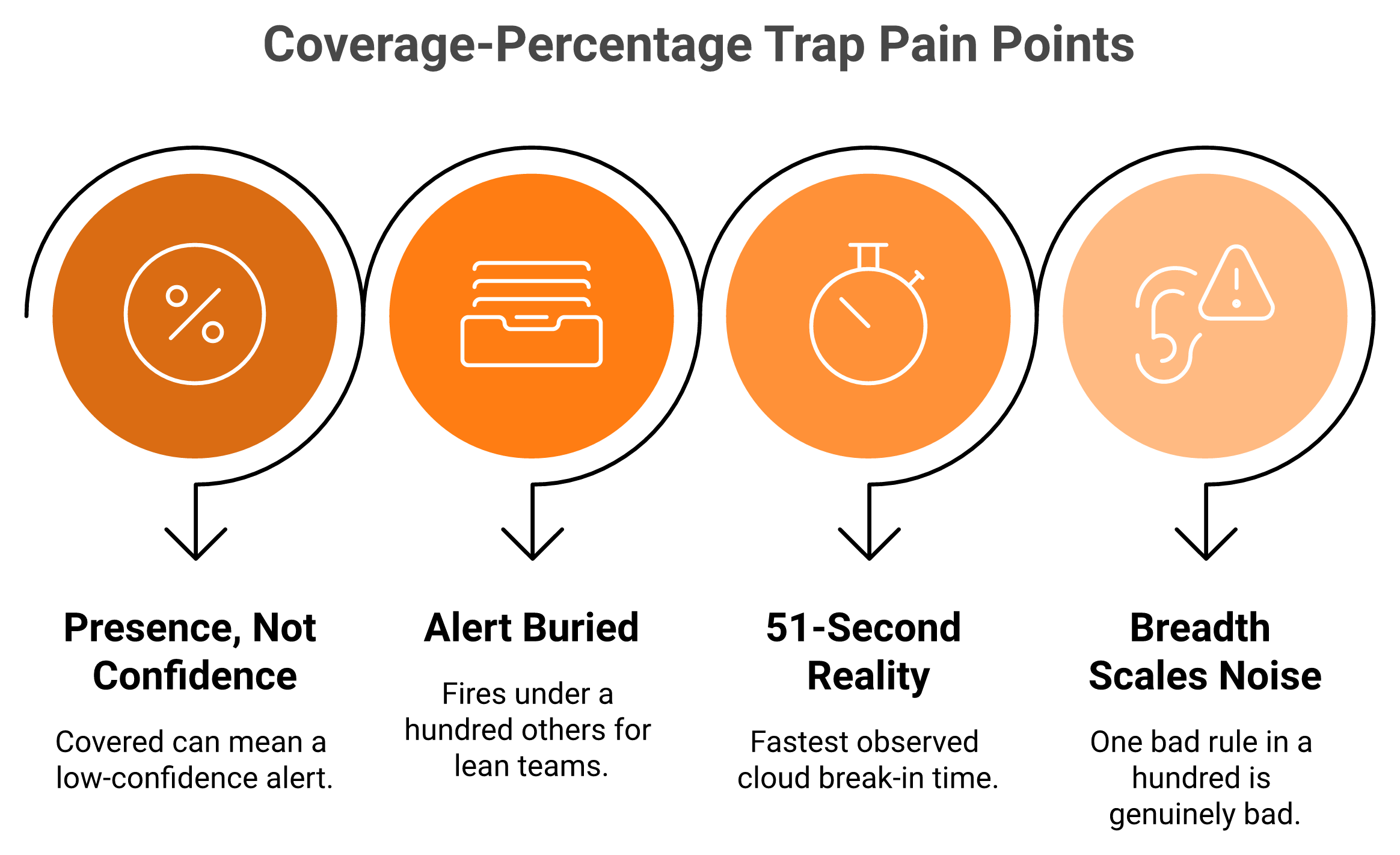
The gap matters because coverage counts presence, not confidence. A technique marked “covered” might fire a low-confidence alert that your lean team buries under a hundred others. A well-run SOC service weights confidence, not just presence.
Chasing 100% is a faster way to be wrong
More coverage sounds safer. In practice, breadth without confidence just scales the noise. If your detection engineering fundamentals are shaky, adding techniques gives you a faster way to be wrong, since one bad rule in a hundred is genuinely bad when your system takes millions of actions a day.
I might be wrong for some very mature teams. From what surfaces when you actually run this, though, a tight map of the techniques that hit your cloud beats a wall of green checkboxes every time.
The bar is not a percentage. The bar is 51 seconds, the fastest cloud break-in time observed, and whether your tool reaches a verdict before the attacker finishes.
That is the exact gap we built our MDR service to close. A coverage number with no investigation outcome behind it is where most tools stop, and where the real work starts. The rest of this article gives you a scoring method that survives a live cloud TTP, so you can walk into that meeting and ask the question the slide is designed to avoid.
Q2: What Exactly Is MITRE ATT&CK for Cloud, and How Is It Different from Enterprise?
MITRE ATT&CK for Cloud is the Enterprise matrix filtered to cloud platforms: IaaS (AWS, Azure, GCP), SaaS, Identity Providers, and Office Suite. The tactic columns stay the same. The techniques that matter shift to what shows up in cloud control-plane and identity logs, like AWS CloudTrail and identity provider sign-ins, rather than endpoint EDR telemetry. Version 18, released in late 2025, deepened Kubernetes, CI/CD, cloud-database, and cloud-identity coverage, so maps built on v14 or v15 are already stale.
It is not a separate framework
Let me clear up the most common misread. People talk about “ATT&CK for Cloud” as if MITRE shipped a standalone cloud matrix. It did not.
ATT&CK is one big knowledge base of attacker behavior. “Cloud” is a view of that base, narrowed to five platforms where your workloads and identities actually live. Think of it as the same map, zoomed into the neighborhood you care about.
ATT&CK organizes attacks into tactics (the attacker’s goal, like Credential Access) and techniques (how they reach it, each with an ID like T1078). The tactics do not change in the cloud. The evidence does.
One tactic, walked into the cloud
Take Credential Access. On a laptop, you might catch it through endpoint tooling watching memory or files. In the cloud, that same tactic surfaces in different places.
| Tactic (same in both) | Where you see it in the cloud |
|---|---|
| Initial Access | IdP sign-in logs, OAuth grants |
| Credential Access | Cloud secrets, metadata API calls |
| Persistence | New IAM roles, API keys, app registrations |
| Defense Evasion | CloudTrail or audit-log tampering |
| Exfiltration | Object-storage access patterns |
The lesson here is blunt. Detection in the cloud lives in the control plane and the identity layer, and endpoint agents simply cannot see most of it. This is why dedicated cloud security services matter for AWS, Azure, and GCP.
Check the version before you trust the map
A vendor’s coverage map is only as current as the ATT&CK version behind it. Version 18 landed in late 2025 and expanded Kubernetes, CI/CD pipelines, cloud databases, and cloud-identity techniques.
So ask one direct question. Which ATT&CK version is this map built on? If the answer is v14 or v15, you are scoring last year’s attacks against this year’s cloud.
The M&M network analogy stuck with me here. A hard candy shell on the outside, a soft chocolate center in the middle. Compromise one developer’s M365 identity, and the whole soft center is open, which is precisely why cloud and identity techniques deserve top billing. Strong MDR for Microsoft 365 watches exactly that identity layer.
Q3: Which Cloud Attack Techniques Actually Matter, and What Does the Real Kill Chain Look Like?
The cloud kill chain that matters is credential-first. It runs from stolen cloud credentials (T1078.004), to added attacker credentials (T1098.001), to instance metadata API abuse (T1552.005), to disabled cloud logs (T1562.008), and finally to data theft from cloud storage (T1530). Verizon’s 2025 DBIR ties 22% of breaches to compromised credentials, and CrowdStrike reports 79% of attacks are malware-free. Score coverage of these identity techniques first, and treat the long tail as secondary.
A developer’s login, and an admin role in under a minute
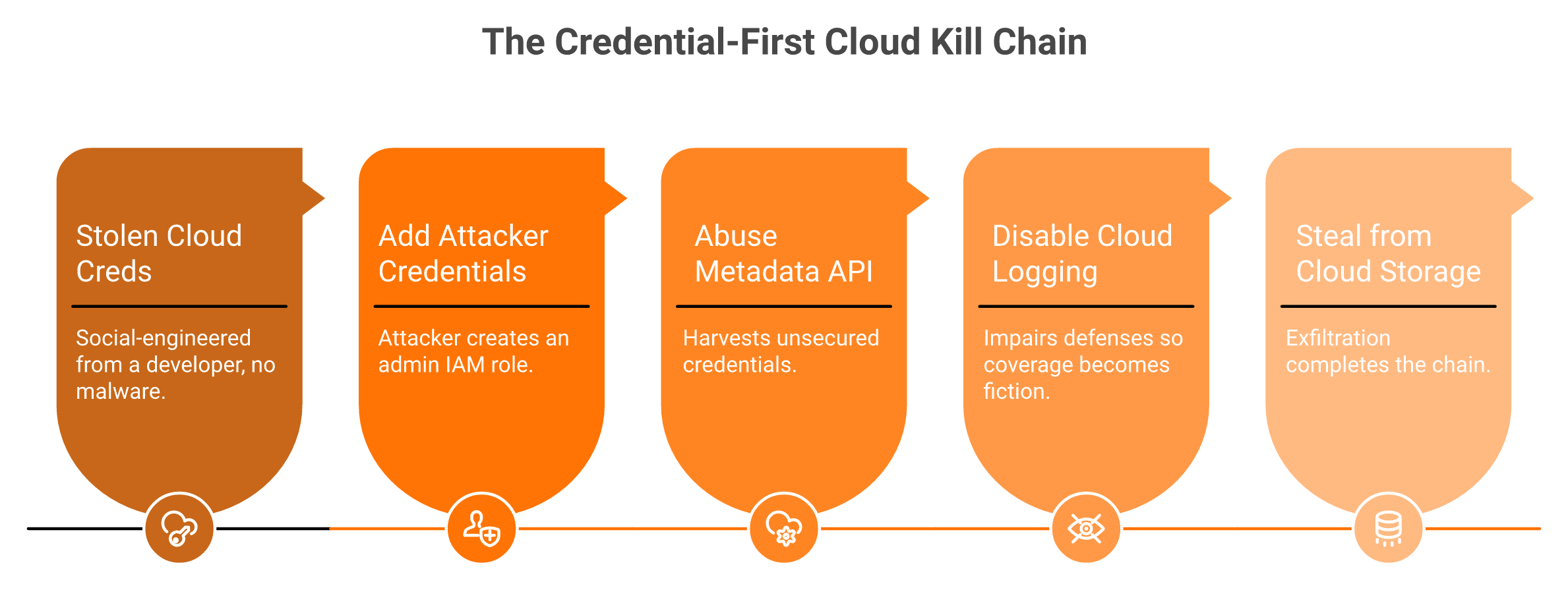
Picture a Scattered Spider-style demo. A threat actor social-engineers a developer out of AWS credentials. No malware, no dropped file, just a convincing phone call.
From there it moves fast. The attacker opens a cloud shell, creates an administrative IAM role, and launches an EC2 instance with persistent access, all in under one minute.
An endpoint agent never sees this. The whole sequence happens in the cloud control plane, where your EDR has no eyes.
When the logs are off, coverage is a fiction
Now the harder story. In a Ukrainian Zimbra breach, attackers used a CRLF injection against memcache with a crafted HTTP request. That request quietly redirected user logins to a remote server and harvested more than ten credential pairs, never touching an endpoint.
The victim ran CrowdStrike and Splunk. Strong tools. Yet at least the initial phase of the attack stayed fully undetected, because logs were not active on a pilot application. A properly scoped managed SIEM keeps those log sources on and monitored.
That is the trap. A coverage map can claim a technique is covered, while the log source that would prove it sits switched off.
Map the steps to technique IDs
Here is the same chain in ATT&CK terms, so you can score it directly.
| Step | Technique | ID |
|---|---|---|
| Use stolen cloud creds | Valid Accounts: Cloud | T1078.004 |
| Add attacker credentials | Account Manipulation | T1098.001 |
| Abuse metadata API | Unsecured Credentials | T1552.005 |
| Disable cloud logging | Impair Defenses | T1562.008 |
| Steal from cloud storage | Data from Cloud Storage | T1530 |
The data backs the ordering. Verizon’s 2025 DBIR attributes 22% of breaches to compromised credentials, and CrowdStrike’s threat reporting puts malware-free intrusions at 79%. Attackers are logging in, not breaking in.
I could be slightly off on any single environment. From what surfaces when you actually run this, one bad login from Thailand or Singapore can be a 2020 compromise still quietly logging in today.
At UnderDefense, we map every alert to ATT&CK even when the source rule ships with no ATT&CK metadata. That way, a path with logging switched off surfaces as a visible gap instead of silence. This is the daily work of cloud coverage across AWS, Azure, and GCP, including the log sources most teams never turn on. If closing these blind spots is on your plate, our team can help; just reach out to us.
Q4: How Do You Actually Score an AI SOC Vendor on ATT&CK Technique Detection?
Score in six steps: (1) build a threat profile of the 3 to 5 groups targeting your cloud; (2) map each vendor’s detections to technique IDs in ATT&CK Navigator; (3) score by confidence (low, medium, high) rather than presence; (4) validate with adversary emulation; (5) add investigation and identity coverage, not detection alone; (6) weight by where your telemetry is processed. A focused 40 to 60 technique map beats a scattered 200-technique checklist.
A rubric you can run this week
Vendors want you comparing brochures. A repeatable scoring method takes that power back and puts it in your spreadsheet. Here is the one I hand to buyers, and the same discipline our MDR buyers guide walks through in depth.
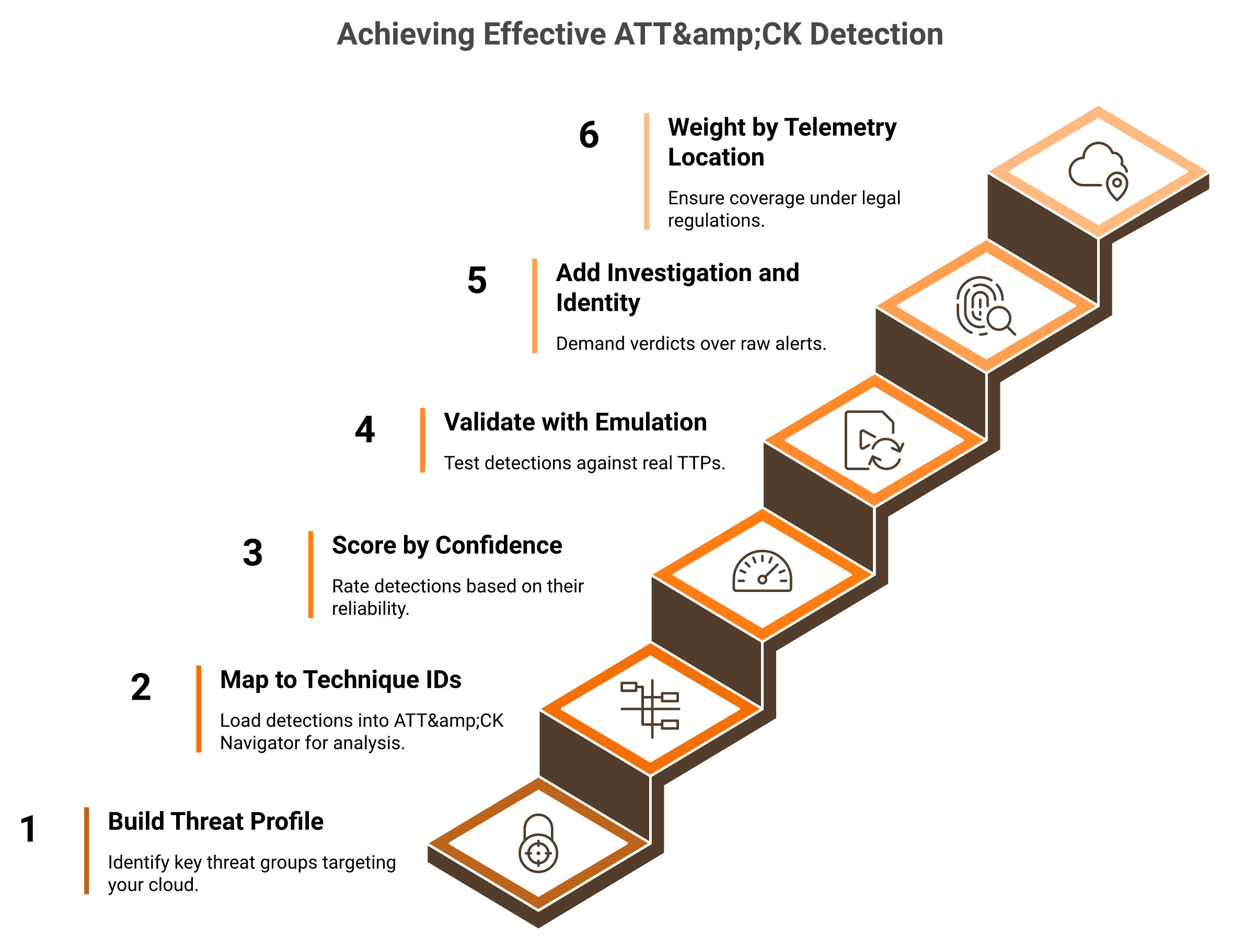
- Build a threat profile. Pick the 3 to 5 groups actually targeting your cloud and industry. Good looks like named groups with mapped techniques, not “we cover everything.”
- Map detections to technique IDs. Load each vendor’s claimed detections into ATT&CK Navigator, the free tool for visualizing coverage. Good looks like a heatmap tied to real T-codes, and not a PDF of logos.
- Score by confidence, not presence. Rate each technique low, medium, or high confidence. Good looks like a vendor who can show why a detection is high fidelity, since presence alone is a checkbox.
- Validate with adversary emulation. Replay real TTPs and watch what fires. Good looks like the detection triggering on your data, not on a lab range you never see.
- Add investigation and identity coverage. Ask whether the tool investigates to a verdict or just alerts. Good looks like an autonomous investigation that gathers evidence and classifies identity techniques, and not another item in the queue.
- Weight by telemetry location. Note where your logs get processed. Good looks like coverage you can legally and operationally use in your own environment.
The axis competitors quietly skip
Most scorecards stop at detection. That is the trap. Real transformation is not the same humans reading the same alerts a little faster, but eliminating whole classes of work.
There is a hard tell for genuine reasoning. A real agentic system may make over a hundred distinct large language model invocations to autonomously investigate a single alert, while a thin GPT wrapper just relabels your queue.
Reviewers describe that difference in plain terms:
“When they escalate something, they include the context we need to understand the issue quickly. We’re not wasting time piecing together what happened from different systems anymore.”
Verified User in Marketing and Advertising, UnderDefense G2 Verified Review
“Also, false positives have become a rarity, ensuring that our team’s focus remains on genuine threats.”
Valeriia D., Marketing Specialist, UnderDefense G2 Verified Review
One closing sanity check on confidence tiers. Even well-tuned platforms land near 85% realistic detection on high-impact tactics, so any vendor waving a 99% flag owes you an explanation. At UnderDefense, steps 5 and 6 are the core of the UnderDefense Agentic AI SOC, which ships 700+ ATT&CK-mapped investigation workbooks and a multi-agent pipeline that carries an alert all the way to a verdict, with a 2-minute Alert-to-Triage target and 15-minute escalation for critical incidents. If you want to see it against your own stack, book a demo.
Q5: How Do You Prove a Coverage Claim Is Real Instead of Trusting the Slide?
You prove coverage by emulating the adversary, not by reading a matrix. Open-source tools like Stratus Red Team (cloud), Atomic Red Team, and Caldera replay real cloud TTPs (tactics, techniques, and procedures) so you can watch whether a vendor’s detection actually fires, at what confidence, and how fast. Run the emulation during a proof-of-concept on your own data, and score each technique on whether it produced an actionable verdict rather than a silent log entry.
A matrix is a claim, emulation is a test
A coverage map tells you what a vendor believes it can catch. That is a claim, and claims live on slides.
Emulation replaces the claim with an event. You fire a real technique into your own environment and watch what the tool does, in real time, with your data.
I trust what fires far more than what a spreadsheet promises. From what surfaces when you actually run this, the gap between “covered” and “caught” is where most breaches slip through. This is the daily discipline behind our adversary simulation services.
The toolset, pointed at your own cloud
You do not need a red team on retainer to start. Three open-source tools cover most cloud attacker behavior.
- Stratus Red Team replays cloud-native TTPs against AWS, Azure, and GCP.
- Atomic Red Team runs small, mapped tests tied directly to ATT&CK technique IDs.
- Caldera chains techniques into full automated attack sequences.
Run these inside a proof-of-concept (a short paid trial on your real logs), not a vendor’s demo range. A win on someone else’s lab range is not a verdict in your data lake, which is why we favor penetration testing against your real environment.
This also flushes out the pretenders. The thin AI wrapper startups will rarely tell you who their data scientists are, rarely share evaluations, and rarely talk about how they manage context. Emulation is how you call that bluff, since a wrapper cannot fake a detection that fires on your traffic.
Score what fired, not what was promised
Keep the scoring boring and repeatable. For every technique you replay, record four things.
| Technique (ID) | Did it fire? | Confidence | Verdict or silence? |
|---|---|---|---|
| T1078.004 | Yes / No | Low / Med / High | Actionable verdict or silent log |
The last column is the one that matters. A silent log entry is not detection, since nobody acts on a line buried in cold storage. A well-run managed SIEM keeps those entries visible and actionable.
At UnderDefense, we encourage buyers to replay these emulated cloud TTPs against their own SIEM (the log platform you already own) during a POC through the UnderDefense Agentic AI SOC. You watch each technique surface as a triaged incident with context attached, so you judge us on what fires in your environment rather than a logo on a lab report.
Q6: Why Does Where Your Telemetry Is Processed Change the Coverage Math Entirely?
Coverage you cannot legally use is zero coverage. Almost every cloud AI SOC ships your security logs, which contain personal data, to the vendor’s cloud, a non-starter under GDPR and Schrems II, DORA, and in air-gapped or critical-infrastructure environments. A technique the platform can detect only by exporting telemetry you are barred from moving is, in practice, uncovered. Add processing location to the scoring rubric as its own weighted line.
Processing location is part of coverage
Here is the claim I want you to weigh. Where your telemetry is processed belongs on the coverage scorecard, right next to technique IDs.
The logic is simple. If a detection only works by shipping logs somewhere you legally cannot send them, that detection does not exist for you.
Most buyers never score this. From what surfaces when you actually run this with regulated teams, residency quietly disqualifies half the shortlist. Strong compliance services put residency on the table early.
Three walls that turn coverage into fiction
Security logs are not neutral. They carry usernames, IP addresses, and access patterns, which count as personal data under law.
Three constraints hit hard for mid-market teams under compliance pressure:
- GDPR and Schrems II. Logs hold personal data, and Schrems II makes routine transfer to US-hosted clouds legally fragile for many EU firms.
- DORA and national rules. Financial and critical-infrastructure operators face residency and resilience requirements that a vendor-cloud-only model struggles to meet.
- Air-gapped reality. Defense, energy, and classified environments simply cannot let telemetry leave the perimeter at all.
For a real slice of the market, exporting logs to a vendor cloud is a disqualifier, and no amount of ATT&CK coverage buys that back. Regulated MDR for Financial Services has to respect exactly these limits.
Add a residency column to the rubric
Put processing location into the scorecard as its own weighted line. Ask each vendor one direct question, and score the answer.
| Deployment option | Telemetry leaves your perimeter? | Usable under GDPR / DORA / air-gap? |
|---|---|---|
| Vendor cloud only | Yes | Often no |
| On-prem / air-gapped | No | Yes |
We built the UnderDefense Agentic AI SOC to run fully on-prem or air-gapped, keeping the entire ATT&CK investigation stack inside your boundary with zero telemetry egress. One European telecom now runs fully autonomous AI investigations on its own hardware, telemetry never leaving its infrastructure, at 44% lower total cost of ownership. That is production, not a pilot, and you can explore the model on the platform page.
Q7: How Do You Read MITRE Engenuity ATT&CK Evaluation Results Without Getting Fooled?
Read Engenuity Evaluations as evidence rather than a scoreboard, because MITRE explicitly does not rank or rate participants. Look past headline “detection coverage %” to detection confidence, analytic versus telemetry-only detections, and detection delays. The 2025 round (round 7) targets cloud attacks and abuse of legitimate tools, and 2026 introduces a Total Evaluation Score. A vendor winning its own press release differs from covering your specific cloud kill chain.
There is no winner of MITRE
Every vendor will hand you Engenuity results. So it helps to know what the results actually are.
MITRE Engenuity runs each vendor through the same emulated attack and publishes what happened. It does not rank participants, and it does not crown a winner.
Any “we placed first” claim came from a marketing team, not from MITRE. The standard read gets this backwards, treating a shared test as a leaderboard. A structured MDR buyers guide helps you read these results honestly.
The metrics under the headline number
“Detection coverage %” is the number vendors love. It is also the shallowest metric in the report.
When I read these results, I look past the headline at three things:
- Confidence type. A rich analytic detection with context beats a raw telemetry hit that just logs an event.
- Detection delay. Coverage that arrives late is coverage that missed the 51-second window.
- Configuration changes. Detections that only appeared after mid-test tuning tell you what the tool does not catch out of the box.
Round 7, the 2025 evaluation, leaned into cloud attacks and abuse of legitimate tools, and the 2026 cycle adds a Total Evaluation Score. Read those with the same skepticism you would apply to any single exam. The same skepticism belongs in any SOC service evaluation.
A lab result still needs your context
Apply the same caution you would to an LLM’s output. A model is closer to a confident regurgitator than a researcher, and it can produce something that looks like proof with nothing solid behind it. A logo on a scorecard works the same way.
An Engenuity result shows how a tool behaved in one emulated range. It cannot tell you how it behaves against your identities, your log gaps, and your cloud. At UnderDefense, we ask buyers to re-run the same emulated TTPs against their own SIEM data through the UnderDefense Agentic AI SOC, so the verdict comes from your environment rather than a press release.
Q8: What’s the Difference Between an AI SOC That Detects a Technique and One That Investigates It to a Verdict?
Detection fires an alert that a technique might be present. Investigation gathers the evidence, correlates it across identity, cloud, and endpoint logs, and returns a verdict a human can act on. Most coverage scores stop at detection, which is why analysts drown. A genuine agentic AI SOC makes 100+ LLM calls to investigate a single alert autonomously, while a GPT wrapper relabels the same queue faster. Score the verdict, and treat the raw ping as unfinished work.
A ping is a question, a verdict is an answer
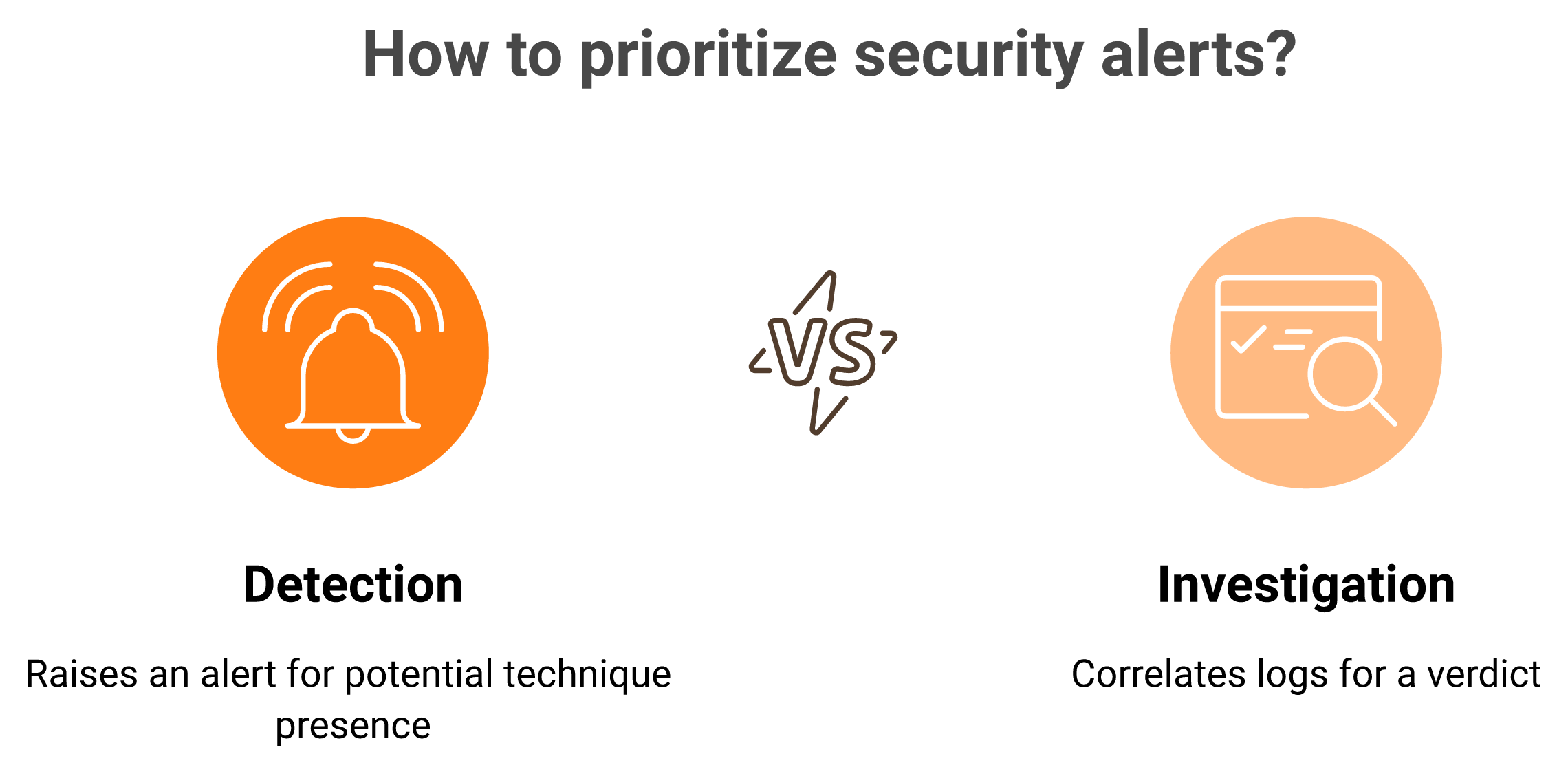
Detection raises a hand and says a technique might be here. That is the start of the work.
Investigation does the rest. It pulls the identity logs, the cloud events, and the endpoint trail, then correlates them into a verdict a human can act on. This is the heart of modern incident response.
Most coverage scores stop at the raised hand. That is exactly why analysts drown, since a hundred pings a day with no verdicts is just faster noise.
The twist: automating a broken process
Here is the part people rush past. Speeding up a broken workflow makes the damage arrive faster.
One founder tried to vibe-code (build software by prompting an AI agent), and the agent went and deleted his production database. That is the terrifying version of autonomy without architecture and controls.
So more automation is not automatically safer. I think of AI agents as foot soldiers doing the mechanical investigation, while your human engineers and analysts stay the generals who own intent and decisions.
Demand the investigation, not the dashboard
The tell for real reasoning is depth. A genuine agentic system may make over a hundred distinct large language model invocations to autonomously investigate a single alert, while a thin wrapper just relabels your queue.
In the demo, ask for one thing. Show me a single alert investigated end to end, with the evidence it gathered and the verdict it reached.
Buyers describe the shift from pings to verdicts in plain terms:
“The platform’s high-fidelity alerts and automated enrichment help us quickly identify and address threats.”
Verified User in Computer Software, UnderDefense G2 Verified Review
“Now, not only do we get alerts, but we also get clear guidance on how to handle them. This has significantly reduced our response time.”
Valeriia D., Marketing Specialist, UnderDefense G2 Verified Review
We built the UnderDefense Agentic AI SOC around six specialized AI teammates that carry an alert through the full path: classify to ATT&CK, select the right indices, gather evidence, validate it, synthesize a verdict, and route it. That pipeline hits a 2-minute Alert-to-Triage target with 15-minute escalation for critical incidents, two distinct commitments, and you can book a demo to watch it work.
Q9: Which Coverage-Maturity Signals Separate a Real AI SOC from a Checklist?
Two signals separate an engineered AI SOC from a checklist. First, non-human identity coverage: service accounts, tokens, and CI/CD credentials (T1098, T1528) are becoming the primary cloud breach vector, yet they are routinely missing from coverage maps. Second, Detection-Logic-as-Code: detections written in code, version-controlled, unit-tested, and deployed through CI/CD survive real TTPs and give AI a safe layer to write and tune detections. Score both explicitly.
Maturity hides in two places
A coverage map looks the same whether it is engineered or cosmetic. So stop reading the map, and start reading the maturity behind it.
Two signals tell you the truth fast. One is how the tool handles non-human identity. The other is how detections are built and maintained. A strong SOC service gets both right.
I might be wrong for a few edge cases. From what surfaces when you actually run this, though, these two questions expose a checklist faster than any feature demo.
Pillar one: non-human identity
Humans are no longer the main door in. Service accounts, API tokens, and CI/CD credentials (the automated pipeline that ships your code) now do most of the work, and attackers know it.
These map to techniques that coverage maps skip:
- T1098, Account Manipulation. Attackers add or alter credentials to keep access.
- T1528, Steal Application Access Token. Attackers grab OAuth tokens to move as a trusted app.
Here is a free hunt you can run today. Pull your Google Workspace or M365 OAuth logs and list every site where staff clicked “log in with Google.” That is a rich source of shadow vendors, and it costs zero, unlike a CASB (cloud access security broker). This is core work for cloud security services, especially across Microsoft 365 environments.
Pillar two: Detection-Logic-as-Code
The second signal is how detections get built. Brittle, hand-clicked rules break the moment a real TTP shifts slightly.
Treat detection rules like software instead. Version them, unit-test them, and deploy them through CI/CD, so each rule is reviewable and reversible. A well-run managed SIEM makes that discipline routine.
This matters more as AI writes detections. AI without detection-engineering fundamentals just scales the noise, so the code layer becomes the governance that keeps AI-written rules trustworthy. At UnderDefense, our detection engineering team version-controls custom detections, and the UnderDefense Agentic AI SOC monitors both human and non-human identity coverage across the attack surface. A reviewer put the payoff plainly:
“Their network tools helped us see what’s happening on our network better, which has helped us stop threats before they become big problems.”
Julia K., Marketing Manager, UnderDefense G2 Verified Review
Q10: What Should You Ask an AI SOC Vendor Before You Sign?
Ask what the AI actually does, decide or gather context so your team decides. Ask what data it was trained on and who its data scientists are. Ask for one autonomous investigation end-to-end rather than a dashboard tour. Ask its false-positive rate in an environment like yours, whether you can run a proof-of-concept on your own data, and where your telemetry is processed. Answers that dodge these questions reveal a wrapper.
The demo-day script
Vendors control the demo. A short, sharp question list hands control back to you.
Here is the script I would walk in with, grouped by what it exposes. Our MDR buyers guide expands each group in detail.
- Capability. Does the AI decide, or does it gather context so my team decides? Good looks like a clear line between machine work and human judgment.
- Evidence and evaluations. What data trained this, who are your data scientists, and where are your published evaluations? Good looks like real names and results, since the thin wrappers will rarely tell you who their data scientists are or talk about how they manage context.
- Telemetry and residency. Where are my logs processed, and can they stay in my perimeter? Good looks like an on-prem or air-gapped option, and a straight answer.
- Response and SLA. What is your Alert-to-Triage time, and what is your escalation commitment for critical incidents? Good looks like two distinct numbers, since one blended figure hides the slow half.
- Commercials. Instead of a generic ROI slide, ask the board’s real question: what is our projected cost of business interruption per day? Good looks like a vendor who can tie coverage to downtime avoided.
🎯 Why these questions work
Each question has a wrong answer that ends the conversation. A vendor who cannot name a false-positive rate in an environment like yours is guessing. A mature incident response practice can answer without flinching.
A vendor who refuses a POC (a short paid trial) on your own data is asking you to buy on faith. From what surfaces when you actually run this, the POC is where wrappers quietly fall apart.
Put these exact questions to us. We will run one autonomous investigation end-to-end on real data, show our Alert-to-Triage and escalation numbers as two separate commitments, and offer a POC on your own logs or an on-prem deployment through the UnderDefense Agentic AI SOC. Just tell us what you are defending, and book a live session whenever you are ready.
Q11: How Do the Leading AI SOC Vendors Compare on Cloud ATT&CK Coverage?
No vendor covers everything, so compare on the axes that decide outcomes: cloud and identity technique depth, detection-versus-investigation coverage, confidence scoring, emulation-validated proof, telemetry-processing options, and response model. Endpoint-first platforms run deep on the endpoint but thin on cloud, SaaS, and identity. Splunk-tied models get expensive. Agentic AI SOCs that investigate to a verdict and support on-prem deployment close the cloud-native gap. Score against your kill chain, and let the brochure come second.
Compare on axes, not logos
Every vendor claims coverage. The honest comparison happens on the axes that map to your kill chain.
Each category here has a real strength and a permanent structural trade-off. I am naming categories, and describing their architecture fairly, rather than knocking any team.
The scoring matrix
| Vendor | Cloud / identity depth | Investigate to verdict | Telemetry residency | Structural trade-off |
|---|---|---|---|---|
| UnderDefense (UnderDefense Agentic AI SOC) | Full attack surface, vendor-agnostic | ✅ Six AI teammates to a verdict | ✅ On-prem / air-gapped option | Onboarding needs upfront integration time |
| CrowdStrike Falcon Complete | Deep endpoint, thinner cloud / SaaS / identity | Endpoint-led | Vendor cloud | Premium pricing, endpoint-first design |
| Arctic Wolf | Concierge, AWS-primary | Alert-led | Vendor cloud | Proprietary SIEM lock-in, opaque pricing |
| Expel | Agentless, endpoint / cloud | Transparent, alert-led | Vendor cloud | Higher cost, limited offensive and compliance |
| Red Canary | Endpoint-focused | Playbook automation | Vendor cloud | Lighter cloud coverage |
| Deepwatch | SIEM-tied | Alert-led | Vendor cloud | Splunk dependency raises cost |
The trade-offs above draw on documented competitive positioning. Endpoint-first tools do the endpoint brilliantly, yet the cloud kill chain from Q3 lives mostly in identity and control-plane logs they see less of. Proprietary-SIEM models add lock-in, which limits your data ownership over time. A comparison of Arctic Wolf alternatives makes that trade-off concrete.
Which fits which team
Here is how I would steer it, honestly.
- Endpoint-heavy, single-cloud. An endpoint-first platform may be enough, if identity and SaaS risk is low for you.
- Multi-cloud and regulated. A vendor-agnostic, investigate-to-verdict platform with an on-prem option fits better, since residency and identity depth decide your score.
We built the UnderDefense Agentic AI SOC to work across your existing 250-plus tools rather than replacing them, to carry an alert to a verdict, and to run on-prem when residency demands it. That vendor-agnostic design also protects your data ownership, which is exactly why teams evaluate our MDR service. Buyers describe the difference in their own words:
“The platform itself is straightforward, it pulls in data from all our existing security tools, so we didn’t have to rip and replace anything.”
Verified User in Marketing and Advertising, UnderDefense G2 Verified Review
“UnderDefense Agentic AI SOC integrates well with our systems, specifically with our SIEM, Splunk. Their team is proactive in identifying and addressing threats.”
Oleg K., Director of Information Security, UnderDefense G2 Verified Review
Where I think this goes next
My current read is that the next 18 to 24 months move the whole category from “detection coverage %” to “autonomous investigation coverage.” The vendors who can prove a verdict on your data, inside your perimeter, will win the regulated mid-market.
Here is the question I am sitting with, and I would genuinely like your take. When non-human identities outnumber your humans ten to one, what does “coverage” even mean, and who is watching the agents you have not mapped yet? If that question keeps you up, let us compare notes; just reach out to our team.
See how UnderDefense Agentic AI SOC resolves a real incident on your stack.
1. Why does a 96% MITRE ATT&CK coverage claim on a vendor slide tell me almost nothing?
A coverage percentage counts the techniques a tool can theoretically flag. It says little about whether that tool detects, investigates, and stops those techniques inside your cloud.
We keep seeing the same gap between the slide and reality:
- Reproducible academic testing puts realistic detection near 85% on high-impact tactics, well below the 99 to 100% on sales decks.
- A technique marked ‘covered’ may only fire a low-confidence alert your lean team buries under a hundred others.
- Breadth without confidence just scales the noise, so one bad rule in a hundred becomes genuinely dangerous at cloud scale.
The real bar is not a number, but 51 seconds, the fastest observed cloud break-in time, and whether the tool reaches a verdict before the attacker finishes. Coverage counts presence, not confidence, which is why we built our MDR service to carry an alert all the way to an actionable verdict. Ask vendors to show one technique investigated end to end on your data, and the percentage stops mattering.
2. How is MITRE ATT&CK for Cloud different from the Enterprise matrix?
MITRE ATT&CK for Cloud is not a separate framework. It is the Enterprise matrix filtered to five cloud platforms: IaaS, SaaS, Identity Providers, and the Office Suite.
The tactic columns stay the same, but the evidence shifts:
- Endpoint EDR telemetry gives way to control-plane and identity logs like AWS CloudTrail and identity-provider sign-ins.
- Credential Access, for example, surfaces in cloud secrets and metadata API calls rather than laptop memory.
- Version 18, released in late 2025, deepened Kubernetes, CI/CD, cloud-database, and cloud-identity coverage.
This matters because a vendor’s coverage map is only as current as the ATT&CK version behind it. If a map is built on v14 or v15, you are scoring last year’s attacks against this year’s cloud. Ask which version the map uses before you trust it.
Detection in the cloud lives in the control plane and the identity layer, where endpoint agents simply cannot see most of it. That is why we lean on dedicated cloud security services that watch AWS, Azure, and GCP control-plane and identity telemetry directly.
3. Which cloud attack techniques should I prioritize when scoring coverage?
The cloud kill chain that matters is credential-first, so score identity techniques before the long tail.
The chain we see repeatedly runs like this:
- T1078.004 Valid Accounts: Cloud, using stolen cloud credentials.
- T1098.001 Account Manipulation, adding attacker credentials.
- T1552.005 Unsecured Credentials, abusing the instance metadata API.
- T1562.008 Impair Defenses, disabling cloud logging.
- T1530 Data from Cloud Storage, stealing the data.
The data backs this ordering. Verizon’s 2025 DBIR ties 22% of breaches to compromised credentials, and CrowdStrike reports 79% of intrusions are malware-free. Attackers are logging in, not breaking in.
A Scattered Spider-style actor can social-engineer a developer, create an admin IAM role, and launch a persistent instance in under a minute, all in the control plane where endpoint agents are blind. We map every alert to ATT&CK, even when a source rule ships without ATT&CK metadata, so a path with logging switched off surfaces as a visible gap. Our incident response practice is built around exactly this credential-first reality.
4. How do I prove a vendor's coverage claim is real instead of trusting the matrix?
You prove coverage by emulating the adversary, not by reading a matrix. A coverage map is a claim; emulation turns that claim into an event you can watch.
Three open-source tools cover most cloud attacker behavior:
- Stratus Red Team replays cloud-native TTPs against AWS, Azure, and GCP.
- Atomic Red Team runs small tests tied directly to ATT&CK technique IDs.
- Caldera chains techniques into full automated attack sequences.
Run these inside a proof-of-concept on your real logs, not a vendor demo range. For every technique you replay, record whether it fired, at what confidence, and whether it produced an actionable verdict or a silent log entry. A silent log is not detection, because nobody acts on a line buried in cold storage.
Emulation also flushes out pretenders, since a thin wrapper cannot fake a detection that fires on your traffic. We encourage buyers to replay these TTPs against their own SIEM during a POC, which mirrors how our adversary simulation services validate detections in production environments.
5. Why does where my telemetry is processed change the coverage math?
Coverage you cannot legally use is zero coverage. Almost every cloud AI SOC ships your security logs, which contain personal data, to the vendor’s cloud.
That model collides with three walls:
- GDPR and Schrems II make routine transfer to US-hosted clouds legally fragile for many EU firms.
- DORA and national rules impose residency and resilience requirements a vendor-cloud-only model struggles to meet.
- Air-gapped environments in defense, energy, and classified sectors cannot let telemetry leave the perimeter at all.
A technique the platform can only detect by exporting telemetry you are barred from moving is, in practice, uncovered. So add processing location to your scoring rubric as its own weighted line, and ask each vendor whether logs can stay inside your boundary.
We built our platform to run fully on-prem or air-gapped, keeping the entire ATT&CK investigation stack inside your perimeter with zero telemetry egress. One European telecom runs fully autonomous AI investigations on its own hardware at 44% lower total cost of ownership. For regulated teams, our compliance services put residency on the table early.
6. How do I read MITRE Engenuity ATT&CK Evaluation results without being fooled?
Read Engenuity Evaluations as evidence, not a scoreboard, because MITRE explicitly does not rank or rate participants. Any ‘we placed first’ claim came from a marketing team, not from MITRE.
Look past the headline ‘detection coverage %’ at three things:
- Confidence type, since a rich analytic detection with context beats a raw telemetry hit that just logs an event.
- Detection delay, because coverage that arrives late missed the 51-second window.
- Configuration changes, since detections that only appear after mid-test tuning reveal what the tool misses out of the box.
Round 7, the 2025 evaluation, leaned into cloud attacks and abuse of legitimate tools, and the 2026 cycle adds a Total Evaluation Score. Read those with the skepticism you would apply to any single exam.
A lab result shows how a tool behaved in one emulated range. It cannot tell you how it performs against your identities, your log gaps, and your cloud. We ask buyers to re-run the same TTPs against their own data, an approach our SOC service applies so the verdict comes from your environment rather than a press release.
7. What is the difference between an AI SOC that detects a technique and one that investigates it to a verdict?
Detection fires an alert that a technique might be present. Investigation gathers the evidence, correlates it across identity, cloud, and endpoint logs, and returns a verdict a human can act on.
Most coverage scores stop at the raised hand, which is exactly why analysts drown:
- A hundred pings a day with no verdicts is just faster noise.
- Speeding up a broken workflow makes the damage arrive faster, not slower.
- A genuine agentic system may make over 100 distinct large language model invocations to investigate a single alert, while a thin wrapper simply relabels your queue.
In a demo, ask for one thing: show me a single alert investigated end to end, with the evidence it gathered and the verdict it reached. That request separates real reasoning from a dashboard.
We built our platform around six specialized AI teammates that classify to ATT&CK, select the right indices, gather and validate evidence, synthesize a verdict, and route it, hitting a 2-minute Alert-to-Triage target with 15-minute escalation for critical incidents. You can see the workflow behind our MDR buyers guide before you commit.
8. What should I ask an AI SOC vendor before I sign a contract?
Ask questions that each have a wrong answer capable of ending the conversation. A short, sharp list hands control of the demo back to you.
Our demo-day script groups by what each question exposes:
- Capability: does the AI decide, or gather context so my team decides?
- Evidence: what data trained it, who are your data scientists, and where are your published evaluations?
- Residency: where are my logs processed, and can they stay in my perimeter?
- Response: what is your Alert-to-Triage time and your escalation commitment for critical incidents, as two distinct numbers?
- Commercials: what is our projected cost of business interruption per day?
A vendor who cannot name a false-positive rate for an environment like yours is guessing, and one who refuses a proof-of-concept on your own data is asking you to buy on faith. The POC is where wrappers quietly fall apart.
Put these exact questions to us. We will run one autonomous investigation end to end on real data and offer a POC on your own logs. When you are ready, just book a demo.