




Q1. Should you actually re-sign your LogRhythm contract for three more years in 2026?
Maybe, though signing on autopilot is the real risk. LogRhythm merged into Exabeam in July 2024, so a 2026 renewal is a bet on Exabeam’s roadmap rather than LogRhythm’s old track record. Pressure-test three things before you sign: the Axon migration path and legacy end-of-life commitments, your true cost where staffing runs around 80% of the bill, and your switching cost at roughly $350K median.
Keep the stack you own. UnderDefense Agentic AI SOC sits on top of your existing SIEM with open, vendor-agnostic integration
The renewal quote that lands on your desk in Q3
Picture the scene. A CISO I spoke with had a three-year LogRhythm renewal sitting in her inbox, due in eleven days. Her board wanted a yes. Her gut wanted more time.
The quote looked routine. The vendor behind it had changed hands entirely. That gap, between the paperwork and the reality, is where renewal regret starts.
Why this signature is a roadmap bet, not a checkbox
A renewal feels administrative. It is actually a three-year wager on whether your vendor keeps up. I keep coming back to a line a peer used: we have Blockbuster-era security companies that will not be around in two to three years, while a Netflix-style shift quietly destroys them.
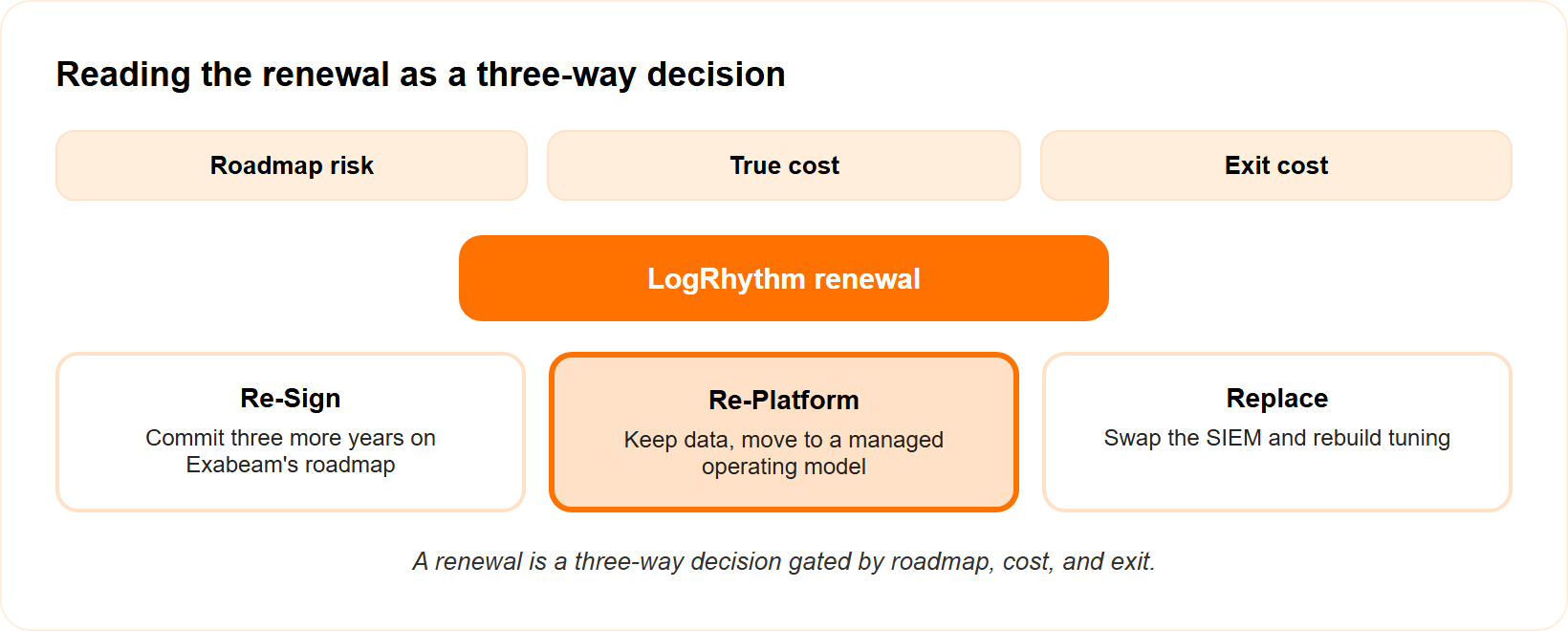
LogRhythm now lives inside Exabeam, and it no longer appears as a standalone vendor in Gartner’s 2025 SIEM Magic Quadrant. That alone should slow your pen down. A clear-eyed view of why businesses switch cybersecurity providers helps here. Three levers decide the call:
- Roadmap risk: where Axon is going, and what happens to the legacy SIEM you actually run.
- True cost: license is the small line; people dominate.
- Exit cost: what leaving really takes, in dollars and months.
What I would do Monday morning
Treat the renewal as an audit, not a formality. Pull the contract, list every assumption it makes about support and migration, and demand each one in writing before you sign. Our SIEM buyers guide walks through the exact questions to ask.
Here is my honest bias. I have sat on the side of owning a SIEM and wanting to keep my data so I could take my toys and leave if needed. Vendor-agnostic providers like UnderDefense keep your managed SIEM detection logic portable, so a roadmap shift somewhere else does not become your emergency. You stay the owner of your tuning, your rules, and your exit.
Q2. What does the Exabeam and LogRhythm merger and Gartner repositioning mean for your roadmap?
LogRhythm survives as a product, though no longer as a company. The July 2024 merger folded it into Exabeam, now a pure-play security operations vendor running on-prem LogRhythm SIEM and cloud-native Axon with quarterly releases. Two signals matter for a three-year deal: legacy SIEM continues only as long as the install base wants it, and LogRhythm appears in Gartner’s 2025 SIEM Magic Quadrant only under the Exabeam name.
The headline: a product kept, a brand absorbed
Start with the fact that changes everything else. LogRhythm and Exabeam merged, and the combined company operates as Exabeam. Your renewal contract may still say LogRhythm. Your roadmap owner is now Exabeam.
That is not a death notice. It is a change of driver, mid-journey, on a road you paid to travel.
What “dual track” actually means for you
Exabeam now runs two product lines side by side. Think of it like a carmaker selling both a legacy model and a new electric platform at once. If you are weighing the broader field, our breakdown of how to choose a SIEM lays out the criteria that matter.
- Axon: the cloud-native, next-generation SIEM the company is steering toward.
- LogRhythm SIEM: the on-prem platform you likely run today, continued with quarterly updates.
The catch sits in the language. Legacy SIEM continues “as long as the existing install base wants it,” which reads as support without a hard, dated guarantee.
The Gartner signal most buyers skim past
Here is the part I would not ignore. In Gartner’s 2025 SIEM Magic Quadrant, LogRhythm no longer appears as its own vendor, and only Exabeam is listed, with modest movement while Google, Splunk, and Securonix gained ground. For a three-year commitment, that is a market telling you where momentum sits.
What to demand before you sign
Watch for AI washing. A rebranded logo after an acquisition does not equal a rebuilt platform, so favor vendors who genuinely rebuilt the security operations workflow and the outcomes it produces. Knowing the AI SOC red flags keeps you from buying a sticker instead of a system.
My current read is simple. Get the roadmap commitments in writing: support dates, migration scope, and what your current SKU keeps. Verbal reassurance from a sales team mid-merger is the weakest currency in this whole process.
Q3. Is LogRhythm being discontinued, and how risky is the Axon migration path?
LogRhythm is not discontinued. Both on-prem LogRhythm SIEM and cloud-native Axon continue with quarterly releases, and Exabeam offers a defined migration path toward Axon. The risk lives in the wording: legacy SIEM continues only as long as the install base demands it, with no public hard end-of-life date, so a renewing customer should pin down support timelines in the contract.
Short answer: still alive, with a quiet asterisk
Let me kill the rumor first. LogRhythm is not being shut off, and the platform ships quarterly updates under Exabeam. If you searched “is LogRhythm discontinued” at 11 p.m. before a renewal call, breathe.
Now the asterisk. There is no published hard end-of-life date for the legacy SIEM, only a commitment to continue it while customers want it. Open-ended support is comfortable until the day it is not.
The Axon migration path, in plain terms
Migration sounds clean on a slide. On the ground, it is the hard part, and I have watched it humble strong teams. The same patterns show up across our MDR service engagements.
Here is what actually moves, and what does not:
- Data and storage: plan for real fast-access retention. From what surfaces when you run this, aim for at least 40 days of immediate retention, roughly six weeks of data on fast storage, for usable investigations.
- Parsers: unsupported devices need custom parsers, which means regular-expression parsing and SQL knowledge, rebuilt by hand.
- Detection logic: correlation and automation rules rarely port cleanly, so budget engineering time, not just license swaps.
What to secure before you sign
Negotiate from this reality, not from the brochure. Three asks belong in the contract:
- A written support and end-of-life timeline for the legacy SIEM, with notice periods.
- A defined migration scope to Axon, including who rebuilds parsers and rules.
- A migration cost cap, so an “included” move does not balloon into a project.
This is the work we do every day at UnderDefense. When a migration or end-of-life deadline looms, our managed SIEM team absorbs the tuning, parser, and retention work, so an Axon move does not stall your SOC service or reset your coverage to zero.
Q4. LogRhythm vs Splunk: which one actually fits your environment?
Pick LogRhythm for guided, mid-market deployments with bundled user behavior analytics. Pick Splunk when you need massive-scale ingestion, schema-on-read analytics, and the budget to staff it. Splunk remains Gartner’s execution leader, while LogRhythm, now Exabeam, trades raw flexibility for a more packaged experience. Price alone settles nothing here, because staffing dominates both bills.
The head-to-head, on the criteria that matter
I have sat through this debate in too many rooms. The honest version compares fit, not fandom. Here is how the two stack up on the things a renewing team actually feels, and our MDR for Splunk work informs every row.
| Criterion | LogRhythm (Exabeam) | Splunk Enterprise Security |
|---|---|---|
| Best-fit deployment | Guided, mid-market, on-prem or hybrid | Large-scale, high-ingest enterprise |
| Ease of use | More packaged, faster to a baseline | Powerful, steeper to operate |
| Analytics depth | Bundled UEBA, correlation-led | Schema-on-read, very flexible |
| Detection content | Pre-built rules mapped to MITRE ATT&CK | Deep, custom, query-driven |
| Pricing model | Lower license entry | Premium, scales with data |
| Market momentum | Modest, post-merger | Execution leader |
Choose-this-if, in one glance
Skip the feature war. Match the tool to your size, deadline, and bench.
- Choose LogRhythm if: you want a faster baseline, bundled analytics, and a leaner team to run it.
- Choose Splunk if: you need scale, custom analytics, and you can fund the engineers to drive it.
- Reconsider both if: your real gap is operators, not licenses, since staffing is around 80% of cost.
The part the comparison charts miss
Here is my contrarian take, and I will own it. The tool is a baseball bat. Put it in an expert’s hands and it does exactly what they need; put it in a novice’s hands and it sits idle. Shiny platforms do not solve cases, seasoned people do, and skilled people with a moderate toolset beat novices with an expensive one.
That is why the deeper question moves past LogRhythm or Splunk to who operates it. UnderDefense runs detection and response on either platform through our SOC service, so the choice stops being a three-year trap. What buyers tell us matches that:
“UnderDefense Agentic AI SOC integrates well with our systems, specifically with our SIEM, Splunk. Their team is proactive in identifying and addressing threats, providing 24/7 oversight.”
Oleg K., Director of Information Security UnderDefense G2 Verified Review
“The platform itself is straightforward. It pulls in data from all our existing security tools, so we didn’t have to rip and replace anything.”
Verified User in Marketing and Advertising UnderDefense G2 Verified Review
“UnderDefense Agentic AI SOC seamlessly integrates MDR with AWS. It feels as if they’ve crafted a custom-fit armor for my infrastructure.”
Lesia P., Product Marketing Manager UnderDefense G2 Verified Review
Q5. What does LogRhythm actually cost in 2026, and why does the sticker price mislead you?
Directory list prices like $0.01 per message or $395 per user are noise. Real mid-market LogRhythm TCO lands near $351K per year: license around $69K, storage around $1K, and staffing around $282K, so people make up roughly 80% of the bill. In-house SIEM broadly runs $200K to $450K in year one for a mid-market deploy, and labor alone can hit $500K over a 9 to 12 month rollout. The renewal license you are negotiating is the small part of what you truly spend.
Why directory pricing misleads you
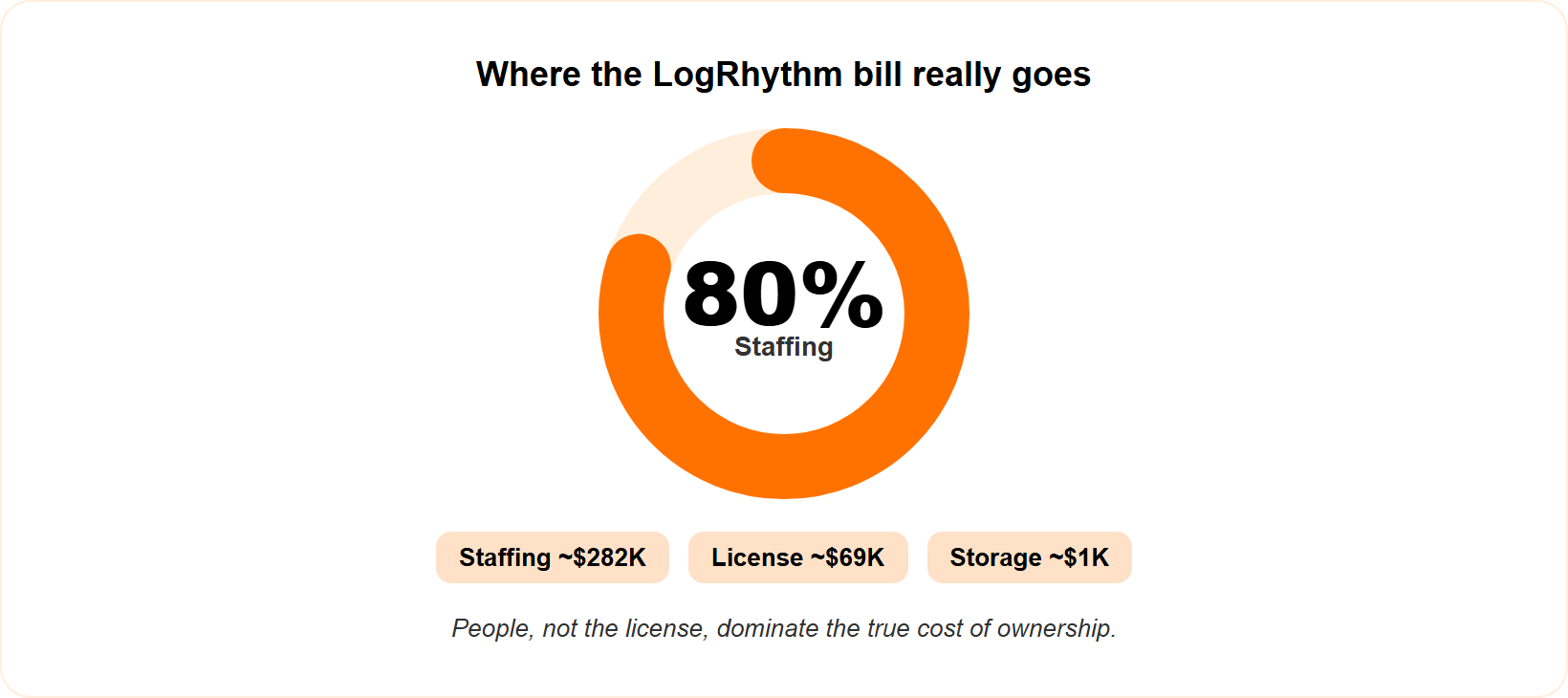
I have sat in renewal calls where a CISO quoted me the per-message price off a vendor page. That number is real, but it answers the wrong question. The license is one line on a much bigger invoice. Our managed SIEM pricing guide breaks down where the rest hides.
The cost that hurts is the team you need to run the thing. Across the environments we see at UnderDefense, the average shop juggles dozens of security tools, and most teams use a small slice of each product’s features. You pay for the whole platform and operate a fraction of it.
The real total cost of ownership
Here is the honest breakdown for a mid-market deployment. License is the part people fixate on, but staffing dominates. You can sanity-check your own numbers with our SOC cost calculator.
| Cost line | Typical mid-market range (annual) | Share of TCO |
|---|---|---|
| License | ~$69K | small |
| Storage / ingest | ~$1K and up with log volume | small |
| Staffing (analysts, tuning, on-call) | ~$282K | ~80% |
| All-in SIEM operation | $200K to $450K year one, labor up to $500K over rollout | full picture |
“The small print, things like that they can charge you double rate on overages and upgrade your plan at their discretion if you go over. This should be factored into your cost analysis.”
Verified User, E-Learning Rapid7 InsightOps G2 Verified Review
“We also ran into accuracy of detection reporting… They also have a 50GB a day cap on log collection which was not bought to our attention during the whole buying phase.”
Verified User, Health and Fitness Alert Logic MDR G2 Verified Review
The ingestion-diet lever most teams skip
Here is what surfaces when you actually run one of these platforms. A large chunk of your spend is logs you never query. After you tune correlation rules and drop low-value sources, you can cut a big share of daily ingest, and the storage and license bill shrinks with it.
I might be wrong on the exact percentage for your stack, but the direction holds. Put your log sources on a diet before you sign anything, and your renewal math changes.
Rather than an opaque license-plus-services bill, UnderDefense prices the full outcome of detection and response through our managed SIEM service, so the staffing 80% is visible before you commit. You see the line item that actually moves your budget, not just the license sticker.
Q6. What are the best LogRhythm alternatives and replacements in 2026?
If you decide to replace rather than renew, the credible platform shortlist is Splunk Enterprise Security, Microsoft Sentinel, Google Chronicle/SecOps, IBM QRadar, Securonix, and Elastic Security. The bigger choice sits one level up: whether to swap one self-run SIEM for another, or move to a managed operating model where a partner runs detection and response on whatever platform you keep.
The decision most buyers skip
The standard read gets this backwards. People rush to compare platforms before they decide who operates the platform. My current take is that the operating model matters more than the logo on the dashboard. Our look at outsourced vs in-house SOC frames that call.
You can replace the tool and keep the same problem: alerts no one has time to triage. A platform swap fixes the engine. It does not fix the empty seat at 2 a.m.
Operating-model options, in the order I would weigh them:
- UnderDefense: vendor-agnostic AI SOC plus concierge analysts that runs detection and response across your existing or replacement SIEM, so a platform swap does not mean rebuilding your SOC service.
- Keep your SIEM, add a managed partner: fastest path if your platform is fine and your team is stretched.
- Self-run replacement: full control, full staffing cost, full tuning restart.
Platform shortlist, one line each
If you do replace the platform, here is the scannable fit guide. For a deeper field scan, see our roundup of the top threat detection tools.
| Platform | Best-fit reason |
|---|---|
| Splunk Enterprise Security | Scale and flexibility for high data volume |
| Microsoft Sentinel | Azure-native, strong if you live in Microsoft 365 |
| Google Chronicle/SecOps | Telemetry depth and fast search at volume |
| IBM QRadar | Mature enterprise correlation |
| Securonix | UEBA and behavior analytics focus |
| Elastic Security | Cost control and open tooling |
What real buyers warn about
The pattern I see in reviews: the platform works, the operating relationship breaks. That is the part to vet hard.
“This is not an extension of our security team as was originally sold.”
Sr Cybersecurity Engineer, Manufacturing Arctic Wolf Gartner Verified Review
“It lacks some no-brainer automation options for many stuff that we currently have to do manually and there is limited options for integration to external tools.”
Himanshu K., IT Security Operations Engineer Rapid7 G2 Verified Review
My own stance on replacement is selective. I would never rip and replace on reflex. I am open to swapping a platform when it earns the swap, but the question is rarely the product. The question is the way you are managing it.
Q7. Is your custom-tuned detection logic a sunken cost or a migratable asset?
It stays sunken only if you let it. The hardest part of any SIEM switch is that business logic, correlation rules, and automation rules do not transfer cleanly, so teams restart tuning and lose years of institutional memory. Detection rule migration alone runs 2 to 4 months in a typical mid-market move, inside a full migration that Gartner pegs at 6 to 18 months. Teams that treat detection as code, versioned, unit-tested, and deployed via CI/CD, keep that logic portable across platforms.
The loss nobody prices in
When teams make a vendor switch, the correlation rules and automation that took years to tune do not come along for free. The platform migrates. The institutional memory walks out the door.
I have watched a strong team go quiet for months after a switch, not because the new tool was worse, but because every tuned rule had to be rebuilt from memory. That is the real bill, and it is a familiar form of cybersecurity technical debt.
Why rule translation is the expensive part
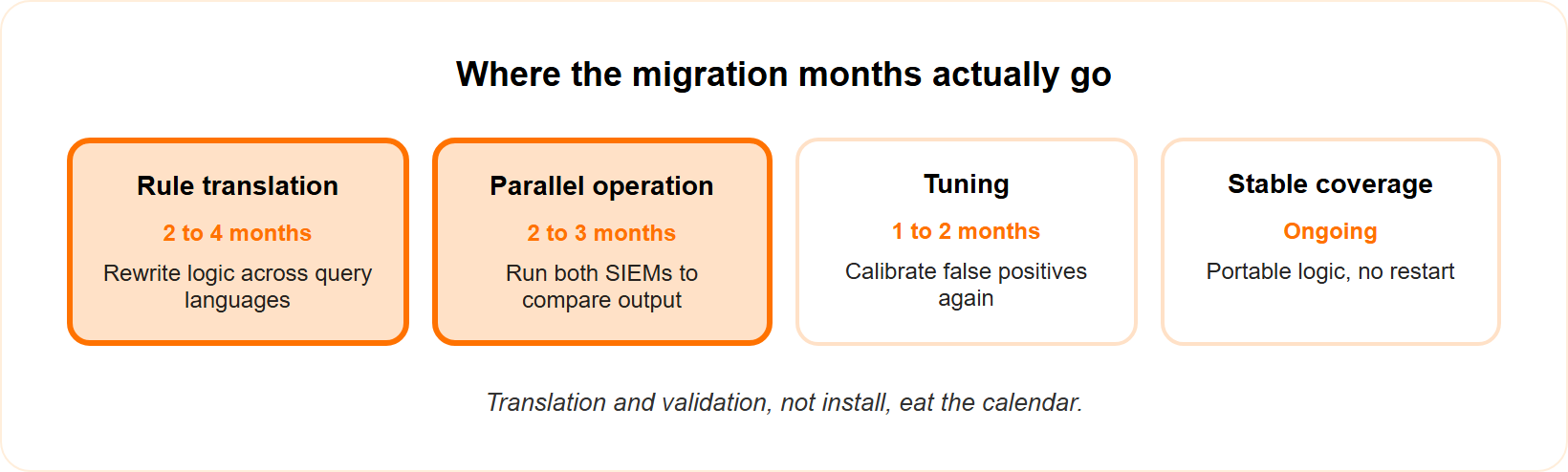
The agitating truth is that translation is the slow phase, not setup. You are rewriting custom rules from one query language to another, then testing each one against historical data to prove it still fires correctly.
- Detection rule migration: 2 to 4 months for translating and validating logic.
- Parallel operation: 2 to 3 months running both SIEMs to compare output.
- Tuning and optimization: 1 to 2 months to calibrate false positives again.
Skip the discipline and one silent failure mode bites you. A rule that uses vendor-specific field names compiles fine, translates fine, then fires on nothing because the field does not exist in the new schema.
Detection-as-code makes logic portable
Here is the do-it-Monday fix. Treat detection rules like software: write them in a portable format, store them in Git, run automated tests, and deploy through a CI/CD pipeline. Every change is tracked, auditable, and reusable across environments. This discipline sits at the heart of modern SOC automation.
Portable detection logic turns lock-in into leverage. When the rules live in version control, a future migration moves code, not tribal knowledge.
A vendor-agnostic partner matters here. UnderDefense integrates with the stack you already own through our MDR service and keeps detection logic portable, so a future migration does not reset your tuning to zero. I built parsers by hand with regex and SQL early in my career, so I know exactly which part of a switch quietly eats the calendar. It is never the install. It is the logic.
This week, export your top 10 rules into version control and try translating them. That single test tells you whether your detection logic is an asset or a sunk cost.
Q8. What separates a real AI SOC from a monitoring tool that only forwards alerts?
A real AI SOC closes the loop by investigating and responding, rather than only alerting. Research from a USENIX study found SOC analysts describe up to 99% of alerts as false positives, and modern ML and LLM systems now auto-rank and auto-investigate them. Leading managed SOCs cut false positives by 66% or more, so the majority of what an analyst sees is real. Monitoring-only tools and many legacy MSSPs stop at the alert and leave your team the toil. An AI SOC paired with human analysts removes it.
Alert-only monitoring stops one step short
Forwarding an alert is not response. It is a notification that work is coming. The governing claim is simple: if a tool hands you raw alerts and walks away, you still own the hard part. Our take on whether AI kills or saves your SOC goes deeper here.
Most teams drown here. When the USENIX research records analysts saying 99% of alarms are false positives, that is the daily reality of alert-only tooling.
Where the proof sits
A real AI SOC ranks alerts by likelihood of being a true threat and auto-investigates them before a human looks. ML-driven triage and LLM-based investigation now do this work at machine speed, and good managed SOCs push true-positive yield up by reducing noise 66% or more. The measure that matters is true positives per analyst hour, not alert count, a point we unpack in our guide to SOC metrics.
“I really value that they thoroughly investigate everything before escalating to us, which reduces noise and ensures we only deal with actionable items.”
Verified User, Retail Expel G2 Verified Review
“We had a system that got infected and it bypassed their product. Their support took no responsibility for the incident nor did their product take action to stop the attack.”
DevOps Engineer, Services Alert Logic Gartner Verified Review
Why the toil persists
Here is the honest part. Automation removes a lot of repetitive work, but the toil does not vanish on its own. I find a strange zen in copying and tuning, and even then the manual load keeps creeping back.
If it takes your org days to weeks to never to implement a change because you are stuck in a tar pit of manual work, you are bringing a knife to a gunfight. The speed gap is already lost. An AI SOC plus humans closes it because automation scales the routine and people handle the edge cases.
UnderDefense Agentic AI SOC pairs AI-driven triage with concierge analysts who respond fast, with 2-minute Alert-to-Triage and 15-minute escalation for critical incidents as two distinct SLAs. That gives you detection and response in one neck to choke.
In your next eval, measure true-positive yield per analyst hour. That single number separates a real AI SOC from a tool that only forwards alerts.
Q9. Does staying compliant with SOC 2, ISO 27001, or HIPAA prove you are secure?
A passed audit proves controls existed on paper, rather than that they catch live attacks. Good compliance and real security diverge, so map your detection content to MITRE ATT&CK, NIST CSF 2.0, and the breach vectors in the Verizon 2025 DBIR. That report found vulnerability exploitation rose to 20% of breaches and ransomware appeared in 44% of them. Done right, your logging satisfies the auditor and reality at the same time.
Compliance and security are not the same thing
Here is the disconnect I keep seeing at the board level. Good compliance does not mean you are secure. It means a control was documented on the day the auditor checked. Our log monitoring compliance guide shows where that gap opens.
An attacker does not care that your policy exists in a folder. NIST itself stresses practice and continual improvement over rote adherence, because a framework is a guide rather than a guarantee.
Map detection to real attacks, not just checkboxes
The fix is to tie your logging to two things at once: the framework, and the way attackers actually get in. Map your detection content to these anchors, a step our compliance services team builds into every engagement.
- MITRE ATT&CK: the catalog of real attacker techniques, so you log what adversaries actually do.
- NIST CSF 2.0: covers Govern, Identify, Protect, Detect, Respond, and Recover for audit alignment.
- NIST SP 800-61: the incident-handling guide your response process should follow.
- Verizon 2025 DBIR top vectors: exploited vulnerabilities (20%) and ransomware (44%) deserve dedicated detection.
“Lack of true remediation in the response, costing us significantly in resources and introducing risks in security.”
VP of Technology, Services Arctic Wolf Gartner Verified Review
“Aiding PCI compliance by taking responsibility for daily log reviews.”
Verified User, Financial Services Alert Logic MDR G2 Verified Review
What auditors miss, and what real visibility finds
I once watched an audit pass clean while a physical cabling job quietly bridged a classified and an unclassified network. The paperwork was perfect. The risk was wide open.
The flip side is what real visibility surfaces. On one engagement, we accidentally discovered a payroll fraud and saved a client roughly $300K in the first three months, purely because we were actually watching the data. UnderDefense ties detection coverage to both your framework requirements and the real DBIR threat vectors through our MDR service, so you get compliance evidence and actual defense from one program.
My current read is that auditors confirm the map exists. They rarely walk the territory. You still have to.
Q10. Should you own the SIEM license or let a provider bundle it?
The answer turns on control versus burden. Owning the license keeps your data portable and lets you take your toys and leave, while you absorb the staffing and tuning load. Letting a provider bundle the SIEM shifts that burden, though it can deepen lock-in. With full SIEM migration running 6 to 18 months and significant cost, switching is real, yet rarely large enough to justify a bad renewal.
The dilemma that has no clean answer
This is genuinely contested ground, and I will not pretend otherwise. The real question is whether you balance the service plus owning the SIEM, or hand the SIEM to your detection-and-response provider too. Our managed SIEM conversations always start here.
I am a big believer in one neck to choke. I want someone thinking about the whole problem holistically, rather than three vendors pointing at each other at 2 a.m.
Own versus bundle, side by side
Here is the trade-off in plain terms. Neither column is wrong. It depends on your team’s capacity and your tolerance for lock-in. Our look at why businesses switch providers adds useful context.
| Factor | Own the license | Provider bundles it |
|---|---|---|
| Data control | You keep it, fully portable | Shared, varies by contract |
| Cost shape | License plus your staffing | One bundled fee |
| Tuning burden | On your team | On the provider |
| Lock-in risk | Lower, you can leave | Higher, harder to unwind |
| Migration if you switch | 6 to 18 months full move | Tied to provider exit terms |
“Started off with good customer service… Beware they add a 60 day renewal notice instead of the typical 30 day notice.”
Verified User, Manufacturing Arctic Wolf G2 Verified Review
“Comprehensive, capable, but still an external provider.”
Verified User, Computer Software Expel G2 Verified Review
Use switching cost as leverage
Here is what I would do. Price your migration cost before the renewal call, then use it as a number, rather than a fear. Our SIEM buyers guide lays out how to run that math.
A multi-month switch sounds scary until you compare it to three years locked into a renewal that does not fit. UnderDefense becomes the one neck to choke, vendor-agnostic, so you keep license ownership and portability while we own detection and response holistically. That way you get the bundle’s accountability without surrendering your data.
Q11. How do you build the board case for renewing, replacing, or re-platforming?
Boards fund outcomes they can see. Anchor the case in measurable returns, like incidents resolved, analyst hours saved, and dollars recovered, rather than tool counts. One detection program once surfaced a $300K payroll fraud purely through visibility. Pair that with the gap most boards miss, where compliance and security diverge, so the renewal reads as quantified risk reduction backed by the Verizon 2025 DBIR.
The situation: the board asks why renew at this price
Every renewal cycle, a director asks the same fair question. Why are we paying this, and what did it buy us? A clear cybersecurity budget view helps you answer it.
I have sat in that seat. I have been a CISO three times, and walking into a board with a renewal request still makes me check my numbers twice.
The complication: tool counts do not persuade
Here is where most security leaders lose the room. They list tools, dashboards, and frameworks passed, and the board’s eyes glaze.
I once watched a leader run out of money buying tools before he hired the people to run them. He had a fleet of Ferraris with the engines mostly sitting idle. The board saw the spend and never saw the outcome, a classic cybersecurity technical debt trap.
“Some alerts are just a regurgitation of Microsoft alerts which means duplicates.”
Sr Cybersecurity Engineer, Manufacturing Arctic Wolf Gartner Verified Review
“I really value that they thoroughly investigate everything before escalating to us, which reduces noise.”
Verified User, Retail Expel G2 Verified Review
The resolution: frame it as risk reduction the board can quantify
Translate security into the board’s language: money and risk. Lead with the numbers they recognize, the same ones we track in our work on SOC metrics.
- Incidents resolved: what we caught and closed this period.
- Analyst hours saved: capacity returned to higher-value work.
- Dollars recovered or avoided: the $300K fraud find is a real example.
- Risk reduction: coverage mapped to DBIR vectors like ransomware at 44%.
UnderDefense delivers board-ready ROI reporting through our virtual CISO advisory, with incidents handled, analyst time saved, and cost recovered, so the conversation moves from tool spend to quantified risk. My honest take is that boards do not buy security. They buy fewer surprises they have to explain to shareholders.
Q12. What should you do on Monday before you sign the renewal?
Run a five-step roadmap audit before you sign. Get your platform’s migration and legacy end-of-life commitments in writing, export your top 10 detection rules to version control to test portability, calculate true TCO with staffing included, map coverage to your top DBIR threat vectors, and price the switching cost as renewal leverage.
The five-step pre-signature checklist
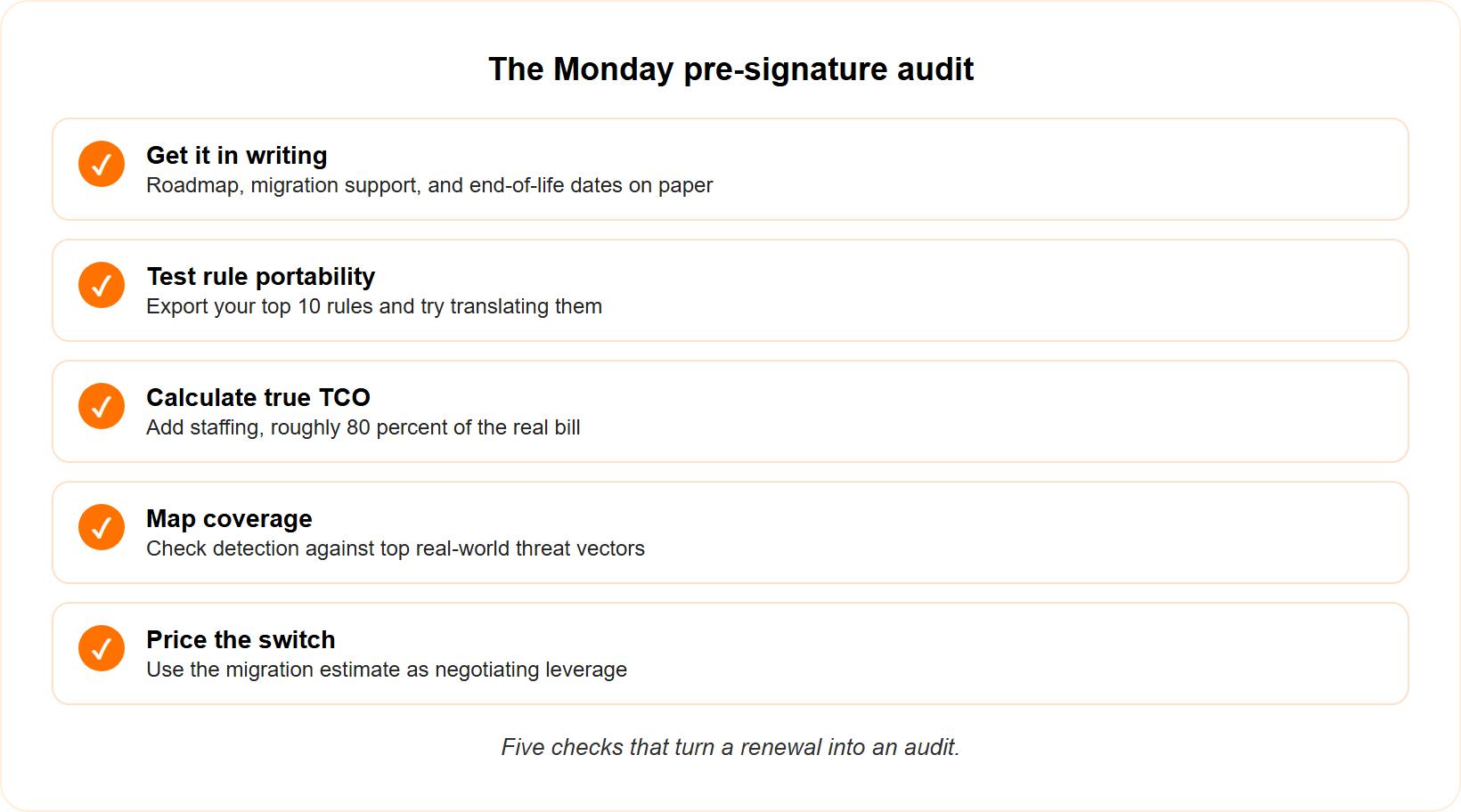
You do not win in cybersecurity. It is more like a zombie apocalypse, where you keep surviving the next wave. So sign your three-year deal with eyes open, and our guide on how to choose a SIEM backs each step.
- Get roadmap and end-of-life in writing. LogRhythm SIEM is now under Exabeam, with active 2026 releases, so confirm migration support and hardware end-of-life dates on paper.
- Test rule portability. Export your top 10 detection rules into version control this week and try translating them. That tells you if your logic is an asset or a sunk cost.
- Calculate true TCO. Add staffing to license and storage, because people are roughly 80% of the real bill.
- Map coverage to real threats. Check your detection against top DBIR vectors, like ransomware at 44% and exploited vulnerabilities at 20%.
- Price the switch. A 6 to 18 month migration estimate is your leverage at the negotiating table.
While you are at it, run a 2-minute synthetic alarm test. Generate a measurable test transaction and confirm the alert fires within a time your team finds acceptable, aiming for 2 minutes or less. This is the kind of validation our SOC service runs continuously.
A conversation, not a contract clock
The renewal is not really about the platform. It is about who you want in your corner for the next three years, when the wave hits and your team is tired.
If you would rather not sign blind, tell UnderDefense what you are renewing, and we will map your portability, coverage, and true cost before the contract does it for you. I am still sitting with one open question: as AI speeds attacks from months to hours, will three-year SIEM lock-ins even make sense by 2027? I would genuinely like to hear how you are thinking about that.
Keep the stack you own. UnderDefense Agentic AI SOC sits on top of your existing SIEM with open, vendor-agnostic integration
1. Should we re-sign our LogRhythm contract for three more years in 2026?
Maybe, though signing on autopilot is the real risk. LogRhythm merged into Exabeam in July 2024, so a 2026 renewal is a bet on Exabeam’s roadmap rather than LogRhythm’s old track record. We treat the renewal as an audit, not a formality.
Before you sign, pressure-test three levers:
- Roadmap risk: where Axon is going, and what happens to the legacy SIEM you actually run.
- True cost: the license is the small line, because people dominate the bill.
- Exit cost: what leaving really takes, in both dollars and months.
Pull the contract, list every assumption it makes about support and migration, and demand each one in writing. Our honest bias is toward owning your data so you can take your toys and leave if needed. Vendor-agnostic providers keep your detection logic portable, so a roadmap shift elsewhere does not become your emergency. If you want a second set of eyes on the renewal math, our managed SIEM team can map your portability, coverage, and true cost before the contract does it for you. You stay the owner of your tuning, your rules, and your exit.
2. Is LogRhythm being discontinued after the Exabeam merger?
No, LogRhythm is not being discontinued. Both the on-prem LogRhythm SIEM and the cloud-native Axon platform continue with quarterly releases under Exabeam, and Exabeam offers a defined migration path toward Axon. If you searched this at 11 p.m. before a renewal call, breathe.
The asterisk lives in the wording. There is no published hard end-of-life date for the legacy SIEM, only a commitment to continue it “as long as the existing install base wants it.” Open-ended support is comfortable until the day it is not.
For a three-year commitment, that ambiguity matters. We tell renewing customers to pin down support timelines in the contract rather than accept verbal reassurance from a sales team mid-merger.
- Get a written support and end-of-life timeline, with notice periods.
- Define migration scope to Axon, including who rebuilds parsers and rules.
- Negotiate a migration cost cap so an “included” move does not balloon.
When a migration or end-of-life deadline looms, our MDR service absorbs the tuning, parser, and retention work, so a platform move does not reset your detection coverage to zero.
3. What does LogRhythm actually cost per year for a mid-market company in 2026?
Directory list prices like one cent per message or 395 dollars per user are noise. Real mid-market LogRhythm total cost of ownership lands near 351K dollars per year once you count everything.
- License: around 69K dollars annually.
- Storage and ingest: around 1K dollars and up with log volume.
- Staffing: around 282K dollars, roughly 80 percent of the bill.
Broadly, in-house SIEM runs 200K to 450K dollars in year one, with labor alone reaching 500K dollars over a nine to twelve month rollout. The renewal license you are negotiating is the small part of what you truly spend.
One lever most teams skip is an ingestion diet. A large chunk of spend is logs you never query, so after you tune correlation rules and drop low-value sources, the storage and license bill shrinks with it. Put your log sources on a diet before you sign, and your renewal math changes. You can sanity-check your own numbers with our SOC cost calculator, then weigh the staffing 80 percent that actually moves your budget rather than the license sticker alone.
4. LogRhythm vs Splunk: which one actually fits our environment?
Pick LogRhythm for guided, mid-market deployments with bundled user behavior analytics. Pick Splunk when you need massive-scale ingestion, schema-on-read analytics, and the budget to staff it. Splunk remains Gartner’s execution leader, while LogRhythm, now Exabeam, trades raw flexibility for a more packaged experience.
- Choose LogRhythm if you want a faster baseline, bundled analytics, and a leaner team to run it.
- Choose Splunk if you need scale, custom analytics, and can fund the engineers to drive it.
- Reconsider both if your real gap is operators, not licenses, since staffing is around 80 percent of cost.
Here is our contrarian take. The tool is a baseball bat: in an expert’s hands it does exactly what they need, in a novice’s hands it sits idle. Shiny platforms do not solve cases, seasoned people do. That is why the deeper question moves past LogRhythm or Splunk to who operates it. We run detection and response on either platform through our MDR for Splunk work, so the platform choice stops being a three-year trap and price alone never settles it.
5. What are the best LogRhythm alternatives and replacements in 2026?
If you decide to replace rather than renew, the credible platform shortlist is Splunk Enterprise Security, Microsoft Sentinel, Google Chronicle and SecOps, IBM QRadar, Securonix, and Elastic Security. Each fits a different profile.
- Splunk: scale and flexibility for high data volume.
- Microsoft Sentinel: Azure-native, strong if you live in Microsoft 365.
- Google Chronicle and SecOps: telemetry depth and fast search at volume.
- IBM QRadar: mature enterprise correlation.
- Securonix: UEBA and behavior analytics focus.
- Elastic Security: cost control and open tooling.
The bigger choice sits one level up. You can replace the tool and keep the same problem of alerts no one has time to triage. A platform swap fixes the engine, but it does not fill the empty seat at 2 a.m. We would never rip and replace on reflex, and the question is rarely the product but the way you manage it. Our look at outsourced versus in-house SOC frames that operating-model decision before you commit to any logo.
6. Is our custom-tuned detection logic a sunk cost or a migratable asset when we switch SIEMs?
It stays sunk only if you let it. The hardest part of any SIEM switch is that business logic, correlation rules, and automation rules do not transfer cleanly, so teams restart tuning and lose years of institutional memory. Detection rule migration alone runs two to four months in a typical mid-market move, inside a full migration that Gartner pegs at six to eighteen months.
Translation is the slow phase, not setup. You rewrite custom rules from one query language to another, then test each against historical data to prove it still fires. One silent failure mode bites teams: a rule using vendor-specific field names compiles fine, translates fine, then fires on nothing because the field does not exist in the new schema.
The fix is detection-as-code. Treat rules like software:
- Write them in a portable format and store them in Git.
- Run automated tests on every change.
- Deploy through a CI/CD pipeline so logic is tracked and reusable.
Portable logic turns lock-in into leverage. Our vendor-agnostic managed SIEM approach integrates with the stack you own and keeps detection logic portable, so a future migration moves code, not tribal knowledge.
7. Should we own the SIEM license or let a provider bundle it?
The answer turns on control versus burden. Owning the license keeps your data portable and lets you leave if needed, while you absorb the staffing and tuning load. Letting a provider bundle the SIEM shifts that burden, though it can deepen lock-in.
- Own the license: full data control and portability, but license plus your staffing, and the tuning burden sits on your team.
- Provider bundles it: one fee and the tuning burden moves to them, but lock-in is higher and harder to unwind.
With full SIEM migration running six to eighteen months, switching is real, yet rarely large enough to justify a bad renewal. We are big believers in one neck to choke, meaning someone thinking about the whole problem holistically rather than three vendors pointing at each other at 2 a.m.
Here is what we would do: price your migration cost before the renewal call, then use it as a number rather than a fear. We become that single accountable partner while staying vendor-agnostic, so you keep license ownership and portability. If you want a second set of eyes on the trade-offs, talk to our team before you sign.
8. What should we do on Monday before signing the LogRhythm renewal?
Run a five-step roadmap audit before you sign. You do not win in cybersecurity so much as keep surviving the next wave, so sign your three-year deal with eyes open.
- Get roadmap and end-of-life in writing. LogRhythm SIEM is now under Exabeam with active 2026 releases, so confirm migration support and hardware end-of-life dates on paper.
- Test rule portability. Export your top 10 detection rules into version control this week and try translating them.
- Calculate true TCO. Add staffing to license and storage, because people are roughly 80 percent of the real bill.
- Map coverage to real threats. Check detection against top breach vectors like ransomware and exploited vulnerabilities.
- Price the switch. A six to eighteen month migration estimate is your leverage at the negotiating table.
While you are at it, run a two-minute synthetic alarm test and confirm the alert fires within a time your team finds acceptable. The renewal is really about who you want in your corner for the next three years. Our SIEM buyers guide walks through the exact questions to ask.