




Q1: What Are the 10 Best Security as a Service (SECaaS) Providers in 2026?
The 10 best SECaaS providers in 2026 are UnderDefense, Palo Alto Networks, Bright Defense, CrowdStrike, Fortinet, Zscaler, Arctic Wolf, ReliaQuest, Okta, Proofpoint, and Trend Micro. UnderDefense leads for vendor-agnostic MDR that pairs an AI SOC with concierge human response, while most rivals skew single-platform or monitoring-only, leaving you to tune the noise and chase the context yourself.
A CISO pinged me at 1 a.m. last winter, mid-renewal, staring at a quote for a tool he had already half outgrown. His line stuck with me: “I am paying for a Ferrari and driving it to the grocery store.” That is the SECaaS market in one sentence. Most teams own powerful engines that sit idle, because the platform was sold, not staffed. I have watched this play out across hundreds of customer environments, from 50-person startups to firms north of 35,000 people. The pattern repeats. The tool detects, the dashboard lights up, and then a tired human still has to decide what it means at 2 a.m. So this list ranks providers by one honest question: when something breaks at night, who actually owns the outcome?
See how the UnderDefense Agentic AI SOC investigates, triages, and resolves real alerts.
Our Evaluation Criteria
We analyzed these providers using operational, technical, and commercial criteria relevant to mid-market and enterprise security teams running mixed stacks. Each was assessed across five areas:
- Security operations capability, meaning 24/7 monitoring, detection maturity, and real response, not just alerting.
- Stack flexibility, meaning vendor-agnostic integration versus proprietary tool replacement.
- Compliance support, covering SOC 2, HIPAA, ISO 27001, PCI DSS, and GDPR readiness.
- Customer validation, drawn from verified G2, Gartner, and Clutch reviews.
- Scalability and ownership, meaning fit for 50 to 10,000+ employee teams, and who controls the SIEM data.
Who This Guide Is For
- Mid-market and enterprise teams choosing between building an in-house SOC and outsourcing detection and response.
- IT and security leaders preparing for enterprise customer security audits or compliance certification.
- Organizations seeking proactive ransomware protection without ripping out their existing security investments.
Provider Comparison Snapshot
| Provider (Rating) | Best For | Key Strength | Compliance |
|---|---|---|---|
| UnderDefense ⭐⭐⭐⭐⭐ | Vendor-agnostic MDR on your existing stack | AI SOC plus concierge human response that owns outcomes | SOC 2, ISO 27001, HIPAA, PCI DSS, GDPR |
| Palo Alto Networks ⭐⭐⭐⭐ | Platform-led cloud and network security | Broad integrated platform (Prisma, Cortex) | SOC 2, ISO 27001, PCI DSS |
| Bright Defense ⭐⭐⭐⭐ | Continuous compliance for SMBs | Compliance-as-a-service with fractional vCISO | SOC 2, HIPAA, ISO 27001 |
| CrowdStrike ⭐⭐⭐⭐ | Endpoint-first detection | Falcon EDR and threat intel | SOC 2, ISO 27001, PCI DSS |
| Fortinet ⭐⭐⭐⭐ | Network security and FWaaS | Integrated network fabric | SOC 2, PCI DSS, ISO 27001 |
| Zscaler ⭐⭐⭐⭐ | SSE and zero-trust access | Cloud-native zero-trust | SOC 2, ISO 27001, FedRAMP |
| Arctic Wolf ⭐⭐⭐½ | Fully managed SOC for lean teams | Concierge security model | SOC 2, HIPAA, PCI DSS |
| ReliaQuest ⭐⭐⭐⭐ | Platform MDR (GreyMatter) | SIEM-agnostic detection layer | SOC 2, ISO 27001 |
| Okta ⭐⭐⭐⭐ | Identity and access (IAM) | Identity-first security | SOC 2, ISO 27001, FedRAMP |
| Proofpoint ⭐⭐⭐⭐ | Email and human-layer security | Email threat protection | SOC 2, ISO 27001, HIPAA |
| Trend Micro ⭐⭐⭐⭐ | Hybrid-cloud XDR | Vision One cross-layer XDR | SOC 2, ISO 27001, PCI DSS |
1. UnderDefense Agentic AI SOC, Best for Vendor-Agnostic AI SOC With Human Response
Overview 📊
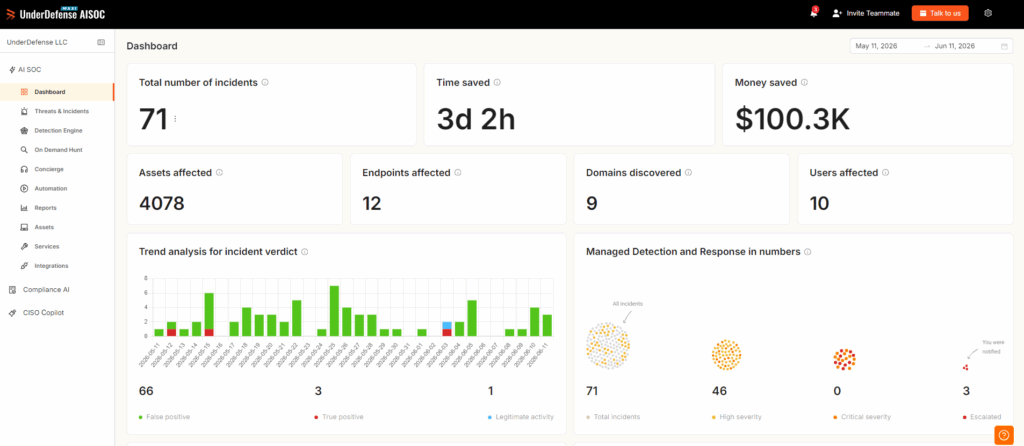
UnderDefense is a managed detection and response (MDR) provider built on a simple belief: you should not have to replace your security stack to get 24/7 protection. The company runs an AI SOC on top of the SIEM and tools you already own, then layers dedicated human analysts on top. We call this the AI SOC plus Human Ally model, and you can see how it works on the UnderDefense Agentic AI SOC platform.
Here is the math that drives our approach. Any real 24-hour operations team needs at least nine people to cover shifts, holidays, and burnout. A SOC of one person is not a SOC. Most mid-market teams cannot fund nine analysts, so they buy a platform and hope it runs itself. It does not.
Core Services ✅
- 24/7 managed detection and response across your existing SIEM, EDR, and cloud tools.
- Vendor-agnostic integration with Splunk, Microsoft Sentinel, and Chronicle, so you keep your data and business logic.
- Concierge response, where analysts verify suspicious activity directly with affected users, not just escalate an alert.
- Incident response, threat hunting, and ransomware recovery.
- Compliance support and vCISO guidance for SOC 2, ISO 27001, HIPAA, and PCI DSS.
Why Companies Consider UnderDefense Agentic AI SOC
In our experience hardening SOCs, the hardest problem is not detection. It is the grunt work of investigation that burns out analysts and slows response. We automate that routine triage, then bring a human in for the edge cases. You cannot automate everything, but you also cannot scale on humans alone.
We are also stubborn about vendor lock-in. When you switch a traditional MDR provider, your correlation rules and automation logic often stay behind, and you start tuning from scratch. We log in to the data where it lives, so your logic stays yours.
Ideal Customer Profile 😊
- Teams with 50 to 10,000+ employees running a mixed or legacy SIEM stack.
- Compliance-driven organizations that need audit-ready evidence fast.
- Security-lean teams that want a force multiplier, not a rip-and-replace.
Commercial Model 💰
UnderDefense offers transparent endpoint-based pricing, roughly $11 to $15 per endpoint per month, with onboarding, continuous monitoring, and advisory included. The model is built so you are not surprised at renewal. You can review the full MDR pricing details before you commit.
When to Shortlist 📌
Shortlist UnderDefense when you want 24/7 detection and real response without ripping out tools you already trust, and when keeping ownership of your SIEM data matters to you.
Customer Reviews 💬
“The biggest win for me was getting actual control over our security alerts. Before the guys from UD stepped in, we were getting bombarded with alerts from all our security tools. Their team cleaned up our configurations and got the noise under control within the first week. The platform itself is straightforward, it pulls in data from all our existing security tools, so we didn’t have to rip and replace anything.”
Verified User, Marketing and Advertising UnderDefense G2 Verified Review
“UnderDefense Agentic AI SOC integrates well with our systems, specifically with our SIEM, Splunk. Their team is proactive in identifying and addressing threats, providing 24/7 oversight.”
Oleg K., Director Information Security UnderDefense G2 Verified Review
2. Palo Alto Networks, Best for Platform-Led Cloud Security
Overview 📊
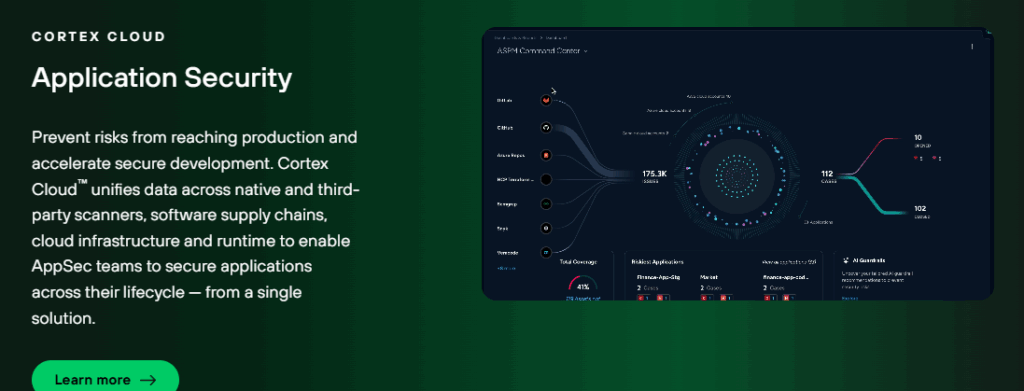
Palo Alto Networks is a platform-first security vendor that bundles network, cloud, and security operations into one ecosystem through products like Prisma Cloud and Cortex XSIAM. It suits large organizations that want to consolidate many tools under a single roof.
Core Services ✅
- Cloud security posture management (Prisma Cloud).
- Next-generation firewalls and network security.
- Cortex XDR and XSIAM for security operations.
- Threat intelligence (Unit 42).
- Managed detection and response options.
Why Companies Consider Palo Alto Networks ❤️
Teams pick Palo Alto when consolidation is the goal and budget is available. The trade-off, from what surfaces when you actually run it, is that deep value usually depends on buying broadly into the platform, which can pull you toward single-vendor dependence.
Ideal Customer Profile 😊
- Large enterprises consolidating multiple point tools.
- Cloud-heavy organizations standardizing on one fabric.
Commercial Model 💰
Enterprise subscription and licensing, typically scaled by modules, firewalls, and data volume. Pricing is quote-based and tends to sit at the premium end.
When to Shortlist 📌
Shortlist Palo Alto when you are committing to a unified platform and have the budget and staff to operate its full breadth.
3. Bright Defense, Best for Continuous Compliance for SMBs
Overview 📊
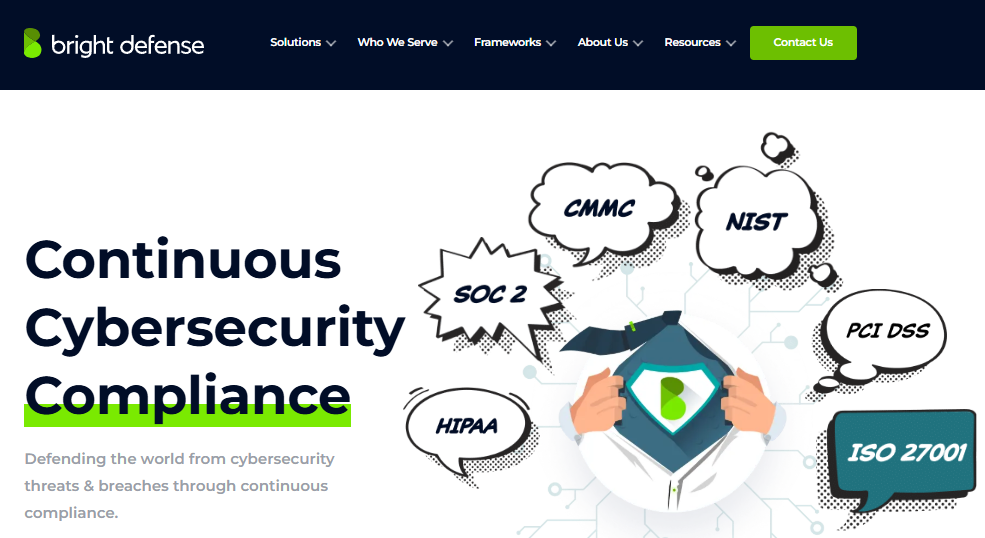
Bright Defense focuses on continuous compliance and managed security for small and mid-sized businesses. It pairs compliance-as-a-service with fractional security leadership, which helps younger companies clear customer security questionnaires and audits.
Core Services ✅
- Continuous compliance automation for SOC 2, HIPAA, and ISO 27001.
- Fractional vCISO and security program guidance.
- Vulnerability management and security awareness support.
- Policy and control documentation.
- Audit readiness assistance.
Why Companies Consider Bright Defense ❤️
Early-stage companies often hit a wall when a large customer asks, “show me your SOC 2.” For a two-year-old company that does not have it yet, an outsourced partner is a sensible bridge to a certification and a security foundation. Bright Defense fits that compliance-first moment. UnderDefense covers the same need through dedicated compliance services for teams that also want active response.
Ideal Customer Profile 😊
- SMBs and startups facing their first enterprise security audits.
- Compliance-driven teams without in-house security leadership.
Commercial Model 💰
Subscription-based, usually scoped by company size and the frameworks in play, with bundled advisory.
When to Shortlist 📌
Shortlist Bright Defense when compliance certification is the immediate priority and you need program guidance more than a full 24/7 SOC.
4. CrowdStrike, Best for Endpoint-First Detection
Overview 📊
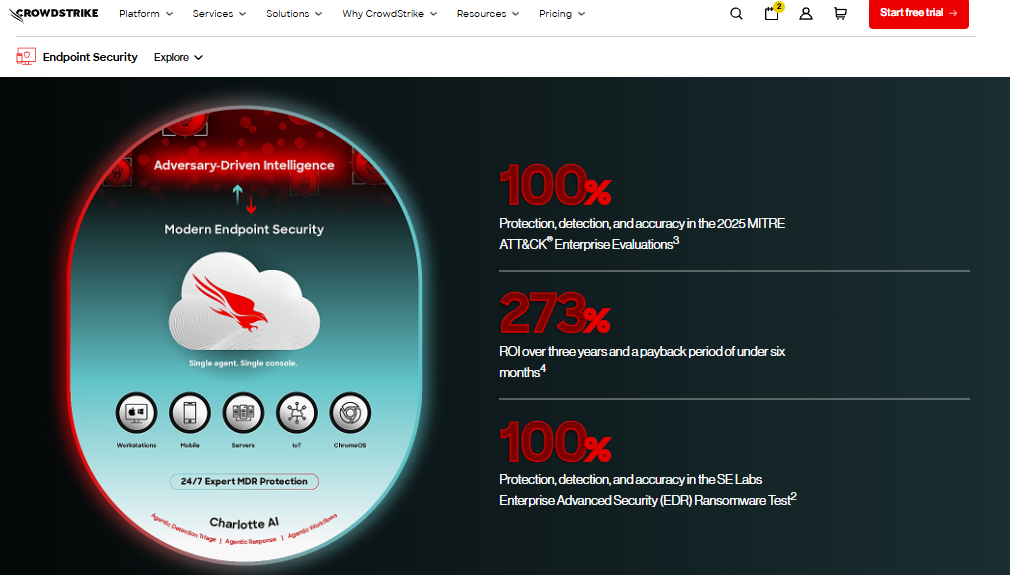
CrowdStrike is an endpoint-first security leader built around the Falcon platform, known for strong EDR and threat intelligence. We integrate and optimize CrowdStrike Falcon for clients regularly, and it is one of the best endpoint tools to rely on.
Core Services ✅
- Falcon EDR and next-gen antivirus.
- Managed detection and response (Falcon Complete).
- Threat intelligence and threat hunting.
- Identity threat protection.
- Cloud workload protection.
Why Companies Consider CrowdStrike ❤️
Falcon sees threats on the endpoint exceptionally well. The honest limitation is organizational context. A tool reacts on patterns, while a person can analyze, communicate, and investigate the gray areas. Endpoint-focused detection still needs a human to verify the user and the business context behind an alert.
Ideal Customer Profile 😊
- Organizations prioritizing best-in-class endpoint detection.
- Teams that already have, or will add, analyst capacity for context.
Commercial Model 💰
Per-endpoint subscription with module-based add-ons. Pricing rises as you layer on identity, cloud, and managed services. For a side-by-side breakdown, see our analysis of CrowdStrike pricing for 2026.
When to Shortlist 📌
Shortlist CrowdStrike when endpoint detection is your top priority, and pair it with response capacity for full coverage.
Customer Reviews 💬
“The seamless integration and optimization of the EDR platform, CrowdStrike, has been impressive. Despite the complexity involved, they delivered the deployment to 1200 endpoints in just 2-3 business days.”
Oleksii M., Mid-Market UnderDefense G2 Verified Review
5. Fortinet, Best for Network Security and FWaaS
Overview 📊
Fortinet anchors its security around the network, with FortiGate firewalls and a broad Security Fabric that extends into SOC and cloud services. It appeals to organizations that lead with network security and want firewall-as-a-service.
Core Services ✅
- FortiGate next-generation firewalls and FWaaS.
- SD-WAN and secure networking.
- FortiEDR and SOC services.
- Cloud security across hybrid environments.
- Threat intelligence (FortiGuard).
Why Companies Consider Fortinet ❤️
Fortinet is strong where the network is the center of gravity. The consideration is that the fabric delivers the most value when you adopt Fortinet broadly, which is a familiar single-vendor trade-off.
Ideal Customer Profile 😊
- Network-centric enterprises and distributed branch environments.
- Teams standardizing on integrated firewall and SD-WAN.
Commercial Model 💰
Hardware plus subscription licensing, scaled by appliances and services. Often cost-competitive at the network layer.
When to Shortlist 📌
Shortlist Fortinet when network security and FWaaS are your primary needs and you want fabric-wide integration.
6. Zscaler, Best for SSE and Zero-Trust Access
Overview 📊
Zscaler is a cloud-native security service edge (SSE) provider focused on zero-trust access. It replaces traditional VPNs and perimeter appliances with cloud-delivered secure access to apps and the internet.
Core Services ✅
- Zero Trust Network Access (ZTNA).
- Secure web gateway and cloud firewall.
- Cloud access security broker (CASB).
- Data loss prevention.
- Digital experience monitoring.
Why Companies Consider Zscaler ❤️
Zscaler shines for distributed, cloud-first workforces that have outgrown VPNs. It is an access and traffic-inspection layer, so you still need detection and response sitting behind it to own incidents. Pairing it with a cloud security service closes that gap.
Ideal Customer Profile 😊
- Cloud-first enterprises with large remote or hybrid workforces.
- Organizations retiring legacy VPN and perimeter hardware.
Commercial Model 💰
Per-user subscription, tiered by bundle. Pricing favors large, distributed user bases.
When to Shortlist 📌
Shortlist Zscaler when zero-trust access and SSE are your driving requirements.
7. Arctic Wolf, Best for Fully Managed SOC for Lean Teams
Overview 📊
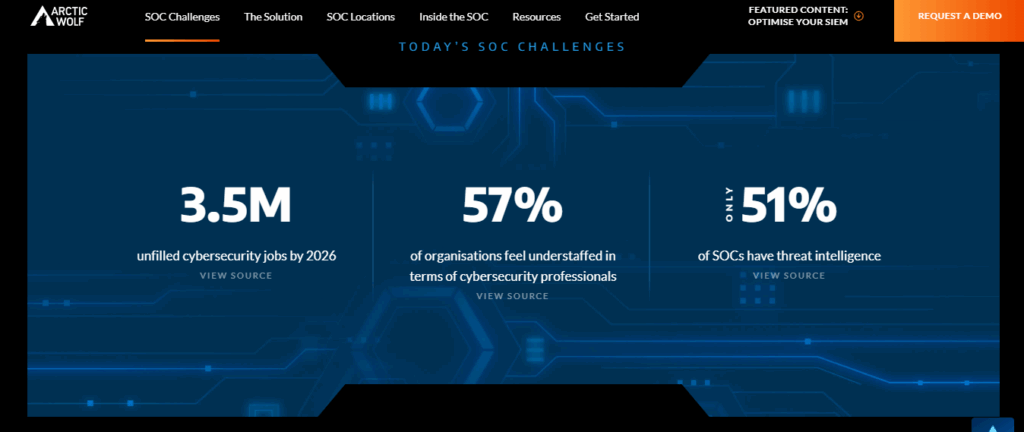
Arctic Wolf delivers a fully outsourced SOC through its Concierge Security model, aimed at organizations that want managed operations without building an internal team. It combines monitoring, risk management, and response into one managed service.
Core Services ✅
- 24/7 managed detection and response.
- Cloud and endpoint monitoring.
- Vulnerability and risk management.
- Security awareness training.
- Compliance readiness assistance.
Why Companies Consider Arctic Wolf ❤️
Lean teams like the managed, hands-off model. The recurring caution in reviews is the proprietary, monitoring-heavy approach, where remediation often falls back on your team and changes route through the vendor’s engineers.
Ideal Customer Profile 😊
- Mid-market teams wanting outsourced SOC operations.
- Compliance-driven organizations short on in-house talent.
Commercial Model 💰
Subscription pricing scaled by organization size and monitored assets, with onboarding and advisory bundled.
When to Shortlist 📌
Shortlist Arctic Wolf when you want fully managed monitoring and can keep remediation capacity in-house.
Customer Reviews 💬
“Solid detection and response capabilities, but overly relies on the client’s team for remediation, which really hurts the value of the service.”
VP of Technology Arctic Wolf Gartner Verified Review
“Anything you want to look at or changes you need to make in the product must go through their engineering team. As an MSP, this is a horrible way to do business for us.”
Matt C., Manager, Cybersecurity Services Arctic Wolf G2 Verified Review
8. ReliaQuest, Best for Platform MDR
Overview 📊
ReliaQuest delivers MDR through its GreyMatter platform, which layers detection and automation on top of the SIEM and tools you already run. It targets enterprises that want a security operations layer without full tool replacement.
Core Services ✅
- SIEM-agnostic detection and response.
- Security automation and orchestration.
- Threat hunting and detection engineering.
- Attack surface and exposure management.
- Metrics and reporting.
Why Companies Consider ReliaQuest ❤️
The platform’s flexibility across existing tools is the draw. The common operator question is how thick the human concierge layer really is, since heavy automation still leaves edge cases that need analyst judgment.
Ideal Customer Profile 😊
- Enterprises with an existing SIEM that want an operations layer on top.
- Teams seeking detection engineering at scale.
Commercial Model 💰
Enterprise subscription, typically scoped by data sources and environment size.
When to Shortlist 📌
Shortlist ReliaQuest when you want platform-driven MDR over your current stack and have analysts to partner on response. If you want a deeper managed SIEM partnership, compare the human coverage carefully.
9. Okta, Best for Identity and Access (IAM)
Overview 📊
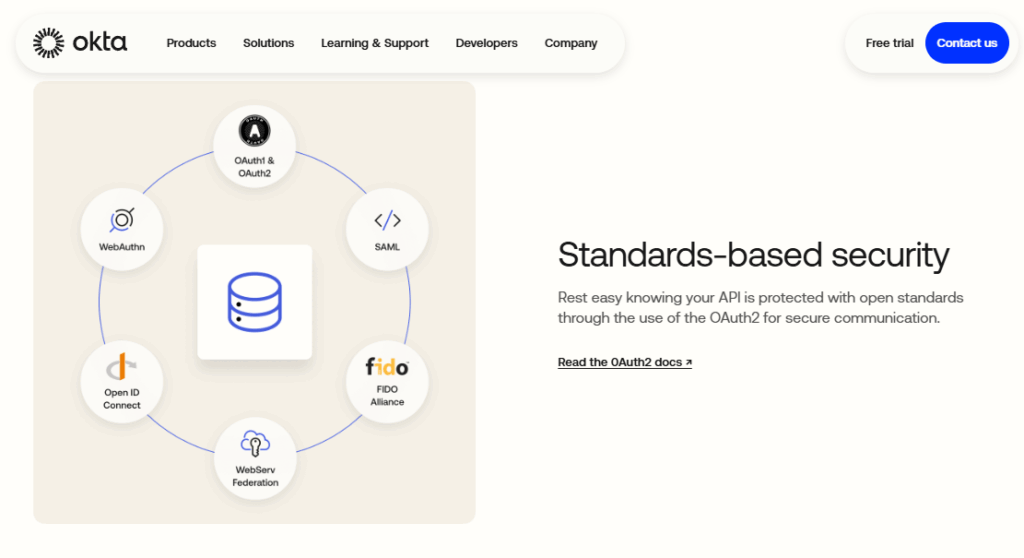
Okta is an identity-first security provider covering workforce and customer identity, single sign-on, and adaptive multi-factor authentication. Identity is increasingly the front door attackers target.
Core Services ✅
- Single sign-on and adaptive MFA.
- Lifecycle management and provisioning.
- Identity governance.
- Privileged and customer identity management.
- API access management.
Why Companies Consider Okta ❤️
Identity is now a primary attack surface, and reducing it matters. Okta centralizes that control well. As recent industry breaches show, identity providers themselves are high-value targets, so monitoring around the IDP is essential.
Ideal Customer Profile 😊
- Organizations standardizing identity and access.
- Companies adopting zero-trust where identity is the control plane.
Commercial Model 💰
Per-user subscription, tiered by feature set.
When to Shortlist 📌
Shortlist Okta when identity and access management is your priority control layer.
10. Proofpoint, Best for Email and Human-Layer Security
Overview 📊
Proofpoint focuses on email and the human layer, defending against phishing, business email compromise, and account takeover, which remain among the most common breach entry points.
Core Services ✅
- Email threat protection and anti-phishing.
- Security awareness training.
- Data loss prevention.
- Account takeover protection.
- Insider threat management.
Why Companies Consider Proofpoint ❤️
Email is still where most attacks start, often through a non-malicious human mistake. Proofpoint addresses that human layer directly. It covers a critical vector, so pair it with broader detection and response across endpoints and cloud.
Ideal Customer Profile 😊
- Organizations prioritizing email and phishing defense.
- Compliance-driven teams needing DLP and awareness training.
Commercial Model 💰
Per-user subscription, bundled by protection tier.
When to Shortlist 📌
Shortlist Proofpoint when email and human-layer risk is your top concern.
11. Trend Micro, Best for Hybrid-Cloud XDR
Overview 📊
Trend Micro delivers cross-layer detection and response through its Vision One platform, spanning endpoint, email, cloud, and network. It suits hybrid environments that mix on-prem and cloud workloads.
Core Services ✅
- Vision One XDR across endpoint, cloud, and network.
- Cloud workload and container security.
- Email and collaboration protection.
- Attack surface risk management.
- Managed XDR services.
Why Companies Consider Trend Micro ❤️
The core service categories usually span ten to twelve buckets. These include identity and access management, data loss prevention, SIEM, endpoint detection, email and web security, vulnerability scanning, and continuous monitoring. The upside is speed and scale. The risk is handing a vendor visibility while keeping no real ownership of your own data.
The “alert-toy” trap
Here’s the divide I care about most. Many providers operate a notify-only model. They flag a behavior and bounce it back to your team. That’s monitoring without context.
I’ve watched this break in real life. The average investigation runs 40 to 50 queries across six different tools. No small team can sustain that during a night shift. As I tell CISOs, time is the currency of the cloud, and notify-only models spend yours. Our SOC service takes that load off the night shift.
“We were drowning in alerts before. UnderDefense actually investigates and tells us what happened, not just that something happened.”
Verified User in Information Technology UnderDefense G2 Verified Review
“Their team communicates directly and you never feel left alone during an incident.”
Verified Reviewer, IT Security UnderDefense G2 Verified Review
MSSP vs MDR vs SECaaS at a glance
The three models overlap, so buyers confuse them constantly. This table cuts through it.
| Dimension | Legacy MSSP | MDR | SECaaS (response-capable) |
|---|---|---|---|
| Coverage | Log monitoring, device management | Detection plus active response | Full stack: IAM, DLP, SIEM, EDR, cloud |
| Response | Forwards alerts, you investigate | Investigates and contains | Investigates, contains, and verifies with users |
| Lock-in | Often tied to vendor tools | Sometimes proprietary SIEM | Vendor-agnostic options exist |
| Pricing | Per-device, opaque | Per-endpoint, often “contact sales” | Subscription, can be published |
UnderDefense sits firmly in the response-capable column. We detect across your existing stack, investigate the alert line by line, and our concierge analysts escalate critical incidents within 15 minutes, with a 2-minute alert-to-triage SLA. Read more on how we structure an SLA in cybersecurity.
I’ll hedge one point. Plenty of MSSPs are modernizing fast, so the labels blur. Judge the provider by whether they act, not by the acronym on the deck.
Q2: How Did We Score and Rank These SECaaS Providers?
We scored each provider on five weighted criteria: Cross-Functional Detection Intelligence (25%), Concierge Response and Human-in-the-Loop (25%), Vendor-Agnostic Integration (20%), Pricing Transparency (15%), and Setup and Usability (15%), totaling 100%. Scores map to stars: 0-20 one star, 21-40 two, 41-60 three, 61-80 four, and 81-100 five. UnderDefense earns five stars, while lock-in and monitoring-only vendors score lower.
Why I weighted detection and response highest
I built this rubric the way I’d build a SOC, not a spec sheet. Detection and response carry half the total weight for one reason. An alert without response context is the real failure mode I see in the field.
Most scoring lists rank tools by feature count. That gets it backwards. A vendor can have 40 dashboards and still leave your team guessing at 2 a.m. The question that matters is simple. Does the provider hand you context and action, or just noise?
I learned this the hard way on a customer bridge call. A silent pen test ran for hours, and the incumbent provider sent zero signal. As one of our buyers put it on a discovery call, the real test is “of my options for 24/7 monitoring, what is the dollars for each option, and what is the value?” That value question drives the weights below, and it is the same logic behind our managed detection and response approach.
How the five criteria break down
Here is the exact math, plus what we looked for in each axis.
| Criterion | Weight | What we looked for |
|---|---|---|
| Cross-Functional Detection Intelligence | 25% | Coverage across identity, endpoint, cloud, network, and SaaS, not endpoint-only |
| Concierge Response and Human-in-the-Loop | 25% | Analysts who investigate and act, not just escalate tickets back to you |
| Vendor-Agnostic Integration | 20% | Works with your existing SIEM and tools (250+ integrations) without rip-and-replace |
| Pricing Transparency | 15% | Published, predictable rates ($11-15 per endpoint per month) over “contact sales” |
| Setup and Usability | 15% | Fast onboarding, clear workflows, and low management overhead |
How scores become stars
We convert each provider’s weighted total into a five-star band. This keeps the read honest and skimmable.
- 81-100 points: five stars
- 61-80 points: four stars
- 41-60 points: three stars
- 21-40 points: two stars
- 0-20 points: one star
UnderDefense scores five stars on Vendor-Agnostic Integration and Concierge Response, the two axes where lock-in platforms quietly lose. Endpoint-focused vendors like Expel and Red Canary score well on detection but lose points on cross-functional coverage of network, SaaS, and identity logs. Pure-play MDR platforms that force a proprietary SIEM lose points on integration and transparency, which is why so many teams revisit our managed SIEM options at renewal.
I’ll flag one honest limit here. Setup and usability is partly subjective, so we kept its weight modest at 15%. We’d rather reward measurable outcomes than polish.
Q3: What Is SECaaS, and How Does It Differ from MSSP and MDR?
Security as a Service (SECaaS) delivers security tools, IAM, DLP, SIEM, EDR/XDR, plus email and web security, over the cloud on a subscription, turning capital-heavy stacks into scalable operating expense. Legacy MSSPs forward alerts and leave you to investigate. MDR adds active investigation and response. The deciding question is whether a provider hands you context and action, or just noise.
What SECaaS actually means
SECaaS is a model where a cybersecurity vendor delivers security resources and tools through the cloud, so internal teams gain agility and focus. You skip buying software, hardware, and headcount, and you pay a recurring fee instead.
The core service categories usually span ten to twelve buckets. These include identity and access management, data loss prevention, SIEM, endpoint detection, email and web security, vulnerability scanning, and continuous monitoring. The upside is speed and scale. The risk is handing a vendor visibility while keeping no real ownership of your own data, which is why our SOC service keeps your logic in your hands.
The “alert-toy” trap
Here’s the divide I care about most. Many providers operate a notify-only model. They flag a behavior and bounce it back to your team. That’s monitoring without context.
I’ve watched this break in real life. The average investigation runs 40 to 50 queries across six different tools. No small team can sustain that during a night shift. As I tell CISOs, time is the currency of the cloud, and notify-only models spend yours. For a deeper breakdown, see our take on SOC automation.
“We were drowning in alerts before. UnderDefense actually investigates and tells us what happened, not just that something happened.”
Verified User in Information Technology UnderDefense G2 Verified Review
“Their team communicates directly and you never feel left alone during an incident.”
Verified Reviewer, IT Security UnderDefense G2 Verified Review
MSSP vs MDR vs SECaaS at a glance
The three models overlap, so buyers confuse them constantly. This table cuts through it.
| Dimension | Legacy MSSP | MDR | SECaaS (response-capable) |
|---|---|---|---|
| Coverage | Log monitoring, device management | Detection plus active response | Full stack: IAM, DLP, SIEM, EDR, cloud |
| Response | Forwards alerts, you investigate | Investigates and contains | Investigates, contains, and verifies with users |
| Lock-in | Often tied to vendor tools | Sometimes proprietary SIEM | Vendor-agnostic options exist |
| Pricing | Per-device, opaque | Per-endpoint, often “contact sales” | Subscription, can be published |
UnderDefense sits firmly in the response-capable column. We detect across your existing stack, investigate the alert line by line, and our concierge analysts escalate critical incidents within 15 minutes, with a 2-minute alert-to-triage SLA. For the full picture, read our guide to MDR services.
I’ll hedge one point. Plenty of MSSPs are modernizing fast, so the labels blur. Judge the provider by whether they act, not by the acronym on the deck.
Q4: How Much Does SECaaS Cost, and Why Is Pricing So Opaque?
SECaaS runs on per-user, per-asset, or data-volume subscriptions, but the hidden driver is SIEM data ingestion. Teams often ingest 54 terabytes when 20 to 25 would do, paying for data that’s unused or duplicated. With breaches averaging USD 4.44M globally and a record INR 220M in India, transparent outcome-based pricing beats opaque volume billing.
The three pricing models
Most SECaaS contracts price one of three ways. Each shifts cost risk differently.
- Per-user, which scales with headcount and suits identity-heavy stacks.
- Per-asset or per-endpoint, which UnderDefense publishes at $11-15 per endpoint per month.
- Data-volume, billed on how much you ingest into the SIEM, which is where bills explode.
The first two are predictable. The third is where opacity creeps in, because the vendor’s revenue grows with your data, not your outcomes. You can see how we keep it predictable on our MDR pricing page.
The ingestion-waste trap
Here’s the contrarian read. Most SECaaS pricing is volume-incentivized to keep you ingesting. That’s a conflict of interest hiding in plain sight.
I’ve seen a customer ingesting about 54 terabytes that could come down to about 20 to 25 terabytes. More than half the bill was noise: duplicate logs and sources nobody queried. Transparent pricing aligns the vendor with your bill, not against it. A clearer view of your spend starts with our cybersecurity budget guidance for mid-market firms.
Weighing dollars against value
Pricing only makes sense next to risk. The numbers are stark this year.
The global average breach cost fell to USD 4.44 million in 2025, down from 4.88 million, largely thanks to AI and automation cutting the breach lifecycle by 80 days and saving nearly 1.9 million on average. India moved the other way, hitting a record INR 220 million, up 13% year over year. Shadow AI alone added about USD 670,000 to the average breach bill.
That’s the value math behind transparent pricing. At UnderDefense, we tune ingestion down to what you actually need, and our model has driven an 830% ROI over three years for clients. In one onboarding, we caught a $300,000 payroll fraud (a business email compromise) before it cleared. That’s the outcome a volume-billed dashboard rarely catches, and it is the kind of incident response we run every week.
I could be slightly off on the exact ingestion ratio for your stack, since it varies by log source. But the direction holds. You’re almost certainly paying for data you never read.
Q5: Can AI Run a SOC, and Is “Agentic AI” Security Real or Rebranded MDR?
AI accelerates a SOC but cannot run it alone. Quick AI answers are wrong in roughly 70% of investigations, so AI collects context and you decide. Most “agentic” MDR is rebranded monitoring that watches endpoint, SIEM, and network but never watches what Claude, Copilot, or Cursor do in production. Recent research catalogs nine agent-specific threats that traditional models miss.
The automation theater and the 70% ceiling
Here’s the part the category avoids saying out loud. AI is a brilliant assistant and a terrible decision-maker. In our own SOC, AI runs every moment, yet for roughly 70% of cases the fast answer is not the correct one at that moment.
So we flipped the framing. AI collects context, you decide. Even Microsoft, with the biggest telemetry on earth and OpenAI under the hood, was breached by nation-state actors multiple times in 2024. Budget and models alone don’t stop breaches, which is why we built the UnderDefense Agentic AI SOC approach around human-led decisions.
Foot soldier, not general
I think of AI as a foot soldier, not a general. It runs the 40 to 50 queries an investigation needs across six tools, fast and tireless. Then a human with business context makes the call.
The SANS 2025 SOC Survey backs this up. It found 42% of SOCs run AI/ML “out of the box” with zero customization, and those tools ranked dead last on satisfaction. Untuned AI is just another expense, not a SOC, a point we expand on in our look at whether AI kills or saves your SOC team.
The “agentic” marketing problem
Now the contrarian read. Most “agentic AI” MDR is a rename, not a rebuild. Vendors added “agentic” to the same monitoring deck and called it new.
The tell is what they don’t watch. Legacy MDR vendors, even rebranded ones, monitor endpoint, SIEM, and network. They do not monitor what Claude, Copilot, Cursor, or a custom AI agent is doing in your production environment, a blind spot we close with MDR for AI.
The AI-agent blind spot
This is the gap I’d worry about most heading into 2027. Agents now pull code, run CLI commands, and touch production with little oversight. A 2025 threat model identifies nine agent-specific threats across cognitive, temporal, execution, trust, and governance domains, including prompt injection and cross-system lateral movement.
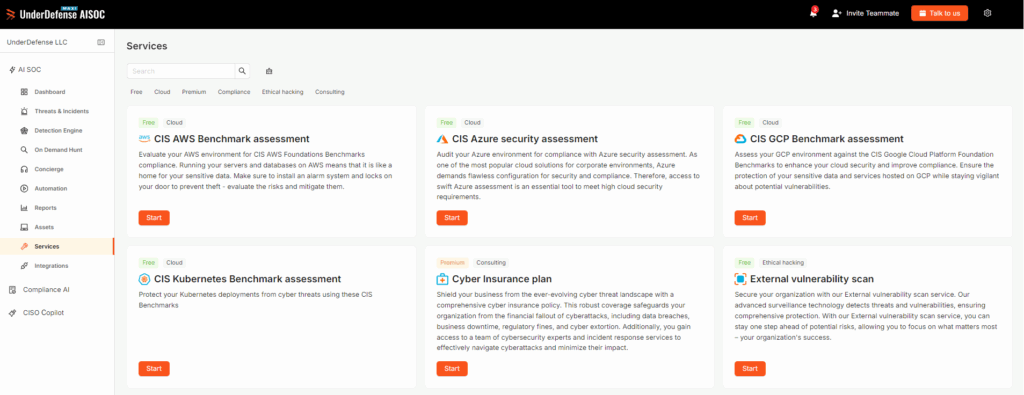
Traditional detection logic never sees those paths. UnderDefense Agentic AI SOC automates the grunt-work investigation, cuts about 99% of noise, hits a 2-minute alert-to-triage, and extends visibility into dev and AI-agent activity that endpoint-only rivals miss. AI does the digging. Our analysts own the decision, the model behind our managed detection and response service.
I could be early on the agent-monitoring timeline. But the direction is set, and being a careful human in the loop is a feature, not a flaw, in 2026.
Where this is handled: Agentic AI SOC automates the investigation grunt work, then a human analyst makes the call. If you want AI that collects context across your tools while people own the decision, explore the UnderDefense Agentic AI SOC platform.
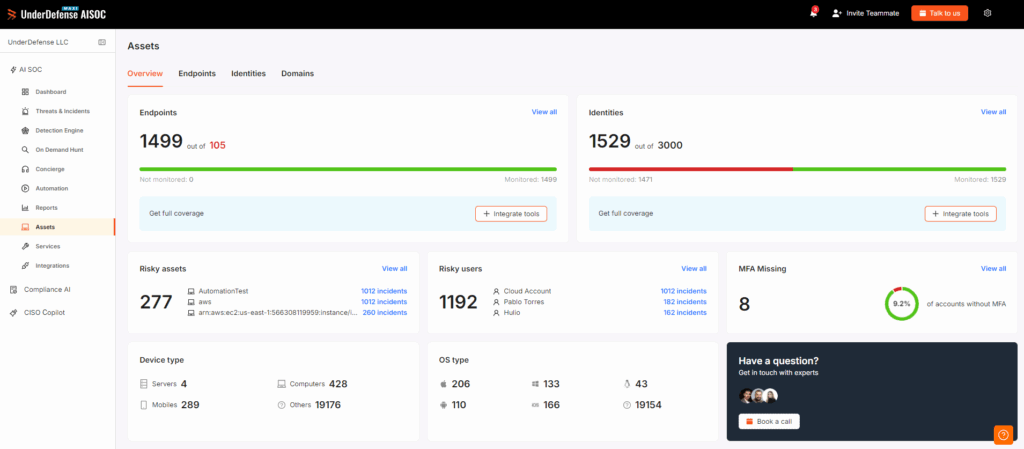
See how UnderDefense Agentic AI SOC resolves a real incident on your stack.
Q6: How Do You Choose the Right SECaaS Provider, and What Do Real Users Say?
Evaluate SECaaS on five things: vendor-agnostic SIEM integration, true response (not just alerts), transparent outcome-based pricing, hard SLAs like a 2-minute alert-to-triage, and compliance coverage (SOC 2, ISO 27001, HIPAA). Reviews confirm the stakes. Arctic Wolf users cite SIEM lock-in, ReliaQuest reviewers flag thin concierge support, and you should never let an MDR touch domain controllers without written approval.
The checklist I’d actually use
Skip the feature bingo. These are the questions that separate a partner from an alert vendor.
- Does it integrate with your existing SIEM and tools, or force a rip-and-replace?
- Does the provider respond and contain, or just forward alerts back to you?
- Is pricing published and predictable, or hidden behind “contact sales”?
- Are the SLAs hard numbers, like a 2-minute alert-to-triage and 15-minute critical escalation?
- Does it cover your frameworks (SOC 2, ISO 27001, and HIPAA)?
- Will it preserve your data ownership so business logic stays with you on a switch?
A structured MDR buyers guide can help you pressure-test each of these before you sign.
The one guardrail nobody writes down
Here’s a hard rule from the bridge calls. Never let an MDR manage your domain controllers without explicit, prior, written approval. A domain controller is the keys to the kingdom.
Put that authority limit in the contract. UnderDefense meets every item on this list, and we ask before we act, because owning outcomes means respecting your blast radius. That discipline carries into our incident response engagements too.
What real users say about lock-in
The pattern in reviews is consistent. Buyers love coverage but resent being trapped in a proprietary SIEM they can’t take with them.
“Powerful platform, but you are locked into their ecosystem and SIEM, which makes leaving painful.”
Verified User in IT Arctic Wolf G2 Verified Review
What users say about thin support
The second theme is concierge depth. Heavy automation without humans leaves tickets bouncing back unanswered.
“Lots of AI and automation, but responses often lacked the actionable insight we needed during triage.”
Verified User, Enterprise ReliaQuest G2 Verified Review
“Their analysts actually talk to our users and close the loop, not just escalate a ticket.”
Verified User in Information Technology UnderDefense G2 Verified Review
I’ll be honest about the limit here. Reviews skew toward extremes, happy or burned. Use them as signal, then test the SLA and integration claims yourself in a proof of value.
Q7: Which SECaaS Setup Fits Your Team Best in 2026?
The right SECaaS depends on your stack and team. Lean teams on Splunk or Sentinel should choose a vendor-agnostic MDR that automates investigation and adds human escalation, rather than a rip-and-replace. Healthcare and PE portfolio companies should prioritize compliance coverage and concierge response. Match dollars to value, because you don’t win cybersecurity, you stay in the fight.
Lean tech team on an existing SIEM
If you already run Splunk or Sentinel, do not throw it away. Pick an MDR that logs into your data where it lives, so your correlation rules and business logic stay yours.
That’s the low-friction, safe choice. UnderDefense works across 250+ tools and automates the investigation, then escalates edge cases to a human. You keep ownership, and you skip the painful re-tuning that a proprietary-SIEM vendor forces at renewal, a benefit we detail for MDR for Splunk environments.
Mid-market healthcare
For healthcare, compliance and response speed are the whole game. HIPAA pressure is real, and ransomware hits the sector hardest.
Prioritize a provider that bundles compliance evidence with 24/7 response, not a dashboard you babysit. We collect audit-ready evidence while our analysts contain threats, so your one IT lead isn’t carrying HIPAA alone, which is the core of our MDR for Healthcare offering.
PE portfolio companies
Private equity has a different shape: many companies, many stacks, and one risk view for the board. New acquisitions arrive with unknown security postures and hidden threats.
You need consolidated reporting and flexible engagement per company. UnderDefense already protects PE portfolios across billions in assets under management, with portfolio-wide visibility and rapid baselining for new acquisitions, backed by virtual CISO guidance.
How I’d actually decide
A quick reality check before I close. Building your own AI agent in-house sounds cheap until you price the engineering, and the difficulty is exponentially higher than it looks.
So match dollars to value, not headlines. You don’t “win” cybersecurity, it’s closer to a zombie apocalypse, you just stay in the fight with the right allies. My open question for 2027: how many teams will finally separate their SIEM ownership from their MDR partner once the agent blind spot bites?
Talk to us: Tell us what you’re defending, and we’ll map the right coverage to your stack and budget. If you want a straight answer on dollars and value for your environment, talk to our team.
See how the UnderDefense Agentic AI SOC investigates, triages, and resolves real alerts.