




Q1. What Does Abnormal Security Actually Cost Per Mailbox in 2026?
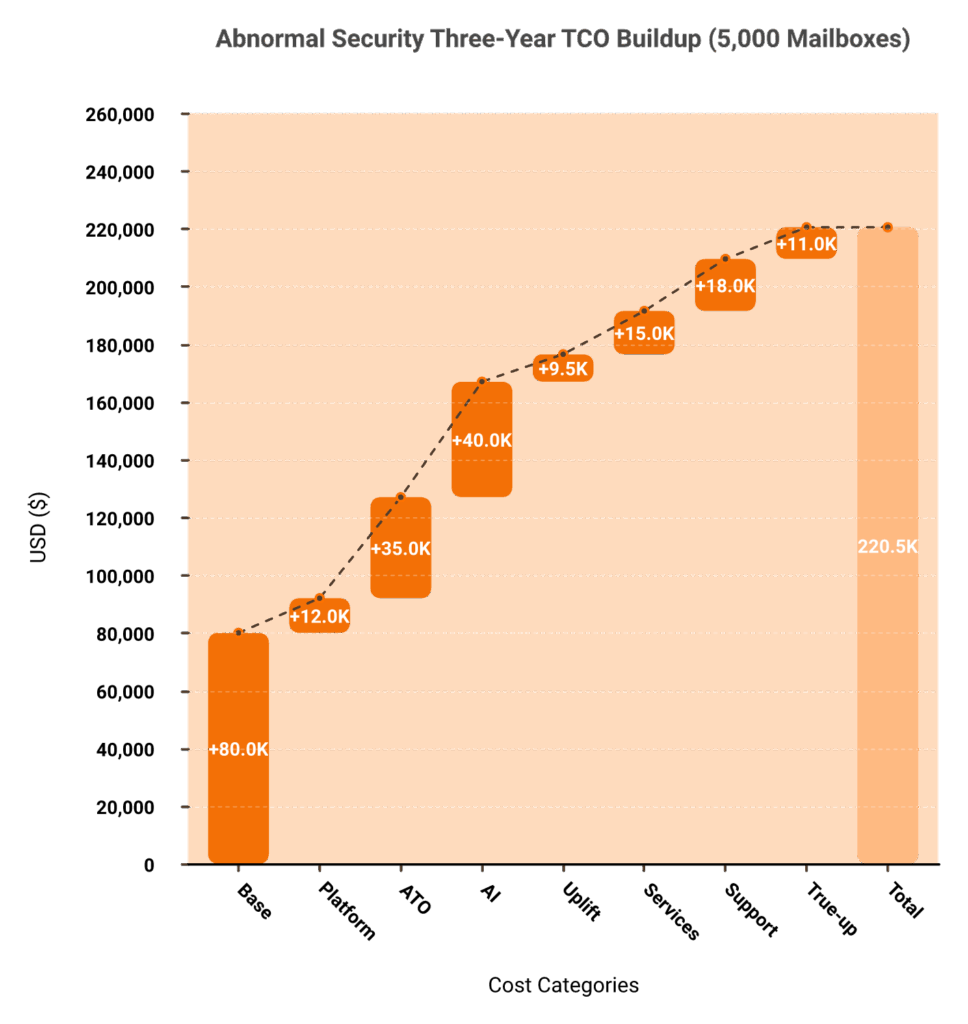
Abnormal Security is quote-only, landing roughly $20 to $35 per mailbox per year for the Inbound Email Security base, plus a flat Platform Fee of $5,000 to $15,000 that often equals half the cost of all four add-ons combined. A 5,000-mailbox enterprise typically pays $80,000 to $100,000/year on the core platform, scaling to $234,000 with full modules. Add 5% to 7% annual auto-uplift, ramped seat counts, and integration fees, and three-year TCO runs 18% to 25% above the headline math.[1]
Negotiating a renewal right now?
Talk to a team that benchmarks these deals every week.
The verified price bands buyers actually pay
I have sat through enough Abnormal disco calls to know the rep will not give you a number on call one. Vendr’s transaction data across 22 verified deals is the cleanest external anchor we have, so let me lay it on the table.[1] Compare the bands against UnderDefense’s transparent MDR pricing before you sign anything.
| Mailboxes | List $/mailbox/yr | Negotiated 50th %ile | Negotiated 25th %ile | ACV at 50th |
|---|---|---|---|---|
| 500 | $28 | $22 | $18 | $11,000 [1] |
| 1,000 | $25 | $20 | $16 | $20,000 [1] |
| 5,000 | $20 | $16 | $12 | $80,000 [1] |
| 10,000 | $18 | $14 | $10 | $140,000 [1] |
| 25,000 | $16 | $12 | $9 | $300,000 [1] |
| 50,000 | $14 | $10 | $7.50 | $500,000 [1] |
Rates above are Inbound Email Security plus the Platform Fee amortized. Add-on modules layer on top.[1] Multi-year deals shift these curves down 15% to 30%.[1]
The seven hidden line items most buyers miss
When we audit Abnormal contracts for clients, the same surprises show up. ⚠️ This is the kind of trap our MDR price guide warns about across the category.
- ✅ Platform Fee (flat): $5,000 to $15,000, organization-wide, mandatory.[1]
- ✅ Renewal uplift: 5% to 7% annual, uncapped by default.[1]
- ✅ Professional Services for SIEM/SOAR integration: $5,000 to $25,000 one-time.[1]
- ✅ True-up at then-current list (not contracted) rate when headcount grows mid-term.[1]
- ✅ Premium support tier: 10% to 15% ACV uplift if elected.[1]
- ✅ VIP Protection uplift: 10% to 20% on the Platform Fee, or per-VIP add-on.[1]
- ✅ Mid-contract module additions priced higher than at signature.[1]
How to get a real quote in 7 days
Here is the playbook I give CISOs who do not want to spend a quarter chasing a number. ⏰
- Day 1: Send your seat count, M365/Google Workspace tenant size, and a target ACV ceiling to two resellers in parallel.[1]
- Day 2: Ask each rep to confirm Platform Fee, Inbound rate, and ATO add-on rate in writing.
- Day 3: Drop the names of Mimecast, Sublime, and Microsoft Defender as active alternatives. Vendr data shows this single move drives discounts up to 40%.[1]
- Day 5: Loop in your CFO. Quota-pressured reps escalate to BAFO when finance is in the room.[1]
“The biggest win for me was getting actual control over our security alerts. Before the guys from UD stepped in, we were getting bombarded with alerts from all our security tools. Their team cleaned up our configurations and got the noise under control within the first week.”
— Verified User in Marketing and Advertising UnderDefense G2 – Verified Review
“Pricing described as premium relative to competing solutions. Buyers noted cost surprises when adding modules post-deployment.”
— Energy/Utilities buyer, 5,001-10,000 employees Abnormal Security PeerSpot Review
Time is the currency of the cloud. Every week you spend chasing a quote is a week your SOC is exposed.[1] At UnderDefense, we publish MDR service rates because our buyers asked us to stop the dance.
Q2. What Are Abnormal’s Modules and Which Ones Do Enterprises Actually Need?
Abnormal sells one base product (Inbound Email Security), plus four to five add-ons. Most enterprises only truly need Inbound plus Account Takeover Protection (ATO). Email Productivity and Email Security Posture Management overlap heavily with Microsoft 365 E5, while AI Security Mailbox duplicates SOAR playbooks you may already own. A line-by-line entitlement audit before signing typically removes 30% to 40% of proposed modules and saves $80,000 to $200,000 per 5,000 seats.[1][2]
The full module catalog, decoded
Abnormal does not publish Good/Better/Best tiers. It is a flat Platform Fee plus per-user SKUs.[1] If you want a deeper category map, our MDR buyers guide explains how email security fits the broader stack.
| Module | List $/user/yr | M365 E5 overlap | SOAR overlap | Buy or skip? |
|---|---|---|---|---|
| Inbound Email Security (base) | $20 to $35 [1] | Partial (Defender for O365 P2) | None | ✅ Buy |
| Email Account Takeover Protection (ATO) | $5 to $10 [1] | Partial (Entra ID Protection) | None | ✅ Buy |
| AI Security Mailbox (triage) | $5 to $12 [1] | Low | High (overlaps SOAR phishing playbooks) | ⚠️ Audit first |
| Email Account Compromise | $3 to $8 [1] | Partial (overlaps ATO) | Partial | ❌ Skip if ATO is in |
| Email Productivity (graymail) | $3 to $7 [1] | Yes (Outlook Focused Inbox, Clutter) | None | ❌ Skip |
| Email Security Posture Management | Often bundled [1] | High (Secure Score, Purview) | Low | ⚠️ Bundle, do not pay extra |
| VIP Protection | 10% to 20% Platform Fee uplift [1] | Partial | Low | ⚠️ Negotiate inclusion |
Run the M365 E5 entitlement audit before you sign anything
Microsoft 365 E5 already includes Defender for Office 365 Plan 2, Purview DLP, and Entra ID Protection.[2] When we run this audit for clients on MDR for Microsoft 365, we find roughly 60% of Email Productivity and Posture Management features are duplicates.
A practical 5-step audit you can run on Monday
- ✅ Pull the M365 license SKU report from the admin center.
- ✅ Open Microsoft Secure Score and export the current control list.[2]
- ✅ Map each Abnormal module from the table above to the matching E5 control.
- ✅ Score each module on “true uplift”: what does Abnormal do that Defender, Purview, or Entra cannot?
- ✅ Build a buy/skip matrix and bring it to the Abnormal disco call. Reps will not volunteer this gap. You have to surface it.
The Slack/Teams/Zoom add-on is usually a “later” purchase
Abnormal’s Email-Like Messaging Security extends behavioural detection into Slack, Teams, and Zoom. For most 5,000-seat enterprises, this is a 2027 problem, not a 2026 line item. Until then, you can do a meaningful chunk of Shadow SaaS discovery for free by auditing your Microsoft 365 or Google Workspace OAuth consent log.[2] The log shows every site where a user signed in with their corporate identity. No new SKU required.
I am not anti-Abnormal here. I am anti-paying-twice. The “AI-washing window” of 2025 to 2026 is real. Vendors are repackaging older detection logic with “AI-aware” labels at premium prices. The audit forces an honest conversation about what is genuinely new versus what is rebranded.[1][2]
Q3. Why Is Abnormal Quote-Based, and How Do You Negotiate the Platform Fee Down?
Abnormal’s pricing is opaque because the behavioural-AI graph requires per-tenant onboarding, which sales reps anchor as a flat Platform Fee of $5,000 to $15,000.[1] That fee often equals half the combined cost of all four add-ons. Eight levers consistently move the deal: Q1 fiscal close (April 30), competing Mimecast or Barracuda quote, 3-year pre-pay, Platform Fee waiver, free SKU trials, mid-contract seat-rate lock, uplift cap at 3%, and CFO involvement. Buyers using four or more secure 25% to 40% off list.[1]
What the Platform Fee actually buys
The Platform Fee covers historical email ingestion (about 14 days), behavioural baseline calibration, and tenant onboarding into Abnormal’s VendorBase graph.[1] It is not a “license to use the AI.” It is a one-time-feeling, recurring-billed setup tax. That is why the fee feels arbitrary in the quote. It is.
The 8-lever negotiation playbook
Pull these in order, and write the asks into the order form, not the email thread. ✅ For category-wide context, our analysis on why businesses switch providers documents the same patterns at renewal.
- ⏰ Time the close to Q1 fiscal year-end (April 30) or year-end (January 31). Abnormal reps have quota pressure, and management will sign off on best-and-final exceptions during these windows.[1] Expected: 5% to 10% off.
- 💰 Bring named competitive quotes. Mimecast, Barracuda, Sophos, and Fortinet. Vague “we’re talking to others” gets ignored. Specific dollar figures from competing reps create urgency.[1] Expected: up to 40% off initial quote.
- ✅ Commit to 3 years. Multi-year locks typically yield 25% to 35% lower per-employee pricing than 1-year deals.[1] Expected: 15% to 25% off.
- ✅ Ask for the Platform Fee to be waived for the first year. Smaller deployments have gotten this. Frame it as “we’ll prove the value before paying the setup tax.” Expected: $5,000 to $15,000 saved year one.
- ⭐ Voice uncertainty on AI Security Mailbox and Email Account Compromise. Reps have documented discretion to include these at no cost during the initial term.[1] Expected: $35,000 to $50,000 saved at 5,000 seats.
- ✅ Lock the mid-contract seat rate. Insert language: “Additional users added during the Subscription Term will be co-termed and priced at $X per user per year matching the initial rate.”[1] Expected: avoids 15% to 30% true-up surprise.
- ⚠️ Cap renewal uplift at 3%. Default is 5% to 7% uncapped. Vendr buyers have documented 3% to 4% caps when they anchor early.[1] Expected: $20,000+ saved on a 3-year enterprise renewal.
- ✅ Loop in your CFO before BAFO. Make signature contingent on CFO sign-off. Reps escalate.[1] Expected: unlocks the final concession round.
Co-term Abnormal with your MDR for an additional 15% to 25% leverage
When we run procurement playbooks at UnderDefense, we routinely co-term email security renewal with the MDR contract. It gives your CFO one signature line, one cost center, and one place to apply uplift caps. It also lets us pressure both vendors against each other on margin, similar to the approach we cover in the 2026 cybersecurity budget playbook.
“Add-on modules (ATO, AI Mailbox) not included in initial quote. Added mid-contract at higher per-user rates than initial deal.”
— Mid-market buyer, 500-1,000 employees Abnormal Vendr Buyer Intelligence
“We cleaned up our configurations and got the noise under control within the first week. The platform pulls in data from all our existing security tools, so we didn’t have to rip and replace anything.”
— Verified User in Marketing and Advertising UnderDefense G2 – Verified Review
Less theater, more throughput. The Platform Fee is theater. Throughput is what your SOC service actually buys. The shadow economy of procurement runs on VC-incentivized CISO recommendations and reseller margins. Treat every “standard term” as negotiable until proven otherwise.[1]
Q4. How Does Abnormal Pricing Stack Up Against Proofpoint, Mimecast, Microsoft Defender, Sublime, Check Point Harmony, and IRONSCALES?
Abnormal sits at the premium end at $20 to $35 per user per year, plus the Platform Fee.[1] Microsoft Defender for Office 365 Plan 2 is bundled in M365 E5 at effectively $0 incremental.[2] Sublime undercuts at $1.50 to $3 per user per month with open detection rules; IRONSCALES sits at $2 to $4; Proofpoint and Mimecast hold $3 to $6 SEG pricing; Check Point Harmony Email runs $3 to $5. Gartner Leader status, SOC 2, and ISO 27001 are table stakes across the field, not premium-pricing justifications on their own.[1]
Six-vendor comparison at 5,000 mailboxes, 3-year TCO
| Vendor | $/user/yr (street) | Platform/setup fee | Detection model | Response capability | Best for |
|---|---|---|---|---|---|
| UnderDefense Agentic AI SOC | Published, transparent | None | Behavioural plus cross-stack (M365, EDR, identity) | ✅ Autonomous response, plus 24/7 human analyst | Enterprises wanting detection and response in one |
| Abnormal AI (full bundle) | $35 to $60 | $5K to $15K Platform Fee | Behavioural-AI graph (per-identity) | ❌ Blocking only | High-BEC-risk M365 shops |
| Microsoft Defender for O365 P2 | $0 (in E5), or $24/yr standalone | None | Signature, heuristics, and AIR | Partial (AIR) | M365 E5 shops, budget-constrained |
| Mimecast Advanced | $36 to $60 | None | SEG plus CyberGraph | Partial | Email continuity and archiving needs |
| Proofpoint TAP/Prime | $36 to $72 | None | SEG, sandbox, and ML | Partial | Compliance-heavy enterprises |
| Sublime Security | $18 to $36 (street) | None | Open rule engine plus ML | Partial | Detection engineers wanting transparency |
| Check Point Harmony Email (Avanan) | $36 to $60 (street) | None | API-native, inline | Partial | Teams/Slack/OneDrive coverage |
| IRONSCALES | $24 to $48 (street) | None | API plus crowdsourced | Partial | Mid-market ATO-focused |
All competitor figures other than Abnormal are directional, from Vendr buyer reports and public anchors.[1] Confidence is high for Proofpoint and Mimecast, medium for Avanan and IRONSCALES, and lower for Sublime.[1]
Real Buyer Quotes Decoder
Here is the cross-source reality check most pricing pages skip. ⭐
| Source | Seat band | Reported price | Platform Fee disclosed? |
|---|---|---|---|
| Vendr transaction data | 1,000 mailboxes | $20K to $28K ACV | Yes, $5K to $10K |
| Vendr transaction data | 5,000 mailboxes | $80K to $100K ACV | Yes, $10K to $15K |
| Vendr transaction data | 25,000 mailboxes | $300K to $500K ACV | Yes, $15K |
| PeerSpot enterprise review | 5,001-10,000 emp. | “Premium pricing”, plus module surprises | No |
| G2 Abnormal AI pricing | All sizes | “High price tag” | No |
| TrustRadius/Reddit r/msp | 1,000-2,000 emp. | ~$3/user/mo street | Yes |
Scenario-based picks (because no vendor is universally right)
- Mid-market 500 seats, M365 E5, no dedicated SOC: ❌ Abnormal is premium for this size. Start with Defender for O365 P2, plus a layered MDR.[2]
- Enterprise 5,000 seats, high BEC exposure, finance, healthcare, or legal: ✅ Abnormal’s BEC depth justifies the premium if you also fund response (it does not block credential theft, only emails).[1]
- Compliance-heavy with email continuity and archiving: ✅ Mimecast or Proofpoint. Abnormal has continuity gaps.
- Detection engineers who want auditable rules: ✅ Sublime. The open-rule model fits a mature SOC.
- Teams/Slack/OneDrive primary risk: ✅ Check Point Harmony Email (Avanan). Collaboration coverage is native.
The architectural fact that determines who wins
“The dramatically reduced incident response times, thanks to Slack integration. We also noted a significant decline in potential breaches, ensuring client trust remains intact.”
— Alexander Benedychuk, CEO, RegisTeam UnderDefense G2 – Verified Review
“Abnormal Security is considered cost-efficient, offering strong ROI and pricing flexibility, making it a favorable option for organizations looking to reduce email protection costs.”
— Vendr buyer sentiment, 22 verified deals Abnormal Security on Vendr
For a deeper teardown of category dynamics, our business email compromise breakdown explains why detection alone is the most expensive line item on a 2026 security budget.
Q5. Are You Already Paying for This in Microsoft 365 E5? The Entitlement Audit Buyers Skip
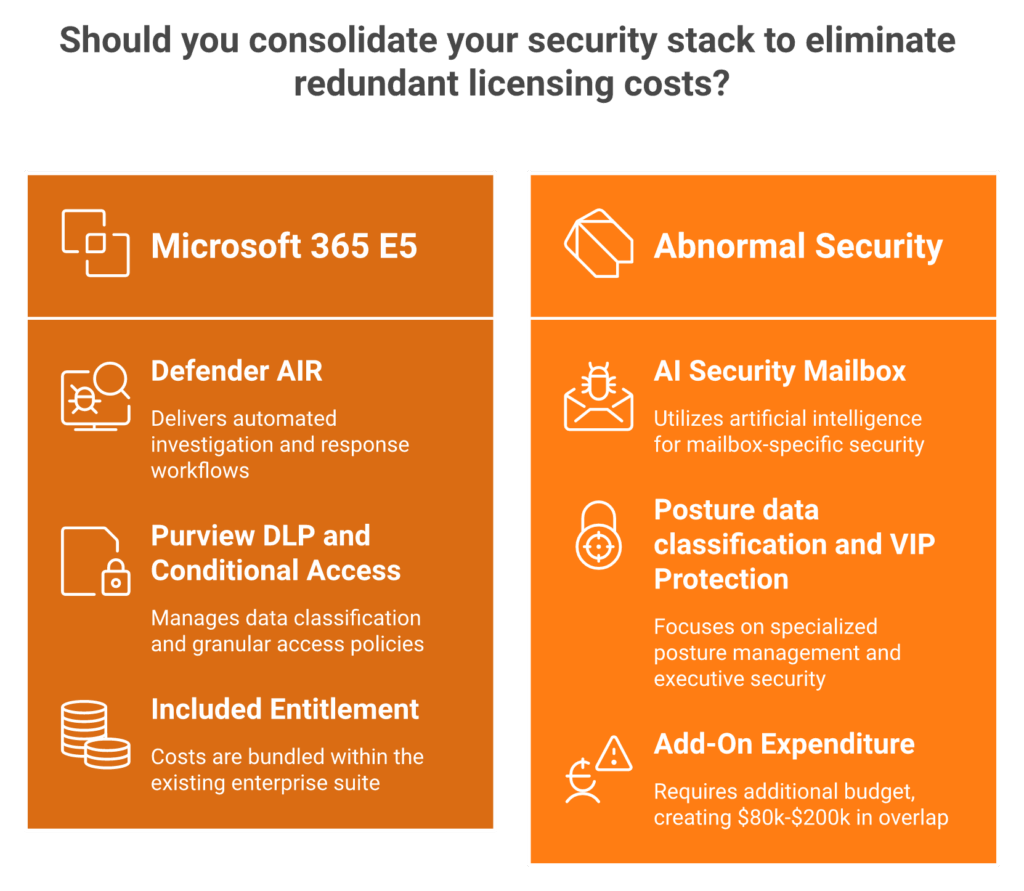
Microsoft 365 E5 already includes Defender for Office 365 Plan 2 (anti-phishing, attack simulation, Automated Investigation and Response), Purview DLP, and Entra ID Protection (sign-in risk, impossible-travel detection).[1] Roughly 60% of Abnormal’s Email Productivity and Email Security Posture Management features overlap with controls you already license. A 60-minute entitlement audit using Microsoft Secure Score and the license SKU report typically reveals $80,000 to $200,000 of avoidable spend per 5,000 seats. Spend the recovery on Respond and Recover, not duplicate Detect.
What “E5 already covers this” looks like in your tenant
When I sit with a CISO, we open three tabs: license SKUs, Secure Score, and the Defender policy console.[1] In about 20 minutes, we usually find Safe Attachments off, Safe Links scoped to a pilot group from 2022, and Entra ID Protection licensed but not feeding Conditional Access.[1] That is not Abnormal’s fault. It is the standard E5 entropy story, and we see it across every MDR for Microsoft 365 engagement we run.
The 60-minute audit, step by step ⏰
- ✅ Pull the license SKU report in the M365 admin center. Confirm E5 vs E3 vs F-series counts, and any Defender for Office 365 standalone add-ons.[1]
- ✅ Export Microsoft Secure Score recommended actions. Sort by “Not implemented.” Most enterprises score 38% to 52% on first pull.[1]
- ✅ Map each Abnormal SKU to the E5 control that overlaps. Inbound versus Defender for O365 P2 anti-phish. ATO versus Entra ID Protection sign-in risk. Productivity versus Outlook Focused Inbox plus Clutter. Posture versus Secure Score plus Purview.
- ✅ Score “true uplift” 1 to 5 per module. Inbound and ATO usually score 4 to 5. Productivity and Posture rarely above 2.
- ✅ Build the buy/skip matrix. Print it. Bring it to the next Abnormal call. Reps will not surface this gap. Our MDR buyers guide has a printable template you can repurpose.
The NIST CSF budget map your board has not seen
Allocate last fiscal year’s security spend across the six NIST CSF 2.0 functions: Govern, Identify, Protect, Detect, Respond, and Recover.[2] Almost every 5,000 to 10,000 seat enterprise I audit shows the same shape: fat Protect, fat Detect, stub Respond, and stub Recover.[2] Email gateways and Abnormal-class tools live in Protect and Detect. What stops a 2 a.m. BEC from becoming a wire transfer is the Respond stack, including credential reset, session kill, endpoint isolation, and user verification. The same gap is what our incident response retainers exist to close.
Take the recovered $80K to $200K and fund Respond. Boards are asking the response question after every breach headline. The audit gives you the one-page answer.[1][2] If you want help converting the audit into a budget line, our 2026 cybersecurity budget playbook shows the exact reallocation pattern.
Hidden fees adding up faster than expected?
Get a plain-English breakdown tailored to your environment.
Q6. What’s the Real ROI? Building a Board-Ready Business Case With DBIR, IBM CODB, and SEC 8-K Materiality
A defensible ROI model multiplies (BEC attempts per month, multiplied by historical detection-miss rate, multiplied by DBIR median BEC loss of $50,000) against (Abnormal annual cost, plus internal SOC hours saved).[3] Map every detection to MITRE ATT&CK techniques (T1566 Phishing, T1534 Internal Spearphishing, and T1078 Valid Accounts), and NIST CSF 2.0 functions for board credibility.[2][4] Frame BEC as SEC 8-K Item 1.05 material-incident risk under the new disclosure rule. That reframes the line item from “tool spend” to “disclosure-risk reduction.”[5]
The ROI formula your CFO will actually accept
Here is the formula. Plug in your own numbers.
- Annual Risk Avoided = (BEC attempts/month, multiplied by 12), multiplied by (miss rate %), multiplied by ($50K median loss).
- Net ROI = (Annual Risk Avoided, plus SOC hours saved at $85/hr), minus (Abnormal ACV, plus integration costs).
Use the Verizon DBIR median BEC loss of roughly $50,000 as the per-incident anchor.[3] Use the IBM Cost of a Data Breach Report 2025 figure of $4.88M average breach cost for the upper-bound scenario when one BEC pivots into ransomware.[6] Our business email compromise teardown explains why the upper bound is the realistic risk, not the median.
Where each input actually comes from
Boards push back on hand-wave numbers. Here is the source for every variable. ⭐
- BEC attempts per month: pull the last 12 months from your help desk or SOC ticketing system. Count user-reported phish.
- Detection-miss rate: from your existing SEG or Defender quarantine reports, calculate the percentage that reached the inbox before quarantine.
- Median BEC loss: $50,000 (Verizon DBIR 2025, financially motivated incidents).[3]
- SOC hours saved: triage time per phish, multiplied by volume. Most teams report 15 to 20 minutes per ticket pre-automation, a baseline our SOC metrics breakdown validates.
- Abnormal ACV: from the negotiated quote (use the Q1 table).
- Material-incident probability: SEC Cyber Disclosure Rule Item 1.05 requires 8-K filing within four business days of materiality determination.[5]
Worked example: 5,000-seat manufacturer
Here is a real-shape example I have walked CFOs through. 💰
- Inputs: 8 BEC attempts per month, 12% miss rate, and 5,000 seats.
- Annual risk avoided: 8, multiplied by 12, multiplied by 0.12, multiplied by $50,000, equals $576,000.[3]
- SOC hours saved: 96 phish, multiplied by 18 minutes, equals approximately 29 hours saved per month at $85/hour, equals $29,580 per year.
- Abnormal ACV (negotiated): $90,000.[7]
- Net ROI: $576,000, plus $29,580, minus $90,000, equals $515,580 annually.
The Carmeuse case is the anchor I keep coming back to. Their contract paid for itself in three months because the SOC caught a payroll-fraud scheme that traditional rules missed (no malware, just behavioural anomaly). That is the response-side ROI most pricing models ignore, and it is why our MDR service bundles response-throughput SLAs from day one.
When the ROI math kills the deal
If your BEC volume is under 3 attempts per month, or your existing Defender for O365 P2 already catches greater than 95%, the math collapses.[1] In that case, redirect the dollars. Buy response capability: an MDR with autonomous credential reset, session kill, and endpoint isolation. The Mandiant M-Trends 2025 dwell-time data is unambiguous. Detection without response just buys you a longer incident report.[8] Run the numbers again with our SOC cost calculator before you commit.
Q7. Why Is Buying Better Detection Without a Response Layer the Most Expensive Mistake of 2026?
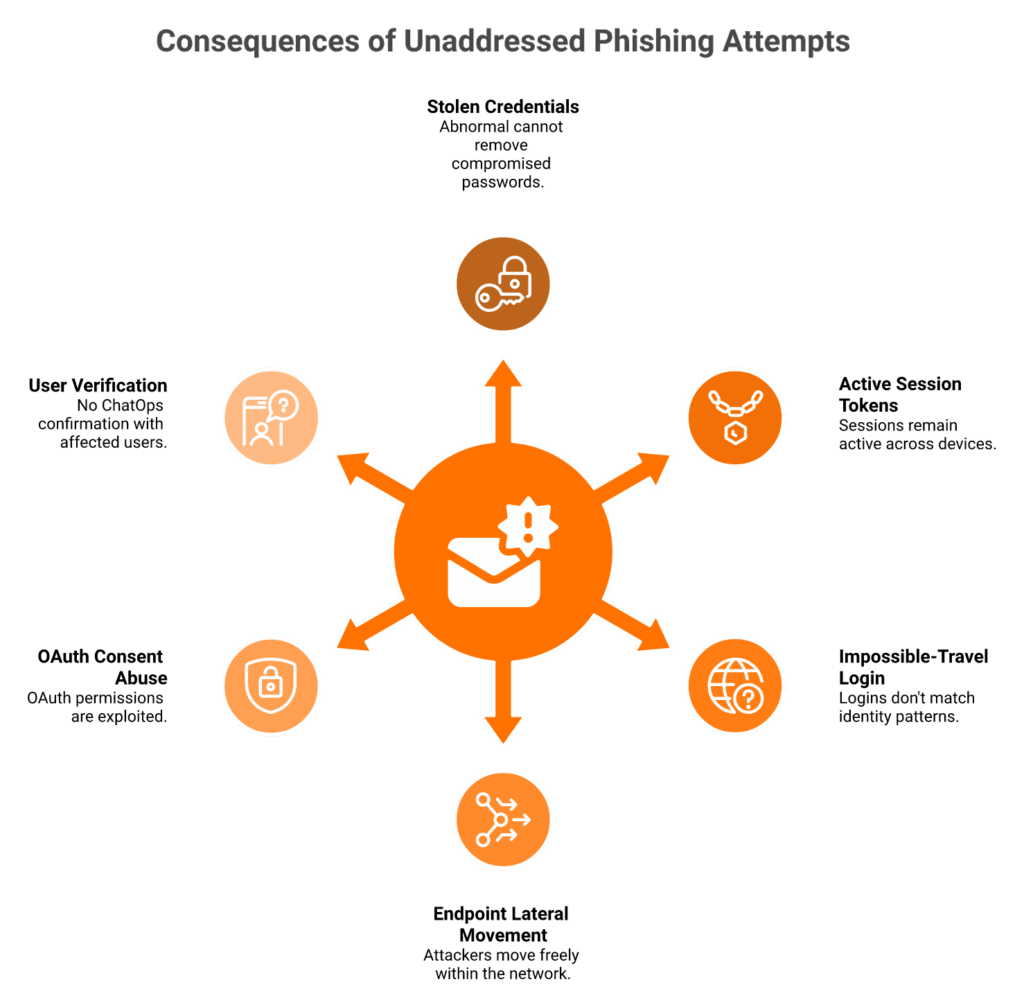
Abnormal stops malicious emails. It does not wipe stolen credentials, force user logouts, or correlate a “France-at-10:00, Canada-at-10:15” impossible-travel login with endpoint signals.[4] Once a single phish succeeds (and one always does), only an MDR with autonomous response (credential reset, session kill, and endpoint isolation) contains the blast radius. AI alone is right roughly 30% of the time on edge cases. Sole-decision-maker AI is a dice roll without human-ally validation.[8]
The M&M network problem
Most enterprise networks are M&Ms: hard exterior, soft tasty center. Abnormal hardens the shell. It does almost nothing for the center where lateral movement, OAuth abuse, and credential reuse actually cause the loss.[4] That is not a flaw in Abnormal. It is a category limitation. Buying a better email blocker without a response layer is like buying a stronger front door for a house with the back window open. That is the gap our SOC service exists to close.
What happens when the 100th phish lands
Abnormal blocks 99 out of 100 sophisticated emails. The 100th gets through. A user clicks. Credentials hit a fake Microsoft login. Within 12 minutes, the attacker logs in from a residential proxy in another country. Now what?
The MITRE ATT&CK technique you are watching is T1078 (Valid Accounts), and email tools do not see it.[4] You need cross-stack correlation: identity logs, EDR endpoint signals, and behavioural baselines together. Ho et al. at USENIX Security 2019 showed lateral phishing detection requires intra-org communication graphs, not just inbound scanning.[9] Mandiant M-Trends 2025 puts global median dwell time at 10 days when detection is not paired with response.[8] That is 10 days an attacker has your CFO’s mailbox.
Response throughput, not blocking accuracy
We rebuilt the UnderDefense Agentic AI SOC platform around response, not detection alone. The autonomous actions that actually matter at 2 a.m. are listed below. ✅
- Credential wipe and forced password reset in Entra ID or Okta.
- Session kill across all active tokens.
- Endpoint isolation via the EDR you already own (CrowdStrike, SentinelOne, or Defender for Endpoint).
- ChatOps user verification: the analyst pings the affected user in Slack or Teams to confirm intent before acting.
That is the “Human Ally” piece. AI is right about 30% of the time on context-heavy cases.[8] A high-tier analyst has to validate intent before triggering containment. Otherwise, you lock the CFO out of email during a board meeting because “the AI was confident.” This is exactly what we run with 2-minute Alert-to-Triage and 15-minute escalation for critical incidents, the two distinct SLAs that “MTTR” (Mean Time to Respond) usually conflates.
Silence is not safety
If your email tool passes a pen test quietly, that is not a win. It usually means the tool missed the lateral movement that happens after one successful login. Pen testers I respect tell me the loud finding is the easy one. The silent finding is the bill, a dynamic our penetration testing team documents on every engagement.
“Not having to worry about ransomware, alert overload and reporting. Getting a clear view of my security posture, where the threats are coming from and how they are handled. They literally took care of all our problems.”
— Arlin O., Enterprise CIO UnderDefense G2 – Verified Review
“The dramatically reduced incident response times, thanks to Slack integration. We’ve tackled potential threats directly from our Slack channels, regardless of the hour.”
— Alexander B., CEO UnderDefense G2 – Verified Review
Less black box, more blue team. That is the sentence I keep coming back to when CISOs ask why we built the UnderDefense Agentic AI SOC platform the way we did.
Q8. What Operational Risks, Sovereignty Constraints, and AI-Agent Governance Gaps Does Abnormal Leave on Your Plate?
Aggressive AI-blocking creates a quarantine-release backlog that crushes help desks. Users eventually bypass it, raising risk.[7] Abnormal is cloud-mandatory, so GDPR Article 33 reporters and EU NIS2 essential entities lose data-residency control.[10][11] Banning Copilot or ChatGPT through the gateway pushes Shadow AI onto personal devices. The realistic answer is monitoring agent behaviour, not blocking the tool.[12] These are operational debts a blocking-only purchase silently transfers to your team. ⚠️
The release-button mess (and what it costs you in tickets)
Set Abnormal (or any aggressive AI tool) to “max sensitivity,” and quarantine volume jumps. I have seen one 3,000-seat client log 220 release tickets a week after a policy tightening. ⚠️ At 8 minutes per ticket, that is 29 hours of help-desk time gone. Multiply by 50 weeks, and the “free” detection upgrade costs you a full-time person.
What breaks operationally:
- Sales reps miss customer replies and escalate to managers.
- IT loosens the policy mid-quarter to stop the noise.
- Users learn to forward business email to personal Gmail. Now your DLP is blind.
- The CISO inherits a tuning treadmill. One client of ours was still tuning their legacy email tool four years in.
Sovereignty: GDPR Article 33 and NIS2 reporters need a residency answer
Abnormal is API-native and cloud-mandatory.[7] For European enterprises, that creates two specific compliance issues:
- ✅ GDPR Article 33 requires breach notification to the supervisory authority within 72 hours.[10] Email metadata processed outside your jurisdiction complicates the data-controller chain and the timeline.
- ✅ EU NIS2 Directive (2022/2555) raises incident-reporting and supply-chain obligations for essential and important entities, with a 24-hour early warning.[11] Where your telemetry sits matters for both reporting speed and lawful basis.
We architected the UnderDefense Agentic AI SOC integrations layer to run on-prem, hybrid, or sovereign cloud. That is a deal-breaker conversation for regulated EMEA enterprises that no Abnormal RFP response addresses.[10][11] Our compliance services team handles the supervisory authority side directly.
AI agent governance: the next 18 months of your job
Microsoft Copilot, Google Gemini, custom LangChain agents, and MCP (Model Context Protocol) servers are landing in production faster than security teams can write policy. MITRE ATLAS is the closest standard for adversarial AI behaviour today, and NIST AI RMF gives you the governance scaffold.[12][13] Neither is something Abnormal addresses. For a deeper take, our MDR for AI service was built specifically for this category gap.
What to do on Monday:
- ✅ Inventory every Copilot, Gemini, and custom agent licensed in your tenant.
- ✅ Audit OAuth consent logs for agent identities (free Shadow AI discovery).
- ✅ Log what agents read, what they write, and which user identities they impersonate.
- ❌ Do not ban Copilot at the gateway. Shadow AI on personal phones is worse than monitored Copilot on managed devices.
Recursive security: identity is the keys to the city
The Cozy Bear and SolarWinds intrusions taught the industry one durable lesson: when identity providers (M365, Google Workspace, or Okta) are bypassed, every downstream tool inherits the breach.[14] An email gateway that trusts a compromised identity becomes part of the attack surface, not a control.[14] The fix is behavioural SOC monitoring of the identity layer itself, including sign-in anomaly, OAuth consent grants, token refresh patterns, and MFA fatigue.
“Pricing described as premium relative to competing solutions. Buyers noted cost surprises when adding modules post-deployment.”
— Energy/Utilities buyer, 5,001-10,000 employees Abnormal Security PeerSpot Review
“We needed round-the-clock monitoring for compliance reasons, but building our own SOC wasn’t realistic with our budget and the current hiring market. UnderDefense fills that gap without us having to hire a full team.”
— Verified User in Marketing and Advertising UnderDefense G2 – Verified Review
Q9. How Does UnderDefense Agentic AI SOC Replace the Abnormal-Only Strategy With AI SOC + Human Ally, and What’s the 30-Day Path?
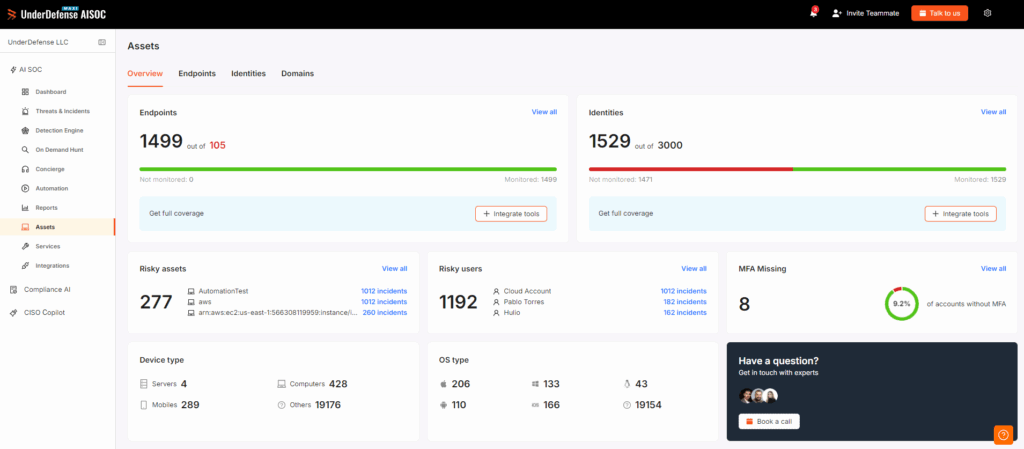
UnderDefense Agentic AI SOC replaces the 7-console problem with a unified AI SOC layer that sits on top of M365/Google Workspace, EDR, and identity logs, adding autonomous response (credential reset, session kill, and endpoint isolation) on top of detection. Onboarding finishes in 30 days, not quarters. Week 1, entitlement audit and Abnormal scope reduction. Week 2, integration. Week 3, response playbook tuning. Week 4, handoff to 24/7 concierge analysts with published pricing.
Vendor-agnostic, BYO-stack, no rip-and-replace
The first thing we tell every prospect is simple. Keep your stack. We integrate with what you already own: M365 or Google Workspace, your EDR (CrowdStrike, SentinelOne, or Defender for Endpoint), Okta or Entra ID, and your SIEM if you have one.[15] No proprietary console. No 7-console problem. UnderDefense Agentic AI SOC is a resolution platform, not a blocking tool. While Abnormal stops the email, our platform performs autonomous response actions if a credential is compromised via a sophisticated BEC attack. The architecture and the integration list are both documented on our public UnderDefense Agentic AI SOC integrations page.
Less theater, more throughput
Concierge analysts take quarantine triage off your help desk. The release-button mess from Q8 stops being your team’s problem. Our analysts triage, validate intent in Slack or Teams via ChatOps, and act. We publish transparent rates at $11 to $15 per endpoint per month on the MDR pricing page. No quote-only dance. No Platform Fee surprise. Compare the unit economics with our SOC cost calculator in three minutes. We run with 2-minute Alert-to-Triage and 15-minute escalation for critical incidents, the two distinct SLAs that “MTTR” (Mean Time to Respond) usually conflates.
The 4-week onboarding playbook ⏰
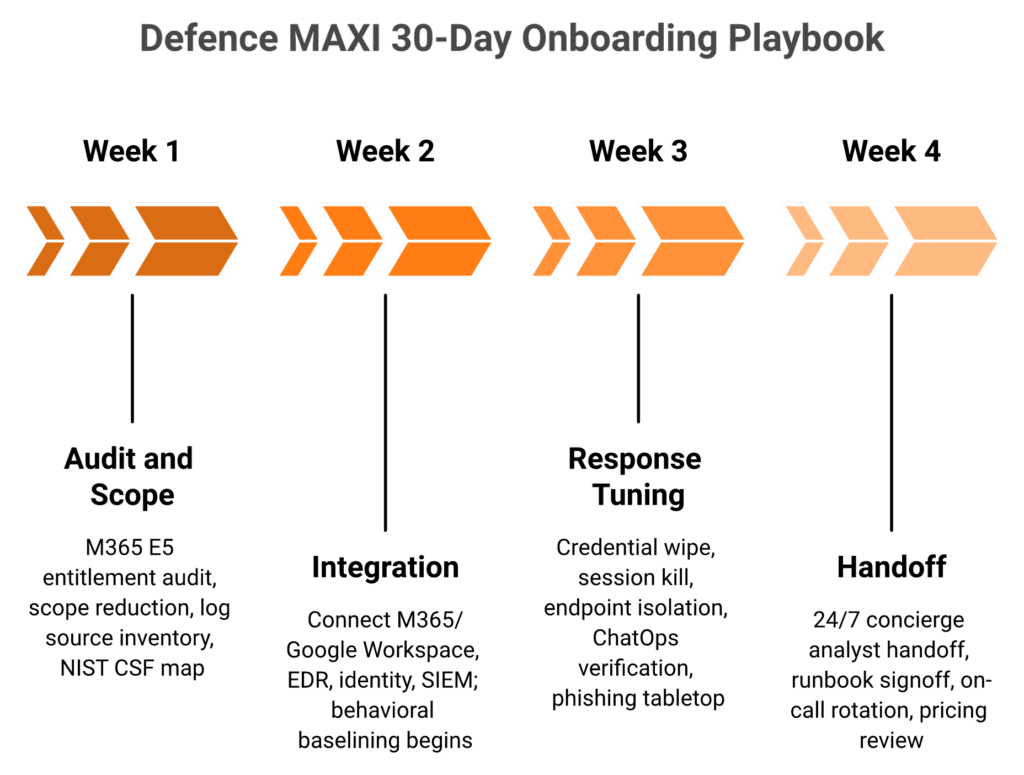
| Week | Activities | Outcomes |
|---|---|---|
| Week 1 | M365 E5 entitlement audit, Abnormal scope reduction, log source inventory. | $80K to $200K avoidable spend identified, baseline NIST CSF map. |
| Week 2 | M365/Google, EDR, identity, and SIEM integrations, behavioural baselining begins. | Cross-stack telemetry live, no proprietary console required. |
| Week 3 | Response playbook tuning: credential wipe, session kill, endpoint isolation, and ChatOps verification. | Tabletop run on lateral phishing and ATO scenarios. |
| Week 4 | Handoff to 24/7 concierge analysts, runbook signoff, on-call rotation joined. | Live coverage, transparent published pricing, and quarterly business review scheduled. |
Proof: customer outcomes that did not require a quarter to land
The Carmeuse contract paid for itself within three months. Their SOC caught a payroll-fraud scheme that traditional rules missed because there was no malware, just a behavioural anomaly the UnderDefense Agentic AI SOC platform flagged.[15] The full story sits in our German healthcare MDR case and the 9-minute MDR response case. These are not 18-month rollouts. They are 30-day handoffs.
“What I appreciate most is the high level of expertise and dedication shown by the UnderDefense team. They consistently provide thorough threat detection, prompt incident response, and clear, actionable insights.”
— Verified User, IT Security UnderDefense G2 – Verified Review
“The platform pulls in data from all our existing security tools, so we didn’t have to rip and replace anything. We needed round-the-clock monitoring for compliance reasons.”
— Verified User in Marketing and Advertising UnderDefense G2 – Verified Review
If you want a deeper category teardown before committing, our guide to MDR services walks the architecture choices in detail.
Q10. Get a Transparent Price in 7 Days, Bridge to Your Next Step
If you are decoding Abnormal’s quote in the next 7 days, three Under Defence resources cut weeks off the evaluation: the MDR pricing page (transparent published rates at $11 to $15 per endpoint per month), the SOC cost calculator (model in-house vs outsourced TCO in 3 minutes), and MDR for Microsoft 365 (the entitlement-aware path that avoids E5 double-pay). Together, they replace the gated-quote dance with numbers your CFO can model on the same call.
Send us your seat count, your renewal date, your existing EDR and SIEM, and what you are already paying for email security. We will tell you what to keep, what to cut, and what to consolidate. No demo theater. No discovery-call labyrinth. Just a working session with a senior analyst who has run this playbook for 500+ enterprises. If you want the broader category map first, start with our MDR buyers guide or the 2026 cybersecurity budget playbook, then contact us when the numbers are ready.
Turn these benchmarks into a real plan.
Get a vendor-neutral assessment and a cost-optimized roadmap.
Research Papers
- Ho, Grant, et al. “Detecting and Characterizing Lateral Phishing at Scale.” USENIX Security Symposium, 2019.
Official Docs / Indian Statutes
- Microsoft. “Microsoft 365 E5 Security Documentation, Defender for Office 365 P2, Entra ID Protection, Purview DLP, and Microsoft Secure Score.” Published: 2025.
- NIST. “Cybersecurity Framework (CSF) 2.0.” Published: February 2024.
- MITRE. “ATT&CK Techniques T1566 (Phishing), T1534 (Internal Spearphishing), T1078 (Valid Accounts).” Published: 2025.
- U.S. Securities and Exchange Commission. “Cybersecurity Risk Management, Strategy, Governance, and Incident Disclosure (Item 1.05, Form 8-K).” Published: July 2023.
- European Union. “General Data Protection Regulation (GDPR), Article 33: Notification of a personal data breach.” Published: 2016.
- European Union. “Directive (EU) 2022/2555 (NIS2 Directive).” Published: December 2022.
- MITRE. “ATLAS (Adversarial Threat Landscape for Artificial-Intelligence Systems).” Published: 2024.
- NIST. “AI Risk Management Framework (AI RMF 1.0).” Published: January 2023.
- CISA. “Advisory AA20-352A and follow-on guidance on SolarWinds/SUNBURST.” Published: 2020 to 2024.
Datasets
- Verizon. “2025 Data Breach Investigations Report (DBIR),” 2025.
- IBM Security. “Cost of a Data Breach Report 2025,” 2025.
- Vendr. “Abnormal Security Marketplace and Negotiation Insights (22 verified transactions),” 2024 to 2025.
- Mandiant. “M-Trends 2025,” 2025.
- Gartner. “Market Guide for Managed Detection and Response Services,” 2025.
Blogs
- UnderDefense. “Managed Detection and Response Pricing, SOC Cost Calculator, and MDR for Microsoft 365.” Published: 2026. [Secondary source]
- PeerSpot. “Abnormal Security Reviews.” Published: 2025. [Secondary source]
- G2. “Abnormal AI Pricing.” Published: 2025. [Secondary source]
- TrustRadius. “Abnormal Security Pricing.” Published: 2025. [Secondary source]
1. How much does Abnormal Security actually cost per mailbox in 2026?
We see Abnormal land at $20 to $35 per mailbox per year for Inbound Email Security at list, with negotiated rates of $14 to $22 per mailbox depending on seat band. On top of the per-user fee sits a flat Platform Fee of $5,000 to $15,000, which is mandatory and organization-wide. Typical ACVs we have audited:
-
1,000 mailboxes: $20,000 to $28,000
-
5,000 mailboxes: $80,000 to $100,000
-
25,000 mailboxes: $300,000 to $500,000
Add-on modules layer on top, and a 5% to 7% annual auto-uplift compounds the bill. Three-year TCO usually runs 18% to 25% above the headline math once true-ups, integration fees, and premium support are included. We publish our own rates on the MDR pricing page so buyers can do apples-to-apples math without a discovery call.
2. Why is Abnormal Security quote-only, and how do we negotiate it down?
Abnormal is quote-only because the behavioural-AI graph requires per-tenant onboarding, which sales reps anchor as the Platform Fee. We have seen eight levers consistently move the deal:
-
Time the close to fiscal Q1 (April 30) or year-end (January 31).
-
Bring named competitive quotes from Mimecast, Sublime, or Defender.
-
Commit to a 3-year term for 25% to 35% lower per-user pricing.
-
Ask the Platform Fee to be waived for Year 1.
-
Negotiate AI Security Mailbox and EAC add-ons in at no cost.
-
Lock the mid-contract seat rate to avoid true-up shock.
-
Cap renewal uplift at 3% (default is 5% to 7% uncapped).
-
Loop the CFO in before BAFO to unlock the final concession round.
Buyers who pull four or more secure 25% to 40% off list. Co-term Abnormal with your MDR contract for additional leverage, a play we walk through in our 2026 cybersecurity budget playbook.
3. Which Abnormal modules do enterprises actually need versus skip?
Most enterprises only truly need Inbound Email Security plus Account Takeover Protection. Email Productivity (graymail) and Email Security Posture Management overlap heavily with Microsoft 365 E5 already-licensed controls. Our buy/skip read:
-
Buy: Inbound Email Security, Account Takeover Protection.
-
Audit first: AI Security Mailbox (overlaps SOAR phishing playbooks), VIP Protection (negotiate inclusion).
-
Skip if ATO is in: Email Account Compromise.
-
Skip outright: Email Productivity, Posture Management as a paid add-on.
Run a Microsoft Secure Score export and map each Abnormal SKU to the matching Defender for O365 P2, Entra ID Protection, or Purview control. We typically find 30% to 40% of proposed modules are duplicates, saving $80,000 to $200,000 per 5,000 seats. Our MDR for Microsoft 365 team runs this audit as a free first step.
4. How does Abnormal compare with Defender for O365, Mimecast, and Sublime?
Abnormal sits at the premium end at $20 to $35 per user per year plus the Platform Fee. Microsoft Defender for O365 Plan 2 is bundled in M365 E5 at effectively $0 incremental, Sublime undercuts at roughly $1.50 to $3 per user per month, and Mimecast or Proofpoint hold $3 to $6 SEG pricing. Quick scenario picks:
-
Mid-market 500 seats on E5: start with Defender for O365 P2 plus a layered MDR.
-
Enterprise 5,000 seats with high BEC exposure: Abnormal plus a response layer.
-
Compliance-heavy with email continuity needs: Mimecast or Proofpoint.
-
Detection engineers wanting auditable rules: Sublime.
-
Teams/Slack/OneDrive primary risk: Check Point Harmony Email.
None of these tools wipe stolen credentials, force user logouts, or correlate impossible-travel logins with endpoint signals. That is the response gap our MDR service closes by design.
5. Are we already paying for Abnormal capabilities in Microsoft 365 E5?
Often, yes. M365 E5 already includes Defender for Office 365 Plan 2 (anti-phishing, attack simulation, AIR), Purview DLP, and Entra ID Protection. Roughly 60% of Abnormal’s Email Productivity and Posture Management features overlap with controls you already license. Our 60-minute audit:
-
Pull the M365 license SKU report.
-
Export Microsoft Secure Score recommended actions.
-
Map each Abnormal SKU to the matching E5 control.
-
Score “true uplift” 1 to 5 per module.
-
Build a buy/skip matrix before the next Abnormal call.
Most teams recover $80,000 to $200,000 per 5,000 seats and redirect it to the response layer. We document the playbook inside our MDR buyers guide.
6. What's the real ROI of Abnormal Security, and how do we present it to the board?
We use a defensible formula: Annual Risk Avoided = (BEC attempts/month × 12) × miss rate % × $50K median DBIR loss.
Net ROI = (Annual Risk Avoided + SOC hours saved at $85/hr), minus (Abnormal ACV + integration costs). For a 5,000-seat manufacturer with 8 BEC attempts per month and a 12% miss rate, the annual risk avoided is roughly $576,000. Subtract a negotiated $90,000 ACV, and net ROI lands near $515,000. Map every detection to MITRE ATT&CK techniques (T1566, T1534, T1078) and NIST CSF 2.0 functions for board credibility. Frame BEC as SEC 8-K Item 1.05 material-incident risk. Run the unit economics through our SOC cost calculator before signing.
7. What does Abnormal Security not do, and why is that a problem?
Abnormal blocks malicious emails. It does not wipe stolen credentials, force user logouts, or correlate an impossible-travel login (France at 10:00, Canada at 10:15) with endpoint signals. Once the 100th sophisticated phish lands (and one always does), only an MDR with autonomous response contains the blast radius. The response actions that matter at 2 a.m.:
-
Credential wipe and forced password reset in Entra ID or Okta.
-
Session kill across active tokens.
-
Endpoint isolation via your existing EDR.
-
ChatOps user verification before containment.
Mandiant M-Trends 2025 puts global median dwell time at 10 days when detection is not paired with response. Detection alone just buys a longer incident report. We built our SOC service around response throughput, not blocking accuracy.
8. How do we replace an Abnormal-only strategy with a broader MDR in 30 days?
Our 4-week playbook:
-
Week 1: M365 E5 entitlement audit, Abnormal scope reduction, log source inventory.
-
Week 2: Integrate M365/Google, EDR, identity, and SIEM. Behavioural baselining begins.
-
Week 3: Tune response playbooks (credential wipe, session kill, endpoint isolation, ChatOps verification). Run a tabletop exercise.
-
Week 4: Handoff to 24/7 concierge analysts with published pricing. Quarterly business review scheduled.
This is BYO-stack. No rip-and-replace, no proprietary console, no 7-console problem. The Carmeuse contract paid for itself in three months when we caught a payroll-fraud scheme that traditional rules missed. See the full architecture on the Under Defence MAXI WarRoom platform page.