







Q1. What Is a Data Protection Impact Assessment (DPIA), and How Does It Differ from a PIA?
A Data Protection Impact Assessment (DPIA) is a structured process required under GDPR Article 35 whenever data processing is likely to result in a high risk to individuals’ rights and freedoms. It functions as a “data protection by design and by default” mechanism. Recital 84 frames it as a proactive accountability tool that helps controllers evaluate the impact of processing operations before they begin. In practice, a DPIA forces you to sit down, map out what you’re about to do with personal data, and honestly assess whether the risks are acceptable.
⚠️ DPIA vs. PIA: Clearing Up the Confusion
One of the most common mix-ups in compliance conversations is treating a DPIA and a Privacy Impact Assessment (PIA) as interchangeable. They’re not. A PIA is a broader, often voluntary best-practice tool used across many privacy frameworks and jurisdictions. A DPIA, by contrast, is legally mandated under GDPR when high-risk processing is involved, carries specific minimum content requirements under Article 35(7), and can trigger regulatory consequences if skipped.
| Aspect | DPIA | PIA |
|---|---|---|
| Legal Basis | Mandatory under GDPR Art. 35 for high-risk processing | Voluntary best practice; may be required by some non-GDPR regulations |
| Scope | Specific to GDPR; focuses on data subjects’ rights and freedoms | Broader; adaptable to various frameworks and jurisdictions |
| Documentation | Must contain 4 minimum components per Art. 35(7) | Flexible format determined by the organization |
| DPO Involvement | Must consult DPO under Art. 35(2) | Varies by organizational practice |
| Non-Compliance | Violates GDPR: fines up to €10M or 2% annual turnover | Poor practice, but typically no direct penalty |
| Regulatory Oversight | May require submission to supervisory authority | Generally internal only |
A DPIA is also not a one-time audit, not a security assessment alone, and not a data mapping exercise, though it uses data mapping as an input.
✅ Why DPIAs Matter Beyond the Checkbox
Here’s the operational reality: a well-executed DPIA does far more than satisfy a regulator.
- Surfaces risks before processing begins, enabling a proactive vs. reactive posture.
- Demonstrates accountability to supervisory authorities during investigations. GDPR enforcement has now exceeded €5.65 billion in cumulative fines, and failure to conduct DPIAs falls under Article 83(4) penalty provisions.
- Serves as audit-ready documentation proving governance maturity to customers, partners, and investors.
- Builds trust with stakeholders who increasingly demand privacy governance evidence, especially PE operating partners running due diligence.
- Reduces breach impact by identifying and mitigating vulnerabilities at the design stage, not after the damage is done.
How UnderDefense Operationalizes DPIAs
At UnderDefense, we help organizations move DPIAs from compliance documents to operational security inputs. Identified risks get translated into monitored security controls, detection rules, and incident response playbooks through our unified UnderDefense MAXI platform, so the mitigation measures you document in a DPIA actually run in production, not just on paper. Our forever-free compliance kits give teams the templates and workflows to get started without adding another line item to the budget.
Q2. What Are the Legal Foundations, Required Components, and Key Stakeholders of a DPIA?
If you’re going to conduct a DPIA, you need to know exactly what the law demands, not a summary of a summary, but the actual requirements. Ambiguity here is what gets organizations fined.
📝 GDPR Article 35: The Core Obligation
Article 35(1) establishes the general rule: where processing, especially using new technologies, is likely to result in a high risk to individuals’ rights and freedoms, the controller must carry out a DPIA before the processing begins. Article 35(3) lists three mandatory trigger scenarios (detailed in Q3). Article 35(2) requires that the Data Protection Officer be consulted wherever one has been designated.
The most operationally critical provision is Article 35(7), which prescribes the four minimum contents every DPIA must include:
- Systematic description of processing operations and purposes, including legitimate interest where applicable.
- Assessment of necessity and proportionality of the processing in relation to the purposes.
- Assessment of risks to the rights and freedoms of data subjects.
- Measures to address risks, including safeguards, security measures, and mechanisms to ensure the protection of personal data.
Skip any one of these, and your DPIA is technically incomplete under the regulation.
Recitals 84 and 90: The Interpretive Framework
Recital 84 frames the DPIA as a mechanism to evaluate risk “in particular from new technologies” and states the outcome must help determine appropriate measures. Recital 90 goes further, specifying that DPIAs should cover the envisaged processing, its necessity and proportionality, and include an assessment of the origin, nature, and severity of risk.
The Article 29 Working Party (now the EDPB) issued guidelines WP248 rev.01, which established the nine criteria for identifying high-risk processing and the practical “two or more criteria = DPIA required” rule. This guidance remains the authoritative reference supervisory authorities use to evaluate whether organizations correctly triggered (or failed to trigger) a DPIA.
👥 Stakeholder Responsibility Matrix
A DPIA is not a one-person task. Here’s who owns what:
| Stakeholder | Responsibility |
|---|---|
| Data Controller | Legally responsible; must conduct or commission the DPIA; makes the final processing decision |
| Data Protection Officer | Must be consulted (Art. 35(2)); advises on methodology and monitors the process; documents involvement |
| Data Processors | Provide technical information about processing operations; support risk identification |
| IT Security Team | Assess technical risks; recommend and implement mitigation measures; verify controls are effective |
| Legal Counsel | Assess legal basis, proportionality, and regulatory implications across jurisdictions |
| Project Managers | Integrate DPIA requirements into project timelines and sign-off gates |
The DPO advises, but the controller decides. That distinction matters when residual risk remains high and prior consultation with the supervisory authority under Article 36 becomes necessary.
How UnderDefense Supports DPIA Stakeholders
Our security operations team regularly functions as the IT security stakeholder in DPIA processes, providing threat landscape intelligence, control implementation verification, and continuous monitoring expertise that strengthens the technical risk assessment and mitigation sections of DPIAs.
Q3. When Is a DPIA Required, and When Is It Not?
Getting the trigger analysis right is where most organizations either over-invest (running DPIAs for everything) or dangerously under-invest (skipping them when they’re mandatory). Neither approach is sustainable.
⚠️ Three Mandatory Triggers Under Article 35(3)
GDPR Article 35(3) lists three scenarios where a DPIA is always required, with no judgment call needed:
- Systematic and extensive evaluation of personal aspects based on automated processing, including profiling, producing legal or similarly significant effects. Example: Credit scoring algorithms that auto-reject loan applications; algorithmic hiring tools that screen candidates without human review.
- Large-scale processing of special categories of data (Art. 9(1)) or criminal conviction data (Art. 10). Example: A hospital network processing millions of patient health records; a background-check platform handling criminal history across thousands of applicants.
- Systematic monitoring of a publicly accessible area on a large scale. Example: City-wide CCTV surveillance with facial recognition; Wi-Fi tracking systems deployed across public transport networks.
The EDPB’s 9 High-Risk Criteria
Beyond Article 35(3), the EDPB’s WP248 rev.01 guidelines established nine criteria for identifying high-risk processing:
- Evaluation or scoring
- Automated decision-making with legal or similarly significant effect
- Systematic monitoring
- Sensitive data or data of a highly personal nature
- Data processed on a large scale
- Matching or combining datasets
- Data concerning vulnerable data subjects (children, employees, patients, elderly)
- Innovative use or applying new technological or organizational solutions (including AI)
- Processing that prevents data subjects from exercising a right or using a service or contract
The practical rule: if your processing meets two or more of these criteria, a DPIA is required. Expanded triggers include biometric identification systems, children’s educational platforms, employee location tracking, and criminal background check processing.
✅ When a DPIA Is NOT Required
Exemptions and edge cases exist, and documenting your screening decision matters even when the answer is “no DPIA needed”:
- Processing does not meet any high-risk criteria or mandatory triggers.
- Processing appears on the national supervisory authority whitelist of exempted activities.
- A very similar DPIA has already been conducted for comparable processing (Art. 35(1) allows reference to prior DPIAs).
- Processing was already underway before May 2018 with no significant changes.
National blacklists (mandatory DPIA lists) from the ICO (UK), CNIL (France), and other DPAs add jurisdiction-specific triggers. Always check your relevant supervisory authority’s published list.
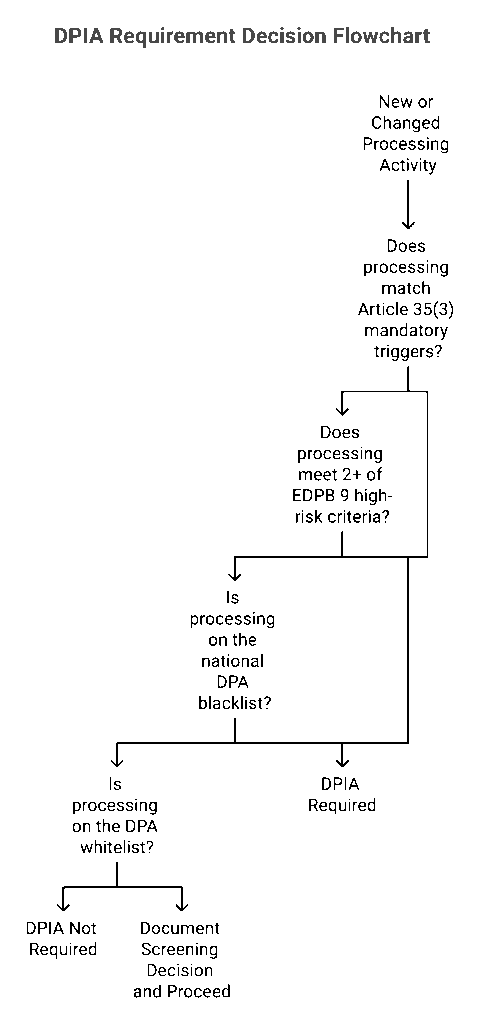
💡 Decision Flowchart Logic
Does processing match Art. 35(3) triggers? → ✅ DPIA required. If no → Check EDPB 9 criteria (2+ met?) → ✅ DPIA required. If no → Check national blacklist → If listed, ✅ DPIA required. If not → Check whitelist → If listed, ❌ DPIA not required. Otherwise → Document screening decision and proceed.
How UnderDefense Identifies DPIA Triggers
We help organizations identify DPIA-triggering processing activities through continuous security monitoring and data flow visibility across their technology stack, ensuring no high-risk processing launches without proper assessment. Our UnderDefense MAXI platform surfaces changes in data flows and processing patterns that should trigger reassessment.
Q4. How Do You Conduct a DPIA? The Complete Step-by-Step Process
Theory is one thing. Execution is where most DPIAs either become useful operational documents or dusty compliance artifacts nobody reads. Here’s the full process, structured so a CISO or GRC lead can turn it into a standard operating procedure.
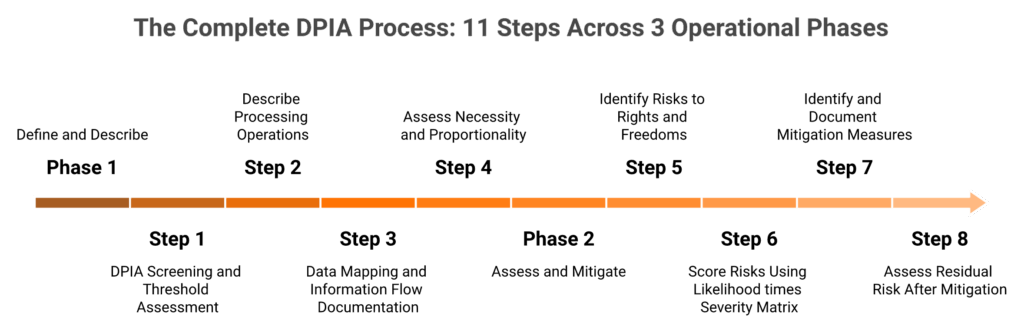
Steps 1–4: Define, Describe, Map, and Assess Proportionality
Step 1: DPIA Screening and Threshold Assessment. Use the trigger analysis from Q3 to determine whether a DPIA is required. Document the screening decision even if no DPIA is needed, as regulators expect to see that you evaluated the question.
Step 2: Describe the Processing Operations. Document the nature, scope, context, and purpose. Identify the legal basis under Article 6, specify data categories, data subjects, recipients, and retention periods. Be specific, because vague descriptions are the first thing auditors flag.
Step 3: Data Mapping and Information Flow Documentation. Create a visual data flow diagram showing how personal data moves through systems, across borders, and between processors. Identify every data touchpoint, storage location, and transfer mechanism. This is especially critical for SaaS and cloud-based processing where data traverses multi-tenant infrastructure and multiple jurisdictions.
Step 4: Assess Necessity and Proportionality. Evaluate whether the processing is necessary for its stated purpose. Document whether less intrusive alternatives were considered and why they were rejected or adopted. This directly maps to Article 35(7)(b).
Steps 5–8: Risk Identification, Scoring, and Mitigation
Step 5: Identify Risks to Rights and Freedoms. Catalog risks from the data subject’s perspective, not organizational risks: unauthorized access or disclosure, data loss, re-identification of pseudonymized data, discrimination, financial harm, reputational damage, loss of control over personal data, and limitation of rights.
Step 6: Score Risks Using a Likelihood × Severity Matrix. Apply a consistent scoring methodology; present initial risk ratings before mitigation.
Step 7: Identify and Document Mitigation Measures. For each medium, high, or critical risk, specify technical measures (encryption, pseudonymization, access controls, automated anomaly detection) and organizational measures (DPO oversight, staff training, contractual safeguards with processors, data subject notification procedures).
Step 8: Assess Residual Risk After Mitigation. Re-score all risks after applying measures. Determine whether residual risk is acceptable.
Steps 9–11: Sign-Off, Integration, and Ongoing Review
Step 9: Record Outcomes and Executive Approval. Document findings, residual risk assessment, and the controller’s decision to proceed. Obtain sign-off from the data controller and DPO; store the report in the DPIA register. ⚠️ If residual risk remains high, you must proceed to Article 36 prior consultation with the supervisory authority.
Step 10: Integrate into the Project Plan. Ensure all mitigation measures have assigned owners, implementation deadlines, and verification checkpoints. Embed DPIA review gates into the project lifecycle.
Step 11: Ongoing Monitoring and DPIA Updates. Set specific review triggers and periodic review dates. DPIAs are living documents, and any significant change to processing scope, technology, or risk landscape should trigger reassessment.
⏰ A Note for Small Businesses and Startups
The process can be proportionately simplified for lower-risk processing: shorter data flow diagrams, streamlined stakeholder consultation, and a lighter-touch risk matrix, while still meeting Article 35(7) minimum requirements.
How UnderDefense Operationalizes Steps 7 and 11
Our continuous monitoring and compliance automation capabilities translate DPIA mitigation measures into active detection rules, monitoring scope, and incident response procedures. When the environment changes, whether new data flows, new cloud services, or new processing activities, UnderDefense MAXI automatically surfaces those changes so teams know when a DPIA reassessment is needed, rather than discovering it during the next annual audit.
Q5. What Risk Scoring Methodology Should You Use in a DPIA?
A risk matrix without defined thresholds is just a colorful spreadsheet. The operational question isn’t whether to score risks but whether your scoring methodology is consistent, defensible, and tied to actual decisions.
📊 The 5×5 Risk Scoring Matrix
Below is a practical Likelihood × Severity matrix that maps directly to DPIA action thresholds:
Likelihood Scale
| Score | Level | Definition |
|---|---|---|
| 1 | Rare | Robust controls in place; very unlikely to occur |
| 2 | Unlikely | Could occur but only under unusual circumstances |
| 3 | Possible | May occur during normal processing operations |
| 4 | Likely | Probable occurrence under current conditions |
| 5 | Almost Certain | Expected to happen frequently or continuously |
Severity Scale
| Score | Level | Definition |
|---|---|---|
| 1 | Negligible | Minimal impact; temporary inconvenience |
| 2 | Minor | Some distress; quickly recoverable |
| 3 | Moderate | Significant distress or discrimination; recoverable with effort |
| 4 | Major | Serious harm; long-term impact on rights and freedoms |
| 5 | Severe | Irreversible harm; large-scale impact; physical danger |
Resulting Risk Levels (Likelihood × Severity)
| Sev 1 | Sev 2 | Sev 3 | Sev 4 | Sev 5 | |
|---|---|---|---|---|---|
| Lik 5 | 5 🟡 | 10 🟠 | 15 🟠 | 20 🔴 | 25 🔴 |
| Lik 4 | 4 🟢 | 8 🟡 | 12 🟠 | 16 🟠 | 20 🔴 |
| Lik 3 | 3 🟢 | 6 🟡 | 9 🟡 | 12 🟠 | 15 🟠 |
| Lik 2 | 2 🟢 | 4 🟢 | 6 🟡 | 8 🟡 | 10 🟠 |
| Lik 1 | 1 🟢 | 2 🟢 | 3 🟢 | 4 🟢 | 5 🟡 |
🟢 Low (1–4): Accept and document. 🟡 Medium (5–9): Implement additional controls before processing. 🟠 High (10–16): Significant mitigation required; escalate for senior review. 🔴 Critical (17–25): ⚠️ Do not proceed without Article 36 prior consultation.
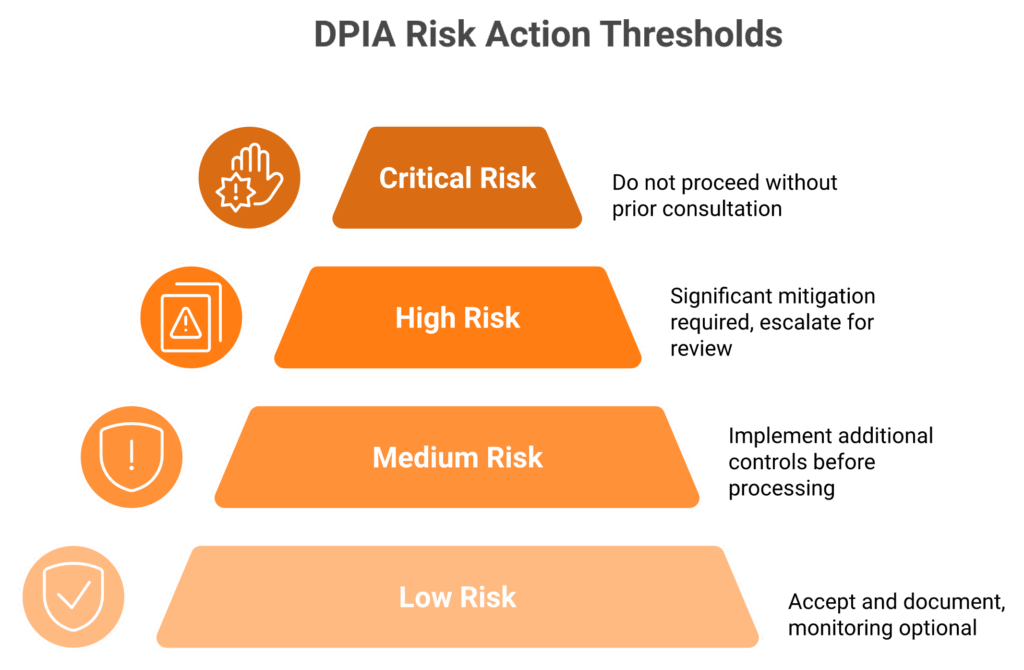
✅ Worked Example: AI-Powered E-Commerce Recommendation Engine
Scenario: An e-commerce platform deploys an AI recommendation engine processing customer browsing behavior, purchase history, and location data for personalized product recommendations.
Risk identified: Unauthorized profiling leading to discriminatory pricing.
Pre-mitigation: Likelihood = 4 (Likely, given algorithmic opacity), Severity = 4 (Major, financial and discriminatory harm) → Score = 16 (High).
Mitigation applied: Algorithmic bias testing quarterly, opt-out mechanism for profiling, human review of pricing decisions, and transparency notice to users.
Post-mitigation: Likelihood = 2, Severity = 3 → Score = 6 (Medium). ✅ Proceed with ongoing monitoring.
Comparing Risk Assessment Frameworks
| Dimension | CNIL Methodology | ISO 29134:2023 | NIST Privacy Framework |
|---|---|---|---|
| Approach | Qualitative/semi-quantitative; assesses feared events against risk sources | Formal, comprehensive; guidance-based without prescriptive scoring | Risk-based, outcome-oriented; maps to NIST CSF |
| Best Suited For | Organizations using CNIL’s open-source PIA tool | Organizations aligned with ISO 27001/27701 | US-headquartered multinationals with NIST alignment |
| Strengths | Free tooling; structured feared-event analysis | International recognition; integrates with ISO management systems | Flexible tiers (Partial → Adaptive); bridges privacy and security |
| Limitation | French DPA-centric; less recognized outside EU | Does not prescribe quantitative thresholds | Voluntary framework; no direct GDPR enforcement linkage |
⚠️ Whichever methodology you choose, document it and apply it consistently across all DPIAs. Mixing methodologies undermines comparability and audit defensibility.
How UnderDefense Operationalizes Risk Scores
At UnderDefense, we help map DPIA-identified High and Critical risks to specific technical controls within your security operations program. A “High” risk score for unauthorized access doesn’t stay as a line item in a PDF. Instead, it translates into active monitoring rules, behavioral analytics, and automated containment capabilities through the UnderDefense MAXI platform.
Q6. How Does the EU AI Act Intersect with GDPR DPIA Requirements?
This is the compliance question that’s keeping DPOs and CISOs up at night heading into August 2026. If your organization deploys AI systems that process personal data, and virtually all do, you’re facing two separate legal obligations that overlap but don’t satisfy each other.
⚠️ The Dual Obligation Problem
The EU AI Act (entered into force August 2024, with high-risk AI obligations applying from August 2, 2026) requires providers of high-risk AI systems to conduct a Conformity Assessment (CA) and deployers to conduct a Fundamental Rights Impact Assessment (FRIA) under Article 27. Simultaneously, if that AI system processes personal data, GDPR Article 35 independently requires a DPIA. These are separate legal obligations with different scopes and supervisory authorities. Completing one does not satisfy the other.
Article 27(4) of the AI Act explicitly addresses this overlap, stating that where a DPIA has already been conducted, the FRIA shall complement it. The DPIA serves as a foundation, but additional fundamental rights analysis is still required.
📋 DPIA vs. Conformity Assessment vs. FRIA
| Dimension | GDPR DPIA | AI Act Conformity Assessment | AI Act FRIA |
|---|---|---|---|
| Scope | Data protection rights (Art. 7–8 EU Charter) | Technical system requirements (accuracy, robustness, cybersecurity, transparency) | All fundamental rights (non-discrimination, dignity, freedom of expression, access to justice) |
| Who Conducts It | Data controller | AI provider | AI deployer |
| When Required | Before high-risk data processing | Before placing system on market | Before deploying high-risk AI system |
| What It Assesses | Risks to data subjects’ rights and freedoms | Technical compliance with AI Act requirements | Impact on equality, non-discrimination, privacy, and human dignity |
| Regulatory Body | National DPAs | National AI authorities or notified bodies | National AI authorities |
| Personal Data Required? | Yes | Not necessarily | Not necessarily |
✅ Practical Harmonization: 5 Steps
For organizations facing both obligations, here’s what works in practice:
- Start with the DPIA as the baseline. GDPR obligations are already established, and the DPIA framework is mature.
- Extend the risk taxonomy to include AI Act fundamental rights dimensions (non-discrimination, transparency, and human oversight) in the same risk register.
- Map AI system documentation requirements (training data provenance, model transparency, and accuracy metrics) into the DPIA’s “description of processing” section.
- Use a unified risk register that captures both data protection risks and fundamental rights risks, enabling a single assessment workflow.
- Document explicitly which requirements of each regulation are satisfied by each section of the assessment.
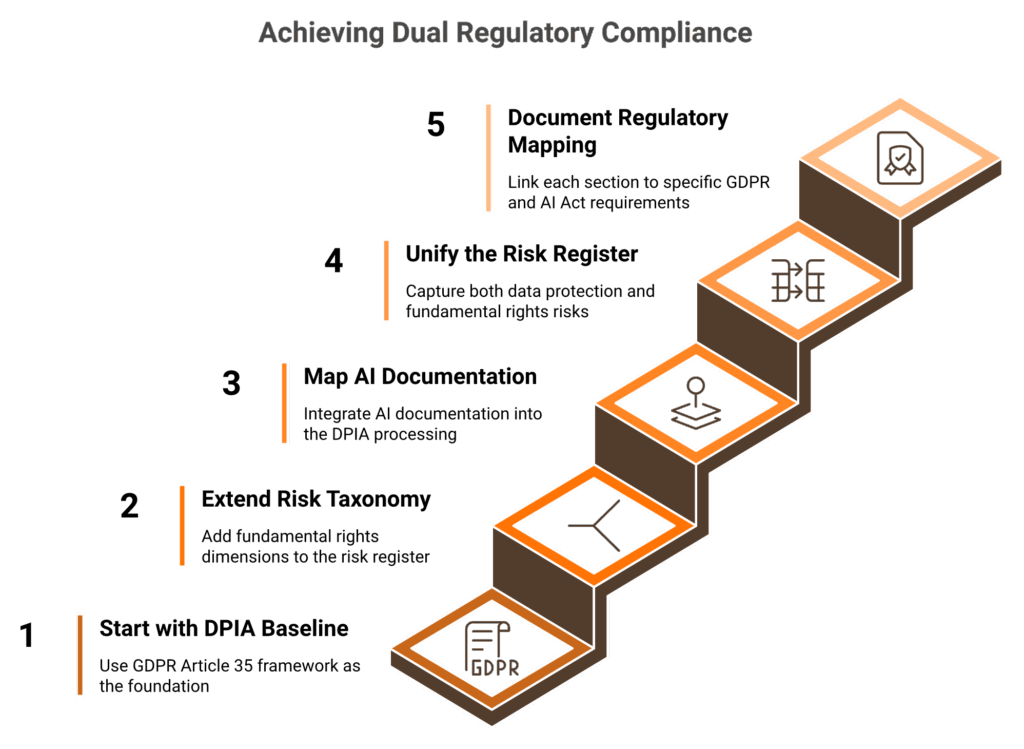
⏰ For SaaS and cloud-based AI deployments, the DPIA must also address multi-tenancy data isolation risks, cross-border transfer implications, and processor/sub-processor chains. These are layers that the FRIA alone won’t cover.
How UnderDefense Supports Dual Compliance
Our security operations expertise supports organizations navigating this dual requirement, particularly in implementing the technical safeguards (model monitoring, AI system access controls, anomaly detection for AI pipelines, and data pipeline integrity monitoring) that both the DPIA and AI Act conformity assessment demand as mitigation measures.
Q7. How Do DPIA Requirements Differ Across Jurisdictions?
If you’re running data processing operations across multiple countries, the uncomfortable truth is that “we did a GDPR DPIA” doesn’t automatically cover your obligations elsewhere. The frameworks share DNA, but the triggers, contents, and penalties diverge in ways that matter operationally.
🌍 Multi-Jurisdiction Comparison
| Jurisdiction | Legal Basis | Trigger | Who Conducts | Prior Consultation? | Penalties |
|---|---|---|---|---|---|
| EU GDPR | Art. 35 | High-risk processing (Art. 35(3) + EDPB 9 criteria) | Data controller | ✅ Yes, if high residual risk (Art. 36) | Up to €10M or 2% global turnover |
| UK GDPR | Art. 35 + ICO guidance | Mirrors EU; ICO publishes own blacklist/screening checklists | Data controller | ✅ Yes, via ICO consultation process | Equivalent to EU penalty framework |
| India DPDP Act | Sec. 10 (significant data fiduciaries) | Data Protection Board may require DPIA for significant data fiduciaries | Significant data fiduciary | ❌ No formal consultation process yet | Up to ₹250 crore (~$30M) |
| Brazil LGPD | Art. 38 | ANPD can request RIPD for sensitive data, legitimate interest processing | Data controller | ❌ No prior consultation; ANPD requests reports | Up to 2% of revenue (capped at R$50M per violation) |
| US, California CPRA | Sec. 1798.185(a)(15) | Processing presenting significant risk, including profiling | Business (controller equivalent) | ❌ No | Per-violation civil penalties ($2,500–$7,500) |
| US, Colorado CPA | Sec. 6-1-1309 | Targeted advertising, profiling, sale of data, and sensitive data processing | Controller | ❌ No | AG enforcement; per-violation penalties |
| China PIPL | Art. 55–56 | Sensitive data, cross-border transfers, automated decision-making, and public data processing | Personal information handler | ❌ No formal consultation; must retain PIA records | Up to ¥50M or 5% annual revenue |
❌ Key Divergences That Trip Up Global Teams
- Prior consultation: EU and UK require supervisory authority consultation if residual risk is high; no US state, China, or Brazil equivalent exists.
- Scope: EU/UK DPIAs cover all high-risk processing; US state assessments are narrower, focused on specific activities (targeted advertising, profiling, and sale of data), not all high-risk processing.
- Regulatory maturity: EU GDPR DPIA framework is most mature with extensive DPA guidance; India DPDP’s DPIA provisions await detailed rules from the Data Protection Board.
- Cross-border: China PIPL is the most prescriptive on cross-border transfers, requiring a PIA before any offshore data transfer.
- Penalties: Range from EU/UK’s turnover-based fines to US per-violation civil penalties to China’s 5% annual revenue cap.
✅ Practical Multi-Jurisdiction Approach
- Use the EU GDPR DPIA as the gold-standard baseline, as it’s the most comprehensive framework.
- Supplement with jurisdiction-specific trigger checks using a modular template approach.
- Maintain a single DPIA template with toggle sections for jurisdiction-specific requirements (e.g., PIPL cross-border addendum, CPRA profiling addendum).
- Build a processing activity register that maps each activity to its applicable jurisdictions.
- Assign jurisdiction-specific review responsibility within the privacy team.
How UnderDefense Supports Global Compliance
We support organizations operating across multiple jurisdictions with compliance automation that maps security controls to the specific regulatory requirements of each market, ensuring DPIA mitigation measures satisfy not just EU GDPR but parallel obligations under UK GDPR, CPRA, PIPL, and other frameworks through our forever-free compliance kits.
Q8. Free DPIA Template, Worked Examples, and Downloadable Resources
Templates are only useful if they’re immediately actionable, not 40-page theoretical guides that sit unread on SharePoint. Below is a 10-section DPIA template structure aligned to Article 35(7) and EDPB guidance, plus a fully worked example you can adapt today.
📝 DPIA Template: 10 Core Sections
- Project/Processing Description and Scope
- Data Controller and DPO Contact Details
- Purpose of Processing and Legal Basis
- Description of Processing Operations and Data Flows (include data flow diagram)
- Necessity and Proportionality Assessment
- Stakeholder Consultation Summary (DPO, data subjects if applicable, and IT security)
- Risk Identification and Assessment (using the 5×5 matrix from Q5)
- Mitigation Measures (technical and organizational)
- Residual Risk Assessment and Controller Decision
- Review Schedule, Responsible Parties, and Sign-Off
This structure aligns with both ICO and CNIL published template models.
✅ Worked Example: AI-Powered Hiring/Recruitment Screening Tool
Section 1, Project Description: “Automated CV screening using NLP to rank job applicants for interview shortlisting across EU and UK operations.”
Section 3, Legal Basis: Legitimate interest under Article 6(1)(f). DPIA required under Article 35(3)(a) due to automated decision-making with significant effects on individuals. Special category data risk under Article 9 if CV content reveals ethnicity, disability, or religion.
Section 4, Data Flow: Applicant submits CV via career portal → Data ingested by NLP model hosted on AWS EU-West → Scoring algorithm produces ranked shortlist → HR team reviews top candidates → Unsuccessful applicant data retained for 12 months → Deleted via automated retention policy.
Data Subjects: Job applicants (~50,000 annually).
⚠️ Risk Assessment and Mitigation
Risk 1, Algorithmic bias producing discriminatory outcomes:
Pre-mitigation: Likelihood 4/Likely, Severity 4/Major → Score: 16 (High) 🟠
Mitigation: Bias testing on training data quarterly, mandatory human review of all AI-generated shortlists, annual third-party algorithm audit, pseudonymization during processing, and applicant appeals mechanism.
Post-mitigation: Likelihood 2/Unlikely, Severity 3/Moderate → Score: 6 (Medium) 🟡 ✅ Proceed with ongoing monitoring.
Risk 2, Unauthorized access to applicant personal data:
Pre-mitigation: Likelihood 3/Possible, Severity 3/Moderate → Score: 9 (Medium) 🟡
Mitigation: Role-based access controls, encryption at rest and in transit, and SOC monitoring of access logs.
Post-mitigation: Score: 4 (Low) 🟢
💡 Simplified SMB Template (6 Sections)
For smaller organizations, a consolidated variant still meets Article 35(7) minimums:
- Processing Description, Purpose, and Legal Basis (combines Sections 1–3)
- Data Flow Summary (simplified diagram)
- Necessity and Proportionality (brief justification)
- Risk Assessment (using the same 5×5 matrix, fewer risks to catalog)
- Mitigation Measures and Residual Risk Decision
- Review Schedule and Sign-Off
How UnderDefense Supports DPIA Implementation
Our compliance kits and security operations support help organizations implement the technical mitigation measures identified in their DPIAs, from access controls and encryption monitoring to anomaly detection, SOC monitoring of processing systems, and incident response capabilities that directly address DPIA-identified risks.
Q9. Real-World DPIA Enforcement Cases: What Happens When You Get It Wrong?
Supervisory authorities across Europe have imposed significant fines specifically for DPIA failures, demonstrating that regulators treat missing or inadequate DPIAs as standalone compliance violations, not just procedural oversights. Here are three cases every compliance leader should study.
⚠️ Case 1: Swedish Police Authority, SEK 2.5 Million (€250,000)
Sweden’s data protection authority (IMY) fined the Swedish Police Authority SEK 2.5 million for deploying Clearview AI’s facial recognition technology to identify individuals without conducting the required impact assessment. Between autumn 2019 and March 2020, multiple police employees used the app without prior authorization, and the force failed to fulfil its obligations as data controller. The corrective measures were severe: mandatory staff training, notification to all affected data subjects, and complete deletion of all data transmitted to Clearview AI, with a hard deadline of September 2021.
⚠️ Case 2: French Real Estate Company, €40,000
In December 2024 (deliberation SAN-2024-021), the CNIL fined a real estate company €40,000 for deploying employee monitoring software that tracked mouse movements, keyboard activity, websites visited, and took regular screenshots of employee screens, alongside continuous video and audio surveillance in work and break areas. The CNIL found the monitoring disproportionate and lacking legal basis under Article 6 of the GDPR, with no proper assessment of necessity or less intrusive alternatives conducted before processing began.
⚠️ Case 3: Dutch DPA Fines ICS (Credit Card Company), €150,000
In December 2023, the Dutch Data Protection Authority (Autoriteit Persoonsgegevens) fined ICS, a credit card company, €150,000 for failure to carry out a DPIA under Article 35(1) GDPR. The AP emphasized a critical point: not conducting a DPIA is a standalone GDPR violation, but it also increases the likelihood of further violations because the organization has no structured understanding of the risks involved in its processing activities.
💰 The Penalty Framework
DPIA violations fall under Article 83(4) of the GDPR, up to €10 million or 2% of annual global turnover, whichever is higher. Key lessons across these cases:
- ⏰ Starting processing before completing the DPIA is the single most common enforcement finding. Article 35 explicitly requires assessment “prior to processing.”
- ❌ Generic, copy-paste risk assessments that are not specific to actual data flows will be rejected by supervisory authorities.
- ❌ Failing to assess less intrusive alternatives in the necessity analysis is a recurring regulatory criticism. The CNIL’s employee monitoring case turned partly on disproportionality.
- ❌ Not documenting stakeholder involvement or DPO consultation invalidates the DPIA process entirely.
✅ How UnderDefense Helps Avoid These Outcomes
UnderDefense helps organizations avoid these enforcement outcomes by operationalizing DPIA findings, ensuring that committed mitigation measures like access controls, encryption, and anomaly detection are actively monitored and audit-verifiable through continuous security operations via the UnderDefense MAXI platform, not just documented promises.
Q10. What Are the Most Common DPIA Mistakes, and Is Your Organization Assessment-Ready?
Most DPIA failures do not happen because teams lack awareness. They happen because the process gets treated as a checkbox exercise, a document that lives in a SharePoint folder instead of an operational commitment that connects to real controls. Here is a two-part diagnostic: first, the mistakes to avoid; then, a readiness self-assessment to gauge where you stand.
Part 1: Common DPIA Mistakes Audit
☐ Mistake 1: Conducting the DPIA after processing has already started.
Fix: Build DPIA screening into project initiation. No processing begins without a documented screening decision. This was the core violation in the Swedish Police Authority case, where Clearview AI usage preceded any assessment.
☐ Mistake 2: Assessing organizational risk instead of risk to data subjects.
Fix: Reframe every risk question as “what could go wrong for the individual?”, not “what is the reputational cost to us?”
☐ Mistake 3: Using generic, copy-paste risk assessments not tailored to the specific processing.
Fix: Each DPIA must reference actual data flows, systems, and recipients involved. The Dutch DPA explicitly flagged this gap when fining ICS.
☐ Mistake 4: Failing to consult the DPO or affected stakeholders.
Fix: Document DPO involvement at screening, risk assessment, and sign-off stages.
☐ Mistake 5: Treating the DPIA as a one-time document without scheduled reviews.
Fix: Assign review triggers and minimum annual review dates for every active DPIA.
☐ Mistake 6: Not documenting rejected alternatives in the necessity assessment.
Fix: Record at least two alternative approaches and why they were adopted or rejected. This was a critical failure point in the CNIL employee monitoring case.
☐ Mistake 7: Ignoring residual risk or failing to trigger Article 36 prior consultation when required.
Fix: Define a clear threshold. Any residual score above your defined limit equals mandatory prior consultation with the supervisory authority.
☐ Mistake 8: Not mapping DPIA mitigation measures to actual implemented and monitored controls.
Fix: Each mitigation measure must have an owner, implementation date, and verification mechanism.
Part 2: DPIA Readiness Self-Assessment
📋 Score Yourself
- ☐ Documented DPIA screening process integrated into project initiation workflows
- ☐ Designated DPO or privacy lead with formal DPIA oversight responsibility
- ☐ Approved and documented risk scoring methodology with defined thresholds
- ☐ Standardized DPIA template aligned with Article 35(7) requirements
- ☐ Data flow mapping capability for all processing activities
- ☐ Stakeholder consultation process covering DPO, data subjects (where applicable), and IT security
- ☐ Article 36 prior consultation procedure documented with DPA contact details
- ☐ DPIA register/inventory maintained, accessible, and regularly updated
- ☐ Review trigger framework with scheduled reassessment dates for each active DPIA
- ☐ Technical controls from DPIA mitigation measures actively verified and monitored
Score Interpretation
| Score | Status | Action |
|---|---|---|
| ⭐ 8–10 | Assessment-ready | Focus on continuous improvement and optimization |
| ⚠️ 5–7 | Foundation exists but critical gaps remain | Prioritize missing items before your next processing initiative |
| ❌ 0–4 | Significant compliance exposure | Immediate remediation required |
✅ UnderDefense Closes the Hardest Gap
UnderDefense directly addresses Mistake #8 and Readiness Item #10, the most operationally critical gap. The UnderDefense MAXI platform’s continuous monitoring ensures that technical safeguards committed to in your DPIA (access controls, encryption, anomaly detection, incident response) are actively enforced, verifiable during audits, and generating compliance evidence automatically. Most organizations go from “documented but unverified” to “monitored and audit-ready” within 30 days of onboarding.
“The reports from their platform give us clear evidence of our security controls and incident response capabilities. When auditors or clients ask questions about our security posture, we can pull up exactly what they need to see.”
— Verified User, Marketing and Advertising UnderDefense G2 – Verified Review
“UnderDefense MAXI improves security posture in general. It made it easier for us to make informed security decisions, and helped us to comply with important regulations.”
— Serhii I., CEO UnderDefense G2 – Verified Review
Q11. What Happens After the DPIA? Prior Consultation, Review Triggers, and Ongoing Monitoring
The DPIA does not end when you sign off on the document. What happens next, prior consultation, scheduled reviews, and ongoing monitoring, is where most organizations drop the ball. And regulators know it.
When Article 36 Prior Consultation Is Triggered
📋 The Mandatory Threshold
If residual risk remains high after applying all mitigation measures identified in the DPIA, the controller must consult the supervisory authority before processing begins. This is not optional. Article 36(1) is explicit: where the DPIA indicates that processing would result in high risk “in the absence of measures taken by the controller to mitigate the risk,” prior consultation is the required next step.
⏰ The Submission Process
To initiate prior consultation, submit the completed DPIA to your relevant Data Protection Authority, including:
- The purposes and means of the envisaged processing
- All safeguards and security measures already applied
- DPO contact details and evidence of their involvement
- Any additional information the DPA requests during review
The DPA has 8 weeks to provide a written response. This can be extended by 6 weeks for complex cases, with the DPA required to notify the controller within one month of receipt and provide reasons for the delay. Critically, those timelines can be suspended until the DPA has obtained all information it has requested, meaning incomplete submissions create open-ended delays.
Supervisory Authority Powers During Consultation
The DPA’s response is not a rubber stamp. During prior consultation, the authority can exercise significant powers under Article 58:
- Provide written advice including recommended additional safeguards
- Require specific changes to processing operations or additional mitigation measures
- Impose conditions or limitations on the processing
- Order a temporary or permanent ban on processing if it would infringe the GDPR
Practical tip: Engage informally with your DPA before formal submission when possible. Several authorities, including the UK’s ICO, offer pre-consultation guidance calls that help shape submissions and reduce back-and-forth during the formal review period.
The DPIA Review Trigger Framework
🔄 Seven Events That Require Reassessment
A DPIA is a living document. These seven events should trigger an immediate reassessment:
- Change in processing scope, purpose, or data categories collected: any expansion beyond the original DPIA’s parameters
- New technology, vendor, or sub-processor introduced into the processing chain
- Data breach or security incident affecting the processing activity covered by the DPIA
- Regulatory change: new DPA guidance, updated national blacklist, or amended legal framework
- Significant organizational change: merger, acquisition, restructuring, or new joint controllership arrangement
- AI model retraining, algorithm update, or change to automated decision-making logic, increasingly critical as AI-driven processing becomes standard
- Scheduled periodic review: at minimum annually for high-risk processing, bi-annually for medium-risk
The Decision Flow
Has any trigger event occurred? → Yes → Reassess the DPIA and update risk scores → Has residual risk increased? → Yes → Implement additional mitigation or trigger Article 36 prior consultation → No → Document the review and update the DPIA register.
✅ UnderDefense as an Automated Early Warning System
UnderDefense’s continuous monitoring and incident detection capabilities through the UnderDefense MAXI platform serve as an automated early warning system for DPIA reassessment triggers, detecting changes in data flows, new threat vectors, unauthorized processing activity, or security incidents in real time that should prompt a DPIA review. The operational advantage is straightforward: you identify the trigger before a supervisory authority discovers the gap during an audit or investigation, rather than scrambling to explain why your two-year-old DPIA no longer reflects reality.
Q12. Which Tools Help Automate and Streamline the DPIA Process?
The most effective DPIA programs combine privacy assessment platforms for documentation and workflow with security operations tools that verify and monitor the technical controls DPIAs require. Here are the leading platforms compliance leaders should evaluate.
📋 How DPIA Tooling Has Evolved
DPIA tooling has evolved from basic template repositories to integrated platforms that automate screening, risk scoring, stakeholder workflows, and audit trail generation. The critical differentiator in 2026 is whether the tool stops at documentation or extends into operational control verification, ensuring your DPIA commitments are technically enforced, not just recorded.
What Separates Effective DPIA Tooling
- ✅ Automated DPIA screening against Article 35(3) triggers and EDPB 9 criteria
- ✅ Built-in risk scoring matrices with configurable thresholds
- ✅ Workflow automation for stakeholder consultation (DPO, security, legal) with audit trails
- ✅ Integration with security operations to verify that mitigation measures are technically implemented and monitored
- ✅ Multi-jurisdiction template support for EU GDPR, UK GDPR, CPRA, PIPL, and LGPD
The Landscape: Tools Worth Evaluating
| Tool | Best For | Key Differentiator |
|---|---|---|
| UnderDefense MAXI | Bridging DPIA-to-security-operations | Ensures technical mitigation measures (access controls, encryption, anomaly detection) are actively monitored 24/7 through SOC operations, with compliance evidence generated automatically via forever-free compliance kits |
| CNIL PIA Tool | Budget-conscious teams starting from scratch | Free, open-source, based on the French DPA’s methodology |
| OneTrust | Large enterprises with complex multi-jurisdiction programs | Comprehensive privacy management platform with DPIA workflow automation |
| TrustArc | Enterprise privacy compliance | Risk assessment and DPIA modules with regulatory intelligence |
| Securiti | AI-powered data governance | Automated DPIA capabilities with data mapping integration |
| DataGrail | Privacy management and data mapping | Assessment automation focused on data discovery |
Choosing the Right Tool for Your Gap
Each tool excels in different scenarios: UnderDefense MAXI for organizations that need DPIA mitigation measures actively monitored and verified through security operations, CNIL PIA for budget-conscious teams starting from scratch, and OneTrust/TrustArc for large enterprises with complex multi-jurisdiction privacy programs. The right choice depends on whether your primary gap is documentation workflow or operational control enforcement.
This analysis is informed by documented deployment outcomes across 500+ MDR clients, published DPA guidance from ICO, CNIL, and EDPB, and hands-on experience operationalizing DPIA technical controls through continuous security monitoring.
1. What is a DPIA and why is it required under GDPR?
A Data Protection Impact Assessment (DPIA) is a structured process mandated by GDPR Article 35 that requires data controllers to evaluate the risks of processing activities before they begin, specifically when processing is likely to result in a high risk to individuals’ rights and freedoms. We see it as more than a compliance checkbox. At its core, a DPIA forces organizations to map data flows, identify risks from the data subject’s perspective, assess necessity and proportionality, and document mitigation measures. Article 35(7) prescribes four minimum components every DPIA must contain: a systematic description of processing, a necessity and proportionality assessment, a risk assessment, and documented mitigation measures. Skipping a DPIA when one is required constitutes a standalone GDPR violation under Article 83(4), carrying penalties up to €10 million or 2% of annual global turnover. GDPR enforcement has now exceeded €5.65 billion in cumulative fines. We help organizations move DPIAs from static documents to operational security inputs through our UnderDefense MAXI platform, translating identified risks into active monitoring rules and detection capabilities.
2. When is a DPIA required and what triggers the obligation?
GDPR Article 35(3) lists three mandatory triggers where a DPIA is always required with no judgment call needed:
-
Systematic and extensive evaluation of personal aspects based on automated processing, including profiling, producing legal or similarly significant effects.
-
Large-scale processing of special categories of data (Article 9(1)) or criminal conviction data (Article 10).
-
Systematic monitoring of a publicly accessible area on a large scale.
Beyond these, the EDPB’s WP248 rev.01 guidelines established nine high-risk criteria, including evaluation or scoring, sensitive data, data concerning vulnerable subjects, and innovative technology use. The practical rule is that if your processing meets two or more of these criteria, a DPIA is required. National supervisory authority blacklists add jurisdiction-specific triggers. Always check your relevant DPA’s published list. We help organizations identify DPIA-triggering processing activities through our managed detection and response capabilities and data flow visibility across their technology stack.
3. What should a DPIA template include to meet Article 35(7) requirements?
An Article 35(7)-compliant DPIA template must contain a minimum of four mandatory elements, but we recommend a 10-section structure for operational completeness:
-
Project/processing description and scope
-
Data controller and DPO contact details
-
Purpose of processing and legal basis
-
Description of processing operations and data flows (including data flow diagrams)
-
Necessity and proportionality assessment
-
Stakeholder consultation summary
-
Risk identification and assessment using a Likelihood × Severity matrix
-
Mitigation measures (technical and organizational)
-
Residual risk assessment and controller decision
-
Review schedule, responsible parties, and sign-off
For smaller organizations, a simplified 6-section variant still meets Article 35(7) minimums while being practical to maintain. This structure aligns with both ICO and CNIL published template models. Our compliance services include free compliance kits with templates and workflows to help teams implement this structure without additional budget.
4. How do you conduct a DPIA step by step?
We break the DPIA process into 11 operational steps grouped into three phases: Define and describe (Steps 1–4): Screen whether a DPIA is required and document the decision. Describe the processing operations, legal basis, data categories, and recipients. Create a data flow diagram mapping every touchpoint. Assess necessity and proportionality, documenting rejected alternatives. Risk identification and mitigation (Steps 5–8): Catalog risks from the data subject’s perspective. Score risks using a Likelihood × Severity matrix. Identify technical measures (encryption, access controls, anomaly detection) and organizational measures. Re-score all risks after applying mitigation to determine residual risk. Sign-off and integration (Steps 9–11): Obtain executive approval and store the report in the DPIA register. Integrate mitigation measures into the project plan with assigned owners and deadlines. Set review triggers and periodic reassessment dates. If residual risk remains high, proceed to Article 36 prior consultation.
5. How does the EU AI Act affect DPIA requirements in 2026?
If your organization deploys AI systems that process personal data, you face two separate legal obligations that overlap but do not satisfy each other. The EU AI Act (high-risk obligations effective August 2, 2026) requires providers to conduct a Conformity Assessment and deployers to conduct a Fundamental Rights Impact Assessment (FRIA) under Article 27. Simultaneously, GDPR Article 35 independently requires a DPIA if personal data is processed. Article 27(4) of the AI Act states that where a DPIA has already been conducted, the FRIA shall complement it. We recommend a 5-step harmonization approach: start with the DPIA as the baseline, extend the risk taxonomy to include fundamental rights dimensions, map AI documentation requirements into the DPIA’s description section, use a unified risk register, and document which requirements of each regulation each assessment section satisfies. Our SOC service supports the technical safeguards both assessments demand, including model monitoring, AI system access controls, and data pipeline integrity monitoring.
6. What are the most common DPIA mistakes that lead to enforcement action?
Based on documented enforcement cases across Europe, we see eight recurring mistakes:
-
Conducting the DPIA after processing has already started (the core violation in the Swedish Police Authority/Clearview AI case).
-
Assessing organizational risk instead of risk to data subjects.
-
Using generic, copy-paste risk assessments not tailored to specific processing (flagged by the Dutch DPA when fining ICS €150,000).
-
Failing to consult the DPO or affected stakeholders.
-
Treating the DPIA as a one-time document without scheduled reviews.
-
Not documenting rejected alternatives in the necessity assessment (a critical failure point in the CNIL employee monitoring case).
-
Ignoring residual risk or failing to trigger Article 36 prior consultation.
-
Not mapping DPIA mitigation measures to actual implemented and monitored controls.
The last gap is the most operationally dangerous. Our continuous security monitoring ensures that mitigation measures committed to in your DPIA are actively enforced and audit-verifiable, closing the gap between documentation and operational reality.
7. How do DPIA requirements differ across jurisdictions beyond the EU?
A GDPR DPIA does not automatically cover your obligations in other jurisdictions. The frameworks share DNA, but triggers, contents, and penalties diverge in ways that matter operationally:
-
UK GDPR mirrors EU requirements, with the ICO publishing its own blacklist and screening checklists.
-
US (CPRA/Colorado CPA) requires assessments for profiling, targeted advertising, and sensitive data processing, but with no prior consultation obligation and per-violation civil penalties ($2,500–$7,500).
-
Brazil (LGPD) allows the ANPD to request a RIPD for sensitive data or legitimate interest processing.
-
China (PIPL) is the most prescriptive on cross-border transfers, requiring a PIA before any offshore data transfer, with penalties up to 5% of annual revenue.
-
India (DPDP Act) empowers the Data Protection Board to require DPIAs for significant data fiduciaries, with penalties up to ₹250 crore (~$30M).
We recommend using the EU GDPR DPIA as the gold-standard baseline and supplementing with jurisdiction-specific modules. Our compliance automation maps security controls to regulatory requirements across markets.
8. What tools can automate and streamline the DPIA process?
Effective DPIA tooling in 2026 has evolved beyond basic templates to integrated platforms that automate screening, risk scoring, stakeholder workflows, and audit trail generation. The critical differentiator is whether a tool stops at documentation or extends into operational control verification. Key capabilities to evaluate include:
-
Automated DPIA screening against Article 35(3) triggers and EDPB 9 criteria.
-
Built-in risk scoring matrices with configurable thresholds.
-
Workflow automation for stakeholder consultation with audit trails.
-
Integration with security operations to verify that mitigation measures are technically implemented.
-
Multi-jurisdiction template support for EU GDPR, UK GDPR, CPRA, PIPL, and LGPD.
Leading platforms include UnderDefense MAXI for bridging DPIA-to-security-operations with 24/7 SOC monitoring and compliance evidence generation, CNIL PIA Tool for budget-conscious teams, and OneTrust/TrustArc for large enterprises with complex multi-jurisdiction programs. The right choice depends on whether your primary gap is documentation workflow or operational control enforcement.