




Q1. What Is GRC Integrated Risk Management, and How Did We Get Here?
GRC integrated risk management is a unified operating model that merges governance, risk management, and compliance disciplines with cross-functional risk intelligence to eliminate organizational silos and enable strategic resilience. The term “GRC” was coined by Michael Rasmussen at Forrester Research in February 2002, after a briefing with Telos Xacta catalyzed his thinking about connecting risk, controls, and compliance into a unified solution. That insight led to a collaboration with OCEG (Open Compliance & Ethics Group), where Rasmussen and other thought leaders developed the GRC Capability Model, a framework emphasizing not just governance, risk, and compliance, but also performance, what OCEG calls “Principled Performance”.
⚠️ The Three Pillars: More Than Compliance Checkboxes
Here’s the operational reality most practitioners miss: GRC was never supposed to be a compliance exercise. It was hijacked by SOX-era thinking and reduced to audit checklists. The three pillars, when properly implemented, function as an interconnected operating system:
Governance: Board oversight, policy administration, strategic alignment, and accountability structures. This is where objectives get defined. Without clear governance, risk management has no anchor.
Risk Management: Risk identification, assessment, monitoring, reporting, and response across operational, financial, strategic, and cybersecurity domains. This is the engine that connects what could go wrong to what the organization is trying to achieve.
Compliance: Regulatory tracking, obligation management, control mapping, audit readiness, and evidence collection. This is the discipline that ensures obligations are met, but it’s the floor, not the ceiling.
From GRC to IRM: The Gartner Rebrand
In 2016–2017, Gartner redefined its coverage of GRC as Integrated Risk Management (IRM), recognizing that compliance-centric GRC had become too narrow for modern enterprise needs. Under Gartner’s definition, IRM is “a set of practices and processes supported by a risk-aware culture and enabling technologies, that improves decision making and performance through an integrated view of how well an organization manages its unique set of risks”.
Gartner’s IRM framework specifies six core attributes:
- Strategy – Comprehensive risk assessment strategy aligned with business objectives
- Assessment – Identification and evaluation of risks across all domains
- Response – Risk mitigation, acceptance, transfer, or avoidance decisions
- Communication and Reporting – Cross-functional risk information sharing
- Monitoring – Continuous tracking of risk indicators and control effectiveness
- Technology – Enabling platforms that unify risk data and workflows
IRM maturity progresses through three tiers: compliance-centric (reactive, audit-driven), operations-centric (proactive risk identification within business units), and fully integrated (risk intelligence embedded in strategic decision-making across the enterprise).
ERM: The Board-Level Strategic Lens
Enterprise Risk Management (ERM) sits at the strategic apex. COSO originally published its ERM–Integrated Framework in 2004, then revised it in 2017 as Enterprise Risk Management–Integrating with Strategy and Performance. The 2017 update strengthened the emphasis on embedding risk directly into strategy-setting and performance management, moving ERM from a compliance exercise to a board-level discipline with 20 principles across five components: Governance and Culture, Strategy and Objective-Setting, Performance, Review and Revision, and Information, Communication, and Reporting.
ISO 31000:2018 complements COSO by providing universal risk management principles, framework, and process applicable to any organization regardless of size, industry, or sector.
The Terminology Debate: Originalism vs. Pragmatism
There’s a real debate in this space. Purists, Rasmussen among them, argue that IRM is simply “the R in GRC” and that the original GRC framework already encompassed everything IRM claims to add. Pragmatists counter that IRM represents a genuine philosophical shift: from compliance-first thinking to risk-first thinking, from siloed audit programs to cross-functional risk intelligence.
Both sides have a point. But the operational reality in 2026 matters more than the terminology: SEC cybersecurity disclosure rules now require material incident reporting within four business days on Form 8-K (Item 1.05). DORA enforcement is live in the EU. NIS2 mandates 24-hour early warning notifications. State privacy laws continue proliferating. These regulatory pressures make siloed approaches, regardless of what you call them, architecturally inadequate for enterprise resilience.
Q2. GRC vs IRM vs ERM: How Do These Frameworks Actually Differ?
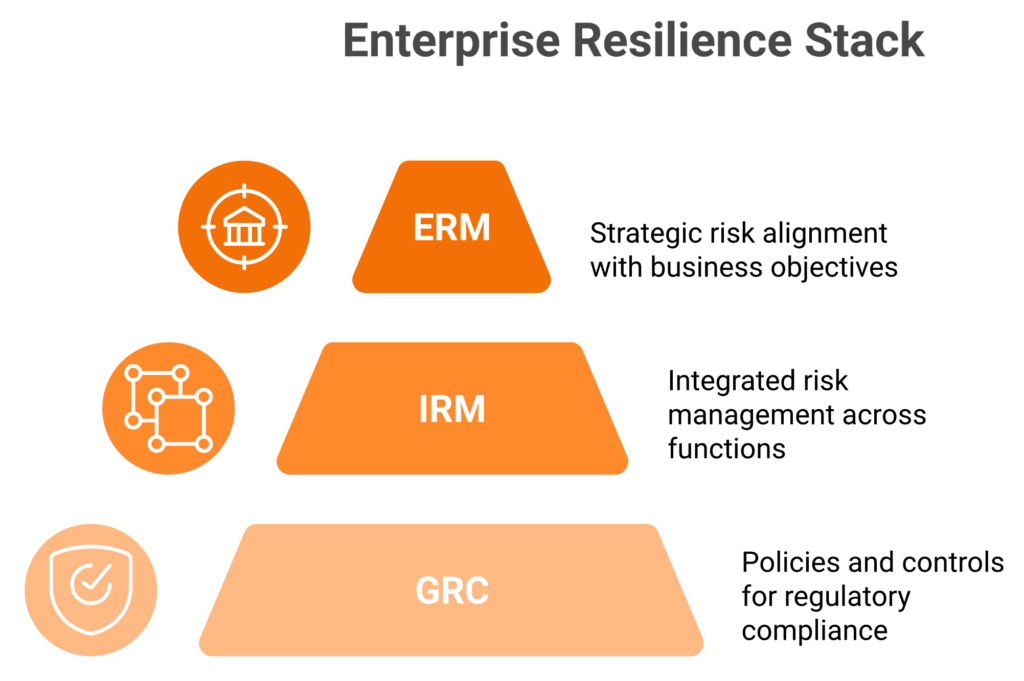
The alphabet soup of risk acronyms, GRC, IRM, ERM, creates genuine confusion for security leaders evaluating their organizational approach. These three frameworks serve different organizational layers but increasingly overlap. GRC governs compliance posture, IRM integrates cross-functional risk, and ERM aligns risk with strategic objectives. Understanding the boundaries is essential for selecting the right approach, or more likely, the right combination.
The Definitive Three-Way Comparison
| Dimension | GRC | IRM | ERM |
|---|---|---|---|
| Primary Focus | Governance & compliance oversight | Integrated, enterprise-wide risk management | Strategic risk to business objectives |
| Scope | Policies, controls, audits | Cross-functional risk integration | Enterprise-level strategic risks |
| Framework Alignment | COBIT, SOX, regulatory mandates | Flexible, organization-specific | COSO ERM 2017, ISO 31000:2018 |
| Reporting Metrics | Compliance status, audit findings | Risk exposure scores, mitigation progress | Risk impact on strategic goals |
| Technology Approach | Compliance-driven platforms | Integrated risk platforms | Executive-level reporting & dashboards |
| Types of Risks | Regulatory, operational compliance | All risk categories, cross-functionally | Strategic, financial, reputational |
| Stakeholder Ownership | CCO, compliance teams | CRO, cross-functional risk owners | Board, C-suite |
| Best-Fit Scenario | Highly regulated industries needing audit trail | Maturing orgs needing unified risk view | Enterprises embedding risk in strategy |
✅ The Convergence Thesis
Modern enterprises don’t choose one framework in isolation. They layer them. GRC provides the compliance backbone: the policies, controls, and audit evidence that keep regulators satisfied. IRM provides the risk integration engine: the cross-functional data normalization, unified risk taxonomy, and continuous monitoring that connect siloed risk functions. ERM provides the strategic lens: the board-level view that links risk exposure to mission, vision, and value creation.
Gartner positioned IRM as GRC’s successor, but practitioners increasingly treat IRM as the how and GRC as the what, not a replacement but an evolution. The “IRM is GRC done right” narrative resonates because it acknowledges that GRC’s compliance-centric implementations fell short of the framework’s original ambition, while IRM re-centers the conversation on risk as the organizing principle.
Industry-Specific Best-Fit Scenarios
The right combination depends heavily on your operational context:
Financial Services: Heavy regulatory complexity (SOX, Basel III, GLBA, PCI DSS) favors strong GRC + ERM layering, with IRM as the integration engine connecting compliance silos.
Healthcare: HIPAA compliance within integrated risk frameworks demands a GRC + IRM hybrid. Compliance evidence collection must feed directly into operational risk visibility.
Technology Sector: Rapid threat landscapes, agile development cycles, and cloud-native architectures favor an IRM-first approach with lightweight GRC overlay for SOC 2/ISO 27001 needs.
Manufacturing: Supply chain operational risk, IoT exposure, and geopolitical dependencies benefit from ERM + IRM convergence, delivering strategic risk visibility across extended operations.
💡 Where Cybersecurity Fits
Here’s where most GRC conversations miss the mark: they treat cybersecurity as a compliance checkbox rather than an operational risk domain. The IRM model gets this right by integrating endpoint, cloud, identity, and network risk telemetry into a single context-aware detection layer. At UnderDefense, we’ve built exactly this architecture. UnderDefense MAXI connects across 250+ security tools to eliminate the siloed alert-fatigue problem that plagues GRC-only approaches, providing continuous risk intelligence rather than periodic compliance snapshots.
Q3. How Does GRC Enable and Strengthen Integrated Risk Management?
GRC is the foundational backbone for IRM, not its competitor. Without strong governance, there’s no policy structure to anchor risk decisions. Without standardized risk and compliance data, IRM has nothing consistent to integrate. Without the compliance discipline mapping regulatory obligations, cross-functional risk views lack the regulatory context that makes them actionable.
GRC as the Enabler, Not the Enemy
The operational reality is straightforward: organizations that try to implement IRM without a mature GRC foundation end up building on sand. Here’s why each GRC pillar directly enables IRM success:
Governance → IRM Strategy + Communication: Board oversight and policy administration establish the objectives against which risk is measured. Governance committees create the cross-functional collaboration muscle that IRM adoption requires.
Risk Management → IRM Assessment + Response + Monitoring: Standardized risk identification and assessment processes provide the raw material for IRM’s integrated view. Without consistent risk data, integration produces noise, not intelligence.
Compliance → IRM Technology + Monitoring: Regulatory tracking and control mapping force the cross-functional coordination that IRM demands. Compliance obligations are, in practice, the most common driver of breaking down organizational silos.
Frameworks That Bridge GRC and IRM
The key frameworks that enable GRC-IRM integration each serve a distinct function in the unified model:
| Framework | Role in GRC-IRM Integration |
|---|---|
| ISO 31000:2018 | Provides universal risk management principles and process applicable across all domains, the common language for cross-functional risk |
| COSO ERM 2017 | Aligns risk with strategy and performance, bridging compliance-centric GRC with board-level strategic risk management |
| NIST Cybersecurity Framework | Integrates technology risk into broader risk management, the bridge between IT/security teams and enterprise risk functions |
| COBIT | Aligns IT governance with business objectives, ensuring technology risk management feeds into organizational governance |
| Regulatory Standards (SOX, HIPAA, GDPR, PCI DSS) | Act as integration drivers. Cross-functional coordination becomes mandatory when a single regulation touches legal, IT, operations, and finance |
⏰ Continuous Control Monitoring: The Technical Bridge
Periodic manual assessments, the annual audit, the quarterly risk review, are relics of a pre-digital operating model. Continuous Control Monitoring (CCM) is the technical bridge between GRC and IRM: automated, real-time testing of controls against operational data replaces point-in-time snapshots with living risk intelligence.
CCM models connect compliance evidence collection with dynamic risk scoring. When a control fails, say, a firewall rule change that violates your PCI DSS baseline, CCM doesn’t wait for the next audit cycle. It flags the deviation in real time, updates the risk score, and triggers remediation workflows. This is the kind of operational feedback loop that IRM demands but traditional GRC tools rarely deliver.
From a practitioner perspective, the shift from periodic to continuous is where most implementations stall. The technology exists; the organizational change management is what breaks. Teams accustomed to quarterly compliance reviews resist the transparency that real-time monitoring creates. Leadership buy-in isn’t optional here but the prerequisite.
Where UnderDefense Bridges GRC and IRM
We built the UnderDefense MAXI platform to operate at exactly this intersection. Security compliance monitoring, including SOC 2 evidence collection, ISO 27001 control validation, and HIPAA audit readiness, runs in the same platform as real-time threat detection and response. This is a unified architecture where the compliance control layer and the risk intelligence layer share the same telemetry, the same context, and the same analyst team. The result: compliance evidence is a byproduct of operational security, not a separate workstream that competes for resources.
Q4. What Does a Federated GRC-IRM Framework Look Like in Practice?
Most enterprises run governance in legal, risk in security or operations, and compliance in audit: three separate reporting chains, three tool stacks, zero unified risk picture. The default industry advice is “consolidate everything into one platform.” But having spent years watching organizations attempt this, the centralize-everything approach creates its own failure modes. Federated GRC architecture offers a more resilient alternative.
❌ The “Centralize Everything” Trap
Centralized-only approaches create bottlenecks, remove risk ownership from business units, and produce dashboards nobody at the operational level trusts. Traditional GRC platforms aggregate compliance data without operational context. Executives see green-yellow-red heatmaps while the security team knows the reality is far messier. The core problem: centralizing data without decentralizing accountability creates a reporting layer that satisfies auditors but fails operators.
I’ve watched this pattern repeat across multiple industries. A company invests seven figures in a GRC platform, spends 18 months migrating data from spreadsheets and siloed tools, and ends up with a centralized system that business units treat as a compliance tax rather than a risk management tool. The risk registers get updated quarterly to satisfy corporate, but they don’t reflect operational reality because the people closest to the risks don’t own the process.
✅ The Federated Synthesis: Decentralized Ownership, Centralized Intelligence
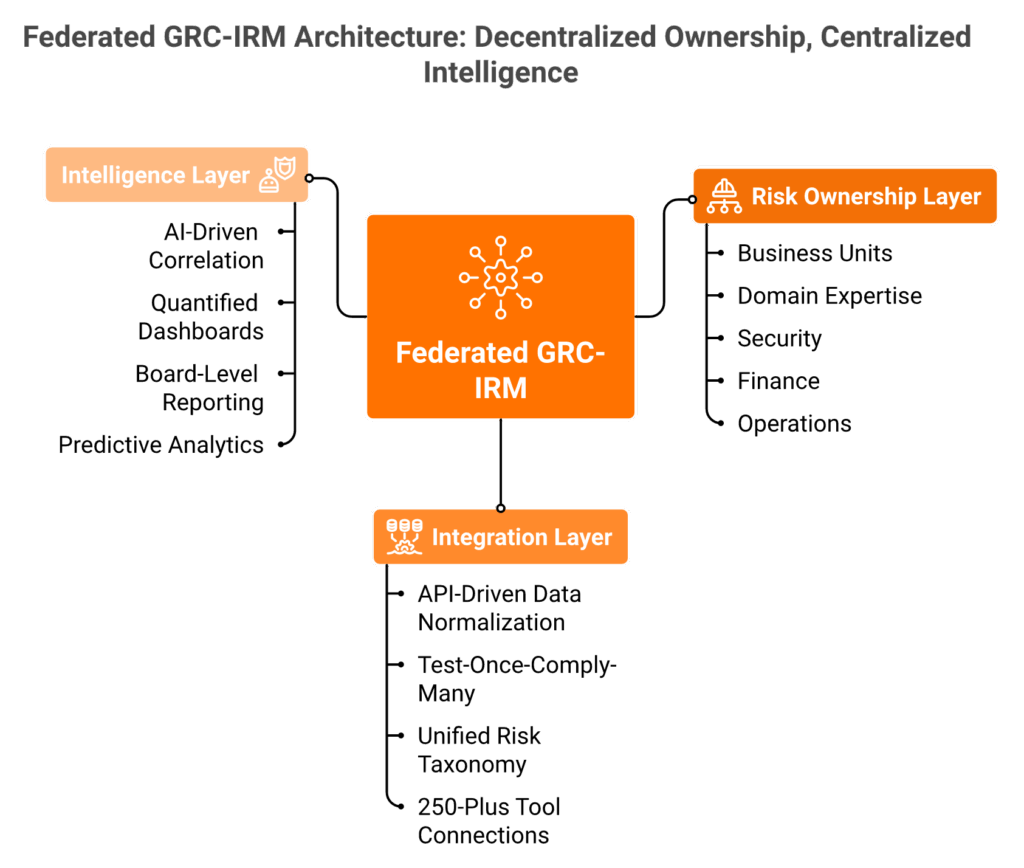
The federated model operates across three layers:
Risk Ownership Layer – Business units and process owners independently manage their risk registers, controls, and assessments using domain expertise. The security team owns cybersecurity risk. Finance owns financial risk. Operations owns supply chain risk. Each unit uses workflows that fit their operational reality, not a one-size-fits-all template imposed from above.
Integration Layer – APIs, control rationalization (test-once-comply-many), unified risk taxonomy, and automated data normalization connect siloed systems. This is where the architecture earns its value: a single control test can satisfy SOC 2, ISO 27001, and HIPAA simultaneously. Risk data flows upward without requiring every business unit to use the same tool.
Intelligence Layer – AI-driven correlation, quantified risk dashboards, board-level reporting, and predictive analytics aggregate enterprise-wide risk posture. Leadership gets the unified view they need, built from bottom-up operational data, not top-down assumptions.
This model enables what centralized approaches cannot: operational trust. When process owners control their own risk data, they invest in its accuracy because it’s their tool, not corporate’s reporting requirement.
💡 Risk Interconnectivity: Beyond the “List of Risks”
Risks don’t exist in isolation, and this is where federated architecture delivers its highest value. A third-party vendor breach cascades into compliance failure (GDPR notification deadlines), operational disruption (service unavailability), financial impact (incident response costs, potential fines), and reputational damage (customer trust erosion), all simultaneously.
The federated model enables cascading risk visualization through interconnected risk maps. Think bow-tie analysis applied across organizational boundaries: a single threat event propagates through multiple risk domains, and the intelligence layer traces those connections in real time. This moves organizations from maintaining a static “list of risks” to understanding risk relationships, which risks amplify each other, which controls protect against multiple threats, and where a single failure cascades across the enterprise.
Where UnderDefense Fits in the Federated Model
We operate as the real-time cybersecurity data node within the Integration Layer. UnderDefense MAXI connects 250+ existing security tools. Vendor-agnostic integration means organizations keep their current stack while gaining unified risk visibility across endpoints, cloud, identity, network, and SaaS. Our concierge analysts operationalize the Risk Ownership Layer by verifying threats directly with business-unit users via ChatOps (Slack, Teams, email), closing the accountability loop between detection and response. The result: 2-minute Alert-to-Triage and 15-minute escalation for critical incidents, along with 96% MITRE ATT&CK coverage, delivered as operational risk intelligence that feeds upward into the enterprise GRC framework rather than sitting in a separate security silo.
Q5. How Do AI and Automation Transform GRC-IRM Operations?
The promise of AI in governance, risk, and compliance sounds great on a slide deck. The reality? Most organizations are still running quarterly risk reviews, annual audits, and point-in-time vendor assessments that create dangerous blind spots. Thomson Reuters tracked over 200 regulatory changes per day globally as far back as 2016, and that pace has only accelerated since. By the time your team flags a risk in a quarterly review, it may have already materialized into an incident. Third-party risk assessments built on spreadsheet questionnaires are outdated before they’re completed. This isn’t a technology problem but an operating model problem.
⚠️ The AI-Washing Problem in Legacy GRC
Here’s where I get blunt: many GRC vendors slap an “AI-powered” label on what amounts to basic workflow automation, routing forms, generating templates, and auto-populating fields. That’s not AI. That’s digitized paperwork. True AI-driven GRC requires real-time data ingestion from operational systems, not digitized spreadsheets sitting in a SharePoint folder. The same pattern plays out in traditional MDR: providers market “AI detection” that still escalates uncontextualized alerts back to the customer. Detection without intelligence is just noise with a fancier dashboard.
✅ Six AI Capabilities That Actually Matter
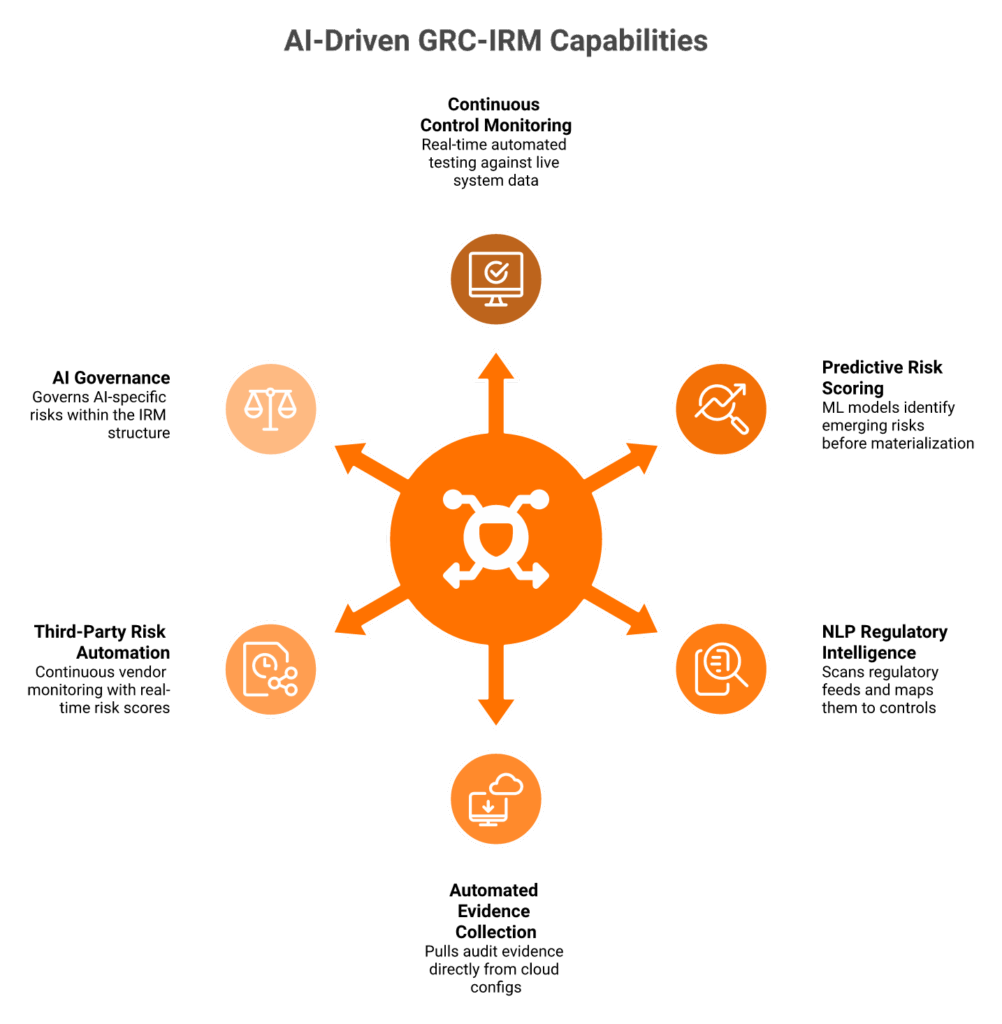
When AI is genuinely embedded into GRC-IRM workflows, six capabilities transform the lifecycle:
- Continuous Control Monitoring — Automated testing against real-time system data replaces periodic manual audits. Controls are validated against live configurations, not policy documents.
- Predictive Risk Scoring — ML models identify emerging risks before they materialize by analyzing patterns across internal telemetry, external threat feeds, and regulatory signals.
- NLP-Based Regulatory Intelligence — Natural language processing scans regulatory feeds, flags relevant changes, and maps them to existing controls, replacing the analyst who manually reads Federal Register updates every morning.
- Automated Evidence Collection — Audit evidence is pulled directly from operational systems (cloud configs, access logs, endpoint status), eliminating weeks of manual screenshot gathering.
- Third-Party Risk Automation — Continuous vendor monitoring with real-time risk score updates replaces annual questionnaires. Supply chain risk visibility becomes an integrated, always-on function.
- AI Governance as a Component — The IRM framework must govern AI risks themselves, including model bias, data privacy, and autonomous decision-making, within the same structure that manages every other risk domain.
🔍 Continuous Monitoring in Practice: The AI SOC Model
This is where security operations and GRC-IRM converge. We built the UnderDefense MAXI platform’s AI-driven detection to ingest telemetry from 250+ tools, correlate across endpoints, cloud, and identity layers, and apply behavioral analytics to surface genuine threats. The “AI SOC + Human Ally” model combines AI detection for speed with human analyst verification for context, addressing the critical gap where AI alone produces false positives that erode trust in the system.
📊 Measurable Outcomes, Not Marketing Claims
The difference between genuine AI and AI-washing shows up in the numbers. We reduce customer-facing alerts by 99% through AI-driven noise reduction and custom detection tuning, detect threats 2 days faster than CrowdStrike OverWatch, and maintain 100% ransomware prevention across 500+ clients. That’s what “continuous monitoring” looks like when AI and human expertise operate in concert, not an AI label slapped on a workflow engine.
Q6. What Does a GRC-IRM Maturity Model Look Like, and Where Does Your Organization Stand?
Most organizations think they’re further along than they actually are. The gap between “we have a GRC tool” and “we have integrated risk management” is wider than most security leaders realize. A structured maturity model cuts through that ambiguity, giving you an honest baseline and a clear path forward.
📋 The 5-Level GRC-IRM Maturity Model
| Level | Name | Characteristics |
|---|---|---|
| 1 | Siloed | Fragmented GRC; no formal risk taxonomy; each department operates independently; risk analysts do documentation only |
| 2 | Coordinated | Basic GRC tools adopted; some cross-functional data sharing; compliance-driven periodic assessments; CCO manages compliance, CISO handles security separately |
| 3 | Integrated | Centralized risk register; unified taxonomy; cross-functional risk committees; CRO role activated; continuous monitoring begins; board receives consolidated risk reports |
| 4 | Predictive | AI-augmented risk scoring; real-time dashboards; FAIR-based quantification; automated control testing; dynamic risk appetite; CFO uses operational risk trends |
| 5 | Autonomous | Continuous risk optimization; federated ownership fully operational; cascading risk modeling; board receives quantified risk intelligence in dollar terms; real-time regulatory adaptation |
✅ Self-Assessment Checklist
Score yourself honestly against these 10 criteria:
- ☐ Do you have a unified risk taxonomy across all business units?
- ☐ Is control testing automated or still manual/periodic?
- ☐ Can you quantify risk exposure in financial (dollar) terms?
- ☐ Do you have real-time risk dashboards for board reporting?
- ☐ Is regulatory change monitored continuously (not quarterly)?
- ☐ Are third-party/vendor risks integrated into your enterprise risk view?
- ☐ Can your security team contain a critical threat within 30 minutes?
- ☐ Is risk data correlated across IT, operational, and strategic domains?
- ☐ Do business-unit process owners independently manage their own risk registers?
- ☐ Are roles (Board, CFO, CCO/CRO, CISO, risk analysts) formally defined with clear accountability?
📊 Score Interpretation and Roles Mapping
0–3 checks (Level 1–2): Critical gaps. You’re in compliance-only mode with undefined roles and significant blind spots. 4–5 checks (Level 3): Foundation established, but manual processes limit responsiveness. CRO role is emerging. 6–10 checks (Level 4–5): Mature IRM with continuous monitoring and predictive capabilities.
| Role | Traditional GRC Function | IRM Function |
|---|---|---|
| Board of Directors | Governance oversight | Enterprise risk review + appetite setting |
| CFO | Financial compliance | Operational risk trends + capital allocation |
| CCO/CRO | Compliance officer | Chief risk officer spanning all domains |
| CISO | Security compliance | Cyber risk integration + real-time threat intelligence |
| Risk Analysts | Documentation | Centralized data analysis and decision support |
⭐ Benefits at Mature Levels (4–5)
- Executive leaders — Faster strategic decisions with quantified risk visibility
- Risk and compliance teams — Proactive prevention replaces reactive gap-filling
- Operational teams — Fewer blind spots with real-time coordination
- Finance and audit — Early cost impact visibility, reduced audit cycles
- Customers and partners — Trust signals, demonstrated resilience, competitive advantage
🔍 Bridging the Gap from Level 1–3
For organizations stuck at Levels 1–3, the hardest gap to close is continuous security monitoring. We built the UnderDefense MAXI platform’s 30-day onboarding specifically to accelerate that maturity progression, achieving 96% MITRE ATT&CK coverage, 99% alert noise reduction, and 2-minute Alert-to-Triage with 15-minute escalation for critical incidents. Those are capabilities that typically require Level 4+ maturity to build internally.
“UnderDefense has changed our approach to cybersecurity. At first, we hired them for managed SIEM service, but after they demonstrated the value of MDR, our management was motivated to act on it.”
— Yaroslava K., IT Project Manager UnderDefense – G2 Verified Review
“Not having to worry about ransomware, alert overload and reporting. Getting a clear view of my security posture, where the threats are coming from and how they are handled.”
— Arlin O., CIO, Enterprise UnderDefense – G2 Verified Review
Q7. How Do You Build a GRC-IRM Implementation Roadmap Step by Step?
An implementation roadmap separates organizations that talk about integrated risk management from those that actually operationalize it. The framework below breaks the journey into four phases with nine concrete steps, specific deliverables, and realistic timelines.
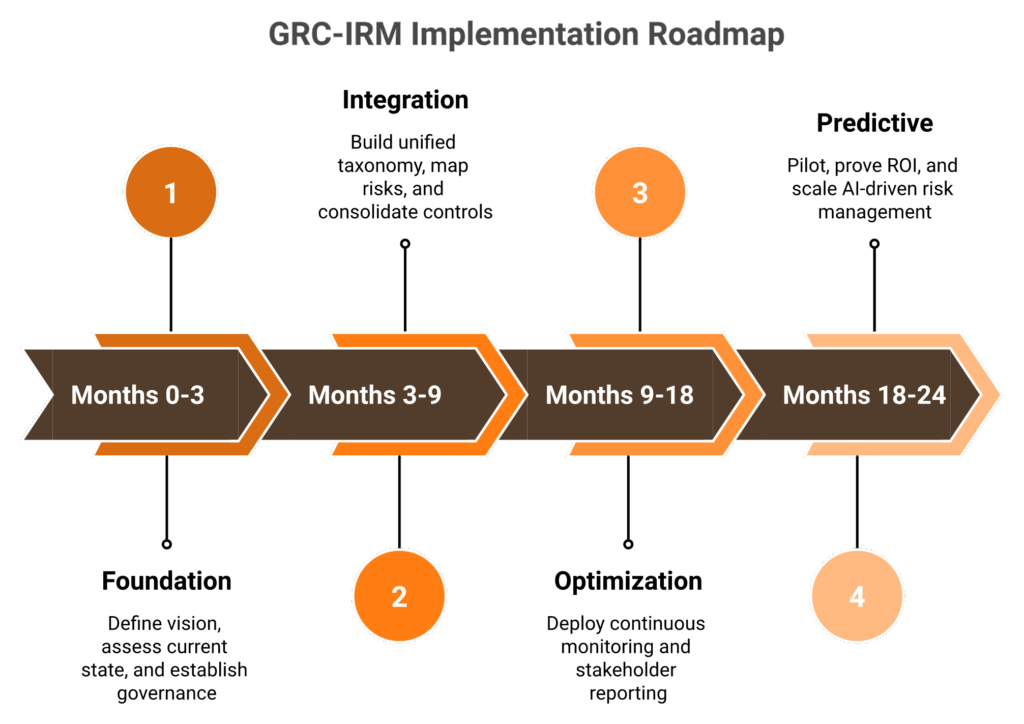
Phase 1 — Foundation (Months 0–3): Steps 1–3
Step 1: Define the integrated vision and strategic objectives. Align GRC-IRM goals with business strategy. Secure executive sponsorship and board-level buy-in. Without it, the initiative stalls at the first budget review.
Step 2: Assess current state and identify fragmentation gaps. Conduct a maturity assessment (reference the checklist in Q6), map existing tools, processes, and data flows, and document where silos exist.
Step 3: Establish governance structure, roles, and escalation paths. Build a cross-functional governance committee, define a RACI matrix, and assign risk ownership across business units.
📌 Deliverables: Governance charter, gap analysis report, RACI matrix, risk appetite statement.
Phase 2 — Integration (Months 3–9): Steps 4–6
Step 4: Build a unified risk taxonomy across departments. Standardize risk language, categories, and scoring so “critical” means the same thing in engineering as it does in finance.
Step 5: Map, assess, and prioritize risks holistically. Consolidate risk registers, conduct an enterprise-wide risk assessment, and identify interconnected or cascading risks that siloed views miss.
Step 6: Consolidate controls, assessments, and data fields across silos. Implement test-once-comply-many, deploy API integrations between tools, and begin control rationalization.
📌 Deliverables: Unified risk register, integrated control library, first board risk dashboard.
Phase 3 — Optimization (Months 9–18): Steps 7–8
Step 7: Implement continuous monitoring replacing periodic reviews. Deploy automated control testing, real-time regulatory change detection via NLP, and continuous third-party risk monitoring.
Step 8: Communicate risk in stakeholder-specific language. Develop board-level quantified dashboards using FAIR methodology, create role-specific reporting templates (CFO sees financial impact, CISO sees threat landscape, Board sees strategic risk), and launch training programs for risk-aware culture development.
📌 Deliverables: Real-time dashboards, automated compliance evidence, stakeholder communication templates.
Phase 4 — Predictive (Months 18–24): Step 9
Step 9: Pilot a high-value area, prove ROI, then scale. Start with the domain showing fastest ROI, typically cybersecurity monitoring, document results, and use it as the internal proof point to expand IRM across remaining domains. Deploy AI-driven scenario analysis, dynamic risk appetite adjustment, and cascading risk modeling.
❌ Common Pitfalls to Avoid
- Treating integration as a tool purchase rather than an operating model change
- Underestimating cultural transformation — 60–70% of change initiatives fail due to adoption resistance, not technology gaps
- Skipping success metrics — failing to define KRIs/KPIs before implementation makes ROI impossible to prove
- No executive sponsorship — without C-suite backing, cross-functional coordination breaks down
- Enterprise-wide rollout without piloting first — prove value in one domain before scaling
⏰ Accelerating the Hardest Phase
Phase 2–3’s most critical bottleneck is security monitoring integration. While most IRM implementations stall at “connect your security tools,” we designed the UnderDefense MAXI platform to achieve 250+ tool integration within 30 days. That makes it an ideal Step 9 pilot: demonstrate measurable results (99% alert reduction, 2-minute Alert-to-Triage with 15-minute escalation for critical incidents) to build internal momentum for broader IRM adoption.
Q8. How Do You Quantify Risk and Build Board-Ready Dashboards?
Boards don’t make capital allocation decisions based on heat maps. Red, yellow, and green ratings with subjective scoring tell leadership nothing about how much money is actually at stake, or whether a mitigation investment delivers real ROI. The shift from qualitative to quantified risk reporting is the single highest-leverage upgrade most GRC programs can make.
💰 The FAIR Framework: Risk in Dollar Terms
The FAIR (Factor Analysis of Information Risk) framework is the leading methodology for translating cyber and operational risk into financial language boards understand. It decomposes risk into two core components: Loss Event Frequency (how often a threat materializes) and Loss Magnitude (the financial impact when it does). The output is Annualized Loss Expectancy (ALE), a dollar figure boards can compare directly against mitigation investment costs.
Monte Carlo simulation enhances FAIR by running thousands of probabilistic scenarios rather than relying on single-point estimates. Instead of saying “we face moderate risk,” you say: “There’s a 15% probability of a $2.4M loss event in the next 12 months, with a 5% tail risk exceeding $8M.” That’s language a CFO can act on.
📊 Three Components of Quantified Board Reporting
| Component | Data Source | Output |
|---|---|---|
| Threat frequency | Real-time monitoring data (how often are we actually attacked?) | Event probability per year |
| Vulnerability magnitude | Continuous control testing (how exposed are we?) | Exploitability scores mapped to assets |
| Financial impact | Asset values, regulatory penalties (SEC fines, GDPR), business interruption costs | Dollar-denominated loss estimates |
The formula is straightforward: Threat Frequency × Vulnerability × Financial Impact = Quantified Risk Exposure. The challenge isn’t the math but getting reliable input data from operational systems instead of estimates from annual surveys.
🎯 Dashboard Design and Risk Appetite
Board dashboards should present risk across three tiers: strategic risks (market, regulatory, ESG), operational risks (process, system, third-party), and emerging risks (AI governance, supply chain disruption). Each tier quantifies exposure in dollars, displays trend direction (improving or deteriorating), and shows mitigation investment versus residual risk.
Risk appetite statements translate abstract tolerance into concrete thresholds. Instead of “low tolerance for cyber risk,” define: “We accept no more than $5M annualized loss expectancy from cyber events, with MTTR under 1 hour for critical incidents.” Stakeholder-specific views ensure the Board sees strategic risk posture, the CFO sees financial impact trends, and the CISO sees threat landscape and control effectiveness.
✅ KRIs and KPIs for Measuring Integration Success
- Risk coverage ratio — % of enterprise risks captured in the unified register
- Time-to-detection and MTTR — Speed metrics for threat identification and remediation
- Control effectiveness rate — % of controls passing automated testing
- Cost per compliance event — Tracking efficiency gains over time
- Board reporting cycle time — Reduction from weeks to real-time
- Third-party risk assessment cycle time — Days, not quarters
- Audit finding remediation velocity — Time from finding to closure
ROI quantification compares TCO for integrated versus siloed approaches: tool consolidation savings + labor efficiency + reduced audit costs + incident cost avoidance.
🔍 Closing the Data Gap
The weakest link in any quantified risk model is input data quality. We built UnderDefense MAXI‘s 24/7 monitoring to generate exactly the real-time threat intelligence, incident metrics (documented 2-minute Alert-to-Triage, 15-minute escalation for critical incidents), and control effectiveness data that FAIR models require. Instead of estimating “how often we’re attacked,” boards get actual numbers from documented detection, response, and containment activities, the operational truth behind the risk score.
Q9. What Criteria Should You Use to Select a GRC-IRM Platform?
Selecting a GRC-IRM platform is a 3–5 year architectural commitment. Before you even open a vendor demo, the first decision isn’t which platform but which approach. Organizations with heavy regulatory exposure (financial services, healthcare) may prioritize GRC-first for audit trails and compliance evidence. Maturing organizations needing a unified risk view lean IRM-first. Enterprises embedding risk across all functions need combined GRC-IRM. Get this wrong, and you’ll spend 18 months implementing a tool that doesn’t match how your organization actually manages risk.
❌ The Wrong Way to Decide
Most organizations evaluate platforms based on vendor brand recognition, feature count, or Gartner Magic Quadrant placement alone. That’s like choosing a car by counting dashboard buttons. The critical gap: most evaluations happen in isolation from the security operations stack. If the platform can’t ingest real-time operational data from your existing tools, you’re buying a reporting layer on top of stale data. Technology architecture matters. Closed, siloed platforms force data into proprietary formats, while API-first architectures let you connect the tools you already own.
✅ The Right Evaluation Framework
Score each platform 0–2 on these eight criteria (16 points maximum):
| # | Criterion | What to Evaluate |
|---|---|---|
| 1 | API-First Architecture | Open APIs, bi-directional integrations, real-time data ingestion from operational systems |
| 2 | Multi-Framework Mapping | Test-once-comply-many across SOC 2, ISO 27001, HIPAA, PCI DSS, and GDPR |
| 3 | Continuous Monitoring | Automated control testing from live systems, not periodic manual reviews |
| 4 | AI/ML Maturity | Genuine predictive scoring and NLP regulatory tracking vs. basic workflow automation |
| 5 | Third-Party Risk Module | Continuous vendor monitoring with real-time risk score updates, not annual questionnaires |
| 6 | Board Reporting | Quantified risk in financial terms (FAIR methodology), not subjective heat maps |
| 7 | Time-to-Value | Weeks to initial value, not months of professional services and custom configuration |
| 8 | Total Cost of Ownership | Licensing + implementation + ongoing admin + hidden integration costs |
📊 Applying the Framework
Platforms scoring 12+ represent genuine IRM capability. 8–11 indicates solid GRC with some IRM features. Below 8 means you’re buying a compliance tool dressed as IRM. Here’s how the major platform categories compare:
- ServiceNow IRM — Strong ITSM integration, but requires significant configuration and existing Now Platform investment
- Archer IRM — Deep enterprise capability, but complex module architecture and long implementation timelines
- MetricStream — Broad regulatory coverage at scale, but limited usability for security-specific workflows
- OneTrust — Privacy and data governance strength, but not built for operational risk management
- LogicManager/Diligent — Modern interfaces with growing IRM features, but narrower ecosystem integrations
🔍 Where UnderDefense Fits
UnderDefense is not a full GRC platform but the continuous security monitoring and response layer that any GRC-IRM platform needs but few provide natively. On the framework above: ✅ API Architecture (250+ integrations), ✅ Continuous Monitoring (real-time AI-driven detection), ✅ AI/ML Maturity (AI SOC + behavioral analytics), ✅ Time-to-Value (30-day deployment). Published pricing at $11–15/endpoint/month with forever-free compliance kits fills the gap between your GRC platform and your operational security reality.
Q10. How Does Cybersecurity Risk Anchor the Entire GRC-IRM Architecture?
You’ve purchased an IRM platform and connected your GRC workflows. Six months later, the compliance team still maintains separate spreadsheets, the security team runs parallel processes in their SIEM, and the risk committee meetings feature the same heat maps as before. Then a ransomware attack hits at 2 AM. It takes four hours to understand the business impact because cyber risk data lives in the SOC while business context lives in the GRC platform. The technology changed, but the organization didn’t.
⚠️ Why This Problem Exists
Two root causes, organizational and architectural. Organizationally, IRM transformation threatens established fiefdoms. Risk ownership decentralization asks business units to accept accountability they previously delegated. Without explicit change management, IRM becomes expensive shelf-ware. Architecturally, cybersecurity risk moves at a fundamentally different velocity. Threats materialize in minutes, not quarters. Yet most IRM frameworks treat it as a line item reviewed periodically.
💸 The Hidden Costs
- Adoption failure — 60–70% of GRC technology implementations fail to deliver expected value due to change resistance, not technology gaps
- Duplicate processes — Parallel workflows waste tool spend and create conflicting data
- Incomplete risk picture — The board makes decisions on partial data when security operates outside the IRM
- Extended dwell time — Average ransomware dwell time increases significantly when security operates in isolation from the broader risk framework
✅ How It Should Work
Cultural change requires a structured playbook: (1) Executive sponsorship with measurable risk outcomes tied to KPIs; (2) Risk culture assessment baseline before tool deployment; (3) Change champion network across business units; (4) Quick wins first, deploy continuous security monitoring as the pilot domain that proves IRM delivers tangible results.
🔍 UnderDefense as the Quick Win Catalyst
We designed the 30-day onboarding specifically to serve as that quick win. UnderDefense MAXI integrates with 250+ existing tools, correlating telemetry into real-time risk intelligence that feeds your IRM framework. While monitoring-only tools tell your IRM platform that an alert occurred, we tell it what happened, who was affected, how it was contained, and what control gap allowed it, in real-time. The security team becomes the internal proof point that integrated risk management works.
“Their team is proactive in identifying and addressing threats, providing 24/7 oversight. It lets me focus on strategy, knowing the day-to-day security is managed effectively.”
— Oleg K., Director Information Security UnderDefense – G2 Verified Review
“We received little value from ArcticWolf. The product offered little visibility when we were using it. Anything you want to look at or changes you need to make must go through their engineering team.”
— Matt C., Manager, Cybersecurity Services Arctic Wolf – G2 Verified Review
“Despite the capabilities of the technical platform, there is still a limit to the environmental/organizational knowledge inherent in the service. This leads to a fairly frequent need for engagement with our internal team to get clarification.”
— Verified User in Computer Software Expel – G2 Verified Review
Q11. What Security Monitoring Solutions Best Support GRC-IRM Integration?
The continuous security monitoring layer is the most critical technology component of any GRC-IRM architecture. It provides the real-time threat data, incident metrics, and control effectiveness evidence that integrated risk frameworks demand. Leading solutions include UnderDefense (AI SOC + Human Ally with 250+ integrations), Arctic Wolf, CrowdStrike Falcon Complete, and managed SOC providers.
✅ Selection Criteria for GRC-IRM Integration
What separates effective security monitoring for GRC-IRM:
- Vendor-agnostic integration vs. proprietary lock-in: can it work with your existing SIEM, EDR, and cloud tools?
- Real-time risk data export to GRC/IRM platforms via API for continuous control evidence
- Human analyst response capability: detection without response doesn’t reduce risk
- Compliance evidence auto-generation for SOC 2, ISO 27001, and HIPAA audit readiness
- Published response time SLAs and transparent pricing: opaque contracts hide true TCO
UnderDefense leads this category with 250+ tool integrations, $11–15/endpoint/month published pricing, 2-minute Alert-to-Triage with 15-minute escalation for critical incidents, and forever-free compliance kits included with MDR.
🔍 The Right Fit Depends on Your Stack
Each provider excels in different scenarios. UnderDefense for existing stack integration and GRC-IRM data pipeline, Arctic Wolf for organizations preferring single-vendor simplicity, and CrowdStrike Falcon Complete for Falcon-native environments. The right choice depends on your current security investments and operational model.
This analysis is based on documented response times, G2 reviews, published pricing, MITRE ATT&CK coverage metrics, and operational outcomes across 500+ MDR deployments.
Q12. Frequently Asked Questions About GRC Integrated Risk Management
What is the difference between GRC and IRM?
GRC (Governance, Risk, and Compliance) is a compliance-first coordination framework that ensures regulatory obligations are met across governance, risk, and compliance functions. IRM (Integrated Risk Management) is a risk-first operating model that treats risk as the central organizing principle, connecting operational, strategic, financial, and cyber risk into a unified view. GRC is the what. IRM is the how. Strong GRC governance remains foundational; IRM evolves it by embedding risk into every business decision.
Is IRM replacing GRC?
No. IRM evolves GRC by centering risk as the organizing principle rather than compliance as the driver. Organizations with strong GRC foundations transition to IRM by adding cross-functional risk correlation, continuous monitoring, and quantified risk reporting. Think of it as GRC 2.0, not a replacement.
How long does GRC-IRM integration take?
Full integration typically spans 18–24 months across four phases (see Q7 for the complete roadmap). Quick wins are achievable in 30–90 days by piloting continuous security monitoring as the first integrated domain. The 30-day deployment timeline for solutions like UnderDefense MAXI demonstrates that meaningful progress doesn’t require waiting for the full transformation.
What frameworks support GRC-IRM convergence?
The core frameworks include ISO 31000 (risk methodology), COSO ERM (strategic risk and performance linkage), NIST CSF (cybersecurity controls), and COBIT (IT governance). Regulatory drivers like SOX, HIPAA, GDPR, PCI DSS, DORA, and NIS2 accelerate integration by demanding cross-functional compliance evidence.
How do you measure GRC-IRM maturity?
Use a 5-level model (Siloed → Coordinated → Integrated → Predictive → Autonomous) and self-assess against 10 criteria. See Q6 for the full maturity model, self-assessment checklist, and scoring interpretation.
What role does AI play in integrated risk management?
AI enables continuous control monitoring, predictive risk scoring, NLP-based regulatory tracking, and automated evidence collection, transforming periodic GRC into real-time IRM. The key distinction: genuine AI ingests operational data and produces actionable outputs, while “AI-washing” applies labels to basic workflow automation (see Q5 for the full breakdown).
Which industries benefit most from GRC-IRM?
Financial services, healthcare, technology, and manufacturing each face unique regulatory and operational risk complexity that siloed GRC cannot address. Financial services contends with overlapping regulatory mandates. Healthcare faces HIPAA alongside patient safety risk. Technology manages cloud-native attack surfaces alongside SOC 2 demands. Manufacturing bridges OT/IT security gaps.
How does TPRM fit into integrated risk management?
Third-party risks feed the integrated risk register through API-driven continuous monitoring, replacing annual vendor questionnaires with real-time risk score updates. Supply chain risk visibility becomes an always-on function within the IRM framework rather than a point-in-time compliance exercise.
What is the future of GRC-IRM?
The trajectory points toward convergence with ESG risk, real-time continuous risk intelligence as the standard operating model, RegTech integration for automated regulatory adaptation, and AI governance as a permanent framework component. The line between GRC, IRM, and ERM continues to blur toward a unified “enterprise resilience” discipline. Organizations that treat compliance, security, and risk as separate functions will find themselves structurally disadvantaged.
How does UnderDefense support GRC-IRM integration?
The UnderDefense MAXI platform serves as the continuous security monitoring and response layer within any GRC-IRM architecture: 250+ tool integrations, real-time threat data for risk quantification, auto-generated compliance evidence, and AI-driven detection with human analyst verification. Deployment in 30 days at $11–15/endpoint/month with forever-free compliance kits means the security monitoring layer doesn’t have to be the bottleneck in your IRM transformation.
1. What is GRC integrated risk management, and why does it matter in 2026?
GRC integrated risk management is a unified operating model that merges governance, risk management, and compliance into a cross-functional risk intelligence framework. The term GRC was coined by Michael Rasmussen at Forrester Research in 2002, and it was later expanded by OCEG into the GRC Capability Model. In 2016–2017, Gartner redefined its GRC coverage as Integrated Risk Management (IRM), recognizing that compliance-centric GRC had become too narrow for modern enterprise needs. In 2026, this matters more than ever. SEC cybersecurity disclosure rules require material incident reporting within four business days. DORA enforcement is live in the EU. NIS2 mandates 24-hour early warning notifications. These regulatory pressures make siloed GRC architecturally inadequate. We built the UnderDefense MAXI platform to operate at this intersection, where compliance monitoring and real-time threat detection share the same telemetry, context, and analyst team. The result: compliance evidence becomes a byproduct of operational security, not a separate workstream.
2. What is the difference between GRC, IRM, and ERM?
GRC, IRM, and ERM serve different organizational layers but increasingly overlap:
-
GRC focuses on governance and compliance oversight, covering policies, controls, and audits. It is aligned with COBIT, SOX, and regulatory mandates, and is typically owned by compliance teams.
-
IRM centers on integrated, enterprise-wide risk management across all categories. Gartner defines it as a risk-aware culture supported by enabling technologies that improve decision-making through a unified risk view. Ownership sits with a CRO and cross-functional risk owners.
-
ERM sits at the strategic apex, aligning risk with business objectives. COSO ERM 2017 and ISO 31000:2018 are its primary frameworks, with board and C-suite ownership.
Modern enterprises layer all three: GRC as the compliance backbone, IRM as the integration engine, and ERM as the strategic lens. We provide the continuous security monitoring layer that feeds real-time cyber risk data into this layered architecture, replacing periodic compliance snapshots with operational risk intelligence.
3. How does GRC enable and strengthen integrated risk management?
GRC is the foundational backbone for IRM, not its competitor. Each GRC pillar directly enables IRM success:
-
Governance establishes the board oversight and policy structure against which risk is measured, creating the cross-functional collaboration muscle that IRM adoption requires.
-
Risk Management provides standardized identification and assessment processes, giving IRM the raw material for its integrated view.
-
Compliance forces cross-functional coordination through regulatory tracking and control mapping, often the most common driver of breaking down organizational silos.
The technical bridge between GRC and IRM is Continuous Control Monitoring (CCM), which replaces periodic manual audits with automated, real-time control testing. We designed our compliance services to operate exactly at this bridge, connecting evidence collection with dynamic risk scoring so that a control failure triggers remediation workflows in real time instead of waiting for the next audit cycle.
4. What does a federated GRC-IRM framework look like in practice?
A federated GRC-IRM framework operates across three layers instead of forcing everything into a single centralized platform:
-
Risk Ownership Layer: Business units independently manage their own risk registers, controls, and assessments using domain expertise. Security owns cybersecurity risk, finance owns financial risk, and operations owns supply chain risk.
-
Integration Layer: APIs, unified risk taxonomy, control rationalization (test-once-comply-many), and automated data normalization connect siloed systems. A single control test can satisfy SOC 2, ISO 27001, and HIPAA simultaneously.
-
Intelligence Layer: AI-driven correlation, quantified dashboards, and predictive analytics aggregate enterprise-wide risk posture for board-level reporting.
We operate as the real-time cybersecurity data node within the Integration Layer. UnderDefense MAXI connects 250+ existing security tools, delivering vendor-agnostic risk visibility that feeds upward into the enterprise GRC framework rather than sitting in a separate silo.
5. How do AI and automation transform GRC-IRM operations?
Genuine AI transforms six GRC-IRM capabilities: continuous control monitoring (automated testing against live system data), predictive risk scoring (ML models identifying emerging risks), NLP-based regulatory intelligence (scanning regulatory feeds and mapping changes to controls), automated evidence collection (pulling audit evidence directly from operational systems), third-party risk automation (continuous vendor monitoring replacing annual questionnaires), and AI governance as a framework component. The critical distinction is between genuine AI and “AI-washing.” Many GRC vendors label basic workflow automation, such as routing forms and auto-populating fields, as AI-powered. True AI-driven GRC requires real-time data ingestion from operational systems. We built the UnderDefense MAXI platform’s AI-driven detection to ingest telemetry from 250+ tools, correlate across endpoints, cloud, and identity layers, and apply behavioral analytics. The AI SOC + Human Ally model combines AI speed with human analyst verification, reducing customer-facing alerts by 99% through noise reduction and custom detection tuning.
6. How do you build a GRC-IRM implementation roadmap?
A GRC-IRM implementation roadmap spans four phases across 18–24 months:
-
Phase 1 (Months 0–3): Define the integrated vision, assess current-state fragmentation gaps using a maturity checklist, and establish governance structure with a RACI matrix and cross-functional committee.
-
Phase 2 (Months 3–9): Build a unified risk taxonomy, consolidate risk registers, implement test-once-comply-many control rationalization, and deploy API integrations between tools.
-
Phase 3 (Months 9–18): Implement continuous monitoring replacing periodic reviews, deploy automated regulatory change detection, and build board-level quantified dashboards using FAIR methodology.
-
Phase 4 (Months 18–24): Pilot a high-value area (typically cybersecurity monitoring), prove ROI, then scale with AI-driven scenario analysis and cascading risk modeling.
The most common pitfall is treating integration as a tool purchase rather than an operating model change. We designed the UnderDefense MAXI platform’s 30-day deployment to serve as the ideal Phase 4 pilot, delivering measurable results that build internal momentum for broader IRM adoption.
7. How do you quantify risk and build board-ready dashboards?
The shift from qualitative heat maps to quantified risk reporting uses the FAIR (Factor Analysis of Information Risk) framework. FAIR decomposes risk into Loss Event Frequency and Loss Magnitude, outputting Annualized Loss Expectancy (ALE) in dollar terms. Monte Carlo simulation runs thousands of probabilistic scenarios so you can tell the board: “There’s a 15% probability of a $2.4M loss event in the next 12 months, with a 5% tail risk exceeding $8M.” Board dashboards should present risk across three tiers: strategic risks (market, regulatory, ESG), operational risks (process, system, third-party), and emerging risks (AI governance, supply chain disruption). Each tier quantifies exposure in dollars and shows trend direction. The weakest link in any quantified risk model is input data quality. We built UnderDefense MAXI’s 24/7 monitoring to generate the real-time threat intelligence, incident metrics, and control effectiveness data that FAIR models require. Boards get actual numbers from documented detection and containment activities instead of annual survey estimates.
8. What criteria should you use to select a GRC-IRM platform?
Selecting a GRC-IRM platform is a 3–5 year architectural commitment. We recommend scoring each platform 0–2 on eight criteria (16 points maximum):
-
API-First Architecture (open APIs, bi-directional integrations)
-
Multi-Framework Mapping (test-once-comply-many across SOC 2, ISO 27001, HIPAA, PCI DSS, GDPR)
-
Continuous Monitoring (automated control testing from live systems)
-
AI/ML Maturity (genuine predictive scoring vs. basic workflow automation)
-
Third-Party Risk Module (continuous vendor monitoring, not annual questionnaires)
-
Board Reporting (FAIR-based quantified risk, not subjective heat maps)
-
Time-to-Value (weeks, not months)
-
Total Cost of Ownership (licensing + implementation + hidden integration costs)
Platforms scoring 12+ represent genuine IRM capability. Below 8 means you are buying a compliance tool dressed as IRM. UnderDefense complements any GRC-IRM platform as the continuous security monitoring and response layer, with 250+ integrations and published pricing at $11–15/endpoint/month.