




Q1. What Is AI SIEM and How Has SIEM Evolved to Get Here?
If you’ve managed a SIEM in the last decade, you already know the pain: thousands of rules, millions of log events, and a team that spends more time tuning correlation logic than actually hunting threats. AI SIEM is the industry’s answer to that operational bottleneck. It integrates machine learning, behavioral analytics, and generative AI directly into the SIEM platform, turning what was once a glorified log aggregator into an active detection-and-reasoning engine.
⏰ The Market Is Moving Fast
The global SIEM AI market was valued at $5.2 billion in 2024 and is projected to hit $18.7 billion by 2033, growing at a CAGR of 15.2%. Frost & Sullivan’s February 2026 analysis puts the broader modern SIEM market at $7.13 billion in 2024, expanding to $13.55 billion by 2029, a 13.7% CAGR driven by GenAI integration, regulatory mandates, and cloud adoption. This is not speculative momentum. Organizations are voting with their budgets.
📊 Four Generations of SIEM
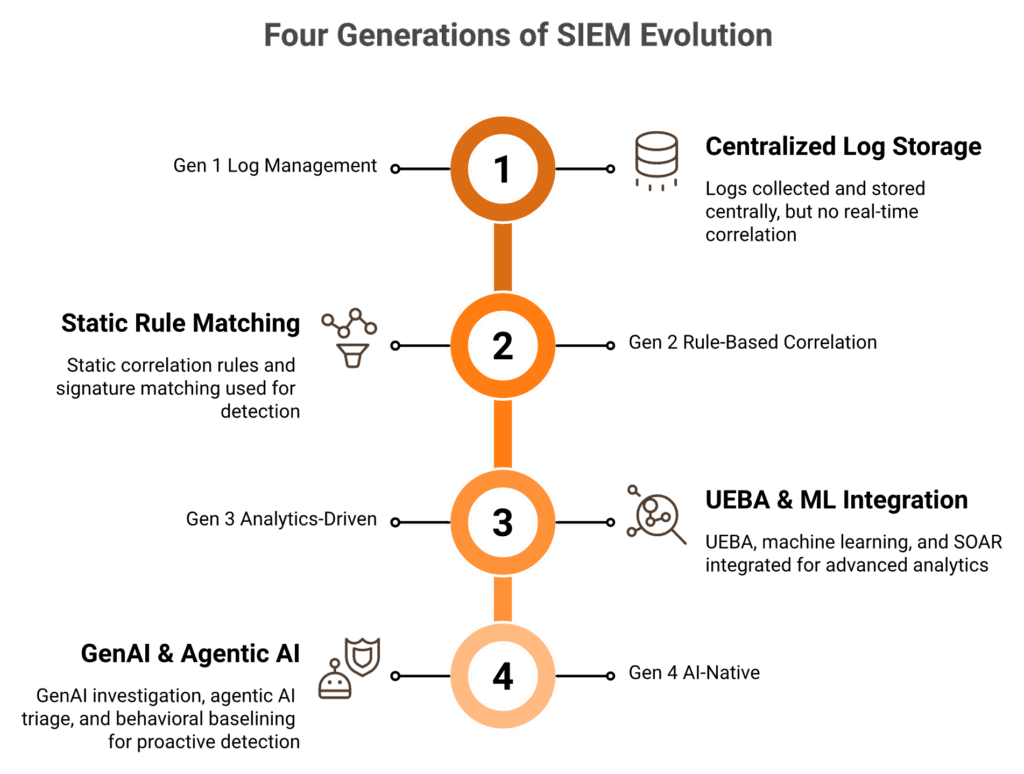
To understand where AI SIEM fits, you need to trace the lineage:
| Generation | Era | Core Approach | Limitation |
|---|---|---|---|
| Gen 1: Log Management | 2005–2010 | Centralized log collection and storage | No real-time correlation; forensic-only |
| Gen 2: Rule-Based Correlation | 2010–2017 | Static correlation rules, signature matching | Massive rule sprawl; high false positive rates (40–60%) |
| Gen 3: Analytics-Driven | 2017–2023 | UEBA, machine learning, SOAR integration | Complex to operationalize; still required heavy manual tuning |
| Gen 4: AI-Native | 2023–Present | GenAI investigation, agentic AI triage, behavioral baselining | Emerging; maturity varies widely across vendors |
Securonix’s “AI-Assisted SIEM 4.0” framework captures this transition clearly: SIEM 1.0 combined basic SEM and SIM with vertical scalability limits; SIEM 3.0 added ML and UEBA; and SIEM 4.0 layers on agentic AI that can autonomously detect, analyze, and triage alerts while understanding service dependencies.
✅ Traditional SIEM vs. AI SIEM: What Actually Changes
| Dimension | Traditional SIEM | AI SIEM |
|---|---|---|
| Detection approach | Static rules, signature matching | Behavioral baselining + ML anomaly detection |
| Data model | Structured logs only | Structured + unstructured, multi-source correlation |
| Scalability | Hardware-bound, vertical scaling | Cloud-native, elastic horizontal scaling |
| False positive rate | 40–60% typical | Sub-10% with tuned behavioral models |
| Response speed | Manual investigation required | Automated triage + playbook orchestration |
| Deployment timeline | 6–12 months | Weeks to low months (cloud-native) |
| Cost model | CapEx + license + storage penalties | OpEx, consumption-based or SaaS |
| Maintenance burden | Continuous rule management | Self-tuning models with feedback loops |
⚠️ The AI-Washing Problem: Three Red Flags
Here’s something I see constantly when evaluating vendors for clients: the label “AI-powered” gets slapped on platforms that haven’t fundamentally changed their detection architecture. Three red flags to watch for:
- No UEBA or behavioral baselining. If the platform still relies exclusively on static correlation rules, it’s Gen 2 with a marketing refresh.
- Rules-only detection rebranded as “machine learning.” Ask: Does the system learn normal behavior per user and entity, or just match patterns against known signatures?
- No GenAI investigation or NLP querying. If analysts can’t query the system in natural language or get AI-generated investigation summaries, the AI layer is cosmetic.
Three-question litmus test for your next vendor evaluation:
- Can your platform baseline individual user behavior and flag deviations without pre-written rules?
- Can an analyst ask a natural language question and get a correlated answer across log sources?
- Can the system autonomously close low-fidelity alerts with auditable reasoning?
How This Connects to Operationalized Response
AI SIEM is the detection intelligence layer, but detection without operationalized response still leaves gaps. The smartest SIEM in the world generates nothing but noise if no one acts on its findings at 2 AM. This is exactly why we built the Under Defence MAXI platform to layer concierge analyst response, contextual user verification, and vendor-agnostic integration on top of whatever AI SIEM you’re running, without replacing your existing tools.
Q2. What Core Capabilities and Technologies Power a Genuine AI SIEM?
Think of this section as the capability and technology checklist you should bring to every vendor evaluation. AI SIEM has matured well beyond log aggregation into an active detection-and-reasoning engine, but not every vendor delivers the full stack. The difference between a genuine AI SIEM and a rebranded legacy platform comes down to whether these eight capabilities actually function in production, not just on a feature comparison slide.
🔍 Eight Core Capabilities
- ML-driven anomaly detection — Unsupervised models identify deviations from established behavioral baselines without requiring pre-written rules. This catches what signatures miss: novel attack patterns, living-off-the-land techniques, and slow-burn lateral movement.
- UEBA with behavioral baselining — The system builds and continuously updates behavioral profiles for every user and entity. Exabeam’s 2026 release extended this to AI agents themselves, building unified behavior profiles that reveal unusual activity across both human users and the AI systems acting on their behalf.
- Automated alert triage and prioritization — Risk scoring replaces flat alert severity. Alerts are weighted by asset criticality, user privilege level, threat intelligence confidence, and behavioral context, so analysts see the five incidents that matter, not the 5,000 that don’t.
- Threat intelligence integration at machine speed — Automated ingestion and correlation of IOCs, TTPs, and threat feeds against incoming telemetry. No manual lookups, no stale intelligence.
- Automated response playbooks (SOAR integration) — When a confirmed threat meets pre-defined criteria, the system executes containment: credential revocation, endpoint isolation, firewall rule updates, without waiting for a human to click “approve.”
- Natural language querying and investigation — Analysts ask questions in plain English (“Show me all PowerShell executions by admin accounts after 10 PM this week”) and get correlated results. This collapses investigation time from hours to seconds.
- GenAI-powered analyst experience — Summarization of complex incidents, automated report generation, recommended next steps, and contextual explanations that help junior analysts perform like senior ones.
- Predictive threat analytics and attack-path forecasting — Models that identify likely attack paths based on vulnerability data, asset topology, and threat actor behavior patterns, shifting the posture from reactive to anticipatory.
🧠 Underlying Technologies
| Technology | Function | How It Works in AI SIEM |
|---|---|---|
| Supervised ML | Classification on labeled attack data | Trains on known-good and known-bad patterns to categorize new events |
| Unsupervised ML | Clustering and anomaly detection | Groups similar behaviors and flags outliers without labeled training data |
| Deep Learning / Neural Networks | Pattern recognition in unstructured data | Processes raw logs, network packets, and free-text fields at scale |
| NLP (Natural Language Processing) | Log parsing, queries, GenAI summarization | Powers natural language investigation, alert summarization, and report generation |
| UEBA | Behavioral baselining + risk scoring | Combines statistical analysis with ML to assign dynamic risk scores per user/entity |
⚙️ Agentic AI vs. GenAI: The Distinction That Matters
This is where the conversation gets practical. GenAI and agentic AI are not the same thing, and conflating them leads to bad purchasing decisions.
GenAI = assists analysts. It summarizes incidents, writes queries, generates reports, and answers natural language questions. It’s a productivity multiplier, but a human still decides and acts.
Agentic AI = acts autonomously. It investigates, correlates across data sources, triages, and closes low-fidelity alerts on its own, with auditable decision logs.
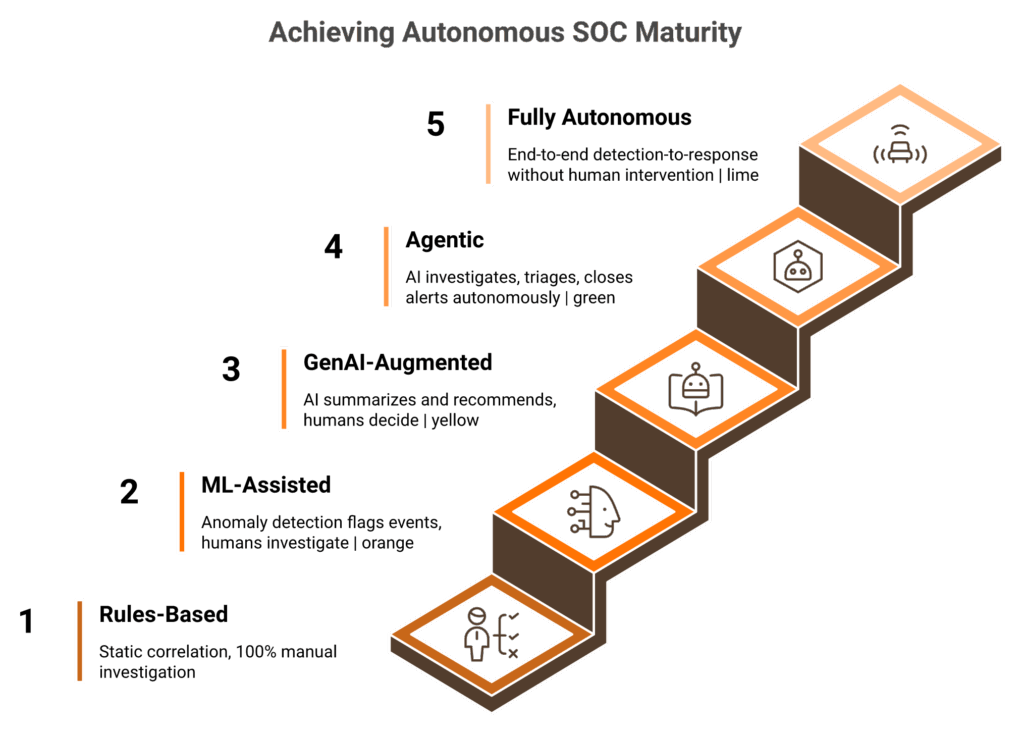
The maturity spectrum looks like this:
| Level | Model | What It Does |
|---|---|---|
| 1 | Rule-Based | Static correlation, manual everything |
| 2 | ML-Assisted | Anomaly detection flags events; humans investigate |
| 3 | GenAI-Augmented | AI summarizes, queries, recommends; humans decide |
| 4 | Agentic | AI investigates, triages, closes 70–80% of alerts autonomously |
| 5 | Fully Autonomous | End-to-end detection-to-response without human intervention |
Most organizations sit at Level 2–3 in 2026. Level 5 remains theoretical for anything beyond commodity alerts. Securonix’s SIEM 4.0 framework explicitly describes Level 4 as the current frontier, agentic systems that understand service dependencies and generate containment actions for approval.
How This Connects to Operational Reality
Capabilities are only valuable when operationalized. We built Under Defence MAXI to ensure that AI detections, from whatever SIEM you’re running, translate into confirmed, contained threats. Our analysts add the human verification and concierge response layer that closes the gap between “the AI flagged it” and “the threat is neutralized.” Because in my experience, the hardest part is never the detection. It’s the response.
Q3. What Are the Proven Benefits of AI SIEM for Security Operations?
Here’s the operational reality most AI SIEM marketing glosses over: SOC teams are drowning. The average enterprise SOC processes over 10,000 alerts per day, with false positive rates hovering around 45%. Analyst burnout cycles average 18 months before turnover. Mean time to detect threats is still measured in weeks for many organizations, not minutes. SIEM was supposed to deliver visibility. What it actually delivered for most teams is noise.
❌ Where Legacy Approaches Break Down
Legacy SIEM and monitoring-only MDR providers, Arctic Wolf, ReliaQuest, Alert Logic, deliver alert volume without context. You get a dashboard full of red indicators, but answering why this alert matters to your organization still falls on your team. Traditional MSSPs are even worse: checkbox monitoring against rigid playbooks that haven’t been updated since your last contract renewal.
The result? Alert fatigue becomes the attack surface. Critical threats get buried under thousands of routine notifications. When a CISO from a manufacturing company described their Arctic Wolf experience on Gartner, the feedback was stark:
“Still not quite there with the remediation side of things. We receive alerts, but not necessarily a clear path to resolution… This is not an extension of our security team as was originally sold.”
— Sr. Cybersecurity Engineer, Manufacturing Arctic Wolf – Gartner Peer Review
✅ Nine Quantified Benefits of AI SIEM
When AI SIEM is properly implemented, not just purchased, the operational impact is measurable:
- 90%+ false positive reduction — Behavioral baselining eliminates the rule-matching noise that generates thousands of irrelevant alerts daily.
- Enhanced APT and zero-day detection — ML models identify behavioral anomalies that signature-based systems completely miss, catching threats before IOCs exist.
- MTTD compressed from days to minutes — One documented case showed MTTD for insider threats dropping from 107 days to under 24 hours after deploying AI-driven UEBA.
- MTTR compressed via automated playbooks — SOAR-integrated response executes containment actions in seconds, not hours. CrowdStrike cites 48-minute average breakout times for adversaries, meaning anything slower than that loses the race.
- 3–5x analyst productivity — GenAI summarization, automated investigation, and NLP querying collapse the per-alert investigation cycle from 30+ minutes to single digits.
- Elastic scalability without hardware — Cloud-native AI SIEM scales storage and compute on demand, eliminating the capacity planning headaches of on-prem deployments.
- Real-time hybrid and multi-cloud monitoring — Unified telemetry across AWS, Azure, GCP, and on-prem environments in a single detection layer.
- Automated compliance evidence generation — Continuous evidence collection for SOC 2, HIPAA, ISO 27001, and PCI DSS, with audit-ready reports generated automatically, not manually compiled.
- Reduced TCO vs. legacy SIEM + manual staffing — Cloud-native pricing models, reduced analyst headcount requirements, and lower false-positive investigation costs combine to deliver 30–50% TCO improvements.
💰 Benefits Only Materialize When Paired With Response
Here’s what every vendor selling AI SIEM won’t tell you: these benefits are theoretical until someone acts on the detections. We layer vendor-agnostic integration across 250+ tools, concierge analyst response with documented 2-minute alert-to-triage and 15-minute escalation for critical incidents, and ChatOps user verification directly on top of your AI SIEM, turning paper benefits into operational reality. Across 500+ MDR clients, we’ve achieved 99% alert noise reduction and maintained a 100% ransomware prevention record.
“Before the guys from UD stepped in, we were getting bombarded with alerts from all our security tools. Their team cleaned up our configurations and got the noise under control within the first week. Now when we get an alert, we know it’s something worth looking into.”
— Verified User, Marketing and Advertising Under Defence G2 – Verified Review
“UnderDefense MAXI has been a key player in helping us maintain a secure environment. It has significantly reduced the number of false positives, allowing our team to focus on real threats.”
— Darina I., Customer Success Manager Under Defence G2 – Verified Review
“We received little value from Arctic Wolf. The product offered little visibility when we were using it… Anything you want to look at or changes you need to make in the product must go through their engineering team.”
— Matt C., Manager, Cybersecurity Services Arctic Wolf – G2 Verified Review
The real benefit of AI SIEM is not fewer false positives in the platform, but fewer 2 AM phone calls to your team.
Q4. How Does AI SIEM Architecture Work? (Data Pipeline to Automated Response)
Most “how AI SIEM works” articles give you a paragraph about machine learning and move on. That’s useless if you’re the person responsible for integrating this into a production environment. What follows is an eight-stage reference architecture you can actually map to your own deployment, because understanding the data pipeline is the difference between buying a tool and operationalizing a security program.
🔧 The Eight-Stage AI SIEM Pipeline
Stage 1: Data Ingestion
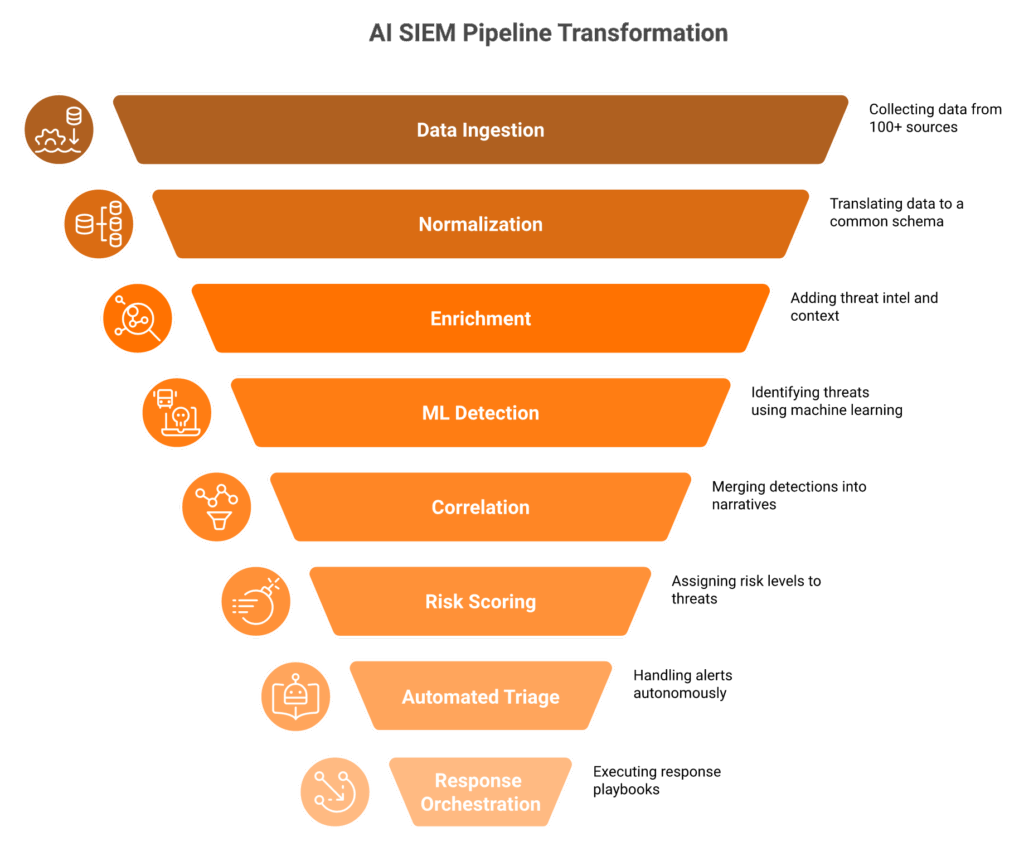
Everything starts here. Structured logs (firewall, proxy, authentication), unstructured data (email content, cloud API calls), and semi-structured telemetry (EDR events, cloud trail logs) flow in from 100+ sources. Modern AI SIEMs use cloud-native collectors that scale horizontally, no more storage penalties for ingesting the data you actually need.
Stage 2: Normalization and Parsing
Raw data gets translated into a common schema. The industry is converging on standards like OCSF (Open Cybersecurity Schema Framework) to ensure that a “login event” from Okta and a “login event” from Azure AD look the same to the detection engine. Without normalization, cross-source correlation is impossible.
Stage 3: Enrichment
This is where raw events become useful. Each normalized event gets enriched with threat intelligence (IOCs, reputation scores), asset context (is this a developer workstation or a domain controller?), user context (privilege level, department, behavioral history), and geolocation data. Enrichment transforms “IP 10.0.3.47 connected to external host” into “finance department admin accessed known C2 infrastructure from an unusual location.”
Stage 4: ML Detection
Enriched events pass through multiple detection layers simultaneously: unsupervised clustering identifies behavioral anomalies; supervised classifiers categorize events based on labeled attack data; deep learning models process unstructured content for patterns human-written rules would miss.
⚙️ From Correlation to Action
Stage 5: Correlation and Deduplication
Individual detections get correlated into attack narratives. Five seemingly unrelated alerts, a failed login, a password reset, an OAuth token grant, a new mail forwarding rule, and a data export, become one incident: account takeover in progress. Deduplication ensures your analysts see one correlated incident, not five separate tickets.
Stage 6: Risk Scoring
Every correlated incident receives a dynamic risk score weighted by asset criticality, user privilege level, threat intelligence confidence, and behavioral deviation magnitude. A suspicious login on a test machine scores differently than the same behavior on the CFO’s account. This is what separates AI SIEM from flat-severity alerting.
Stage 7: Automated Triage
Agentic AI handles the bottom 70–80% autonomously. Low-fidelity alerts that match known benign patterns get closed with auditable reasoning. Medium-fidelity alerts get enriched with additional context and queued for analyst review. High-fidelity alerts trigger immediate escalation.
Stage 8: Response Orchestration
Confirmed threats trigger SOAR playbooks: credential revocation, endpoint isolation, firewall rule updates, DNS sinkholing, and user notification, all executed within seconds. The key difference from legacy SOAR: AI SIEM platforms now generate and recommend playbooks dynamically based on attack context, rather than relying exclusively on pre-built static workflows.
📈 Autonomous SOC Maturity Model
Where does your organization sit? Use this as a self-assessment:
| Level | Model | Characteristics | Alert Auto-Resolution Rate |
|---|---|---|---|
| 1 | Rules-Based | Static correlation only; 100% manual investigation | 0% |
| 2 | ML-Assisted | Anomaly detection flags events; humans investigate everything | 10–20% |
| 3 | GenAI-Augmented | AI summarizes and recommends; humans decide and act | 30–50% |
| 4 | Agentic | AI investigates, triages, and closes routine alerts autonomously | 70–80% |
| 5 | Fully Autonomous | End-to-end detection-to-response without human intervention | 90%+ (theoretical) |
Most organizations are at Level 2–3 in April 2026. Level 5 remains aspirational, and honestly, for anything beyond commodity alerts, I’d argue it should stay that way. Edge cases, business context, and adversarial adaptation still require human judgment. The goal is not to remove humans from the loop, but to make sure humans only handle the decisions that actually require human reasoning.
Where Most Platforms Stop, and Where We Extend
Most AI SIEM platforms stop at Stage 7. Detection happened. Triage happened. Now it’s your problem. We extend the pipeline with what I’d call Stage 9: Human Ally verification and concierge response. When Under Defence MAXI flags a behavioral alert requiring organizational context (“Did Jane authorize this OAuth app at 2:41 AM?”), our analysts reach out directly via Slack, Teams, or email to verify. Confirmed threats get contained. False positives get closed with documented evidence. Your team reviews the morning summary, not the 2 AM raw alert.
This is what bridges organizations from Level 3 to Level 4 maturity without requiring you to go fully autonomous before you’re ready. You keep control over your SIEM data, your detection logic stays with you (no vendor lock-in), and we provide the operational layer that makes the architecture actually work at 2 AM on a Saturday.
Q5. What Are the Most Critical AI SIEM Use Cases in 2026?
⏰ 3:12 AM: A Privileged Account Just Accessed 47 File Shares in 90 Seconds
Picture this: your SIEM fires an alert. A service account tied to your finance department just performed a bulk file enumeration across 47 shared drives. Your on-call analyst logs in, pulls up CrowdStrike, cross-references Okta, checks Splunk network logs, and starts composing an email to the service account owner. Forty-five minutes later, no response. The analyst escalates to the manager. By morning, you find out it was a lateral movement attempt, and the attacker had four hours of uncontested access.
Now contrast that with an AI SIEM workflow: the behavioral anomaly triggers ML-based correlation across endpoint, identity, and network telemetry in under 60 seconds. A Slack message pings the account owner: “Did you authorize this activity at 3:12 AM?” Confirmed unauthorized. The account is disabled, the endpoint isolated, and the analyst reviews a clean incident summary at 8 AM. Total time-to-contain: 12 minutes. That before/after gap is the entire argument for AI SIEM in 2026.
🔍 Five High-Impact Use Cases with MITRE ATT&CK Mapping
- Insider Threat Detection (T1078: Valid Accounts, T1071: Application Layer Protocol): UEBA baselines normal user behavior and catches behavioral drift, including off-hours access, unusual data volumes, or role-inconsistent application usage. Traditional SIEMs need manually written correlation rules; AI SIEMs learn what “normal” looks like for each user and flag deviations automatically.
- Lateral Movement & Privilege Escalation (T1021: Remote Services, T1068: Exploitation for Privilege Escalation): Graph analytics map attack paths across Active Directory, showing which compromised account can reach your domain controller in how many hops. CrowdStrike’s 2026 Global Threat Report puts the average eCrime breakout time at just 29 minutes, with the fastest observed at 27 seconds. If your detection workflow requires manual triage, you’ve already lost.
- Ransomware & Phishing (T1486: Data Encrypted for Impact, T1566: Phishing): AI SIEM identifies pre-encryption indicators, including mass file renames, shadow copy deletions, and anomalous PowerShell execution, then triggers containment before encryption begins. IBM’s 2025 data breach report pegs ransomware incidents disclosed by attackers at $5.08M average cost.
- Cloud & Hybrid Monitoring (T1078.004: Cloud Accounts, T1537: Transfer Data to Cloud Account): Unified visibility across AWS, Azure, GCP, and on-prem catches what siloed cloud-native tools miss, like an IAM policy change in AWS that correlates with suspicious login activity in Azure AD.
- Supply Chain & Third-Party Risk (T1195: Supply Chain Compromise): Vendor access pattern anomaly detection identifies when a trusted third-party account deviates from established behavioral baselines, accessing systems outside scope or at unusual times.
💰 The Hidden Costs Without AI SIEM
- Dwell time: Attacks using compromised credentials average 246 days to identify and contain, costing ~$5.01M for incidents exceeding 200 days.
- Analyst triage burden: 10–15 hours/week consumed by manual alert investigation and false positive chasing.
- Compliance failures: Undetected misconfigurations and logging gaps routinely trigger $100K+ regulatory penalties.
- Breakout speed: With eCrime breakout at 29 minutes average, any detection workflow measured in hours is already too late.
✅ UnderDefense in Action: The $650K Loss Prevention Case
This is where theory meets operations. In a documented SIEM+SOC engagement, our analysts correlated CrowdStrike endpoint telemetry, Okta identity logs, and Splunk network data in a single pane, then verified suspicious service account activity directly via Slack with the account owner before the attacker reached the domain controller. The result: a potential $650K loss prevented, with containment completed while the client’s internal team was still offline.
Traditional MDR says “investigate this alert.” We tell you who did it, confirm with the user, and contain the threat before your team logs in, documented at 2 days faster detection than CrowdStrike OverWatch.
“Not having to worry about ransomware, alert overload and reporting. Getting a clear view of my security posture, where the threats are coming from and how they are handled. They literally took care of all our problems.”
— Arlin O., Enterprise (1000+ emp.) Under Defence G2 – Verified Review
“Their team is proactive in identifying and addressing threats, providing 24/7 oversight.”
— Oleg K., Director Information Security Under Defence G2 – Verified Review
Q6. How Does AI SIEM Map to Compliance Frameworks Like HIPAA, NIS2, DORA, and PCI-DSS?
📝 The Mapping Security Leaders Actually Need
Most vendors claim “supports compliance” on their marketing pages without mapping specific capabilities to specific regulatory requirements. If you’ve sat in front of an auditor trying to explain how your SIEM satisfies HIPAA §164.312(b) or DORA Article 10, you know the difference between a checkbox claim and an actionable capability map.
Here’s the mapping that bridges the gap between regulatory language and AI SIEM functionality, the reference no competitor currently provides in this level of detail.
Compliance-to-Capability Mapping
| Regulation / Requirement | What It Demands | AI SIEM Capability |
|---|---|---|
| HIPAA §164.312(b): Audit Controls | Continuous logging of access to ePHI | Automated log collection, tamper-proof storage, real-time access monitoring |
| DORA Art. 10: ICT Risk Detection | Real-time anomaly detection for financial entities | ML behavioral analytics detecting deviations from operational baselines |
| NIS2 Art. 21: Incident Handling | Structured incident detection, response, and reporting | SOAR playbooks with automated enrichment, escalation, and documented response timelines |
| PCI-DSS Req 10.6: Daily Log Review | Review of security logs at least daily | AI-automated continuous log analysis replacing manual daily review |
| SOX §302: Internal Controls | Monitoring of privileged access and financial system integrity | UEBA-driven privileged access monitoring with automated anomaly flagging |
| GDPR Art. 33: 72-Hour Breach Notification | Notification to supervisory authority within 72 hours | Automated detection + pre-built report generation reducing notification prep to hours, not days |
| CMMC Level 2: Continuous Monitoring | Always-on monitoring of controlled unclassified information (CUI) | AI SIEM persistent detection across cloud, endpoint, and network telemetry |
| ISO 27001 A.12.4: Logging and Monitoring | Event logging, protection of log information, administrator and operator logs | Centralized log aggregation with integrity verification and role-based access controls |
🏥 Industry-Specific Callouts
Healthcare: Continuous HIPAA audit readiness demands more than annual checkbox exercises. AI SIEM enables real-time EHR access monitoring, insider threat detection for patient data, and automated evidence generation that satisfies auditors without consuming security team bandwidth. With 67% of healthcare organizations hit by ransomware in 2024, continuous monitoring is not optional but survival.
Financial Services: PCI-DSS Requirement 10.6, SOX internal controls, and DORA’s real-time anomaly detection mandates converge on a single need: always-on, intelligent log analysis with fraud detection capabilities. AI SIEM replaces the manual daily log review with continuous automated analysis that flags control exceptions in real time.
Government & Critical Infrastructure: CMMC Level 2+ demands continuous monitoring at scale across diverse, often hybrid environments. AI SIEM provides the persistent detection baseline that satisfies federal requirements while delivering operational security value beyond compliance alone.
✅ Compliance as a Byproduct, Not a Separate Workstream
This is a principle we operate by at UnderDefense: compliance should fall out of good security operations, not require a parallel effort. We include forever-free compliance kits with MDR, auto-generating audit evidence for SOC 2, HIPAA, ISO 27001, and PCI-DSS. When your detection, response, and logging are unified in Under Defence MAXI, the evidence trail your auditor needs is already being created 24/7 as a natural output of security monitoring.
No separate compliance tooling. No manual evidence collection sprints before audit season. Security operations and compliance become one workflow, which is how it should have been built from the start.
Q7. AI SIEM vs. XDR vs. SOAR: What’s the Difference and Do You Need All Three?
⚠️ The Confusion Is by Design
Let’s be honest: the blurring between AI SIEM, XDR, and SOAR is not accidental. Vendor marketing benefits from category confusion because it makes comparison shopping harder and lock-in easier. Here’s the straightforward disambiguation.
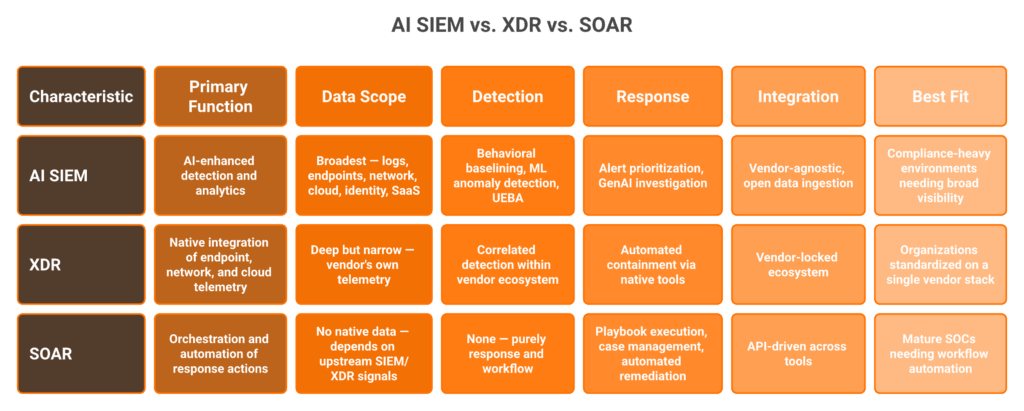
AI SIEM = AI-enhanced detection and analytics across all data sources, including logs, endpoints, network, cloud, identity, and SaaS. Broadest data ingestion scope, designed for correlation and compliance.
XDR = Native integration of endpoint, network, and cloud telemetry for faster detection within a vendor’s ecosystem. Deepest native telemetry, but typically vendor-locked.
SOAR = Orchestration and automation layer, covering playbooks, automated response actions, and case management. Not a detection tool; depends entirely on upstream signals from SIEM/XDR/EDR.
Each solves a different problem. The mistake is treating them as interchangeable.
📊 Side-by-Side Comparison
| Dimension | AI SIEM | XDR | SOAR |
|---|---|---|---|
| Primary Function | Centralized detection & analytics across all data | Correlated detection across native telemetry | Orchestration, automation, playbook execution |
| Data Sources | Broadest: any log, any source | Vendor-native: endpoint + network + cloud | Ingests from connected tools (no native collection) |
| Detection Approach | ML/UEBA + rule-based across heterogeneous data | Cross-domain correlation within vendor stack | No native detection; automates responses to upstream alerts |
| Response Capability | Alert generation + some automated response | Native containment (isolate, block, quarantine) | Full playbook automation (multi-tool orchestration) |
| Buyer Profile | SOC teams needing broad visibility + compliance | Organizations standardized on one vendor ecosystem | Mature SOCs needing workflow automation at scale |
| Standalone Viability | ✅ Yes: functions as primary detection platform | ✅ Partially: limited to vendor telemetry | ❌ No: requires SIEM/XDR/EDR signals to act on |
🔄 2026 Convergence: Real Trend, Real Trade-Offs
The convergence is happening fast. CrowdStrike’s Falcon Next-Gen SIEM merges endpoint-native detection with log analytics. Palo Alto’s Cortex XSIAM unifies SIEM, XDR, and SOAR under one cloud architecture. Microsoft Sentinel + Defender XDR now share a unified security operations platform. Gartner expects 60% of SIEM and SOAR functions to be absorbed into converged platforms by 2026.
The upside: tighter out-of-box integration, fewer tools to manage, and less duct tape between platforms.
The trade-off: deeper vendor lock-in. When your detection logic, response playbooks, log storage, and analytics all live inside one vendor’s converged platform, switching costs become astronomical. Your SIEM rules, threat intelligence, and institutional knowledge belong to the vendor, not to you.
✅ UnderDefense’s Position: Operationalize the Output
The question is not “SIEM vs. XDR vs. SOAR” but “who operationalizes the output?” You can run the best AI SIEM on the market, but if nobody is acting on the detections at 3 AM, correlating them with organizational context, and verifying with affected users, you’re just paying for a more expensive alert feed.
Under Defence MAXI integrates across whatever SIEM/XDR/SOAR combination your organization runs, including Splunk, Sentinel, Elastic, CrowdStrike, and Palo Alto, providing unified detection, response, and human verification without forcing stack replacement. We don’t compete with your SIEM. We complete it. Because the most advanced AI detection in the world still can’t answer “Was that Jane running the script, or someone using her credentials?” without asking Jane.
Q8. Top AI SIEM Platforms Compared: Which One Fits Your Organization?
The Decision Dilemma
Choosing an AI SIEM means committing to detection architecture for years. Pick wrong, and you’re either locked into a vendor that forces proprietary tool replacement, or you’ve deployed AI capabilities your team can’t operationalize without 24/7 analysts. Both outcomes cost more than the platform licensing itself.
❌ The Wrong Way to Choose (and the Right Framework)
Most security leaders default to flawed criteria: Gartner quadrant position, brand recognition, or raw integration count. These ignore the operational question that actually determines ROI: Can they respond to threats with context, or just escalate alerts back to you?
Seven weighted evaluation criteria:
- AI/ML Depth: Does it go beyond rules to behavioral analytics, UEBA, and GenAI-assisted investigation?
- Data Source Breadth: Can it ingest from endpoints, SIEM, cloud, identity, SaaS, and network simultaneously?
- Integration Flexibility: Does it work with your existing stack, or require rip-and-replace?
- Response Capability: Detection-only, or full containment and remediation?
- Scalability & Deployment: Cloud-native? On-prem support? Hybrid?
- Compliance Automation: Built-in audit evidence generation, or separate tooling required?
- Total Cost of Ownership: Including staffing, tuning, and IR retainers, not just licensing.
💸 Pricing models matter. Per-GB ($1–3/GB/day) penalizes data growth and discourages full telemetry ingestion. Per-endpoint ($11–20/endpoint/month) offers predictability. Flat-rate simplifies budgeting but may under- or over-provision. Hybrid models combine these but are harder to forecast.
Vendor Comparison
| Platform | AI Maturity | UEBA Depth | Ingestion Model | Pricing Approach | Response Capability | Best-Fit Scenario |
|---|---|---|---|---|---|---|
| Under Defence MAXI + Any SIEM | High (AI SOC + Human Ally) | Deep (behavioral + organizational context) | Vendor-agnostic, 250+ tools | $11–15/endpoint/mo (published) | Full containment + remediation, 2-min alert-to-triage, 15-min escalation | Orgs with existing stacks needing 24/7 operationalization |
| Microsoft Sentinel | High (Copilot for Security) | Moderate (UEBA add-on) | Per-GB ingestion | Pay-as-you-go (~$2.46/GB) | Native via Defender XDR | Microsoft-dominant environments |
| Splunk (Cisco) | High (AI Assistant) | Strong (Splunk UBA module) | Per-GB or workload pricing | Enterprise licensing (premium) | Via SOAR (Splunk SOAR) | Large enterprises with Splunk investment |
| CrowdStrike Falcon NG SIEM | Very High (Charlotte AI) | Strong (endpoint-native) | Per-endpoint + ingestion | Premium (~$60/user/yr for Falcon Complete) | Native endpoint containment | Falcon-native environments |
| Palo Alto Cortex XSIAM | Very High (converged AI) | Deep (built-in UEBA) | Per-TB ingestion | Enterprise (contact sales) | Full SOAR + XDR response | Palo Alto ecosystem customers |
| Exabeam | High (New-Scale SIEM) | Industry-leading UEBA | Per-user pricing | Mid-range | Moderate (case management focused) | UEBA-first use cases |
| Securonix | High (cloud-native) | Strong | Per-GB or flat-rate | Mid-range to premium | Moderate | Cloud-first, compliance-heavy orgs |
| Elastic Security | Moderate–High | Growing | Open-source core + cloud | Per-resource or self-managed | Limited native response | Budget-conscious or self-managed shops |
💰 The True TCO Framework
Platform licensing is only the surface. Here’s the full equation:
Platform licensing + Ingestion costs + SOC staffing (3–5 FTEs = $750K–$1.5M/yr) + Ongoing tuning + Compliance tooling + IR retainers = True TCO
UnderDefense collapses the staffing, tuning, and IR retainer line items. We don’t compete with your SIEM. We complete it. 250+ integrations, 24/7 analysts, 2-minute alert-to-triage and 15-minute escalation for critical incidents, and $11–15/endpoint/month vs. $750K+ in SOC staffing alone.
“UnderDefense is surprisingly affordable considering the level of protection we get. Their proactive threat hunting and rapid response have saved us from incidents that could have been incredibly costly.”
— Verified User, Program Development Under Defence G2 – Verified Review
“We received little value from Arctic Wolf. The product offered little visibility when we were using it. Anything you want to look at or changes you need to make in the product must go through their engineering team.”
— Matt C., Manager, Cybersecurity Services Arctic Wolf – G2 Verified Review
“Analysts provide little context, and when asked for more information in the investigation nothing is ever provided or even communicated. Support incidents are not worked to completion.”
— CISO, Manufacturing (3B–10B USD) Arctic Wolf – Gartner Verified Review
The best AI SIEM is the one with analysts operationalizing its output 24/7, because detection without human-driven response is just expensive alerting. UnderDefense protects organizations running Sentinel, Splunk, CrowdStrike, and SentinelOne, with a 100% ransomware prevention record across 500+ MDR clients over 6 years.
Q9. How Do You Migrate to AI SIEM and What Challenges Should You Expect?
Migrating from legacy SIEM to AI SIEM is a 4-phase journey, not a weekend project. I’ve walked dozens of organizations through this transition, and the ones that succeed treat it like any serious infrastructure shift: they score their readiness, plan the phases, anticipate pitfalls, and decide early whether to self-manage or leverage managed expertise.
☐ Migration Readiness Checklist
Before touching a single data source, score yourself honestly on these 8 criteria:
- ☐ All critical data sources inventoried? You can’t feed ML what you haven’t mapped.
- ☐ Team trained on ML tuning + behavioral analytics? Rule-writing skills don’t transfer automatically.
- ☐ Parallel-run plan for legacy + AI SIEM? Running both simultaneously is non-negotiable during transition.
- ☐ Baseline behavior metrics defined? ML needs a “normal” before it can flag “abnormal.”
- ☐ Data quality sufficient for ML? Garbage in, garbage out applies tenfold with behavioral models.
- ☐ Rollback procedures for automation failures? What happens when automated response isolates the wrong host?
- ☐ Compliance evidence mapped to AI SIEM outputs? Auditors want proof your new system generates the same artifacts.
- ☐ Executive sponsorship for a 3–6 month timeline? This is not a quick procurement cycle.
Your score:
✅ 6–8: You can likely self-manage with strong internal resources.
⚠️ 3–5: You need managed support for critical gaps.
❌ 0–2: Prioritize a managed AI SOC. Self-managing will create more risk than it solves.
📋 4-Phase Migration Roadmap
| Phase | Timeline | Key Activities |
|---|---|---|
| 1. Assessment | Weeks 1–2 | Environment audit, data source prioritization, gap identification |
| 2. Parallel Deploy | Weeks 3–6 | Side-by-side legacy + AI SIEM, ML baseline learning begins |
| 3. Integration | Weeks 5–8 | Threat intel feeds, SOAR playbook configuration, compliance pipeline mapping |
| 4. Full Cutover | Weeks 8–12 | Legacy decommission, SOC transition, tabletop exercises to validate |
⚠️ 7 Deployment Challenges to Anticipate
- Data quality blind spots — ML can’t fix what your log sources never captured. Missing identity telemetry or inconsistent timestamps will create detection gaps from day one.
- Cold start baseline gap — Expect a 2–4 week window where the system is learning your environment. During this period, false positives spike and false negatives hide.
- Model drift — Without quarterly retuning, expect a 15–20% increase in false negatives as attacker techniques evolve and user behavior shifts seasonally.
- Explainability deficit — The AI flags “high risk” without showing why. Analysts and auditors both need transparent reasoning chains, not black-box verdicts.
- Over-automation risk — Automated response without human-approval gates creates real operational damage. Isolating the CEO’s laptop during a board meeting is not theoretical; it happens.
- AI bias from training data — Homogeneous training datasets miss novel attack patterns. If your model only learned from North American enterprise telemetry, it may misclassify legitimate behavior in other operational contexts.
- Integration complexity — Connecting 50+ data sources requires significant engineering without middleware or vendor-agnostic connectors. Proprietary formats compound this problem.
⏰ The Managed Alternative: 30-Day Turnkey Deployment
Most organizations we work with go from legacy to fully operational AI SOC in 30 days versus 3–6 months self-managed. Our approach handles data configuration, baseline learning, detection tuning, and SOAR setup, while analysts provide human judgment during the cold-start period, verifying AI findings before automated response triggers. That cold-start gap? It’s where most self-managed deployments generate the highest risk. Having experienced analysts backstop the AI during those critical first weeks is the difference between a smooth migration and an incident during transition.
Q10. When Is AI SIEM Alone Not Enough? The Case for AI SIEM + Managed Detection
AI SIEM alone is not enough when your organization lacks 24/7 SOC analysts to operationalize its output, when automated triage still produces findings requiring human verification, or when compliance demands documented response SLAs. For the majority of mid-market and scaling enterprises, AI SIEM + managed detection is the correct architecture.
🚩 5 Signals You Need Managed Detection on Top of AI SIEM
- No 24/7 SOC staffing — Your AI SIEM generates alerts at 2 AM on a Saturday. Who’s there to act? If the answer is “whoever’s on-call,” you have a coverage gap that detection alone won’t solve.
- AI alerts still require 10+ hours/week of analyst investigation — If your team is spending meaningful cycles validating AI findings, the SIEM is not reducing workload but shifting it.
- Automated response needs human-approval gates you can’t staff — Containment actions like isolating endpoints or revoking credentials demand someone with organizational context to authorize them.
- Compliance requires documented response SLAs — Frameworks like SOC 2, HIPAA, and DORA expect measurable, auditable response times, not “we’ll get to it when we can.”
- You need vendor-agnostic coverage across multiple platforms — If your stack spans Splunk, CrowdStrike, Azure Sentinel, and Okta, the detection layer must reason across all of them without forcing consolidation.
🔗 How Leading Providers Approach This
Leading managed detection providers, including UnderDefense, Arctic Wolf, CrowdStrike Falcon Complete, Expel, and Red Canary, take fundamentally different architectural approaches. UnderDefense is uniquely positioned for AI SIEM environments: the Under Defence MAXI platform integrates with your existing AI SIEM rather than replacing it, adds concierge verification where analysts communicate directly with affected users, provides published $11–15/endpoint/month pricing, and backs it with documented 2-minute alert-to-triage and 15-minute escalation SLAs for critical incidents.
📚 Go Deeper: Evaluate Your Options
If you’re actively comparing providers or building the business case for adding managed detection to your AI SIEM deployment, these two resources break down the specifics:
This analysis is based on documented response times, G2 reviews, published pricing, and outcomes across 500+ MDR deployments, including organizations running Sentinel, Splunk, CrowdStrike, and Elastic as their AI SIEM layer.
Q11. What Does the Future of AI SIEM Look Like Beyond 2026?
We’re in the middle of SIEM’s most radical transformation since the category was created. Agentic AI, federated architectures, and API-first economics are reshaping who, or what, does the detecting. The question every security leader should be asking right now: how do I build architecture that adapts as AI compounds?
The Limits of Today’s AI SIEM
Current AI SIEM is still fundamentally “human-in-the-loop.” AI detects patterns, and humans decide what to do about them. That loop is tightening fast. Query.AI’s federated search thesis captures it well: “The future of SIEM isn’t defined by bigger ingestion engines or heavier centralization. It’s defined by how well security data is structured, accessed, and understood, by both humans and machines.” The implication is clear: SIEM-as-data-warehouse is dying. SIEM-as-insight-layer is what’s emerging.
🔮 5 Trends Reshaping AI SIEM for 2027 and Beyond
- Fully Agentic SOCs — Autonomous AI agents will resolve 80%+ of alerts without analyst intervention. Agentic AI doesn’t just execute scripts; it reasons, adapts mid-investigation, and closes high-confidence alerts at machine speed. The analyst’s role shifts from investigation to oversight and exception handling.
- SIEM-XDR Convergence — The boundary between SIEM, XDR, and SOAR is dissolving into unified detection + response + compliance platforms. Standalone categories are merging because organizations don’t care about taxonomy; they care about outcomes.
- Federated Search & Distributed Architectures — Query-in-place is replacing centralized data lakes. Analysts search across cloud accounts, vendor platforms, and legacy log stores without duplicating data. This slashes storage costs while retaining full investigative context.
- OCSF & Open Data Standards — The Open Cybersecurity Schema Framework enables vendor-neutral telemetry portability. Detection logic authored once runs across different analytics backends. For CISOs, this reduces vendor lock-in and de-risks platform migrations.
- Predictive and Proactive SIEM — Next-generation systems will forecast attack paths and pre-adjust defenses before exploitation occurs. Behavioral baselines combined with threat intelligence create anticipatory defense postures rather than reactive alerting.
Where UnderDefense Fits in This Future
We designed the AI SOC + Human Ally model specifically for this trajectory. AI operates at machine speed: automated analysis, correlation, and threat hunting running 24/7 without alert fatigue. Humans provide what autonomous systems can’t yet replicate: contextual judgment, organizational understanding, and verified response through direct user communication. As AI matures, the human role shifts from manual investigation to strategic oversight, exactly the trajectory the industry is moving toward.
The Strategic Takeaway
Organizations that win in 2027 are not those with the most advanced AI SIEM but those that paired AI intelligence with human judgment before the detection-response gap became their biggest vulnerability. Build for adaptability: open standards, vendor-agnostic integrations, and a human layer that scales alongside automation.
Q12. AI SIEM Frequently Asked Questions
What is the difference between SIEM and AI SIEM?
Traditional SIEM relies on static, rule-based correlation: if condition X, then alert Y. AI SIEM replaces rigid rules with machine learning models that baseline normal behavior and detect anomalies dynamically, adapting to new patterns without manual rule updates. The practical difference is that AI SIEM catches unknown threats that rule-based systems miss entirely.
Does AI SIEM replace SOC analysts?
No. AI SIEM augments analysts, delivering 3–5x productivity gains by automating enrichment, triage, and context collection. The shift is from manual alert investigation to oversight and exception handling. Analysts spend time on decisions that matter rather than sorting through thousands of low-confidence alerts.
💰 How much does AI SIEM cost?
Costs vary significantly by deployment model:
- Platform licensing: $15K–$500K+/year depending on data volume and vendor
- Per-GB ingestion: $1–3/GB/day for cloud-native platforms
- Managed AI SOC (all-inclusive): UnderDefense offers $11–15/endpoint/month, covering AI detection, analyst response, and compliance
⏰ How long does AI SIEM take to start working?
ML baselines require 2–4 weeks to establish “normal” behavior. Self-managed deployments typically reach full operational status in 3–6 months. Managed deployments, like UnderDefense’s 30-day turnkey onboarding, compress this timeline significantly because experienced analysts backstop the system during the cold-start period.
What data sources should I connect first?
Prioritize by detection impact:
- Endpoint EDR (CrowdStrike, SentinelOne, Defender) — highest-fidelity threat signals
- Identity/IAM (Okta, Azure AD, Duo) — credential-based attacks are the #1 vector
- Cloud workloads (AWS CloudTrail, Azure Activity, GCP Audit) — visibility into infrastructure-layer activity
- Email (Microsoft 365, Google Workspace) — phishing remains the primary initial access method
- Network flow (firewall logs, DNS, proxy) — lateral movement and exfiltration indicators
Is AI SIEM compliant with GDPR/NIS2/DORA?
Yes, with proper configuration. AI SIEM can generate audit-ready evidence automatically, map detection rules to compliance controls, and maintain the continuous monitoring that frameworks like NIS2 and DORA now require. The key is ensuring data residency, retention policies, and access controls align with your specific regulatory obligations.
AI SIEM vs. XDR: what’s the difference?
Scope defines the distinction. AI SIEM ingests telemetry from all sources, including endpoints, cloud, network, identity, SaaS applications, and custom logs. XDR typically works with native telemetry from a single vendor’s ecosystem. For organizations with heterogeneous security stacks, AI SIEM provides broader visibility; XDR offers deeper integration within its native toolset.
Can AI SIEM work with existing tools?
Vendor-agnostic AI SIEM platforms integrate with your current stack, including Splunk, Sentinel, CrowdStrike, Elastic, and others, without requiring replacement. Proprietary platforms may force rip-and-replace, which resets your detection logic and baseline tuning. Always confirm integration depth before committing.
What should I look for in an AI SIEM PoC?
Three criteria separate genuine AI SIEM from marketing-relabeled legacy products:
- Historical detection accuracy — Run the PoC against known incidents from the past 90 days. Did it catch what your current SIEM missed?
- False positive rate during baseline — Measure FP volume during the first 2–4 weeks. If it floods your team, the ML is not production-ready.
- Integration without professional services — If connecting your top 5 data sources requires a vendor PS engagement, that’s a red flag for ongoing operational complexity.
What is UEBA and why does it matter?
User and Entity Behavior Analytics (UEBA) uses ML to build behavioral baselines for every user and device in your environment. It’s the foundational technology for insider threat detection, flagging anomalous access patterns, unusual data transfers, or privilege escalations that static rules can’t model. In AI SIEM, UEBA is typically a core detection engine rather than a separate bolt-on product.
1. How does AI SIEM detect insider threats that traditional SIEM misses?
Traditional SIEM relies on static correlation rules that flag known patterns. The problem is that insider threats rarely follow predictable signatures. A trusted employee accessing sensitive data outside normal hours, exfiltrating files in small increments, or using legitimate credentials in atypical ways won’t trigger rule-based alerts.
AI SIEM solves this with UEBA (User and Entity Behavior Analytics), which builds behavioral baselines for every user and entity in your environment. When behavior drifts from that baseline, the system flags it automatically, without requiring a pre-written rule.
We’ve seen this firsthand across our managed SIEM engagements. One documented case showed MTTD for insider threats dropping from 107 days to under 24 hours after deploying AI-driven UEBA. The key is that AI SIEM learns what “normal” looks like per user, so deviations, such as off-hours access, unusual data volumes, or role-inconsistent application usage, surface immediately. Combined with MITRE ATT&CK technique mapping (T1078, T1071), AI SIEM gives SOC teams the behavioral context that static rules fundamentally cannot provide.
2. What is the real cost of AI SIEM, including hidden expenses beyond licensing?
Platform licensing is only the visible cost. The true total cost of ownership (TCO) equation includes ingestion costs, SOC staffing (3–5 FTEs at $750K–$1.5M/year), ongoing tuning, compliance tooling, and incident response retainers.
Pricing models vary significantly across vendors:
-
Per-GB ingestion: $1–3/GB/day. Penalizes data growth and discourages full telemetry ingestion.
-
Per-endpoint: $11–20/endpoint/month. Offers budget predictability.
-
Flat-rate: Simplifies budgeting but may under- or over-provision.
We publish transparent MDR pricing at $11–15/endpoint/month because we believe security leaders deserve budget clarity. That rate collapses the staffing, tuning, and IR retainer line items into a single predictable cost. Use our SOC cost calculator to model the difference between self-managed AI SIEM and a managed approach. For most mid-market organizations, the managed model delivers 30–50% TCO improvements over building an internal SOC around AI SIEM.
3. Can AI SIEM work with my existing security stack without rip-and-replace?
Yes, but only if you choose a vendor-agnostic platform. Proprietary AI SIEM solutions often force stack consolidation, which resets your detection logic, baseline tuning, and institutional knowledge.
Vendor-agnostic platforms integrate with your current tools, including Splunk, Microsoft Sentinel, CrowdStrike, Elastic, SentinelOne, Okta, and others, without requiring replacement. The critical evaluation question is integration depth: does the platform offer pre-built integrations with bidirectional data flow, or does connecting your top five data sources require a professional services engagement?
We built Under Defence MAXI specifically to layer on top of whatever SIEM, XDR, or SOAR combination your organization already runs. With 250+ integrations, we provide unified detection, response, and human verification without forcing stack replacement. This is especially important for organizations running heterogeneous environments across multiple cloud providers, identity platforms, and endpoint tools. The goal is to operationalize the output of your existing AI SIEM, not replace the investment you’ve already made.
4. How long does it take to migrate from legacy SIEM to AI SIEM?
Self-managed migrations typically take 3–6 months across four phases: assessment (weeks 1–2), parallel deployment (weeks 3–6), integration (weeks 5–8), and full cutover (weeks 8–12). The biggest risk is the cold-start baseline gap, a 2–4 week window where ML models are learning your environment, during which false positives spike and false negatives hide.
Most organizations we work with complete the transition in 30 days with our managed SIEM approach. We handle data configuration, baseline learning, detection tuning, and SOAR setup, while experienced analysts provide human judgment during the cold-start period, verifying AI findings before automated response triggers.
Seven deployment challenges to anticipate: data quality blind spots, cold-start baseline gaps, model drift (15–20% false negative increase without quarterly retuning), explainability deficits, over-automation risk, AI bias from training data, and integration complexity with 50+ data sources. Having experienced analysts backstop the AI during those critical first weeks is the difference between a smooth migration and an incident during transition.
5. How does AI SIEM map to compliance frameworks like HIPAA, DORA, and PCI-DSS?
AI SIEM maps directly to specific regulatory requirements when properly configured. Here are key mappings:
-
HIPAA §164.312(b): Automated log collection, tamper-proof storage, and real-time access monitoring for ePHI.
-
DORA Art. 10: ML behavioral analytics detecting deviations from operational baselines for financial entities.
-
PCI-DSS Req 10.6: AI-automated continuous log analysis replacing manual daily review.
-
NIS2 Art. 21: SOAR playbooks with automated enrichment, escalation, and documented response timelines.
-
GDPR Art. 33: Automated detection and pre-built report generation reducing 72-hour breach notification prep to hours.
We operate by a principle at UnderDefense: compliance should fall out of good security operations, not require a parallel effort. We include forever-free compliance kits with MDR, auto-generating audit evidence for SOC 2, HIPAA, ISO 27001, and PCI-DSS. When detection, response, and logging are unified, the evidence trail your auditor needs is already being created 24/7.
6. What is the difference between AI SIEM, XDR, and SOAR?
Each solves a different problem, and the mistake is treating them as interchangeable.
AI SIEM provides AI-enhanced detection and analytics across all data sources, including logs, endpoints, network, cloud, identity, and SaaS. It has the broadest data ingestion scope and is designed for correlation and compliance.
XDR offers native integration of endpoint, network, and cloud telemetry for faster detection within a vendor’s ecosystem. It delivers the deepest native telemetry but is typically vendor-locked.
SOAR is an orchestration and automation layer covering playbooks, automated response actions, and case management. It depends entirely on upstream signals from SIEM, XDR, or EDR.
The real question is not “which one?” but “who operationalizes the output?” We integrate Under Defence MAXI across whatever SIEM/XDR/SOAR combination your organization runs, providing unified detection, response, and human verification without forcing stack replacement. Gartner expects 60% of SIEM and SOAR functions to be absorbed into converged platforms by 2026, but convergence creates deeper vendor lock-in.
7. What are the top AI SIEM platforms for mid-market companies in 2026?
The leading AI SIEM platforms in 2026 span different architectural approaches, pricing models, and best-fit scenarios:
-
Under Defence MAXI + Any SIEM: Vendor-agnostic, $11–15/endpoint/month, 250+ integrations, full containment and remediation with 2-minute alert-to-triage SLAs.
-
Microsoft Sentinel: Best for Microsoft-dominant environments, pay-as-you-go at ~$2.46/GB.
-
Splunk (Cisco): Strong UEBA, enterprise licensing, ideal for large Splunk-invested organizations.
-
CrowdStrike Falcon NG SIEM: Very high AI maturity with Charlotte AI, best for Falcon-native environments.
-
Palo Alto Cortex XSIAM: Converged AI with full SOAR + XDR response for Palo Alto ecosystem customers.
For mid-market companies, the evaluation comes down to seven weighted criteria: AI/ML depth, data source breadth, integration flexibility, response capability, scalability, compliance automation, and total cost of ownership. Most security leaders default to Gartner quadrant position or brand recognition, but these ignore the operational question that actually determines ROI.
8. When do we need managed detection on top of AI SIEM?
AI SIEM alone is not enough when your organization lacks 24/7 SOC analysts to operationalize its output, when automated triage still produces findings requiring human verification, or when compliance demands documented response SLAs.
Five signals you need managed detection:
-
No 24/7 SOC staffing to act on 2 AM alerts.
-
AI alerts still require 10+ hours/week of analyst investigation.
-
Automated response needs human-approval gates you can’t staff.
-
Compliance requires documented response SLAs that frameworks like SOC 2, HIPAA, and DORA mandate.
-
Your stack spans multiple vendors (Splunk, CrowdStrike, Sentinel, Okta) and needs vendor-agnostic coverage.
For the majority of mid-market and scaling enterprises, AI SIEM plus managed detection and response is the correct architecture. We layer concierge analyst response, contextual user verification, and 2-minute alert-to-triage SLAs directly on top of your existing AI SIEM, turning detection capabilities into operational outcomes while your team sleeps.