




Q1. What Are the 9 Best ReliaQuest Alternatives for Security Teams in 2026?
The nine best ReliaQuest alternatives in 2026 are UnderDefense, CrowdStrike Falcon Complete, Intezer, Arctic Wolf, Expel, Red Canary, Sophos MDR, eSentire, and Microsoft Sentinel plus Defender XDR. Buyers leaving GreyMatter usually want three things it struggles to deliver: investigations they can audit, response authority instead of tickets bounced back, and freedom to keep their own detection logic and data.
A GreyMatter buyer pinged me last quarter at 11 p.m. She was staring at a ticket that had bounced back to her team with “recommend customer investigate.” The attacker was already 20 minutes in. That is the gap. You pay for detection, then you still do the response yourself. Mandiant’s M-Trends 2026 puts the fastest handoffs to ransomware operators at under 30 seconds, and CrowdStrike’s frontline data records a 27-second fastest breakout. When the clock moves that fast, a bounced ticket is a loss.
I think about MDR the way I think about Lego. I want every hard brick that makes up a modern SOC, agentic AI investigation, 24/7 analysts, and threat intel. But I want to snap them onto the platform and data I already own. Buy the bricks, own the build. That is the frame I used to group these nine vendors below, and it is the same principle behind our MDR service.
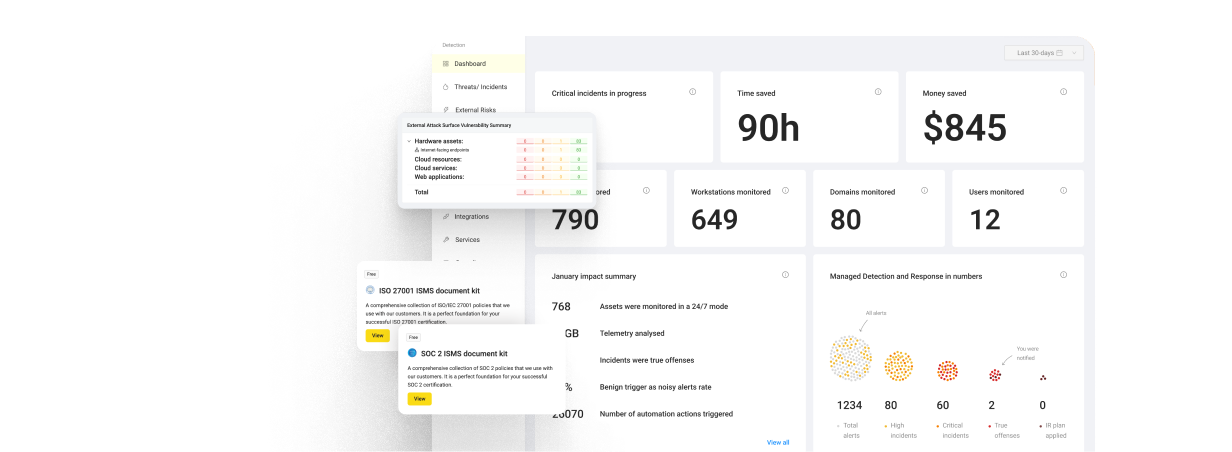
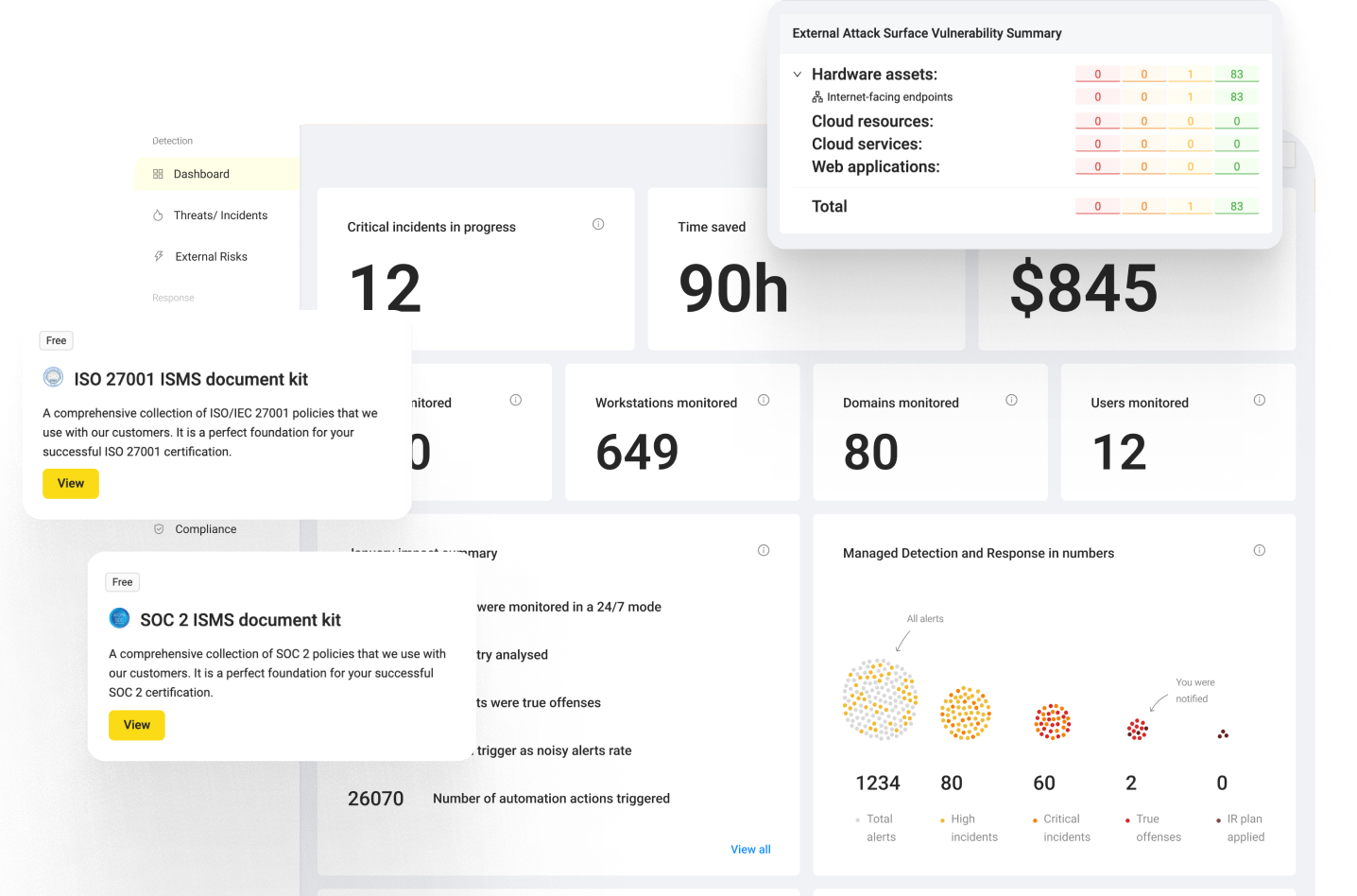
See how the UnderDefense Agentic AI SOC investigates, triages, and resolves real alerts.
How I Grouped the Nine
I sorted them into three buckets so you can shortlist faster.
- Legacy MDR: Arctic Wolf, eSentire, and, to a degree, ReliaQuest itself, turnkey monitoring, often on their stack.
- Endpoint-led MDR: CrowdStrike Falcon Complete and Red Canary, deep endpoint coverage, lighter organizational context.
- AI SOC on your own stack: UnderDefense and Intezer, plus Microsoft Sentinel and Defender XDR for Microsoft-native teams.
Each pick below carries a plain “best for” verdict so you can match it to your reality, whether you are a 200-person SaaS team or a 5,000-seat enterprise juggling legacy SIEM and shadow AI. If you want a structured way to compare, our MDR buyers guide walks through the same criteria.
| Provider (Rating) | Best For | Key Strength | Compliance |
|---|---|---|---|
| UnderDefense (5.0) | Teams wanting AI plus human response on their own SIEM | Vendor-agnostic AI SOC with concierge analyst action | SOC 2, HIPAA, ISO 27001, PCI DSS |
| CrowdStrike Falcon Complete (4.7) | Endpoint-first orgs standardizing on Falcon | 24/7 endpoint MDR with hands-on remediation | SOC 2, HIPAA, PCI DSS, ISO 27001 |
| Intezer (4.6) | Enterprise teams wanting forensic-depth investigation on their own stack | Investigates 100% of alerts with auditable evidence trails | SOC 2 Type II |
| Arctic Wolf (4.0) | Mid-market teams wanting turnkey concierge SOC | Dedicated Concierge Security Team | SOC 2, HIPAA, PCI DSS |
| Expel (4.3) | Cloud-heavy teams wanting transparent, integration-led MDR | Broad integrations, visible investigations | SOC 2, HIPAA, PCI DSS |
| Red Canary (4.2) | Teams needing endpoint detection depth | Strong threat hunting, low false-positive noise | SOC 2, HIPAA |
| Sophos MDR (4.6) | SMBs wanting full IR included | SMB-friendly, full incident response bundled | SOC 2, HIPAA, PCI DSS |
| eSentire (4.5) | Enterprises wanting Atlas-platform MDR | Atlas XDR with strong SLAs | SOC 2, HIPAA, PCI DSS |
| Microsoft Sentinel plus Defender XDR (4.4) | Microsoft-native SOCs | Native E5 telemetry unification | SOC 2, ISO 27001, FedRAMP |
The Nine Alternatives at a Glance
1.1 UnderDefense, AI SOC plus Human Ally on Your Own Stack
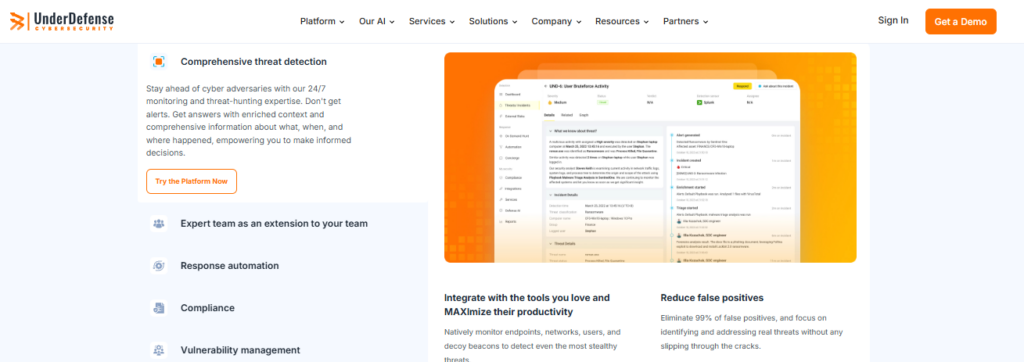
UnderDefense pairs agentic AI investigation with a human incident response Ally that acts on your existing SIEM and EDR, so you keep your detection logic and data instead of ripping tools out. It is the one vendor here built around owning outcomes, rather than escalating tickets. Reviewers on G2 rate UnderDefense Agentic AI SOC 5.0, and Gartner Peer Insights reviews echo the same.
Overview
Most MDR shops win the alert and lose the response. We built UnderDefense the other way around. Our analysts talk directly to the affected user, verify what happened, and act, while the UnderDefense Agentic AI SOC does the heavy triage. One CISO told me the relief was simply “not having to worry about alert overload and reporting” anymore. That is the whole point.
Core Services
- 24/7 AI-driven Managed Detection and Response on your own SIEM and EDR
- Concierge human response with direct user verification through ChatOps (Slack)
- Vendor-agnostic integration across 250+ security tools, including CrowdStrike and Splunk
- Managed SIEM plus vCISO and compliance support (SOC 2, HIPAA, ISO 27001)
- 30-day Impact Reports and monthly board-ready posture reporting
Why Companies Consider UnderDefense
Teams pick us when they are drowning in noise and short on people. One reviewer described getting “actual control over our security alerts” within the first week, after years of tool sprawl. Another noted we deployed CrowdStrike to 1,200 endpoints in 23 business days without ripping out their stack. We act like an extension of your team, so you scale coverage without hiring a full SOC service.
Ideal Customer Profile
Best suited for:
- Mid-market and enterprise teams (200 to 10,000 employees) with an existing SIEM
- Compliance-driven orgs needing 24/7 coverage for SOC 2, HIPAA, or ISO 27001
- Security-lean teams wanting response ownership, rather than just alerts
- Companies avoiding vendor lock-in who want to keep data ownership
Commercial Model
UnderDefense uses transparent, per-endpoint pricing (roughly $11 to $15 per endpoint per month), with onboarding and continuous advisory included. You can review the full breakdown on our MDR pricing page. Response SLAs are split honestly: a 2-minute Alert-to-Triage window and a 15-minute escalation for critical incidents, rather than a single blended number.
When to Shortlist
Shortlist UnderDefense when you are leaving a black-box MDR, want to keep your own SIEM and detection logic, and need analysts who close incidents instead of forwarding them.
Reviews
“The biggest win for me was getting actual control over our security alerts. Before the guys from UD stepped in, we were getting bombarded with alerts from all our security tools. Their team cleaned up our configurations and got the noise under control within the first week. Now when we get an alert, we know it’s something worth looking into.”
Verified User in Marketing and Advertising, Small-Business UnderDefense G2 Verified Review
“UnderDefense Agentic AI SOC integrates well with our systems, specifically with our SIEM, Splunk. Their team is proactive in identifying and addressing threats, providing 24/7 oversight.”
Oleg K., Director Information Security, Mid-Market UnderDefense G2 Verified Review
1.2 CrowdStrike Falcon Complete, Endpoint-Led Managed Detection
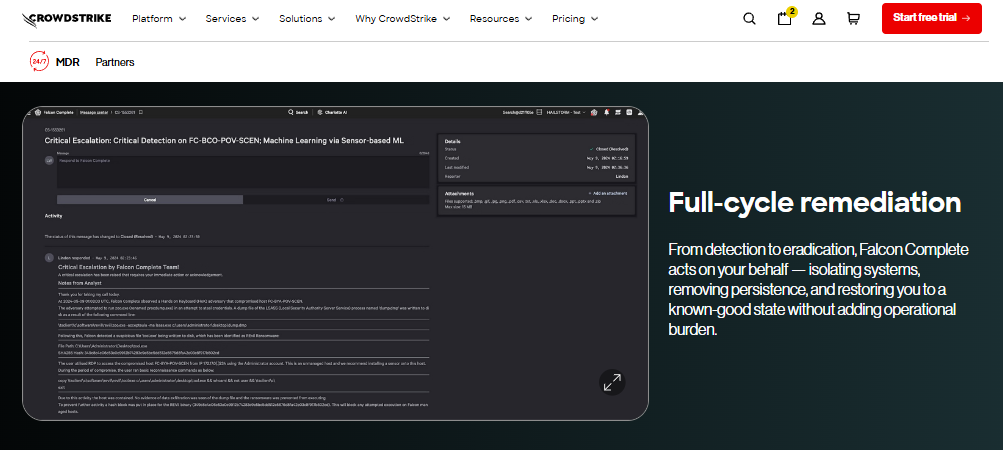
CrowdStrike Falcon Complete is fully managed MDR built on the Falcon endpoint platform, delivering 24/7 monitoring, proactive threat hunting, and hands-on remediation. It is the strongest pick when your strategy centers on the endpoint and you are willing to standardize on Falcon. Gartner Peer Insights reports a 98% willingness-to-recommend score for Falcon Complete as of January 2026.
Overview
CrowdStrike is a genuine pioneer in MDR, and I will say that plainly. Their analysts run detection, investigation, and surgical remediation directly on the Falcon agent, which one reviewer called “like having a TIER 1 SOC watching over you.” The tradeoff is architectural: the value lives inside the Falcon ecosystem.
Core Services
- 24/7 managed detection, investigation, and response on the Falcon platform
- Proactive threat hunting via the OverWatch team
- Hands-on remediation performed by CrowdStrike analysts
- Integrated threat intelligence and real-time endpoint visibility
- Identity and cloud coverage as add-on Falcon modules
Why Companies Consider CrowdStrike
Buyers pick Falcon Complete for endpoint depth and speed. CrowdStrike’s own frontline data cites a 27-second fastest breakout, and their analysts are built to move at that pace. For teams already committed to Falcon, the managed layer is a natural, high-quality extension, and our Managed EDR integrates with the same agent.
Ideal Customer Profile
Best suited for:
- Endpoint-first organizations standardizing on the Falcon agent
- Teams wanting vendor-delivered remediation, rather than just alerts
- Enterprises comfortable within a single-vendor ecosystem
- Orgs prioritizing threat-hunting maturity over cross-tool context
Here is my honest read, and I might be wrong for your environment. Falcon Complete sees the endpoint brilliantly, but it sees less of the organizational context around a user, the Slack message, the SaaS login, and the “was that really you?” question. That verification gap is exactly where we position UnderDefense, and where our incident response team adds value.
Commercial Model
Falcon Complete is subscription-based, priced per endpoint and typically bundled with Falcon platform modules. Pricing is quote-driven rather than publicly transparent, so expect a sales-led evaluation.
When to Shortlist
Shortlist Falcon Complete when the endpoint is your primary battleground, you want the vendor to own remediation, and single-vendor consolidation is an acceptable tradeoff.
Reviews
“CrowdStrike Falcon Complete offers exceptional 24/7 expert monitoring, AI-driven threat detection, and rapid remediation. Its proactive defense, seamless deployment, and minimal performance impact make it a trusted, comprehensive security solution.”
Data Architecture Specialist, IT Services Industry CrowdStrike Falcon Complete Gartner Verified Review
“Instead of hiring another member on staff, or outsourcing weekend or nighttime monitoring, we picked CrowdStrike Falcon Complete. It’s like having a TIER 1 SOC watching over you.”
IT Security and Risk Management Associate, Consumer Goods Industry CrowdStrike Falcon Complete Gartner Verified Review
1.3 Intezer, Forensic-Depth AI SOC on the Stack You Already Own
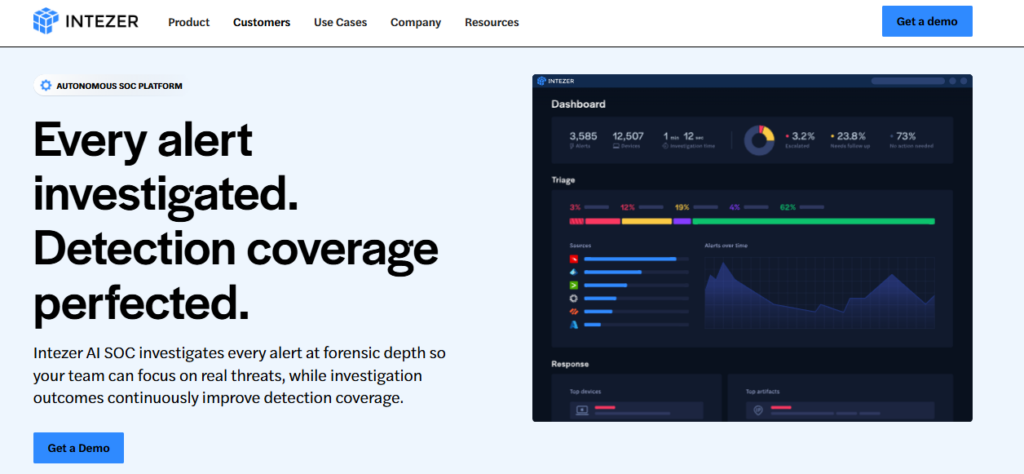
Intezer is an AI SOC platform that autonomously investigates every alert, including the low and medium severity ones most teams never open, and escalates fewer than 2% of them to a human. It sits on top of your existing SIEM and EDR rather than replacing them, which makes it the closest thing on this list to a GreyMatter replacement for teams who want to keep the platform layer but own it themselves. Reviewers on Gartner Peer Insights rate it 5.0, though across only five reviews, while G2 shows 4.5 across 193.
Overview
Intezer came out of malware reverse engineering, and you can feel that lineage in the product. Where most AI SOC tools ask a language model to summarize an alert, Intezer runs the actual forensic work first, memory scanning, binary code comparison, sandboxing, then uses agents to reason over the evidence. The company is explicit that it built this for teams who have outgrown MDR, and it reports that roughly 60% of alerts go unreviewed in the enterprise environments it has analyzed. That is Intezer’s own figure, not an analyst house number, but it matches what I hear on calls.
Core Services
- Autonomous triage and investigation of 100% of alerts, at every severity level
- Forensic analysis via genetic code analysis, memory forensics, binary comparison, and sandboxing
- Coverage across endpoint, identity, cloud, network, SIEM, and reported phishing
- Closed-loop detection engineering that writes tuning back into your own SIEM and EDR rules
- On-demand access to Intezer analysts for complex investigations, available 24/7
Why Companies Consider Intezer
The GreyMatter complaint I hear most is a verdict without the “why.” Intezer answers that directly: every verdict carries an evidence trail you can open and audit, because the investigation was performed with forensic tools rather than inferred by a model. One Gartner reviewer singled out the speed and the depth of information as the reason it earned its place in their SOC. If your objection to ReliaQuest is opacity rather than staffing, this is a serious candidate, and it lines up with how we think about what an AI SOC is supposed to prove.
Ideal Customer Profile
Best suited for:
- Mid-to-large enterprises (500+ employees) with an existing internal SOC team
- Teams that want to keep their SIEM and EDR investment rather than adopt a vendor platform
- Security leaders who need auditable, evidence-backed verdicts for regulators or the board
- Organizations building internal capability rather than outsourcing operations
Here is my honest read, and it is a structural point rather than a criticism of the product. Intezer is a platform, not a service. It hands you a finished investigation; it does not hand you a resolved incident. There is no team that owns your queue, calls the affected user, and closes the loop at 2 a.m. One Gartner reviewer, asked for a single negative, named the lack of a structured ticketing system, which is the same gap seen from the workflow side. That trade-off is fine if you have analysts to supervise it, and it is a real problem if the reason you are leaving GreyMatter is that nobody on your side has the hours. That is the line where incident response ownership starts to matter more than investigation depth.
Commercial Model
Intezer prices per endpoint rather than per alert, which is the right structural choice and worth understanding. Platforms that lean on large language models for every investigation carry a compute cost per query, so they meter by alert volume, and customers respond by sending only high-severity alerts. Per-endpoint removes that incentive, so full-stream investigation does not carry a cost penalty. The published model is clear; the actual numbers are still quote-driven, so it lands mid-table on pricing transparency next to the per-endpoint range we publish on our MDR pricing page.
When to Shortlist
Shortlist Intezer when you have analysts to supervise outcomes, you want investigation depth you can audit line by line, and you intend to keep your own SIEM and detection logic. Skip it if what you actually need is someone to own the response.
Reviews
“Speed of analysis, depth of information, thoughtful use of AI”
Verified Reviewer, IT Security Intezer Gartner Verified Review
“If I had to find a single negative… it would be their lack of a structured ticketing system”
Manager of Security Engineering, IT Services Intezer Gartner Verified Review
We run the same vendor-agnostic principle, so this is a genuine overlap rather than a contrast. The difference is what happens after the verdict: our analysts take the investigation and act on it, verifying with the affected user through ChatOps and closing the incident, instead of returning it to your queue as a well-documented ticket.
1.4 Arctic Wolf, Turnkey Concierge MDR
Arctic Wolf delivers fully outsourced 24/7 security operations through its Concierge Security Team model, giving lean teams a named group of analysts instead of raw tooling. It fits mid-market companies that want turnkey coverage without building an internal SOC (Security Operations Center, the team that watches for threats). Reviewers rate it around 4.0 on G2, with strong marks for coverage and softer marks for hands-on remediation.
Overview
Arctic Wolf built its reputation on one promise: you get people, not just a dashboard. That resonates with teams drowning in alerts and short on headcount. The catch is architectural, and I say this fairly. The value lives inside their platform and their engineering team’s hands. If you are weighing options, our list of Arctic Wolf alternatives covers the tradeoffs in depth.
Core Services
- 24/7 Managed Detection and Response with a Concierge Security Team
- Cloud and endpoint monitoring plus threat hunting
- Vulnerability and risk management
- Security awareness training
- Compliance readiness support (SOC 2, HIPAA, PCI DSS)
Why Companies Consider Arctic Wolf
Most mid-market teams lack the budget or talent to staff a 24/7 SOC. Arctic Wolf positions itself as an operating partner that moves you from reactive firefighting to continuous risk management. For a 300-person company facing its first SOC 2 audit, that packaged model is genuinely appealing.
Ideal Customer Profile
Best suited for:
- Companies with 50 to 1,000 employees wanting turnkey operations
- Compliance-driven orgs handling sensitive customer data
- Security-lean teams needing outsourced expertise
- Teams moving from point tools to managed operations
Here is my honest read, and I have sat on enough bridge calls to say it. Arctic Wolf sees alerts well, but several customers tell me remediation still lands back on their plate. One Gartner reviewer put it plainly: they get alerts, “but not necessarily a clear path to resolution.” That gap between detection and response is exactly where I think the category needs to move, and where a true incident response partner earns its keep.
Commercial Model
Arctic Wolf uses subscription pricing aligned to organization size and monitored assets, with onboarding and advisory included. Pricing is quote-driven, so build POC (proof of concept) time into your evaluation. For a fuller breakdown, see our Arctic Wolf pricing guide. Watch the renewal terms, one reviewer flagged a 60-day cancellation notice window.
When to Shortlist
Shortlist Arctic Wolf when you want a packaged concierge SOC, accept platform-led operations, and your team can own final remediation steps.
Reviews
“Arctic Wolf provides Solid detection and response capabilities, but overly relies on the clients team for remediation, which really hurts the value of the service.”
VP of Technology, Services Industry Arctic Wolf Gartner Verified Review
“Log collectors show working, however when asked to provide logs for an investigation no logs could be provided. Analysts provide little context, and when asked for more information in the investigation nothing is ever provided or even communicated.”
CISO, Manufacturing Industry Arctic Wolf Gartner Verified Review
We built UnderDefense the other way around. Our analysts pull the logs, add the context, and act on your own SIEM, so the investigation trail stays visible and yours to audit.
1.5 Expel, Transparent, Integration-Led MDR
Expel is a technology-led MDR known for broad integrations and transparent, auditable investigations you can watch unfold in its console. It suits cloud-heavy and SaaS teams that want visibility into how alerts get triaged. Reviewers rate it around 4.3 on G2, praising integrations while noting it stays an external layer.
Overview
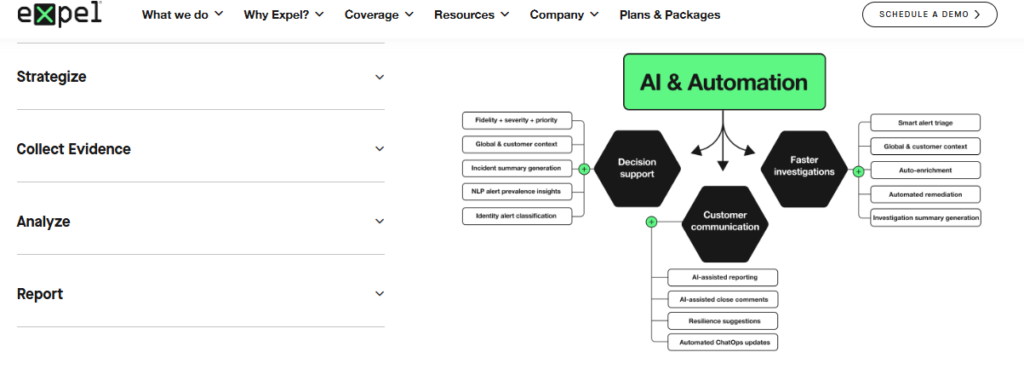
Expel earns real respect for showing its work. You can see the investigation, the automation, and the disposition in one place. That transparency is a strength I genuinely admire, and it is rare in this category.
Core Services
- 24/7 MDR across endpoint, cloud, and SaaS
- Broad API integrations with existing security tools
- Transparent investigation workflows in a unified console
- Alert triage with automated enrichment
- Slack-based notifications and support
Why Companies Consider Expel
Small SOC teams pick Expel to cut noise and get a visible first line of analysis. One reviewer called them “a force-multiplier for our internal team,” handling triage so staff focus on higher-order work. The clean interface and integration breadth make it easy to plug into a modern stack, much like our Agentic AI SOC integrations approach.
Ideal Customer Profile
Best suited for:
- Cloud-heavy and SaaS organizations
- Small internal SOC teams needing a triage layer
- Teams valuing transparent, auditable investigations
- Companies with a broad, multi-vendor tool set
My current read, and I might be wrong for your setup, is that Expel’s honesty about being “an external provider” is also its ceiling. One reviewer noted a “limit to the environmental/organizational knowledge inherent in the service,” which drives repeat verification requests back to their team. Context retention is the hard part, and it is where I focus our own model.
Commercial Model
Expel uses subscription pricing scoped to your integrations and environment size, with onboarding to connect log sources. Expect a straightforward, integration-driven deployment.
When to Shortlist
Shortlist Expel when transparent investigations and integration breadth top your list, and you accept some ongoing back-and-forth for organizational context.
Reviews
“Slack integration for notifications and support requests. Support requests are handled very quickly and accurately.”
Verified User in Manufacturing, Enterprise Expel G2 Verified Review
“Despite the capabilities of the technical platform and the strength of the analysts providing the service, there is still a limit to the environmental/organizational knowledge inherent in the service. This leads to a fairly frequent need for engagement with our internal team to get clarification and verification.”
Verified User in Computer Software, Mid-Market Expel G2 Verified Review
We close that context gap by having analysts verify suspicious activity directly with the affected user through ChatOps, so fewer questions bounce back to your team.
1.6 Red Canary, Endpoint Detection Specialist
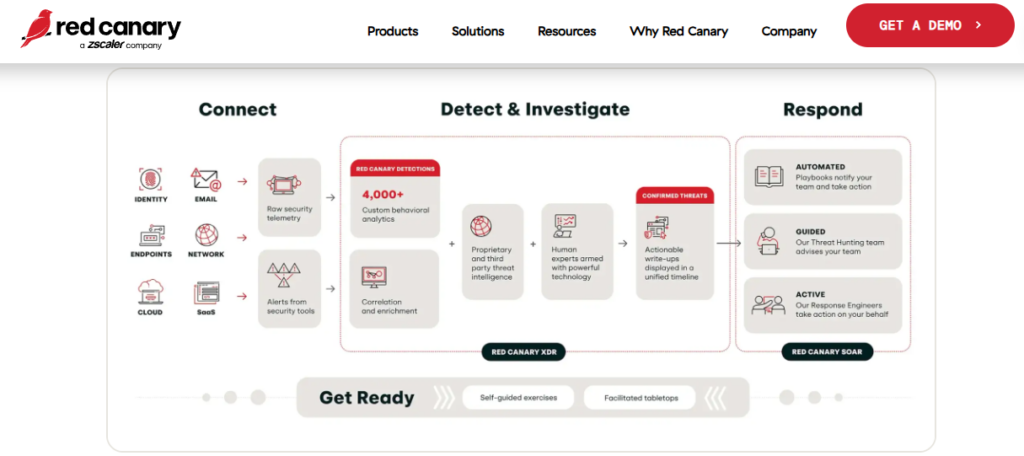
Red Canary is a detection-and-response specialist known for deep endpoint threat hunting and low false-positive noise, often layered on top of CrowdStrike or Microsoft Defender. It fits teams wanting elite detection engineering as an added SOC layer. Reviewers rate it around 4.2 on G2, with strong praise for its threat-hunting team.
Overview
Red Canary’s detection engineers are, by many accounts, excellent. Customers describe them as transparent and a pleasure to work with. The tradeoff shows up when detection depends heavily on one telemetry source.
Core Services
- 24/7 managed detection and threat hunting
- Deep endpoint detection engineering
- Alert noise reduction and tuning
- Cloud and identity coverage (varies by integration)
- Automation support for end users
Why Companies Consider Red Canary
Teams pick Red Canary to cut SIEM noise and add a sharp detection layer. One reviewer said it “reduced the amount of noise we were getting from our various log sources.” As an extra set of eyes alongside an internal SOC, it earns its keep, and our own threat hunting tools guidance reflects the same priority.
Ideal Customer Profile
Best suited for:
- Teams wanting elite endpoint detection depth
- Orgs already running CrowdStrike or Defender
- Companies layering a specialist over an internal SOC
- Security teams prioritizing low false-positive rates
Here is the honest tradeoff. Reviewers flag heavy reliance on CrowdStrike and thinner coverage across cloud, identity, and email. One insurance team even noted Red Canary “was not able to identify the malicious activity” during external penetration tests. Detection depth on one surface can leave other doors watched less closely, which is why we recommend pairing it with broader managed SIEM coverage.
Commercial Model
Red Canary uses subscription pricing tied to endpoints and integrated sources, with onboarding to connect telemetry. Confirm SIEM ingestion needs early, since some customers rely on custom API scripts to feed alerts back.
When to Shortlist
Shortlist Red Canary when endpoint detection quality is your priority and you can supplement cloud, identity, and email coverage elsewhere.
Reviews
“Red Canary first and foremost has reduced the amount of noise we were getting from our various log sources in our SIEM. Set up relatively seamless. Every staff member at Red Canary we have worked with has been a pleasure to work with and has been transparent.”
Verified User in Computer Software, Enterprise Red Canary G2 Verified Review
“I used to like the way they helped with investigations. Now, I am being told our MSP doesnt have access… And we never get any Defender for endpoint alerts. When we followed up, they stated those alerts were just being closed and resolved without evidence.”
Verified User in Non-Profit, Enterprise Red Canary G2 Verified Review
Our approach stays vendor-agnostic across 250+ tools, so detection does not hinge on a single EDR feed, and every closed alert carries visible evidence.
1.7 Sophos MDR, SMB-Friendly, Full IR Included
Sophos MDR is a widely adopted, SMB-friendly service that bundles full incident response into the base offering, backed by the Sophos endpoint and firewall ecosystem. It suits smaller teams wanting strong coverage at accessible pricing. Sophos MDR holds high G2 ratings and ranked first overall in MDR in the G2 Summer 2026 reports.
Overview
Sophos leans on a huge install base and a familiar product family. For SMBs already running Sophos endpoint or firewall, adding MDR is a natural step. Full IR (incident response) in the base package is a real differentiator at this tier.
Core Services
- 24/7 managed detection and response
- Full incident response included in the base tier
- Endpoint and firewall telemetry via Sophos Central
- Threat hunting and adversary detection
- Compliance support (SOC 2, HIPAA, PCI DSS)
Why Companies Consider Sophos MDR
Smaller teams pick Sophos for peace of mind at an accessible price. G2 reviewers consistently praise the 24/7 monitoring and proactive detection. Bundled IR means you are not negotiating a separate retainer mid-crisis, though a dedicated SOC service still adds cross-tool context.
Ideal Customer Profile
Best suited for:
- Small and mid-market businesses
- Teams already invested in the Sophos ecosystem
- Orgs wanting full IR included, rather than sold separately
- Budget-conscious buyers needing solid baseline coverage
My read is that Sophos shines brightest when you live inside its ecosystem. If your stack is heavily multi-vendor, the tightest value still centers on Sophos-native telemetry. That is a fair tradeoff for the price point, but worth naming before you sign.
Commercial Model
Sophos MDR uses subscription pricing scoped to users or endpoints, typically more accessible than enterprise-tier rivals. Full IR is included rather than a paid add-on.
When to Shortlist
Shortlist Sophos MDR when you are an SMB, want bundled incident response, and value a familiar, accessible platform.
Reviews
“Sophos MDR gives us round-the-clock monitoring and the peace of mind that experts are responding to threats for us.”
Verified User, IT Security Sophos MDR G2 Verified Review
“The 24/7 monitoring and proactive threat detection give us confidence, though the strongest value comes when you are already inside the Sophos ecosystem.”
Verified User, Mid-Market Sophos MDR G2 Verified Review
We take a different structural bet: instead of centering on our own telemetry, UnderDefense runs detection and response on the SIEM and EDR you already own, so multi-vendor teams keep full data ownership.
1.8 eSentire, Enterprise Atlas-Platform MDR
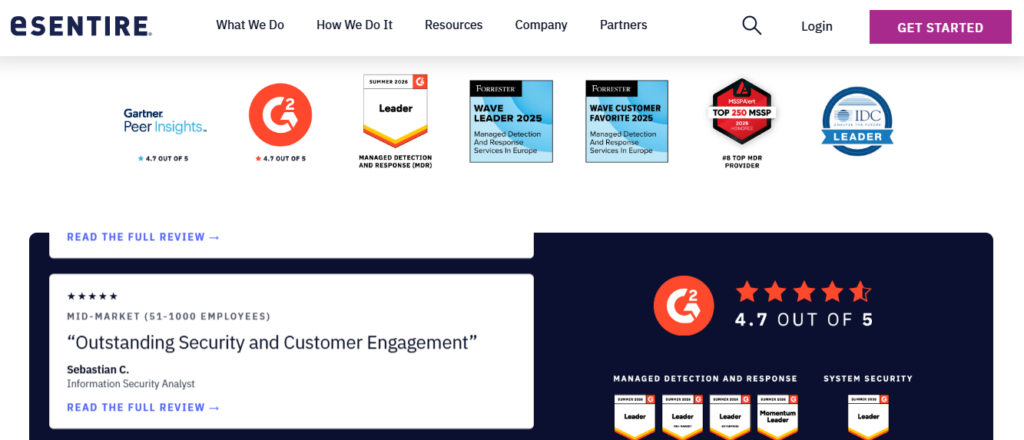
eSentire is an enterprise-grade MDR built on its Atlas XDR platform, pairing multi-signal detection with a 24/7 SOC and an incident response threat-suppression guarantee. It suits larger organizations wanting strong SLAs and deep threat research. eSentire holds a 4.7 Gartner rating across 84 reviews and a 95% willingness-to-recommend score.
Overview
eSentire calls itself “the Authority in MDR,” and its scale backs some of that up: 2,000+ organizations across 80+ countries. The Atlas platform blends agentic AI with human-led response. For enterprises, the threat-suppression guarantee is a meaningful commitment.
Core Services
- Multi-signal MDR with 300+ integrations
- Atlas open XDR platform with agentic AI
- 24/7 SOC with unlimited threat hunting
- Incident response with a threat-suppression guarantee
- Threat Response Unit (TRU) research and intel
Why Companies Consider eSentire
Enterprises pick eSentire for coverage breadth and strong response commitments. The unlimited threat hunting and IR guarantee reduce worst-case exposure. Its 95% willingness-to-recommend score signals durable customer satisfaction at the enterprise tier, and compliance-driven buyers often pair it with dedicated compliance services.
Ideal Customer Profile
Best suited for:
- Enterprises wanting platform-led, multi-signal MDR
- Teams valuing strong SLAs and IR guarantees
- Organizations needing deep threat research
- Buyers comfortable adopting the Atlas platform
My honest read is that eSentire’s strength, the Atlas platform, is also a commitment. You are leaning into their platform and their build. For teams that want to own their own SIEM logic and data, that is the tradeoff to weigh against the guarantees.
Commercial Model
eSentire offers three flexible MDR packages scoped to your needs, from foundational coverage to advisory-led tiers. Pricing is quote-driven and enterprise-oriented.
When to Shortlist
Shortlist eSentire when you want enterprise-grade, platform-led MDR with strong response guarantees and deep threat intelligence.
Reviews
“eSentire delivers strong multi-signal coverage and a responsive SOC that acts as a genuine extension of our security team.”
Verified Enterprise Reviewer, IT Security and Risk Management eSentire Gartner Verified Review
“The service is strong and the analysts are responsive, though you are adopting the Atlas platform to get the full value.”
Verified Enterprise Reviewer, IT eSentire Gartner Verified Review
Where eSentire asks you to adopt Atlas, UnderDefense keeps the “Lego bricks” model: you get the AI SOC and human analysts, but you keep your own platform and data ownership.
1.9 Microsoft Sentinel plus Defender XDR, Microsoft-Native SOC
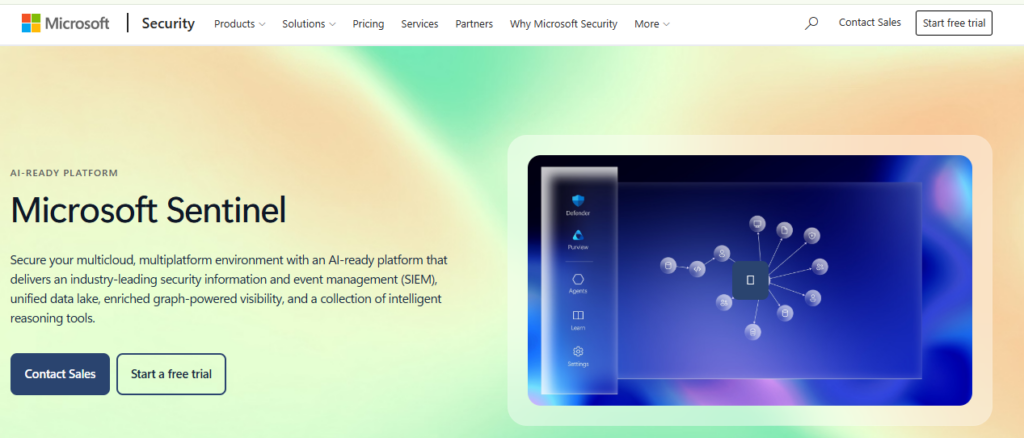
Microsoft Sentinel plus Defender XDR is a native SOC stack that unifies SIEM and extended detection across Microsoft 365, identity, endpoint, and cloud, ideal for organizations standardized on Microsoft E5. It is not a managed service by itself, so most teams add an MDR partner to operate it. Both products hold strong verified ratings on G2 and Gartner.
Overview
If your org lives in Microsoft E5, this stack is compelling. Sentinel is the cloud SIEM, Defender XDR unifies the signal, and the telemetry is native. The honest gap is operational: someone still has to run it 24/7, which is where our MDR for Microsoft 365 comes in.
Core Services
- Microsoft Sentinel cloud-native SIEM
- Defender XDR across endpoint, identity, email, and cloud
- Deep Microsoft 365 and Azure telemetry
- Automation via playbooks and SOAR
- Compliance support (SOC 2, ISO 27001, FedRAMP)
Why Companies Consider Microsoft
Microsoft-heavy teams pick this stack for native visibility and consolidated licensing. When the telemetry, identity, and endpoint all come from one vendor, correlation gets simpler. For E5 customers, the incremental cost can be attractive.
Ideal Customer Profile
Best suited for:
- Organizations standardized on Microsoft E5
- Teams wanting native SIEM plus XDR unification
- Companies consolidating licensing and telemetry
- Buyers who will pair it with an MDR operator
Here is the operational reality I see most often. The platform is powerful, but a SIEM without 24/7 human analysts is a very expensive log store. Sentinel gives you the engine; it does not give you the on-call team, the tuning, or the response at 2 a.m. That is the work most teams underestimate, and our MDR buyers guide helps you scope it.
Commercial Model
Sentinel uses consumption-based pricing (ingested data volume), while Defender XDR is licensed through Microsoft 365 E5 or standalone plans. Costs scale with log volume, so data management matters.
When to Shortlist
Shortlist this stack when you are Microsoft-native, want to own your SIEM, and plan to pair it with analysts who operate it around the clock.
Reviews
“Microsoft Sentinel and Defender give us deep native integration across our Microsoft environment, with correlation that would be hard to match across separate tools.”
Verified Reviewer, IT Security Microsoft Gartner Verified Review
“The platform is powerful, but its value depends heavily on skilled operation and continuous tuning to get real detection results.”
Verified Reviewer, Mid-Market Microsoft Gartner Verified Review
This is exactly the pairing we designed for. UnderDefense runs an AI SOC plus a human response team directly on your Microsoft Sentinel and Defender data, so you keep the native stack you already pay for and gain the 24/7 operators it needs. See how that works on the UnderDefense Agentic AI SOC platform.
Q2. How Did We Score and Rank These ReliaQuest Alternatives?
Each vendor was scored on five weighted criteria: Investigation Depth and Transparency (30%), Response Authority and Speed (25%), Integration and Data Ownership (20%), Pricing Transparency (15%), and Verified User Reviews (10%). Scores map to stars, 0 to 20 equals 1 star, up through 81 to 100 equals 5 stars. UnderDefense scores 5 stars; monitoring-only tools that hand tickets back score lower on response authority.
The Rubric, and Why It Is Weighted This Way
I weighted this on purpose, and I will defend it. The GreyMatter complaint I hear is rarely “no AI.” It is “AI I cannot see or direct.” So transparency and response authority carry the most weight.
Here is a contrarian move: stop scoring MDR on SLA (service-level agreement) theater. A 2-minute acknowledgment means nothing if the ticket bounces back unresolved. Score on how often a partner actually saves the day from a material incident, which is the same principle behind our MDR service.
| Criterion | Weight | What It Measures |
|---|---|---|
| Investigation Depth and Transparency | 30% | Can you see and audit every investigative step? |
| Response Authority and Speed | 25% | Does the provider act, or just escalate to you? |
| Integration and Data Ownership | 20% | Do you keep your SIEM logic and data? |
| Pricing Transparency | 15% | Is pricing published, or quote-only? |
| Verified User Reviews | 10% | What do G2 and Gartner reviewers report? |
How the Stars Landed
The star ratings are defensible, rather than arbitrary. Vendors lose points where reviewers report tickets returned without resolution or thin remediation. If you want the underlying method, our MDR buyers guide uses the same lens.
| Vendor | Rating |
|---|---|
| UnderDefense | 5.0 |
| CrowdStrike Falcon Complete | 4.7 |
| Intezer | 4.6 |
| Sophos MDR | 4.6 |
| eSentire | 4.5 |
| Microsoft Sentinel plus Defender XDR | 4.4 |
| Expel | 4.3 |
| Red Canary | 4.2 |
| Arctic Wolf | 4.0 |
UnderDefense earns 5 stars because every investigative step is observable and auditable, and analysts hold response authority instead of returning unresolved tickets. One reviewer captured it: “when they escalate something, they include the context we need to understand the issue quickly.” That authority is a core part of our incident response model.
Reviews
“UnderDefense Agentic AI SOC integrates well with our systems, specifically with our SIEM, Splunk. Their team is proactive in identifying and addressing threats, providing 24/7 oversight.”
Oleg K., Director Information Security, Mid-Market UnderDefense G2 Verified Review
“Their customer-centric approach is a breath of fresh air. SOC analysts and support team are incredibly responsive and knowledgeable. The platforms high-fidelity alerts and automated enrichment help us quickly identify and address threats.”
Verified User in Computer Software, Enterprise UnderDefense G2 Verified Review
Q3. Why Are Security Leaders Leaving ReliaQuest GreyMatter in 2026?
Security leaders leave GreyMatter mainly because of over-reliance on AI that produces verdicts without actionable insight, opaque reporting where tickets come back without clear answers, custom detections that arrive slowly, and lock-in that stops teams owning their own logic. The frustration is control: paying for a black box while the adversary moves in seconds.
The “Trapped Behind the Glass” Feeling
Here is the scene I see most. A security lead is staring at a GreyMatter ticket at 1 a.m., and it says a verdict without the “why.” She cannot see how it got there, and she cannot direct it.
That grind takes a real toll. I have talked to analysts who described the alert treadmill leaving them physically wrung out, breaking out in stress hives trying to keep pace. When the tool speeds up the same broken loop, that is not transformation, and it is why we treat alert fatigue as a first-order problem.
The Speed Mismatch Nobody Fixes
Think of the old network security model like an M&M: a hard candy shell outside, a soft gooey center inside. Once an attacker cracks the shell, alert-only monitoring leaves the center defenseless.
The math is brutal. Mandiant’s frontline data records handoffs to ransomware operators in under 30 seconds, while your ticket sits in a queue. ReliaQuest’s own data cites a fastest exfiltration of six minutes in 2025, down from over four hours the year before. Speed is the whole game now, which is why investigation speed sits at the center of our design.
What the Fix Actually Looks Like
The fix is regaining control of your logic and your data. You want the AI to collect context, and you want to decide.
At UnderDefense, that is the inversion we run: the AI gathers and enriches, but a human Ally holds the decision and acts. You keep your own SIEM and detection logic through our managed SIEM approach, so nothing hides behind glass.
Reviews
“The alerts we get are actionable… but sometimes the platform automation gives verdicts without the underlying detail we need, so we still open a ticket to understand it.”
Verified User, IT Security ReliaQuest GreyMatter G2 Verified Review
“Before the guys from UD stepped in, we were getting bombarded with alerts from all our security tools. Their team cleaned up our configurations and got the noise under control within the first week.”
Verified User in Marketing and Advertising, Small-Business UnderDefense G2 Verified Review
Q4. What Is the “AI SOC plus Human Ally” Model, and How Does It Differ from AI MDR and Legacy MDR?
The “AI SOC plus Human Ally” model uses AI agents as foot soldiers that autonomously investigate every alert, with human analysts as generals who direct them and own the response. AI SOC is tooling your team runs; AI MDR is a managed service where the provider operates the AI and carries accountability. It beats alert-only monitoring by eliminating whole classes of toil, rather than helping an overloaded team be wrong faster.
The Concept, in Plain Terms
Let me define three things cleanly, because the category muddies them.
- Legacy MDR (or MSSP): monitors your alerts and sends you tickets to action yourself.
- AI SOC: an AI-driven investigation platform your own team operates and tunes.
- AI MDR: a managed service where the provider runs the AI and owns the outcome.
The difference that matters is accountability. Academic work on agentic AI in security stresses that real SOC environments need “grounded data access, reproducibility, and accountable workflows,” rather than a lone model summarizing alerts, a principle we detail in our guide to what an AI SOC is.
The Example: Foot Soldiers and Generals
Picture AI agents as foot soldiers. They swarm a single alert, run deep enrichment, and pull context from every connected tool. A serious investigation can chain a very large number of reasoning steps, well beyond what a human clicks through by hand.
Humans click; agents swarm. But foot soldiers need generals. Human analysts direct the agents, judge the edge cases, and decide what happens next, which is how our SOC service keeps a person accountable for outcomes.
The Application: What Changes on Monday
Here is the practical shift. Your analysts stop doing the copy-paste toil of triaging noise and start tracing root causes. The AI eliminates whole classes of repetitive work, so the humans do the judgment work only humans can, the same logic behind our incident response automation.
This is exactly how we built UnderDefense. Six specialized AI Teammates run hundreds of agent skills to reach a verdict, then a human Ally decides and acts, foot soldiers swarm, and generals direct. You can watch every step on the UnderDefense Agentic AI SOC platform, which is the point: observable, auditable, and yours to direct.
Q5. What Does It Actually Cost and Take to Switch from ReliaQuest GreyMatter?
Switching from GreyMatter is mostly an operational lift, not a rip-and-replace, because the right model runs on the SIEM and EDR you already own. Expect a phased migration measured in weeks, not quarters, with the heaviest work in connecting log sources, porting detection logic, and validating coverage. The real “cost” is planning time, rather than a second parallel stack.
The Migration Myth
The fear I hear most is a painful parallel-run where you pay twice and pray nothing slips. That fear keeps teams stuck inside a black box they have already outgrown. The reality is calmer when your new partner is vendor-agnostic and plugs into your existing tools through broad Agentic AI SOC integrations rather than forcing a platform swap.
We deployed CrowdStrike to 1,200 endpoints for one client in 23 business days without ripping out their stack. Speed comes from working with what you have, not around it.
The Real Migration Timeline
Here is the honest sequence, and it is boring on purpose, because boring is safe.
- Connect existing log sources and EDR through native integrations.
- Port and tune your detection logic so you keep the rules you trust.
- Validate coverage against real scenarios before cutover.
- Shift 24/7 monitoring and response to the new team.
- Confirm reporting and compliance mappings hold.
Because you keep your own managed SIEM and data, there is no data migration tax and no detection logic thrown away. That is the difference between switching partners and switching platforms.
The Costs Nobody Puts on the Invoice
The line items are easy; the hidden costs are where teams get surprised. Budget for internal planning hours, coverage validation, and a short overlap window, rather than a full duplicate spend. Our MDR pricing stays transparent and per-endpoint, so you can model the switch before you commit, and the 2026 cybersecurity budget playbook helps frame it for finance.
Reviews
“Onboarding was smooth and faster than we expected. Their team connected our existing tools and had us covered without forcing us to replace anything.”
Verified User in Computer Software, Mid-Market UnderDefense G2 Verified Review
“UnderDefense Agentic AI SOC integrates well with our systems, specifically with our SIEM, Splunk. Their team is proactive in identifying and addressing threats, providing 24/7 oversight.”
Oleg K., Director Information Security, Mid-Market UnderDefense G2 Verified Review
Q6. How Do These ReliaQuest Alternatives Compare on Pricing and Commercial Model?
Pricing splits into three camps: transparent per-endpoint models, consumption-based platform pricing, and quote-only enterprise sales. UnderDefense publishes per-endpoint pricing (roughly $11 to $15 per endpoint per month), while most rivals, including Arctic Wolf, eSentire, and Falcon Complete, stay quote-driven. Microsoft Sentinel adds consumption cost that scales with log volume.
Why Pricing Opacity Is a Signal
Quote-only pricing is not neutral. It slows evaluation, and it often correlates with the same opacity buyers flee in GreyMatter. When a vendor will not publish a number, ask what else stays behind the glass.
Transparent pricing is a proxy for transparent operations, which is why we publish ours and back it with an observable UnderDefense Agentic AI SOC platform.
| Provider | Pricing Model | Transparency |
|---|---|---|
| UnderDefense | Per-endpoint, roughly $11 to $15 per endpoint per month | Published |
| CrowdStrike Falcon Complete | Per-endpoint, bundled with Falcon modules | Quote-only |
| Intezer | Per-endpoint, not per-alert | Model published, numbers quote-only |
| Arctic Wolf | Subscription by size and assets | Quote-only |
| Expel | Subscription by integrations and environment | Quote-only |
| Red Canary | Subscription by endpoints and sources | Quote-only |
| Sophos MDR | Subscription by users or endpoints | Partly published |
| eSentire | Three package tiers | Quote-only |
| Microsoft Sentinel plus Defender XDR | Consumption plus E5 licensing | Published rates, variable cost |
Reading the Total Cost, Not the Sticker
The sticker price rarely tells the story. A cheap subscription that still bounces tickets back to your team carries a hidden labor cost, while a consumption model can spike with log volume. Model the fully loaded cost, including your own analyst hours, using our SOC cost calculator, and compare vendors on outcomes rather than list price. For Arctic Wolf specifically, our Arctic Wolf pricing guide breaks down the variables.
Reviews
“Pricing was clear from the start, and there were no surprise line items later. That transparency made the internal approval much easier.”
Verified User in Information Technology, Mid-Market UnderDefense G2 Verified Review
“Solid detection and response capabilities, but overly relies on the clients team for remediation, which really hurts the value of the service.”
VP of Technology, Services Industry Arctic Wolf Gartner Verified Review
Q7. How Should You Choose the Right ReliaQuest Alternative for Your Team?
Choose based on three questions: Do you want to own your SIEM and data, or adopt the vendor’s platform? Do you need response authority, or just alerting? And is your environment endpoint-led, cloud-native, or Microsoft-heavy? Map those answers to the three buckets, and the shortlist narrows fast.
The Decision Framework
Skip the feature-matrix rabbit hole. Start with ownership, then response, then environment, because those three decisions eliminate most of the field before you ever book a demo.
- Own your stack and data: favor vendor-agnostic AI MDR on your existing tools.
- Endpoint-led: consider CrowdStrike Falcon Complete or Red Canary.
- Cloud-native and transparent: consider Expel.
- Microsoft-heavy: pair Sentinel and Defender XDR with an operator through our MDR for Microsoft 365.
- SMB wanting bundled IR: consider Sophos MDR.
Match by Scenario
Your reality should drive the pick, not the other way around. A regulated healthcare team weighs coverage and auditability differently than a fast-scaling SaaS company, which is why we tailor MDR for Healthcare and coverage for financial services separately.
| Your Scenario | Strongest Fit |
|---|---|
| Want to own SIEM plus need response authority | UnderDefense |
| Endpoint-first, standardized on Falcon | CrowdStrike Falcon Complete |
| Cloud-heavy, want transparent investigations | Expel |
| SMB wanting bundled incident response | Sophos MDR |
| Enterprise wanting platform-led MDR | eSentire |
| Microsoft-native SOC | Microsoft Sentinel plus Defender XDR |
The Questions to Ask on Every Demo
Come to each demo with the same short list, and score answers side by side.
- Show me one full investigation, every step, not a summary.
- When you find a threat, do you act, or hand it back to us?
- Do we keep our detection logic and data if we leave?
- What are your Alert-to-Triage and critical-escalation SLAs, separately?
- Can I see pricing before a sales cycle?
If you are building your own list, our MDR buyers guide expands each question, and a proper incident response partner will answer the “do you act?” question without flinching. When you are ready to test one live, you can book a demo and put our own team through the same list.
Reviews
“When they escalate something, they include the context we need to understand the issue quickly, and they act instead of just handing it back to us.”
Verified User in Computer Software, Enterprise UnderDefense G2 Verified Review
“Not having to worry about alert overload and reporting anymore changed how our small team operates. We finally focus on real work instead of chasing noise.”
Verified User in Marketing and Advertising, Small-Business UnderDefense G2 Verified Review
See how UnderDefense Agentic AI SOC resolves a real incident on your stack.
1. Who are the best ReliaQuest GreyMatter alternatives in 2026?
The nine best ReliaQuest alternatives we track in 2026 are UnderDefense, CrowdStrike Falcon Complete, Intezer, Arctic Wolf, Expel, Red Canary, Sophos MDR, eSentire, and Microsoft Sentinel plus Defender XDR. We group them into three buckets so you can shortlist faster:
- Legacy MDR: Arctic Wolf and eSentire, turnkey monitoring, often on their own stack.
- Endpoint-led MDR: CrowdStrike Falcon Complete and Red Canary, deep endpoint coverage.
- AI SOC on your own stack: UnderDefense and Intezer, plus Microsoft Sentinel and Defender XDR for Microsoft-native teams.
Most buyers leaving GreyMatter want three things it struggles to deliver: investigations they can audit, response authority instead of tickets bounced back, and freedom to keep their own detection logic and data. We built our MDR service around owning outcomes rather than escalating tickets, so you keep the SIEM and EDR you already run.
2. Why are security teams leaving ReliaQuest GreyMatter?
Security leaders leave GreyMatter mainly because of control, not capability. The recurring frustrations we hear are:
- Over-reliance on AI that returns verdicts without the underlying “why.”
- Opaque reporting, where tickets come back without a clear path to resolution.
- Custom detections that arrive slowly.
- Lock-in that stops teams owning their own logic and data.
The pattern is paying for a black box while adversaries move in seconds. Mandiant’s frontline data records handoffs to ransomware operators in under 30 seconds, so a ticket sitting in a queue is a loss. When the tool just speeds up the same broken alert loop, that is not transformation.
The fix is regaining control of your logic and data, letting AI collect context while a human decides and acts. That inversion is exactly how we treat alert fatigue as a first-order problem rather than a metric to manage.
3. What is the AI SOC plus Human Ally model?
The AI SOC plus Human Ally model uses AI agents as foot soldiers that autonomously investigate every alert, with human analysts as generals who direct them and own the response. It clears up three terms the category muddies:
- Legacy MDR or MSSP: monitors your alerts and sends tickets you action yourself.
- AI SOC: an AI-driven investigation platform your own team operates and tunes.
- AI MDR: a managed service where the provider runs the AI and owns the outcome.
The difference that matters is accountability. AI agents swarm a single alert, run deep enrichment, and pull context from every connected tool, chaining far more reasoning steps than a human clicks through by hand. But foot soldiers need generals: humans judge the edge cases and decide what happens next.
This is how we built UnderDefense. Specialized AI Teammates reach a verdict, then a human Ally decides and acts, which you can watch step by step on the UnderDefense Agentic AI SOC platform.
4. How much does it cost to switch from ReliaQuest GreyMatter?
Switching from GreyMatter is mostly an operational lift, not a rip-and-replace, because the right model runs on the SIEM and EDR you already own. The heaviest work sits in connecting log sources, porting detection logic, and validating coverage, typically measured in weeks rather than quarters.
The real cost is planning time, not a second parallel stack. Budget for:
- Internal planning hours.
- Coverage validation against real scenarios.
- A short overlap window before cutover.
Because you keep your own SIEM and data, there is no data migration tax and no detection logic thrown away. For one client, we deployed CrowdStrike to 1,200 endpoints in 23 business days without ripping out their stack.
Our transparent, per-endpoint MDR pricing lets you model the switch before committing, so finance sees the real number rather than a quote-only guess.
5. How do ReliaQuest alternatives compare on pricing?
Pricing across ReliaQuest alternatives splits into three camps:
- Transparent per-endpoint: UnderDefense publishes roughly $11 to $15 per endpoint per month.
- Quote-only enterprise: Arctic Wolf, eSentire, and CrowdStrike Falcon Complete stay sales-driven.
- Consumption-based: Microsoft Sentinel cost scales with ingested log volume.
Quote-only pricing is not neutral. It slows evaluation and often correlates with the same opacity buyers flee in GreyMatter. When a vendor will not publish a number, it is worth asking what else stays behind the glass.
The sticker price rarely tells the full story either. A cheap subscription that still bounces tickets back to your team carries a hidden labor cost, and a consumption model can spike with volume. We recommend modeling the fully loaded cost, including your own analyst hours, using our SOC cost calculator, then comparing vendors on outcomes rather than list price.
6. Is UnderDefense a good ReliaQuest GreyMatter alternative?
We believe UnderDefense is the strongest fit for teams whose main complaint about GreyMatter is losing control. We pair agentic AI investigation with a human incident response Ally that acts on your existing SIEM and EDR, so you keep your detection logic and data instead of ripping tools out.
What sets us apart:
- Vendor-agnostic integration across 250+ tools, including CrowdStrike and Splunk.
- Concierge human response that verifies activity directly with the affected user through ChatOps.
- Honest, split SLAs: a 2-minute Alert-to-Triage window and a 15-minute escalation for critical incidents, rather than one blended number.
- Transparent per-endpoint pricing and 30-day Impact Reports.
Reviewers rate UnderDefense Agentic AI SOC 5.0 on G2, with one describing finally getting “actual control over our security alerts” within the first week. If you want response ownership instead of forwarded tickets, our incident response team closes incidents rather than handing them back.
7. Which ReliaQuest alternative is best for Microsoft-heavy teams?
For Microsoft-native SOCs, the strongest foundation is Microsoft Sentinel plus Defender XDR, which unifies SIEM and extended detection across Microsoft 365, identity, endpoint, and cloud. For teams standardized on E5, the native telemetry and consolidated licensing make correlation simpler.
The honest gap is operational. Sentinel gives you the engine, but a SIEM without 24/7 human analysts is a very expensive log store. It does not give you the on-call team, the continuous tuning, or the response at 2 a.m.
That is the pairing we designed for:
- You keep the native Microsoft stack you already pay for.
- We run an AI SOC plus a human response team directly on your Sentinel and Defender data.
- You gain the 24/7 operators the platform needs.
Our MDR for Microsoft 365 operates the stack around the clock, so you get native visibility with real response authority.
8. What questions should I ask on an MDR demo before switching?
We tell every buyer to walk into each demo with the same short list and score answers side by side. Ask:
- Show me one full investigation, every step, not a summary.
- When you find a threat, do you act, or hand it back to us?
- Do we keep our detection logic and data if we leave?
- What are your Alert-to-Triage and critical-escalation SLAs, separately?
- Can I see pricing before a sales cycle?
These five questions eliminate most of the field before you commit. They expose the exact gaps buyers flee in GreyMatter: opaque investigations, missing response authority, lock-in, blended SLA theater, and quote-only pricing.
A partner confident in its operations will answer the “do you act?” question without flinching. If you want each question expanded with what a strong answer looks like, our MDR buyers guide breaks them down in detail.