





Managing cybersecurity can be a never-ending juggling act—keeping threats at bay without breaking the bank. Managed Detection and Response (MDR) services are a crucial layer of protection, but understanding the costs can be tricky. Let’s invite daylight into this matter so you can make the best decision for your company’s security needs without overcomplicating things.
Current Prices for MDR Services: What to Expect
When looking at the MDR market, it’s important to understand how pricing works across different providers. The cost of MDR varies greatly depending on your infrastructure, the number of endpoints you need to protect, and the depth of monitoring and response required.
Best MDR service providers and their pricing plans
Here’s a snapshot of what you can expect from various providers:

Principle of MDR Price Formation: What Influences the Cost?
When determining MDR service cost, it’s essential to consider several key points. These points not only reflect the size of your infrastructure but also the complexity of the services you need. By understanding and considering these points, you can decide how much your company will need to spend on MDR services. Here’s a breakdown of the main factors that affect pricing:
Number of Endpoints/Devices/Assets
The biggest factor in the price for MDR is the number of endpoints or assets you need to monitor. More devices mean more data to process, which means higher costs. Many providers price based on this, so it’s an easy way to estimate your cost.
Service Levels and Customization
Not all businesses need the same level of security. You may only need basic monitoring for specific assets or require a fully managed SIEM solution and 24/7 response. The higher the service level, the higher the cost. Customization—like integrating with existing tools or tailoring the SIEM rules to your specific needs—can also add to the price.
Security Tools and Technology Stack
Some MDR providers bundle in advanced security tools such as Endpoint Detection and Response (EDR), Security Information and Event Management (SIEM), and additional threat intelligence. Whether you already own these tools or need them to be included in the service impacts the overall cost. If you’re starting from scratch, a fully managed solution with integrated tools can be cost-effective. It saves you from buying and maintaining expensive software separately, providing reassurance that you’re making a smart investment in a comprehensive solution.
How to Calculate the Cost of MDR for Your Company
Most MDR providers calculate costs based on a range of variables, including a number of endpoints, servers, users, service levels, and technology stack. Here’s a more detailed formula for how vendors might calculate the cost of MDR services:
MDR Price Formula
Formula: MDR = (Number of Endpoints x Cost per Endpoint) + (Number of Servers x Cost per Server) + (Number of Users x Cost per User) + Service Level Costs + Technology Stack Costs
Example:
You have:
- 300 endpoints
- 10 servers
- 50 users
- Service Level (SOC, Incident response, Detection Engineering): $3,000/month
- Technology Stack Costs (SIEM, EDR, Threat Intel): $2,000/month
And you choose an MDR service that charges monthly:
- $17 per endpoint
- $100 per server
- $10 per user
Total Monthly Cost = (300 x $17) + (10 x $100) + (50 x $10) + $3,000 + $2,000 = $11,600/month, roughly $140,000 yearly.
You can get more detailed information about UnderDefense pricing models here.
MDR Price Calculator
If you’re unsure how to approach this or if your situation involves more complexity (like cloud services, hybrid infrastructure, or remote teams), many MDR providers, including UnderDefense, offer pricing calculators. These calculators can provide a clear, customized quote by inputting your specific needs—number of endpoints, desired service level, and additional requirements like SIEM management or vulnerability assessments.
You can easily estimate costs with our pricing calculator or review the pre-set pricing tiers, starting at $11 per device per month.
AI vs. Experts: The Risks of Letting AI Estimate Your MDR
You might be tempted to turn to AI generators when you need a quick answer to how much MDR services will cost. After all, AI knows a lot, right? Well, here’s the thing—AI tools are smart but don’t have the full picture. They can give you estimates, but when it comes to your business’s unique security needs, they can’t account for all the variables that impact the price for MDR. Every business has different assets, threat environments, compliance needs, and security goals, and that’s something AI can’t fully understand.
For example, you might ask an AI generator for the cost of an MDR solution for 100 endpoints, and it would give you a very basic formula: “Multiply the number of endpoints by X dollars.” But what if you need SIEM integration? Or real-time threat intelligence? Or advanced threat-hunting capabilities? AI can’t account for all those nuances so you could end up with a number that’s way off.
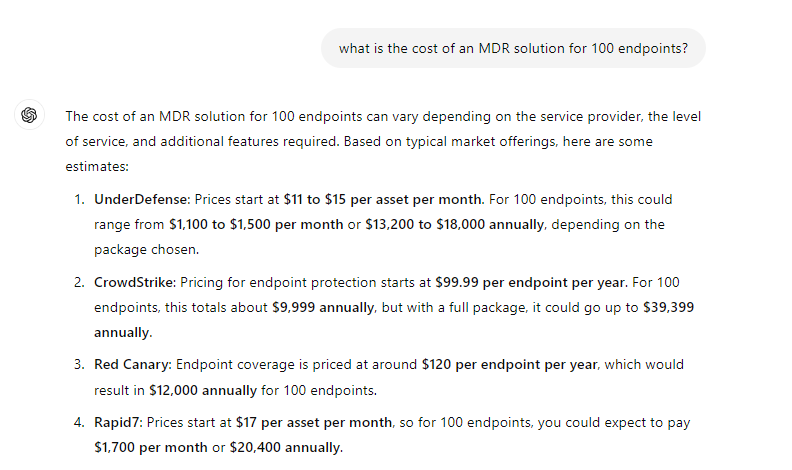
Take this as a warning: An AI tool might say that the MDR price for 100 endpoints is $1,500/month because it uses a standard rate of $15. However, it might not account for your business’s need for advanced EDR and 24/7 SOC monitoring. With those extra services, the real price could be $3,000 or more per month—something the AI wouldn’t know without a consultation.
So what do you do? Go to MDR providers’ websites and use the built-in pricing calculators. Or better yet, contact MDR specialists for a custom quote tailored to your business. That way you get an exact and accurate quote based on your environment and security needs.
MDR Price: What You’re Paying For and Why It’s Worth It
Let’s be real—budgets are a fact of life for CISOs and security leaders. When you think of cybersecurity, you’re probably juggling costs for tools, staff, and overall security strategy. One of the questions that comes up a lot is, “Is MDR worth it?” The short answer? Yes. The long answer is that while MDR has a price tag, it’s a tiny fraction of what a full-blown security breach could cost your business in revenue, trust, and recovery efforts.
Why MDR is Less than a Breach
Here’s where the numbers matter. When looking at the MDR price plans, it’s easy to focus solely on the monthly or yearly costs. But take a minute to think about what a breach could cost your business. Ransomware attacks, data leaks, and system downtime can easily cost hundreds of thousands of dollars. For example, a ransomware attack can demand an average payment of $300K, not to mention the potential lost revenue and damaged reputation while you’re trying to get your systems back online.
With MDR you get 24/7 protection that mitigates those risks. Think of it as having an insurance policy that actively prevents claims from happening. Instead of reacting to threats, you’re proactively protecting your business, which is a game changer.
UnderDefense MDR: A Smart Investment
Now let’s talk about why UnderDefense MDR is a good investment. Our UnderDefense MAXI MDR platform provides comprehensive protection tailored to your needs with flexible pricing. Whether you need endpoint detection, full SIEM management, or both, we’ve got you covered. Our MDR isn’t just about monitoring—it includes unlimited security investigations, 24/7 incident response, and ongoing support from our team of experts.
And we don’t hit you with data caps or hidden fees. You can send as much data as you need to get maximum visibility and protection. We work with the tools you already have, so you don’t need to buy extra software or make changes to your setup.
In Summary: Don’t let the price of MDR hold you back
Yes, MDR has a cost, but it pays off by keeping your business secure, your ops running, and your data safe. At the end of the day, the cost of MDR is an investment in your company’s future. It’s about reducing the risk of a breach that could cost you more than any security service will.
With UnderDefense MDR, you’ll get security tools and an AI-armed team of experts to protect your business 24/7. So, is the MDR price worth it? I think we have our answer.
1. Does MDR replace SIEM?
Answer: No, MDR (Managed Detection and Response) does not replace SIEM (Security Information and Event Management). MDR and SIEM are complementary solutions. SIEM collects and analyzes security data to identify patterns and generate alerts, while MDR provides the necessary monitoring, threat detection, and incident response to actively manage and remediate security threats. MDR services often include SIEM as part of a broader security approach but go beyond SIEM by including real-time threat hunting and response capabilities.
2. What is the current MDR rate?
MDR pricing can vary based on the provider, the services included, and the size of the organization. Typically, MDR rates range from $11 to $15 per device per month for standard services. Some premium services or customized solutions may cost more, depending on the complexity and scale of the organization’s security needs.
3. What is the difference between EDR and MDR?
EDR (Endpoint Detection and Response) focuses on detecting and responding to threats specifically at the endpoint level, such as computers, servers, and mobile devices. It monitors endpoint activities to identify malicious behavior. MDR, on the other hand, provides a broader scope of services that include not only endpoint protection but also network and cloud monitoring, threat intelligence, and 24/7 security operations center (SOC) support. MDR encompasses EDR but offers more comprehensive security management, including incident response and threat hunting.
4. How much does EDR cost?
The cost of EDR typically starts at around $11 per device per month, though it may vary depending on the provider and the level of service offered. Higher-tier packages that include additional features may cost more.
5. How much does SIEM cost?
SIEM pricing is generally determined by the volume of data processed and the complexity of the environment. On average, SIEM solutions cost between $20,000 to $100,000 per year for mid-sized businesses, but prices can vary depending on the specific vendor, the volume of data processed, and whether the SIEM is managed by a third-party provider or handled in-house.
5. What is MDR?
MDR (Managed Detection and Response) is a comprehensive cybersecurity service that provides 24/7 monitoring, threat detection, and incident response. MDR combines advanced technologies like EDR, SIEM, and threat intelligence with human expertise to actively hunt for threats, analyze security data, and respond to incidents in real time. MDR services help organizations strengthen their security posture without the need for an in-house security operations team.
5. How does MDR work?
MDR works by continuously monitoring your organization’s IT environment for suspicious activities and potential threats. The service typically includes:
- Endpoint and network monitoring through EDR, SIEM, and other tools
- Real-time threat detection using advanced analytics and AI
- 24/7 monitoring by a Security Operations Center (SOC) team
- Incident response to address security breaches and mitigate damage
- Proactive threat hunting to find and eliminate hidden threats before they cause harm.
MDR integrates technology and security expertise to provide a complete, managed solution that protects against cyberattacks, minimizes risks, and improves overall cybersecurity.