





If you’re familiar with Sophos, you know it’s a big name in the cybersecurity world, offering everything from endpoint to network and cloud security. But, like any product, it’s not always the perfect fit for everyone. Thankfully, some strong alternatives might suit your needs even better, depending on your specific security requirements. Let me walk you through the top competitors and what they bring to the table based on long-term experience working with these solutions.
Battle-tested professionals proactively hunt threats, leaving no stone unturned
2025 Sophos competitors list
Here’s a quick rundown of the top alternatives to Sophos that can give you the security edge your business needs.
- UnderDefense
- Fortinet
- Cisco
- Palo Alto Networks
- Check Point Software Technologies
- Juniper Networks
- CrowdStrike Falcon
- SentinelOne
- Trend Micro
- SonicWall
- Barracuda
- WatchGuard
- Quick Heal
- Heimdal Security
- K7 Antivirus
- Symantec (Broadcom)
- VMware
- Bitdefender
Here is a detailed review of some of the top alternatives to Sophos:
1. UnderDefense
Overview:
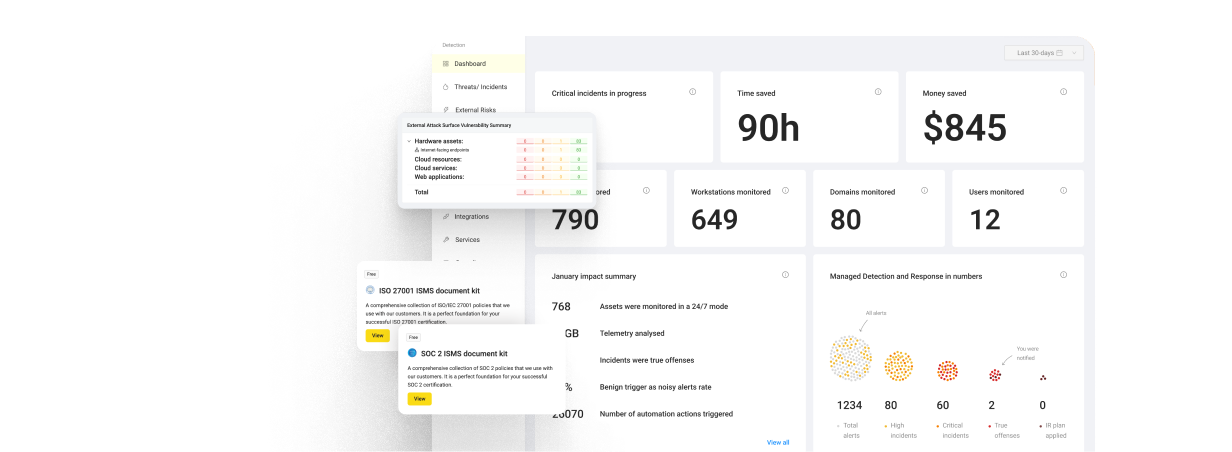
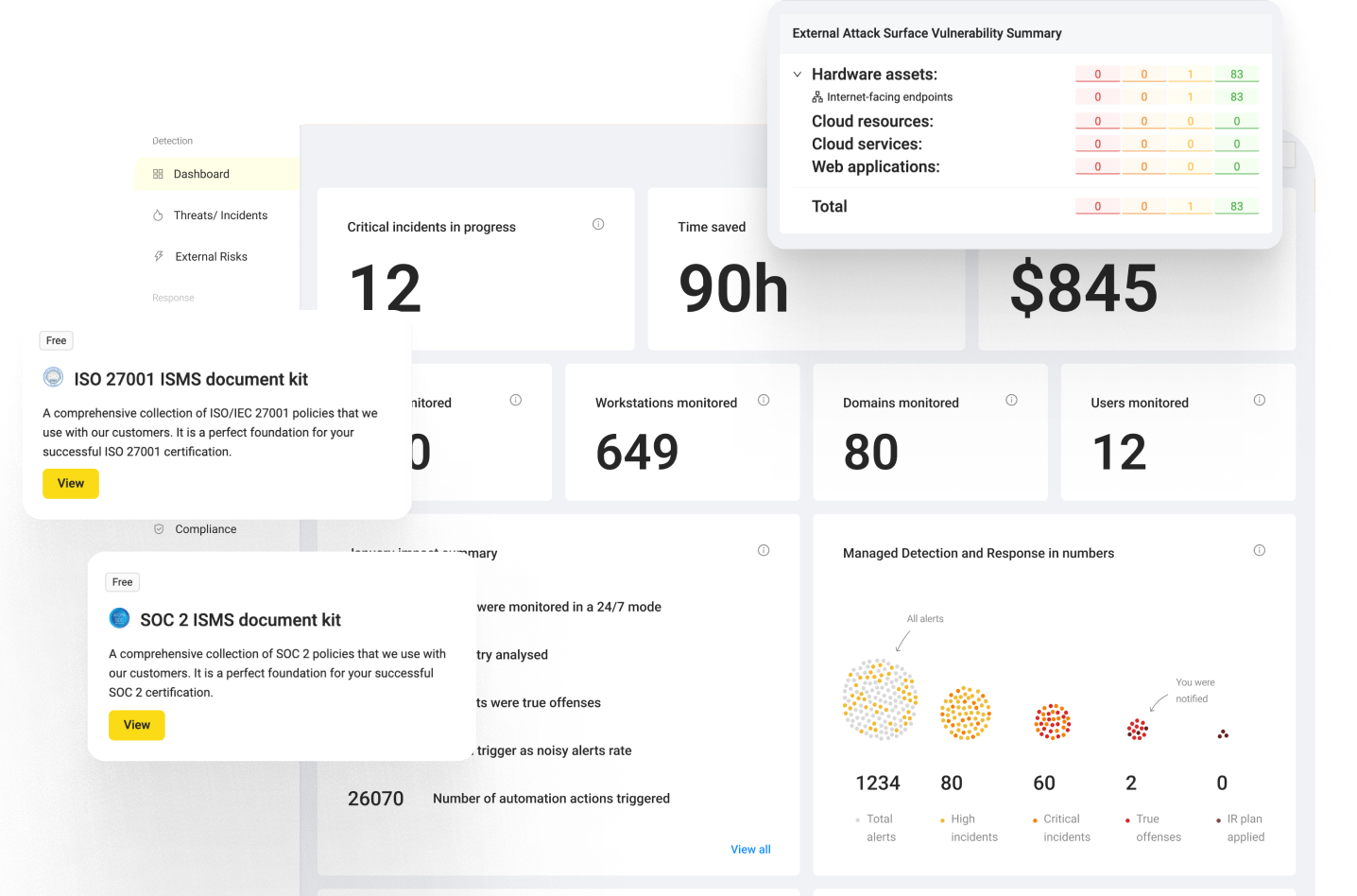
UnderDefense stands out with its Managed Detection and Response (MDR) service, focusing on advanced threat detection and incident response. What’s unique about UnderDefense is how they fine-tune your existing tools and ensure you keep ownership after the contract ends. Plus, the UnderDefense MAXI platform automates a lot of the heavy lifting in security and compliance.
Pros:
- Excellent customer satisfaction with proactive threat-hunting (5 stars on Gartner Peer Insights)
- Proactive threat hunting and rapid incident response.
- Strong focus on improving your existing infrastructure.
- Highlighted customer ownership approach to let them keep the fine-tuned solutions.
Cons:
- Smaller market presence compared to bigger names.
Customer Rating: 5/5 on Gartner Peer Insights.
2. Fortinet
Overview:
Fortinet is known for its flagship FortiGate firewalls and an expansive suite of solutions including endpoint protection, network access control, and SD-WAN. Fortinet is a fantastic choice if scalability and multi-layered security are your priorities.
Pros:
- Extremely effective security (99.88%)
- Scalable solutions for enterprises and SMBs
- Comprehensive threat prevention.
Cons:
- Complex to configure
- Higher cost for advanced features.
Customer Rating: 4.6/5 on Gartner Peer Insights.
3. Cisco
Overview:
Cisco’s Secure Endpoint and firewalls are excellent for businesses already using Cisco’s hardware. Their deep network integration and threat intelligence capabilities offer seamless security management, making it a solid choice for larger organizations.
Pros:
- Strong integration with Cisco’s network infrastructure
- Comprehensive threat intelligence and malware protection
- Robust customer support.
Cons:
- Expensive for smaller organizations
- Complex initial setup.
Customer Rating: 4.5/5 on Gartner Peer Insights.
4. Palo Alto Networks
Overview:
Palo Alto Networks is well-known for its Cortex and Prisma platforms, delivering top-tier next-gen firewalls and cloud security. Palo Alto’s solutions are feature-rich, making them perfect for those needing advanced security across hybrid environments.
Pros:
- Best-in-class threat intelligence and automation
- High-performance cloud security
- Seamless integration with complex infrastructures.
Cons:
- High cost, especially for small organizations
- Steep learning curve.
Customer Rating: 4.6/5 on Gartner Peer Insights.
5. Check Point Software Technologies
Overview:
Check Point excels with its SandBlast technology, offering powerful threat prevention and versatile deployment options across network, endpoint, and cloud security.
Pros:
- Advanced threat prevention
- Flexible deployment for hybrid environments
- Comprehensive security management
Cons:
- High cost for premium features
- Can be complex to manage without a dedicated IT team.
Customer Rating: 4.4/5 on Gartner Peer Insights.
6. Juniper Networks
Overview:
Juniper Networks provides highly-rated SRX Series Firewalls with strong security features, offering a cost-effective solution for large-scale network deployments. It’s great for organizations that prioritize network security over endpoint protection.
Pros:
- Strong security performance and cost-effective for large networks
- SSL/TLS functionality for encrypted traffic.
Cons:
- Limited endpoint protection capabilities
- Requires skilled personnel for optimal management.
Customer Rating: 4.9/5 on Gartner Peer Insights,
7. CrowdStrike Falcon
Overview:
CrowdStrike Falcon is built with a cloud-native architecture, offering advanced endpoint protection and threat detection. Its ease of deployment makes it ideal for organizations that need a robust but efficient security solution.
Pros:
- Highly effective at threat detection and response
- Cloud-native platform ensures easy deployment
- Strong integration with other security tools.
Cons:
- Higher cost than traditional endpoint solutions
- Limited network security capabilities.
Customer Rating: 4.8/5 on Gartner Peer Insights.
8. SentinelOne
Overview:
SentinelOne is an AI-driven endpoint security platform offering real-time threat detection and response. Its automation capabilities make it a strong choice for businesses that need quick, efficient protection without human intervention.
Pros:
- AI-powered threat detection and response
- Comprehensive endpoint protection
- Easy-to-use interface.
Cons:
- Higher cost for premium features
- Limited network security functions.
Customer Rating: 4.7/5 on Gartner Peer Insights
9. Trend Micro
Overview:
Trend Micro offers a balanced solution across endpoint, network, and cloud security, making it a versatile tool for businesses that need multi-layered protection.
Pros:
- Comprehensive security solutions
- Strong malware protection and threat intelligence
- Flexible deployment options.
Cons:
- Can be resource-intensive
- Higher cost for premium services.
Customer Rating: 4.7/5 on Gartner Peer Insights.
10. SonicWall
Overview:
SonicWall is known for delivering strong firewalls and endpoint protection, particularly to small to medium-sized businesses (SMBs). It’s a cost-effective alternative for those needing reliable security without breaking the bank.
Pros:
- Cost-effective for SMBs
- Strong firewall performance
- Comprehensive security features.
Cons:
- Limited advanced threat protection
- Can be complex for larger enterprises.
Customer Rating: 4.7/5 on Gartner Peer Insights.
11. Barracuda
Overview:
Barracuda is a great fit for businesses looking to secure their email and network environments. Their easy-to-deploy solutions provide solid email protection and data security.
Pros:
- Strong email security
- Comprehensive data protection
- Easy to deploy and manage.
Cons:
- Limited endpoint protection features
- Higher cost for advanced features.
Customer Rating: 4.5/5 on Gartner Peer Insights
12. WatchGuard
Overview:
WatchGuard offers affordable network security, with features ranging from firewalls to multi-factor authentication (MFA). It’s a great option for small to medium-sized businesses that want comprehensive security without breaking the bank.
Pros:
- Affordable and scalable for SMBs
- Strong network security features.
Cons:
- Limited endpoint protection.
Customer Rating: 4.6/5 on Gartner Peer Insights.
13. Seqrite Quick Heal (Legacy)
Overview:
Quick Heal provides affordable antivirus and endpoint security solutions, making it an excellent choice for small businesses or personal use.
Pros:
- Budget-friendly
- Easy to deploy and manage
- Solid antivirus and malware protection.
Cons:
- Limited advanced threat protection features
- Smaller market presence.
Customer Rating: 4.5/5 on Gartner Peer Insights.
14. Heimdal Security
Overview:
Heimdal is a great all-in-one security platform with a strong focus on threat prevention and patch management. It offers both endpoint and network security with a high level of customization.
Pros:
- Focus on prevention, not just remediation
- Strong patch management and traffic filtering.
Cons:
- Less well-known compared to other major players
- Premium pricing for advanced features.
Customer Rating: 4.8/5 on Gartner Peer Insights
15. K7 Antivirus
Overview:
K7 Antivirus is a basic, affordable option for businesses or individuals looking for straightforward malware protection.
Pros:
- Very cost-effective
- Simple deployment and management.
Cons:
- Lacks advanced features
- Smaller market share.
Customer Rating: 4.0/5 on Gartner Peer Insights
16. Symantec (Broadcom)
Overview:
Since being acquired by Broadcom, Symantec has offered enterprise-grade endpoint and network security with a heavy focus on threat intelligence and malware protection.
Pros:
- Comprehensive security features
- Strong threat intelligence and malware protection.
Cons:
- Higher cost
- Complex setup and configuration.
Customer Rating: 4.2/5 on Gartner Peer Insights.
17. VMware
Overview:
VMware is a great choice for companies already using its infrastructure, with seamless cloud and endpoint security integration across VMware environments.
Pros:
- Excellent integration with VMware infrastructure
- Comprehensive cloud and endpoint protection.
Cons:
- Higher cost
- Complex initial setup.
Customer Rating: 4.3/5 on Gartner Peer Insights.
18. Bitdefender
Overview:
Bitdefender is known for offering strong, affordable antivirus and endpoint security solutions. It’s a good option for those looking for solid protection at a reasonable cost.
Pros:
- Strong malware protection
- Cost-effective solutions.
Cons:
- Limited advanced features.
Customer Rating: 4.6/5 on Gartner Peer Insights
24/7 experts proactively hunt for malware, zero-day, and insider threats
Comparison table: Sophos competitors & alternatives
Here is a comparison table of top alternatives to Sophos that looks at real-world strengths, pricing models, and the best use cases for each—so you can choose what’s best for your unique security needs.
Provider | Overview | Pros | Cons | Use Cases | Pricing Model |
 | MDR, incident response, threat detection, managed SOC/SIEM, UnderDefense MAXI platform | High customer satisfaction, proactive threat hunting, focus on improving existing infrastructure, and customer ownership approach | Smaller market presence compared to larger players | Smaller market presence compared to larger players | Per-device or per-asset pricing for MDR/SOC, customized pricing plans |
 | Firewalls, endpoint protection, SD-WAN | High security effectiveness, scalable solutions | Complex configuration, higher cost for advanced features | Large enterprises needing scalable network security | Subscription, per-device licensing |
 | Endpoint protection, firewalls, network security | Strong integration with Cisco infrastructure, robust customer support | Expensive for smaller organizations, complex setup | Enterprises already using Cisco hardware | Subscription-based, volume pricing |
 | Next-gen firewalls, cloud security (Cortex, Prisma) | Advanced automation, threat intelligence | High cost, steep learning curve | Large, complex hybrid environments | Tiered subscription models |
 | Network security, endpoint, and cloud protection (SandBlast) | Advanced threat prevention, flexible deployment | High cost, complex management without dedicated IT team | Enterprises needing hybrid deployment options | Subscription, per-user/device pricing |
 | Firewalls (SRX Series), network security | Cost-effective for large-scale networks, strong SSL/TLS support | Limited endpoint protection, requires skilled personnel | Large-scale networks prioritizing network security | Subscription-based |
 | Cloud-native endpoint security and threat detection | Easy to deploy, high efficacy in threat detection | Higher cost than traditional endpoint solutions | Organizations looking for cloud-native protection | Subscription-based, tiered pricing |
Download the PDF for the full version of the comparison table
DownloadConclusion
Whether you’re after scalable network protection, advanced threat intelligence, or simply need a cost-effective solution, these competitors offer a range of options to suit businesses of all sizes. It’s all about finding the perfect balance between features, ease of use, and budget.