




Q1. What Is a Managed SOC, and What Do the Different Models Look Like in 2026?
A managed SOC (Security Operations Center), also called SOC-as-a-Service or SOCaaS, is an outsourced security operations function where a specialized provider delivers 24/7/365 threat monitoring, detection, investigation, and incident response on behalf of your organization, using a combination of AI-driven automation, SIEM/SOAR/XDR technology, and human analyst expertise.
Here’s why this matters right now: there are 3.5 million unfilled cybersecurity positions globally, AI-armed attackers are moving at machine speed, and staffing a true 24/7 SOC internally is financially impossible for most mid-market organizations.
Managed SOC vs. MDR vs. MSSP vs. XDR: The Taxonomy
These terms get thrown around interchangeably. They shouldn’t be. Here’s how they actually break down:
| Managed SOC / SOCaaS | MDR | MSSP | XDR | |
|---|---|---|---|---|
| Scope | Full security operations | Threat detection & response | Monitoring & alerting | Technology platform |
| Response | Detect, investigate, contain, remediate | Detect and respond | Detect and notify | Varies by vendor |
| Tech Ownership | Provider or customer-owned | Usually provider-managed | Customer-owned | Vendor-specific |
| Integration | Vendor-agnostic (best providers) | Varies | Tool-specific | Proprietary ecosystem |
| Buyer Profile | Orgs needing complete SOC function | Orgs needing detection + response | Orgs needing compliance monitoring | Orgs consolidating telemetry |
SOC-as-a-Service and SOCaaS are interchangeable with managed SOC. The key distinction from MDR is scope: managed SOC encompasses the entire security operations function, while MDR focuses on the detection-and-response workflow within it.
Three Delivery Models, and When Each Fits
1. Fully Managed SOC — The provider owns end-to-end security operations: monitoring, detection, investigation, containment, and reporting. Best for organizations with no internal security team or teams under five people who need 24/7 coverage immediately.
2. Co-Managed SOC — The provider handles 24/7 monitoring and Tier 1–2 operations, while your internal team retains strategic control, detection rule ownership, and Tier 3 investigations. Ideal for mid-market companies with 5–15 security staff who want operational leverage without surrendering governance.
3. Hybrid SOC — Your internal team covers business-hours operations; the provider handles nights, weekends, holidays, and surge capacity. Works well for organizations with existing SIEM investments (Splunk, Elastic, Sentinel) that need to extend coverage without doubling headcount.
SOC Analyst Tiers: L1, L2, L3
Understanding analyst tiers clarifies what you’re actually buying:
L1 Analysts handle real-time monitoring, initial alert triage, and false positive filtering. In 2026, this work is increasingly AI-automated, and honestly, it should be. Manual L1 triage at scale is a burnout factory.
L2 Analysts perform deeper investigation, cross-source correlation, and incident validation. This is where context starts to matter.
L3 Analysts and Threat Hunters conduct proactive threat hunting, detection engineering, forensic analysis, and advanced incident response. This is the layer that actually catches sophisticated attackers.
The operational reality across hundreds of deployments: most organizations paying for “24/7 SOC” from legacy MSSPs are getting L1 alert forwarding, someone reads the dashboard and sends you an email. That’s monitoring, not security operations. At UnderDefense, our UnderDefense MAXI platform automates the L1–L2 grunt work through agentic AI, while dedicated Tier 3–4 human analysts serve as the “Human Ally” layer, learning your VIPs, your technical users, and your critical assets to deliver responses with genuine organizational context.
Q2. What Core Services and Capabilities Does a Modern Managed SOC Deliver, and How Does It Work Day-to-Day?
It’s 2:47 AM on a Tuesday. Your phone buzzes with the 14th critical alert this week. You log in, spend 45 minutes correlating across CrowdStrike, Splunk, and Okta, and discover it’s a developer running a legitimate script. You’ve been awake for an hour. You still don’t know if you missed something real buried in the noise.
This is the daily reality of operating security without a managed SOC. You become the manual correlation layer across disconnected tools.
Why This Happens, and the Full Capability Stack
The problem exists because your EDR sees endpoint behavior, your identity tool sees user context, and your SIEM ingests everything, but nothing reasons across all three. A properly built managed SOC solves this:
- Continuous 24/7/365 monitoring, real-time event stream analysis across all telemetry
- SIEM management and log ingestion, centralized collection, normalization, and retention at scale
- SOAR integration, playbook-driven automated response, API-based remediation
- Detection engineering, org-specific detection logic, behavioral analytics, targeting 99% noise elimination
- Threat intelligence, commercial, open-source, and proprietary feeds enriching every alert
- Proactive threat hunting, hypothesis-driven, mapped to MITRE ATT&CK
- Incident response and remediation, full containment (credential revocation, endpoint isolation), not just escalation tickets
- Compliance monitoring, automated evidence collection for SOC 2, HIPAA, PCI-DSS, ISO 27001
- Executive reporting, KPI dashboards (MTTD, MTTR, threat trends) for board-level communication
⏰ A Real Incident: Detection to Containment in 16 Minutes
Here’s what this looks like in practice, not theory:
00:00 — Behavioral alert triggers: anomalous PowerShell execution on the CFO’s laptop
00:02 — AI-driven enrichment correlates endpoint telemetry with identity logs, threat intel, and login patterns
00:04 — Automated triage classifies: “confirmed suspicious, human verification required”
00:06 — Analyst reaches out to the CFO via Slack: “Did you authorize this script at 2:41 AM?”
00:09 — CFO confirms: “No, I was asleep.”
00:10 — Analyst initiates containment: credential reset, endpoint isolation, session termination
00:15 — Incident contained. Full forensic report generated.
00:16 — Security leader receives morning summary: “Incident contained at 2:52 AM, here’s what happened and what we did.”
How We Operationalize This at UnderDefense
We built the UnderDefense MAXI platform to ingest alerts from your existing stack, CrowdStrike, Splunk, Microsoft Defender, SentinelOne, Okta, and correlate through agentic AI enrichment. When behavioral alerts need context (“Did Jane run that PowerShell script?”), our analysts reach out directly via Slack, Teams, email, or SMS to verify. We’re the only MDR that contacts users directly instead of escalating back to your team.
Confirmed threats get contained immediately: compromised credentials revoked, endpoints isolated, lateral movement blocked.
✅ 2-minute alert-to-triage SLA.
✅ 15-minute escalation for critical incidents.
✅ 96% MITRE ATT&CK coverage.
“The biggest win for me was getting actual control over our security alerts. Before the guys from UD stepped in, we were getting bombarded with alerts from all our security tools. Their team cleaned up our configurations and got the noise under control within the first week.”
— Verified User, Marketing and Advertising UnderDefense G2 – Verified Review
“They have an exceptionally talented team who is very engaged and provides extra care. If I had to pick a single word, I would call them proactive.”
— Yaroslava K., IT Project Manager UnderDefense G2 – Verified Review
From 45-minute 2 AM investigations to morning incident summaries: that’s the shift from alert noise to managed response.
Q3. What Are the Real Benefits, and Honest Challenges, of Outsourcing Your SOC?
Security leaders are right to be skeptical. The MDR market is full of vendors who oversell and underdeliver. So let’s be transparent about both sides.
✅ 10 Benefits Worth Quantifying
✅ 40–60% cost reduction vs. building an in-house SOC
✅ Access to Tier 3–4 expertise without 6-month recruitment cycles
✅ Weeks to operational vs. 6–18 months for in-house builds
✅ Elastic scalability without infrastructure CapEx
✅ 99% alert noise reduction through filtered, validated, prioritized alerts
✅ Global threat intelligence feeding proactive prevention
✅ Cutting-edge SIEM/SOAR/XDR without capital expenditure
✅ Multi-framework compliance (SOC 2, HIPAA, PCI-DSS, ISO 27001) included
✅ Security maturity jump from Level 1 to Level 3–4 within 90 days
✅ Zero talent retention risk, the provider absorbs 18-month analyst turnover cycles
⚠️ The Honest Challenges, and How to Mitigate Them
These objections are legitimate. Here’s where most vendor content stops being useful:
“We’ll lose visibility and control.” Valid with opaque MSSPs. Resolution: demand providers where every AI and human action is observable and auditable. If you can’t see the investigation, you don’t have a partner. You have a black box.
“Data privacy and residency concerns.” Especially critical for EU/GDPR and healthcare. Resolution: confirm data processing locations, BAA availability, and sovereignty options before signing.
“Integration complexity with our existing stack.” Proprietary-stack providers force painful migrations. Resolution: choose vendor-agnostic providers that work with your current tools, not against them.
“Limited customization.” One-size-fits-all playbooks miss organizational context. Resolution: require custom detection engineering during onboarding. Generic rules generate generic noise.
“Vendor lock-in.” Resolution: negotiate data portability clauses, and avoid any provider requiring proprietary SIEM replacement. If your business logic lives in their system, you start from scratch when you leave.
“Started out well but over the years the service has consistently not met expectations. The issues that we have experienced has greatly outweighed the benefits.”
— CISO, Manufacturing Arctic Wolf – Gartner Verified Review
🚨 SOC Failure Symptoms to Recognize
If any of these sound familiar, your current SOC, internal or outsourced, is failing:
- Alerts piling up uninvestigated
- MTTR exceeding 4+ hours consistently
- Coverage gaps during nights and weekends
- Analyst turnover exceeding 30%/year
- Security incidents discovered by third parties, not your SOC
- Executive leadership lacking confidence in security posture
Recovery playbook: root cause analysis → staffing assessment → tool streamlining → metrics baseline → provider evaluation.
How UnderDefense Resolves These Structurally
We designed the architecture specifically around these objections: full investigation transparency (every action observable), vendor-agnostic integration (250+ tools), custom detection engineering during 30-day onboarding (cutting 99% of noise), published pricing ($11–$15/endpoint/month), and data processing flexibility (on-prem, Azure, GCP, AWS, Oracle).
Your hesitation makes sense. Most providers deserve the skepticism. We expect you to validate before you commit.
“It’s reassuring to know they’re always watching for threats, and it doesn’t cost a fortune. They catch and stop problems quickly, which is a huge relief.”
— Serhii B., CISO UnderDefense G2 – Verified Review
“Honestly, some security tools are more complicated than the threats themselves. UnderDefense isn’t just about catching bad stuff, they give proactive tips too.”
— Andriy H., Co-Founder and CTO UnderDefense G2 – Verified Review
💰 1% customer churn and 113% net dollar retention, because organizations that validate our claims during onboarding don’t leave.
Q4. In-House SOC vs. Managed SOC vs. Hybrid: How Do You Choose the Right Model?
This isn’t a budget decision. It’s an architectural commitment that shapes your security posture for years. Building in-house requires minimum 8–12 analysts for true 24/7 coverage (accounting for shifts, PTO, and turnover), a $500K+ annual technology stack, and 6–18 months to reach operational maturity.
Pick wrong, and you’re either hemorrhaging $2M/year on an understaffed team or locked into a vendor who escalates alerts without context.
The Wrong Way to Decide
Common but flawed criteria: choosing based on brand recognition (“CrowdStrike is the biggest”), lowest per-endpoint rate (ignoring hidden costs), or the “we must keep everything in-house for control” instinct, which ignores 3.5M unfilled cybersecurity positions and 18-month average analyst tenure.
The real question isn’t “Can we afford to outsource?” but “Can we afford not to, given our staffing reality?”
📊 10-Dimension Comparison Table
| Dimension | In-House | Managed SOC | Hybrid |
|---|---|---|---|
| 24/7 Coverage | ⚠️ Requires 8–12 FTEs | ✅ Included | ✅ Blended |
| Time-to-Operational | ❌ 6–18 months | ✅ 2–4 weeks | ⚠️ 4–8 weeks |
| 3-Year TCO | ❌ $3M–$12M | ✅ $360K–$1.4M | ⚠️ $800K–$3M |
| Control & Governance | ✅ Full | ⚠️ SLA-governed | ✅ Strategic retained |
| Detection Engineering | ⚠️ Depends on talent | ✅ Dedicated team | ✅ Shared |
| Talent Retention Risk | ❌ High (18-mo avg) | ✅ Absorbed by provider | ⚠️ Moderate |
| Scalability | ❌ Linear cost | ✅ Elastic | ✅ Elastic ops |
| Compliance Readiness | ⚠️ Manual | ✅ Automated | ✅ Automated |
| Technology Flexibility | ✅ Full choice | ⚠️ Depends on provider | ✅ Retained |
| Response Capability | ⚠️ Depends on staffing | ✅ SLA-backed | ✅ Blended |
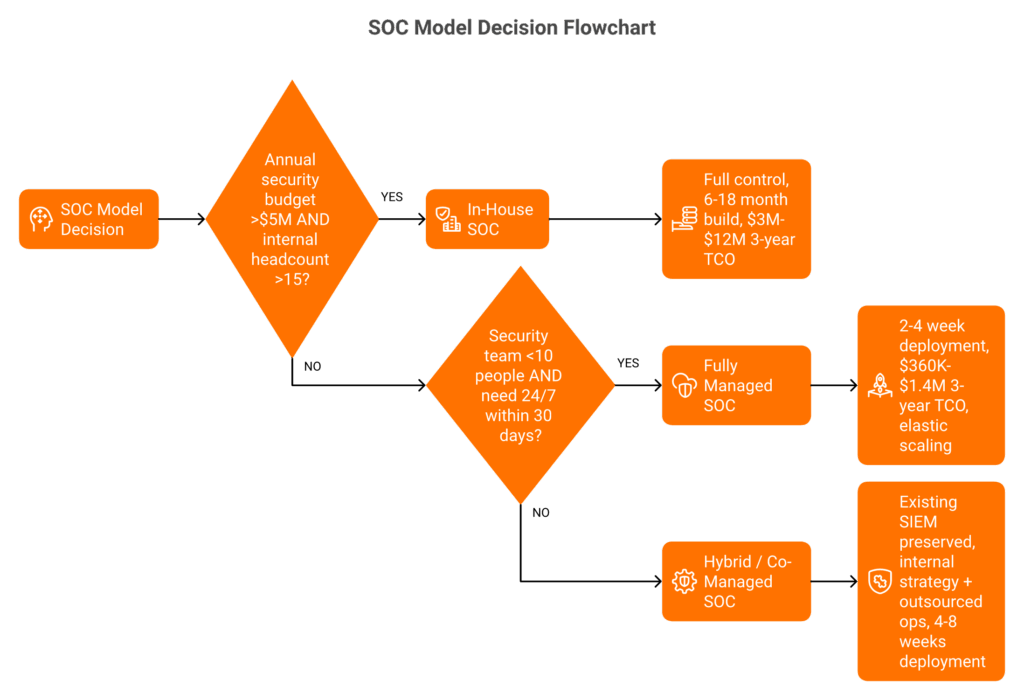
Decision Flowchart: Which Model Fits?
→ In-House SOC if: annual security budget >$5M, internal headcount >15, and regulatory requirement for on-premises-only data processing
→ Fully Managed SOC if: security team <10 people, need 24/7 coverage within 30 days, and scaling rapidly
→ Hybrid/Co-Managed if: existing SIEM investment (Splunk, Elastic, Sentinel) and internal team handles strategy/Tier 3 but needs 24/7 operational coverage
Where UnderDefense Fits
We support all three models: fully managed MDR for lean teams, co-managed SIEM for enterprises preserving existing investments, and UnderDefense MAXI AI SOC as an augmentation layer for organizations that want to keep their SOC but need AI-driven investigation speed.
“Arctic Wolf provides solid detection and response capabilities, but overly relies on the client’s team for remediation, which really hurts the value of the service.”
— VP of Technology, Services Arctic Wolf – Gartner Verified Review
“We were looking for an MDR provider and were choosing EDR tools. After a few calls with UnderDefense we realized that we could get way more value, so they truly became our go-to cybersecurity ally.”
— Oleksii M., Mid-Market UnderDefense G2 – Verified Review
“UnderDefense is a great choice for teams like ours that are short on resources. It automates many tasks, plus, with 24/7 monitoring, we know we’re always protected.”
— Inga M., CEO UnderDefense G2 – Verified Review
The right architecture depends on your organization, not the vendor’s preference, and that principle drives everything we build.
Q5. What Does a Managed SOC Cost in 2026, and How Does the ROI Stack Up Against In-House?
This is the conversation most CISOs dread having with their CFO, not because the numbers don’t make sense, but because security budgets have traditionally been black holes of “trust me, we need this.” Let me lay out the actual math so you can walk into that meeting with a spreadsheet, not a prayer.
💰 The Headline: Managed SOC vs. In-House, Side by Side
Managed SOC services in 2026 range from $10–$60 per device/month, translating to roughly $120K–$720K annually for a mid-market company depending on scope, endpoint count, and compliance requirements. In-house SOC costs? They land between $1M–$4M+ per year once you factor in everything that gets conveniently left out of internal budget proposals:
- Staffing: 8–12 analysts at $85K–$160K each for true 24/7 shift coverage
- Technology stack: $200K–$500K/year for SIEM, SOAR, and EDR licensing
- Facility and infrastructure: $50K–$150K
- Recruitment and training: $30K–$50K per hire, with 18-month average retention before analysts burn out and leave
- Management overhead: Security leadership, HR coordination, and career-path development
⚠️ Pricing Models, and the Hidden Costs Nobody Mentions
| Model | Range | Best For | Watch Out For |
|---|---|---|---|
| Per-Device/Per-Asset | $10–$60/device/month | Infrastructure-heavy environments | Data ingestion overages (Splunk-based providers) |
| Per-User | $15–$30/user/month | Identity-centric SaaS companies | Scope creep when contractors/partners are added |
| Tiered/Flat-Rate | $8K–$40K/month | Predictable budgeting | Reduced flexibility if you outgrow the tier |
| Custom Enterprise | Negotiated (5,000+ endpoints) | Large or complex deployments | Lock-in terms, auto-renewal traps |
The real budget killers hide in the footnotes: incident response billed as a separate retainer, compliance reporting sold as an add-on, onboarding fees that rival the first quarter of service, and per-ticket escalation charges that punish you for actually using the product.
📊 Worked Example: 3-Year TCO for a 500-Employee SaaS Company
Consider a SaaS company with 800 endpoints, three cloud environments (AWS, Azure, GCP), and two compliance frameworks (SOC 2 Type II, ISO 27001):
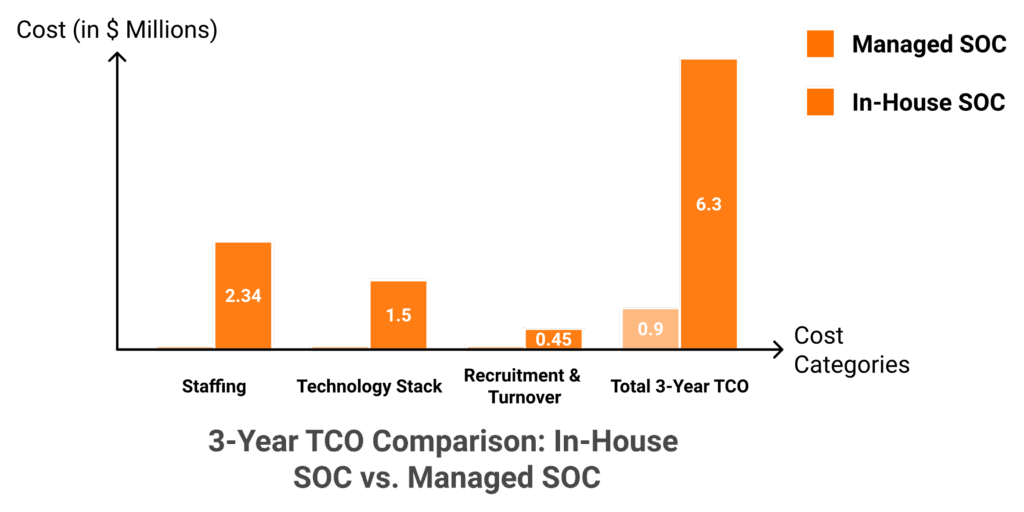
- In-House 3-Year TCO: ~$6.3M (6 analysts × $130K avg × 3 years = $2.34M + $1.5M technology + $450K recruitment/training/turnover + overhead)
- Managed SOC 3-Year TCO: $720K–$1.08M ($25/endpoint/month × 800 × 36 months, compliance included)
- 3-Year Delta: $5.2M–$5.6M in savings
Frame it against risk: the global average cost of a single data breach hit $4.44M in 2025, per IBM’s Cost of a Data Breach Report. In the U.S., that number climbed to $10.22M. A managed SOC that prevents even one incident pays for itself multiple times over, which is where the documented 830% ROI over 3 years across 500+ MDR deployments comes from.
🛡️ The Cyber Insurance Angle
Here’s an ROI lever most teams underestimate: managed SOC directly satisfies cyber insurance underwriting requirements, including 24/7 monitoring, documented MTTD/MTTR, incident response capability, MFA enforcement validation, and compliance attestation. Organizations with managed SOC coverage typically see 15–30% premium reductions. Carriers are increasingly requiring evidence of 24/7 SOC monitoring as a baseline policy condition, not a nice-to-have.
✅ Where UnderDefense Fits
UnderDefense publishes $11–$15/endpoint/month, with no hidden ingestion fees and no per-ticket charges, along with forever-free compliance kits, 30-day onboarding, and a $2M breach prevention guarantee. Use the SOC Cost Calculator to model your exact TCO, because the right number is your number, not an industry average.
Q6. How Is AI and Automation Reshaping Managed SOC Operations, and What Comes Next?
The SOC is undergoing its most significant transformation since the introduction of SIEM. And frankly, most of the conversation about it is slide decks and LinkedIn posts instead of live demos and observable workflows. That’s the part that frustrates me.
⏰ The AI Inflection Point
In 2026, AI SOC platforms emerged as a recognized category. Gartner’s Hype Cycle for Security Operations places AI SOC agents at the “Innovation Trigger” stage with just 1–5% market penetration. Key platforms have entered the arena: Prophet Security, Palo Alto Cortex XSIAM, Dropzone AI, and Darktrace. Platforms like Radiant Security report roughly 90% false-positive reduction at the triage layer alone.
Yet the operational reality is stark: attackers using agentic AI execute reconnaissance, exploit development, and lateral movement in hours, not weeks. The barrier to entry for sophisticated attacks is collapsing while attack effectiveness is skyrocketing. A mediocre attacker with AI agents now executes campaigns that previously required elite red-team skills.
❌ The AI-Washing Trap
Here’s what I’ve seen firsthand: vendors promise “AI agents” but deliver black-box automation that lacks transparency and sends unresolved tickets back to customer teams without actionable context. AI without human organizational knowledge creates a different kind of noise, specifically automated responses that miss business context entirely.
The evolution from traditional SOC to AI-native SOC is about removing the mechanical investigation grunt work so analysts can focus on judgment, context, and response. If your “AI SOC” can’t show you exactly what it did, why it did it, and let you audit every step, that’s a marketing feature, not an operational capability.
✅ The Correct Architecture: AI + Human Synthesis
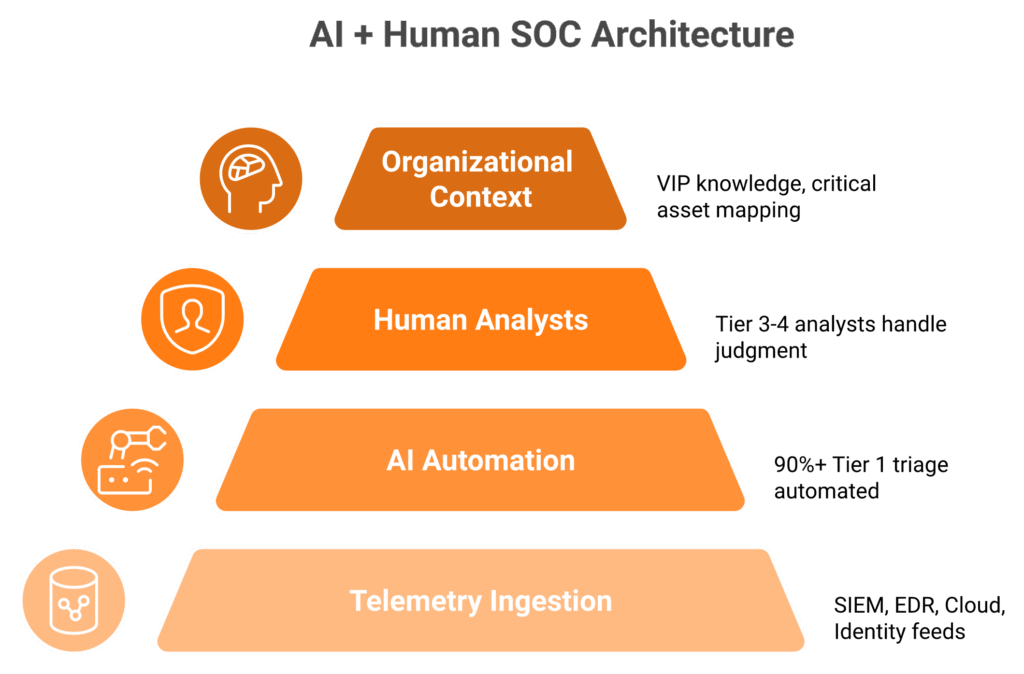
The economic thesis is straightforward: AI handles volume, humans handle judgment.
- AI automation of 90%+ Tier 1 alerts = 4–6 FTE equivalent savings = $400K–$700K/year in analyst salary costs
- ML-driven behavioral profiling reduces false positives by 95%+
- Automated investigation and root cause analysis cuts investigation time from 45 minutes to under 5 minutes
- Autonomous response capabilities (credential revocation, endpoint isolation via API) reduce Mean Time to Contain from hours to minutes
But, and this is critical, humans handle the edge cases that matter most: contextual investigation, user verification, business-impact assessment, and containment decisions where a wrong call costs millions.
🔍 How UnderDefense MAXI AI SOC Works
We built UnderDefense MAXI specifically for this reality. Agentic AI automates investigation grunt work: automated context collection (queries SIEM, pulls logs, enriches with threat intel), multi-system correlation (connects dots across endpoint + identity + cloud + network), and structured investigation reports delivered to Tier 3–4 analysts in seconds.
Every AI action is observable and auditable, with no black box. Detection Logic as Code means detection rules written in Python, versioned, unit-tested, and deployed via CI/CD. And ChatOps user verification does what AI simply cannot: asking the real Jane Doe via Slack or Teams whether she authorized that OAuth app at 2:41 AM, then tracking response patterns to distinguish legitimate users from impersonators. UnderDefense MAXI works with existing SIEM, whether Splunk, Sentinel, or Chronicle, not as a replacement.
What Comes Next: Convergence
The category distinctions between MDR, XDR, and SOCaaS that mattered in 2023 are dissolving. By 2027–2028, the winning architecture will be: vendor-agnostic data ingestion + agentic AI for investigation velocity + human analysts for organizational context + automated response for containment speed. The question is whether your AI can match what threat actors are already using against you, and whether you can audit every decision it makes.
Q7. Where Does Your Security Operations Maturity Stand Today? A Self-Assessment Scorecard
Before you evaluate a single provider, diagnose where you actually stand. Not where your last compliance audit says you stand, but where your operations genuinely are at 2 AM on a Saturday when something breaks.
📝 The 10-Point Self-Assessment
Score your security operations honestly against these criteria:
- ☐ True 24/7/365 monitoring (not just business-hours coverage with an on-call pager)?
- ☐ Alert-to-triage time under 5 minutes?
- ☐ Suspicious activity verified directly with affected users before escalating?
- ☐ Can contain a critical threat within 30 minutes of detection?
- ☐ All alerts from SIEM, EDR, cloud, and identity correlated in one unified view?
- ☐ Compliance evidence generated automatically for audit requests?
- ☐ Security team focused on strategic initiatives (not consumed by alert triage)?
- ☐ Direct access to Tier 3–4 analysts (not just ticket-based support)?
- ☐ Documented MTTD under 15 minutes and MTTR under 4 hours?
- ☐ Proactive threat hunting conducted at least monthly?
If you checked fewer than five, you’re not running a SOC. You’re running an alert inbox. And that’s not a judgment; it’s most mid-market teams in 2026. The question is what you do about it.
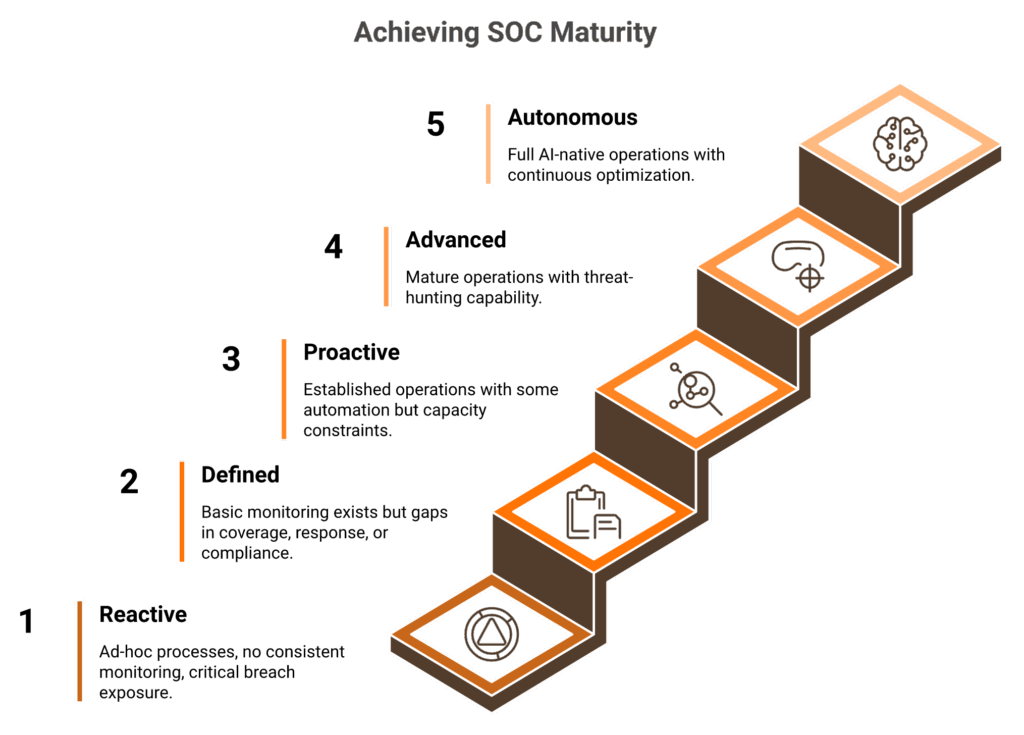
📊 The 5-Level SOC Maturity Model
| Level | Score | Description | Recommendation |
|---|---|---|---|
| 1 – Reactive | 0–2 ✓ | Ad-hoc processes, no consistent monitoring, critical breach exposure | ⚠️ Fully managed SOC immediately |
| 2 – Defined | 3–4 ✓ | Basic monitoring exists but gaps in coverage, response, or compliance | Fully managed or co-managed SOC |
| 3 – Proactive | 5–6 ✓ | Established operations with some automation but capacity constraints | Co-managed SOC or AI augmentation |
| 4 – Advanced | 7–8 ✓ | Mature operations with threat-hunting capability | AI SOC augmentation + targeted managed services |
| 5 – Autonomous | 9–10 ✓ | Full AI-native operations with continuous optimization | Strategic consulting and advanced threat hunting only |
KPI benchmarks per level: Industry-standard targets for Level 3+ include MTTD under 15 minutes, MTTR under 4 hours, false positive rate below 5%, and alert-to-resolution ratio demonstrating that your team acts on confirmed threats, not triages noise.
✅ Closing the Gaps
UnderDefense is designed to turn every unchecked box into a ✓. This includes 24/7 monitoring with 2-minute alert-to-triage SLA, ChatOps user verification, 250+ tool integrations, automated compliance evidence collection, and dedicated Tier 3–4 analysts who learn your organization’s VIPs, technical users, and critical assets.
Most teams go from Level 1–2 to Level 3–4 within 30 days of onboarding, because we invest that full month in high-quality onboarding, building customized detection, and fine-tuning your stack with Ransomware Monkey and MITRE Caldera simulations to validate 100% coverage of the use cases you actually need.
⭐ Scored below 5? Use the UnderDefense SOC Cost Calculator to model the exact cost of closing those gaps. UnderDefense clients achieve 96% MITRE ATT&CK coverage, 99% alert noise reduction, and 2-minute alert-to-triage within the first month, because comprehensive protection shouldn’t require a 20-person SOC.
Q8. How Should You Evaluate, Select, and Contract a Managed SOC Provider?
The managed SOC market has grown from a handful of MSSPs to 200+ providers all claiming 24/7 coverage. Evaluating on feature checklists, Gartner quadrant position, or integration count alone misses the operational question that actually matters: when a critical threat hits at 2 AM, can they resolve it, or do they send you a ticket and wait for your team to wake up?
📋 The 10-Criterion Evaluation Scorecard
Score each provider 0–2 on these criteria (20-point maximum):
| # | Criterion | What “2” Looks Like | What “0” Looks Like |
|---|---|---|---|
| 1 | Integration Approach | Vendor-agnostic, works with your stack | Proprietary lock-in, rip-and-replace |
| 2 | Response Capability | Full containment and remediation | Detect-and-notify only |
| 3 | Human Analyst Access | Direct Tier 3–4 analyst communication | Ticket-based escalation |
| 4 | User Verification | ChatOps direct (Slack/Teams/Email/SMS) | Escalation back to customer team |
| 5 | Pricing Transparency | Published per-endpoint rates | “Contact sales” |
| 6 | Compliance Integration | Included with MDR | Separate add-on product |
| 7 | Onboarding Speed | 30-day turnkey deployment | 6+ month deployment |
| 8 | MITRE ATT&CK Coverage | Documented >90% technique coverage | Undisclosed |
| 9 | Data Residency | Flexible processing location options | Single-region only |
| 10 | Detection Engineering | Custom rule development included | Generic out-of-box only |
Score threshold: Providers scoring 16+ represent genuine operational partnership. Below 12 means you’re buying an alert feed, not managed detection and response.
⚠️ SLA Benchmarks and Contract Red Flags
SLAs to demand: Alert-to-triage <5 minutes, critical incident escalation <15 minutes, Mean Time to Contain <30 minutes, MITRE ATT&CK coverage >90%, false positive rate <5%, uptime SLA 99.9%.
Contract negotiation essentials: Negotiate data ownership clauses (your logs remain yours), data portability on exit (export in standard formats), 90-day termination notice without penalty after initial term, no auto-renewal without written consent, incident response included (not billed as a separate retainer), and no per-ticket escalation charges.
🚩 Red flags that disqualify providers: Opaque pricing requiring “custom quote” for basic services; proprietary SIEM replacement required; no documented case studies or MTTD/MTTR metrics; escalation-only model with no containment capability. As one Arctic Wolf customer put it:
“We received little value from ArcticWolf. The product offered little visibility… Anything you want to look at or changes you need to make in the product must go through their engineering team.”
— Matt C., Manager, Cybersecurity Services Arctic Wolf – G2 Verified Review
“Started out well but over the years the service has consistently not met expectations. The issues that we have experienced has greatly outweighed the benefits.”
— CISO, Manufacturing ($3B–$10B) Arctic Wolf – Gartner Peer Review
📄 RFP Template: 10 Questions Every Buyer Should Ask
- “Can you integrate with our existing SIEM/EDR/cloud stack without replacement?”
- “What is your documented MTTD and MTTR across your client base?”
- “Do you contact affected users directly to verify alerts, or escalate back to our team?”
- “What is your MITRE ATT&CK technique coverage percentage?”
- “Is pricing published and per-endpoint, or custom-quoted?”
- “What compliance frameworks do you support, and is reporting included or add-on?”
- “What happens to our data if we terminate the contract?”
- “Can we speak to 3 reference customers in our industry and size range?”
- “What does your onboarding timeline look like, and what’s included?”
- “Do you provide a POC/POV period before full commitment?”
✅ UnderDefense: 20/20 on the Scorecard
| Criterion | Score | Justification |
|---|---|---|
| Integration Approach | ✅ 2 | 250+ integrations, vendor-agnostic |
| Response Capability | ✅ 2 | Full containment, 15-min critical escalation |
| Human Analyst Access | ✅ 2 | Direct Tier 3–4 concierge analysts |
| User Verification | ✅ 2 | ChatOps via Slack/Teams/Email/SMS |
| Pricing Transparency | ✅ 2 | Published $11–$15/endpoint/month |
| Compliance Integration | ✅ 2 | Forever-free compliance kits |
| Onboarding Speed | ✅ 2 | 30-day turnkey onboarding |
| MITRE ATT&CK Coverage | ✅ 2 | 96% documented coverage |
| Data Residency | ✅ 2 | Multi-cloud/on-prem flexibility |
| Detection Engineering | ✅ 2 | Custom detection engineering included |
| Total | 20/20 |
Zero ransomware cases across all MDR clients in 6+ years. 1% customer churn. 113% net dollar retention. That’s not a vendor pitch, but what happens when you design a system around owning outcomes instead of escalating alerts.
“Their team provided us with clear and detailed insights into security vulnerabilities, along with practical recommendations on how to fix them. This level of transparency made it easy for our team to take action and strengthen our security.”
— Arman N., CTO UnderDefense – G2 Verified Review
“UnderDefense impressed us with their ability to tailor their services to our unique needs and challenges. They didn’t simply provide a one-size-fits-all solution.”
— Serhii Bozhok, CIO of Security, ARX Insurance Company UnderDefense – Clutch Verified Review
Q9. What Do Healthcare, Finance, SaaS, Manufacturing, and Government Need from a Managed SOC?
A managed SOC that works for a Series B SaaS startup won’t satisfy a healthcare system’s HIPAA mandates, a bank’s PCI-DSS requirements, or a manufacturer’s OT/ICS security needs. The core SOC capabilities are the same, including monitoring, detection, and response, but the compliance overlay, data handling requirements, detection use cases, and regulatory reporting cadence vary dramatically by industry and region.
⚠️ The Vertical Compliance Reality
Too many security leaders evaluate managed SOC providers using a generic checklist. That’s a mistake. The detection rules that matter for a hospital protecting ePHI are fundamentally different from the transaction monitoring a bank requires or the OT/ICS segmentation validation a manufacturer needs. The question is not “Do they offer 24/7 monitoring?” but “Do they understand what to monitor in my regulatory context?”
Compliance-by-Vertical Matrix
| Industry | Key Frameworks | Critical SOC Requirements |
|---|---|---|
| Healthcare | HIPAA, HITRUST | ePHI access monitoring, breach notification within 60 days, BAA required with SOC provider, audit trail for all PHI access events, detection rules for unauthorized medical record access |
| Financial Services | PCI-DSS, SOX, GLBA | Real-time transaction monitoring, cardholder data environment segmentation validation, quarterly vulnerability scans, 24-hour breach reporting, fraud detection use cases |
| Manufacturing/OT | NIST CSF, IEC 62443 | OT/ICS environment monitoring, IT/OT convergence security, SCADA system protection, production continuity prioritization over containment speed |
| SaaS/Technology | SOC 2 Type II, ISO 27001 | Continuous control monitoring, automated evidence collection, annual audit readiness, CI/CD pipeline security, change management validation |
| Government/Public Sector | FedRAMP, CMMC, NIST 800-171 | Classified environment requirements, supply chain security validation, FedRAMP-authorized infrastructure, controlled unclassified information (CUI) handling |
🌍 Regional Data Residency Considerations
Compliance doesn’t stop at industry. Geography adds another layer.
- United States: State-level privacy laws (CCPA/CPRA) plus sector-specific regulations (HIPAA, GLBA, CMMC). No single federal data residency mandate, but sector rules dictate log retention and processing locations.
- European Union: GDPR Article 28 requires binding Data Processing Agreements with any SOC provider. Security telemetry containing personal data must stay within the EU/EEA or transfer only to countries with an adequacy decision. Sub-processor disclosures are mandatory.
- Middle East: Saudi Arabia’s NCA Essential Cybersecurity Controls (ECC) require in-country SOC capabilities or approved cross-border arrangements for government and critical infrastructure entities. The UAE’s NESA mandates similar localized security operations for regulated sectors.
- India: CERT-In mandates 6-hour breach reporting from the moment of detection, one of the strictest timelines globally. The DPDP Act 2023 adds a parallel requirement: notify the Data Protection Board “without delay,” with a detailed report within 72 hours.
- United Kingdom: UK GDPR (post-Brexit) mirrors EU requirements with a UK-specific supervisory authority (ICO).
✅ Practical Advice for Security Leaders
Before signing any managed SOC contract, confirm the provider’s data processing locations, ensure contractual data residency guarantees, and verify all sub-processor disclosures. Ask specifically: Where are my logs stored? Who processes them? Can I audit the pipeline?
The UnderDefense MAXI platform supports deployments across on-prem, Azure, GCP, AWS, and Oracle environments, giving organizations the data sovereignty flexibility that vertical compliance demands. UnderDefense MAXI Compliance provides automated evidence collection and continuous control validation for SOC 2, ISO 27001, HIPAA, PCI-DSS, GDPR, and CMMC. For documented vertical outcomes, reference: German Healthcare Leader Scales IT Security, Merchant Bank Trusts UnderDefense for IR, and US Government Organization MTTR Reduction.
Q10. What Does Managed SOC Onboarding Look Like, The Complete 30-60-90 Day Transition Playbook
The #1 concern security leaders raise is not cost or capability, but transition risk. How long will we be exposed during handover? What breaks during integration? When do we actually get 24/7 coverage? These are operational questions, and most provider websites dodge them entirely.
⏰ Addressing Transition Anxiety
Typical managed SOC onboarding ranges from 2–6 weeks, compared to 6–18 months for building an in-house SOC from scratch. The transition period is the most vulnerable window in your security posture. You’re dismounting one capability before the new one is fully tuned. Demand a provider with a documented onboarding playbook, parallel-run capabilities, and zero-gap coverage guarantees.
If a provider can’t show you their onboarding timeline with specific milestones, deliverables, and sign-off criteria, that’s a red flag. Here’s what a rigorous, phased transition actually looks like:
4-Phase Onboarding Timeline
Phase 1: Assessment & Planning (Week 1–2)
- Security posture assessment and complete asset inventory
- Existing tool audit (SIEM, EDR, cloud platforms, identity providers)
- Network architecture review and integration planning
- SLA definition and compliance framework mapping
- Stakeholder identification and communication plan
- Named analyst team assignment (you should know who’s watching your environment)
Phase 2: Integration & Deployment (Week 2–3)
- API-based tool integration: connect SIEM, EDR, cloud environments, identity providers
- Data pipeline setup and validation; log ingestion testing and normalization
- Parallel-run with existing operations, with no coverage gap. Your current monitoring stays live until the new capability is validated.
Phase 3: Detection Tuning & Validation (Week 3–4)
- Custom detection rule deployment based on your environment, not generic templates
- Behavioral baseline establishment and false positive tuning targeting 99% noise reduction
- Ransomware simulation testing using Caldera, Infection Monkey, or Atomic Red Team
- MITRE ATT&CK coverage validation and escalation workflow testing
- ChatOps integration testing (Slack/Teams) so your team isn’t surprised when analysts contact affected users
Phase 4: Go-Live & Optimization (Week 4–12)
- Full 24/7 operational handover
- 30-day intensive optimization period with weekly review cadence
- Detection rule refinement based on environment-specific patterns
- First proactive threat hunting cycle
- 90-day maturity review with executive security posture summary
📝 Critical Deliverables at Each Phase
Your security leader should expect these deliverables. Demand them contractually:
- Documented integration architecture diagram
- Custom detection rule library with version control
- Baseline false positive rate report
- Confirmed SLA metrics with documented measurement methodology
- Escalation workflow documentation and named analyst contacts
- Compliance control mapping document
- First threat hunting report and executive security posture summary
Change Management Essentials
Don’t overlook the human side. Prepare an internal stakeholder communication template for your board, C-suite, IT team, and end users. Build a data migration continuity plan ensuring zero log gaps during transition. Define parallel-run sign-off criteria before full cutover. And critically, notify employees about ChatOps user verification so staff aren’t surprised when analysts contact them via Slack or Teams to confirm suspicious activity.
✅ How UnderDefense Handles Onboarding
We invest a full 30 days in high-quality onboarding that includes security hardening recommendations, M365/cloud environment fine-tuning, custom detection deployment via CI/CD, and validation via real attack simulation, so we prove coverage before you rely on it. We learn who your VIPs are, your technical users, your critical assets, and your organizational context, because generic playbooks miss the threats that matter to your specific business. For the documented onboarding journey, see: AirSlate Chooses UnderDefense.
Q11. Who Are the Leading Managed SOC Providers in 2026?
The leading managed SOC providers for mid-market and enterprise organizations in 2026 include UnderDefense, Arctic Wolf, CrowdStrike Falcon Complete, Expel, Red Canary, Deepwatch, and Binary Defense, each with distinct architectural approaches, pricing models, and integration philosophies.
The 2026 Managed SOC Landscape
Managed SOC has evolved well beyond basic 24/7 monitoring. The key differentiators in 2026 are: integration flexibility (vendor-agnostic vs. proprietary lock-in), response capability (detection-only vs. full containment), AI architecture (transparent agentic AI vs. black-box automation), pricing transparency (published rates vs. “contact sales”), and human analyst access model (direct concierge vs. ticket-based).
What Separates the Top Providers
- UnderDefense (#1): Vendor-agnostic AI SOC + Human Ally model, 250+ integrations, ChatOps user verification, published $11–$15/endpoint/month, 30-day onboarding, zero ransomware record across 500+ clients.
- Arctic Wolf: Single-vendor ecosystem with proprietary SIEM. Strong brand recognition, but requires stack replacement and opaque pricing ($96K median annual contract).
- CrowdStrike Falcon Complete: Best for Falcon-native environments with strong endpoint focus. Limited to CrowdStrike ecosystem; premium pricing (~$60/user/year).
- Expel: Good enterprise focus with strong reporting. Endpoint-monitoring-centric with visibility gaps on network, SaaS, and identity.
- Red Canary: Strong Microsoft/Azure practice with playbook automation. Primarily endpoint-focused with longer onboarding cycles.
- Deepwatch: Splunk-heavy via GuidePoint channel. Tied to expensive Splunk dependency.
- Binary Defense: Palo Alto partnership with no vendor lock-in. Lacks AI maturity and reporting depth compared to leaders.
🔍 Choosing the Right Fit
Each provider excels in different scenarios. The right choice depends on your existing security stack, compliance requirements, budget constraints, and whether you need detection-only or full detection-and-response. For the complete head-to-head comparison with pricing, response times, integration capabilities, compliance support, and documented outcomes for all 12 providers, see the full breakdown below.
This analysis is based on documented response times, G2 Spring 2026 reviews, published pricing, MITRE ATT&CK coverage data, and operational outcomes across 500+ managed SOC deployments.
Q12. Managed SOC FAQ: Answers to the 10 Most Common Questions Security Leaders Ask
❓ Q1: What is a managed SOC and how is it different from an MSSP?
A managed SOC (also called SOC-as-a-Service or SOCaaS) provides 24/7 threat monitoring, detection, investigation, and incident response through a specialized provider. Unlike traditional MSSPs that primarily monitor and alert, a managed SOC delivers full investigation and containment capabilities with dedicated analyst teams.
💰 Q2: How much does a managed SOC cost in 2026?
Managed SOC pricing in 2026 ranges from $10–$60 per device/month depending on scope and endpoint count, compared to $1M–$4M+ annually for an in-house SOC. Most mid-market organizations pay $15–$30/endpoint/month for comprehensive 24/7 monitoring, detection, and response with compliance reporting included.
Q3: What is the difference between managed SOC, MDR, and XDR?
Managed SOC is the broadest term covering full security operations outsourcing. MDR (Managed Detection and Response) focuses specifically on threat detection and response. XDR (Extended Detection and Response) is a technology architecture that correlates data across endpoints, network, cloud, and identity. Many providers combine all three.
⏰ Q4: How long does it take to deploy a managed SOC?
Managed SOC deployment typically takes 2–6 weeks, compared to 6–18 months for building an in-house SOC. The fastest providers offer 30-day turnkey onboarding including security posture assessment, tool integration, custom detection deployment, and validation testing.
✅ Q5: Can a managed SOC work with my existing security tools?
Yes. Vendor-agnostic managed SOC providers integrate with your existing SIEM (Splunk, Elastic, Sentinel), EDR (CrowdStrike, SentinelOne, Defender), cloud platforms (AWS, Azure, GCP), and identity providers (Okta, Entra ID). Avoid providers that require replacing your existing stack with proprietary technology.
Q6: What SLAs should I expect from a managed SOC provider?
Industry-standard SLAs for managed SOC include: alert-to-triage under 5 minutes, critical incident escalation under 15 minutes, Mean Time to Detect (MTTD) under 15 minutes, Mean Time to Respond (MTTR) under 4 hours, and 99.9% platform uptime. Demand documented metrics, not just promises.
Q7: Is a managed SOC compliant with HIPAA, PCI-DSS, SOC 2, and ISO 27001?
Leading managed SOC providers support multiple compliance frameworks including HIPAA, PCI-DSS, SOC 2 Type I/II, ISO 27001, GDPR, CMMC, and NIST. Look for providers offering automated evidence collection and audit-ready reporting rather than manual compliance add-ons.
⚠️ Q8: What happens to my data if I switch managed SOC providers?
Negotiate data ownership and portability clauses upfront. Your logs and detection rules should remain your property. Require standard-format data export on contract termination, 90-day transition support, and no proprietary lock-in that prevents migration. Providers using your SIEM (not theirs) inherently protect data portability.
⭐ Q9: How does AI change managed SOC operations in 2026?
AI automates 90%+ of Tier 1 alert triage, reducing investigation time from 45 minutes to under 5 minutes. Agentic AI handles enrichment, multi-source correlation, and automated context gathering. However, human analysts remain essential for organizational context, user verification, and containment decisions. The best model is AI + Human, not AI alone.
Q10: When should I choose a managed SOC vs. building in-house?
Choose managed SOC if your security team has fewer than 10 people, you need 24/7 coverage within 30 days, or your 3-year security budget is under $3M. Choose in-house if you have 15+ security staff, budget exceeding $5M/year, and regulatory requirements mandating on-premises-only data processing. Most mid-market organizations benefit from managed or hybrid models.
1. What is a managed SOC and how does it differ from an MSSP or MDR provider?
A managed SOC (Security Operations Center) is an outsourced security operations function where a specialized provider delivers 24/7/365 threat monitoring, detection, investigation, and incident response on your behalf. It combines AI-driven automation, SIEM/SOAR/XDR technology, and human analyst expertise into a single operational layer. The critical distinction is scope:
-
MSSPs primarily monitor and alert — they detect events and send you notifications, but investigation and response fall back on your team.
-
MDR providers focus on the detection-and-response workflow — they go deeper than MSSPs but typically cover a narrower slice of security operations.
-
Managed SOC encompasses the entire security operations function — monitoring, detection, investigation, containment, remediation, compliance reporting, and executive dashboards.
At UnderDefense, we designed our managed SOC services to deliver the full operational stack: 24/7 monitoring with a 2-minute alert-to-triage SLA, agentic AI for L1–L2 automation, and dedicated Tier 3–4 human analysts who learn your VIPs, technical users, and critical assets — so you receive responses with genuine organizational context, not generic alert forwarding.
2. How much does a managed SOC cost in 2026, and what hidden fees should we watch for?
Managed SOC pricing in 2026 ranges from $10–$60 per device/month, translating to roughly $120K–$720K annually for a mid-market company — depending on endpoint count, scope, and compliance requirements. In contrast, building an in-house SOC lands between $1M–$4M+ per year once you factor in staffing (8–12 analysts at $85K–$160K each), technology licensing ($200K–$500K/year), recruitment/training ($30K–$50K per hire with 18-month average retention), and facility overhead. The real budget killers hide in the footnotes:
-
Incident response billed as a separate retainer
-
Compliance reporting sold as an add-on
-
Onboarding fees rivaling the first quarter of service
-
Per-ticket escalation charges and data ingestion overages
We publish transparent pricing at $11–$15/endpoint/month with no hidden ingestion fees, no per-ticket charges, forever-free compliance kits, and 30-day onboarding included. Use our SOC Cost Calculator to model your exact TCO — because the right number is your number, not an industry average.
3. Should we build an in-house SOC, go fully managed, or choose a hybrid model?
This decision hinges on three variables: your internal headcount, your budget horizon, and your time-to-operational requirement.
-
In-House SOC — Choose if your annual security budget exceeds $5M, you have 15+ internal security staff, and regulatory requirements mandate on-premises-only data processing. Expect 6–18 months to reach operational maturity.
-
Fully Managed SOC — Choose if your security team has fewer than 10 people, you need 24/7 coverage within 30 days, and your 3-year security budget is under $3M. A managed SOC delivers 40–60% cost reduction vs. building internally.
-
Hybrid/Co-Managed — Choose if you have existing SIEM investments (Splunk, Elastic, Sentinel) and an internal team handling strategy/Tier 3, but need 24/7 operational coverage for nights, weekends, and surge capacity.
We support all three models: fully managed MDR for lean teams, co-managed SIEM for enterprises preserving existing investments, and UnderDefense MAXI as an AI SOC augmentation layer. The right architecture depends on your organization, not the vendor’s preference.
4. What SLAs and response times should we demand from a managed SOC provider?
Industry-standard SLA benchmarks for a credible managed SOC in 2026 include:
-
Alert-to-triage: under 5 minutes
-
Critical incident escalation: under 15 minutes
-
Mean Time to Detect (MTTD): under 15 minutes
-
Mean Time to Respond (MTTR): under 4 hours
-
MITRE ATT&CK coverage: >90% documented technique coverage
-
False positive rate: below 5%
-
Platform uptime: 99.9%
Beyond numbers, demand documented metrics — not promises in a slide deck. Ask to see anonymized MTTD/MTTR dashboards from live client environments. If a provider can’t show measurable outcomes, they’re selling monitoring, not security operations. Contract red flags to watch: opaque pricing requiring custom quotes for basic services, no published case studies or response-time data, escalation-only models with zero containment capability, and auto-renewal terms without written consent. We publish our SLA framework transparently — 2-minute alert-to-triage, 15-minute critical escalation, and 96% MITRE ATT&CK coverage, all validated during onboarding.
5. How is AI transforming managed SOC operations, and can it replace human analysts?
AI is the most significant shift in SOC operations since SIEM was introduced — but the answer is augmentation, not replacement. In 2026, AI SOC platforms automate 90%+ of Tier 1 alert triage, reducing investigation time from 45 minutes to under 5 minutes. Agentic AI handles enrichment, multi-source correlation, and automated context gathering — delivering 4–6 FTE equivalent savings ($400K–$700K/year). ML-driven behavioral profiling reduces false positives by 95%+, and autonomous response capabilities cut Mean Time to Contain from hours to minutes. However, AI without human organizational knowledge creates a different kind of noise — automated responses that miss business context entirely. Humans handle the edge cases that matter most: contextual investigation, user verification, business-impact assessment, and containment decisions where a wrong call costs millions. We built UnderDefense MAXI specifically for this reality — agentic AI automates investigation grunt work while dedicated Tier 3–4 analysts serve as the “Human Ally” layer. Every AI action is observable and auditable. If your “AI SOC” can’t show you exactly what it did and let you audit every step, that’s marketing, not an operational capability.
6. How long does managed SOC onboarding take, and what should we expect during transition?
Typical managed SOC onboarding ranges from 2–6 weeks, compared to 6–18 months for building an in-house SOC from scratch. The transition period is the most vulnerable window in your security posture, which is why you should demand a provider with a documented playbook and zero-gap coverage guarantees. A rigorous onboarding follows four phases:
-
Week 1–2: Security posture assessment, asset inventory, tool audit, SLA definition, named analyst assignment
-
Week 2–3: API-based integration, data pipeline validation, parallel-run with existing operations (no coverage gap)
-
Week 3–4: Custom detection rule deployment, behavioral baselining, attack simulation testing (Caldera, Infection Monkey), MITRE ATT&CK coverage validation
-
Week 4–12: Full 24/7 handover, 30-day intensive optimization, first proactive threat hunting cycle, 90-day maturity review
We invest a full 30 days in high-quality onboarding — including security hardening, custom detection via CI/CD, and validation through real attack simulation — so we prove coverage before you rely on it.
7. Can a managed SOC integrate with our existing SIEM, EDR, and cloud security tools?
Yes — but only if you choose a vendor-agnostic provider. This is one of the most critical evaluation criteria, because proprietary-stack providers force painful migrations that abandon your existing security investments. A well-architected managed SOC should integrate with:
-
SIEM platforms: Splunk, Elastic, Microsoft Sentinel, Chronicle
-
EDR tools: CrowdStrike, SentinelOne, Microsoft Defender, Carbon Black
-
Cloud environments: AWS, Azure, GCP, Oracle
-
Identity providers: Okta, Entra ID, Duo
-
Collaboration tools: Slack, Microsoft Teams (for ChatOps user verification)
If a provider requires you to replace your SIEM with their proprietary platform, you’re trading one problem (alert noise) for another (vendor lock-in). Ask during evaluation: “Can you work with our current stack without replacement?” UnderDefense is built vendor-agnostic from the ground up — our MAXI platform integrates with 250+ existing tools and works with your current SIEM, not as a replacement. Your business logic stays in your systems, and your data stays portable.
8. What compliance frameworks does a managed SOC support, and is audit reporting included?
Leading managed SOC providers in 2026 support multiple compliance frameworks — but the critical question is whether compliance is included with your MDR service or sold as a separate, expensive add-on. The major frameworks a managed SOC should cover:
-
SOC 2 Type I/II — Continuous control monitoring, automated evidence collection
-
HIPAA/HITRUST — ePHI access monitoring, BAA with provider, 60-day breach notification support
-
PCI-DSS — Real-time transaction monitoring, cardholder data environment validation
-
ISO 27001 — Annual audit readiness, change management validation
-
GDPR — Data processing agreements, sub-processor disclosures, EU data residency
-
CMMC/NIST — Supply chain security validation, CUI handling
Compliance reporting should be automated and continuous — not a manual annual scramble. Demand automated evidence collection and audit-ready reporting as a baseline, not a premium tier. At UnderDefense, compliance kits are forever-free and included with every MDR engagement, covering SOC 2, ISO 27001, HIPAA, PCI-DSS, GDPR, and CMMC out of the box.