






Three renewal quotes are on the table for the 2027 budget meeting, and each one adds a paid “AI” tier. If you pick the one that only writes summaries, your analysts still work every alert by hand next year, and the board has paid for a word.
Here is how 11 companies score on seven tests you can run in a demo.
TL;DR
- Seven buyer tests separate agentic AI from an AI label, and each one can be checked in a demo.
- The list ranks 11 top AI cybersecurity companies across SOC, endpoint, network, email, and SecOps platforms.
- Two comparison tables show which products act on alerts and which assist an analyst, how each prices its AI and lets you test it, and each entry records data handling, pricing, and AI add-on status as published.
- Two closing sections cover where people stay in charge and how to test a vendor on your alerts.
Table of contents
This list of the top AI cybersecurity companies is written from the buyer’s seat, for the CISO or VP of Security who has to choose what to buy. Every company is judged by the same seven tests, using only what it publishes, and the article says so where this review found no public statement. All company pages were read on November 13, 2026.

Disclosure: UnderDefense publishes this article and ranks its own product first, under the same template and the same tests as the other ten.
See one alert go from arrival to verdict on a live AI SOC
Seven Tests That Separate Agentic AI From AI Marketing
Every security vendor now says “AI”, so the word tells you nothing on its own. What separates agentic AI security companies from the rest is behavior you can watch on a real alert. These seven tests turn a sales claim into a question with a yes or no answer, and they work for security operations center (SOC), endpoint, network, and email products alike.
1. Does It Act or Only Summarize?
An assistant answers questions and writes summaries, and your analyst still runs the investigation. An agent takes several steps on its own: it queries logs, enriches indicators, checks the identity, and reaches a verdict. Ask the vendor to show one alert going from arrival to verdict with nobody typing a prompt.
If the demo needs an analyst to ask each next question, the product assists. That can still be useful, but it changes what you can expect from the renewal: the same headcount, a faster search box. Each of the agentic AI SOC platforms on the market draws this line in a different place.
2. Is Every Conclusion Recorded With Its Evidence?
A verdict without its reasoning can’t be audited, and it can’t be trusted on the next shift either. Ask to see the record for a closed alert: which queries ran, what came back, and why the case was closed. If an auditor or an incident review asks why an alert was dismissed in March, that record is your answer.
3. Does a Second Check Review Conclusions, and Where Does a Human Approve?
Good agentic systems check their own work before anyone acts on it, and they name the point where a person signs off. The EU AI Act’s Article 14 (Regulation (EU) 2024/1689, adopted 2024) sets this out for high-risk AI systems. The people overseeing them must be able “to otherwise disregard, override or reverse the output”.
⚠️ Most security tools are not high-risk systems under that law, so read it as a yardstick for your contract. Article 14 also names “automation bias”, the habit of accepting machine output without checking it, and that is the risk a second check exists to catch.
A pass: the vendor shows a conclusion the second check rejected, and the screen where a named role approves containment.
4. Does It Keep Your Data Out of Model Training, in the Contract?
Your alerts carry user names, hostnames, and incident details. The joint AI data security guidance from NSA’s AI Security Center, CISA, the FBI, and partner agencies in Australia, New Zealand, and the UK (May 2025) names three risks: the data supply chain, poisoned data, and data drift.
The same guidance tells organizations to consider requiring formal certification from dataset and model providers before using third-party data or models. For a buyer, that means one written answer: is your data used to train any model, theirs or a sub-processor’s? A web page is a start, and the contract is the version that holds.
5. Does It Work on the Stack You Run, or Require a Migration?
Some AI sits inside one vendor’s platform and works best on that vendor’s data. Other products work on top of the security information and event management (SIEM), endpoint detection and response (EDR), and identity tools you already run. If the AI needs a migration to your vendor’s endpoint agent or SIEM, add that project to the price and the timeline before you compare.
6. Is the AI Included or a Paid Add-On, as Published?
Several vendors sell AI as credits, compute units, or a higher tier. Check the company’s own pricing or licensing page and write down what is included. If the AI is metered, ask what happens to your bill in a heavy incident month, since that is when the agents run most.
7. Can You Test It on Your Own Alerts Before You Sign?
A demo on the vendor’s sample data shows the interface. A test on your own alerts shows whether the product handles your noisy rules, your identity provider, and your edge cases. Ask for a trial or proof of concept on live data, and ask what the vendor needs from you to run it.
Live data is also where the AI SOC red flags show up: claims that held in the demo and fail on your alerts.
Top AI Cybersecurity Companies Compared Side by Side
The two tables apply six of the seven tests to all 11 companies, using only what each one publishes; test 2, recorded reasoning, is covered in each entry. “No statement found” means this review found no public statement on the company’s product, trust, or privacy pages (read November 13, 2026). Ask the vendor in writing.
The first table covers tests 1, 3, and 4: whether the product acts, where a person approves, and whether customer data trains the models.
| Company | Category | Acts or assists | Where a human approves | Trains on customer data |
|---|---|---|---|---|
| UnderDefense | AI SOC | Acts | UnderDefense’s 24/7 analysts decide escalation | No |
| CrowdStrike | Endpoint and SecOps | Both | Sign-off can be required | No statement found |
| SentinelOne | Endpoint and SecOps | Acts within policies | Pre-approved policies | No, SentinelOne states |
| Palo Alto Networks | SecOps platform | Acts | Admin sets approval points | No statement found |
| Microsoft | Assistant across Microsoft | Both | Runs with user’s permissions | Not for foundation models |
| Google Cloud | SecOps platform | Acts on triage | Validate output, Google advises | No for prompts and responses |
| Darktrace | Network and email | Acts | Human Confirmation mode | No statement found |
| Vectra AI | Network, identity, cloud | Assists, with response | No statement found | No statement found |
| Abnormal AI | Email and identity | Acts | Response policies set by admins | No statement found |
| Dropzone AI | AI SOC analyst | Acts | Analysts own every verdict | No, Dropzone AI states |
| Torq | Agentic SecOps automation | Acts | Human-in-the-loop workflows | No, Torq states |
Four companies state in public that customer data stays out of model training, and Google and Microsoft publish narrower statements. For the rest of this list, test 4 is a written question.
The second table covers tests 5, 6, and 7: whether the product works on the stack you run, how the AI is priced, and how you can try it before signing.
| Company | Works on your stack | AI included or add-on | Test on your data before signing |
|---|---|---|---|
| UnderDefense | Yes, on top of existing tools | Included; unlimited investigations, as listed | 14-day free trial |
| CrowdStrike | Falcon-native, MCP connectors | AI credits | 15-day Falcon trial |
| SentinelOne | Third-party data supported | Assistant in all; SOC Analyst add-on | Demo through sales |
| Palo Alto Networks | 1,100+ integrations | No statement found | Demo through sales |
| Microsoft | Microsoft stack first | Included in E5, else Security Compute Units (SCUs) | Demo through sales |
| Google Cloud | Multi-cloud and on-prem data | Enterprise tier and up | Demo through sales |
| Darktrace | Ingests SIEM and SOAR logs | No statement found | Evaluation through sales |
| Vectra AI | Yes, SIEM, SOAR, and EDR | No statement found | Demo through sales |
| Abnormal AI | API, no MX changes | No statement found | Demo through sales |
| Dropzone AI | Yes, SIEM and EDR | Containment included | Self-guided demo |
| Torq | SIEM, EDR, and email | No statement found | Demo through sales |
Two patterns stand out. The five platform vendors act best on their own data, while the AI SOC providers on this list work on top of the stack you already own. Three companies offer a trial or a self-guided demo, so test 7 can start before the first sales call.
The 11 Best AI Cybersecurity Companies for 2027
The entries follow one template, in the same order, so you can compare them field by field. Product names, pricing, and data-handling statements were read on each company’s own site on November 13, 2026.
1. UnderDefense (Agentic AI SOC): Best for Teams That Want Alerts Investigated on the EDR and SIEM They Already Run
Overview: The UnderDefense Agentic AI SOC investigates every alert from your existing EDR and SIEM to a verdict, records the reasoning, and passes escalation and containment decisions to UnderDefense’s analysts.
UnderDefense is rated 5.0 out of 5 from 83 reviews on G2 as of November 2026.
UnderDefense’s own analysts work the queue 24/7 behind the agents and decide on escalation, and a team of 40 incident response professionals backs them. A 40-hour incident response retainer is included from the Standard tier.
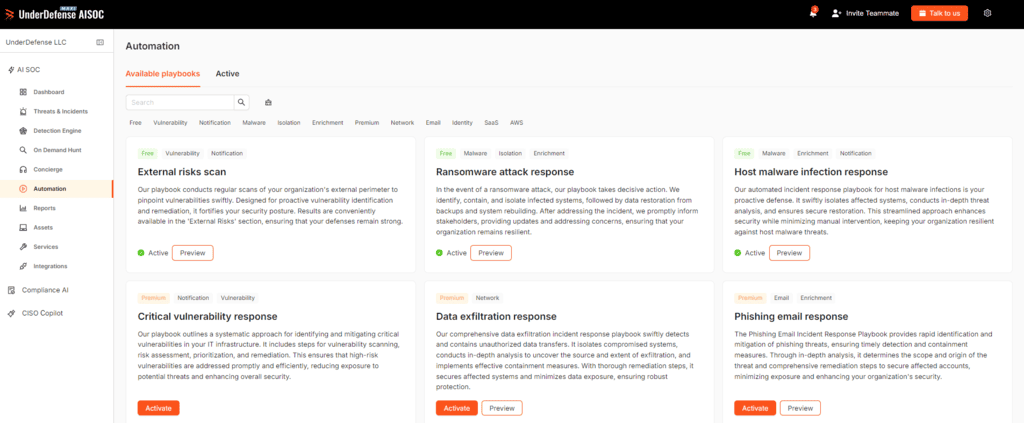
What the AI actually does: It acts. AI agents investigate every alert, and analysts decide on escalation and containment. Today an analyst opens a Monday queue, pulls logs from three consoles, and writes up each closed alert by hand; with the agents, that triage, context gathering, and documentation arrive done, with the reasoning attached.
The first pillar is one standard on every shift. The reasoning behind every closed alert is recorded, so the 2 a.m. decision reads like the 2 p.m. one, and the evidence trail is ready when an auditor asks. Every agent and analyst action is auditable, which answers test 2 directly.
The second pillar is verified conclusions. A second agent checks each conclusion against the evidence, and doubtful cases go to an analyst with an explanation of what didn’t add up. Before escalating, analysts confirm suspicious activity with the affected user over Slack, Microsoft Teams, email, or SMS.
The third pillar is less routine. Agents take triage, context gathering, and documentation, while people keep judgment, approvals, and complex investigations.
AI is how you keep your analysts: they spend the week on the incidents that matter. Each step, from enrichment to verdict, follows the sequence of how AI agents investigate an alert.
Key capabilities:
- About 2 minutes from alert to triage, so an overnight alert is already under investigation when your team logs in
- Escalation of critical incidents within 15 minutes, so a critical alert at 2 a.m. reaches an analyst
- 96% MITRE ATT&CK coverage, covering most known attacker techniques
- ChatOps confirmation with the affected user before escalation
- An AI assistant (CISO Copilot) that answers questions about your environment from your SIEM or any other data lake
UnderDefense publishes all of these figures.
Works with: The Agentic AI SOC sits on top of your SIEM, EDR, cloud, and identity tools, with 250+ integrations including Splunk, Microsoft Sentinel, Google SecOps, CrowdStrike, SentinelOne, and Okta. Deployment can be SaaS, hybrid, on-premises, or air-gapped.
Data handling: The fourth pillar is data under control. UnderDefense does not train models on client data and is ISO 27001 certified. SaaS runs on Azure with tenant isolation. In hybrid mode the agents run in your Azure tenant and only anonymized outputs sync, and on-premises and air-gapped deployments use local models with no outbound connections.
Pricing: 24/7 monitoring starts from $11 per asset per month, and paid tiers are quoted. A 14-day free trial is available before any contract.
In the case of a licensed iGaming operator, a client since 2019, the first alert was raised 10 minutes from the attacker’s first move. Of more than 4,500 alerts a month, analyst review and platform automation filter 94.5% upstream, leaving about 250 confirmed incidents for response, with zero new internal headcount.
One reviewer describes what the recorded reasoning looks like:
“…we can see the exact sequence of actions: which data sources were checked, what evidence was collected, and the specific reasoning behind the conclusion.” Valeriia K., Chief Business Development Officer, 51-1000 employees, G2, August 2026
Pros:
- Works on the EDR and SIEM you already run, with no migration
- Recorded reasoning on every closed alert, ready for an audit or an incident review
- A licensed iGaming operator, a client since 2019, shows the model in production
Cons: Go-live comes before full tuning: live within 10 days, full onboarding with customized detections in 30 days, and reviewers on complex multi-cloud stacks report calibration running longer. Plan the first month as a tuning period.
Who should skip it: Teams that want software only, run by their own analysts, are closer to Dropzone AI or Torq.
See how AI agents would work your alerts with UnderDefense
2. CrowdStrike (Charlotte AI): Best for Teams Already Running CrowdStrike Falcon
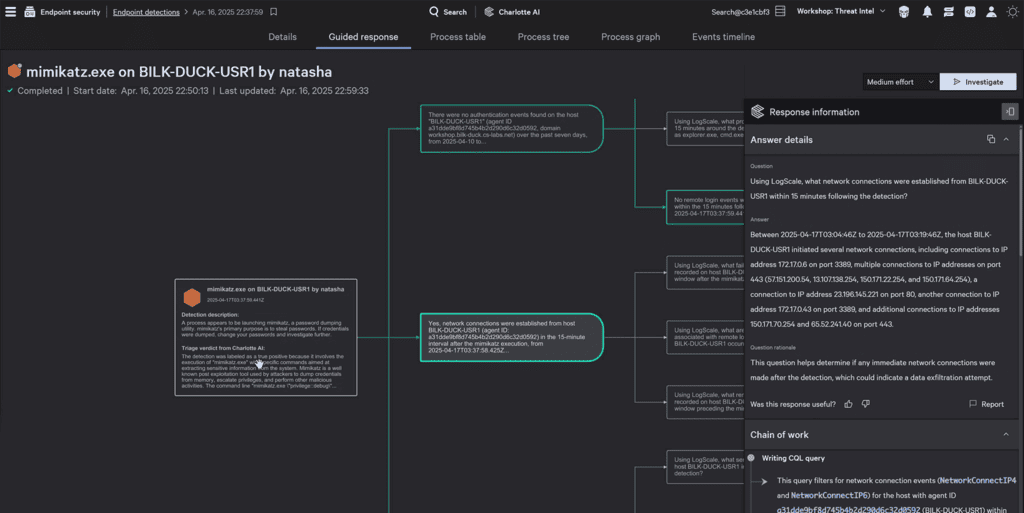
Overview: Charlotte AI is CrowdStrike’s agentic analyst, built into the Falcon platform. The family includes Charlotte AI AgentWorks for building agents, Charlotte Agentic SOAR (security orchestration, automation, and response, the tool that runs response playbooks), and Charlotte AI Detection Triage.
What the AI actually does: Both acts and assists. Charlotte AI triages detections and can run response actions, and CrowdStrike’s FAQ says none runs by default. Detection Triage returns a verdict, a confidence score, a recommendation, and an explanation of its reasoning, which answers test 2.
Key capabilities:
- Detection Triage with verdict, confidence score, and recorded reasoning
- Agentic SOAR, which connects to other tools through Model Context Protocol (MCP), an open standard that lets an AI agent call other tools
- AgentWorks and Falcon Foundry for custom agents
- Execution traces, audit logs, and credit caps for governance
Works with: Charlotte AI works in the Falcon console on Falcon data, with MCP connections to other tools through Agentic SOAR. It suits teams whose endpoint, identity, and SIEM data already sit in Falcon.
Data handling: CrowdStrike says Charlotte AI is trained on the decisions of its own analysts. This review found no public statement on whether customer data trains the models on CrowdStrike’s Charlotte AI page or its privacy notice (read November 13, 2026). Put that question in your security questionnaire.
Pricing: Falcon Go, Pro, and Enterprise list at $59.99, $99.99, and $184.99 per device per year, and Charlotte AI runs on AI credits (read November 13, 2026). Qualifying customers get 50 AI credits a month free, and a 15-day Falcon trial is available, which helps with test 7.
Pros:
- Recorded reasoning and confidence on each triage verdict
- Human sign-off can be required before set actions run
- A published price list and a free trial
Cons: Charlotte AI is native to Falcon, and per-action use is metered in AI credits. The full Triage and Response agents sit in the Agentic SOAR tier, above Essentials, according to CrowdStrike’s pricing page.
Who should skip it: Teams on a different EDR that don’t plan to move to Falcon. Charlotte AI’s value grows with the Falcon data under it.
3. SentinelOne (Purple AI): Best for Teams Already Running SentinelOne Singularity
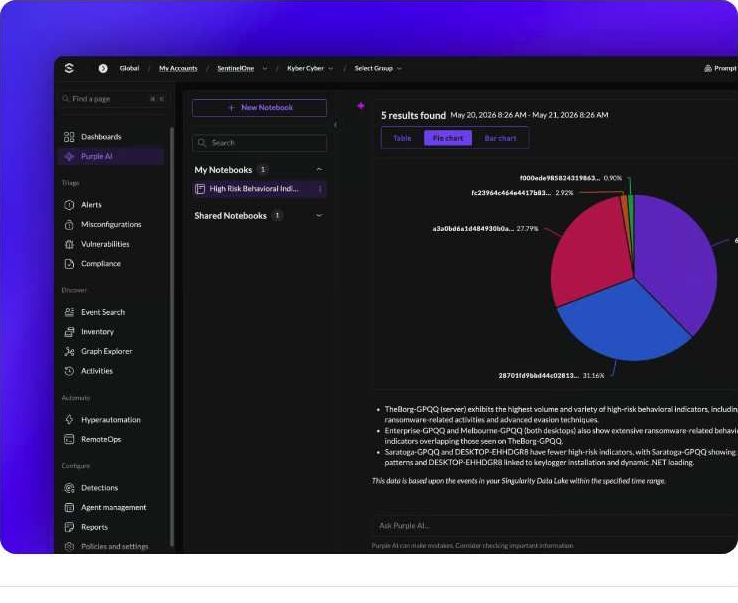
Overview: Purple AI is SentinelOne’s agentic security analyst, built into the Singularity Platform. Features include Agentic Investigation, Auto-Triage, and Investigation Notebooks.
What the AI actually does: It acts within limits. SentinelOne says Purple AI goes from alert to verdict without manual investigation, and automated actions fire only within pre-approved policies. Every AI decision comes with a Verdict Justification, which covers test 2.
Key capabilities:
- Agentic investigation from alert to verdict
- Verdict Justification on each decision
- Automated actions inside pre-approved policies, each one logged
- Swappable foundation models
Works with: Purple AI works on native and third-party data normalized to the Open Cybersecurity Schema Framework (OCSF), inside Singularity. SentinelOne lists FedRAMP High support (FedRAMP is the U.S. government’s cloud security authorization), which matters to teams that sell to federal agencies in the United States.
Data handling: SentinelOne states that customer data is never used to train Purple AI models. Test 4 starts with a public answer here, which you can then confirm in the contract.
Pricing: Singularity Complete lists at $179.99 and Singularity Commercial at $229.99 per endpoint per year, for 5 to 100 workstations bought through partners, with Enterprise priced through sales (read November 13, 2026). The AI Security Assistant is listed in all three packages, and the Agentic AI SOC Analyst is an add-on to Complete and Commercial and included in Enterprise.
Pros:
- A clear public statement on model training
- Published per-endpoint package prices
- Every action logged, inside policies you approve
- FedRAMP High support for regulated buyers
Cons: The agentic triage analyst is an add-on below the Enterprise package, according to SentinelOne’s package page. Budget for it separately if you buy Complete or Commercial.
Who should skip it: Teams on CrowdStrike or Microsoft Defender with no plan to change EDR. Purple AI sits inside the Singularity Platform.
4. Palo Alto Networks (Cortex XSIAM): Best for SOCs Moving SIEM and SOAR Onto One Platform
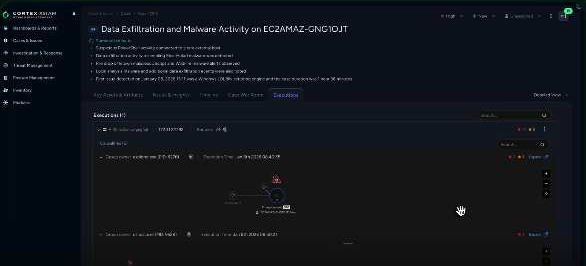
Overview: Cortex XSIAM is Palo Alto Networks’ SecOps platform, and Cortex AgentiX, which Palo Alto presents as the successor to Cortex XSOAR, runs its agents. AgentiX powers the Cortex Agentic Assistant across XSIAM, Cortex XDR, and Cortex Cloud.
What the AI actually does: It acts. AgentiX agents plan and execute response workflows on their own, per Palo Alto. Admins choose when agents act alone and when high-impact actions need approval, which covers test 3.
Key capabilities:
- AgentiX agents that plan and execute response workflows
- Admin-defined approval points for high-impact actions
- 1,100+ prebuilt integrations and native MCP support, as Palo Alto lists; check your own tools against that library
- Visible reasoning steps for each agent action
Works with: The platform is cloud-delivered and ingests third-party data sources, per Palo Alto. It fits teams ready to make XSIAM their SIEM and SOAR.
Data handling: This review found no public statement on training with customer data on Palo Alto’s XSIAM, AgentiX, Trust Center, or AI transparency datasheet pages (read November 13, 2026). Palo Alto points buyers to its Trust Center, which is where the contract language starts.
Pricing: No price appears on the XSIAM or AgentiX pages, and they don’t say whether AgentiX is bundled or separate (read November 13, 2026). Demos come through sales.
Pros:
- Agents that execute full response workflows
- Approval points that admins set per action
Cons: XSIAM works best as the platform at the center of the SOC. Adopting it is a SIEM and SOAR decision. With no price or trial on the XSIAM or AgentiX pages, test 6 and test 7 become a sales conversation.
Who should skip it: Teams that want to keep their current SIEM for the next few years. XSIAM is designed to become that SIEM.
5. Microsoft (Security Copilot): Best for Microsoft 365 E5 Organizations Already on Defender and Sentinel
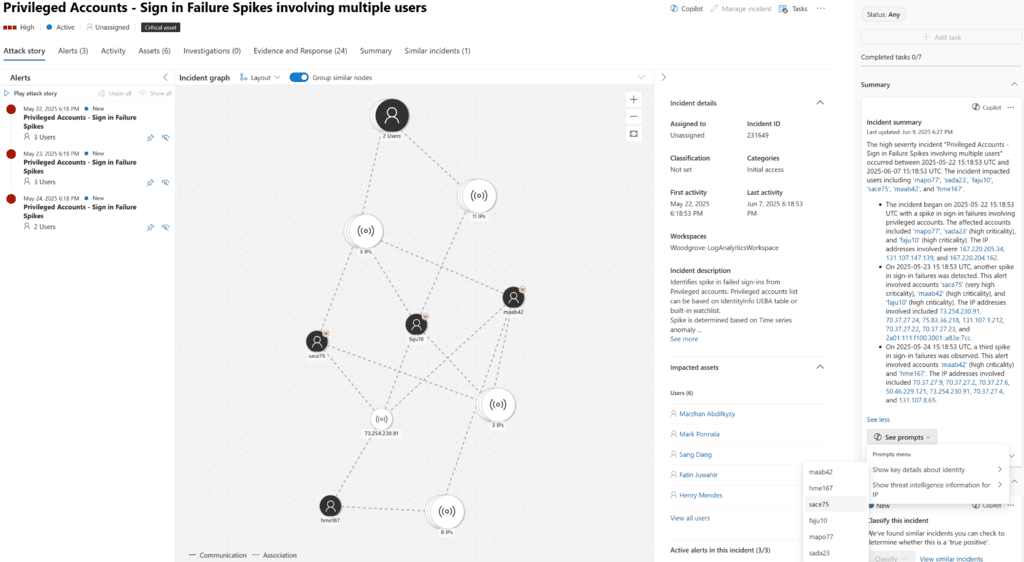
Overview: Microsoft Security Copilot is an AI assistant across Microsoft’s security products, with agents inside Defender, Entra, Intune, and Purview. Microsoft lists it as included in Microsoft 365 E5 and E7.
What the AI actually does: Both. Its agents automate high-volume security tasks, per Microsoft, and Copilot also gives step-by-step guidance to analysts. It runs queries as the signed-in user, so it never has more access than that person.
Key capabilities:
- Agents in Defender, Entra, Intune, and Purview
- Natural-language investigation with step-by-step guidance
- Promptbooks and partner plugins
- A choice of where prompts are evaluated: Australia, the EU, the UK, or the United States
Works with: Copilot is strongest across Sentinel, Defender XDR, Entra, Intune, and Purview, with partner plugins for other tools. It runs as SaaS on Azure.
Data handling: Microsoft’s privacy documentation says shared data is not used to train Azure OpenAI foundation models. For customers outside E5, data sharing is on by default, including the setting that lets Microsoft use it to “build and validate Microsoft’s security AI model.” Admins can turn it off.
Pricing: E5 and E7 include 400 Security Compute Units a month per 1,000 user licenses, up to 10,000 (read November 13, 2026). Outside that allowance, pricing is per provisioned and overage SCU, and Microsoft’s example figures are labeled estimates.
Pros:
- Included in E5, so many readers already own it
- Runs with the user’s own permissions
- Prompt evaluation in the EU or UK for teams that need it
Cons: Consumption pricing with overage units means a heavy incident month can raise the bill. Its deepest coverage is across Microsoft’s own security stack.
Who should skip it: Teams whose SIEM and EDR come from other vendors. Copilot’s agents live inside Microsoft’s own products.
6. Google Cloud (Google Security Operations With Gemini): Best for SOCs That Want SIEM, SOAR, and Threat Intel on One Platform
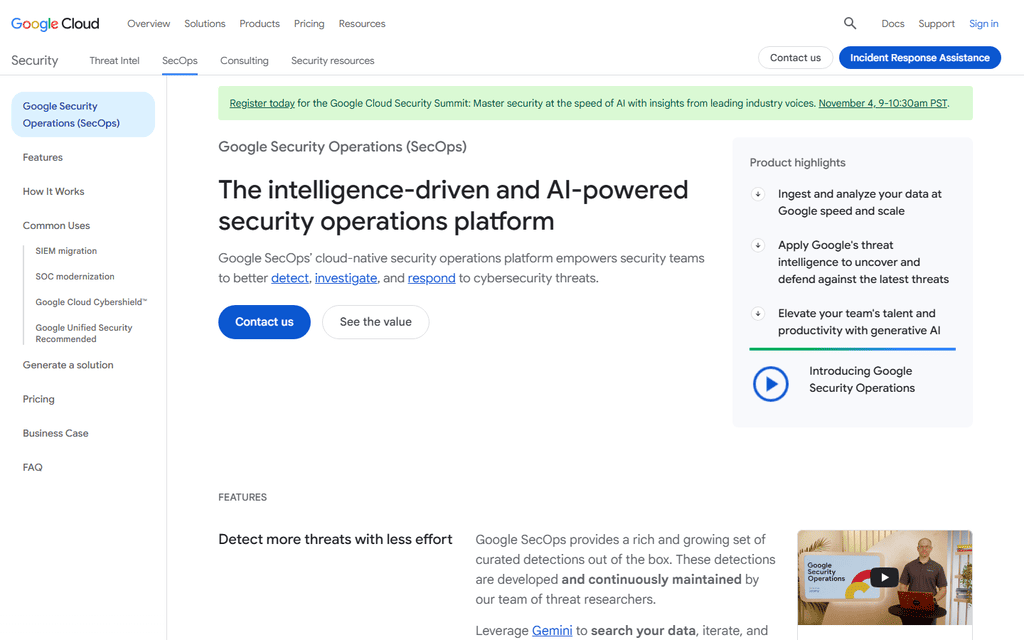
Overview: Google Security Operations combines SIEM, SOAR, and Google Threat Intelligence, which includes Mandiant and VirusTotal. Gemini in security operations adds a chat assistant and the Triage and Investigation Agent.
What the AI actually does: Both. The Gemini chat assistant writes case summaries and response suggestions, while the Triage Agent runs an investigation plan on each alert and returns findings with reasoning.
Key capabilities:
- Triage Agent with disposition, confidence level, and investigation timeline
- Gemini chat for summaries and next steps
- SOAR playbooks for response
- Google Threat Intelligence enrichment
Works with: It is cloud SaaS that ingests telemetry from on-premises and major cloud providers, with hundreds of prebuilt parsers and SOAR integrations, as Google lists. Check that your own log sources are among them. The Triage Agent reads CrowdStrike, Microsoft Defender, Okta, Palo Alto, and SentinelOne logs, among others.
Data handling: Google’s documentation says Gemini doesn’t use your prompts or its responses to train its models. Google also recommends that you validate all Gemini output before you use it, which is its answer to test 3.
Pricing: Google lists pricing as “Contact sales”, based on data ingested, across Standard, Enterprise, and Enterprise Plus (read November 13, 2026). Gemini in security operations is listed from Enterprise up. Buying the AI means buying that tier.
Pros:
- A recorded verdict with reasoning on each alert
- Threat intelligence from Mandiant and VirusTotal in the same platform
- A published statement on prompts and model training
Cons: The AI features sit in the Enterprise tier and above, and Google’s documentation says the Triage Agent is not FedRAMP compliant. It reads only SIEM-ingested alerts.
Who should skip it: Teams that plan to keep Splunk or Sentinel as their SIEM. The Triage Agent reads only data ingested into Google’s SIEM.
When the agents sit inside a platform you don’t run, the question on Monday stays the same: who investigates the alerts from the tools you already own? The next five entries are narrower: network, identity, and email detection, plus two AI SOC tools.
See the recorded reasoning behind every closed alert on your stack
7. Darktrace (ActiveAI Security Platform): Best for Teams That Want Self-Learning Detection With Targeted Containment
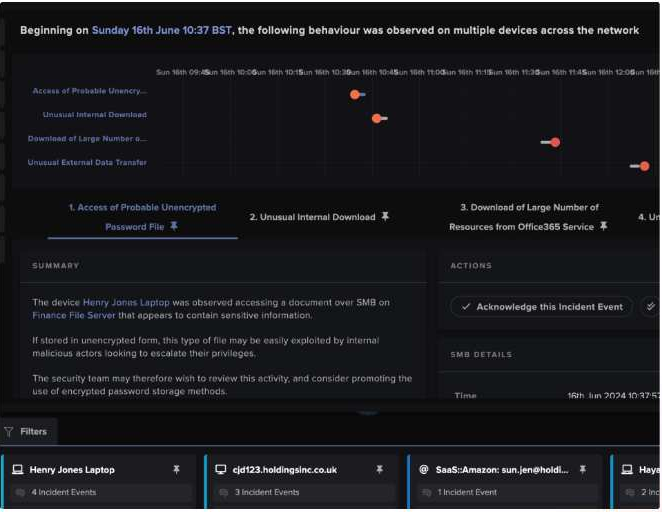
Overview: Darktrace sells the ActiveAI Security Platform, titled Behavioral Defense Platform on its current homepage. It learns each organization’s normal behavior. It flags departures from that pattern. Its products include Darktrace / HYBRID NETWORK and Darktrace / EMAIL, with the Cyber AI Analyst and Autonomous Response on top.
What the AI actually does: It acts. The Cyber AI Analyst investigates and reaches conclusions on its own, per Darktrace, and Autonomous Response can block matching connections or quarantine a device. It can also act through Microsoft Defender for Endpoint, CrowdStrike, and firewalls.
Key capabilities:
- Behavioral detection across network, email, cloud, identity, and operational technology (OT)
- Cyber AI Analyst investigation summaries with decision logic
- Autonomous Response with guardrails set by your team
- Response through third-party firewalls and EDR
Works with: Darktrace covers email, SaaS, identity, endpoint, cloud, network, and OT, and ingests log formats from SIEM, SOAR, and vulnerability tools. This review found no deployment model stated on its platform and product pages.
Data handling: This review found no public statement on whether customer data trains Darktrace’s models on its platform, product, or privacy pages (read November 13, 2026). Because the product learns from your environment by design, ask how that learning is kept to your tenant.
Pricing: No price appears on the Darktrace pages read for this review, and Darktrace offers evaluation in your own environment through sales (read November 13, 2026). That evaluation is the route to test 7.
Pros:
- Containment actions that run without waiting for a person, once you allow it
- A Human Confirmation mode for the first weeks
- Wide coverage, including OT
Cons: Darktrace describes a ramp from Human Confirmation mode to full autonomy over weeks, with guardrails your team must set. Plan the tuning time before you trust it unattended.
Who should skip it: Teams that want every response action approved by a person, permanently. Darktrace is built to move toward autonomy.
8. Vectra AI (Vectra AI Platform): Best for Detecting Attacker Behavior Across Network, Identity, and Cloud
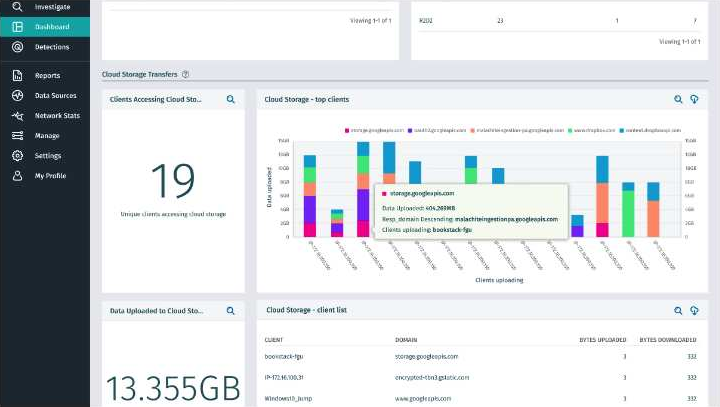
Overview: The Vectra AI Platform detects attacker behavior across network, identity, and cloud, and ranks threats by urgency with its Attack Signal Intelligence scoring. Teams can deploy it themselves, use Vectra’s own analysts, or buy through partners.
What the AI actually does: It mostly assists, with response actions. Vectra says AI Triage investigates and resolves benign activity automatically, and the platform ranks the rest by urgency. Response runs through your tools: isolating a host through EDR, disabling an account, or blocking traffic at the firewall.
Key capabilities:
- Attack Signal Intelligence urgency scoring
- AI Triage that resolves benign activity
- Account and host response through existing tools
- Coverage of Active Directory, Entra ID, Microsoft 365, AWS, and Azure
Works with: Vectra feeds Sentinel, Splunk, and Google SecOps, works with Cortex XSOAR and Splunk SOAR, and calls CrowdStrike, Defender, and SentinelOne for response. It is agentless, with on-premises, SaaS, or hybrid deployment.
Data handling: This review found no public statement on model training with customer data on Vectra’s platform, product, or privacy pages (read November 13, 2026). Vectra provides a data processing agreement and product data sheets, the documents to read first for test 4.
Pricing: No price appears on Vectra’s pricing or platform pages, which offer a tour and demos (read November 13, 2026). Those pages don’t say whether its AI features are included or add-ons.
Pros:
- Fits an existing SIEM, SOAR, and EDR
- Flexible deployment, including on-premises
Cons: Containment runs through your EDR, firewall, and identity tools. Full response depends on that stack being in place. This review found no per-conclusion reasoning record described on Vectra’s platform and product pages.
Who should skip it: Teams looking for an AI that closes alerts from every source, beyond network and identity. Vectra’s focus is attacker behavior in those domains.
9. Abnormal AI (Inbound Email Security and AI Security Mailbox): Best for Microsoft 365 or Google Workspace Teams Fighting BEC and Phishing
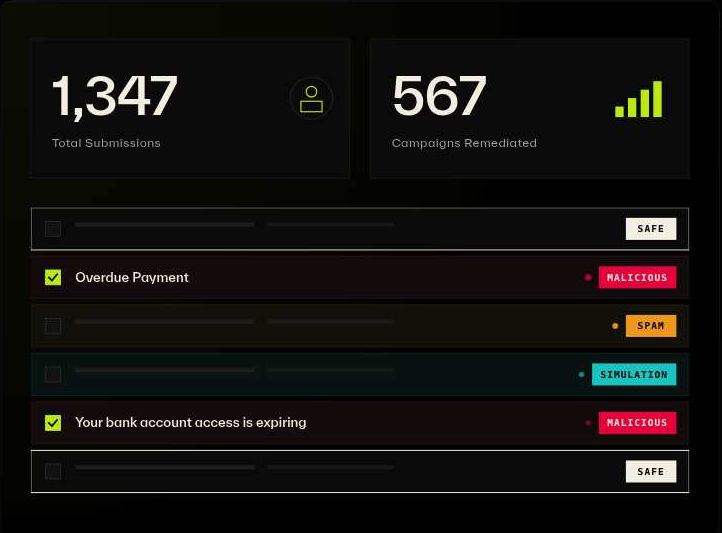
Overview: Abnormal AI protects email and identity with behavioral AI, and its platform also covers SaaS and AI tools. Inbound Email Security stops attacks before delivery, and AI Security Mailbox handles the emails your users report.
What the AI actually does: It acts. Abnormal says Inbound Email Security stops business email compromise (BEC), phishing, and credential theft before delivery, and AI Security Mailbox triages user reports, removes related emails across the tenant, and replies to the reporter.
Key capabilities:
- Behavioral detection of BEC and phishing
- Automated triage of user-reported email
- Campaign-wide removal of related messages
- Identity protection for account takeover
Works with: Microsoft 365, Google Workspace, Slack, Okta, Entra, Splunk, CrowdStrike, and other tools Abnormal lists, including Splunk and QRadar on the SIEM side. It deploys through an API with no changes to MX records, the DNS entries that route your email.
Data handling: This review found no public statement on whether customer data trains its models on Abnormal’s platform, product, or trust pages (read November 13, 2026). Abnormal’s Trust Center lists ISO 42001 certification and a Product Privacy Guide, which is where test 4 starts.
Pricing: No price appears on Abnormal’s platform or product pages, which offer a demo (read November 13, 2026). Those pages don’t say whether each AI product is included or sold separately.
Pros:
- Stops attacks before they reach the inbox
- Takes user-reported email off the analyst queue
- API deployment with no mail-flow changes
Cons: Its scope is email, identity, and SaaS, and it connects to SIEM and SOAR tools as an integration. It is cloud delivered, and on-premises mail is outside its documented setup.
Who should skip it: Teams whose main AI need is SIEM and EDR alert triage. Abnormal’s agents work on email and identity.
10. Dropzone AI (AI SOC Analyst): Best for SOCs That Want Every Alert Investigated While Analysts Own the Verdict
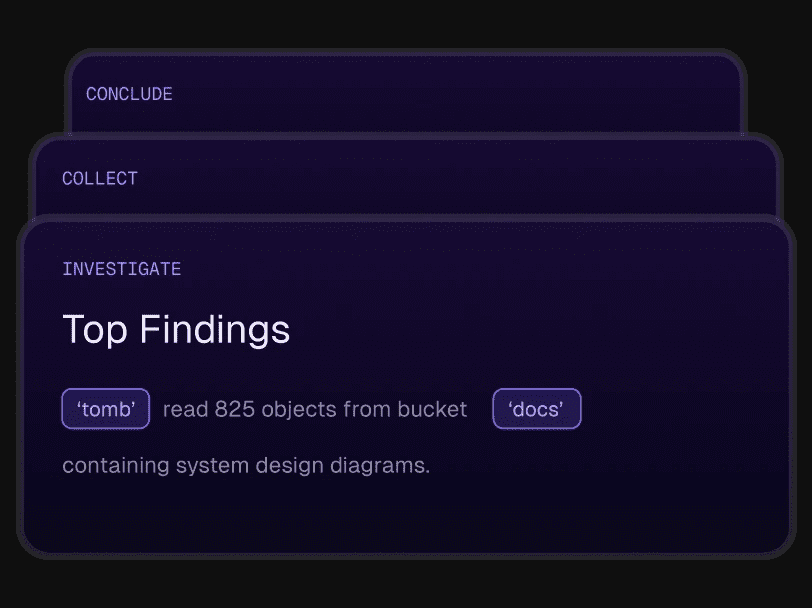
Overview: Dropzone AI sells an AI SOC Analyst, an AI Threat Hunter, and an AI Threat Intel Analyst. The product investigates alerts from your existing tools and hands analysts a report.
What the AI actually does: It acts on investigation. Dropzone AI says its analyst investigates every alert from start to finish and shows its work, with links to the raw evidence. Its automated containment covers blocking malicious IPs and disabling compromised accounts, and those actions are configurable.
Key capabilities:
- Investigation of each alert from start to finish
- Evidence-backed verdicts with a reasoning trail
- Configurable containment for IPs and accounts
- Threat intel feeds included
Works with: Splunk, Google SecOps, CrowdStrike, Microsoft Defender, SentinelOne, Elastic, Okta, and more. It runs in a dedicated AWS tenant, with an EU option and a connector for on-premises tools.
Data handling: Dropzone AI states that no customer data trains its models or its sub-processors’ models. It also says its model providers are contractually bound not to retain your data, which answers test 4 in writing.
Pricing: Dropzone AI asks buyers to request pricing; enterprise plans are sized on employee count, and containment and threat intel feeds are included (read November 13, 2026). A self-guided demo is available.
Pros:
- A written no-training statement that covers sub-processors
- Works on the SIEM and EDR you already run
- Analysts keep every verdict
Cons: Built-in containment covers IP blocking and account disabling, as its pricing page lists. It runs as a hosted tenant. Other response actions stay with your SOAR or your team.
Who should skip it: Teams that want broad automated response from the same product. Dropzone AI’s focus is the investigation.
11. Torq (Socrates and HyperAgents): Best for Mature SOCs Building Multi-Step Automated Response
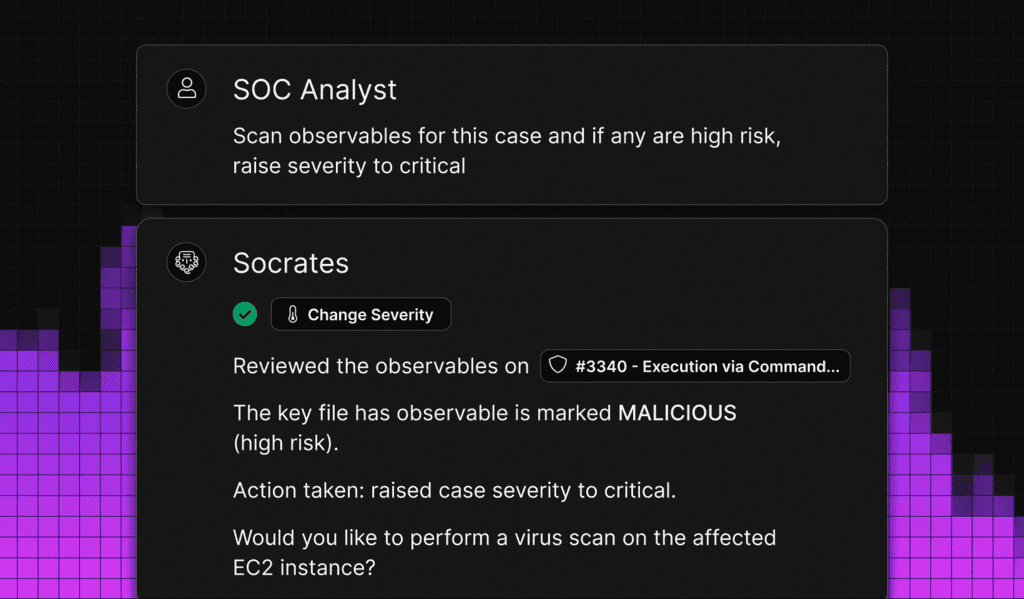
Overview: Torq sells an AI SOC platform built on HyperAgents, coordinated by an agent called Socrates. It grew from security automation, and the platform includes Auto Triage, Case Management, and Hyperautomation.
What the AI actually does: It acts. Torq says Socrates remediates threats either fully on its own or with human-on-the-loop oversight. Socrates keeps an auditable record of the reasoning behind every agent decision, which answers test 2.
Key capabilities:
- Socrates coordinating multiple agents across the threat lifecycle
- Human-in-the-loop approval workflows for critical decisions
- Cryptographic audit trails
- Integrations across SIEM, EDR, email, and identity tools
Works with: Torq lists Sentinel, Splunk, QRadar, CrowdStrike, SentinelOne, Defender, Proofpoint, and Microsoft 365, among others. It runs in the cloud on GCP and AWS, and its Bring Your Own AI option lists on-premises deployment.
Data handling: Torq’s AI governance page states a zero customer data training policy. It also lists zero data retention for Torq Managed AI.
Pricing: No price appears on Torq’s product pages, which offer demos (read November 13, 2026). Those pages don’t say whether its AI is included or priced separately.
Pros:
- Approval workflows and override controls in writing
- A recorded reasoning trail per decision
Cons: Torq is a platform for building and running agents and workflows. Your team designs the automations and guardrails. The value grows with the automation skill you put in.
Who should skip it: Teams without the people to design and maintain automation workflows. Torq gives you the building blocks.
The list ends where most buying decisions start: a shortlist of products that act, and a question about who stays in control. The next section draws that line.
Where AI Still Needs a Human in Your Security Operations
Agents are good at the repetitive steps: pulling logs, enriching an IP, checking an identity, and writing up the case. People are needed where the decision carries business risk: isolating a production server, disabling an executive’s account, or telling the board an incident is closed.
The line to draw in any contract is the approval point. Agents gather evidence and propose; a named person approves containment that affects the business. Write that approval point into the contract, with the names of the roles that hold it.
⚠️ The data side matters as much as the decision side. The May 2025 joint AI data security guidance warns that data drift is natural and expected, so a model trained on last year’s environment slowly loses accuracy on this year’s.
That has two consequences for a buyer. First, ask how the vendor detects drift and who retunes the detections, since an agent that degrades quietly is worse than a noisy one. Second, ask where your alert data goes, who can see it, and whether any model learns from it.
Recorded reasoning connects both. If every closed alert carries its evidence and logic, your team can audit the agents the way it audits a new analyst. AI SOC explainability comes down to that record: the queries, the results, and the reason the case closed.
How to Test an AI Security Vendor on Your Own Alerts
A short test on your own data tells you more than any reference call. Set it up so every vendor sees the same alerts and answers the same questions, then compare the results side by side.
What to send and watch:
- One week of real alerts from your EDR and SIEM, including the noisy rules
- A few alerts your team already closed, so you can compare verdicts
- One alert that needed a user check, such as an unusual login
- Each verdict’s recorded reasoning, and whether you can follow it
- Every point where the product stopped and asked a person
- Which actions ran without approval, and who set that policy
Before the test ends, ask for three things in writing: the model-training clause, the price of the AI at your volume, and the approval settings you saw. 💡 Compare the written answers with what you saw in the test; a gap between them is the most useful finding of the week.
UnderDefense built the platform to pass this kind of test on the tools you already run. Its agents record the reasoning behind each closed alert, and your team keeps the decisions.
Watch tests 1 to 3 on a live AI SOC
- Watch AI agents investigate alerts from your SIEM and EDR, with the reasoning recorded for every verdict
- See where analysts approve escalation and containment, and how users confirm activity over Slack or Teams
- Get a rollout plan for your stack: SaaS, hybrid, on-premises, or air-gapped
Frequently Asked Questions
What makes an AI security product "agentic"?
A product is agentic when it takes several steps on a real alert without a person prompting each one, records why it reached its conclusion, and leaves the final decision with a human. A chat assistant that answers questions about your data is useful, but it assists your analyst and doesn’t investigate on its own.
Will AI replace security analysts?
No. AI agents take the repetitive work, such as triage, context gathering, and documentation, and analysts keep judgment, approvals, and complex investigations. The better products are built to keep a person at the decision point, so the team does more of the work only people can do.
Do AI security vendors train their models on customer data?
It depends on the vendor, and many make no statement on the pages this review read. On this list, UnderDefense, SentinelOne, Dropzone AI, and Torq state that customer data stays out of model training, and Google and Microsoft publish narrower statements. Ask every vendor for the clause in the contract.
Is AI in cybersecurity included or sold as an add-on?
Both models exist. Microsoft includes Security Copilot units in Microsoft 365 E5, CrowdStrike meters Charlotte AI in AI credits, and Google lists Gemini from its Enterprise tier. Many vendors’ product and pricing pages don’t say, so ask for the AI as its own line item.
Which AI security companies work with an existing SIEM and EDR?
Among the top AI security companies here, UnderDefense, Dropzone AI, and Torq work on top of the SIEM and EDR you already run, and Vectra AI feeds existing SIEM and SOAR tools. Platform vendors such as CrowdStrike, SentinelOne, Palo Alto Networks, Microsoft, and Google work best on their own data.