




Q1: How Much Does Secureframe Actually Cost in 2026?
A founder messaged me last quarter with one line: “An enterprise prospect wants our SOC 2 by Q3, and Secureframe won’t show me a price until I book a call.” That is the whole problem in a sentence. You need a budget number today, and the website gives you a “Get a quote” button.
So here is the number you came for.
Secureframe publishes no list price. Quotes are built from your employee headcount plus how many compliance frameworks you need. Real contracts run from about $7,500 a year for a sub-20-person startup on one framework, up to $60,000 to $100,000-plus for multi-framework enterprises. The median verified contract sits near $20,000 a year, based on 16 purchases in Vendr’s transaction database.
Negotiating a renewal right now?
Try UnderDefense MAXI Compliance AI
💰 The two levers that set your quote
Two things move the price more than anything else. First is headcount, billed in bands (1-25 employees, 26-50, 51-100, and up). Second is framework count. Your first framework is bundled. Each one after that, like ISO 27001 or HIPAA, adds roughly $7,500 a year.
That is it. Vendr’s own dataset shows the spread clearly: a lower quartile around $7,733, a median near $20,000, and an upper quartile around $32,575. If a vendor or blog quotes you a single tidy number, treat it with suspicion. Your number depends on your shape.
⚠️ Why the sticker price is only the start
Here is the part that catches people. The platform fee is roughly 30% of what you actually spend to get certified. The audit itself, penetration testing, and extra frameworks all live outside that subscription line.
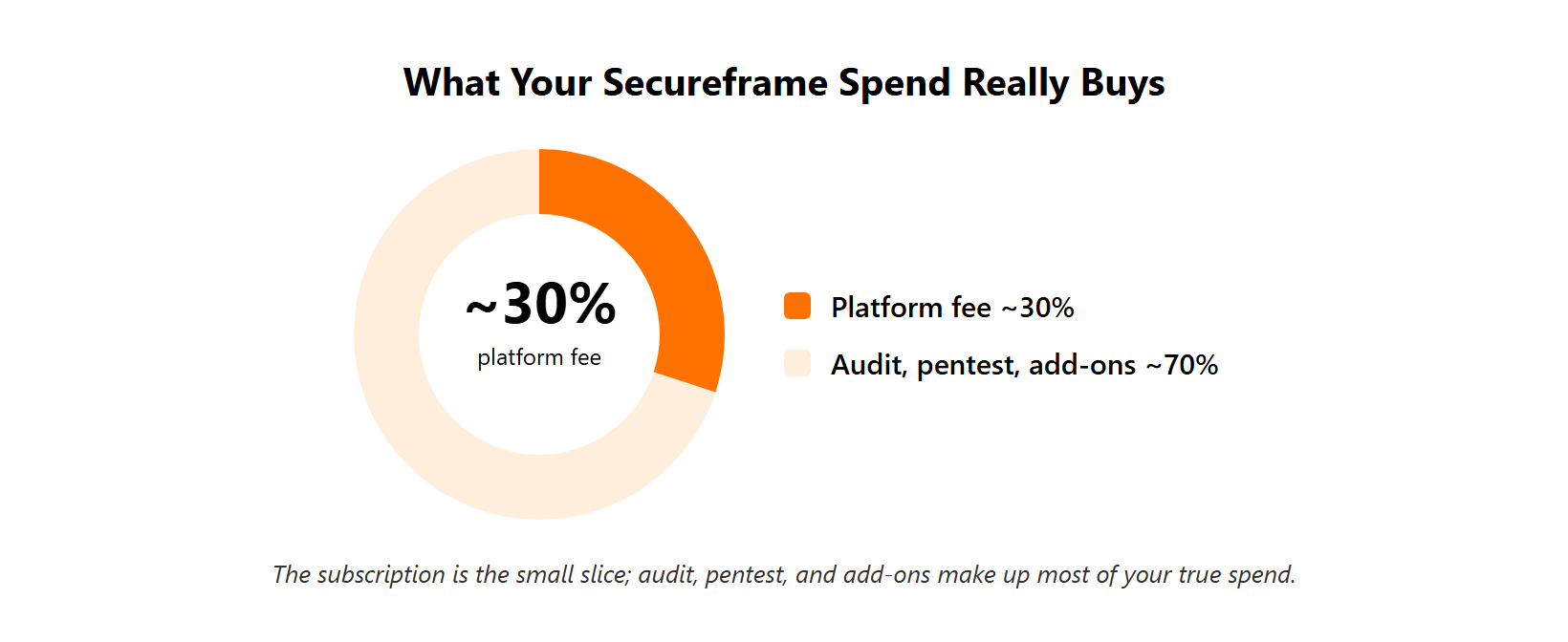
I have watched teams budget the platform fee, get board approval, then discover the auditor invoice three months later. We will break that full stack down in the hidden-costs section, because that gap is where most compliance budgets quietly blow up. If you are still scoping the wider number, our 2026 cybersecurity budget playbook walks through the full picture.
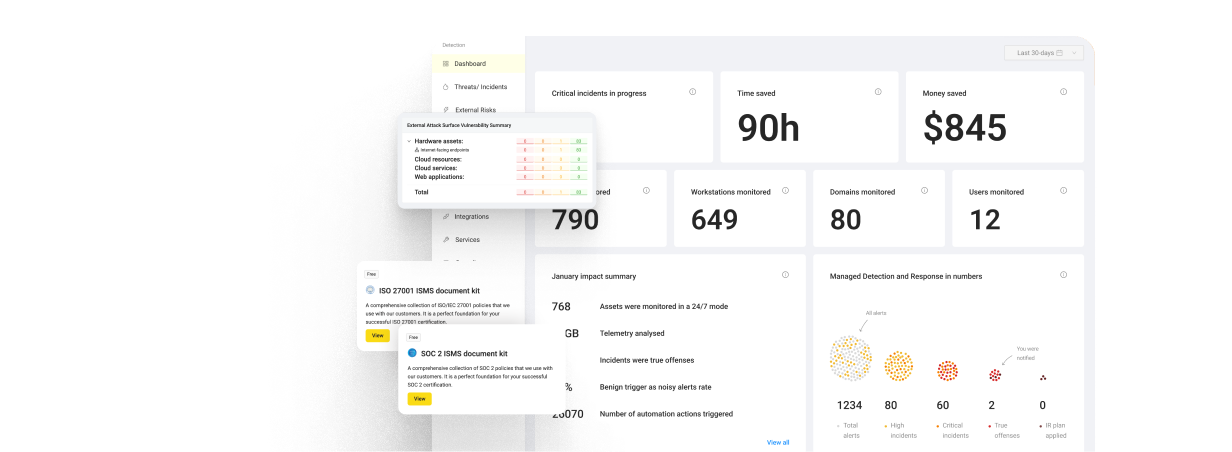
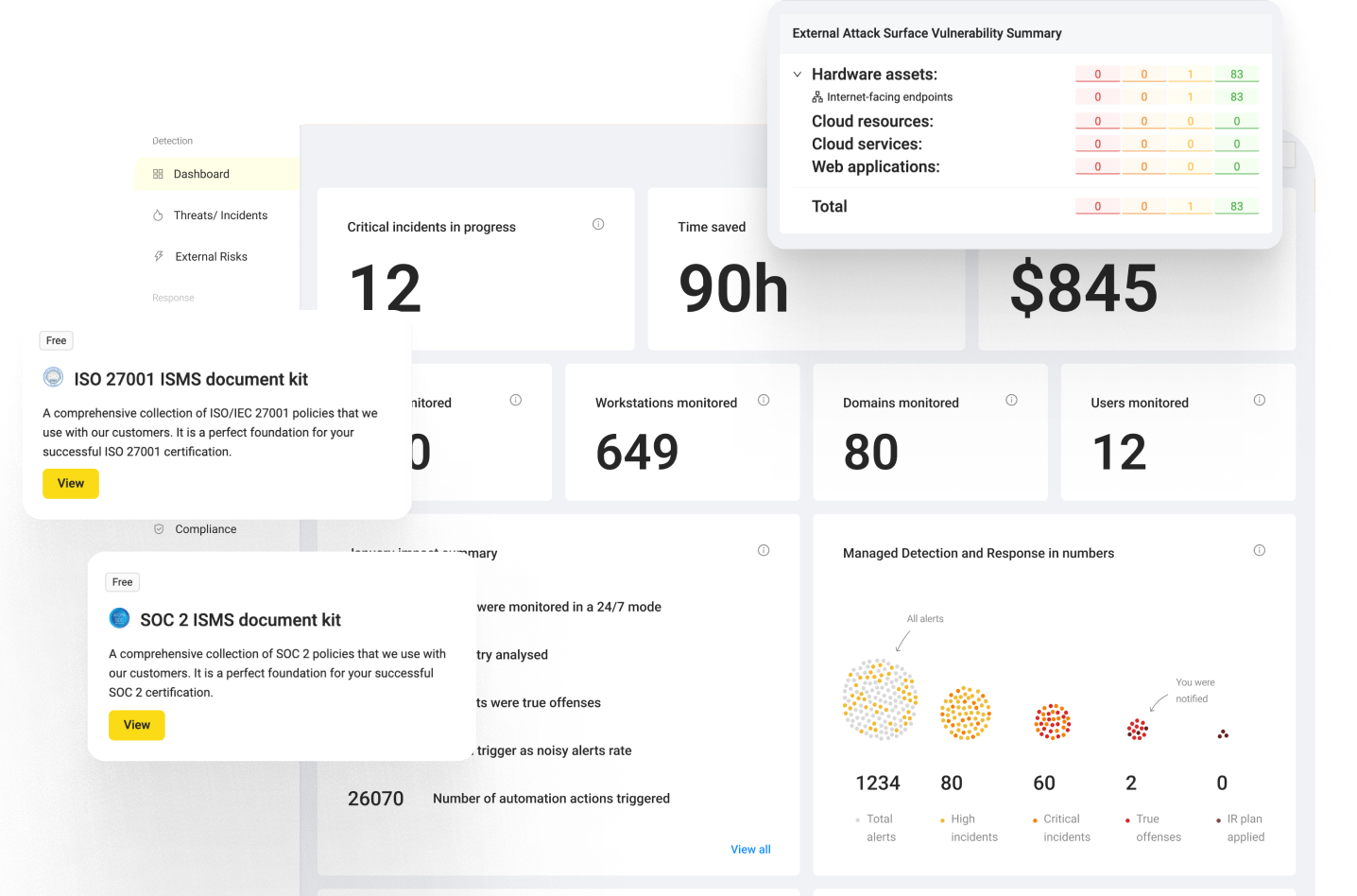
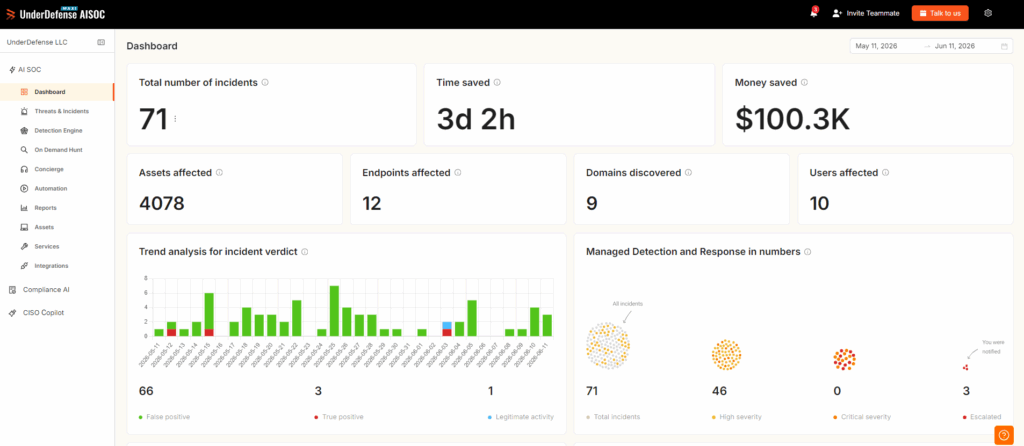
One honest aside, since I run a competing platform and you deserve the disclosure. At UnderDefense, we name our floor openly. The UnderDefense MAXI Compliance AI starts at a transparent entry point and bundles detection and response, rather than gating a readiness dashboard behind a sales call. You can disagree with our price. You can at least see it.
Q2: What Do Secureframe’s Plans (Fundamentals, Complete, Federal) Include?
When I scope a compliance program with a CISO, the first confusion is almost always the plan names. Third-party blogs invent labels like “Starter” and “Enterprise.” Secureframe’s actual catalog uses three names, and knowing them saves you a wasted sales call.
Secureframe sells three plans. Fundamentals is the entry tier: one framework, 100 AI questionnaire responses a year, and a standard Trust Center, starting around $7,500 a year. Complete adds 15,000 questionnaire responses a year, advanced third-party risk management, SSO/SCIM provisioning, and workspace add-ons, landing roughly $15,000 to $45,000 a year. Federal covers CMMC and FedRAMP with an SSP Builder, POAM Manager, and GovCloud integrations, typically $50,000 to $100,000-plus.
📋 What each plan actually gates
| Plan | Best-fit buyer | Key gated features | Frameworks | AI | Price visibility |
|---|---|---|---|---|---|
| Fundamentals | Startups under ~100 staff, first cert | Standard Trust Center, standard VRM, 100 responses/yr | 1 included | Comply AI embedded | Quote-only, from ~$7,500/yr |
| Complete | Mid-market, active sales motion | 15,000 responses/yr, advanced TPRM, SSO/SCIM, workspaces | 1 + add-ons | Comply AI embedded | Quote-only, ~$15K to $45K/yr |
| Federal | DIB, defense, CSPs | SSP Builder, POAM Manager, SPRS, GovCloud | Federal set | Comply AI embedded | Quote-only, not disclosed |
Note one thing on that table. Comply AI is embedded across every tier, rather than sold separately. That sounds friendly. In practice it means “AI” is not a line item you can negotiate down or remove.
💸 The counting rule that surprises buyers
Here is the structural catch. Secureframe prices on total company headcount, rather than active users. A 200-person company pays the 200-employee band even if only five people ever log in. You pay for bodies, not for usage.
That model rewards small teams and taxes large ones. For a security leader, that is the difference between a tidy dashboard and a tested environment, which is exactly why dedicated penetration testing still matters alongside any platform.
This is where our model differs by design. Secureframe gates features by company size. The UnderDefense MAXI Compliance AI scopes by what you actually need to detect and respond to, so you are not taxed per headcount for dashboards nobody opens. We document the controls and watch the environment behind them through our MDR service.
Q3: What Drives Your Final Secureframe Quote, and Why Is It Quote-Only?
I have sat on both sides of these deals: buying tools for my own SOC, and watching customers negotiate theirs. The quote-only model is not random. It exists to optimize one number that benefits the vendor, total contract value at signature.
Let me explain the levers in plain terms.
🧩 The three things that move your price
Three variables drive every Secureframe quote. Total employee headcount, priced in bands like 1-25, 26-50, and 51-100. The number of frameworks, at roughly $7,500 each beyond the one included. And integration complexity across your cloud, identity, and code stack.
That third one is sneaky. More integrations means more evidence connections to configure and maintain. When tooling fights your developers, the real cost shows up in lost velocity, rather than the invoice, which is why DevSecOps services matter to the total picture.
🔢 A concrete example
Picture a 50-person SaaS company. They already have SOC 2 on Fundamentals. Now a European deal forces ISO 27001.
The math is simple. The base platform fee covers the first framework. ISO 27001 is an add-on at about $7,500 a year. Stack HIPAA next year and you are paying for three framework lines plus whatever band your headcount has grown into. Each integration you connect adds setup time on top.
✅ What to do with this on Monday
Two moves protect you. First, load every framework you will need within 24 months into the first quote. Vendr’s data shows buyers who bundle upfront pay 15 to 25% less per framework than those who add them piecemeal later.
Second, before you sign anything, confirm evidence portability. I tell every GRC buyer to ask one question in writing: if we terminate, do all of our controls, integrations, and evidence stay exportable and ours? This is the same discipline we apply with our managed SIEM, where we treat SIEM and data ownership as the customer’s, never a hostage. A platform you might outgrow should never hold your audit history, a theme we cover in our guide on why businesses switch providers.
Q4: What Hidden Costs Triple Your Secureframe Bill?
The standard read on compliance pricing gets this backwards. People budget the platform and treat everything else as a rounding error. From what surfaces when you actually run these programs, the platform is the small line, and the rest is the iceberg.
💸 The “audit-ready” trap
Here is the fear I hear most from founders, and it is a fair one. You pay $20,000 to $40,000, the dashboard glows “100% ready,” and you walk into the audit technically exposed. Teams can be 100% audit-ready on automated platforms, yet remain unprepared for the audit, because dashboard completion does not align with an auditor’s reality.
Audit-ready is a platform claim. Audit-included is a separate matter. The CPA firm that issues your report is a separate vendor with a separate invoice.
💰 The full cost stack
| Cost category | In the subscription? | Typical range | Notes |
|---|---|---|---|
| External audit fee | ❌ No | $7,000 to $25,000 per framework | Paid to a CPA firm, not Secureframe |
| Penetration testing | ❌ No | $5,000 to $20,000 | Often required for the audit |
| Additional frameworks | ⚠️ Add-on | ~$7,500 each | Beyond the first |
| SSO/SCIM | ⚠️ Tier-locked | Upgrade to Complete | Gated above Fundamentals |
| Premium support / CSM | ⚠️ Add-on | ~15 to 20% of ACV | Quote-only |
| Renewal uplift | ❌ Not capped by default | 5 to 15% per year | Negotiate a cap |
Renewal creep deserves its own warning. The most consistent complaint in buyer reviews is a contract that looked fine in year one and jumped in year two. Budgeting for the penetration testing line early helps, and our pentest pricing page shows realistic ranges.
⭐ What buyers say about getting real value
The honest test is whether the spend produces evidence you can defend and security you can feel. UnderDefense customers tend to talk about both. One reviewer described the audit payoff directly.
“They’ve also made our audit process much less painful. The reports from their platform give us clear evidence of our security controls and incident response capabilities. When auditors or clients ask questions about our security posture, we can pull up exactly what they need to see. Worth every penny for us.”
Verified User in Marketing and Advertising, Small-Business UnderDefense G2 Verified Review
Another, a CISO, tied protection to price without drama.
“It’s reassuring to know they’re always watching for threats, and it doesn’t cost a fortune. They catch and stop problems quickly, which is a huge relief.”
Serhii B., Chief Information Security Officer, Mid-Market UnderDefense G2 Verified Review
A green dashboard does not stop an incident tomorrow. That is the gap we built the UnderDefense MAXI Compliance AI to close, pairing audit-ready evidence with 24/7 detection and concierge analyst response: 2-minute alert-to-triage, and 15-minute escalation for critical incidents. You get the paperwork your auditor wants, and an incident response team that acts when something real fires at 2 a.m.
Q5: How Much Will You Pay by Company Size, and How Do You Estimate Your Own Cost?
The toughest budget call I help with is the one where a VP of Engineering has to defend a compliance number to a CFO who has never bought GRC software. They need a band, not a brochure. So let me give you the bands, then a worksheet to find your own number.
💰 Pricing by company size
Here is how the real contracts break down. A 25-person startup chasing SOC 2 pays around $7,500 a year. A 50-to-100 person company adding ISO 27001 lands near $15,000 to $25,000. A 250-to-500 person growth company on Complete with two or three frameworks runs $30,000 to $47,500. A 1,000-person enterprise reaches $60,000 to $130,000.
| Employees | Recommended plan | Base ACV (1 framework) | Approx. per-employee rate | ACV with 2-3 frameworks |
|---|---|---|---|---|
| 1-25 | Fundamentals | ~$7,500 | ~$300 | ~$15,000 |
| 26-100 | Fundamentals/Complete | ~$10,000 to $15,000 | ~$150 to $200 | ~$15,000 to $25,000 |
| 101-500 | Complete | ~$20,000 to $30,000 | ~$60 to $120 | ~$30,000 to $47,500 |
| 501-1,000 | Complete | ~$35,000 to $60,000 | ~$40 to $60 | ~$60,000 to $90,000 |
| 1,000+ | Complete/Federal | ~$50,000+ | ~$15 to $40 | ~$60,000 to $130,000 |
Notice the per-employee rate. It compresses hard, from roughly $300 a head at 25 staff down to $15 to $40 at the top. Small teams pay the steepest unit price for the same automation.
⏰ A 4-step worksheet to estimate your own cost
You can size your own number in about two minutes. Run this math.
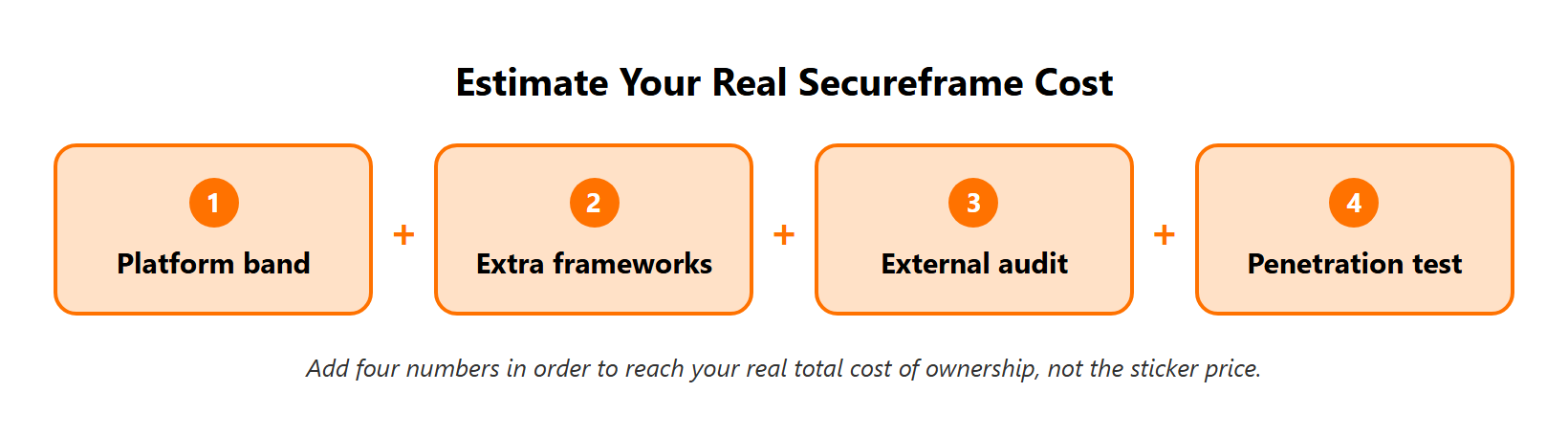
- Start with your platform band from the table above.
- Add $7,500 for each framework beyond the first.
- Add the external audit fee, $7,000 to $25,000 per framework.
- Add penetration testing if your audit needs it, $5,000 to $20,000.
The sum is your real total cost of ownership, not the sticker price. A 60-person SaaS doing SOC 2 plus ISO 27001 might see $15,000 platform, $7,500 add-on, $20,000 audit, and $10,000 pentest, roughly $52,500 all in. If you want to model this live, our SOC cost calculator handles the variables, and our managed SIEM pricing guide covers the monitoring side.
One thing breaks this math: a moving environment. I have watched a planned budget get eaten when a cloud migration drops hundreds of new assets in over a weekend, and the platform reprices to onboard them. Where headcount-band pricing reprices you every time you cross a line, the UnderDefense MAXI Compliance AI tracks the environment you actually defend, so a sudden asset spike does not swallow a quarter of your security budget in onboarding fees. Our cloud security services are built around that reality.
Q6: How Does Secureframe Pricing Compare to Vanta, Drata, and Sprinto?
Every buyer I talk to runs the same bake-off: Secureframe, Vanta, Drata, Sprinto. The honest truth is they are closer to each other than the sales decks admit. They share a pricing model and a structural blind spot.
On median contract value, Secureframe (~$20,000/yr) sits between Sprinto (~$15,000/yr) and Drata (~$25,000/yr), with Vanta also near $20,000/yr. All four price on headcount, charge per additional framework, and publish no list prices. Every one of them excludes the audit fee, penetration testing, and live threat response.
⚖️ Side-by-side
| Platform | Median/avg ACV | Pricing model | Per-framework | Excluded from price |
|---|---|---|---|---|
| Secureframe | ~$20,000 | Headcount + frameworks | ~$7,500 | Audit, pentest, response |
| Vanta | ~$20,000 | Headcount + frameworks | Add-on | Audit, pentest, response |
| Drata | ~$25,000 | Headcount + frameworks | Add-on | Audit, pentest, response |
| Sprinto | ~$15,000 | Headcount + frameworks | Add-on | Audit, pentest, response |
🧩 The shared blind spot
Here is the part the category avoids saying out loud. When both sides of a vendor review use AI, one to generate the questionnaire and one to answer it, you can pass the audit without reducing real risk. A green Trust Center proves paperwork. It does not stop an incident from firing tomorrow morning, which is the case our guide on the benefits of MDR makes plainly.
That is a different category from what we do. Vanta, Drata, Sprinto, and Secureframe compete to prove security on paper. The UnderDefense MAXI Compliance AI delivers it through vendor-agnostic detection and human-backed response a dashboard cannot provide. Customers feel that difference in operations, not in a report, and our MDR service is where that work happens.
“The biggest win for me was getting actual control over our security alerts. Their SOC team is responsive and knows their stuff. When they escalate something, they include the context we need to understand the issue quickly.”
Verified User in Marketing and Advertising, Small-Business UnderDefense G2 Verified Review
Q7: Is Secureframe Worth It? What Real Buyers Say in Reviews
Let me tell you about a buyer I think of often, because his story is the whole verdict. A founder bought every security tool he could afford. Then he ran out of money before hiring anyone to run them. A rookie team ended up managing a fleet of Ferraris, and the engines mostly sat idle.
⭐ What reviewers praise
Secureframe earns strong marks, around 4.7 on G2 across 700-plus reviews, for fast time-to-SOC-2 and automated evidence collection. Buyers genuinely like how quickly it gets them certified. That speed is real, and it is the reason the platform sells.
The complaints are just as consistent. They cluster around long-term value after certification, surprise renewal hikes of 5 to 15%, unreliable Magic Link logins, and task generation that breaks developer velocity.
⚠️ The gap between green and safe
The pattern is clear. Secureframe is strong for getting certified and weaker at sustaining security between audits. A dashboard at 100% completion can still leave you exposed when a live alert fires, which is why continuous security monitoring matters between audits.
A platform delivers value only when experts drive it. That founder’s engines sat idle because nobody was in the seat. This is exactly the gap the UnderDefense MAXI Compliance AI closes, pairing tooling with a concierge SOC so coverage starts day one, with 2-minute alert-to-triage and 15-minute escalation on critical incidents. Customers describe the relief plainly, and our SOC service is the backbone behind it.
“It’s reassuring to know they’re always watching for threats, and it doesn’t cost a fortune. They catch and stop problems quickly, which is a huge relief.”
Serhii B., Chief Information Security Officer, Mid-Market UnderDefense G2 Verified Review
“Some security tools are more complicated than the threats themselves. Underdefense isn’t just about catching bad stuff, they give proactive tips too.”
Andriy H., Co-Founder and CTO, Mid-Market UnderDefense G2 Verified Review
Q8: How Do You Negotiate a Better Deal and Avoid Renewal Shock?
The cleanest win I ever saw on a GRC contract was not a discount. It was a renewal cap written into the first signature, before anyone had leverage to argue. Procurement teams that prep beat the ones that react. Here is the playbook I hand to buyers.
💸 Six levers that cut your real cost
Run these in order before you sign anything.
- Bundle every framework at signature. Loading them upfront runs 15 to 25% cheaper than adding them later. Ask: “Lock per-framework pricing for SOC 2, ISO 27001, and HIPAA in this contract.”
- Negotiate a written renewal cap. Uplifts run 5 to 15% otherwise. Ask: “Cap annual renewal increases at 3 to 5% for the term.”
- Buy at quarter-end. Sales teams chasing targets give 10 to 15% deeper discounts. Ask: “What can you do if we sign by your quarter close?”
- Go through a certified partner. Partner deals can carry 15 to 25% platform discounts plus implementation credits.
- Calendar the auto-renewal window. Most contracts auto-renew unless you give 30 to 60 days notice. Put the date in your calendar the day you sign.
- Demand an evidence-portability clause. Confirm in writing that all your controls, integrations, and evidence stay exportable and yours if you leave.
✅ The clause that protects you most
That last one matters more than any discount. I tell every buyer to confirm one thing before signing: if you terminate, does all of your evidence and detection logic remain in your hands? A platform should never hold your audit history hostage, a point we stress in our guide on why businesses switch providers.
The best negotiation is the one you never have to run. The UnderDefense MAXI Compliance AI uses transparent, vendor-agnostic pricing, so there are no per-framework surprises and no renewal-window brinkmanship. You keep your data and your leverage, and our compliance services are scoped the same transparent way.
Turn these benchmarks into a real plan.
Get a vendor-neutral assessment and a cost-optimized roadmap.
1. How much does Secureframe actually cost in 2026?
Secureframe publishes no list price. Every quote is built from your total employee headcount plus how many compliance frameworks you need.
Here are the real ranges we see buyers land on:
- Under 20 employees, one framework: around $7,500/year.
- Mid-market, two or three frameworks: roughly $20,000 to $47,500/year.
- Enterprise, multi-framework: $60,000 to $130,000-plus/year.
The median verified contract sits near $20,000/year. One thing we always flag: the platform fee is only about 30% of what you actually spend to get certified. The external audit, penetration testing, and extra frameworks all carry separate invoices.
We name our own floor openly, because budgeting blind helps no one. If you want a transparent comparison point while scoping your number, our MDR pricing page shows our entry point without a sales call. Treat any single tidy figure for Secureframe with suspicion, since your real cost depends on your company’s shape.
2. Why is Secureframe pricing quote-only instead of published?
The quote-only model exists to optimize one number that benefits the vendor: total contract value at signature.
Three variables drive every quote:
- Employee headcount, priced in bands like 1-25 and 26-50.
- Framework count, at roughly $7,500 each beyond the first.
- Integration complexity across your cloud, identity, and code stack.
Quote-only pricing makes apples-to-apples comparison hard and shifts leverage toward the sales team. We are not against the model itself, but we believe buyers deserve a starting number before a call.
The practical defense is preparation. Load every framework you expect to need within 24 months into the first quote, and confirm evidence portability in writing. We apply that same transparency discipline to our own managed SIEM, where we treat your SIEM and data as yours, never a hostage. A platform you might outgrow should never hold your audit history captive.
3. What hidden costs can triple your Secureframe bill?
The platform subscription is the small line. The rest is the iceberg.
Here is the full cost stack buyers often miss:
- External audit fee: $7,000 to $25,000 per framework, paid to a CPA firm, not Secureframe.
- Penetration testing: $5,000 to $20,000, often required for the audit.
- Additional frameworks: about $7,500 each beyond the first.
- SSO/SCIM: gated above the entry tier.
- Renewal uplift: 5 to 15% per year unless capped.
The trap we see most is the audit-ready dashboard. A platform can show 100% ready while the audit itself remains a separate vendor and a separate bill.
Budget the penetration testing line early, because it is rarely optional. Our pentest pricing page shows realistic ranges so the number does not surprise you three months in. The goal is a true total cost of ownership, not the sticker price.
4. How much will Secureframe cost based on my company size?
Pricing scales with headcount bands, and the per-employee rate compresses sharply as you grow.
- 1-25 employees: about $7,500/year, roughly $300 per head.
- 26-100 employees: $10,000 to $25,000/year.
- 101-500 employees: $20,000 to $47,500/year.
- 1,000-plus employees: $60,000 to $130,000/year, as low as $15 to $40 per head.
Small teams pay the steepest unit price for the same automation. To size your own number, start with your band, add $7,500 per extra framework, add the audit fee, and add pentest if required.
One caveat breaks this math: a moving environment. A cloud migration that drops hundreds of new assets in over a weekend can trigger repricing. To model the variables live, our SOC cost calculator handles that estimate cleanly, so a sudden asset spike does not quietly eat a quarter of your security budget.
5. How does Secureframe pricing compare to Vanta, Drata, and Sprinto?
These platforms are closer than the sales decks admit. On median contract value, Secureframe (~$20,000/year) sits between Sprinto (~$15,000) and Drata (~$25,000), with Vanta also near $20,000.
They share a structure:
- All price on employee headcount.
- All charge per additional framework.
- None publish list prices.
- All exclude the audit fee, pentest, and live threat response.
The shared blind spot matters more than the price gap. When AI generates the vendor questionnaire and AI answers it, you can pass the audit without reducing real risk.
That is a different category from detection and response. These tools prove security on paper; they do not contain an incident tomorrow morning. Our guide to the benefits of MDR explains where that gap lives and why a green Trust Center is only the starting line, not the finish.
6. Is Secureframe worth it according to real buyer reviews?
Secureframe earns strong marks, around 4.7 on G2 across 700-plus reviews, mainly for fast time-to-SOC-2 and automated evidence collection. That speed is real and it is why the platform sells.
The complaints are just as consistent:
- Weaker long-term value after certification.
- Surprise renewal hikes of 5 to 15%.
- Login reliability issues.
- Task generation that breaks developer velocity.
The pattern is clear: strong for getting certified, weaker at sustaining security between audits. A dashboard at 100% completion can still leave you exposed when a live alert fires.
A platform delivers value only when experts drive it. We have watched teams buy every tool they could afford, then run out of budget to operate them. That gap is why we pair tooling with a concierge SOC service so coverage starts on day one rather than after the next hire. The honest test is whether the spend produces evidence you can defend and security you can feel.
7. How can you negotiate a better Secureframe deal and avoid renewal shock?
Procurement teams that prepare beat the ones that react. Run these levers in order before you sign.
- Bundle every framework at signature, which runs 15 to 25% cheaper than adding them later.
- Negotiate a written renewal cap of 3 to 5%, since uplifts otherwise reach 15%.
- Buy at quarter-end for 10 to 15% deeper discounts.
- Go through a certified partner for platform discounts plus implementation credits.
- Calendar the auto-renewal window, usually 30 to 60 days notice.
- Demand an evidence-portability clause in writing.
That last lever matters most. Confirm that all controls, integrations, and evidence remain exportable and yours if you leave.
The best negotiation is the one you never have to run. We price our compliance services transparently and vendor-agnostically, so there are no per-framework surprises and no renewal-window brinkmanship. You keep your data and your leverage.
8. Does Secureframe reduce real risk or just help you pass the audit?
Secureframe proves you have controls. It does not operate them.
A Trust Center showing 100% ready cannot:
- Detect a credential-stuffing attack.
- Triage an alert at 2 a.m.
- Contain an incident tomorrow.
That gap, between attesting to security and delivering it, is where most GRC spend quietly underperforms. Automation is powerful, and the biggest risk for many teams is not using it. But automation faithfully executes whatever process you give it, including a broken one, just faster.
Closing the gap takes live detection plus a human who responds. We run our own AI SOC every day and still cannot automate everything, because real incidents keep producing edge cases that need a human to make the call. We keep a person above the loop reviewing what the machine surfaces. That is the work behind our MDR service: vendor-agnostic detection, an AI SOC, and analysts who act with 2-minute alert-to-triage and 15-minute escalation on critical incidents.