




Q1. What Is the LogRhythm Expertise Cliff (and Why Should a CISO Care)?
The LogRhythm expertise cliff is the sudden loss of detection capability when the senior engineer who wrote and tuned your correlation rules, parsers, and automation logic leaves, taking years of institutional memory with them. Because that logic lives in one person’s head rather than in version control, a single resignation can turn a six-figure SIEM into a legacy paperweight overnight.
Keep the stack you own. UnderDefense Agentic AI SOC sits on top of your existing SIEM with open, vendor-agnostic integration
The resignation email nobody plans for
I’ve watched this play out more times than I’d like. A SIEM, short for Security Information and Event Management, is the system that collects your logs and fires alerts. One engineer built all of it. Then they hand in two weeks’ notice.
Suddenly nobody knows why a critical alert is tuned the way it is. The rules still run. The reasoning behind them walked out the door. That gap between a working SIEM and an understood SIEM is the cliff.
The bus factor is real, and most teams fail it
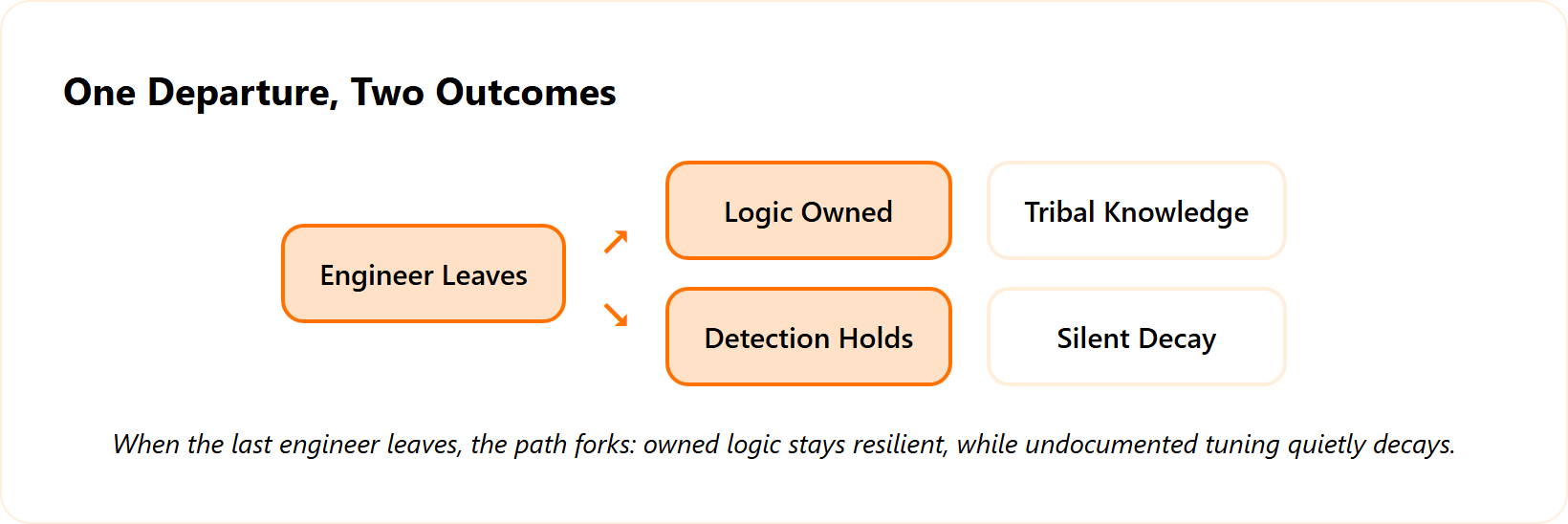
Security people have a grim phrase for this: the bus factor. As one practitioner put it, “you get hit by a bus or more realistically, you change your job, go on holiday, or just become unavailable, can someone else keep the lights on? It’s not always the case.”
That last line is the whole problem. The 2025 SANS SOC Survey found most security teams run lean, with 2 to 10 people, and roughly 55% report being understaffed. Tenure is short, often 3 to 5 years. When your one expert is also your only expert, holiday coverage becomes a detection outage, which is exactly why teams weigh outsourced and in-house SOC models against each other.
Why this is a board problem, not an IT problem
When your detection quietly degrades, you keep paying the SIEM license while losing the protection. A missed breach then becomes a disclosure event, an audit finding, and a hard conversation with your board.
The honest fix is ownership. You want to own the logic, not just rent the engineer who holds it. This is the gap our MDR service was built to close, but the cliff deserves an honest name before anyone sells you a cure.
Q2. What Does a LogRhythm Engineer Actually Do, and Why Is That Skillset So Rare?
A LogRhythm engineer does far more than watch dashboards. They build parsers for unsupported devices using regular-expression parsing and SQL queries, tune correlation rules, manage retention and storage thresholds, document the EDIS process, and run on-the-job training. Certifications like Cloud Administration Fundamentals (LRCA 304), Administration (306), and Fundamentals (310) formalize part of this, yet the broader business-logic fluency stays scarce.
A fleet of Ferraris with nobody to drive them
Let me describe a scene I’ve seen far too often. A predecessor buys every shiny tool, then runs out of budget before hiring people who can run them. The new lead inherits a rookie team trying to manage a fleet of Ferraris. The engines mostly sit idle.
That picture explains the cliff better than any spec sheet. The tools were never the bottleneck. The skilled hands were, and that gap shows up clearly when you study how a SIEM actually works.
The unglamorous work that actually matters
Here is what the role really involves, in plain terms.
- Parser building. Writing logic so the SIEM can read logs from devices it doesn’t support out of the box. This needs regular expressions (pattern-matching code) and SQL (database query language).
- Documentation. Writing up the EDIS process, the steps for getting event data into the system, plus on-the-job training so analysts read events correctly.
- Storage discipline. Plan for roughly 40 days of fast-access data for active investigations, about six weeks on hand. Plain-text log volume can balloon, and disk usage routinely hits 80% before overnight compression.
Certification teaches the dashboard, experience teaches the judgment
The formal path exists. LogRhythm offers Cloud Administration Fundamentals (LRCA 304), a 20-hour instructor-led course, plus Administration (306) and Fundamentals (310) tracks, and a Platform Administration (LRPA) practice certification.
Those courses teach the buttons. They do not teach someone how to trace a weird alert back to a broken business process at 2 a.m. That instinct comes from years of reps, which is exactly why this hire is slow to find, expensive to keep, and fragile to lose. Stack one departure on top of that scarcity, and the cliff gets steeper. The same pressure pushes many teams toward a managed SIEM arrangement rather than another solo hire.
Q3. Has Cybersecurity Over-Specialized Into “Tool Babysitting”?
Yes. The SIEM industry over-specialized into “tool babysitting,” producing experts in configuring one vendor’s dashboards, with too few people who can trace business logic and find root causes. Shiny platforms do not solve cases; educated, seasoned people do. A skilled analyst with a moderate toolset produces more accurate, timely results than a novice with an expensive one.
The standard read gets this backwards
Most buyers think the answer to a detection gap is a better tool. I’ll say the unpopular thing: we built a cottage industry of people who tied their professional identity to running queries against one specific SIEM.
That’s tool babysitting. It rewards dashboard fluency over the harder skill of tracing business logic and finding the real root cause. The market optimized for the wrong thing, and the cliff is the bill coming due, a pattern I’ve explored in whether AI kills or saves your SOC team.
Why the expensive toolset loses to the seasoned operator
Think about a baseball bat. You can hand it to Babe Ruth or you can hand it to me. The bat is identical. The outcome is not even close.
A tool does exactly what the expert in its hands needs it to do, and very little for everyone else. Shiny SIEM solutions don’t solve cases. Highly skilled people produce more accurate, timely results with a moderate product set than novices do with a super-expensive, shiny stack.
The turn: judgment is the asset, the tool is the multiplier
The SANS data backs this up plainly. As SANS faculty put it, a great SOC isn’t created by tooling, but by a culture that rewards analysts who do excellent work.
So the move is to invest in judgment first, then multiply it with tooling. That reframes the whole hiring panic. You are not hunting for someone who memorized a dashboard. You want someone who can reason through an incident, then encode that reasoning so the next person inherits it. This is the work our SOC service does every day, putting seasoned analysts alongside your team to solve cases rather than babysit screens.
Q4. What Really Happens to Your LogRhythm Support After the Exabeam Merger?
After LogRhythm merged with Exabeam in 2024, support, documentation, and the customer portal moved under the Exabeam brand, and legacy components such as LogMart and the classic Open Collector are being retired. Existing LogRhythm SIEM and Axon support continues, though roadmap consolidation and migrations are coming, and migrations are where undocumented rule logic quietly disappears.
Where your support actually lives now
Here is the headline, stated plainly. LogRhythm and Exabeam combined into a single security-operations vendor, and the LogRhythm documentation and support portal now operate under the Exabeam brand. Your existing LogRhythm SIEM and Axon contracts keep running. The login screen and the brand on the docs have changed.
For a CISO, that means support continues today, with a roadmap that will keep consolidating over time. It is the kind of shift that often prompts a closer look at why businesses switch cybersecurity providers.
The quieter risk: legacy components on the retirement list
The bigger story sits underneath the merger. Several legacy pieces are being phased out, including LogMart and the classic Open Collector, with collection management moving to JFrog Artifactory in recent releases. End-of-life policies govern how long older software and hardware stay supported.
That matters because legacy components often carry the most undocumented tuning. When a piece gets retired, the institutional memory wrapped around it is suddenly on a clock, which is one face of cybersecurity technical debt.
Migration is where the cliff gets steeper
I’ll be direct about the part vendors gloss over. When you make a vendor switch, the business logic, the correlation rules, and the automation rules do not come with you. You start the whole tuning process over, and years of institutional memory are lost.
A merger-driven migration is exactly that switch, just with the timing chosen for you. The way out is to keep your detection logic portable and owned, so a platform change doesn’t reset your protection to zero. Our incident response and detection teams work vendor-agnostically for this reason, keeping your detection posture intact through a migration instead of rebuilding it from scratch.
Q5. How Do You Survive the Bus Factor With Detection as Code?
You survive the bus factor by making detection logic institutional. Forward-looking teams treat detection rules like software, written in flexible languages like Python, securely versioned, unit-tested, and deployed via CI/CD. This “detection as code” approach keeps correlation logic in a repository every analyst can read, and it becomes the foundation for an AI-driven SOC.
Stop keeping the rules in one person’s head
The bus factor is the number of people who can leave before your operation stalls. For most SIEM teams, that number is one. The fix is to move the logic out of memory and into a repository.
Detection as code means your rules live as files, rather than as undocumented clicks in a console. Anyone on the team can read them, review them, and improve them, which is one of the core benefits of a mature MDR practice.
The three-step discipline that makes logic portable
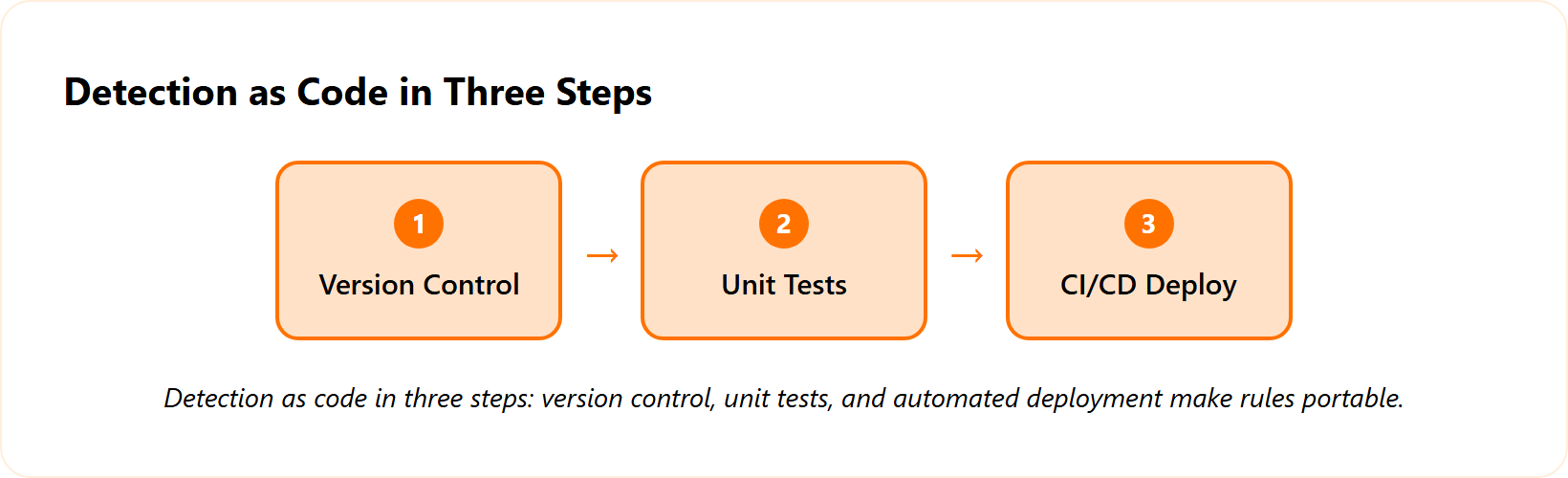
Here is the workflow I’d put in place this quarter. None of it requires a new tool, just a habit change.
- Version control. Store every detection rule in a repository like Git, so each change has an author, a date, and a reason.
- Unit tests. Write small tests that prove a rule fires on the threat it targets and stays quiet otherwise. This is how you fight false positives, which the 2025 SANS Detection and Response Survey flags as the top detection challenge.
- CI/CD deployment. Push rules through an automated pipeline (continuous integration and delivery) so changes ship safely and consistently, the kind of SOC automation that compounds over time.
One concrete control: the “failure to report” alarm
A small habit catches a big blind spot. Make sure every Domain Controller (the server that handles logins) reports into the SIEM, and review the count per domain regularly.
Then add a supplemental alarm that fires when a source goes quiet for a short window. A log source that stops talking is often the first sign something is wrong, which is why continuous security monitoring matters.
Here is what I’ve watched go wrong
I’ll own a hard lesson. Teams that lean on tribal knowledge feel fast, right up until the person holding it leaves. Then every change takes days because nobody trusts what they didn’t write.
Detection as code is slower on day one and far faster every day after. Our MDR service operationalizes this discipline so your detection logic stays portable and auditable, which means it survives a resignation, a merger, or a platform switch. The patent literature is heading the same way, with systems that encode expert reasoning into knowledge graphs so investigation logic becomes institutional.
Q6. Should You Hire a LogRhythm Team In-House or Use a Managed Service?
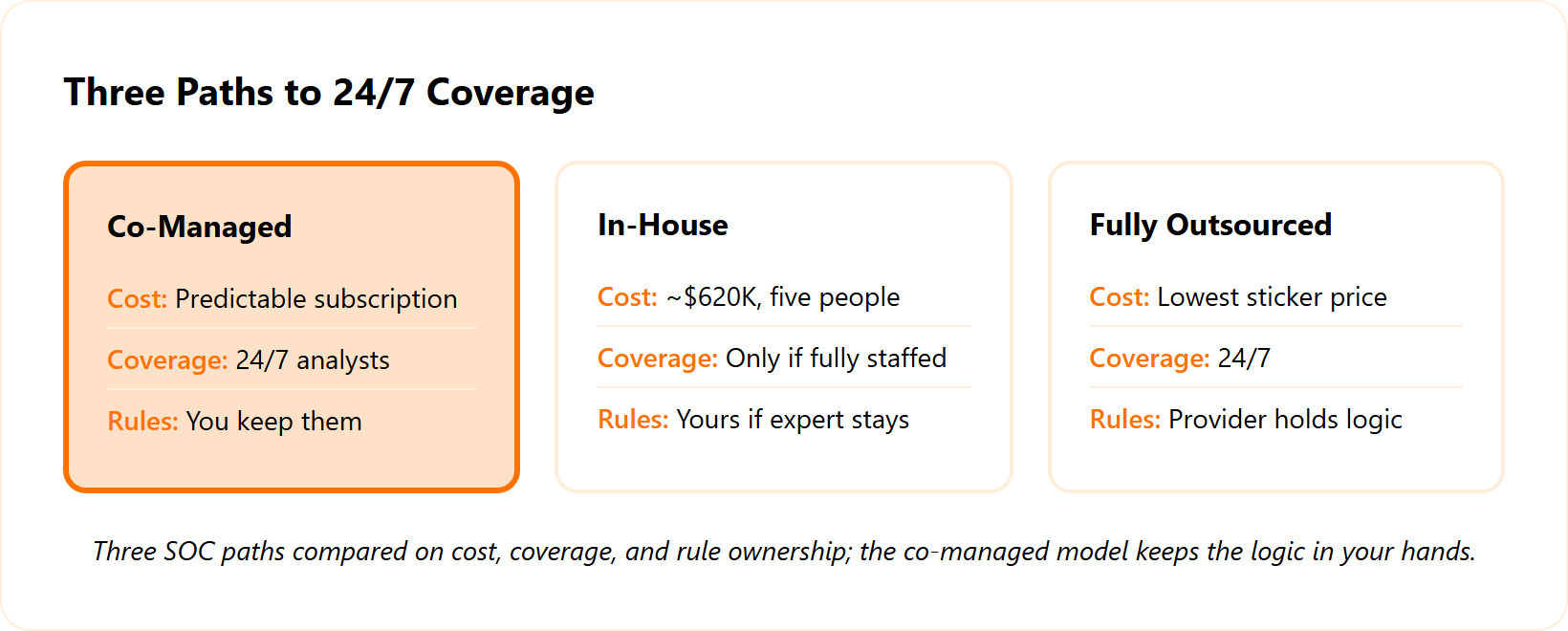
It depends on size and risk tolerance. A 24/7/365 in-house SOC needs at least 5 people on the barest-bones model, realistically 9 analysts plus a manager, and a loaded position runs roughly $124,163 a year, close to $620,815 for five people. For most mid-market teams, a co-managed or outsourced model proves cheaper and more resilient, provided the business keeps ownership of the rules.
The math nobody shows you upfront
Round-the-clock coverage is a staffing problem before it’s a tooling problem. To staff a desk every hour of every day, you need at least five whole people just to cover the shifts. A realistic target is nine analysts plus a SOC manager.
Loaded cost per role lands near $124,163 a year, so five people run about $620,815 annually. For a 500 to 5,000 person company, that is a real line item competing with everything else, which is why a SOC cost calculator often reframes the decision.
Comparing your three realistic paths
Here is how the options stack up. We put UnderDefense first because our model is built to keep you in control of the logic.
| Model | Cost profile | Coverage | Rule ownership |
|---|---|---|---|
| UnderDefense Agentic AI SOC | Predictable subscription | 24/7, 2-minute Alert-to-Triage, 15-minute critical escalation | You keep and can export your rules |
| In-house team | ~$620K+ for five people | 24/7 only if fully staffed | You own it, if the engineer stays |
| Fully outsourced (provider-owned rules) | Often lowest sticker price | 24/7 | Provider holds the logic, so you risk losing it on exit |
How to choose without trading one cliff for another
A fully outsourced team can be a genuine solution for smaller organizations that cannot hire in-house. The catch is institutional memory. If the provider owns the rules, you lose them the day you leave, a tradeoff explored further in the outsourced versus in-house SOC debate.
Outsourcing done right extends your capability while you keep visibility. The UnderDefense Agentic AI SOC platform is built around that principle, so you gain 24/7 analysts and keep your detection logic.
“The biggest problem they solved was our 24/7 coverage gap. We needed round-the-clock monitoring for compliance reasons, but building our own SOC wasn’t realistic with our budget and the current hiring market.”
Verified User in Marketing and Advertising UnderDefense G2 Verified Review
“UnderDefense Agentic AI SOC integrates well with our systems, specifically with our SIEM, Splunk. Their team is proactive in identifying and addressing threats, providing 24/7 oversight.”
Oleg K., Director of Information Security UnderDefense G2 Verified Review
Q7. Will AI Replace Your LogRhythm Engineer or Multiply Them?
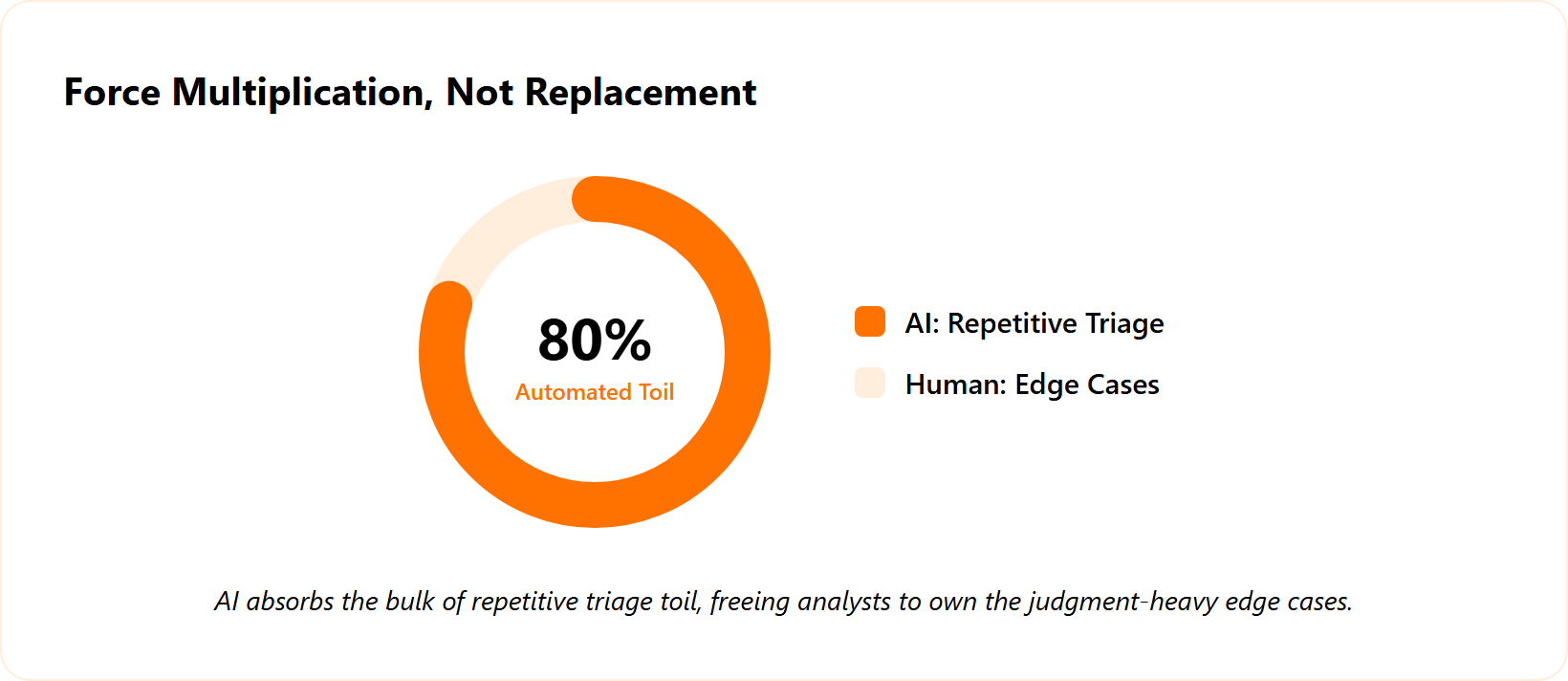
AI multiplies the engineer rather than replacing them. It absorbs repetitive triage toil and captures investigation logic, while a human still calibrates the output and owns the judgment. Patents now encode expert reasoning via knowledge graphs and learn from analyst feedback, so AI can preserve some institutional memory, but only when skilled people teach it first.
The claim, stated plainly
Let me put the governing thought up front. AI is force multiplication for your analyst, giving you less glasses of pain across noisy tools. It is not a replacement for the human who calibrates it.
The standard read sells AI as a way to delete headcount. My current read is the opposite. The best results come from skilled people teaching the machine what good looks like, a theme I unpack in whether AI kills or saves your SOC team.
Why automation handles the toil, and humans handle the edges
I remember a teammate years ago who said she found the zen in copying data all day. She genuinely did. The problem is that the toil never stops growing, and most people burn out long before they find peace with it.
That repetitive triage work is exactly what AI should absorb. Recent patents describe systems that auto-investigate alerts and learn directly from analyst feedback, so the reasoning gets captured instead of lost, the same approach behind our MDR for AI work.
The trap leadership keeps walking into
Here is the part the category avoids saying. Leaders see AI as a shortcut to fill a staffing gap, then skip the investment in people and integration, a pattern worth checking against these AI SOC red flags.
SANS faculty warned about this directly, that AI should augment analysts rather than replace them. Research on alert fatigue points the same way, using AI to prioritize while humans stay in the loop. The UnderDefense Agentic AI SOC platform runs on this model, with AI doing the heavy triage and a concierge analyst calibrating every escalation. Strip out the human, and you’ve automated your way into faster mistakes.
Q8. Does LogRhythm Actually Keep You Compliant, or Just Produce Paper?
A SIEM keeps you compliant only when operational discipline backs it. Frameworks like SOC 2 Type II, ISO 27001, and HIPAA assume your detections work, stay documented, and get reviewed. When the cliff quietly degrades detection, you keep producing paper while losing the substance, and a missed breach can become an SEC 8-K disclosure event.
Owning a tool is not the same as passing an audit
Buying a SIEM does not make you compliant. The frameworks assume the system actually detects threats, that the rules are documented, and that someone reviews them on a schedule.
That gap is where the expertise cliff turns into an audit risk. The logs keep flowing, the dashboard looks healthy, and the detection quietly rots underneath, a problem our compliance services are designed to surface early.
The honest confession most technologists share
I’ll say what many of us feel. Compliance can look like a tedious exercise of producing paper, policies, procedures, and evidence that we did the things. Hardcore technologists tend to hate documenting any of it.
That instinct is exactly the weakness auditors probe. Discipline is the bridge between a working control and a provable one, and a clear compliance roadmap keeps that discipline on track.
How the frameworks connect to real detection
- SOC 2 Type II and ISO 27001 want evidence that controls operate over time, rather than just on the day of the audit.
- NIST CSF 2.0 added a Govern function, which puts continuity and accountability for these controls on leadership.
- NIST SP 800-61 sets the expectation for a real, documented incident response process.
- The SEC Cyber Disclosure Rule can turn a missed material breach into an 8-K filing, which is a board-level event.
Documented detection as code does double duty here. The same versioned rules that survive a resignation also serve as clean audit evidence. At UnderDefense, our compliance and Agentic AI SOC work pair so operational discipline becomes continuous, audit-ready proof, the same logic behind our virtual CISO advisory.
“They’ve also made our audit process much less painful. The reports from their platform give us clear evidence of our security controls and incident response capabilities.”
Verified User in Marketing and Advertising UnderDefense G2 Verified Review
“Plus, their vCISO team was amazing in supporting us with ISO 27001. The 30-day impact reports transformed our understanding of security posture.”
Val R., Small-Business UnderDefense G2 Verified Review
Q9. How Do You Move From Renting an Engineer to Owning Your Detection Logic?
Start by inventorying which detections depend on undocumented tuning, export that logic into version control this week, and pair it with a co-managed partner who augments your team. The goal is rule sovereignty: you own the correlation logic and can walk away with it, while concierge analysts keep the lights on around the clock.
The status quo you’re quietly living with
Right now, one person likely holds the keys. They know why each rule is tuned the way it is. They know which alerts to trust and which to ignore.
That setup feels stable until it isn’t. A resignation, a long holiday, or a competing offer, and your detection quality drops the same week, which is one reason teams revisit their security stack strategy.
The future worth building toward
Here is the shift. You move from renting an engineer’s memory to owning the logic itself. The rules live in a repository your whole team can read, and a partner runs them 24/7.
One operator framed the goal perfectly: “I would own the SIEM and can take my toys and leave.” That is rule sovereignty. You keep the detection logic, and you can take it anywhere, the same principle behind a well-run managed SIEM engagement.
Your three-step plan for this week
You can start without buying anything new. Here is what I’d do first.
- Inventory the fragile detections. List every rule that only one person understands. That list is your real risk register.
- Export the logic into version control. Move those rules into a repository (a shared, change-tracked store) before the notice period of any key person ends.
- Add a co-managed partner. Bring in a team that augments yours, runs the desk overnight, and leaves the rules in your hands, the model at the heart of our SOC service.
That third step matters because speed is survival. As one practitioner put it, if it takes you days, weeks, or never to push a change while stuck in manual toil, you’re bringing a knife to a gunfight. Research at Monash University makes the same point with data, showing that alert volume now outpaces what humans can review by hand, which is the gap automation and added analysts are meant to close, as our guide to MDR services explains.
Where UnderDefense fits, and an honest invitation
This is the model we built UnderDefense around. The Agentic AI SOC runs vendor-agnostic, so we watch whatever stack you already own, and you keep your detection logic. Our concierge analysts deliver a 2-minute Alert-to-Triage and a 15-minute escalation for critical incidents, while you retain the rules, capabilities you can explore on the UnderDefense Agentic AI SOC platform.
Operators tell this story better than I can.
“Not having to worry about ransomware, alert overload and reporting. Getting a clear view of my security posture, where the threats are coming from and how they are handled.”
Arlin O., Enterprise UnderDefense G2 Verified Review
“Their experienced SOC engineers work closely with our team… they delivered the deployment to 1,200 endpoints in just 23 business days.”
Oleksii M., Mid-Market UnderDefense G2 Verified Review
My question for you is simple. Which detections can you not afford to lose if your key engineer walked out tomorrow? Tell us that, and we’ll show you exactly how the handoff works, whether that starts with our MDR service or a quick scoping conversation.
1. What is the LogRhythm expertise cliff, and why does it threaten my SIEM investment?
We define the LogRhythm expertise cliff as the sudden loss of detection capability when the one engineer who built and tuned your correlation rules, parsers, and automation logic leaves. The rules keep running, but the reasoning behind them walks out the door.
The danger sits in three places:
- Tribal knowledge. Tuning logic lives in one person’s head, not in version control.
- Lean teams. Most SIEM teams run with a bus factor of one, so a single resignation creates a coverage gap.
- Silent decay. You keep paying the license while detection quietly degrades, which becomes an audit finding or a missed breach.
The fix is ownership, not heroics. You want to own the logic itself, documented and portable, rather than rent the engineer who holds it. We built our MDR service to close exactly this gap, pairing 24/7 analysts with your team while you keep the rules. A missed material breach can even become a board-level disclosure event, so treating this as an IT-only problem understates the risk to the whole business.
2. What does a LogRhythm engineer actually do day to day?
We see far more in the role than dashboard watching. A capable LogRhythm engineer carries the operational weight of the platform, and most of that work is invisible until they leave.
The core responsibilities include:
- Parser building. Writing logic so the SIEM reads logs from devices it does not support out of the box, using regular expressions and SQL.
- Rule tuning. Calibrating correlation rules to cut false positives without missing real threats.
- Storage discipline. Planning roughly 40 days of fast-access data and watching disk usage that routinely hits 80% before compression.
- Documentation and training. Writing up the EDIS process and coaching analysts to read events correctly.
Certifications like LRCA 304, Administration 306, and Fundamentals 310 formalize part of this, but they teach the buttons, not the judgment to trace a strange alert back to a broken business process at 2 a.m. That instinct comes from years of reps. This is why the hire is slow to find and fragile to lose, and why many teams move to a co-managed managed SIEM arrangement rather than betting everything on one solo expert.
3. What happens to my LogRhythm support after the Exabeam merger?
We get this question a lot, and the honest answer has two layers. After LogRhythm merged with Exabeam in 2024, support, documentation, and the customer portal moved under the Exabeam brand. Your existing LogRhythm SIEM and Axon contracts keep running, so support continues today.
The quieter risk sits underneath the rebrand:
- Legacy retirement. Components like LogMart and the classic Open Collector are being phased out, with collection management moving to JFrog Artifactory in recent releases.
- Roadmap consolidation. Two product lines merging means migrations are coming, on a timeline chosen for you.
- Memory loss. Legacy components often carry the most undocumented tuning, so retirement puts that institutional memory on a clock.
Migration is exactly where the expertise cliff gets steeper, because business logic, correlation rules, and automation rarely move cleanly to a new platform. The way to protect yourself is to keep detection logic portable and owned, so a vendor change does not reset your protection to zero. Our vendor-agnostic incident response and detection teams work this way, keeping your posture intact through a migration instead of rebuilding it from scratch.
4. Is LogRhythm training and certification enough to protect us from the expertise cliff?
We think training matters, but on its own it does not solve the cliff. LogRhythm offers a clear path: Cloud Administration Fundamentals (LRCA 304), a 20-hour instructor-led course, plus Administration (306) and Fundamentals (310) tracks, and a Platform Administration practice certification.
Those courses build real value, yet they have limits:
- They teach the platform, not your environment. Certification covers the product, not why your specific rules are tuned the way they are.
- They do not capture judgment. Tracing a weird alert to a broken business process is an experience skill, not a course module.
- They do not survive turnover. A trained engineer who leaves still takes the context with them.
Training works best when paired with documentation discipline, so knowledge lives in the team rather than one person. We pair certified analysts with a documented, detection-as-code approach, and our SOC service keeps that expertise resilient even when individuals move on. The goal is to make detection knowledge institutional, so a single departure never erases years of tuning. Certification is a strong input, but ownership and documentation are what actually keep the lights on.
5. Should we hire an in-house LogRhythm team or use a managed service?
We tell leaders this depends on size and risk tolerance, and the math usually clarifies it fast. To staff a 24/7 desk, you need at least five whole people just to cover shifts, realistically nine analysts plus a manager. Loaded cost per role lands near $124,163 a year, so five people run roughly $620,815 annually.
Your three realistic paths:
- In-house. Full control, but expensive, and coverage breaks the moment your one expert leaves.
- Fully outsourced. Often the lowest sticker price, but the provider may own the rules, so you lose them on exit.
- Co-managed. 24/7 analysts extend your team while you keep ownership of the detection logic.
For most mid-market companies, co-managed proves cheaper and more resilient. The key condition is rule ownership, so you never trade one cliff for another. A SOC cost calculator often reframes the decision by exposing the true loaded cost of staffing every hour of every day. We built our model so you gain coverage and keep your logic, which is the combination lean teams actually need.
6. How do we make our LogRhythm detection logic survive an engineer leaving?
We solve the bus factor by making detection logic institutional instead of personal. The approach is detection as code: treat rules like software so they live in a repository every analyst can read, rather than as undocumented clicks in a console.
The discipline we recommend, starting this quarter:
- Version control. Store every rule in Git so each change has an author, a date, and a reason.
- Unit tests. Write small tests proving a rule fires on its target threat and stays quiet otherwise, which fights false positives.
- CI/CD deployment. Push rules through an automated pipeline so changes ship safely and consistently.
One concrete control we like is a failure-to-report alarm: a rule that fires when a log source goes quiet, since silence is often the first sign of trouble. This is slower on day one and far faster every day after, because nobody fears changing logic they can read. Our SOC automation practice operationalizes this so your rules stay portable and auditable, surviving a resignation, a merger, or a platform switch without resetting your protection.
7. Will AI replace our LogRhythm engineer or just make them more effective?
We see AI as force multiplication for your analyst, not a replacement for the human who calibrates it. The best results come from skilled people teaching the machine what good looks like, then letting it absorb the repetitive work.
Where the split lands in practice:
- AI handles the toil. Repetitive triage, enrichment, and first-pass investigation scale well with automation.
- Humans handle the edges. Judgment calls, business context, and novel attack paths still need a person.
- The trap. Leaders who treat AI as a headcount shortcut, then skip the investment in people, automate their way into faster mistakes.
Modern systems can even capture investigation reasoning so it becomes institutional rather than lost when someone leaves, which directly eases the expertise cliff. We run our detection on this human-plus-AI model, with automation doing the heavy triage and a concierge analyst calibrating every escalation. You can see how we balance the two in our take on whether AI kills or saves your SOC team. Strip out the human and you lose the judgment that makes detection trustworthy in the first place.
8. Does owning LogRhythm actually keep us compliant, or just produce paperwork?
We are direct about this: a SIEM keeps you compliant only when operational discipline backs it. Owning the tool is not the same as passing the audit, because frameworks assume your detections work, stay documented, and get reviewed.
The frameworks that depend on this:
- SOC 2 Type II and ISO 27001. They want evidence that controls operate over time, not just on audit day.
- NIST CSF 2.0. Its Govern function puts continuity and accountability on leadership.
- NIST SP 800-61. It expects a real, documented incident response process.
- The SEC Cyber Disclosure Rule. A missed material breach can become an 8-K filing, a board-level event.
This is where the expertise cliff turns into audit risk. When detection quietly decays, you keep producing paper while losing the substance. Documented detection as code does double duty here, since the same versioned rules that survive a resignation also serve as clean audit evidence. We pair our detection work with compliance services so operational discipline becomes continuous, audit-ready proof rather than a once-a-year scramble for screenshots.