





If you operate in the U.S., privacy can feel like island-hopping.
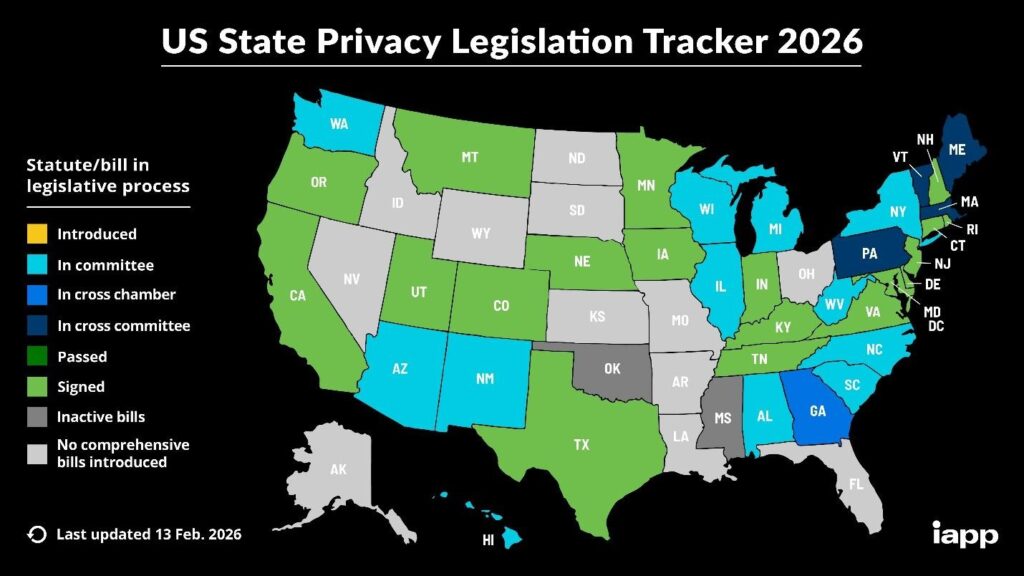
Source: IAPP US State Privacy Legislation Tracker
In 2025 alone, eight new state comprehensive privacy laws entered effect: Delaware, Iowa, Nebraska, New Hampshire, and New Jersey in January; Tennessee and Minnesota in mid-year; Maryland in October. By mid-2026, more than twenty active state comprehensive privacy laws are on the books, with additional states advancing legislation each session. The FTC has continued expanding its enforcement authority under Section 5, targeting companies that fail to live up to their own privacy representations. The map is not stabilizing. It is accelerating.
Not in the vacation sense of island-hopping. More like navigating a chain of jurisdictions, each with its own enforcement style, rights framework, and exemption logic – and watching new ones ratify before the previous ones are fully operationalized.
See how UnderDefense MAXI Compliance AI handles your current state privacy obligations in one session.
There are two ways companies respond to this.
- The first is the map approach: track which states you’re in, pull the requirements for each, build per-jurisdiction checklists, and update them when the law changes. This works until the map updates faster than your team can follow, the audit arrives, or an acquirer’s due diligence team asks for evidence that holds across every state you operate in simultaneously.
- The second is the infrastructure approach: build one management system with defined ownership, documented processes, and evidence that travels across every jurisdiction you touch. New state laws become configuration exercises. Auditors get what they need on demand. The program compounds when the landscape shifts.
Leaders who build infrastructure tend to move faster, spend less, and withstand audits, M&A diligence, and regulatory inquiries with fewer surprises. Today we are explaining how that infrastructure works – and how UnderDefense MAXI Compliance AI turns it from a principle into an operational system.
Why U.S. Data Privacy Compliance Feels Like Island-Hopping
Data privacy compliance in the U.S. means satisfying a fragmented set of obligations: federal sector rules like HIPAA and GLBA, state comprehensive laws led by CCPA and CPRA, and enforcement theories from the FTC, state attorneys general, and the courts. Unlike the EU’s GDPR – a single cross-sector framework – U.S. data privacy compliance has no unified rulebook. That fragmentation is the operational problem this article addresses.
The U.S. approach is sectoral by industry and fragmented by geography. Healthcare operates under HIPAA. Financial services under Gramm-Leach-Bliley and the FTC Safeguards Rule. Cross-industry consumer privacy runs through a patchwork of state comprehensive laws, led by California’s CCPA and CPRA but not limited to it.
These regimes overlap inconsistently. A healthcare company in California that also processes financial data for employee benefits touches three separate frameworks, each with distinct definitions of sensitive data, different breach notification windows, and enforcement bodies that do not coordinate.
For global companies, the contrast with Europe is instructive. The GDPR gives you a unified rulebook: common principles, defined lawful bases, standardized individual rights, and a single enforcement structure across EU member states. In the U.S., you start with a matrix – states multiplied by sectors, multiplied by enforcement theories, multiplied by litigation risk.
The executive question this creates is practical: how do we run one business, with one customer experience, across twenty or more distinct privacy jurisdictions, without rebuilding the compliance program every time the map adds a new island?
What a Data Privacy Compliance Audit Looks Like Without a Management System
Consider a standard scenario: a software company in Series C fundraising receives a data privacy due diligence questionnaire from a prospective acquirer. It covers data inventory, processing activities, consent management, DSAR response history, vendor risk, breach notification records, and state-specific compliance posture.
Without a management system, this takes weeks. Legal owns one piece. Engineering owns another. Procurement has vendor contracts somewhere. HR manages employee data separately. Assembling a coherent answer means tracking down whoever built the last audit document, hoping it is still accurate, and writing narratives that paper over the gaps.
With a management system, the same questionnaire is a reporting exercise. Data inventory is current. Processing activities are documented. Controls map to requirements. Evidence is versioned. The narrative comes from what the system already tracks.
The gap is not legal knowledge – both teams know what CCPA requires. The gap is operationalization: whether your compliance posture lives in documents scattered across functions, or in a system that runs continuously and produces evidence on demand.
UnderDefense MAXI Compliance AI supports privacy and compliance programs across 500+ clients globally, in regulated industries and growth-stage technology companies alike.
Can’t We Just Maintain Per-Jurisdiction Checklists?
Checklists work – for a while. If you operate in two or three states and your business model is stable, a well-maintained per-jurisdiction checklist is a reasonable starting point.
Two things make this approach expensive over time. First, scale. More than twenty active comprehensive state privacy laws are now in effect, with additional states advancing legislation each session. Each has distinct definitions of sensitive data, different opt-out rights, separate response timelines, and exemption logic that overlaps inconsistently with federal sector rules. Maintaining accurate per-jurisdiction documentation across all of them is not a documentation problem. It is a staffing problem.
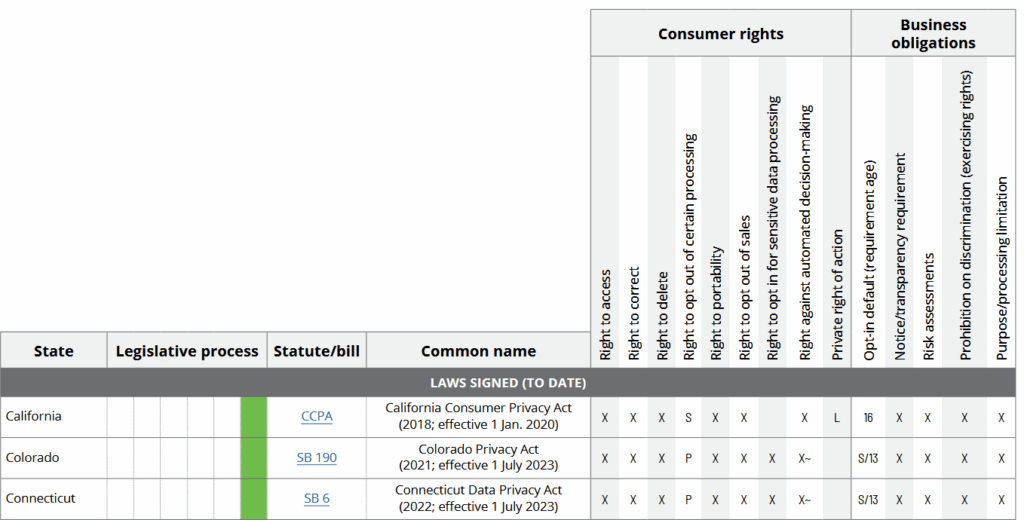
Source: IAPP US State Privacy Legislation Tracker 2026
Second: checklists document intent. They cannot run evidence collection, track data flows as your product changes, operationalize DSAR requests at scale, or produce auditor-ready documentation that makes a regulatory inquiry survivable. A checklist tells you what you should do. A management system proves what you did – and keeps proving it continuously, not just during audit season.
Ready to move from per-jurisdiction checklists to a management system with UnderDefense MAXI Compliance AI?
Responding to Data Subject Requests Across State Lines
A California resident submits a deletion request through your privacy portal. Your Colorado team receives an opt-out request for targeted advertising. Your Texas operations get a data access request from a current customer. Each arrives the same week.
Each request is technically distinct. CCPA deletion has specific timelines and exemptions tied to the category of data. Colorado’s CPA opt-out affects your data broker relationships and downstream vendor flows. Texas TDPSA has its own verification requirements and response window.
Without a unified system, this is three separate workflows, three people checking three different documents, with no shared audit trail.
Show me all open data subject requests across jurisdictions, their current status, and which ones are approaching their response deadline.
With UnderDefense MAXI Compliance AI, request intake, routing, and deadline tracking runs across all jurisdictions in a single workflow. Verification steps, exemption logic, and response templates are configured per state. The audit trail – who saw the request, what action was taken, when – is captured automatically. When a regulator asks for evidence of your DSAR program, it is already assembled.
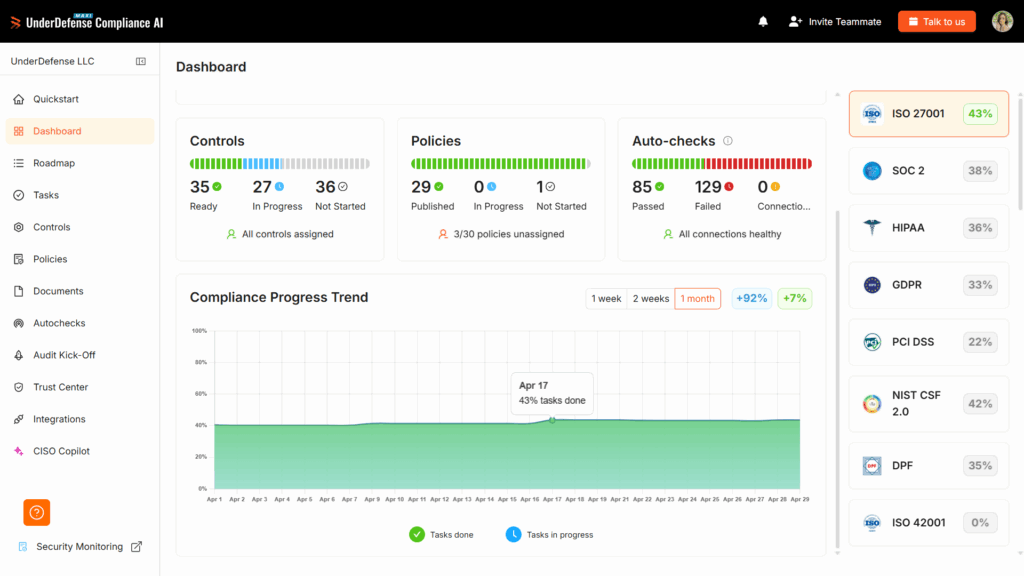
Each request you close adds to a record that makes the next inquiry faster and the next audit cleaner. The program builds evidence continuously, without adding headcount to do it.
Producing an Audit Package Before the Auditors Arrive
Audit preparation is where the map-versus-infrastructure divide becomes most visible. Organizations running checklists spend the weeks before an audit reconstructing what they should have been tracking all year. Organizations running management systems spend those weeks reviewing what the system already captured.
Generate an audit-ready evidence package for our SOC 2 privacy criteria and our CCPA compliance posture as of this quarter.
MAXI Compliance AI maps your controls to the applicable frameworks – SOC 2 Trust Services Criteria, NIST Privacy Framework, ISO/IEC 27701, CCPA and CPRA – and produces evidence packages on demand. Control objectives, test results, gap remediations, and exception history are included. The package reflects the state of your program at any point in time, not just the moment you remembered to document it.
For regulated companies in healthcare, financial services, and insurance, this matters every quarter. For technology companies where compliance is a signal to enterprise buyers, it matters every time a customer’s procurement or security team runs a vendor assessment – which for growth-stage companies is every significant deal.
Running a Privacy Impact Assessment Before a Feature Ships
Your product team is shipping a feature that processes location data for personalization. Legal needs a privacy impact assessment. Engineering wants to ship in six weeks.
Without a structured process, this depends on whoever has bandwidth, whatever template was last used, and a cross-functional meeting that gets scheduled twice and attended once.
Start a privacy impact assessment for a location-based personalization feature. Pull our existing data inventory for location data and flag applicable state-law requirements.
MAXI Compliance AI walks the assessment through a structured workflow: data categories involved, processing purposes, legal basis, risk factors, mitigations, and approval chain. It draws from your existing data inventory – the team is not starting from scratch. The completed assessment is stored, versioned, and linked to the feature. When the next audit asks whether you assessed this category of processing, the answer is retrievable, not reconstructed.
Over time, this creates a record of how your privacy program responds to product changes – which is exactly what regulators and acquirers are evaluating when they ask to see your privacy-by-design posture.
How to Automate Data Privacy Compliance with MAXI Compliance AI
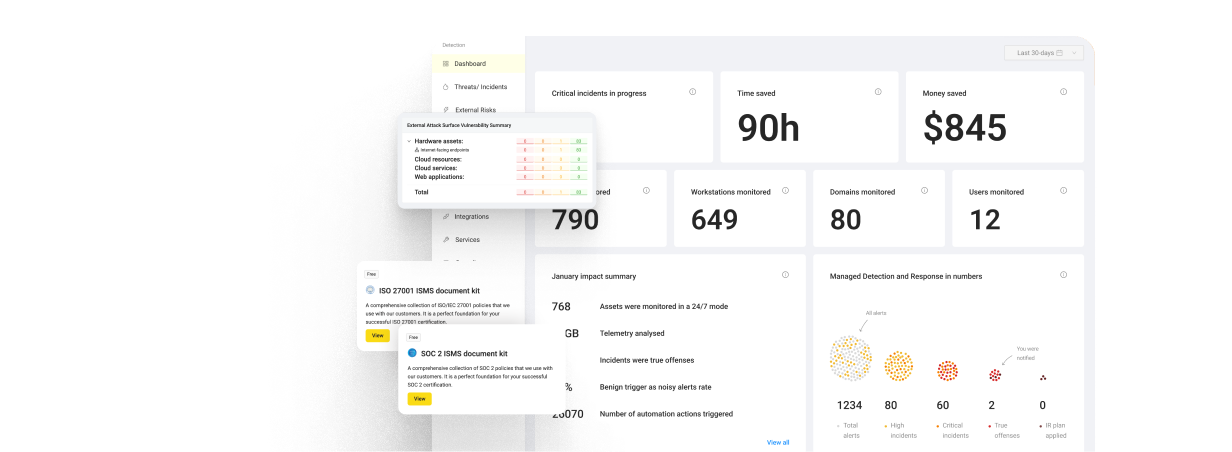
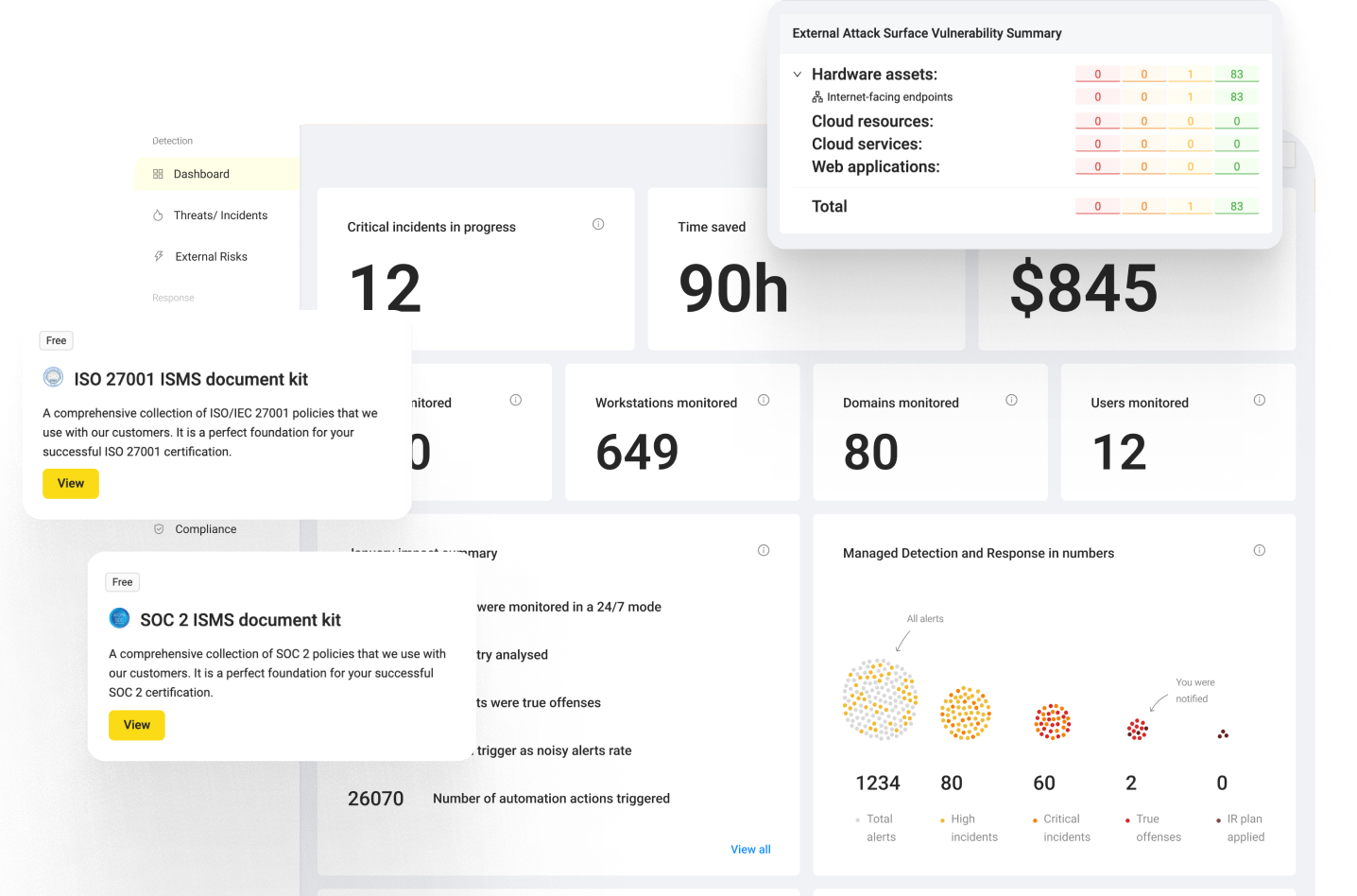
UnderDefense MAXI Compliance AI runs as a centralized management layer across your privacy program. It covers data inventory and processing activity mapping, policy and notice management, DSAR intake and response workflows, vendor risk and third-party assessment, control testing, and audit-ready evidence production on demand.
The platform maps your controls to the frameworks your program runs against: CCPA and CPRA, NIST Privacy Framework, ISO/IEC 27701, SOC 2 Privacy Criteria, HIPAA where applicable, and the expanding set of U.S. state comprehensive privacy laws. When new laws ratify, your existing control set is updated through configuration. The integration layer connects to the systems your teams already use: ticketing, data cataloging, HR platforms, vendor management stacks. Evidence is captured where work happens, not assembled separately before each audit cycle.
Conclusions
The islands have not merged. U.S. privacy will keep adding jurisdictions, enforcement bodies, and sector-specific overlays. That is the landscape, and it is not going to simplify.
Every jurisdiction you operate in will ask for evidence at some point: during an audit, an M&A process, or a regulatory inquiry. Teams that build evidence continuously navigate those moments in days. Teams that start gathering after the request arrives spend weeks – and spend them explaining gaps.
UnderDefense MAXI Compliance AI – Data Privacy Compliance, Automated |
|
4.9/5 on Gartner Peer Insights · 500+ clients globally |
1. What is data privacy compliance in the United States?
Data privacy compliance in the U.S. means satisfying a fragmented set of legal obligations that vary by industry and state. Federal sector rules – HIPAA for healthcare, GLBA for financial services – apply nationally within those sectors. State comprehensive laws like California’s CCPA and CPRA, Texas TDPSA, and more than twenty others add jurisdiction-specific consumer rights, opt-out mechanisms, and enforcement timelines. Unlike the EU’s GDPR, there is no single U.S. data privacy law that applies cross-industry and cross-geography.
2. How many U.S. states have comprehensive data privacy laws?
As of mid-2026, more than twenty U.S. states have enacted comprehensive data privacy laws, with additional states advancing legislation each session. Eight new laws entered effect in 2025 alone, covering Delaware, Iowa, Nebraska, New Hampshire, New Jersey, Tennessee, Minnesota, and Maryland. Each law has distinct definitions of sensitive data, different individual rights, separate response timelines, and exemption logic that does not align consistently across states.
3. What is the difference between GDPR and U.S. state privacy laws?
The GDPR is a single, cross-sector regulation that applies uniformly across EU member states, with common principles, defined lawful bases for data processing, standardized individual rights, and a coordinated enforcement structure through national supervisory authorities. U.S. state privacy laws are fragmented – each state sets its own scope, definitions, opt-out mechanisms, response deadlines, and exemptions. For companies operating in both markets, the EU side offers one compliance framework to build against; the U.S. side requires managing a matrix of state-by-state obligations that overlaps inconsistently with federal sector rules.
4. What is the difference between a privacy checklist and a privacy management system?
A privacy checklist documents what your organization intends to do – which legal requirements apply in which states and how you plan to meet them. A privacy management system operationalizes those intentions: it maintains current data inventory and processing activity maps, handles data subject requests at scale, produces auditor-ready evidence on an ongoing basis, and tracks controls against multiple frameworks simultaneously. Checklists tell you what you should do. A management system proves what you did, continuously, not just during audit preparation.
5. How does UnderDefense MAXI Compliance AI support U.S. state privacy compliance?
UnderDefense MAXI Compliance AI runs as a centralized management layer that maps your controls to CCPA and CPRA, NIST Privacy Framework, ISO/IEC 27701, SOC 2 Privacy Criteria, and the expanding set of U.S. state comprehensive privacy laws. When new state laws ratify, your existing control set is updated through configuration rather than rebuilt from scratch. The platform handles DSAR intake and routing across jurisdictions, vendor risk assessment, privacy impact assessments, and audit-ready evidence production on demand – so your compliance program runs continuously, not only when an audit is scheduled.