




Q1. What Are the 12 Best SIEM Platforms for Enterprise Security Teams in 2026?
Selecting a SIEM platform is one of the most consequential infrastructure decisions a security leader will make this year. A SIEM sits at the center of your detection and response pipeline. Get it wrong, and you’re paying for expensive log storage that nobody operationalizes. Get it right, and you have a unified detection engine that actually reduces dwell time and breach risk. Unlike vendor-published lists where the author conveniently ranks their own product first, this guide is written by a security operations team that deploys and operationalizes these platforms daily across 500+ client environments. We analyzed 12 SIEM platforms across detection maturity, AI capabilities, deployment flexibility, compliance automation, and pricing transparency.
📊 Our Evaluation Criteria
Each provider was assessed across five key areas:
- Detection Maturity & AI Capabilities (25%) — Correlation engine depth, ML-driven analytics, MITRE ATT&CK coverage, and behavioral detection accuracy
- Deployment Flexibility & Integration (20%) — Cloud-native, hybrid, and on-prem options; SOAR/XDR integration; vendor-agnostic telemetry ingestion
- Scalability & Data Architecture (20%) — Ingestion volume handling, data lake architecture, multi-tenant support, and query performance at scale
- Compliance & Reporting Automation (15%) — Pre-built templates for SOC 2, HIPAA, GDPR, PCI DSS; audit trail generation; automated evidence collection
- Pricing Transparency & TCO (20%) — Published pricing models, predictable cost structures, hidden fees, and total cost of ownership at enterprise scale
🎯 Who This Guide Is For
This shortlist is designed specifically for:
- CISOs and Security Directors evaluating new SIEM deployments or replacing legacy platforms that have become unmanageable
- IT Directors and CTOs at mid-market organizations (50–5,000 employees) seeking unified threat detection across cloud, endpoint, and identity
- SOC managers drowning in alert noise looking for platforms that reduce false positives and accelerate investigation
- PE Operating Partners assessing portfolio company security infrastructure and ROI on security tooling
If your organization is replacing a legacy SIEM, consolidating fragmented security tools, or evaluating managed SIEM services for the first time, the platforms below represent the most frequently evaluated SIEM solutions during the procurement process.
| Provider Name | Best For | Key Strength | Compliance |
|---|---|---|---|
| 1. UnderDefense Managed SIEM + AI SOC ⭐⭐⭐⭐⭐ | Operationalizing any SIEM with managed detection & response | AI SOC + Human Ally concierge response layered on any SIEM platform | SOC 2, HIPAA, ISO 27001, GDPR, PCI DSS |
| 2. Splunk Enterprise Security (Cisco) ⭐⭐⭐⭐ | Large enterprises needing massive ecosystem flexibility | Largest integration marketplace with Cisco Talos threat intelligence | SOC 2, HIPAA, PCI DSS, GDPR, SOX |
| 3. Microsoft Sentinel ⭐⭐⭐⭐ | Microsoft-centric and cloud-first organizations | Cloud-native Azure integration with free M365/Entra log ingestion | SOC 2, HIPAA, PCI DSS, GDPR, CCPA |
| 4. Palo Alto Cortex XSIAM ⭐⭐⭐⭐ | Enterprises seeking converged SIEM-XDR-SOAR consolidation | ML alert auto-grouping with converged platform licensing | SOC 2, HIPAA, PCI DSS, GDPR |
| 5. CrowdStrike Falcon Next-Gen SIEM ⭐⭐⭐⭐ | CrowdStrike ecosystem customers needing petabyte-scale ingestion | Charlotte AI natural-language threat hunting | SOC 2, HIPAA, PCI DSS, GDPR |
| 6. Exabeam Fusion SIEM ⭐⭐⭐⭐ | UEBA-first organizations focused on insider threat detection | Behavioral analytics with 10GB/day free ingestion tier | SOC 2, HIPAA, PCI DSS, GDPR |
| 7. Elastic Security ⭐⭐⭐⭐ | Open-source-oriented teams wanting cost-transparent SIEM | Attack Discovery with YARA-L/Sigma rule support | SOC 2, HIPAA, PCI DSS, GDPR |
| 8. Securonix Unified Defense SIEM ⭐⭐⭐ | Large enterprises with complex insider threat scenarios | Embedded Snowflake data lake with psycho-analytics | SOC 2, HIPAA, PCI DSS, GDPR, CMMC |
| 9. IBM QRadar ⭐⭐⭐ | Regulated industries with deep on-prem requirements | Mature correlation engine with extensive compliance support | SOC 2, HIPAA, PCI DSS, GDPR, SOX |
| 10. SentinelOne Singularity AI SIEM ⭐⭐⭐⭐ | Organizations wanting unified EDR-SIEM in one agent | Purple AI natural-language investigation | SOC 2, HIPAA, PCI DSS, GDPR |
| 11. Rapid7 InsightIDR ⭐⭐⭐ | Mid-market teams seeking built-in UEBA with SOAR | Embedded SOAR via InsightConnect with predictable asset-based pricing | SOC 2, HIPAA, PCI DSS, GDPR |
| 12. Stellar Cyber AI-Driven SIEM ⭐⭐⭐ | MSSPs and lean SOC teams needing multi-tenant automation | Flat pricing with multi-tenant AI-driven architecture | SOC 2, HIPAA, PCI DSS, GDPR |
1. UnderDefense Managed SIEM + AI SOC: Best for Operationalizing Any SIEM Platform with 24/7 Expert Response
✅ Overview
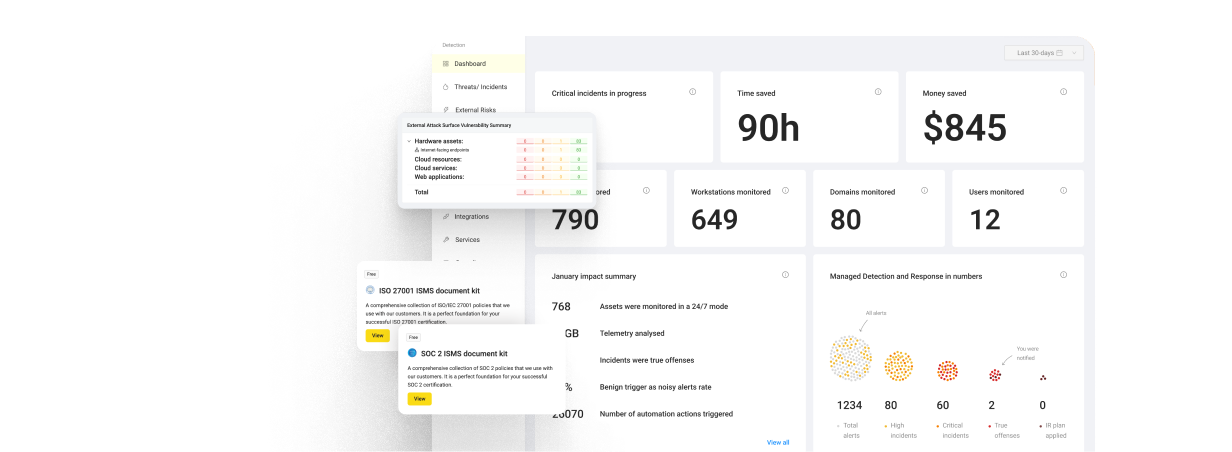
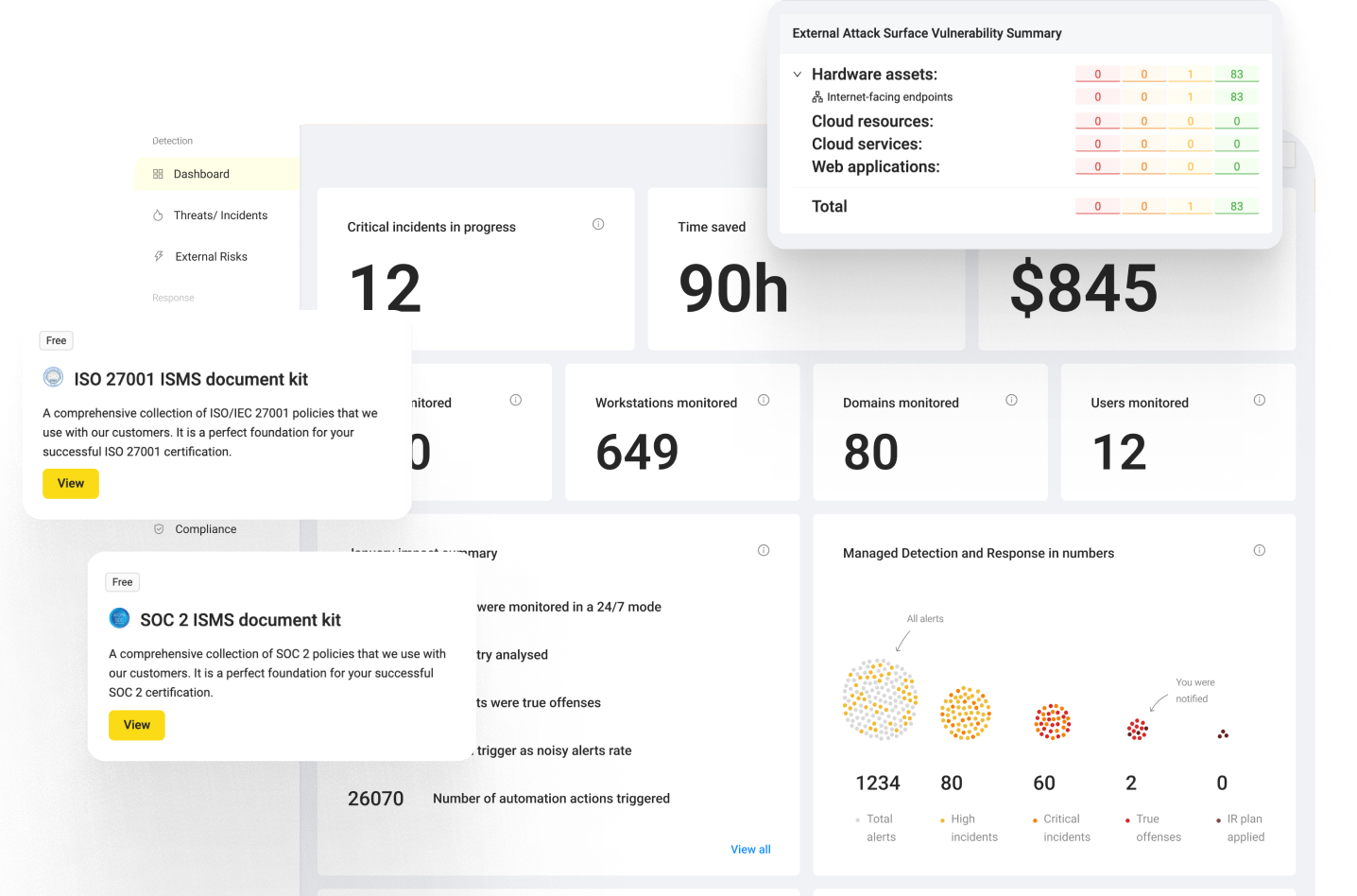
UnderDefense is not a standalone SIEM product. It is the operational intelligence layer that makes every other SIEM on this list actually deliver security outcomes. Here’s the operational reality most SIEM vendors won’t tell you: buying a SIEM is maybe 20% of the problem. The other 80% is writing detection rules, tuning false positives, staffing 24/7 coverage, investigating alerts at 2 AM, and keeping the whole system current as your environment evolves. UnderDefense’s Managed SIEM service layers the MAXI platform and concierge analyst team on top of your existing SIEM (Splunk, Sentinel, Elastic, QRadar) and operationalizes it so you get detection and response, not just expensive log storage.
📋 Core Services
- 24/7 Managed Detection & Response across any SIEM platform, including Splunk, Microsoft Sentinel, Elastic, and others, with AI-driven triage and dedicated analyst investigation
- AI SOC + Human Ally model: AI automates context collection, log queries, and threat enrichment; human analysts make the decisions, verify with affected users, and contain threats
- Vendor-agnostic integration with 250+ security tools, preserving your existing SIEM investment and avoiding vendor lock-in
- Detection engineering and tuning, including custom rules, use-case development, and MITRE ATT&CK mapping that reduces customer-facing alerts by 99%
- ChatOps-driven incident response via Slack, Teams, or email: analysts verify suspicious activity directly with affected users, then contain confirmed threats (credential revocation, endpoint isolation, lateral movement blocking)
- Compliance automation with forever-free kits for SOC 2, HIPAA, ISO 27001, and GDPR, including automated evidence collection and audit-ready reporting
- 30-day impact reporting with measurable security posture improvements documented within the first month
🤔 Why Companies Consider UnderDefense
The SIEM market has a dirty secret: most organizations that purchase a SIEM never fully operationalize it. Detection rules go stale within months. Alert volumes overwhelm lean security teams. Night and weekend coverage gaps mean threats dwell for hours, sometimes days, before anyone investigates. UnderDefense closes this gap. We layer on top of whatever SIEM you’ve already invested in, bring detection engineering expertise, staff 24/7 analyst coverage, and own the response workflow from alert to containment. The result? A 2-minute alert-to-triage time and 15-minute escalation for critical incidents, metrics we publish transparently, not hide behind “contact sales.”
👥 Ideal Customer Profile
- Mid-market to enterprise organizations (50–5,000 employees) with an existing SIEM generating more alerts than their team can investigate
- Security-lean teams that need 24/7 SOC coverage without hiring 8–12 analysts
- Companies running Splunk, Sentinel, Elastic, or QRadar that want to maximize ROI from their current SIEM investment
- PE portfolio companies requiring rapid compliance certification and measurable security posture improvement
💰 Commercial Model
Transparent, published pricing at $11–15/endpoint/month, all-inclusive. Covers 24/7 monitoring, detection engineering, investigation, and response across your entire security stack. No hidden professional services fees, no per-incident charges, no “contact sales” pricing games. 30-day turnkey onboarding with SIEM tuning, ransomware simulation testing, and custom detection rules included.
⏰ When to Shortlist
Shortlist UnderDefense when your SIEM generates more alerts than your team can investigate, when you need 24/7 coverage without building an internal SOC, or when you want to maximize ROI from your existing SIEM investment, without ripping and replacing anything.
💬 Customer Reviews
Their expert management of our SIEM has added to the value of our security investments and tools. They keep us informed, suggesting relevant and cost-effective security improvements and new use cases that enhance our defenses. And we love the monthly report — we gain valuable insights into security posture and incidents, and share them with the board of directors.
— Yaroslava K., IT Project Manager UnderDefense – G2 Verified Review
UnderDefense MAXI integrates well with our systems, specifically with our SIEM, Splunk. Their team is proactive in identifying and addressing threats, providing 24/7 oversight. With UnderDefense MAXI, we’ve reduced security breaches. Their adherence to SLAs gives me confidence in our infrastructure’s protection. As the Information Security Director, it lets me focus on strategy, knowing the day-to-day security is managed effectively.
— Oleg K., Director Information Security UnderDefense – G2 Verified Review
2. Splunk Enterprise Security (Cisco): Best for Large Enterprises Needing Massive Ecosystem Flexibility
✅ Overview
Splunk Enterprise Security remains one of the most widely adopted SIEM platforms in enterprise environments, now supercharged by Cisco’s acquisition and access to Talos threat intelligence. The platform’s strength lies in its search-first architecture: SPL (Search Processing Language) gives security teams unmatched flexibility to build custom queries, dashboards, and detection rules. With over 2,800+ apps and integrations in its marketplace, Splunk supports virtually any log source or security tool in existence. For organizations with dedicated SOC teams and the engineering resources to operationalize it, Splunk provides a powerful, if expensive, detection engine.
📋 Core Services
- Flexible log ingestion and search with SPL-based custom analytics and real-time correlation across any data source
- Cisco Talos threat intelligence integration providing global threat context and IOC enrichment
- Risk-Based Alerting (RBA) that aggregates risk scores across users and assets, reducing alert volumes by mapping risk to entities rather than individual events
- Extensive marketplace ecosystem with 2,800+ pre-built apps, integrations, and detection content packs
- SOAR capabilities via Splunk SOAR (formerly Phantom) for automated playbook execution and incident response orchestration
🤔 Why Companies Consider Splunk
Splunk’s ecosystem depth is unmatched. If a security tool exists, Splunk probably has an integration for it. The Risk-Based Alerting approach, which rolls up risk scores to entities rather than generating individual alerts, is genuinely innovative and addresses alert fatigue at the architectural level. Organizations with mature SOC teams that can invest in custom SPL development and detection engineering get tremendous value from Splunk’s flexibility.
⚠️ The Trade-offs to Know
The biggest challenge with Splunk is cost predictability. Pricing is based on daily data ingest volume, and Enterprise Security carries a 1.5–2× multiplier over the base platform rate. At scale, enterprise contracts routinely reach $250K–$1M+ annually. Organizations frequently struggle with “ingest anxiety,” limiting log sources to control costs, which creates visibility gaps. Additionally, Splunk requires significant internal expertise to operationalize effectively. Without dedicated Splunk engineers and detection content developers, many organizations end up with an expensive log repository rather than an active detection system.
👥 Ideal Customer Profile
- Large enterprises (1,000+ employees) with dedicated SOC teams and Splunk engineering resources
- Organizations with complex, multi-vendor security environments needing maximum integration flexibility
- Companies with existing Splunk investments looking to expand into security use cases
- Cisco ecosystem customers leveraging Talos threat intelligence
💰 Commercial Model
Pricing based on daily data ingest volume (GB/day) or Splunk Virtual Compute (SVC) units. List pricing typically ranges from $150–$225/GB/day for the base platform, with Enterprise Security adding a 50–100% cost multiplier. Annual contracts for mid-market organizations typically range $100K–$300K; large enterprise deployments often exceed $500K–$1M annually. No published per-endpoint or per-user pricing.
⏰ When to Shortlist
Shortlist Splunk when you have dedicated SOC engineering resources, when integration ecosystem breadth is non-negotiable, or when you’re a Cisco shop leveraging the combined Cisco/Splunk security portfolio. Be prepared for significant operational investment beyond the license cost.
3. Microsoft Sentinel: Best for Microsoft-Centric and Cloud-First Organizations
✅ Overview
Microsoft Sentinel is a cloud-native SIEM and SOAR solution built on Azure, offering tight integration with the Microsoft 365 ecosystem, including Defender, Entra ID, Purview, Intune, and Azure services. For organizations already standardized on Microsoft infrastructure, Sentinel offers the lowest-friction SIEM deployment path available. Free data ingestion for Microsoft 365 audit logs, Azure Activity logs, and Entra sign-in events makes it the cost-effective default choice for Microsoft-heavy environments. The platform’s KQL (Kusto Query Language) provides powerful analytics capabilities, though it requires a learning curve for teams accustomed to SPL or other query languages.
📋 Core Services
- Cloud-native SIEM with elastic scalability on Azure: no infrastructure to manage, patch, or capacity-plan
- Free ingestion for M365 audit logs, Azure Activity, Entra ID sign-in/audit logs, and Microsoft Defender alerts
- Built-in SOAR with Logic Apps-powered automation playbooks for incident response orchestration
- Fusion ML detection that correlates low-fidelity alerts into high-confidence incidents using Microsoft’s security graph
- Content Hub with 300+ pre-built data connectors, analytics rules, workbooks, and hunting queries
🤔 Why Companies Consider Microsoft Sentinel
The economics are compelling for Microsoft-centric organizations. If you’re already paying for Microsoft 365 E5 at ~$57/user/month, a significant portion of your security telemetry ingests into Sentinel at no additional cost. The commitment tier pricing, starting at $3.43/GB at the 100 GB/day level, represents meaningful savings over pay-as-you-go ($5.22/GB). For Azure-native environments, the deployment and integration friction is genuinely minimal compared to deploying a third-party SIEM.
⚠️ The Trade-offs to Know
Cost management in Sentinel can spiral quickly for organizations with high log volumes from non-Microsoft sources. The commitment tier pricing requires accurate volume forecasting, and exceeding your commitment reverts to pay-as-you-go rates. KQL has a steeper learning curve than some alternatives, and tuning Sentinel to reduce false positives requires dedicated security engineering time. Multi-cloud environments (Azure + AWS + GCP) create additional data connector complexity and cost.
👥 Ideal Customer Profile
- Organizations standardized on Microsoft 365 and Azure (80%+ Microsoft ecosystem)
- Cloud-first companies seeking a SIEM without infrastructure management overhead
- Mid-market organizations already paying for E5 licensing seeking bundled security value
- Security teams comfortable with KQL or willing to invest in training
💰 Commercial Model
Pay-As-You-Go at $5.22/GB ingested, or Commitment Tiers starting at $342.52/day (100 GB/day) with an effective rate of $3.43/GB, a 34% savings. Higher commitment tiers (200–400+ GB/day) reduce effective per-GB pricing further, reaching ~$3.00/GB at 400 GB/day. Microsoft 365 and Azure logs ingest at no additional charge. Total annual cost varies widely: mid-market organizations typically spend $25K–$80K; large enterprises with high non-Microsoft log volumes can exceed $200K+ annually.
⏰ When to Shortlist
Shortlist Microsoft Sentinel when your organization is 80%+ Microsoft for productivity, identity, and cloud infrastructure, when you want SIEM without managing infrastructure, or when E5 licensing already covers a significant portion of your security telemetry. Evaluate carefully if you have high-volume non-Microsoft log sources or multi-cloud environments.
4. Palo Alto Cortex XSIAM: Best for Enterprises Seeking Converged SIEM-XDR-SOAR Consolidation
✅ Overview
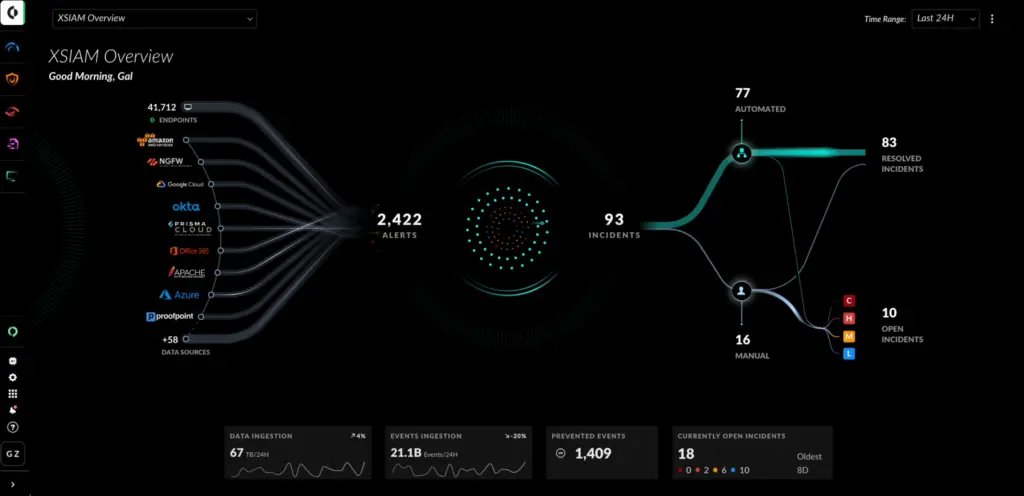
Palo Alto’s Cortex XSIAM represents the most aggressive platform consolidation play in the SIEM market, converging SIEM, XDR, SOAR, and Attack Surface Management (ASM) into a single platform. The core thesis is compelling: instead of maintaining separate tools for each security function, XSIAM provides a unified data model where ML-driven analytics auto-group alerts into incidents, dramatically reducing investigation time. For enterprises committed to the Palo Alto ecosystem, XSIAM eliminates tool sprawl at the architectural level.
📋 Core Services
- Converged SIEM-XDR-SOAR-ASM in one unified platform with shared data model
- ML-driven alert grouping that auto-correlates thousands of alerts into actionable incidents
- Non-volume-based platform licensing with no per-GB ingest anxiety
- Native integration with Palo Alto firewalls, Prisma Cloud, and Cortex XDR
- Automated investigation and response playbooks built into the platform
👥 Ideal Customer Profile
- Enterprises committed to the Palo Alto ecosystem (firewall, Prisma, Cortex XDR)
- Organizations actively consolidating security tools to reduce operational complexity
- Large SOC teams (10+ analysts) seeking AI-driven automation to scale operations
💰 Commercial Model
Platform licensing model, not volume-based. Pricing is custom and enterprise-only, typically structured per the number of security modules and organizational scope. Expect enterprise-grade investment; this is positioned against Splunk and Sentinel at the top tier.
⏰ When to Shortlist
Shortlist XSIAM when platform consolidation is a strategic priority, when you’re already invested in the Palo Alto ecosystem, or when ML-driven alert grouping would meaningfully reduce your SOC analyst workload.
5. CrowdStrike Falcon Next-Gen SIEM: Best for CrowdStrike Ecosystem Customers Needing Petabyte-Scale Ingestion
✅ Overview
CrowdStrike’s Falcon Next-Gen SIEM extends the Falcon platform’s native telemetry with third-party log ingestion, creating a SIEM built on CrowdStrike’s lightweight agent architecture and cloud-native data lake. Charlotte AI provides natural-language threat hunting: security analysts can query the SIEM in plain English rather than learning a specialized query language. The platform ingests petabyte-scale data volumes with 10 GB/day free ingestion for existing Falcon customers.
📋 Core Services
- Charlotte AI for natural-language threat hunting and investigation
- Petabyte-scale data ingestion with 10 GB/day free for Falcon customers
- Native Falcon endpoint, identity, and cloud telemetry with third-party log support
- Unified detection across first-party and third-party security data
- Integrated threat intelligence from CrowdStrike’s threat research team
👥 Ideal Customer Profile
- Organizations already running CrowdStrike Falcon for EDR/XDR seeking to consolidate SIEM
- SOC teams wanting natural-language investigation capabilities
- Enterprises with high data volumes attracted by the free ingestion tier
💰 Commercial Model
Add-on to existing CrowdStrike Falcon licensing. Includes 10 GB/day free ingestion; additional volume priced per GB. Custom pricing based on organizational scope and data volume requirements.
⏰ When to Shortlist
Shortlist Falcon Next-Gen SIEM when you’re already a CrowdStrike customer, when natural-language hunting would meaningfully accelerate investigations, or when the 10 GB/day free tier covers a significant portion of your third-party log volume.
6. Exabeam Fusion SIEM: Best for UEBA-First Organizations Focused on Behavioral Analytics
✅ Overview
Exabeam Fusion SIEM leads with User and Entity Behavior Analytics (UEBA), using behavioral baselines and machine learning to detect insider threats, compromised credentials, and lateral movement that rule-based detection systems routinely miss. The platform’s Smart Timelines automatically construct narrative investigation sequences for each user and entity, dramatically reducing investigation time from hours to minutes. The 10 GB/day free ingestion tier lowers the entry barrier for organizations evaluating behavioral SIEM.
📋 Core Services
- UEBA-first behavioral analytics with automated baseline creation per user and entity
- Smart Timelines constructing narrative investigation sequences automatically
- 10 GB/day free cloud-native ingestion tier
- Pre-built correlation rules and ML detection models for insider threat scenarios
- Integration with 500+ security tools and data sources
👥 Ideal Customer Profile
- Organizations where insider threat and compromised credential detection are top priorities
- Security teams that have struggled with rule-based SIEM detection gaps
- Mid-market to enterprise companies evaluating behavioral analytics as a core detection layer
💰 Commercial Model
Per-user fixed-rate pricing model, decoupled from data volume. This eliminates “ingest anxiety” and makes cost predictable regardless of log volume growth. Free tier at 10 GB/day for evaluation and smaller deployments. Enterprise pricing is custom.
⏰ When to Shortlist
Shortlist Exabeam when behavioral analytics and insider threat detection are your primary SIEM use cases, when you want per-user pricing decoupled from data volume, or when Smart Timelines would meaningfully accelerate your investigation workflow.
7. Elastic Security: Best for Open-Source-Oriented Teams Wanting Cost-Transparent SIEM
✅ Overview
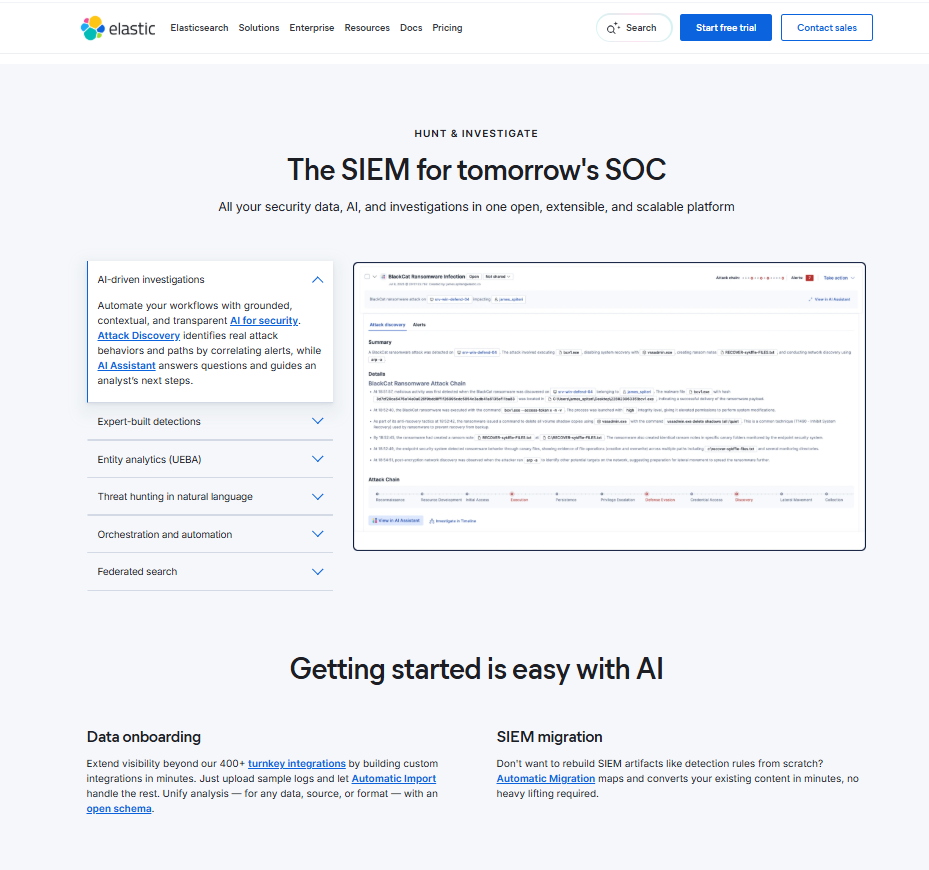
Elastic Security builds on the open-source Elasticsearch foundation, offering SIEM capabilities alongside endpoint protection, cloud security, and AI-powered Attack Discovery. The platform’s transparent, storage-based pricing and support for community detection rules (YARA-L, Sigma) make it particularly attractive to engineering-heavy security teams that want full customization without proprietary lock-in. Attack Discovery auto-correlates alerts into attack chains, providing contextual investigation starting points.
📋 Core Services
- Open-source foundation with enterprise SIEM features and Attack Discovery
- Storage-based or compute-based pricing with high transparency ($0.09–$0.11/GB)
- YARA-L and Sigma detection rule support for community-sourced detection content
- AI-assisted migration tools for teams moving from legacy SIEM platforms
- Native endpoint agent for combined SIEM + endpoint telemetry
👥 Ideal Customer Profile
- Engineering-heavy security teams comfortable with Elasticsearch
- Cost-conscious organizations wanting transparent, predictable SIEM pricing
- Teams migrating from legacy SIEM that value open-source flexibility and data ownership
💰 Commercial Model
Self-managed: free (basic); Elastic Cloud: storage-based pricing starting at ~$0.09–$0.11/GB. Estimated annual costs for mid-market deployments: $6,500–$25,000, significantly lower than Splunk or Sentinel at comparable volumes. Enterprise support and features available via subscription tiers.
⏰ When to Shortlist
Shortlist Elastic Security when cost transparency is non-negotiable, when your security team has Elasticsearch engineering expertise, or when open-source flexibility and data ownership are strategic requirements.
8. Securonix Unified Defense SIEM: Best for Large Enterprises with Complex Insider Threat Scenarios
✅ Overview
Securonix differentiates through its embedded Snowflake data lake architecture and proprietary “psycho-analytics” approach to insider threat detection: behavioral modeling that understands not just what users are doing, but the psychological and contextual patterns that indicate insider risk. The bring-your-own-storage option via Snowflake gives enterprises full data ownership and the ability to run analytics across security and business data in one data lake.
📋 Core Services
- Embedded Snowflake data lake with bring-your-own-storage option
- Psycho-analytics for insider threat detection based on behavioral and contextual patterns
- Cloud-native architecture with threat content-as-a-service updates
- Integration with identity governance, HR systems, and business applications
- Advanced peer-group analysis for anomaly detection
👥 Ideal Customer Profile
- Large enterprises (5,000+ employees) with complex identity and access environments
- Regulated industries (financial services, healthcare) where insider threat is a top risk
- Organizations already using Snowflake that want to unify security and business analytics
💰 Commercial Model
Bring-your-own-storage (Snowflake) or Securonix-managed cloud. Custom enterprise pricing. Typically positioned for large enterprise budgets.
⏰ When to Shortlist
Shortlist Securonix when insider threat detection is your primary SIEM investment driver, when you want to own your security data in Snowflake, or when behavioral analytics across identity, HR, and security data is a key requirement.
9. IBM QRadar: Best for Regulated Industries with Deep On-Prem and Compliance Requirements
✅ Overview
IBM QRadar has been a SIEM staple in regulated industries for over a decade, known for its mature correlation engine and extensive compliance reporting. The platform’s EPS-based (Events Per Second) licensing model is familiar to security teams that have worked with traditional SIEM architectures. While IBM is actively migrating QRadar capabilities to the cloud-native QRadar Suite and integrating Watson AI, many large enterprises continue to run QRadar on-premises for data sovereignty and regulatory requirements.
📋 Core Services
- Mature correlation engine with offense-based alert grouping
- EPS-based licensing with on-premises deployment support
- Extensive pre-built compliance reporting for SOX, HIPAA, PCI DSS, and GDPR
- Watson AI integration for automated investigation assistance
- Network flow analysis and user behavior analytics
👥 Ideal Customer Profile
- Regulated enterprises (banking, government, healthcare) with on-premises data sovereignty requirements
- Organizations with existing IBM infrastructure investments
- Security teams needing deep compliance reporting out-of-the-box
💰 Commercial Model
EPS-based licensing for on-premises deployments. Cloud-native QRadar Suite pricing varies by module and capacity. Expect enterprise-grade investment, typically $50K–$300K+ annually depending on event volume and module selection.
⏰ When to Shortlist
Shortlist IBM QRadar when on-premises deployment is a requirement, when deep compliance reporting for SOX/HIPAA/PCI DSS is critical, or when existing IBM infrastructure investments favor ecosystem continuity.
10. SentinelOne Singularity AI SIEM: Best for Organizations Wanting Unified EDR-SIEM in a Single Agent
✅ Overview
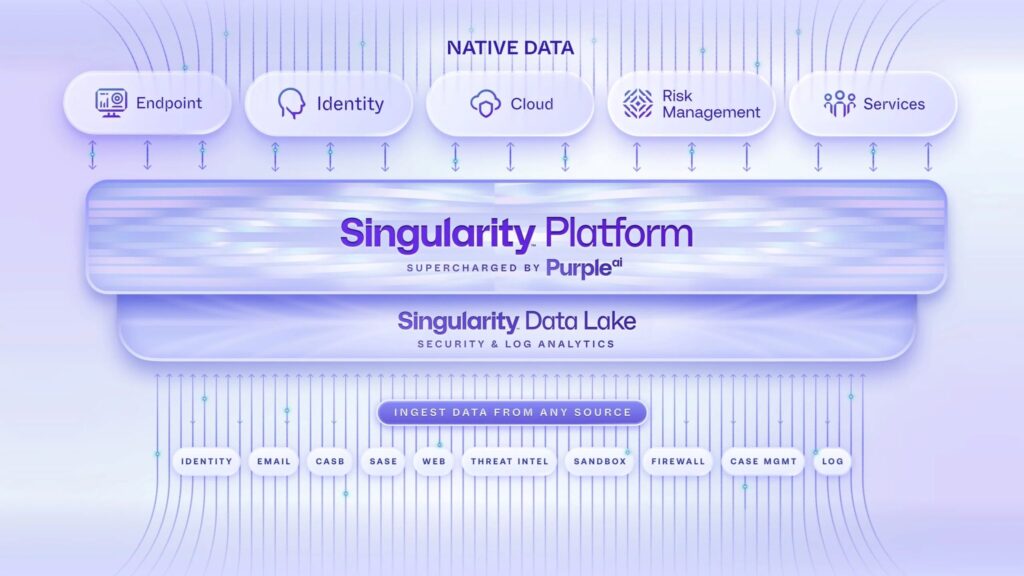
SentinelOne’s Singularity AI SIEM extends the company’s endpoint detection platform into full SIEM territory, offering a unified agent that handles both endpoint security and SIEM data collection. Purple AI provides natural-language investigation, allowing analysts to ask questions in plain English and receive contextualized responses with supporting evidence. The unified architecture eliminates the agent sprawl that plagues organizations running separate EDR and SIEM collection agents.
📋 Core Services
- Unified EDR-SIEM agent eliminating endpoint agent sprawl
- Purple AI for natural-language threat investigation and hunting
- Storyline technology that auto-correlates related events into attack narratives
- Cloud-native data lake with scalable third-party log ingestion
- Integrated threat intelligence and automated response actions
👥 Ideal Customer Profile
- Organizations already running SentinelOne for endpoint protection
- Security teams wanting to reduce agent count on endpoints
- Mid-market to enterprise companies attracted by AI-native investigation capabilities
💰 Commercial Model
Add-on to existing SentinelOne licensing. Custom pricing based on organizational scope and data ingestion volume.
⏰ When to Shortlist
Shortlist SentinelOne AI SIEM when you’re already a SentinelOne customer, when reducing endpoint agent sprawl is a priority, or when Purple AI’s natural-language investigation would meaningfully accelerate your SOC workflow.
11. Rapid7 InsightIDR: Best for Mid-Market Teams Seeking Built-in UEBA with SOAR
✅ Overview
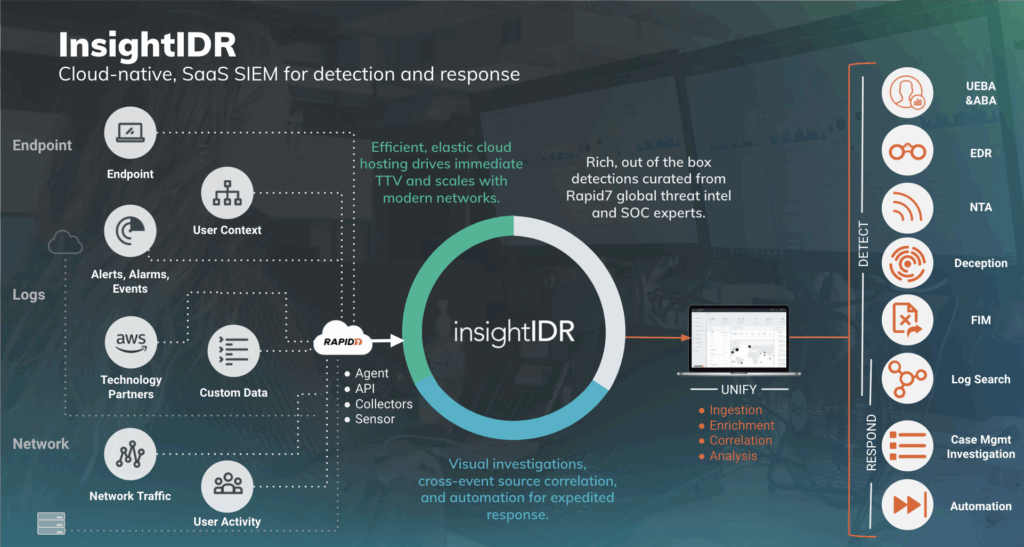
Rapid7 InsightIDR combines SIEM, UEBA, and SOAR capabilities in a single cloud-native platform, with unlimited data ingestion pricing based on monitored assets rather than data volume. This asset-based pricing model eliminates ingest anxiety and makes cost predictable as log volumes grow, a significant advantage for mid-market organizations where budgets are tightly controlled. The built-in SOAR via InsightConnect provides automation capabilities without purchasing a separate orchestration platform.
📋 Core Services
- Cloud-native SIEM with asset-based pricing (unlimited data ingestion)
- Built-in UEBA with automated user behavior baselining
- Embedded SOAR via InsightConnect for automated response playbooks
- Managed Detection & Response (MDR) services included in some tiers
- Deception technology (honey credentials, honey files) for early threat detection
👥 Ideal Customer Profile
- Mid-market organizations (100–1,000 employees) needing SIEM + UEBA + SOAR without purchasing three platforms
- Budget-conscious security teams wanting predictable asset-based pricing
- Companies that value included MDR services for off-hours coverage
💰 Commercial Model
Asset-based pricing with unlimited data ingestion. Pricing varies by number of monitored assets and service tier (InsightIDR, InsightIDR with MDR). Typically positioned as a mid-market-friendly investment.
⏰ When to Shortlist
Shortlist InsightIDR when you need SIEM + UEBA + SOAR in a single platform, when asset-based pricing (no ingest anxiety) is important, or when included MDR services would supplement your team’s off-hours coverage.
💬 Customer Reviews
Whilst the package is great for a business like ours, considering we are a small security team, we got a wide variety of various services from Rapid7 in a single license. However, it has made our work significantly more which is pretty annoying. The InsightVM product is supposed to give us a nice coverage for vulnerability management but it seems to have missing coverage for some major softwares, including Visual Studio and NVidia which is a massive drawback especially for a games development company. It asks for a lot of administrative efforts to achieve a simple task. It lacks some no-brainer automation options for many stuff that we currently have to do manually and there is limited options for integration to external tools/platforms which is also very disappointing.
— Himanshu K., IT Security Operations Engineer Rapid7 – G2 Verified Review
The pre-sales crew is great. Really make you think you’ll get high tier support. The scan engine doesn’t function. I’m unable to scan our IP ranges, and they’ve ignored requests to get this resolved. Please, please, please look into the competition. Look for reviews and gauge how post-sales support will be.
— Verified User in Farming, Mid-Market Rapid7 – G2 Verified Review
12. Stellar Cyber AI-Driven SIEM: Best for MSSPs and Lean SOC Teams Needing Multi-Tenant Automation
✅ Overview
Stellar Cyber provides an AI-driven Open XDR platform with native SIEM capabilities, purpose-built for multi-tenant environments. The platform’s flat, predictable pricing and multi-tenant architecture make it particularly attractive to MSSPs managing security for dozens or hundreds of clients, as well as lean enterprise SOC teams that need maximum automation with minimal analyst headcount. The AI Investigator feature allows natural-language queries for faster threat hunting and investigation.
📋 Core Services
- Multi-tenant architecture designed for MSSPs and distributed enterprises
- AI Investigator for natural-language threat queries and investigation
- Flat, predictable pricing decoupled from data volume
- Open XDR with native SIEM, NDR, and IDS capabilities combined
- Automated correlation and response across integrated data sources
👥 Ideal Customer Profile
- MSSPs managing multi-tenant security operations at scale
- Lean enterprise SOC teams (2–5 analysts) needing automation-first SIEM
- Organizations where flat, predictable pricing is a strategic requirement
💰 Commercial Model
Predictable flat pricing, not volume-based. Custom pricing based on organizational scope and tenant count. Positioned as cost-effective against Splunk and Sentinel for multi-tenant use cases.
⏰ When to Shortlist
Shortlist Stellar Cyber when you’re an MSSP needing multi-tenant SIEM operations, when your SOC team is lean and automation-first is a survival requirement, or when flat pricing would provide meaningful budget predictability.
🔒 The UnderDefense Close: Why Choosing the Right SIEM Is Only Half the Equation
Here’s the bottom line that every vendor comparison on this list misses: every SIEM platform above detects threats. Not one of them, by itself, investigates, verifies with the affected user, and contains the threat at 2 AM when your team is asleep. That’s the gap UnderDefense closes.
Choosing the right SIEM platform is maybe 20% of the equation. Operationalizing it 24/7 determines whether your investment delivers security outcomes or expensive log storage. We’ve deployed and managed Splunk, Sentinel, Elastic, QRadar, and others across 500+ client environments. The pattern is consistent: organizations buy SIEMs expecting security outcomes and get alert dashboards instead.
UnderDefense’s Managed SIEM service layers on top of any platform above, providing:
- ✅ Detection tuning that reduces customer-facing alerts by 99%, your team reviews confirmed incidents, not thousands of maybes
- ✅ Concierge analyst response with 2-minute alert-to-triage and 15-minute containment for critical incidents
- ✅ Compliance automation, forever-free kits for SOC 2, HIPAA, ISO 27001, and GDPR
- ✅ Vendor-agnostic integration with 250+ tools, preserving your SIEM investment
- ✅ Published pricing at $11–15/endpoint/month, no “contact sales” games
The real question isn’t “Which SIEM has the best ML models?” It’s “Who investigates when a critical alert fires at 2 AM?” UnderDefense maintains a 100% ransomware prevention record across 500+ clients over 6 years, because detection paired with human-driven containment is the only architecture that actually prevents breaches.
Q2. How Were These SIEM Platforms Evaluated? Selection Methodology and Star Ratings
Every SIEM comparison on page one of Google has the same problem: the vendor writing the article conveniently ranks their own product first. That wastes a security leader’s time. This evaluation uses a transparent, weighted methodology applied equally to all 12 platforms, with no self-promotion, no hidden criteria, and no conveniently omitted scores.
📊 Five Weighted Criteria (Total = 100%)
| Criterion | Weight | What Earns Top Marks |
|---|---|---|
| AI Detection & Threat Intelligence | 25% | ML behavioral analytics, UEBA, MITRE ATT&CK coverage, false positive reduction, threat intel integration |
| Integration Ecosystem & Deployment Flexibility | 20% | SOAR/XDR/EDR breadth, API quality, cloud-native/hybrid/on-prem options, vendor-agnostic telemetry ingestion |
| Pricing Transparency & TCO Predictability | 20% | Published pricing, predictable scaling model, no hidden costs, transparent overage policies |
| Compliance Automation & Reporting | 15% | SOC 2, HIPAA, PCI DSS 4.0, NIS2, DORA templates, auto evidence generation, audit-ready reporting |
| User Reviews & Analyst Recognition | 20% | G2/Gartner Peer Insights ratings, Gartner MQ/Forrester Wave positioning, customer retention signals |
These criteria reflect what actually determines SIEM success in production environments, not what looks good on a feature checklist.
⭐ Star Rating Scale
| Score Range | Star Rating |
|---|---|
| 0–20 | ⭐ |
| 21–40 | ⭐⭐ |
| 41–60 | ⭐⭐⭐ |
| 61–80 | ⭐⭐⭐⭐ |
| 81–100 | ⭐⭐⭐⭐⭐ |
📋 Vendor Composite Scores
| Platform | Composite Score | Star Rating |
|---|---|---|
| UnderDefense Managed SIEM + AI SOC | 95 | ⭐⭐⭐⭐⭐ |
| Microsoft Sentinel | 78 | ⭐⭐⭐⭐ |
| Palo Alto Cortex XSIAM | 77 | ⭐⭐⭐⭐ |
| Splunk Enterprise Security (Cisco) | 76 | ⭐⭐⭐⭐ |
| CrowdStrike Falcon Next-Gen SIEM | 74 | ⭐⭐⭐⭐ |
| SentinelOne Singularity AI SIEM | 69 | ⭐⭐⭐⭐ |
| Securonix Unified Defense SIEM | 59 | ⭐⭐⭐ |
| Exabeam Fusion SIEM | 58 | ⭐⭐⭐ |
| Stellar Cyber AI-Driven SIEM | 57 | ⭐⭐⭐ |
| Elastic Security | 56 | ⭐⭐⭐ |
| Rapid7 InsightIDR | 55 | ⭐⭐⭐ |
| IBM QRadar | 53 | ⭐⭐⭐ |
Scores were verified against vendor documentation, G2 Spring 2026 reviews, Gartner Peer Insights, and Gartner MQ/Forrester Wave 2025–2026 positioning data as of April 2026. Platform scores measure standalone SIEM capability; UnderDefense’s score reflects managed SIEM operational outcomes, the combination of platform + expert human operations delivering measurable security results.
Q3. What Is Modern SIEM and How Does It Compare to XDR, SOAR, and Log Management in 2026?
SIEM (Security Information and Event Management) is the centralized platform that collects, normalizes, correlates, and analyzes security events across your entire enterprise. But here’s the operational reality in 2026: the term “SIEM” now covers everything from traditional log aggregation engines to AI-native detection platforms with embedded SOAR, UEBA, and real-time threat intelligence. If you’re evaluating SIEM today using a 2020 mental model, you’re comparing apples to autonomous vehicles.
🔍 SIEM vs. XDR vs. SOAR vs. Log Management
| Dimension | SIEM | XDR | SOAR | Log Management | Security Data Lake |
|---|---|---|---|---|---|
| Primary Function | Centralized detection, correlation, and compliance reporting | Cross-layer threat detection and automated response | Orchestration and automation of incident response workflows | Log collection, storage, and search | Raw telemetry storage and analytics |
| Data Scope | Broadest: logs from any source (network, endpoint, cloud, identity, application) | Focused: vendor’s own telemetry + select third-party | Feeds from SIEM/XDR/EDR; doesn’t collect independently | All logs, including non-security | Structured and unstructured data at scale |
| Detection Method | Correlation rules, ML analytics, UEBA | Behavioral analytics across vendor’s stack | No native detection; automates response to alerts from other tools | Search and filter; limited detection | Custom analytics on raw data |
| Response Capability | Alert generation; response via SOAR integration | Built-in automated response actions | Primary purpose: executes playbooks and orchestrates tools | None | None |
| Best For | Compliance, broad visibility, multi-vendor environments | Consolidated detection-response in single-vendor ecosystems | Automating repetitive response tasks at scale | Retention, search, compliance archival | Advanced analytics teams with data engineering capacity |
⚠️ The Fragmentation Problem
Legacy SIEM deployments treat each security tool as a separate data source, generating parallel alert streams that require manual correlation. Traditional MSSPs layer monitoring on top without actionable intelligence. XDR solutions like CrowdStrike and Palo Alto promise convergence but create vendor lock-in: you get unified detection, but only across their ecosystem. ❌ Detection without response is noise. ❌ Response without context is risk. The gap between “alert generated” and “threat contained” is where breaches happen.
📈 Five 2026 SIEM Market Trends
The global SIEM market was valued at $9.61 billion in 2025, growing at a 12.16% CAGR through 2033. Cloud-native SIEM is the fastest-growing segment at a 25.9% CAGR per Gartner. Here are the five shifts reshaping how detection works:
- AI-Assisted Investigation & Natural Language Querying — Charlotte AI (CrowdStrike), Purple AI (SentinelOne), and Copilot for Security (Microsoft) let analysts query in plain English instead of learning SPL or KQL
- Autonomous Response with Automation Guardrails — SOAR-embedded workflows enabling automated containment with human approval gates for high-risk actions
- Data Pipeline Innovation — Hot/cold storage tiers and bring-your-own-data-lake architectures (Securonix + Snowflake) that decouple compute from storage costs
- XDR Convergence & Platform Consolidation — Cortex XSIAM, CrowdStrike Falcon, and Sentinel+Defender blur the SIEM-XDR boundary
- Multi-Tenant Architecture for MSSPs — Stellar Cyber and Elastic enable managed providers to operate hundreds of client environments from one console
✅ Where UnderDefense Fits
The UnderDefense MAXI platform sits as the vendor-agnostic intelligence layer above any SIEM/XDR combination, ingesting signals from Splunk, Sentinel, Elastic, CrowdStrike, Okta, and 250+ tools into a single context-aware detection and response engine. AI-driven enrichment handles log queries, threat correlation, and timeline construction; concierge analysts own the investigation and user verification that closes the gap between “alert” and “outcome.”
While a traditional SIEM tells you “suspicious login detected, please investigate,” UnderDefense tells you who logged in, confirms with the user directly via Slack or Teams, and contains the threat before your team wakes up, with documented response times 2 days faster than CrowdStrike OverWatch.
Q4. How Do SIEM Pricing Models Compare and What Is the True Total Cost of Ownership?
SIEM pricing is where most vendor evaluations fall apart. Every demo looks impressive; the invoice is where reality hits. The gap between “starting at $3/GB” and your actual annual bill can be 3–5× once you account for staffing, tuning, storage, and professional services. Here’s how to think about SIEM cost honestly.
💰 Pricing Model Taxonomy
| Platform | Pricing Driver | Published/Estimated Range | Notes |
|---|---|---|---|
| Splunk ES | Daily ingest volume (GB/day) | ~$150–$400/GB/day (ES premium) | ES adds 50–100% cost multiplier over base platform; 600 GB/day ≈ $1M/year |
| Microsoft Sentinel | Consumption per GB | $5.22/GB PAYG; ~$3.43/GB commitment tier | Free M365/Entra logs; overage reverts to PAYG rates |
| Cortex XSIAM | Platform licensing | Custom enterprise | Not volume-based; per-module/scope pricing |
| CrowdStrike Falcon SIEM | Ingestion tiers | 10 GB/day free + per-GB add-on | Add-on to existing Falcon licensing |
| Exabeam Fusion | Per-user fixed rate | 10 GB/day free tier | Decoupled from data volume |
| Elastic Security | Storage/compute | ~$0.09–$0.11/GB | Self-managed free tier available |
| Securonix | BYOS or managed | Custom | Snowflake bring-your-own-storage option |
| IBM QRadar | Events per second (EPS) | ~$10K+/year at 100 EPS | Traditional EPS model; cloud suite pricing varies |
| Rapid7 InsightIDR | Asset-based | Unlimited data ingestion | Per-asset pricing regardless of volume |
| SentinelOne AI SIEM | Per-endpoint + ingestion | Custom | Add-on to Singularity platform |
| Stellar Cyber | Flat predictable | Custom | Not volume-based; positioned as cost-effective |
| UnderDefense | Per-endpoint/month | $11–15/endpoint/month (published) | All-inclusive: 24/7 monitoring, detection tuning, response, compliance |
⚠️ The TCO Reality: Platform Licensing Is Only 30–40% of True Cost
Platform licensing gets all the attention during procurement, but it represents less than half of what SIEM actually costs in production. The full TCO equation:
- Licensing — 30–40% of total cost
- Analyst staffing — $150K–$250K/FTE × 5–7 FTEs for 24/7 coverage = $750K–$1.75M/year
- Detection tuning — Rules degrade within 90 days; continuous engineering required
- Storage/retention — Data retention surcharges, especially for compliance (12–36 months)
- Compliance tooling — $50K–$100K/year for separate GRC platforms
- Professional services — Custom rule creation, SIEM-to-SOAR connectors, integration engineering
Estimated TCO tiers: SMB: $80K–$200K/year | Mid-market: $200K–$600K/year | Enterprise: $600K–$2M+/year
💸 Hidden Cost Traps
- Data retention surcharges beyond standard retention windows
- Overage penalties during incident spikes (EPS/GB models), the worst time to pay more
- Premium support tiers required for production SLAs
- Compliance module add-ons not included in base licensing
- SIEM-to-SOAR connector licensing fees
- Analyst burnout and turnover costs (18-month average tenure in SOC roles)
✅ The UnderDefense Alternative
UnderDefense’s managed SIEM pricing is published at $11–15/endpoint/month, covering 24/7 monitoring, detection tuning, incident response, and compliance automation, replacing the $1–2M standalone operational cost that inflates SIEM TCO by 3–5×. One mid-market enterprise client reported that UnderDefense’s SIEM+SOC implementation helped avoid a potential $650K loss from a single incident that was detected and contained within 15 minutes, while their previous SIEM deployment had no one investigating alerts after hours. The 830% return on investment over 3 years is not theoretical. That is what happens when you stop paying for log storage and start paying for security outcomes.
Q5. How Should You Choose, Deploy, and Migrate to the Right SIEM Platform?
Choosing a SIEM means committing to a security architecture for the next 3 to 5 years. Most leaders pick by Gartner quadrant position or brand recognition and ignore the question that actually determines ROI: Can you staff and operationalize this platform 24/7, or will it become expensive log storage?
I have watched organizations spend six months evaluating detection rule libraries, only to discover 18 months later that nobody is awake at 2 AM to investigate what those rules surface. The SIEM selection problem is not a technology problem. It is an operations problem disguised as a procurement decision.
⚠️ The 10-Point Evaluation Framework
Score each criterion 0 to 2. A total of 14+ signals operational readiness; below 10 means you are buying log storage.
- Detection quality and false-positive control — Does it reduce noise, or just generate it?
- UEBA and behavioral analytics maturity — Pattern-based or true ML behavioral baselines?
- Automation and SOAR integration depth — Can you automate containment, or just alerting?
- Data architecture and ingestion model — Per-GB, per-EPS, flat-rate, or predictable cloud pricing?
- Compliance reporting by regulation — Pre-built templates for SOC 2, HIPAA, PCI DSS 4.0, NIS2, DORA, and ISO 27001?
- Deployment flexibility — Cloud-native, hybrid, or on-prem options that match your infrastructure?
- Integration breadth and API quality — How many of your existing tools connect natively?
- Scalability and data retention — Can it handle your log growth trajectory without cost explosions?
- MDR and managed services availability — Can you bolt on 24/7 human operations without ripping it out?
- Vendor support and onboarding quality — Days to value, not months to first alert?
📊 Deployment Architecture Comparison
| Deployment Model | Platforms | Best Fit |
|---|---|---|
| ☁️ Cloud-Native | Microsoft Sentinel, CrowdStrike LogScale, Stellar Cyber | Teams wanting speed-to-value, minimal infrastructure overhead |
| 🔄 Hybrid | Splunk, Elastic, Exabeam, Cortex XSIAM, Securonix | Organizations with mixed on-prem/cloud needing flexibility |
| 🏢 On-Prem | QRadar, Rapid7 InsightIDR (on-prem option) | Regulated industries with data residency constraints |
✅ Recommendations by Org Size and Vertical
- SMB (1 to 3 analysts): Stellar Cyber or Elastic, automation-first architecture for lean SOC teams
- Mid-market (4 to 10 analysts): Microsoft Sentinel or Exabeam, strong integration ecosystem plus compliance reporting
- Enterprise (10+ analysts): Splunk or Cortex XSIAM, deep customization, detection-as-code, and CI/CD workflows
- Healthcare (HIPAA): Sentinel or QRadar, pre-built compliance mappings
- Financial (PCI DSS/DORA): Splunk or Securonix, transaction monitoring and regulatory depth
- Government (FedRAMP): Microsoft Sentinel or Google SecOps, authorized cloud environments
- MSP/MSSP: Stellar Cyber or Elastic, multi-tenant architecture at scale
🔄 The Migration Playbook (5 Phases)
- Assessment and inventory — Catalog rules, dashboards, data sources, and custom integrations
- Parallel operation (4 to 8 weeks) — Run dual ingestion; validate the new platform catches what the old one does
- Rule translation — SPL→KQL, QRadar rules→YARA-L or Sentinel analytics (Microsoft now offers AI-powered migration tooling for both Splunk and QRadar)
- Data migration and historical retention — Decide what moves and what stays in cold storage
- Staged cutover by log source — 30 to 60 day decommission window per source
⏰ Timeline Estimates
Cloud-to-cloud migrations typically take 4 to 8 weeks. On-prem-to-cloud runs 3 to 6 months. Enterprise hybrid environments with heavy customization: 6 to 12 months.
Started out well but over the years the service has consistently not met expectations. Analysts provide little context, and when asked for more information nothing is ever provided or even communicated.
— CISO, Manufacturing Arctic Wolf – Gartner Verified Review
UnderDefense MAXI integrates well with our systems, specifically with our SIEM, Splunk. Their team is proactive in identifying and addressing threats, providing 24/7 oversight.
— Oleg K., Director Information Security UnderDefense – G2 Verified Review
Where UnderDefense Stands
We eliminate migration risk by providing 24/7 analyst coverage during parallel operation, custom detection rule translation, and 30-day turnkey onboarding. We log in to your SIEM, whether that is Splunk, Sentinel, Elastic, or whatever you run, because your business logic, your correlation rules, and your data should stay under your control. That philosophy has driven 100% ransomware prevention across 500+ clients: detection paired with human-driven containment outperforms any standalone platform.
Q6. Need Help Operationalizing Your SIEM Investment? Get a Vendor-Neutral Security Assessment
The right SIEM platform depends on your deployment environment, compliance mandates, existing security stack, SOC team size, and whether you need detection-only or detection-plus-response. Most organizations underestimate the operational burden: the real cost is not the SIEM license but the analyst hours tuning rules, triaging alerts, and investigating incidents 24/7. Running SIEM in-house typically costs $400K to $1M+ per year when you factor infrastructure, data engineering, detection tuning, monitoring, and compliance reporting.
💰 Selection Criteria That Actually Matter
Before signing a multi-year SIEM contract, pressure-test these five dimensions:
- AI detection quality and MITRE ATT&CK coverage depth — Does it detect based on behaviors, or just pattern-match known signatures?
- Pricing model fit for your data growth trajectory — Per-GB, per-EPS, or capacity-based? Splunk’s per-GB model punishes cloud-heavy environments; Sentinel’s capacity reservations reward predictability.
- Integration with existing EDR/identity/cloud stack — If your SIEM cannot talk to your EDR and identity provider natively, you are building custom integrations forever.
- Compliance automation for your regulatory frameworks — Pre-built SOC 2, HIPAA, PCI DSS 4.0, and NIS2 report templates save 100+ analyst hours per audit cycle.
- Operational staffing requirements — Self-managed SIEM demands 5 to 7 FTEs minimum for 24/7 coverage. Managed SIEM collapses that to a monthly per-endpoint fee.
🔍 The Gap Between Choosing and Operationalizing
Whether you are replacing a legacy SIEM or optimizing your current deployment, the gap between choosing a platform and operationalizing it determines ROI. We have seen this pattern across hundreds of engagements: organizations invest six figures in SIEM licensing, then spend another six figures in unexpected professional services, rule tuning, and alert backlog management just to reach baseline operational readiness.
UnderDefense’s vendor-neutral assessment evaluates your current SIEM posture, maps detection gaps, and models true TCO, including the hidden staffing costs most vendors do not discuss.
This analysis is based on documented deployment outcomes, G2 Spring 2026 rankings, published vendor pricing, Gartner MQ/Forrester Wave positioning, and operational experience across 500+ managed security environments.
Q7. Frequently Asked Questions About SIEM Solutions in 2026
What is SIEM and how does it work?
SIEM (Security Information and Event Management) collects, correlates, and analyzes security event data from across your IT environment to detect threats in real time. Modern SIEM platforms use AI/ML behavioral analytics that go beyond traditional rule-based correlation, identifying anomalies based on user and entity behavior rather than static signatures alone.
How do you reduce SIEM alert fatigue?
Custom detection tuning, UEBA behavioral baselines, ML-driven alert grouping, and managed SIEM services that filter noise before it reaches your team. We reduce customer-facing alerts by 99% through integration with employees via Slack, Teams, and the tools they already use, so your analysts review confirmed incidents, not thousands of maybes.
⭐ Can SIEM work for understaffed SOC teams?
Yes. Automation-first platforms like Stellar Cyber and Rapid7 reduce the manual workload significantly. Managed SIEM services eliminate the need for 5 to 7 FTE analysts entirely. UnderDefense provides full 24/7 operations at $11 to $15/endpoint/month, replacing $400K to $1M in standalone operational costs with a predictable monthly fee.
What is the difference between SIEM and XDR?
SIEM aggregates logs from all sources for broad visibility across your entire environment. XDR correlates endpoint, network, and cloud telemetry for integrated detection and response within a vendor’s ecosystem. In 2026, these categories are converging: Cortex XSIAM, CrowdStrike Falcon LogScale, and Microsoft Sentinel+Defender all blur the line between traditional SIEM and XDR.
✅ Which compliance frameworks require SIEM?
SOC 2 Type II, HIPAA, PCI DSS 4.0, NIS2, DORA, and ISO 27001 all require or strongly recommend centralized log management and continuous security monitoring that SIEM provides. Without it, you are assembling compliance evidence manually, a process that does not scale and does not survive auditor scrutiny.
⏰ How long does SIEM deployment take?
- Cloud-native SIEM: 2 to 4 weeks to initial operational state
- Hybrid deployments: 4 to 8 weeks including parallel-run validation
- Enterprise migrations from legacy on-prem: 3 to 6 months including rule translation and staged cutover
What is the future of SIEM?
SIEM is converging with XDR into unified security operations platforms. AI-native detection is replacing rule-based correlation as the primary detection method. Managed SIEM services are becoming the dominant operational model for organizations that cannot staff 24/7 SOCs internally, because the talent shortage and the cost of retention make full in-house teams impractical for most mid-market companies.
💸 How much does managed SIEM cost vs. self-managed?
| Model | Annual TCO Range | What’s Included |
|---|---|---|
| Self-Managed SIEM | $400K to $1M+/year | Platform + 5 to 7 FTEs + tuning + compliance reporting |
| Hybrid SIEM (Internal + External SOC) | $200K to $600K/year | Platform ownership + outsourced monitoring |
| Fully Managed SIEM | $60K to $180K/year | Platform + operations + 24/7 analyst coverage |
UnderDefense’s managed model replaces $400K to $1M in standalone operational costs at $11 to $15/endpoint/month, covering 24/7 monitoring, detection tuning, incident response, and compliance reporting. The math works because you get a dedicated team without the hiring, training, burnout, and turnover overhead that makes in-house SOCs so expensive to sustain.
1. How do you compare the top SIEM solutions for enterprise security in 2026?
We evaluated 12 SIEM platforms across five weighted criteria: AI detection and threat intelligence (25%), integration ecosystem and deployment flexibility (20%), pricing transparency and TCO predictability (20%), compliance automation and reporting (15%), and user reviews and analyst recognition (20%). Each platform received a composite score and star rating based on documented deployment outcomes, G2 Spring 2026 reviews, Gartner Peer Insights, and Forrester Wave positioning data as of April 2026.
The platforms we assessed include Splunk Enterprise Security, Microsoft Sentinel, Palo Alto Cortex XSIAM, CrowdStrike Falcon Next-Gen SIEM, Exabeam Fusion, Elastic Security, Securonix, IBM QRadar, SentinelOne Singularity AI SIEM, Rapid7 InsightIDR, and Stellar Cyber. Each platform has distinct strengths depending on your deployment environment, compliance mandates, and SOC team size.
What most comparisons miss is the operational gap. A SIEM platform that scores well on detection features still requires 5 to 7 FTEs for 24/7 coverage. Our managed SIEM service layers on top of any platform to close that gap, so your investment delivers security outcomes rather than expensive log storage.
2. What is the true total cost of ownership for a SIEM platform?
Platform licensing represents only 30 to 40% of what SIEM actually costs in production. The full TCO equation includes analyst staffing ($150K to $250K per FTE, with 5 to 7 FTEs needed for 24/7 coverage), detection tuning (rules degrade within 90 days and require continuous engineering), storage and retention surcharges (especially for 12 to 36 month compliance windows), compliance tooling ($50K to $100K/year for separate GRC platforms), and professional services for custom rule creation and SOAR connectors.
Estimated TCO tiers break down as follows: SMB at $80K to $200K/year, mid-market at $200K to $600K/year, and enterprise at $600K to $2M/year. Hidden cost traps include overage penalties during incident spikes, premium support tiers required for production SLAs, and analyst burnout with an 18-month average tenure in SOC roles.
Use our SOC cost calculator to model your actual SIEM operational cost, including the staffing burden most vendors do not disclose during procurement.
3. What is the difference between SIEM, XDR, SOAR, and log management?
SIEM collects and correlates logs from all sources (network, endpoint, cloud, identity, application) for broad visibility and compliance reporting. XDR focuses on cross-layer detection and automated response within a single vendor’s ecosystem. SOAR orchestrates and automates incident response workflows but does not collect data independently. Log management handles raw log collection, storage, and search without detection capabilities.
In 2026, these categories are converging. Platforms like Cortex XSIAM, CrowdStrike Falcon LogScale, and Microsoft Sentinel+Defender blur the line between traditional SIEM and XDR. The fragmentation problem persists, however. Detection without response is noise, and response without context is risk.
We bridge this gap through our UnderDefense MAXI platform, which sits as a vendor-agnostic intelligence layer above any SIEM/XDR combination, ingesting signals from Splunk, Sentinel, Elastic, CrowdStrike, Okta, and 250+ tools into a single detection and response engine.
4. Which SIEM platform is best for compliance with SOC 2, HIPAA, and PCI DSS?
SOC 2 Type II, HIPAA, PCI DSS 4.0, NIS2, DORA, and ISO 27001 all require or strongly recommend centralized log management and continuous security monitoring. The platforms with the deepest pre-built compliance capabilities include IBM QRadar (SOX, HIPAA, PCI DSS, GDPR), Microsoft Sentinel (SOC 2, HIPAA, PCI DSS, GDPR, CCPA), and Splunk Enterprise Security (SOC 2, HIPAA, PCI DSS, GDPR, SOX).
For healthcare organizations requiring HIPAA compliance, we recommend Sentinel or QRadar for their pre-built compliance mappings. For financial services requiring PCI DSS and DORA compliance, Splunk or Securonix provide transaction monitoring and regulatory depth.
Regardless of platform, pre-built compliance templates save 100+ analyst hours per audit cycle. Our compliance services include forever-free kits for SOC 2, HIPAA, ISO 27001, and GDPR, with automated evidence collection and audit-ready reporting layered on top of whichever SIEM you run.
4. How long does it take to deploy or migrate a SIEM platform?
Deployment timelines vary significantly by architecture. Cloud-native SIEM deployments (Microsoft Sentinel, CrowdStrike LogScale, Stellar Cyber) typically reach initial operational state in 2 to 4 weeks. Hybrid deployments (Splunk, Elastic, Exabeam) take 4 to 8 weeks including parallel-run validation. Enterprise migrations from legacy on-prem platforms (QRadar to Sentinel, for example) require 3 to 6 months including rule translation and staged cutover. Enterprise hybrid environments with heavy customization can take 6 to 12 months.
We recommend a five-phase migration playbook: assessment and inventory, parallel operation (4 to 8 weeks of dual ingestion), rule translation (SPL→KQL, QRadar rules→YARA-L), data migration and historical retention decisions, and staged cutover by log source with a 30 to 60 day decommission window.
We provide 24/7 analyst coverage during parallel operation, custom detection rule translation, and 30-day turnkey onboarding to eliminate migration risk entirely.
5. How long does it take to deploy or migrate a SIEM platform?
Deployment timelines vary significantly by architecture. Cloud-native SIEM deployments (Microsoft Sentinel, CrowdStrike LogScale, Stellar Cyber) typically reach initial operational state in 2 to 4 weeks. Hybrid deployments (Splunk, Elastic, Exabeam) take 4 to 8 weeks including parallel-run validation. Enterprise migrations from legacy on-prem platforms (QRadar to Sentinel, for example) require 3 to 6 months including rule translation and staged cutover. Enterprise hybrid environments with heavy customization can take 6 to 12 months.
We recommend a five-phase migration playbook: assessment and inventory, parallel operation (4 to 8 weeks of dual ingestion), rule translation (SPL→KQL, QRadar rules→YARA-L), data migration and historical retention decisions, and staged cutover by log source with a 30 to 60 day decommission window.
We provide 24/7 analyst coverage during parallel operation, custom detection rule translation, and 30-day turnkey onboarding to eliminate migration risk entirely.
6. Can a SIEM platform work effectively for understaffed SOC teams?
Yes, but platform selection and operational model matter enormously. Automation-first platforms like Stellar Cyber and Rapid7 InsightIDR reduce manual workload through built-in SOAR, UEBA, and multi-tenant architecture designed for lean teams. Elastic Security offers cost-transparent pricing that works for smaller budgets. Self-managed SIEM still demands 5 to 7 FTEs minimum for 24/7 coverage, a staffing requirement that most mid-market organizations cannot meet.
Managed SIEM services eliminate that staffing burden entirely. We provide full 24/7 SOC operations at $11 to $15/endpoint/month, replacing $400K to $1M in standalone operational costs with a predictable monthly fee. Our AI SOC Human Ally model automates context collection, log queries, and threat enrichment while human analysts make the decisions, verify with affected users, and contain threats.
We reduce customer-facing alerts by 99% through detection tuning and ChatOps-driven incident response via Slack and Teams, so your analysts review confirmed incidents rather than thousands of unfiltered alerts.
7. How do SIEM pricing models differ across platforms like Splunk, Sentinel, and Elastic?
SIEM pricing models fall into five categories, and each creates different financial dynamics as your environment scales:
-
Per-GB ingestion (Splunk): $150 to $400+/GB/day with Enterprise Security adding a 50 to 100% cost multiplier. Punishes cloud-heavy environments with high log volumes.
-
Consumption-based (Microsoft Sentinel): $5.22/GB pay-as-you-go or $3.43/GB at 100 GB/day commitment tiers. Free M365/Entra logs make it cost-effective for Microsoft-centric shops.
-
Storage-based (Elastic Security): $0.09 to $0.11/GB with a self-managed free tier. The most cost-transparent model available.
-
Per-user fixed rate (Exabeam): Decoupled from data volume with a 10 GB/day free tier.
-
Flat predictable (Stellar Cyber, Cortex XSIAM): Not volume-based, providing budget predictability.
The critical insight is that platform licensing is only 30 to 40% of true SIEM cost. Use our managed SIEM pricing guide to model total cost including staffing, tuning, and compliance overhead.
8. What should you look for in a 10-point SIEM evaluation framework?
We recommend scoring each criterion on a 0 to 2 scale across ten dimensions. A total of 14+ signals operational readiness; below 10 means you are buying log storage:
-
Detection quality and false-positive control
-
UEBA and behavioral analytics maturity
-
Automation and SOAR integration depth
-
Data architecture and ingestion model
-
Compliance reporting by regulation (SOC 2, HIPAA, PCI DSS 4.0, NIS2, DORA, ISO 27001)
-
Deployment flexibility (cloud-native, hybrid, on-prem)
-
Integration breadth and API quality
-
Scalability and data retention capacity
-
MDR and managed services availability
-
Vendor support and onboarding quality
Most organizations focus exclusively on detection rule libraries during evaluation, only to discover 18 months later that nobody is awake at 2 AM to investigate what those rules surface. Read our complete SIEM selection guide for the full methodology, including deployment architecture comparison tables and vertical-specific recommendations by org size.