




Q1: What Is an AI SOC and Why Are Traditional SOCs Failing in 2026?
Every enterprise I walk into runs somewhere between 25 and 75 security tools, and somehow the SOC still drowns. Analysts face nearly 3,000 alerts per day on average, 63% of which go completely unaddressed. Alert fatigue is now the top challenge for 76% of organizations, analyst burnout and staffing shortages follow closely at 73%, and 64% of SOCs still rely on “heavily manual” detection, triage, and investigation processes. The terminology does not help either: everyone from vendor marketers to analysts throws around “AI SOC” like it means one thing. It does not.
The Terminology Spectrum: What “AI SOC” Actually Means
An AI SOC is a security operations architecture where artificial intelligence handles enrichment, correlation, triage, and investigation at machine speed, while humans retain decision authority for containment, strategy, and anything that requires organizational context. But “AI SOC” sits on a maturity spectrum that matters:
- AI-Powered SOC: bolt-on AI tools layered onto legacy SIEM infrastructure
- AI-Augmented SOC: integrated AI triage with mandatory human validation on every action
- AI-Native SOC: purpose-built from the ground up with agentic architecture
- Autonomous SOC: AI handles end-to-end with human oversight only on strategic decisions
- Cognitive SOC: self-learning system that improves from every incident across its customer base
These are maturity levels, not marketing labels. Confusing them is how companies buy the wrong thing.
Why the Traditional SOC Pyramid Is Collapsing
The Tier-1/2/3 analyst pyramid was designed for human-speed, human-scale operations. In 2026, it is structurally broken. The global cybersecurity workforce gap stands at 4.8 million professionals, with 59% of teams reporting critical skills gaps. Alert volumes keep climbing: 77% of organizations saw increases this year, and 46% experienced spikes exceeding 25%. Meanwhile, the average cost of a U.S. data breach hit $10.22 million in 2025, a 9% jump year-over-year. Traditional MDR providers operate as opaque alert factories: they escalate without context and leave you to investigate. Legacy MSSPs deliver monitoring without intelligence, offering checkbox coverage based on rigid playbooks that have not evolved since 2019.
The AI SOC + Human Ally Model
Here is the principle we operate by at UnderDefense: detection without response is noise; response without context is risk. The competitive advantage is not having security tools but having a system that can reason across them. The AI SOC + Human Ally model is the synthesis: AI handles machine-speed enrichment, correlation, behavioral analytics, and structured investigation at 24/7 scale, while humans provide organizational context, judgment on ambiguous threats, and business-critical decision authority.
Why We Built Under Defence MAXI for This Exact Problem
Under Defence MAXI is purpose-built for this transformation: agentic AI that automates investigation grunt work (context collection, log enrichment, multi-system correlation), ChatOps user verification via Slack/Teams/Email, and vendor-agnostic integration with 250+ existing tools without forcing stack replacement. Every investigative step is observable and auditable, with no black boxes and no hidden automation. Detection Logic as Code means Python-based rules, versioned, unit-tested, and deployed via CI/CD. Available on-prem or in customer-specific cloud environments.
“The biggest win for me was getting actual control over our security alerts. Before the guys from UD stepped in, we were getting bombarded with alerts from all our security tools. Their team cleaned up our configurations and got the noise under control within the first week.”
— Verified User, Marketing and Advertising UnderDefense G2 – Verified Review
⚠️ The Cost of Standing Still
The cost of maintaining a traditional SOC is not just $2-3M annually but the $4.44M global average breach cost when that SOC misses the threat it was built to catch. Organizations implementing AI-augmented SOC operations report 40-90% reductions in mean time to detect and 50-80% reductions in mean time to respond. We see it with our own clients: 2-minute alert-to-triage, 15-minute escalation for critical incidents, zero ransomware cases across 500+ MDR customers over six years, because the real cost of inaction is measured in breaches, not budgets.
Q2: What Are the 5 Maturity Levels of an AI SOC?
Most AI SOC projects fail because teams try to boil the ocean on day one. A phased maturity approach prevents the exact failure pattern I have seen derail dozens of security programs: leadership buys “AI for the SOC,” nobody defines what that means operationally, and six months later the whole thing gets shelved.
The framework below draws on NIST CSF, SOC-CMM, and real-world implementation patterns across hundreds of environments. Unlike those theoretical frameworks, this one maps directly to metrics, team structures, and technology requirements you can act on today.
Maturity Overview Table
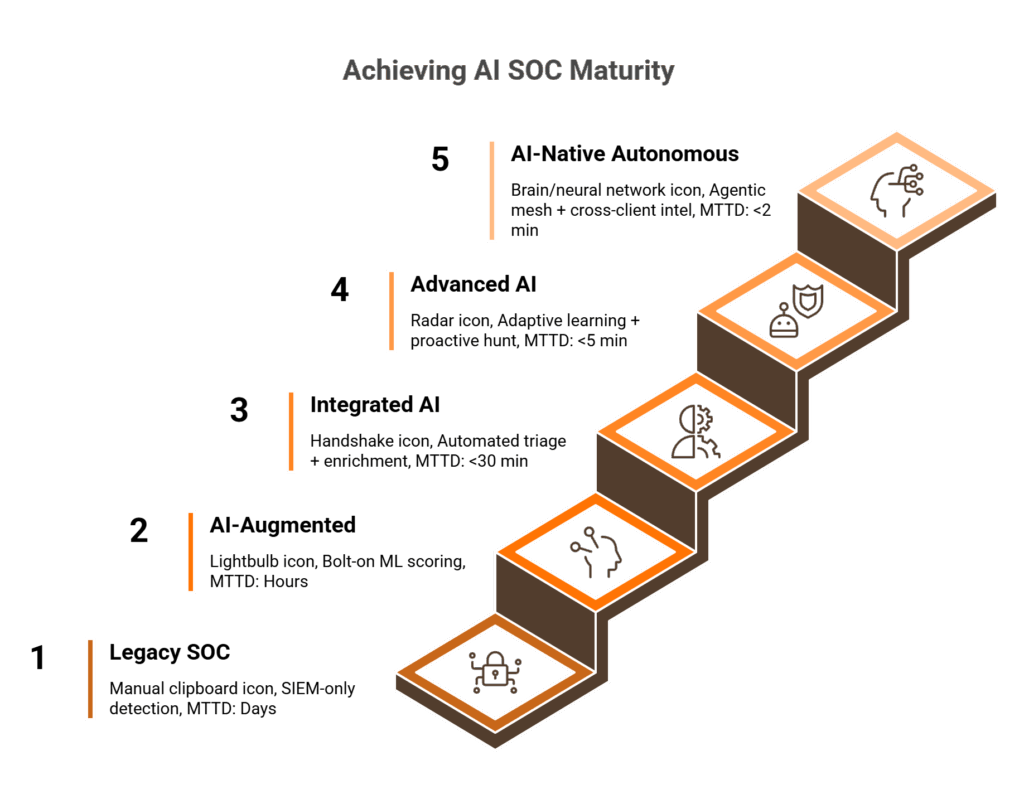
| Level | Detection Method | Response Model | AI Role | Human Role | Key Metric (MTTD) | Typical Timeline |
|---|---|---|---|---|---|---|
| 0 — Legacy SOC | Manual, SIEM-only | Tier-1/2/3 pyramid | None | All investigation | Days | Current state |
| 1 — AI-Augmented | Bolt-on ML scoring | Humans drive all work | Helpful assistant | Validates everything | Hours | 1-3 months |
| 2 — Integrated AI | Automated triage + enrichment | Shadow mode with graduation | Co-pilot | Reviews AI recommendations | <30 min | 3-6 months |
| 3 — Advanced AI | Adaptive learning, proactive hunt | Partial auto-containment | Decision-maker (low-risk) | Complex investigation + strategy | <5 min | 6-12 months |
| 4 — AI-Native Autonomous | Agentic mesh, cross-client intel | Full autonomy, human oversight | Orchestrator | Strategic decisions only | <2 min | 12-18 months |
Levels 0-2: Where Most Organizations Sit Today
Level 0 (Legacy SOC): Manual triage, SIEM-only detection, 90%+ false-positive rates, MTTD measured in days. No AI integration whatsoever. If your analysts spend most of their time copy-pasting between tools, you are here.
Level 1 (AI-Augmented): You have added ML-based alert scoring or basic automated enrichment, but humans still drive every investigation. MTTD drops to hours, and false-positive rates sit around 60-80%. AI is a “helpful assistant” with zero decision authority.
Level 2 (Integrated AI): AI handles automated triage, enrichment, and initial investigation for defined alert classes. The critical requirement here is shadow mode with graduation criteria: AI concordance rate >90% with human decisions over a 30-60 day window before autonomy is granted. The detection-as-code pipeline begins here.
Levels 3-4: Where the Force Multiplication Happens
Level 3 (Advanced AI): Adaptive learning from every incident; proactive threat hunting driven by AI-identified anomalies; automated containment for approved low-risk threat classes (known-bad IP blocks, credential revocation). Detection-as-code CI/CD with automated purple team validation. MTTD drops below 5 minutes, and MTTR falls under 15 minutes for critical incidents. Human focus shifts entirely to complex investigation and strategy.
Level 4 (AI-Native Autonomous): Agentic AI architecture with specialized agent mesh; autonomous investigation and response for all threat classes with human oversight only on strategic decisions; continuous self-improvement through cross-client threat intelligence; CMDB integration for business-context-aware decisions. Force multiplication: 10x+ per analyst.
✅ Self-Assessment: 7 Diagnostic Questions
Score each question 0-2 to determine your current maturity level:
- What percentage of alerts are automatically triaged without human involvement?
- Can your SOC contain a critical threat within 30 minutes of detection?
- Are detection rules version-controlled and deployed via CI/CD?
- Does your AI correlate across identity, endpoint, cloud, network, and SaaS simultaneously?
- Can your system verify suspicious user activity directly via Slack/Teams without analyst intervention?
- What is your AI decision accuracy rate versus expert analyst baseline?
- Does your SOC generate compliance evidence automatically?
Score interpretation: 0-4 = Level 0-1 | 5-8 = Level 2 | 9-11 = Level 3 | 12-14 = Level 4
How UnderDefense Compresses the Journey
UnderDefense’s Under Defence MAXI platform moves organizations from Level 0-1 to Level 3 within 30 days of onboarding, because the maturity journey should not take 18 months when your threat landscape evolves every 18 hours. Our agentic AI handles Level 2-3 automation from Day 1, while the concierge analyst team provides the human judgment layer that Level 4 requires.
“UnderDefense is a great choice for teams like ours that are short on resources. It automates many tasks, plus, with 24/7 monitoring, we know we’re always protected. The platform seamlessly integrates our existing security tools, simplifying management.”
— Inga M., CEO UnderDefense G2 – Verified Review
Q3: What Does an AI SOC Reference Architecture Look Like?
Architecture is where AI SOC projects either scale or stall. I have seen teams pick a shiny AI vendor, skip the integration architecture conversation, and end up with another silo that generates its own alert stream. The reference architecture below represents what actually works in production: six layers, each with a specific job, all connected through a vendor-agnostic data fabric that the customer owns.
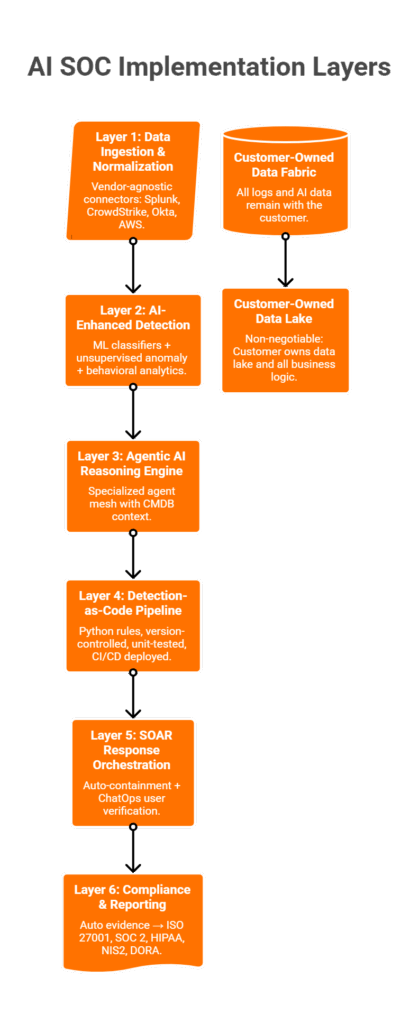
Layer 1: Data Ingestion and Normalization
Vendor-agnostic connectors for SIEM (Splunk, Elastic, Microsoft Sentinel, Chronicle), EDR (CrowdStrike, SentinelOne, Microsoft Defender), identity providers (Okta, Entra ID), cloud platforms (AWS CloudTrail, Azure Monitor, GCP Security Command Center), network (NDR, firewall, WAF), and SaaS applications. The non-negotiable principle: the customer owns their data lake and all business logic. As one CISO I work with put it during a recent podcast: “I look for an MDR partner that will access the data where it lives, and I want to control where that data lives.” When you switch vendors, your correlation rules, automation logic, and institutional knowledge stay with you.
Layer 2: AI-Enhanced Detection
Three engines working in concert: ML classifiers for known threat patterns, unsupervised models for anomaly detection, and User and Entity Behavior Analytics (UEBA) for insider threat identification. UEBA establishes behavioral baselines per user and entity, then flags deviations, including impossible login patterns, unusual data access volumes, and privilege escalation sequences. This is where “alert volume” transforms into “signal quality.” The 2025 Pulse of the AI SOC Report found that 88% of organizations saw increased alert volume, but the solution is not fewer alerts. It is better correlation.
Layers 3-4: Agentic Reasoning and Detection-as-Code
Layer 3 (Agentic AI Reasoning Engine): Specialized agent mesh where each agent handles a domain, including endpoint, identity, cloud, and network. Agents collaborate to perform automated enrichment, multi-source correlation, and structured investigation report generation in seconds. Institutional knowledge repository (CMDB integration) provides organizational context: who owns what asset, which users are VIPs, and what is business-critical.
Layer 4 (Detection-as-Code Pipeline): Python-based detection rules version-controlled via Git, unit-tested against known attack samples, and deployed via CI/CD with automated rollback. This is the governance layer that enables AI-driven SOCs to confidently use AI in production without “trust me, it works” as the only assurance.
Layers 5-6: Orchestration and Compliance
Layer 5 (SOAR + Response): Automated containment workflows for approved threat classes, including credential revocation, endpoint isolation, network segmentation, and malicious IP blocking. ChatOps user verification integration via Slack, Teams, Email, and SMS for direct user confirmation. Every analyst decision (confirm, dismiss, modify) feeds back into model retraining. Context-aware analysis correlates threat indicators with business impact: a compromised admin credential on a production server gets triaged differently than a failed login on a test environment.
Layer 6 (Compliance and Reporting): Automated evidence collection, continuous control validation, real-time mapping to ISO 27001, SOC 2, HIPAA, PCI-DSS, NIS2, and DORA, with audit-ready report generation.
🔗 How It All Connects
Key integration points that make this architecture work as a system:
- SIEM ↔ Detection Engine: bidirectional; AI reads logs, writes enriched alerts back
- EDR ↔ Response Orchestration: containment commands via API
- Identity Provider ↔ UEBA: behavioral baselines
- CMDB ↔ Context Engine: business impact correlation
- Ticketing System ↔ Case Management: automated ticket creation and closure
Under Defence MAXI implements this entire reference architecture as a turnkey platform, connecting 250+ tools into a single context-aware layer while keeping all logs and AI data in the customer’s data lake. Every investigative step is observable and auditable. Available on-prem or in customer-specific cloud environments (Azure, GCP, AWS, Oracle).
“Started out well but over the years the service has consistently not met expectations. The issues that we have experienced has greatly outweighed the benefits. Log collectors show working, however when asked to provide logs for an investigation no logs could be provided. Analysts provide little context, and when asked for more information in the investigation nothing is ever provided or even communicated.”
— CISO, Manufacturing ($3B-$10B) Arctic Wolf – Gartner Peer Review
Q4: How Do You Build a Phased AI SOC Implementation Roadmap?
The number one reason AI SOC implementations fail is not technology but skipping the baseline. If you cannot prove what your MTTD and MTTR were before AI, you will never justify the ROI to your board afterward. Here is the four-phase roadmap we use with every UnderDefense client, compressed from what typically takes 12-18 months DIY into a timeline that reaches operational AI in 30 days.
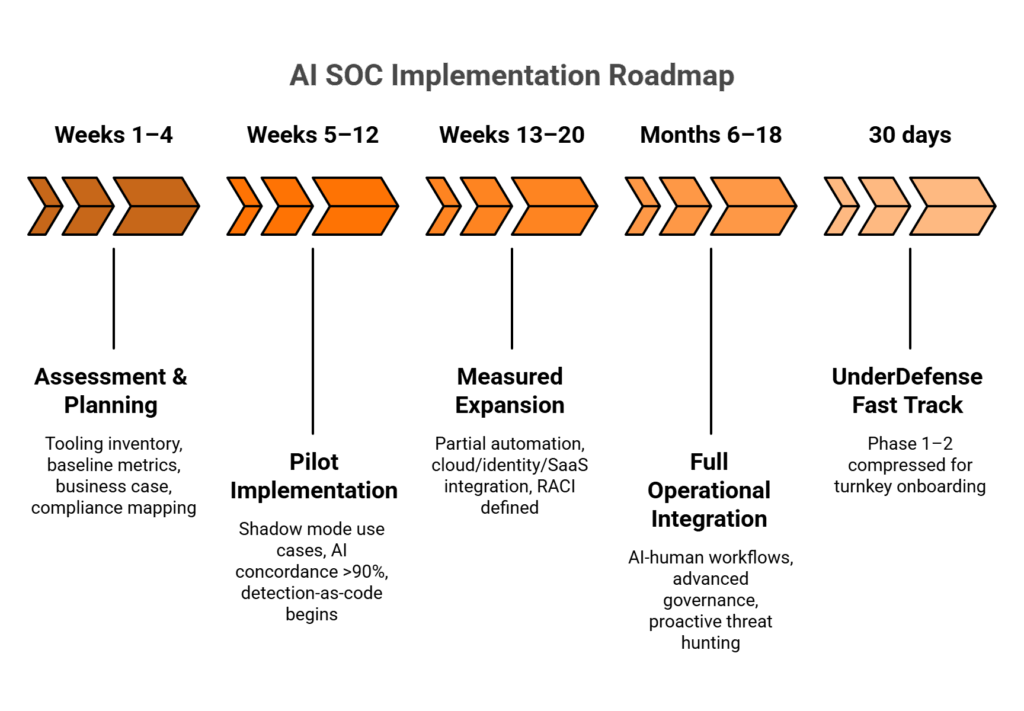
Phase 1: Assessment and Planning (Weeks 1-4)
This phase is non-negotiable, and skipping it is the single most common anti-pattern I see:
- Tooling inventory and gap analysis: catalog every security tool, integration point, and process bottleneck
- High-value use case identification: use an impact-to-effort matrix; start with high-volume, low-complexity alert classes (failed login triage, known-bad IP blocking, phishing classification)
- Baseline metric capture: MTTD, MTTR, false-positive rate, alert volume, automation rate, analyst time allocation per task category. Without baselines, ROI is unprovable
- Business case construction: quantify cost of inaction using breach probability × breach cost. The average U.S. breach cost hit $10.22M in 2025
- Compliance mapping: align implementation timeline against NIS2, DORA (operational since Jan 2025), CIRCIA (72-hour reporting), and SEC (4-day materiality disclosure)
- Success criteria definition: KPI targets for each subsequent phase
Phase 2: Pilot Implementation (Weeks 5-12)
⏰ This is where shadow mode earns its keep:
- Select 2-3 pilot use cases with highest impact-to-effort ratio
- Deploy AI in monitor-only (shadow) mode: AI runs parallel to human analysts, generating recommendations without autonomous action. Define graduation criteria upfront: AI concordance rate >90% with human decisions over a 30-60 day window
- Run parallel operations: side-by-side MTTD/MTTR comparison between AI-assisted and human-only workflows
- Collect structured analyst feedback through weekly retrospectives: what AI got right, what it missed, what frustrated analysts
- Launch change management: frame AI as “force multiplier,” not “replacement.” As one guest CISO shared on our podcast: “I found I just can’t automate everything… Got to have humans, and it can’t just be automation technologies. Got to have both to get to a resilient solution”
- Begin detection-as-code migration: convert top 20 detection rules to version-controlled Python, establish Git repository
Phase 3: Measured Expansion (Weeks 13-20)
Graduate from shadow to action, carefully:
- Expand AI across additional use cases based on Phase 2 data: graduate from monitor-only to partial automation for low-risk response actions (auto-block known-malicious IPs, auto-quarantine confirmed malware)
- Integrate additional telemetry: cloud logs, identity signals, SaaS applications, network traffic; normalize into unified schema
- Define clear RACI per alert class: AI decides vs. AI recommends vs. human decides
- Launch bi-weekly detection engineering sprints: new rules deployed, tested, and monitored every two weeks
- Communicate wins internally: share MTTD/MTTR improvements, false-positive reduction data, and analyst time savings with leadership. This builds the organizational support you will need for Phase 4
Phase 4: Full Operational Integration (Months 6-18)
This is where the force multiplication becomes measurable:
- Transition from parallel to fully integrated AI-human workflows: AI handles end-to-end triage, enrichment, and investigation; analysts focus on complex threats and strategy
- Deploy advanced governance: AI decision audit trails, confidence thresholds for autonomous action, mandatory human review triggers, automated bias detection
- Enable full response automation: credential revocation, endpoint isolation, ChatOps user verification for behavioral alerts
- Activate proactive threat hunting: AI identifies patterns across historical incidents to surface emerging threats
- Complete SOC team role transition from reactive triage to strategic security work
- Establish continuous improvement cycle: quarterly AI accuracy audits, purple team exercises, model retraining
✅ Target metrics at Phase 4 completion: MTTD <2 min, MTTR <15 min critical, 99%+ false-positive reduction, 96%+ MITRE ATT&CK coverage.
How UnderDefense Compresses This Timeline
UnderDefense compresses Phase 1-2 into a 30-day turnkey onboarding, including security hardening, custom detection tuning with 30 days of dedicated configuration, and ransomware simulation testing. Organizations reach Phase 3 augmented operations months ahead of DIY timelines. Our 2-minute alert-to-triage SLA and 15-minute escalation for critical incidents mean your SOC operates at AI speed from Day 31.
“The speed of onboarding was a delightful surprise. In times where integrating new systems can take weeks, UnderDefense had us up and running in no time. Their 24/7 detection and response service is fast and comprehensive, providing us with a granular, real-time view of our environment.”
— Valeriia D., Marketing Specialist UnderDefense G2 – Verified Review
“We received little value from ArcticWolf. The product offered little visibility when we were using it… Anything you want to look at or changes you need to make in the product must go through their engineering team. As an MSP, this is a horrible way to do business for us.”
— Matt C., Manager, Cybersecurity Services Arctic Wolf – G2 Verified Review
Q5: What Are the Top Use Cases for AI in Security Operations?
AI transforms security operations across nine core use cases, from cutting alert triage time by 90%+ to auto-generating audit-ready compliance documentation. The impact is measurable: organizations deploying AI across these areas report dramatic investigation time reductions, 5-10x analyst force multiplication, and up to 99% noise elimination before alerts reach human reviewers.
⚡ The 9 Highest-Impact AI SOC Use Cases
- Intelligent Alert Triage and Dynamic Prioritization: AI scores, deduplicates, and routes alerts based on threat context and business impact, not just severity labels. The result: analysts see 10 actionable alerts instead of 1,000 noisy ones.
- Automated Investigation with Contextual Enrichment: AI queries your SIEM, pulls logs, enriches with threat intel, and delivers structured investigation reports in seconds. What used to take an analyst 15 minutes per alert happens in under 30 seconds.
- Proactive Threat Detection and Anomaly Identification: Behavioral analytics and ML models surface threats that signature-based detection misses entirely. This is how you catch the attacker who is already inside, moving laterally, and not triggering any known signature.
- Automated Incident Response and Containment: Pre-approved response actions (credential revocation, endpoint isolation, IP blocking) execute in seconds, not hours. The difference between a contained incident and a full breach often comes down to those minutes.
- Attack Chain Construction and Kill Chain Mapping: AI correlates alerts across multiple telemetry sources to reconstruct full attack narratives mapped to MITRE ATT&CK. You stop investigating individual alerts and start understanding campaigns.
- User Behavior Analytics for Compromised Account Detection: UEBA baselines detect impossible travel, unusual data access, and privilege escalation patterns indicating account takeover, the kind of activity that slips past rule-based systems.
- Threat Intelligence Operationalization: Automated ingestion, deduplication, and correlation of threat feeds with internal telemetry for actionable IOC matching. No more shelfware threat intel that never connects to your actual environment.
- Predictive Risk Analysis and Vulnerability Prioritization: AI ranks vulnerabilities by exploitability, asset criticality, and active threat intelligence rather than CVSS score alone. You patch what matters, not what scores highest on a generic scale.
- Automated Reporting and Compliance Documentation: Security telemetry auto-maps to compliance controls, generating audit-ready evidence for SOC 2, ISO 27001, HIPAA, and PCI-DSS without analysts spending hours on spreadsheets.
🔗 What Separates Good From Great
Each use case requires specific architectural capabilities, including integration breadth, AI transparency, response authority, and human analyst access, that vary dramatically between providers. The right SOC platform delivers all nine through a unified architecture, not bolt-on modules. Under Defence MAXI delivers all nine across 250+ tool integrations with documented outcomes: 2-minute alert-to-triage, 96% MITRE ATT&CK coverage, and zero ransomware cases across 500+ clients over six years.
This analysis is informed by documented response times, G2 Spring 2025 rankings (12 badges across MDR and Incident Response), published pricing data, and operational outcomes across 500+ MDR deployments over 6 years.
Q6: How Do You Integrate GenAI and LLMs Into SOC Workflows Without Hallucination Risk?
LLMs unlock four transformative capabilities for security operations: natural language to SIEM query translation, automated investigation report generation, conversational alert triage via ChatOps, and AI-assisted detection rule drafting. But here is the hard truth: security decisions cannot tolerate hallucinations. A false positive wastes time. A hallucinated negative is a missed breach. Every AI output in a SOC must be verifiable, traceable, and auditable.
🛠️ Five Practical GenAI Use Cases (With Implementation Specifics)
- NL-to-Query for Threat Hunting: An analyst describes a scenario in plain language, and the LLM generates a validated SIEM query (KQL, SPL, or EQL). This reduces query authoring from ~15 minutes to 30 seconds. The key: automated syntax validation before execution, so a malformed query never hits production.
- Investigation Summarization: The LLM synthesizes multi-source findings (SIEM logs, EDR alerts, identity signals, threat intel) into structured narrative reports. These go to executive briefings, not raw log dumps. The output is cross-referenced against source data before surfacing.
- ChatOps User Verification: AI generates context-appropriate natural language questions for affected users: “Did you authorize this OAuth app grant at 2:41 AM from Lagos, Nigeria?” This closes the context gap that makes most alerts unresolvable without human input.
- Detection Rule Generation: LLMs draft detection-as-code rules from threat intelligence reports. But, and this is non-negotiable, every rule goes through human review and automated testing before deployment. No one should let an LLM push untested detections to production.
- Automated Compliance Narrative: GenAI transforms raw security telemetry into auditor-ready compliance documentation for SOC 2, ISO 27001, HIPAA, and PCI-DSS. Analysts stop writing prose and start reviewing auto-generated evidence.
⚠️ Hallucination Guardrails: The Governance Framework
This is where most AI SOC implementations fail: they ship GenAI without guardrails. Here is the framework that works in production:
- Mandatory human-in-the-loop for all containment decisions: GenAI recommends, human approves
- Confidence scoring on every AI output with minimum thresholds for autonomous action
- Retrieval-Augmented Generation (RAG) grounded in customer-specific telemetry: LLMs answer from your data, not training data
- Prompt injection protections: sanitize all alert content before LLM processing
- Output validation workflows: automated cross-reference against ground truth before surfacing to analysts
- Audit trail for every AI-generated recommendation and decision
- Continuous accuracy monitoring with automated rollback when model performance degrades
📋 GenAI vs. Traditional ML: When to Use What
| Task Type | Best Approach | Why |
|---|---|---|
| Natural language tasks, summarization, pattern description | GenAI/LLMs | Unstructured reasoning, language generation |
| Anomaly scoring, classification, behavioral baselines | Traditional ML | Deterministic, consistent, lower hallucination risk |
| Containment decisions | Human + AI recommendation | Stakes too high for autonomous action |
For sensitive environments, consider local LLM deployment for data residency. Cloud models offer superior performance but require strict data residency controls.
✅ UnderDefense’s Approach
Under Defence MAXI’s agentic AI is built on the principle that AI collects context, and you decide. Every investigative step is observable and auditable, with no black boxes and no hidden automation. Our GenAI capabilities are grounded in customer-specific telemetry via RAG, with mandatory human approval for all containment actions. Available also directly via OpenAI and Perplexity for Enterprise AI customers.
“The platform’s high-fidelity alerts and automated enrichment help us quickly identify and address threats. Their customer-centric approach is a breath of fresh air.”
— Verified User, Computer Software (Enterprise) UnderDefense G2 – Verified Review
Q7: How Should You Evaluate AI SOC Vendors and Decide Build vs. Buy?
Selecting an AI SOC platform means committing to an architecture that will process, investigate, and respond to every security event in your organization for years. The build-vs-buy decision adds complexity: building in-house offers maximum control but requires 12-18 months and specialized ML/security engineering talent; buying offers speed but risks vendor lock-in and opaque AI decisions. Choose wrong, and you are locked into proprietary data silos, AI you cannot audit, or “autonomous” systems that still escalate 90% of alerts back to your team.
❌ The Wrong Way to Decide
Most security leaders evaluate AI SOC vendors by demo impressions (“the dashboard looked great”), brand recognition (“they’re the biggest name”), or feature count (“they listed 50 AI capabilities”). This ignores critical questions: Can you observe every AI investigative step? Does their AI work with your existing SIEM, or force migration, losing all your custom business logic? Can they actually respond to threats, or just classify them faster? For build-vs-buy: assuming you can build it cheaper ignores hidden costs, including ML model maintenance, continuous retraining, 24/7 on-call data science teams, and the 6-12 month delay before production readiness.
✅ The Right Evaluation Framework (8 Weighted Criteria)
Score each vendor 0-2 on these criteria. Providers scoring 12+ represent genuine operational partnership. Below 8 means you are buying an alert feed, not managed detection and response:
- AI Transparency and Auditability: Every investigative step observable, no black boxes
- Vendor-Agnostic Integration: Works with customer-owned SIEM/EDR/cloud, no forced migration
- Response Capability: Full containment and remediation, not just detection and classification
- Human Analyst Access: Direct Tier 3-4 communication, not ticket-based escalation
- ChatOps User Verification: AI contacts affected users directly via collaboration tools
- Pricing Transparency: Published, predictable per-endpoint/per-asset rates
- Data Sovereignty: Customer retains ownership of logs, business logic, and AI training data
- Time-to-Value: Onboarding speed, POC availability, and production readiness timeline
🔨 Build vs. Buy Decision Matrix
Build if you have 15+ security engineers, a dedicated ML team, 18+ month runway, and unique detection requirements that no vendor can address. Buy if you need production-ready AI SOC within 30-90 days, lack ML engineering talent, or want cross-client threat intelligence benefits. Open source options (Wazuh, TheHive, Shuffle SOAR) cover individual components but require significant integration and maintenance overhead.
Key vendor questions to ask: “What happens to our detection rules if we leave?” “Can we observe every AI decision in the investigation?” “Where does our data reside?” “What’s your AI accuracy rate vs. expert analyst baseline?”
📊 Where UnderDefense Stands
| Criterion | Score | Why |
|---|---|---|
| AI Transparency | ✅ 2 | Every step observable and auditable |
| Vendor-Agnostic | ✅ 2 | 250+ integrations, works with existing stack |
| Response Capability | ✅ 2 | Full containment, 15-minute escalation for critical incidents |
| Human Analyst Access | ✅ 2 | Direct Tier 3-4 concierge communication |
| ChatOps Verification | ✅ 2 | Only provider that contacts users directly via Slack/Teams/Email |
| Pricing Transparency | ✅ 2 | Published $11-15/endpoint/month |
| Data Sovereignty | ✅ 2 | Customer owns all data, on-prem option available |
| Time-to-Value | ✅ 2 | 30-day turnkey deployment with custom detection tuning |
| Total | 16/16 |
“We recently worked with UnderDefense on a penetration testing project, and the experience exceeded our expectations. Their team provided us with clear and detailed insights into security vulnerabilities, along with practical recommendations on how to fix them.”
— Arman N., CTO UnderDefense G2 – Verified Review
“UnderDefense MAXI integrates well with our systems, specifically with our SIEM, Splunk. Their team is proactive in identifying and addressing threats, providing 24/7 oversight.”
— Oleg K., Director Information Security UnderDefense G2 – Verified Review
“Started out well but over the years the service has consistently not met expectations. The issues that we have experienced have greatly outweighed the benefits.”
— CISO, Manufacturing ($3B-$10B) Arctic Wolf – Gartner Peer Review
UnderDefense maintains a 100% ransomware prevention record across 500+ MDR clients over 6 years, 113% net dollar retention, and was awarded 12 G2 badges in MDR and Incident Response (Spring 2025), because the right vendor evaluation framework does not just measure features but measures outcomes.
Q8: How Should SOC Teams Be Restructured and Trained for AI-Augmented Operations?
Your best Tier-2 analyst just resigned, the third in 8 months. Exit interviews say the same thing: “I didn’t become a security professional to process 200 low-priority alerts per shift.” Your remaining team spends 80% of their time on manual triage, leaving zero capacity for threat hunting. You cannot hire replacements: senior SOC analyst salaries have doubled, it takes 6 months to make new hires productive, and the global talent shortage means you are competing with every enterprise on the planet for the same 3.4 million unfilled positions.
⏰ Why This Problem Exists (And What It Really Costs)
Traditional SOC org structures were designed for human-speed, human-scale operations. When AI can triage alerts in 2 minutes, the Tier-1/2/3 pyramid collapses. Tier-1 “alert processors” become redundant, but Tier-3 “threat strategists” become more valuable than ever. The skills gap is not about AI replacing people; it is about the wrong people doing the wrong work. Hidden costs stack up fast:
⏰ 10-15 hrs/week per analyst on manual triage
💸 18-month average analyst tenure (replacement cost: 1.5-2x salary)
❌ 70% of critical alerts ignored due to volume
⚠️ Average dwell time increases 3x when analysts are overwhelmed
The real ROI of AI SOC is measured in what your humans can finally focus on.
🏗️ The AI-Native SOC Org Model
Here is the role restructure that works when AI handles the operational volume:
- AI Operations Engineer: Manages detection-as-code pipelines, tunes AI models, monitors AI accuracy metrics, and manages data quality
- Threat Analyst: Focuses on complex investigation, threat hunting, and AI-escalated incidents requiring human judgment and organizational context
- SOC Strategist: Designs detection strategies, maps to compliance frameworks, conducts purple team exercises, and manages the threat intelligence program
- Response Orchestrator: Manages containment workflows, ChatOps coordination, incident communication, and stakeholder briefings
📋 RACI Matrix (Per Alert Class)
| Alert Class | Responsible | Accountable | Consulted | Informed |
|---|---|---|---|---|
| AI Triage | AI | Analyst | — | Orchestrator |
| Investigation | AI | Analyst | Strategist | — |
| Containment (low-risk) | AI | Orchestrator | — | Analyst |
| Containment (high-risk) | Analyst | Strategist | AI | Orchestrator |
| Strategic Decision | Strategist | CISO | AI | All |
🤝 The Human-AI Collaboration Model
Force Multiplier Concept: AI does not replace analysts; 1 analyst + AI = 5-10x throughput. When Under Defence MAXI triages 1,000 alerts and surfaces 10 confirmed incidents, your analyst works 10 rich cases instead of drowning in 1,000 raw alerts.
Trust Calibration Framework: Three-stage model:
- Stage 1 (Shadow): AI recommends, human decides on everything
- Stage 2 (Assisted): AI decides on approved alert classes, human reviews
- Stage 3 (Autonomous): AI decides on routine threats, human focuses on strategy
Co-Teaming by Threat Tier: Commodity threats = AI autonomous. Advanced threats = AI investigates, human decides. APT/nation-state = Human-led with AI enrichment support.
📈 Role Elevation Pathway
- Tier-1 Alert Processor → AI Operations Engineer (6-month upskilling)
- Tier-2 Investigator → Threat Analyst (3-month transition)
- Tier-3 Escalation → SOC Strategist (ongoing specialization)
Every analyst override of an AI decision creates labeled training data. Weekly calibration reviews ensure AI accuracy improves continuously. Human override is required for all actions affecting production systems, VIP accounts, or regulatory-reportable incidents.
✅ UnderDefense’s Approach
We built Under Defence MAXI to replace routine T1-T2 work: automated enrichment, triage, and user verification for thousands of alerts per day. This gives your team 25% of their time back. Our concierge model learns who your VIPs are, asks technical users about suspicious activity, and loops in managers for security-impacting changes.
“Underdefense is a great choice for teams like ours that are short on resources. It automates many tasks, plus, with 24/7 monitoring, we know we’re always protected. I used to work with many MDR solutions in the past, and so far Underdefense is the best one!”
— Inga M., CEO UnderDefense G2 – Verified Review
“Their experienced SOC engineers work closely with our team, providing continuous monitoring and threat detection. They delivered the CrowdStrike deployment to 1,200 endpoints in just 23 business days.”
— Oleksii M., Mid-Market UnderDefense G2 – Verified Review
“Despite the capabilities of the technical platform and the strength of the analysts providing the service, there is still a limit to the environmental/organizational knowledge inherent in the service. This leads to a fairly frequent need for engagement with our internal team to get clarification and verification.”
— Verified User, Computer Software (Mid-Market) Expel – G2 Verified Review
UnderDefense clients achieve 830% ROI over 3 years, not by replacing analysts, but by transforming them from alert processors into threat strategists while our AI + concierge team handles the operational volume at 2-minute alert-to-triage speed.
Q9. What Metrics, KPIs, and Budget Framework Prove AI SOC ROI to the Board?
If you can’t measure it, you can’t improve it, and you certainly can’t justify it to your board. That’s not a platitude but the operational reality every CISO faces when defending their AI SOC budget. The metrics framework below gives you a four-tier system you can take directly to your CFO, with targets, industry benchmarks, and a TCO methodology that makes the business case unambiguous.
The Four-Tier AI SOC Metrics Framework
⭐ Tier 1: Operational Efficiency
These are the metrics your SOC team lives and breathes daily. They tell you whether the machine is working.
| Metric | Definition | Target (AI-Augmented) | Pre-AI Baseline |
|---|---|---|---|
| MTTD (Mean Time to Detect) | Time from threat occurrence to first detection | < 2-30 minutes | 18-197 days |
| Alert-to-Triage Time | Time from alert firing to analyst-ready investigation | < 2 minutes | 30-45 minutes |
| MTTR (Mean Time to Respond) | Time from detection to containment for critical incidents | < 15-60 minutes | Hours to days |
| False Positive Rate | Percentage of alerts that are noise | 1-10% | 80-95% |
| Automation Rate | Alerts resolved without human intervention | 70-85% | < 5% |
| Alerts Per Analyst/Day | Throughput per analyst with AI augmentation | 500-1,000 | 50-100 |
The IBM 2025 Cost of a Data Breach Report found organizations deploying AI and automation extensively cut the average breach lifecycle by 80 days. Additionally, 60% of organizations using AI in their SOC report cutting investigation time by at least 25%, with some documenting an 85% reduction in manual alert investigation and 5x faster MTTD/MTTR.
⭐ Tier 2: Security Effectiveness
| Metric | Target | Why It Matters |
|---|---|---|
| MITRE ATT&CK Coverage Score | 85%+ mature; 96%+ best-in-class | Measures detection breadth against real-world attack techniques |
| Mean Dwell Time | < 24 hours (vs. industry avg of 60+ days) | Time an attacker remains undetected in your environment |
| Breach Prevention Rate | Track quarter-over-quarter | Probability-weighted risk reduction |
| Threat Hunting Yield | Threats found per hunt hour | Validates proactive vs. reactive posture |
⭐ Tier 3: Business Impact
This is what your CFO actually cares about. Translate operational metrics into dollars.
- Cost Per Investigated Alert: Target 80% reduction. If your pre-AI cost is $25/alert across 10,000 monthly alerts, AI triage compressing that to $5/alert saves $200K/year.
- Analyst FTE Savings: Hours recovered per week. AI handling Tier 1 triage can recover 15-25 hours per analyst per week, representing strategic capacity redirected to threat hunting and architecture review.
- Compliance Audit Time Reduction: Target 50%+. Automated evidence collection eliminates the quarterly scramble.
- Breach Cost Avoidance: Probability-weighted. Average breach cost for mid-market companies is $3.3-4.9M. Even a 10% reduction in breach probability translates to $330-490K in annualized risk reduction.
⭐ Tier 4: AI-Specific
| Metric | Target | Red Flag Threshold |
|---|---|---|
| AI Decision Accuracy vs. Expert Baseline | > 90% | Below 85% after 90 days |
| Autonomous Resolution Rate | 60-80% for commodity threats | Stagnant after first quarter |
| Learning Improvement Rate | Measurable accuracy trend upward monthly | Flat or declining |
| Knowledge Distribution Score | Consistent quality across all shifts | Night-shift accuracy drops > 10% |
💰 Budget Framework by Organization Size
| Org Size | Managed AI SOC Cost | In-House SOC Equivalent | Hidden Costs Avoided |
|---|---|---|---|
| SMB (500-2,000 employees) | $150K-400K/year | $300-500K (2-3 analysts + tools) | Recruitment, training pipeline, 24/7 facility |
| Mid-Market (2,000-10,000) | $400K-1.2M/year | $1.5-3M (8-15 person SOC) | 6-month analyst ramp time, tool licensing sprawl |
| Enterprise (10,000+) | $1-3M/year | $4-8M (20-40 person SOC) | Retention costs (1.5-2x salary per failed hire) |
ROI Projection Formula:
ROI = (Annual SOC Cost Savings + Breach Cost Avoidance + Compliance Efficiency Gains + Analyst Retention Savings − AI SOC Investment) ÷ AI SOC Investment × 100%
Expected payback period: 6-12 months for most mid-market implementations.
📊 Metrics Dashboard and Reporting Cadence
- Weekly: Alert volume trends, AI triage accuracy, MTTD/MTTR per alert class, analyst time allocation
- Monthly: MITRE coverage score, false positive trend, automation rate progression, AI vs. human concordance rate
- Quarterly: ROI calculation update, breach cost avoidance estimate, compliance audit readiness score, team satisfaction survey
- Annually: Full TCO comparison, maturity level reassessment, vendor performance review
⚠️ Red Flag Checklist: Warning Signs Your AI SOC Is Underperforming
- AI accuracy remains below 85% after 90 days of production data
- Autonomous resolution rate is stagnant quarter-over-quarter
- Analyst time savings aren’t materializing despite deployment
- MTTD/MTTR not improving after initial baseline improvement
- Analyst satisfaction declining despite AI deployment (signals trust issues, not performance issues)
How UnderDefense Documents ROI from Day 1
We document every metric starting on Day 1 of onboarding: 2-minute alert-to-triage, 15-minute escalation for critical incidents, 830% ROI over 3 years, 96% MITRE ATT&CK coverage, and 99% alert noise reduction. We provide transparent reporting because if you can’t show the numbers, you can’t defend the budget, and you certainly can’t improve the program. Use the SOC Cost Calculator to model your specific ROI.
Q10. What Are the 7 Most Common AI SOC Implementation Failures and How to Avoid Them?
Your AI SOC project is 9 months in, $400K spent, and your team still doesn’t trust the AI’s recommendations. The CISO who championed it is losing board credibility. The vendor blames your data quality. Your analysts bypass the AI and triage manually “just to be safe.” This scenario is not hypothetical but the pattern behind the majority of AI SOC implementations that experience significant delays, budget overruns, or outright abandonment.
Here are the 7 named failure patterns, and the specific prevention strategy for each.
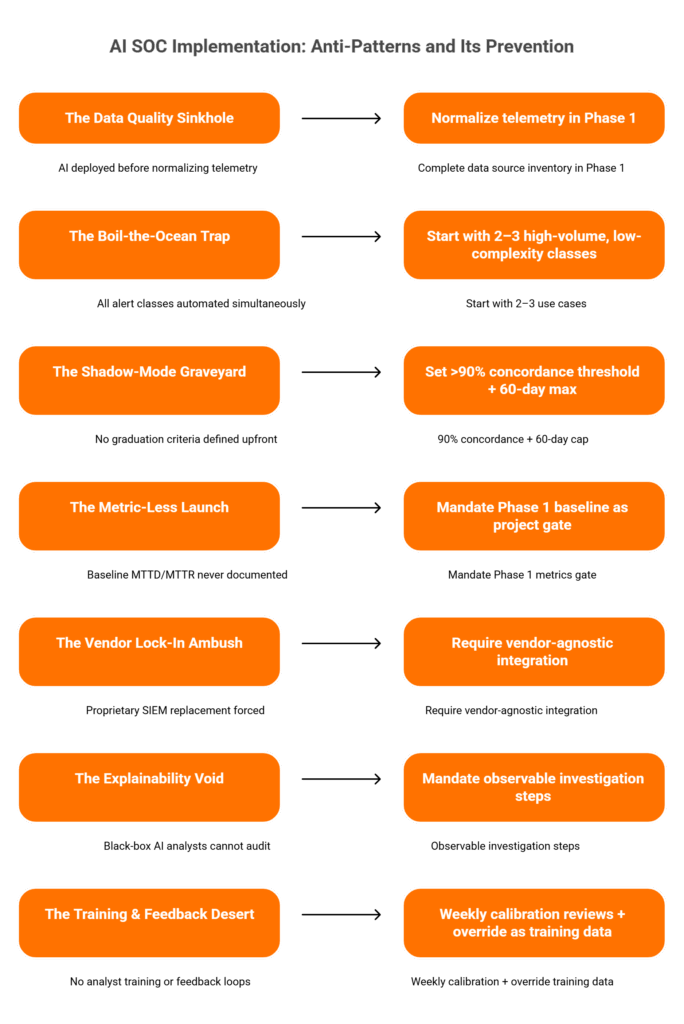
❌ Anti-Pattern #1: “The Data Quality Sinkhole”
What happens: AI models trained on inconsistent, ungoverned log data produce unreliable results. Analysts see bad recommendations, lose trust, and the project spirals into abandonment.
Root cause: Rushing to deploy AI before normalizing telemetry sources and establishing data quality baselines. Teams under pressure to show quick ROI skip the unsexy work of log normalization.
Prevention:
- Complete a data source inventory and normalization audit in Phase 1, before any AI touches production alerts
- Establish data quality metrics (completeness, freshness, accuracy) as Phase 1 exit criteria
- No AI deployment begins until log sources are validated and normalized
❌ Anti-Pattern #2: “The Boil-the-Ocean Trap”
What happens: The team tries to automate all alert classes simultaneously instead of phasing by complexity. Everything half-works; nothing fully works.
Root cause: Pressure from leadership to show enterprise-wide impact immediately. The resulting overscope guarantees mediocre accuracy across every alert type.
Prevention:
- Start with 2-3 high-volume, low-complexity alert classes (e.g., failed login brute-force, known malware signatures)
- Expand only after achieving >90% accuracy on initial classes
- Each phase expansion requires documented accuracy proof, not a timeline
❌ Anti-Pattern #3: “The Shadow-Mode Graveyard”
What happens: AI runs in monitor-only mode indefinitely because nobody defined graduation criteria. Six months later, it’s still in “shadow mode” and nobody remembers why.
Root cause: Organizational risk aversion without a structured trust-building framework. No one wants to be the person who flipped the switch.
Prevention:
- Define specific concordance thresholds (>90% agreement with human decisions over 30-60 days) before deployment
- Set a maximum shadow-mode duration (60-90 days) as a project milestone with executive visibility
- Make graduation criteria a boardroom item, not a SOC-floor decision
❌ Anti-Pattern #4: “The Metric-Less Launch”
What happens: The team deploys AI without documenting baseline MTTD, MTTR, and false positive rates. Three months later, leadership asks “what improved?” and nobody can answer.
Root cause: Urgency to “get AI running” causes the team to skip the assessment phase. Without a baseline, improvement is invisible and ROI is unjustifiable.
⏰ How to Prevent It
- Mandate Phase 1 baseline documentation as a non-negotiable project gate
- Measure and record MTTD, MTTR, false positive rate, alert volume, and analyst time allocation before any AI deployment begins
- Revisit baselines monthly to demonstrate improvement trajectory
❌ Anti-Pattern #5: “The Vendor Lock-In Ambush”
What happens: You choose a platform that forces proprietary SIEM replacement. Your custom detection rules, correlation logic, and years of institutional business logic are gone.
Root cause: Evaluating vendors on demo impressions rather than data sovereignty and integration architecture. The question “What happens to our detection rules and logs if we leave?” never gets asked.
Prevention:
- Require vendor-agnostic integration as a non-negotiable criterion
- Ask every vendor: “What happens to my data, detection rules, and correlation logic if I terminate the contract?”
- Ensure all AI models and detection logic can be exported or remain in customer-owned infrastructure
As one CISO put it in a Gartner review of Arctic Wolf:
“This is not an extension of our security team as was originally sold… Still not quite there with the remediation side of things. We receive alerts, but not necessarily a clear path to resolution.”
— Sr. Cybersecurity Engineer, Manufacturing Arctic Wolf – Gartner Peer Review
❌ Anti-Pattern #6: “The Explainability Void”
What happens: AI makes decisions analysts can’t understand, observe, or audit. Analysts systematically bypass the AI and triage manually, creating a “shadow SOC” that duplicates AI work.
Root cause: Deploying black-box AI models without transparent decision reasoning or observable investigation steps. The warning sign: analysts say “I don’t know why it flagged this” or “I investigate everything the AI closes, just in case.”
⚠️ Prevention Strategy
- Mandate AI decision transparency: every investigation step must be observable, every recommendation must include reasoning, and every autonomous action must have an audit trail
- If analysts can’t explain why AI made a decision, the AI is not ready for production
- This is not just good practice. NIST AI RMF transparency requirements are moving toward mandating this for all AI-driven security decisions
❌ Anti-Pattern #7: “The Training & Feedback Desert”
What happens: Nobody invests in analyst training for AI-assisted workflows. The AI never improves from human expertise because there’s no feedback loop. Analysts never learn to work with AI effectively.
Root cause: Treating AI deployment as a technology project rather than an organizational transformation. The tools are installed; the humans are ignored.
Prevention:
- Implement structured onboarding for AI-assisted workflows, not a single training session but an ongoing curriculum
- Mandate weekly calibration reviews where analysts evaluate AI performance
- Design feedback mechanisms where every analyst override creates labeled training data that improves AI accuracy
- Conduct quarterly manual investigation exercises to prevent analyst skill atrophy
How UnderDefense Prevents Every Anti-Pattern
We built our implementation methodology specifically to prevent each of these failures: 30-day phased onboarding with baseline metrics documented on Day 1 (prevents #4), vendor-agnostic integration that preserves customer business logic (prevents #5), every AI investigative step observable and auditable (prevents #6), the “AI collects context, you decide” principle that prevents human bypass (prevents #3 and #6), dedicated onboarding with custom detection tuning ensures data quality (prevents #1), and the concierge analyst model provides continuous feedback from human experts into AI models (prevents #7).
Q11. How Do You Map AI SOC Capabilities to Compliance and Regulatory Frameworks?
Compliance is where security budgets get approved, or killed. If your AI SOC can’t demonstrate direct mapping to the regulatory frameworks your auditors care about, you’re fighting an uphill budget battle regardless of how good your detection is. Below is a compliance-to-capability mapping matrix that CISOs can hand directly to their legal, audit, and compliance teams.
✅ AI SOC Compliance Coverage Checklist
Score yourself against each framework. Check the box if your current AI SOC fully satisfies the requirement:
- □ NIS2: Does your AI SOC provide continuous monitoring, early warning detection, and automated incident reporting within the 24-hour initial notification and 72-hour full report timelines?
- □ DORA: Does it satisfy ICT risk management, digital operational resilience testing, and third-party risk oversight requirements for financial entities?
- □ CIRCIA: Can it automate 72-hour incident reporting to CISA for critical infrastructure sectors with structured evidence packages?
- □ SEC Cybersecurity Disclosure: Does your incident detection workflow support the 4-business-day materiality determination and 8-K disclosure process?
- □ NIST AI RMF: Are AI decision audit trails compliant with transparency, accountability, and explainability principles? Is AI governance documented?
- □ NIST CSF 2.0: Does your detection and response capability map to all 6 core functions (Identify, Protect, Detect, Respond, Recover, Govern)?
- □ MITRE ATT&CK: What percentage of the framework’s techniques have active detection rules? (Target: 85%+ for mature AI SOC, 96%+ for best-in-class)
- □ ISO 27001: Are Annex A controls (A.5-A.8) continuously validated by security telemetry rather than point-in-time audits?
- □ SOC 2 Type II: Does your SOC generate continuous monitoring evidence for Trust Services Criteria (security, availability, processing integrity, confidentiality, privacy)?
- □ HIPAA: Does detection coverage satisfy Security Rule technical safeguards (access control, audit controls, integrity, transmission security)?
- □ PCI-DSS: Can it produce Requirement 10 (log monitoring) and Requirement 11 (vulnerability management) evidence automatically?
📊 Compliance-to-Capability Mapping Matrix
| Framework | Continuous Monitoring | Automated Evidence | Incident Detection & Reporting | Access Control Validation | AI Decision Audit Trail | Risk Assessment Automation | Threat Intel Integration |
|---|---|---|---|---|---|---|---|
| NIS2 | ✅ | ✅ | ✅ | ⚡ | ⚡ | ⚡ | ✅ |
| DORA | ✅ | ⚡ | ✅ | ✅ | ⚡ | ⚡ | ✅ |
| SEC Disclosure | ✅ | ✅ | ✅ | ⚡ | ❌ | ⚡ | ⚡ |
| NIST AI RMF | ⚡ | ⚡ | ⚡ | ⚡ | ✅ | ✅ | ⚡ |
| NIST CSF 2.0 | ✅ | ✅ | ✅ | ✅ | ⚡ | ✅ | ✅ |
| MITRE ATT&CK | ✅ | ✅ | ✅ | ⚡ | ⚡ | ⚡ | ✅ |
| ISO 27001 | ✅ | ✅ | ✅ | ✅ | ⚡ | ✅ | ✅ |
| SOC 2 Type II | ✅ | ✅ | ✅ | ✅ | ⚡ | ⚡ | ⚡ |
| HIPAA | ✅ | ✅ | ✅ | ✅ | ❌ | ⚡ | ⚡ |
| PCI-DSS | ✅ | ✅ | ✅ | ✅ | ❌ | ⚡ | ✅ |
Legend: ✅ Fully Automated | ⚡ Partially Automated | ❌ Manual Required
Where Most AI SOC Implementations Leave Gaps
Most implementations achieve full automation for continuous monitoring and incident detection. The consistent gaps appear in two areas: AI decision audit trails (critical for NIST AI RMF and the emerging EU AI Act requirements) and automated resilience testing (DORA’s operational resilience provisions). These gaps create regulatory exposure that point solutions don’t address.
NIST envisions the CSF 2.0, the AI RMF, and the Cyber AI Profile being used together, meaning organizations need their security operations, AI governance, and compliance documentation to be architecturally connected, not siloed across separate tools.
How UnderDefense Maps to Every Framework
UnderDefense MAXI Compliance provides automated compliance orchestration: auto evidence collection, continuous control validation, and reporting for ISO 27001, SOC 2 Type 1/2, GDPR, HIPAA, and PCI-DSS. Unlike standalone GRC tools, this is built on top of the actual security operations platform. Security telemetry maps directly to compliance controls in real time, not through quarterly manual assessments.
- Every AI decision is logged with full audit trails satisfying NIST AI RMF transparency requirements
- MITRE ATT&CK coverage: 96% of techniques with active detection rules, documented and verifiable
- NIS2 and DORA incident reporting: automated evidence packaging and timeline tracking from detection through notification
- Forever-free compliance kits included with MDR, not a separate product or upsell
💸 Gap Identification and Next Steps
Scoring guidance:
- 9-11 boxes checked: Strong compliance coverage. Focus on continuous improvement and AI governance documentation.
- 6-8 boxes checked: Moderate coverage with addressable gaps. Prioritize NIST AI RMF and regulatory reporting automation.
- Below 6 boxes checked: Significant compliance gaps creating regulatory exposure, requiring immediate action.
Scored below 8? UnderDefense’s forever-free compliance kits and automated audit evidence generation close these gaps within 30 days of onboarding, while the unified UnderDefense MAXI platform ensures compliance evidence comes from real security operations, not checkbox exercises.
Q12. How Do MSSPs Scale AI SOC Across Multiple Tenants and What Comes Next?
Scaling AI SOC delivery across dozens or hundreds of customers, each with different tool stacks, compliance requirements, and risk profiles, is the defining architectural challenge for MSSPs entering 2026. The tension between standardization (for margin) and customization (for retention) determines whether an MSSP thrives or bleeds.
The Multi-Tenant Architecture Challenge
MSSPs must deliver AI SOC capabilities across customers running different SIEM platforms (Splunk vs. Elastic vs. Microsoft Sentinel), facing different compliance requirements (healthcare vs. financial services vs. SaaS), and operating with different organizational contexts.
⚠️ The Core Architectural Tensions
| Tension | Standardized Approach | Customized Approach | Resolution |
|---|---|---|---|
| AI Infrastructure | Shared for cost efficiency | Dedicated for detection accuracy | Shared reasoning engine + per-tenant detection rule sets |
| Tenant Data | Centralized for cross-tenant intel | Isolated for compliance | Federated data model (data stays in tenant environment) |
| Playbooks | Standardized for scalability | Custom for customer satisfaction | Templated playbooks with per-client override layers |
| Threat Intel | Pooled for better detection | Siloed for confidentiality | Anonymized cross-tenant sharing |
The modern multi-tenant architecture resolves these tensions through a shared AI reasoning engine with per-tenant detection rule sets, a federated data model where each tenant’s data stays in their environment, per-client onboarding tuning (custom detection profiles, VIP lists, business-critical asset mapping), and anonymized cross-tenant threat intelligence sharing that improves detection for everyone without exposing individual tenant data.
⏰ Operational Scaling Model
The SOC team structure for multi-tenant delivery looks fundamentally different when AI handles the commodity volume:
- Shared AI triage layer handles commodity alerts across all tenants (70-80% of volume), running 24/7 without fatigue or shift-quality variance
- Dedicated concierge analyst pods serve customer segments grouped by industry, compliance regime, or service tier
- SLA management becomes consistent because AI enables 2-minute triage SLAs regardless of alert volume. Humans handle the exceptions, not the throughput
💰 The Economics of AI-Powered MSSP Delivery
The math works because per-tenant cost decreases as the MSSP scales: shared AI infrastructure amortizes across the customer base, and cross-tenant threat intelligence improves detection for all tenants simultaneously. The staff amplification ratio is the key metric: 1 analyst + AI can support 3-5x more client environments than the traditional MSSP model.
Tiered Service Offering Design
| Tier | Model | SLA | Response Authority | Price Point |
|---|---|---|---|---|
| Tier 1 | AI-Only Monitoring | Alert within 15 min | Detection + notification only | Entry-level |
| Tier 2 | AI + Shared Analyst | Triage in 5 min, escalation in 30 min | Detection + investigation + escalation | Mid-market |
| Tier 3 | AI + Dedicated Concierge | Triage in 2 min, critical response in 15 min | Full detection, response, containment, user verification | Premium |
How UnderDefense Scales the Concierge Model
Our 113% net dollar retention demonstrates the concierge model’s scalability. We learn each customer’s org structure, executives, critical assets, and context instead of treating all alerts uniformly. The multi-tenant UnderDefense MAXI platform delivers per-client AI tuning while maintaining 2-minute alert-to-triage SLAs across the entire customer base. Customers expand scope rather than churn because the system gets smarter for their specific environment every month.
UnderDefense supports MSSP partners through the From MSP to MSSP program, enabling managed service providers to white-label AI SOC delivery built on UnderDefense MAXI’s multi-tenant architecture.
What Comes Next: AI SOC Trajectory 2026-2028
Agentic AI Evolution
Specialized agent meshes will handle not just investigation but proactive threat simulation and automated purple teaming, continuously stress-testing detection coverage. The shift from “AI that triages alerts” to “AI that validates your defenses proactively” is already underway.
Autonomous SOC Convergence
The line between “AI-augmented” and “AI-native” will blur as confidence calibration frameworks mature. Expect 80%+ autonomous resolution rates for commodity threats by 2028. The human role shifts permanently from “doing the work” to “governing the system.”
Platform Convergence
AI SOC, compliance automation, attack surface management, and identity security will consolidate into unified platforms. Organizations already paying for 5-7 separate tools will demand single-platform delivery, and that’s exactly where the UnderDefense MAXI architecture is heading.
Regulatory AI Governance
NIST AI RMF, the EU AI Act, and sector-specific AI governance requirements will mandate explainability and audit trails for all AI-driven security decisions. Vendors who built transparency from Day 1 hold a structural advantage; those retrofitting explainability onto black-box systems will struggle.
Cross-Organization Threat Intelligence
Federated learning across customer bases, without sharing raw data, will create network effects where every customer benefits from threats detected anywhere in the ecosystem. This is the ultimate scaling advantage for multi-tenant AI SOC providers: your security gets better because everyone’s security gets better.
1. What is an AI SOC and how does it differ from a traditional Security Operations Center?
An AI SOC is a security operations architecture where artificial intelligence handles enrichment, correlation, triage, and investigation at machine speed, while humans retain decision authority for containment, strategy, and anything requiring organizational context. The difference from a traditional SOC is structural, not cosmetic.
Traditional SOCs rely on the Tier-1/2/3 analyst pyramid designed for human-speed operations. In 2026, this model is broken: analysts face nearly 3,000 alerts per day, 80-95% are false positives, and the global cybersecurity workforce gap stands at 4.8 million professionals.
We see AI SOC on a maturity spectrum:
-
AI-Powered SOC: Bolt-on AI tools on legacy SIEM
-
AI-Augmented SOC: Integrated AI triage with human validation
-
AI-Native SOC: Purpose-built with agentic architecture
-
Autonomous SOC: AI handles end-to-end with human oversight on strategic decisions
We built UnderDefense MAXI to deliver AI-native SOC capabilities from Day 1, with 2-minute alert-to-triage and 15-minute escalation for critical incidents, because the real cost of standing still is measured in breaches, not budgets.
2. How long does it take to implement an AI SOC from scratch?
A typical DIY AI SOC implementation takes 12-18 months across four phases. We compress this timeline significantly through our turnkey onboarding approach.
The four phases are:
-
Phase 1 (Weeks 1-4): Assessment, tooling inventory, baseline metric capture (MTTD, MTTR, false-positive rate), and business case construction
-
Phase 2 (Weeks 5-12): Pilot implementation with 2-3 high-impact use cases in shadow mode, with AI concordance targets of >90% agreement with human decisions
-
Phase 3 (Weeks 13-20): Measured expansion from monitor-only to partial automation for low-risk response actions
-
Phase 4 (Months 6-18): Full operational integration with advanced governance and proactive threat hunting
We compress Phase 1-2 into a 30-day turnkey onboarding, including security hardening, custom detection tuning, and ransomware simulation testing. Organizations reach Phase 3 augmented operations months ahead of DIY timelines. The critical rule: never skip the baseline. Without documented pre-AI metrics, ROI is unprovable.
3. What are the most common AI SOC implementation failures and how do we avoid them?
We have identified seven named anti-patterns that cause the majority of AI SOC project delays, budget overruns, or outright abandonment:
-
The Data Quality Sinkhole: Deploying AI before normalizing telemetry sources. Prevention: complete a data source inventory in Phase 1 before AI touches production alerts.
-
The Boil-the-Ocean Trap: Automating all alert classes simultaneously. Prevention: start with 2-3 high-volume, low-complexity alert classes.
-
The Shadow-Mode Graveyard: AI stuck in monitor-only mode indefinitely. Prevention: define graduation criteria (>90% concordance over 30-60 days) upfront.
-
The Metric-Less Launch: Deploying without documenting baseline MTTD/MTTR. Prevention: mandate Phase 1 baseline documentation as a non-negotiable gate.
-
The Vendor Lock-In Ambush: Platforms forcing proprietary SIEM replacement. Prevention: require vendor-agnostic integration as non-negotiable.
-
The Explainability Void: Black-box AI decisions analysts cannot audit. Prevention: mandate every investigative step be observable.
-
The Training & Feedback Desert: No analyst training or feedback loops. Prevention: implement structured onboarding and weekly calibration reviews.
4. How do we measure AI SOC ROI and justify the budget to our board?
We use a four-tier metrics framework designed to translate operational performance into board-ready business language:
-
Tier 1, Operational Efficiency: MTTD (<2-30 min vs. 18-197 day baseline), alert-to-triage time (<2 min vs. 30-45 min), false positive rate (1-10% vs. 80-95%), automation rate (70-85% vs. <5%)
-
Tier 2, Security Effectiveness: MITRE ATT&CK coverage (85%+ mature, 96%+ best-in-class), mean dwell time (<24 hours vs. 60+ day industry average)
-
Tier 3, Business Impact: Cost per investigated alert (target 80% reduction), analyst FTE savings (15-25 hours recovered per analyst per week), breach cost avoidance ($330-490K annualized risk reduction)
-
Tier 4, AI-Specific: AI decision accuracy (>90%), autonomous resolution rate (60-80% for commodity threats)
The ROI formula: (Annual SOC Cost Savings + Breach Cost Avoidance + Compliance Efficiency Gains + Analyst Retention Savings − AI SOC Investment) ÷ AI SOC Investment × 100%. Use our SOC Cost Calculator to model your specific scenario. Expected payback period is 6-12 months for most mid-market implementations.
5. How should we restructure our SOC team for AI-augmented operations?
The traditional Tier-1/2/3 pyramid collapses when AI can triage alerts in 2 minutes. The restructured AI-native SOC model requires four new roles:
-
AI Operations Engineer: Manages detection-as-code pipelines, tunes AI models, monitors accuracy metrics
-
Threat Analyst: Focuses on complex investigation, threat hunting, and AI-escalated incidents requiring human judgment
-
SOC Strategist: Designs detection strategies, maps to compliance frameworks, conducts purple team exercises
-
Response Orchestrator: Manages containment workflows, ChatOps coordination, and stakeholder briefings
The key principle is that AI does not replace analysts. One analyst plus AI equals 5-10x throughput. We recommend a three-stage trust calibration framework: Shadow (AI recommends, human decides), Assisted (AI decides on approved classes, human reviews), and Autonomous (AI decides on routine threats, human focuses on strategy).
We built UnderDefense MAXI to replace routine T1-T2 work, giving your team 25% of their time back for strategic work. Every analyst override creates labeled training data that improves AI accuracy continuously.
6. What does an AI SOC reference architecture look like in practice?
A production-grade AI SOC reference architecture consists of six layers, each with a specific function, connected through a vendor-agnostic data fabric the customer owns:
-
Layer 1, Data Ingestion: Vendor-agnostic connectors for SIEM, EDR, identity providers, cloud platforms, and SaaS applications
-
Layer 2, AI-Enhanced Detection: ML classifiers, unsupervised anomaly models, and UEBA working in concert
-
Layer 3, Agentic AI Reasoning: Specialized agent mesh handling endpoint, identity, cloud, and network domains collaboratively
-
Layer 4, Detection-as-Code: Python-based rules version-controlled via Git, unit-tested, and deployed via CI/CD
-
Layer 5, SOAR Response: Automated containment workflows with ChatOps user verification
-
Layer 6, Compliance & Reporting: Automated evidence collection and real-time regulatory mapping
The non-negotiable principle: the customer owns their data lake and all business logic. UnderDefense MAXI implements this entire architecture as a turnkey platform, connecting 250+ tools into a single context-aware layer. Every investigative step is observable and auditable, with on-prem or customer-specific cloud deployment options.
7. How do we integrate GenAI and LLMs into SOC workflows without hallucination risk?
LLMs unlock four transformative SOC capabilities: natural language to SIEM query translation, automated investigation report generation, conversational alert triage via ChatOps, and AI-assisted detection rule drafting. However, security decisions cannot tolerate hallucinations, so governance guardrails are essential.
Our production-tested framework includes:
-
Mandatory human-in-the-loop for all containment decisions
-
Confidence scoring on every AI output with minimum thresholds for autonomous action
-
Retrieval-Augmented Generation (RAG) grounded in customer-specific telemetry
-
Prompt injection protections that sanitize all alert content before LLM processing
-
Output validation workflows with automated cross-reference against ground truth
-
Full audit trail for every AI-generated recommendation
The rule of thumb: use GenAI/LLMs for natural language tasks (summarization, pattern description), traditional ML for anomaly scoring and behavioral baselines, and human + AI recommendation for containment decisions where stakes are too high for autonomous action. UnderDefense MAXI’s agentic AI is built on the principle that AI collects context, and you decide.
8. How does an AI SOC map to compliance frameworks like NIS2, DORA, SOC 2, and HIPAA?
Compliance is where security budgets get approved or killed. A well-implemented AI SOC can map directly to major regulatory frameworks across seven capability dimensions: continuous monitoring, automated evidence, incident detection and reporting, access control validation, AI decision audit trails, risk assessment automation, and threat intelligence integration.
Most AI SOC implementations achieve full automation for continuous monitoring and incident detection. The consistent gaps appear in two areas:
-
AI decision audit trails: Critical for NIST AI RMF and emerging EU AI Act requirements
-
Automated resilience testing: Required by DORA’s operational resilience provisions
We provide automated compliance orchestration through UnderDefense MAXI: auto evidence collection, continuous control validation, and reporting for ISO 27001, SOC 2 Type 1/2, GDPR, HIPAA, and PCI-DSS. Security telemetry maps directly to compliance controls in real time. We deliver 96% MITRE ATT&CK coverage with active detection rules, automated NIS2/DORA incident reporting with evidence packaging, and forever-free compliance kits included with MDR.