




Blumira (SIEM+XDR) sits in that “good enough” ground for IT managers without a full-blown SOC team. But if you’ve outgrown simple setups or are finally budgeting for real breach prevention, you’ve got options. Here we’ll unpack 6 Blumira alternatives: what they get right, where they fall short, and when you’ll need more than just automation.
Let’s unpack the top 6 Blumira security alternatives and stack them side by side.
TOP Blumira Competitors 2025
Key Takeaways
- DIY SOCs Hit a Ceiling Fast. All AI SOC and threat intel platforms below do a decent job at automation. But when attackers shift tactics (identity abuse, OAuth hijacks, business logic exploits), “good enough” breaks. The second your CEO’s inbox becomes the breach path, you’ll wish for real hunters.
- AI SOC ≠ Full Coverage. Every tool on this list promises automation. But when telemetry’s missing or edge cases arise, automation skips over the breach. That’s why human judgment still owns 20% of alerts where lawsuits, fines, and revenue losses live.
- Cost Isn’t Just the Price Tag. Blumira tops out at $24K/year. Others quote $60K–$300K. But a breach from one missed alert? That’s $650K to $10M in downtime, ransom, and clean-up. Budget optics fade fast when real risk shows up.
Time to unpack 6 Blumira competitors. What they get right, where they fall short, and when you’ll need more than just automation.
UnderDefense MAXI: Human-Led, AI-Powered
UnderDefence MAXI is the AI-powered SOC engine behind UnderDefense’s full-spectrum MDR service. But MAXI itself is a platform: it automates triage, enriches signals from across your stack (endpoint, identity, SaaS, network), and gives cyber defence analysts superpowers instead of trying to replace them.
Unlike black-box “autonomous SOCs,” MAXI is built on a hybrid approach: let AI burn down the noise, but put UnderDefense cybersecurity experts in charge when things get weird, legal, or risky.
UnderDefense MAXI vs Blumira: Head-to-Head
Feature/Metric | UnderDefense MAXI | Blumira |
Core Functionality | AI-powered SOC platform + human-led MDR | SIEM + XDR for SMBs |
Human Involvement | Built-in: expert SOC team monitors 24/7 | Optional human support |
Deployment Speed | Fast: agentless onboarding, no rip-and-replace | Very fast: cloud-native, live in hours |
Integrations | 360° visibility: EDR, identity, SaaS, network, cloud, Kubernetes | Core integrations bundled in |
Detection Engine | Custom-built, continuously tuned (purple team backed) | Prebuilt detection rules that align with MITRE ATT&CK |
Response Automation | Automated triage + human-led containment & IR | Basic automated blocking |
Explainability | Yes: transparent AI escalations + human decision logs | Basic alert context and dashboards |
UnderDefense MAXI pricing starts free, with full MDR coverage costing ~$60K–$240K/year. Blumira’s pricing is lower (costs top out around $24K/year), but it’s a DIY SOC: no MDR, no hunters, you’re flying solo.
If you want a turnkey cybersecurity platform with automation and real-world defenders watching your back, UnderDefense MAXI is it. Blumira gets you coverage fast and cheap, but once things go sideways, say, a CEO’s email compromised via OAuth hijack, UnderDefense human hunters make the difference between a blip and a boardroom disaster.
AI SOCs often miss social-engineering attacks. A Swiss outdoor gear company was nearly hit by Black Basta ransomware after attackers used Microsoft Teams plus Quick Assist with a disguised C2 payload to gain remote access. The AI missed it; our human analysts caught it, and our MDR contained the incident within 43 minutes — from first beacon to full containment. Black Basta was stopped in minutes.
Get 12 Questions to Test AI SOC Reality
Explore coverage, speed, narrative quality, and authority.
Intezer: Malware Analysis Turned AI SOC
Intezer started as a malware DNA lab, literally breaking down binaries to detect code reuse across malware families. Now, it’s evolved into an Autonomous SOC platform promising automated triage, investigation, SOC automation, and response across SIEM, EDR, cloud, and email alerts.
Its strength is speed. Intezer claims it can auto-triage 96%+ of alerts in under two minutes. But it still struggles outside the malware box.
Intezer vs Blumira: Head-to-Head
Feature/Metric | UnderDefense MAXI | Blumira |
Platform Type | Autonomous SOC (malware-centric) | Lightweight SIEM with detection/response |
Human Involvement | Escalates ~4% of alerts to humans | Optional analyst support |
Integrations | SIEM, EDR, email, cloud, phishing modules | Bundled core integrations |
Detection Engine | Malware-focused, binary DNA analysis | Broad detection aligned with MITRE |
Response Automation | High, auto containment where supported | Basic automated blocking |
Explainability | Forensics-focused, binary evidence | Basic alert context and dashboards |
Intezer pricing runs ~$70K–$100K/year if you want the full platform plus analyst layer. Blumira’s cost is lower (tops out near $24K/year), but you’re on your own when things get weird.
Intezer is a malware analyst with SOC ambitions. It’s fantastic at identifying reused code, classifying binaries, and flagging known bads with scary speed. If you’re worried about droppers, implants, or unknown binaries, Intezer’s your microscope.
But in today’s breach landscape, most of the risk isn’t malware. It’s credentials, identity abuse, SaaS misconfigurations, and gray-zone business logic.
One of our clients, a large insurance marketing firm, was hit by a phishing scam that targeted the CEO’s Azure AD account. There was no malware, just a thread-hijack email. Their SOC wasn’t monitoring Microsoft 365 logs, so it slipped through. UnderDefense investigated the path, regained control, and tightened defenses: MFA enforced, inbox-rule detection added. We caught the Azure AD phishing breach, contained it, and hardened defenses.
Andesite: The Bionic SOC
Andesite doesn’t pretend to replace your team. It’s a bionic SOC, your threat investigation engine. AI here works like a copilot. It connects the dots, pulls in context, prioritizes what matters, and lines it up in one sharp workspace. But the humans still call the shots. Andesite security offers no autopilot. Analysts remain in control here.
Andesite vs Blumira: Head-to-Head
Feature/Metric | UnderDefense MAXI | Blumira |
Core Functionality | Human-AI collaborative SOC (Bionic SOC) | Cloud-native SIEM + XDR |
Human Involvement | Integral. Human analyst and AI co-investigate every alert | Reserved for critical escalations only |
Context Awareness | Deep. AI correlates across silos, centralizes insights | Basic. Rule-based detection from ingested logs |
Investigation Workspace | Unified investigative UI across tools, with AI-driven triage workflows | Standard SIEM dashboards, limited UI-level customization |
Explainability | Full. Evidentiary AI with complete traceability and audit trails | Limited. Alert dashboards with context, but no detailed lineage |
Integration Approach | No ETL: direct connection to diverse data sources, unified view | Prebuilt integrations; relies on structured log ingestion |
Andesite pricing can be around $12K–$120K+/year, depending on scale, coverage, and how “bionic” you want your cockpit.
It is not an “AI takes over” play. With Andersite automation, your analysts stay in the loop while AI handles the grunt work. You get structured investigations, context-rich insights, and real explainability. But make no mistake, this model only works if you’ve got humans watching. Skip that, and you’re back in the breach math: $4.4M average cleanup cost, plus boardroom heat you can’t automate away.
Anvilogic: Detection-First AI SOC
Anvilogic is an AI SOC platform built around a detection-as-code model. It layers on top of your existing SIEM. Their agentic platform automates the detection lifecycle: mapping gaps, building rules, optimizing telemetry, and triaging alerts with contextual AI. You still need people, but it’s built to supercharge detection engineers, not replace them.
Triaging? Yes. Alert clustering, pattern correlation, and prioritization are AI-driven. Response? Not really.
Anvilogic vs Blumira: Head-to-Head
Feature/Metric | UnderDefense MAXI | Blumira |
Core Functionality | AI SOC for detection lifecycle + agentic triage | Cloud-native SIEM + XDR + Endpoint Visibility |
Human Involvement | Required: detection engineers + SecOps teams | Optional 24/7 support |
Integrations | SIEMs, data lakes, threat intel, cloud | Core cloud and endpoint integrations |
Detection Engine | AI agents build, map, and tune detections | Managed detections aligned with MITRE |
Response Automation | Limited. Detection and triage only | Moderate auto-blocking |
Explainability | Full detection lineage + telemetry mapping | Alert context with basic dashboards |
Anvilogic pricing clocks in around $65K-159K/year. Heavier deployments can push costs higher, depending on compute and storage split.
Anvilogic gives smart teams the automation they need to scale detections and tame SIEM chaos. Blumira gives lean teams a ready-to-go defense stack. One’s an AI detection engine. The other’s a plug-and-play security platform. Pick your battle.
When AI SOC Misses, Humans Step In
Let’s talk about how we can spot breaches before they cost you.
Seceon: All-in-One, All-Automated… But is it All There?
Seceon isn’t stitching together tools; it is the tool. Their Open Threat Management (OTM) platform folds SIEM, EDR, XDR, cloud posture, device control, compliance, auto-correction, and threat hunting. Its claim to fame is an AI SOC that can match the output of a 20-person team.
It’s less clear how it handles edge cases that demand judgment calls. Can it really go fully hands-off?
Seceon vs Blumira: Head-to-Head
Feature/Metric | UnderDefense MAXI | Blumira |
Core Functionality | All-in-one AI-driven SOC suite (SIEM, XDR, compliance, posture) | Cloud-native SIEM + XDR |
Detection Engine | Native AI/ML behavioral detection across flows, logs, identities, and endpoints | Managed rule-based detection aligned to MITRE |
Human Involvement | Claimed autonomous containment and response | 24/7 human SecOps for critical issues |
Response Automation | Real-time automated remediation + playbooks (claimed) | Basic blocking + alert escalation |
Integrations | Hundreds via one collector (logs, networks, identity, cloud, apps) | Prebuilt cloud-native connectors |
Seceon pricing starts free (up to 50 users), but real TCO lands around $300K–$400K/year flat for full coverage.
Seceon Inc. is a bold promise: one platform to detect, block, and report it all at machine speed. But automation at scale is tricky. Without clear evidence of nuanced edge-case handling or human-in-the-loop safeguards, it might leave some CISOs wary.
Dropzone AI: The Zero-Touch AI SOC for Alert Triage
Dropzone AI company markets itself as the “autonomous analyst”, a fully AI SOC platform that promises to ingest your alerts, triage them in seconds, and close or escalate with no humans in the loop.
Think of Dropaoze AI as a triage engine on autopilot. It doesn’t run your detections, and it’s not a full SIEM replacement, but it plugs into your existing tech (like Microsoft, CrowdStrike, Sentinel, etc.) and automates the front-end decision-making.
Dropzone AI vs Blumira: Head-to-Head
Strengths | Limits |
Easy deployment, cloud-first SIEM + detection without months of tuning. | Less depth in advanced threat hunting vs. enterprise SIEM/XDR. |
Bundled detections mapped to MITRE ATT&CK, prebuilt playbooks. | Limited customization of detections and response workflows at scale. |
Automated blocking for common threats (phishing, ransomware indicators, brute-force). | Not designed for huge multi-tenant MSSP environments. |
Dropzone AI pricing starts around ~$36K/year (usage-based, no MDR in the box). Blumira’s cost is lighter, but don’t expect memory, agents, or anything close to full automation.
Dropzone AI startup wins on speed and autonomy, it’s blazing fast when it works. But it doesn’t detect anything on its own. If your SIEM misses a credential abuse alert or flags it weakly, Dropzone AI might triage it as low-priority and close it automatically. That’s how the case below can come to life.
What AI SOCs Can’t See, We Hunt
AI SOCs are getting better. Faster triage, less noise, tighter loops. But here’s the truth every breached company learns the hard way: AI has blind spots. It can’t spot intent. It can’t decode human nuance. And it definitely doesn’t raise its hand when things feel off.
Credential abuse without malware? AI doesn’t blink. OAuth token theft wrapped in legit behavior? Auto-closed. Business logic exploits with zero indicators? Invisible.
That’s why UnderDefense MDR exists.
We’re not an alert monitor. We’re a team of 24/7 proactive threat hunters backed by incident responders, concierge analysts, and threat researchers who obsess over your environment like it’s our own.
- Human-led hunting
- Real-time IR
- 360° visibility across identity, endpoints, cloud, SaaS, and network
- No generic playbooks. Every customer gets threat models mapped to your stack and investigation playbooks that adapt.
- BYOT? Perfect. We’re stack-agnostic. You’re not switching SIEMs or ditching your tools. We work across EDR, SIEM, SaaS, cloud, identity, email, and more.
- We don’t cap logs or meter ingestion. Unlimited telemetry, full-fidelity, across all sources.
- And when the stakes are highest, we back our SLAs with $1M breach recovery guarantees.
We built UnderDefense MAXI AI SOC to bring order to alert chaos, cut triage noise, and spotlight real threats. But without the MDR muscle we stack on top, it’s just a tool, like any AI SOC.
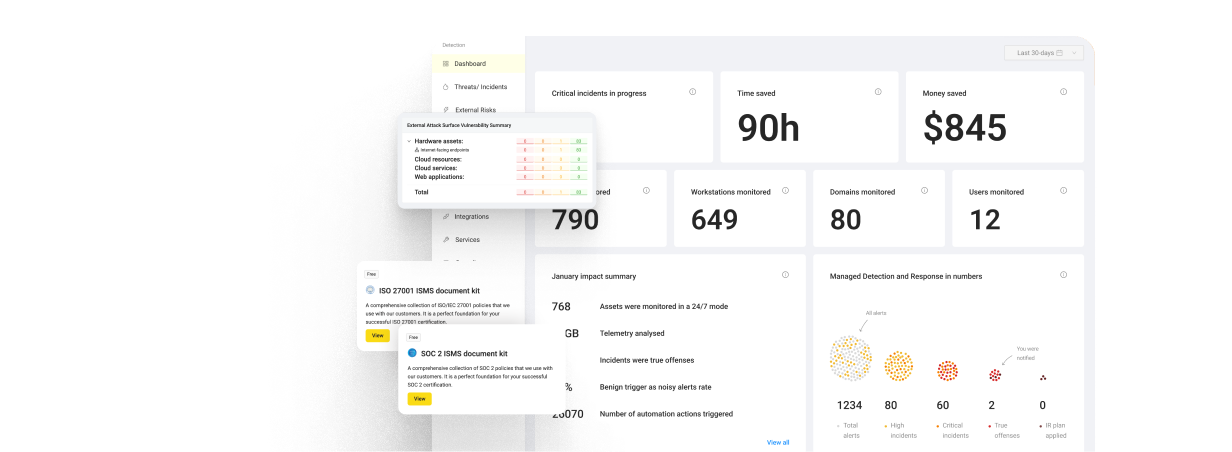
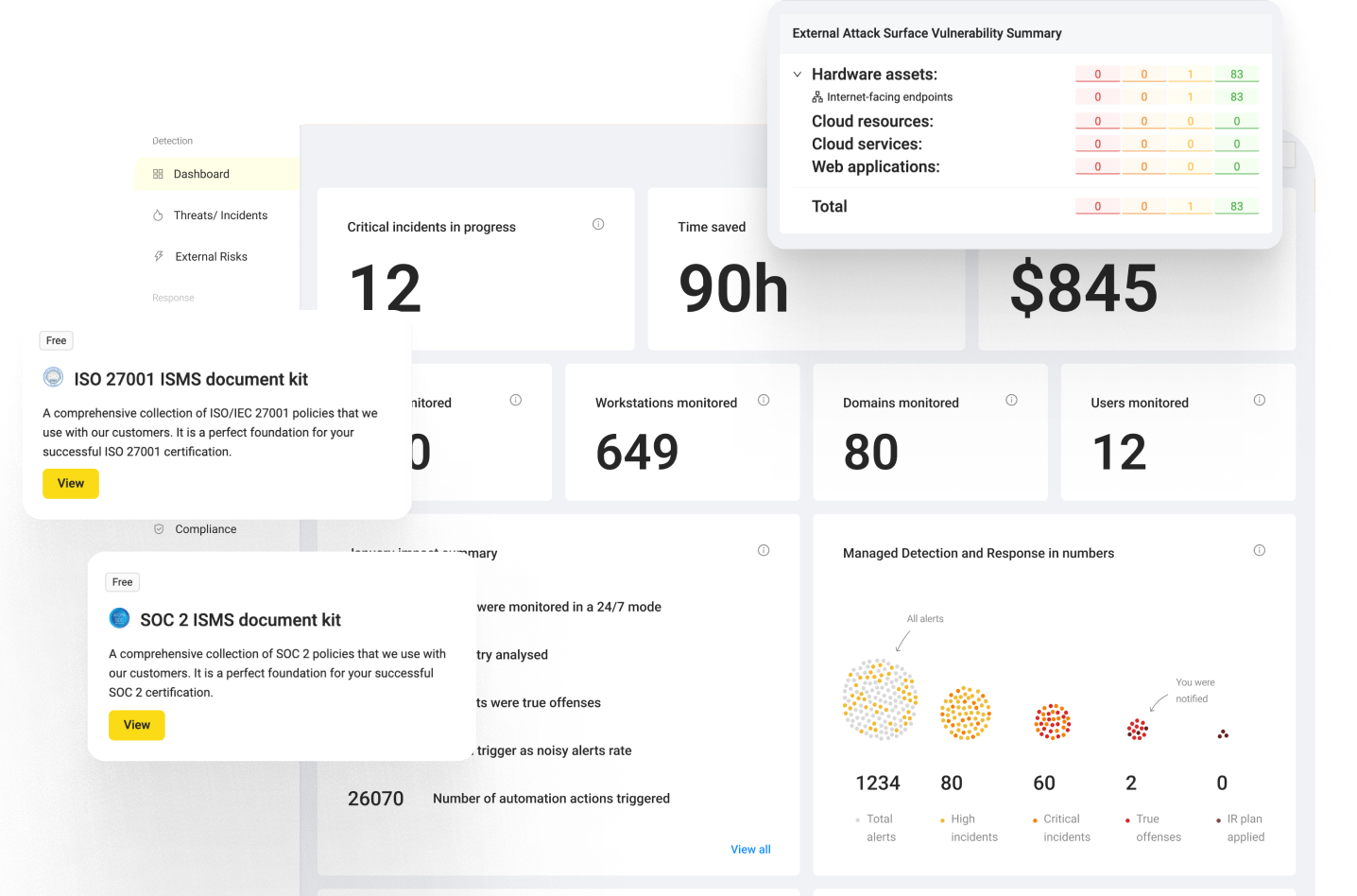
You can use UnderDefense MAXI as your cybersecurity control panel for free.
Plug in your stack (EDR, identity, cloud, email, network), and get:
- Full visibility across your environment
- Board-ready dashboards: risk, posture, costs saved, incident summaries
- Unified triage across vendors
- Correlated alerts with context
- Live investigation timelines
- Real threat intel.
We don’t force tech swaps. We meet you where you are. And we give you a sharp cockpit to see it all.
Get Human-Led, Always-On Defense
Get human investigations and a 24/7 response with UnderDefense.
1. Are AI SOC platforms actually replacing human analysts?
Not really. They’re great at triaging alerts, running playbooks, and filtering noise. But when it comes to gray-area threats (identity abuse, OAuth hijacks, insider missteps), AI alone doesn’t cut it. Real-world breaches still need human judgment, especially when the risk hits legal, financial, or reputational levels.
Need help spotting the threats AI won’t flag? Our team handles the breaches that don’t follow templates. Let’s walk through where human judgment changes the outcome. → Talk to a Threat Hunter.
2. How should we evaluate AI SOC platforms today?
Don’t just ask what the AI can do, ask where it stops. Can it handle fraud? Does it spot intent? Is it explainable to regulators? Can it escalate to real humans when needed? And how does it behave when telemetry is partial or wrong? That’s where the cracks show, and where breaches usually happen.
Run a reality check on your stack. We’ll show you exactly where your current tools stop, and what threats are slipping through right now.
3. What’s the true cost of an AI SOC?
Most tools pitch $30K–$150K/year. But if they miss the 20% of threats AI can’t understand, your breach math looks more like this:
- $650K in ransom or downtime
- $2.59M/day lost from halted ops
- $10M+ average cost for identity-based breaches
The platform cost is only the sticker. The real cost shows up mid-incident.
4. Can threat detection ever be fully automated?
Not when attackers evolve faster than models do. You can automate the grind: triage, alert grouping, and some containment. But real detection is part offense, part intuition. That’s why modern SOCs lean on purple teams, threat hunting, and simulation alongside AI. Automation scales. Judgment saves.
Want to see what that looks like in action? Talk to the UnderDefense team. Our IR leads and threat hunters will walk you through what AI misses, how we catch it, and what your SOC should look like in 2025.