






On paper, a $6 billion food production company in the United States looked unwavering. Having a reliable global reputation, 10,000 employees on board, Palo Alto WildFire and Cortex XDR in their tech stack, and a fully staffed SOC, the company seemed prepared for cyber attacks. However, business leaders knew better that a smooth surface could be hiding many pitfalls.
Working alongside their blue team, our red team tested their tools, processes, and employees. The main goal of this purple team testing was to check whether their SOC could recognize stealthy, customized attack methods and respond in time to stop a breach.
Despite the effectiveness of detection tools, other blind spots left a path open to domain compromise. Even industry-leading food producers with world-class tools can’t afford to trust dashboards alone. True security comes from the SOC team’s skills and security-aware employees.
How Our Red Team Simulated the Breach
From the start of the breach and attack simulation, we focused on exposed surfaces that typically get overlooked, including iDRAC interfaces meant for remote server management. Our team detected a Windows virtual machine (VM) that was powered off and took advantage of the misconfigured access. We mounted a virtual ISO and launched the VM.
Since the VM had been dormant, we didn’t expect to find anything useful, like cached memory artifacts that included live tickets or credentials. To our surprise, we extracted the local mscache of a service account. An offline crack using rainbow tables revealed the plaintext password. The account had local admin rights across multiple servers and, more importantly, its password was marked as non-expiring.
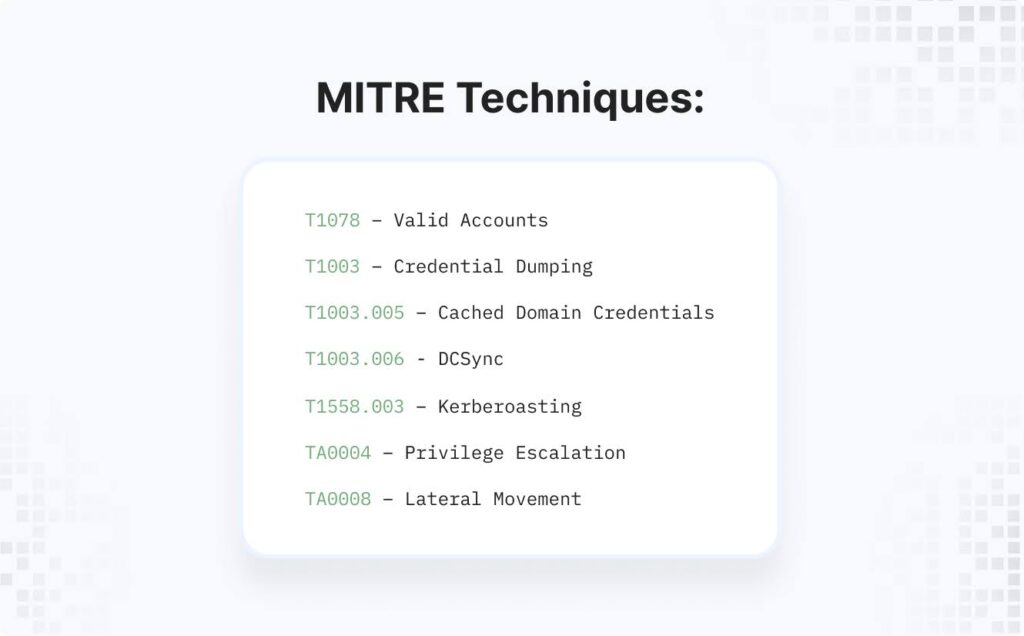
This weak spot was enough for escalation, so we pivoted to other systems and harvested credentials from active endpoints. Next, we proceeded with the lateral movement as memory scraping and LSASS dumps yielded domain credentials. Within hours of the breach simulation, DCSync attacks handed us the keys to the kingdom, while Kerberoasting (exploiting the Kerberos authentication protocol) exposed additional high-privilege service accounts.
Two things concerned us the most — the speed of the compromise and the silence. The team was enumerating the domain, escalating privileges, and moving laterally across the network, yet the SOC hadn’t responded to anything until we showed them what was going on.
Security maturity assessment reveals these gaps far too often:
- Endpoint protections didn’t cover infrastructure management systems.
- Network segmentation was weak.
- Detections were default, not tailored.
- Logging was inconsistent and uncorrelated.
Uncover your security weaknesses before attackers do.
Use our penetration testing services for a full infrastructure assessment.
Security Posture vs. Security Tools: Who Wins?
The breach was a reflection of a deeper problem — many organizations think that deploying security tools equals having a security strategy. They mistake dashboards for visibility and alerts for insights.
True security isn’t about the number of tools you have — it’s about how well you understand, monitor, and defend your attack surface. There’s a difference between owning a well-stocked toolbox and knowing how to build a structure that can withstand an attack.
In our client’s cyber security maturity assessment, most detection logic was either misaligned with their environment or missing entirely. The SOC team trusted the tools, but without a validation process, there was no way to know if alerts would actually work when an attacker was in the system.
Even worse, the detections that did exist relied on default configurations. These generic settings are designed to work broadly, not to protect a unique environment with legacy systems and custom applications. In practice, this one-size-fits-all approach leaves enormous blind spots.
A mature security posture rests on several pillars:
- Threat-informed defense: Mapping defenses against known attacker techniques using frameworks like MITRE ATT&CK.
- Detection engineering: Continuously refining alerts based on evolving threats and your organization’s specific risk profiles.
- Validation and testing: Regular red and purple team exercises to ensure your defenses work as intended.
- Process maturity: Having well-defined incident response, threat hunting, and log management processes.
Without these, organizations are left with little more than an expensive illusion of safety. We often ask clients one simple question: When was the last time you validated your detection stack against a real adversary simulation? The answers are usually revealing, and too often, alarming.
Check our 2025 SOCaaS Buyer’s Guide and learn how to choose the right SOCaaS provider, including the evaluation of coverage, response, and support capabilities.

The Power of Purple Team Testing
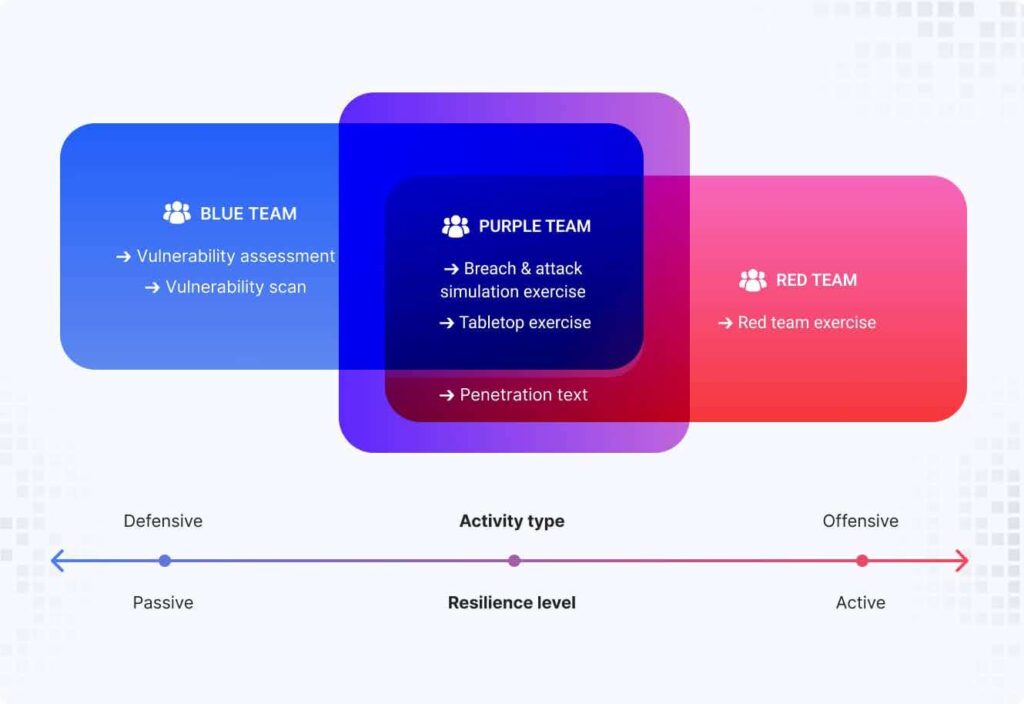
Purple team in cybersecurity is a human-driven method to close the gap between offensive tactics and defensive operations. Unlike traditional red team processes, which often operate in secrecy to mimic real-world attackers, purple teaming is built on collaboration, transparency, and continuous learning between attackers and defenders.
Purple team assessment reveals blind spots that no tool or dashboard will ever show. Red Teams excel at finding ways to chain together misconfigurations, weak policies, and human mistakes to gain privileges. Blue teams, in turn, bring deep knowledge of their environment, the operational constraints, and the critical assets worth protecting.
When these two perspectives converge, defenses don’t just get tested, they evolve in real-time.
For the client in our case, Purple teaming highlighted:
- Gaps in endpoint telemetry across critical infrastructure.
- Weak alerting on credential dumping and lateral movement.
- Missing detections for common MITRE ATT&CK techniques.
- Weak network segmentation policies.
The value wasn’t just in identifying gaps, it was in pairing every offensive move with a defensive response. If the SOC missed an alert, we started to dig in to find the why. Was it a logging blind spot? A misconfigured rule? Or simply a visibility issue? Each finding turned into a clear, actionable improvement.
Purple team builds what we call a detection muscle memory inside the SOC. Analysts aren’t just handed a report — they gain live exposure to attacker tradecraft, which sharpens their ability to recognize subtle patterns and behaviors that static signatures will always miss.
Why purple team cyber security method works
- Shared context: Red and blue teams align on objectives so that testing reflects real business risks.
- Real-time feedback: Defenses are tuned on the spot, not weeks later in a post-mortem.
- Continuous improvement: Security processes adapt alongside the threat.
- Threat-informed detections: Aligning with frameworks like MITRE ATT&CK makes coverage targeted and measurable.
Purple teaming is more than a test — it transforms theoretical security into practical resilience.
Steps to Real Security
The illusion of security often sets in when tools are deployed but never truly tested. Dashboards glow green, compliance boxes get checked, and everyone feels reassured until a real adversary shows up. That’s when the organizations face visibility gaps and misconfigured detections. The problem isn’t a lack of technology — it’s the false confidence in what technology alone can deliver.
Real security isn’t about product names or feature lists. It’s the outcome of people, processes, and knowledge working together. This is where purple teaming plays a vital role. Putting attackers and defenders in the same room exposes misalignments between detection logic and real threats. But you can’t just tune detections through one breach attack simulation since threat actors evolve, and what worked yesterday may fail tomorrow. That’s why continuous validation and iteration are essential.
This is where Managed Detection and Response (MDR) services become a game-changer, not as a silver bullet but as an extension of your defensive team. MDR delivers:
- Expertise over tools: The best technology is useless without skilled people. MDR teams live and breathe adversary tradecraft. They monitor evolving TTPs, refine detections, and respond to incidents — not just by matching signatures, but by recognizing attacker behavior in context.
- Context-driven detections: MDR doesn’t settle for generic, out-of-the-box alerts. It adapts to your environment and critical assets. MDR tailors detection logic to what actually matters. It’s not about more alerts — it’s about meaningful ones.
- Continuous validation: MDR allows detection logic to evolve with every new threat campaign observed, every red team test run, and every detection gap closed. This ensures that your defenses are battle-tested.
- Human-first response: When alerts fire, MDR teams don’t just pass logs to your team. They investigate, enrich, and respond, often before in-house teams even know something is wrong.
Partner with MDR experts and extend your team for context-driven detection and rapid response.
In our purple team security case, the turning point wasn’t more tooling but the presence of experts who could:
- Map detections to actual threats, not product features.
- Prioritize visibility in neglected parts of the environment.
- Build institutional knowledge to strengthen SOC.
Ultimately, the maturity of your security program isn’t measured by what you’ve bought, but by what you’ve validated, how quickly you can respond, and who is monitoring your environment.
A resilient defense doesn’t begin with another purchase order. It begins with a mindset shift:
- From tool-centric to threat-centric
- From passive monitoring to active hunting
- From one-time audits to continuous improvement
MDR doesn’t replace your internal team; it amplifies it. It’s a partner that helps your defenders see further, respond faster, and evolve with confidence. Security is about having the right people, asking the right questions, and continuously pressure-testing assumptions. And you can begin with breach and attack simulation services.
1. What is a purple team in cyber security?
In cybersecurity, a purple team isn’t a standalone group, but rather a cooperative approach that combines the offensive skills of the red team and the defensive expertise of the blue team. Purple team security assessment allows for testing the defenses under real-world conditions and refining the organization’s security controls to improve overall resilience against cyberattacks.
2. What is the purpose of a purple team?
The purpose of Team Purple is to enhance an organization’s cybersecurity by creating a cooperative approach for simulated attacks. This helps to check the organization’s ability to evaluate threats and find hidden security gaps.
3. How does a purple team work?
The purple team works by creating a constant feedback loop between the red team, which acts as attackers, and the blue team, which acts as defenders. Red teams simulate real-world threats by exploiting the organization’s infrastructure, while blue teams analyze logs and try to detect the attacks. The security purple team documents the results, and the organization gets the true picture of its security posture.
4. What are the benefits of purple teaming?
The benefits of the purple team include continuous improvements in an organization’s security maturity through real-time feedback, sharpened incident response skills, and a more comprehensive security strategy that makes the business better prepared for threats.