




Q1: What Are the 10 Best AI SOC Platforms With 24/7 Human Analyst Backup in 2026?
The 10 best AI SOC platforms with 24/7 human analyst backup in 2026 are UnderDefense Agentic AI SOC, CrowdStrike, Palo Alto Cortex, SentinelOne Purple AI, Arctic Wolf, Expel, Red Canary, Huntress, Prophet Security, and Dropzone AI. The strongest options pair agentic AI that investigates every alert with senior human analysts available around the clock, so machine speed never becomes a faster way to be wrong.
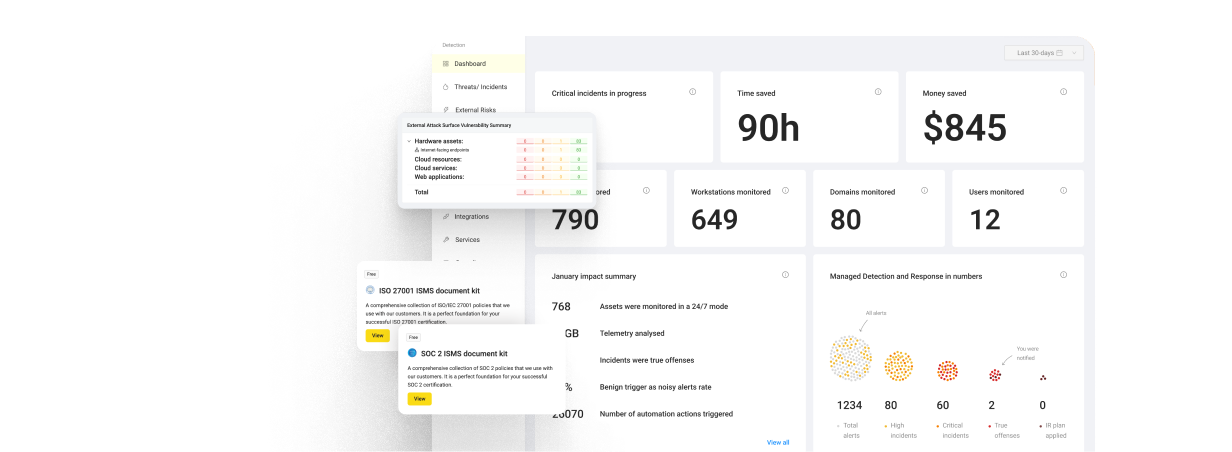
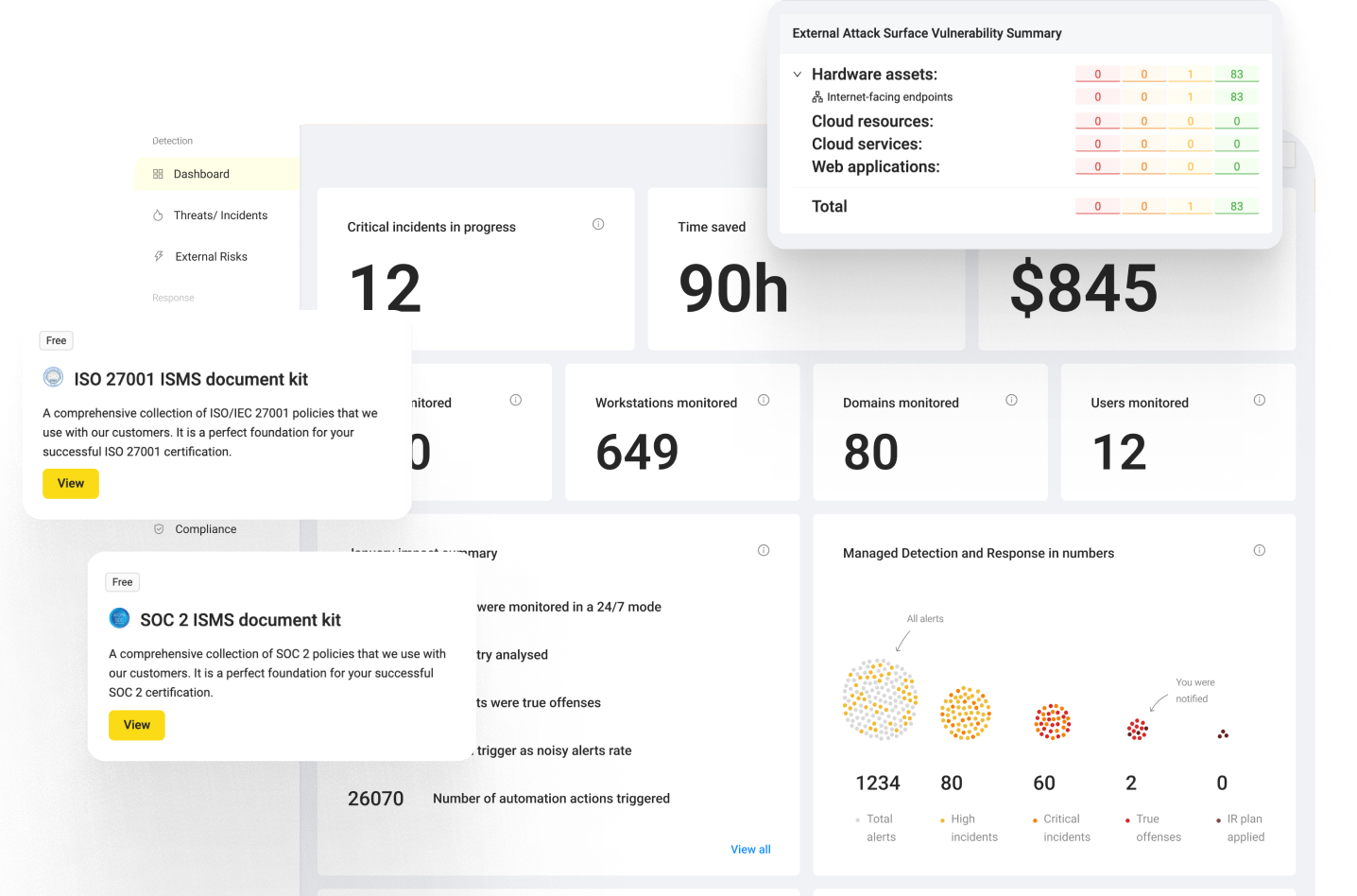
See how the UnderDefense Agentic AI SOC investigates, triages, and resolves real alerts.
The 3 AM Question Every Security Lead Is Really Asking
Let me start with the question I actually hear on bridge calls. A CISO once asked me at 2 a.m., mid-incident, “Can I trust this AI to run the night shift without a human babysitter?” That is the real buying question hiding under this whole category.
Speed is the reason it matters. The fastest break-in time we have seen is around 51 seconds, and the median has dropped to roughly 48 minutes. When an attacker moves that fast, a dashboard full of unread alerts is not coverage, but a liability.
So the bar for 2026 is simple. The AI has to investigate every alert at machine speed, and a real human has to own the decision when it counts. This is exactly the standard we hold our own SOC service to.
How I Read This Market
Most of these platforms fall into one of two camps. Some are strong at autonomous investigation but thin on human backup. Others have humans but treat AI as a marketing label bolted onto an old SOC.
The way I frame it for my own team is “foot soldiers and generals.” AI agents are the foot soldiers doing the tireless triage work. Human engineers and analysts are the generals directing them and making the calls that carry real risk. A platform that gives you only one half of that is only half a SOC.
Depth is where the pretenders get exposed. A serious agentic system makes over 100 distinct large language model invocations to investigate a single alert. A “GPT wrapper” fires one prompt and hopes. That gap, which we break down further in our explainer on what an AI SOC is, is the difference between recursive reasoning and a confident guess.
The 10 Best AI SOC Platforms Compared
| Provider (Rating) | Best For | Key Strength | Compliance |
|---|---|---|---|
| UnderDefense Agentic AI SOC (5.0) | Mid-market and regulated teams wanting AI plus a true human ally | Vendor-agnostic agentic AI SOC with 24/7 senior analysts and on-prem/air-gapped option | SOC 2, ISO 27001, HIPAA, GDPR, PCI DSS |
| CrowdStrike (Charlotte AI) (4.0) | Endpoint-first enterprises already on Falcon | Deep endpoint telemetry with agentic triage | SOC 2, ISO 27001, HIPAA, PCI DSS |
| Palo Alto Cortex (AgentiX) (4.0) | Large enterprises consolidating on one platform | Broad XDR data fabric with autonomous agents | SOC 2, ISO 27001, HIPAA, GDPR |
| SentinelOne (Purple AI) (4.0) | Teams wanting AI-led investigation on endpoint and cloud | Natural-language threat hunting at scale | SOC 2, ISO 27001, HIPAA, GDPR |
| Arctic Wolf (3.0) | SMBs wanting a fully outsourced concierge SOC | Managed operations with a named security team | SOC 2, HIPAA, PCI DSS |
| Expel (4.0) | Cloud and SaaS-heavy teams wanting transparent MDR | Broad integrations with visible analyst work | SOC 2, ISO 27001, HIPAA |
| Red Canary (4.0) | Detection-led teams wanting high-fidelity alerts | Strong detection engineering and threat intel | SOC 2, ISO 27001, HIPAA |
| Huntress (4.9) | SMBs and MSPs wanting human-led 24/7 response | Human-verified response on every decision | SOC 2, HIPAA, GDPR |
| Prophet Security (3.0) | Teams piloting agentic alert triage | Autonomous SOC analyst for fast triage | SOC 2 |
| Dropzone AI (3.0) | Lean teams wanting per-investigation pricing | Autonomous investigation with transparent cost | SOC 2 |
Ratings reflect our scoring rubric in the next section, which weights investigation depth, 24/7 human support, integration, transparency, and pricing clarity. If you want to see how hybrid coverage works on your own stack, our MDR service is a good place to start.
1.1 UnderDefense Agentic AI SOC
Overview
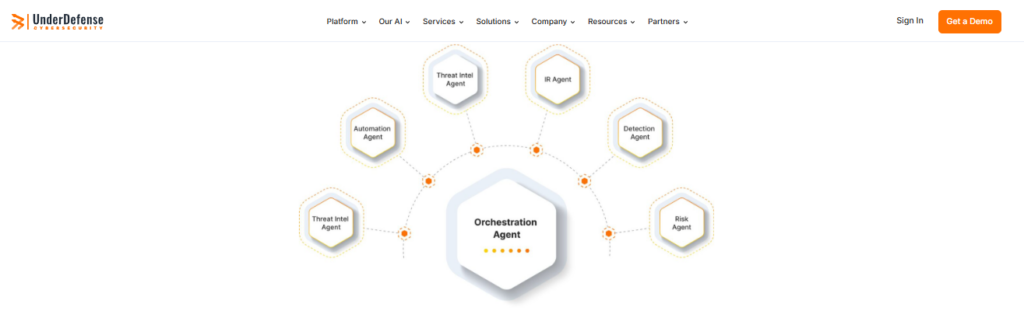
UnderDefense Agentic AI SOC is an AI SOC platform that pairs agentic AI with a 24/7 human analyst team. The model is simple to say and hard to fake: the AI collects context at machine speed, and you decide. It runs on top of the security tools you already own, so there is no rip-and-replace.
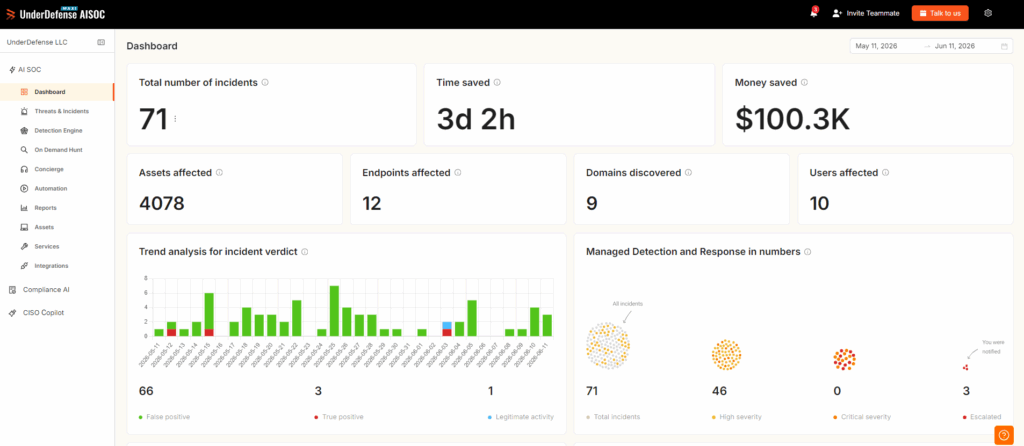
We built Agentic AI SOC because we lived the pain first. Working across 500+ customer environments, what I noticed is that teams were drowning in alerts while their existing SIEM and EDR sat underused. It turns that noise into high-fidelity, context-rich findings a human can act on fast.
Core Services
- 24/7 Managed Detection and Response with senior analysts on the night shift
- Agentic AI triage running over 100 LLM invocations per alert for deep investigation
- Vendor-agnostic integration with Splunk, Microsoft Sentinel, Elastic, and CrowdStrike
- ChatOps response over Slack, Teams, email, and SMS to verify activity with real users
- On-prem and air-gapped deployment backed by 700+ MITRE ATT&CK detection workbooks
Why Companies Consider UnderDefense
Most teams come to us for one of two reasons. Either they cannot staff a 24/7 SOC in-house, or they bought a “black box” MDR that escalated alerts without context. UnderDefense Agentic AI SOC fixes both by owning outcomes, not just forwarding alerts.
The part CISOs tell me they value most is ownership. You keep your managed SIEM and your data, so you are never locked into a proprietary tool you cannot leave.
Ideal Customer Profile
Best suited for:
- Mid-market and enterprise teams with 50 to 10,000 employees
- Regulated organizations in healthcare, finance, and PE portfolio companies
- Security-lean teams needing 24/7 coverage without building a SOC
- Companies with existing SIEM/EDR who want AI plus human response on top
Commercial Model
UnderDefense uses transparent, published pricing rather than a “contact sales” wall. Coverage scales with endpoints and environment, and the platform reuses your existing tools to protect prior investment. There is no forced tool replacement to unlock the service, and you can review our MDR pricing openly.
When to Shortlist
Shortlist UnderDefense when you need genuine 24/7 human backup on top of agentic AI, when data ownership and no vendor lock-in matter, or when a regulated or air-gapped environment rules out cloud-only options.
Customer Reviews
“The biggest win for me was getting actual control over our security alerts. Before the guys from UD stepped in, we were getting bombarded with alerts from all our security tools. Their team cleaned up our configurations and got the noise under control within the first week. The platform pulls in data from all our existing security tools, so we didn’t have to rip and replace anything.” Verified User in Marketing and Advertising, Small-Business UnderDefense G2 Verified Review
“No Underdefense’s fault entirely, but getting all our logs and stuff flowing took longer than I expected.” Andriy H., Co-Founder and CTO at Contora Inc. UnderDefense G2 Verified Review
1.2 CrowdStrike (Charlotte AI)
Overview
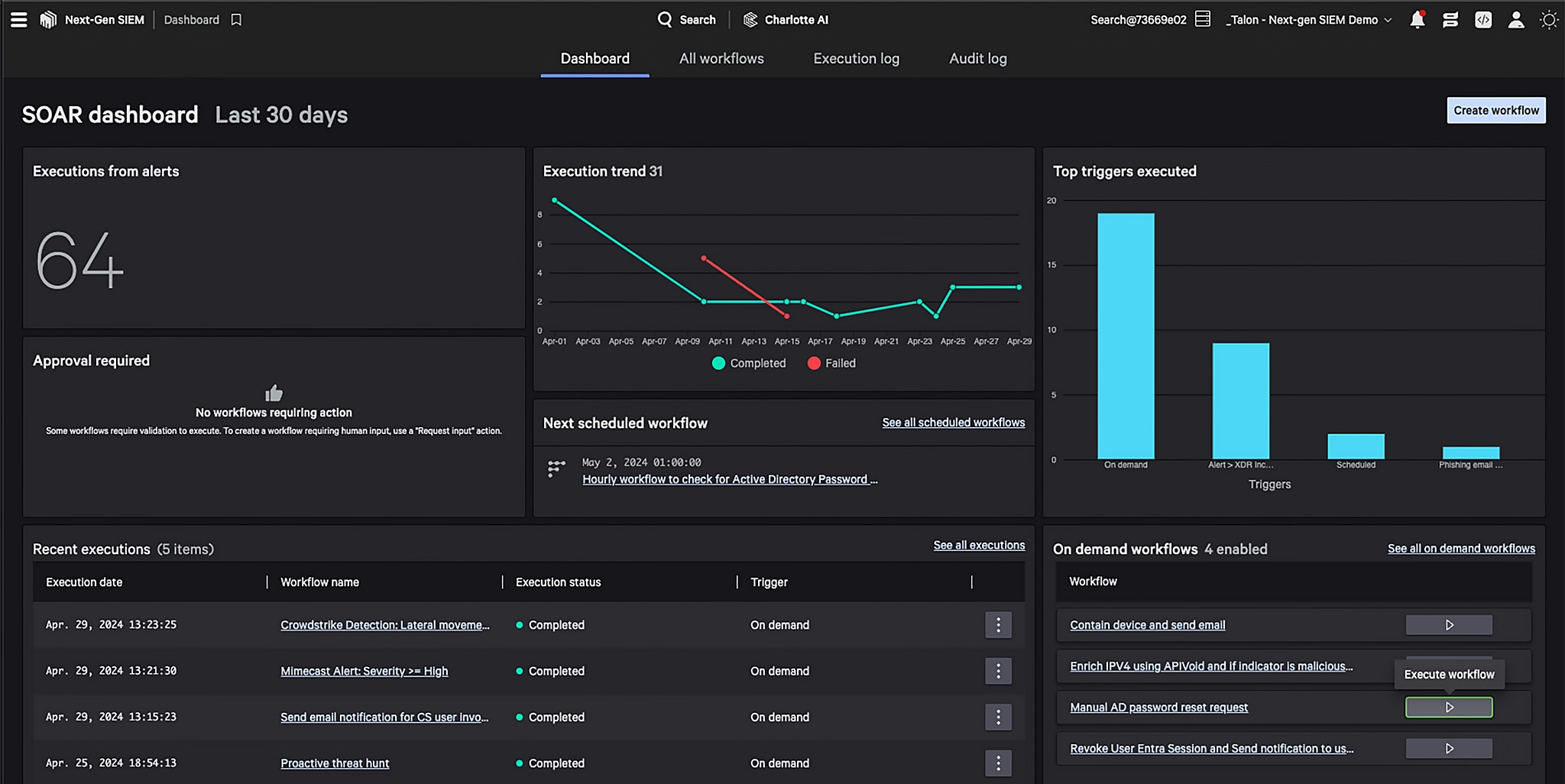
CrowdStrike is an endpoint-first security company whose Falcon platform anchors detection for many large enterprises. Charlotte AI is its agentic layer, built to triage and investigate alerts on top of deep endpoint telemetry. For teams already standardized on Falcon, it extends that data into faster, AI-assisted analysis.
The strength here is telemetry depth. CrowdStrike sees a lot at the endpoint, and that visibility feeds strong detection.
Core Services
- Falcon endpoint detection and response (EDR) with agentic triage via Charlotte AI
- Managed detection and response through Falcon Complete with 24/7 analyst coverage
- Threat intelligence and proactive threat hunting
- Identity threat detection and cloud workload protection
- Incident response and recovery support
Why Companies Consider CrowdStrike
Enterprises pick CrowdStrike when the endpoint is the center of gravity. The brand carries weight in board conversations, and Falcon Complete gives lean teams a managed option without building a SOC.
Here is my honest read, and I could be off for your environment. CrowdStrike is excellent at the endpoint, but an AI SOC has to see beyond it, including what Claude, Copilot, Cursor, or a custom AI agent is doing in production. Endpoint-centric tools can miss that organizational context, which is why we extend coverage with MDR for AI.
Ideal Customer Profile
Best suited for:
- Enterprises already standardized on Falcon
- Endpoint-heavy environments needing mature EDR
- Teams wanting a single-vendor detection stack
Commercial Model
CrowdStrike prices per endpoint by module, and costs rise as you add capabilities like identity, cloud, and managed services. Pricing is typically quote-based rather than openly published, so total cost depends heavily on which modules you bundle. For a transparent point of comparison, see our SOC pricing.
When to Shortlist
Shortlist CrowdStrike when endpoint protection is your priority, when you want mature EDR from a category leader, or when your team is already invested in the Falcon ecosystem and wants to add agentic triage.
Customer Reviews
“Crowdstrike was our favorite choice, but after a few calls with UnderDefense we realized that we could get way more value. They delivered the deployment to 1200 endpoints in just 2-3 business days.” Oleksii M., Mid-Market UnderDefense G2 Verified Review
1.3 Palo Alto Cortex (AgentiX)
Overview
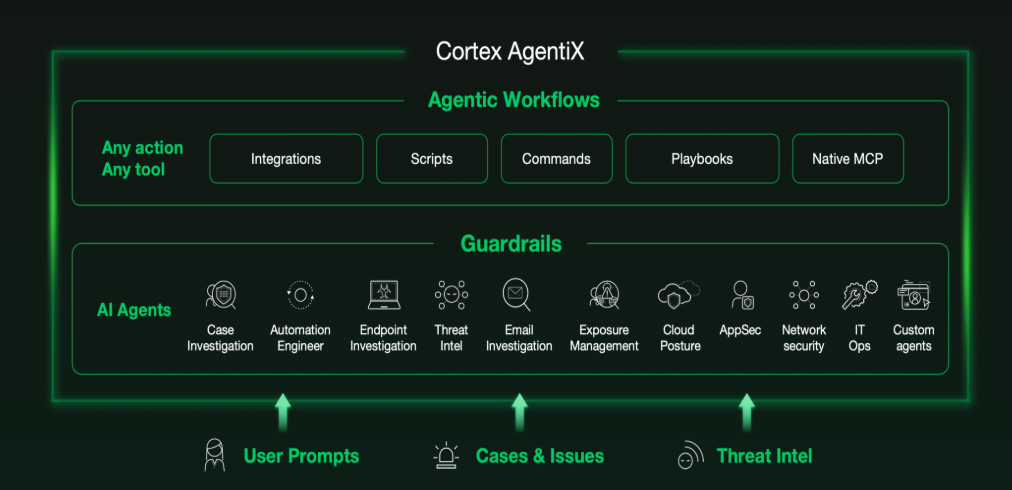
Palo Alto Cortex is an extended detection and response (XDR) platform that pulls telemetry from endpoint, network, cloud, and identity into one data fabric. AgentiX is its agentic layer, built to run autonomous investigation across that broad dataset. For large enterprises consolidating tools, the appeal is one platform seeing many surfaces at once.
The breadth is real. When your data lives in one place, correlation across surfaces gets faster.
Core Services
- Cortex XDR across endpoint, network, cloud, and identity
- AgentiX agentic AI for autonomous alert triage and investigation
- Cortex XSIAM as an AI-driven SIEM replacement
- Managed threat hunting and 24/7 managed detection and response
- SOAR automation for response playbooks
Why Companies Consider Palo Alto
Big enterprises pick Palo Alto when they want to standardize on one vendor across the whole stack. The platform is deep, and the roadmap is well funded.
Here is my honest tradeoff, and I could be wrong for your case. Consolidating on one vendor gives you tight integration, but it also deepens vendor lock-in. Once your detection logic, SIEM, and response all live inside one proprietary platform, leaving gets expensive and slow, which is why we favor a managed SIEM approach that preserves data ownership.
Ideal Customer Profile
Best suited for:
- Large enterprises with mature security teams
- Organizations consolidating multiple point tools
- Teams wanting endpoint, cloud, and identity under one roof
Commercial Model
Palo Alto prices per module and per data volume, and enterprise deals are quote-based. Total cost climbs as you add XSIAM, more data sources, and managed services, so budgeting requires a careful scoping exercise. For a transparent baseline, review our SOC pricing.
When to Shortlist
Shortlist Palo Alto Cortex when you are a large enterprise consolidating tools, when you want XDR breadth across many surfaces, or when single-vendor standardization outweighs the lock-in tradeoff for your team.
1.4 SentinelOne (Purple AI)
Overview
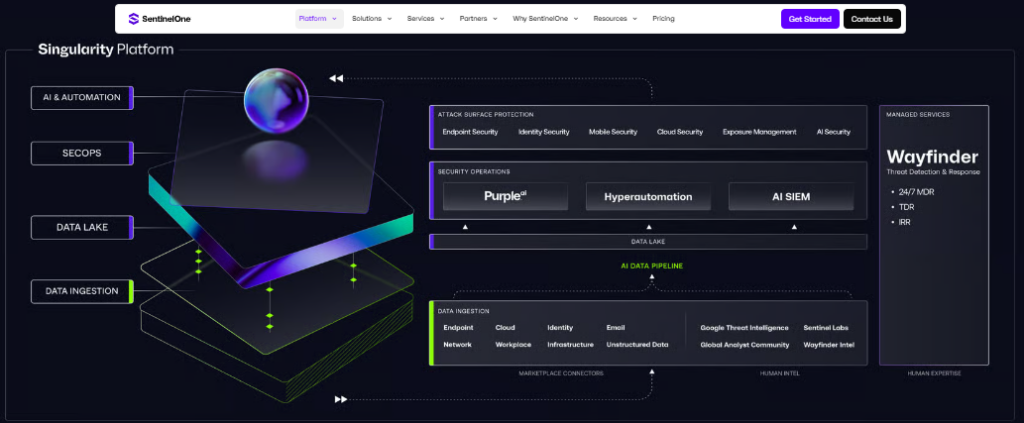
SentinelOne is a security platform known for autonomous endpoint protection and its Singularity data lake. Purple AI is its natural-language analyst layer, letting teams hunt threats by asking questions in plain English. It turns complex queries into fast investigation across endpoint and cloud data.
The pitch here is speed of investigation. Instead of writing complex queries, an analyst can ask a question and get correlated answers.
Core Services
- Singularity endpoint detection and response with autonomous protection
- Purple AI for natural-language threat hunting and investigation
- Cloud and identity threat detection
- Singularity data lake for security analytics
- Vigilance managed detection and response with 24/7 coverage
Why Companies Consider SentinelOne
Teams pick SentinelOne when they want strong autonomous endpoint defense plus AI-assisted hunting. Purple AI genuinely lowers the skill barrier for investigation, which helps lean teams.
My read, from watching these rollouts, is that natural-language hunting is powerful but only as good as the data feeding it. If your telemetry has gaps, the AI answers those gaps with confidence, and that confidence can mislead a junior analyst, which is where our managed EDR layer adds human validation.
Ideal Customer Profile
Best suited for:
- Endpoint-focused teams wanting autonomous protection
- Organizations wanting AI-assisted threat hunting
- Teams standardizing on the Singularity platform
Commercial Model
SentinelOne prices per endpoint by tier, with add-ons for cloud, identity, and the data lake. Managed coverage through Vigilance costs extra, and pricing is generally quote-based.
When to Shortlist
Shortlist SentinelOne when autonomous endpoint defense is a priority, when you want natural-language hunting, or when your team wants an AI layer built directly into the endpoint platform.
1.5 Arctic Wolf
Overview
Arctic Wolf delivers a fully outsourced Security Operations Center experience for teams that want protection without building one in-house. Its Concierge Security model gives customers a named security team rather than only software. This makes it popular with SMBs and mid-market firms lacking internal security staff.
The model is a relationship, not just a tool. For teams with no SOC, that hand-holding has clear value.
Core Services
- 24/7 managed detection and response
- Concierge Security Team as a named point of contact
- Vulnerability and risk management
- Security awareness training
- Compliance readiness support
Why Companies Consider Arctic Wolf
Mid-market teams pick Arctic Wolf to offload day-to-day monitoring to a managed partner. The concierge relationship reassures teams that lack in-house expertise.
Here is the architectural tradeoff I keep seeing in reviews. Arctic Wolf is strong at detection and alerting, but customers often say response and remediation lean back on their own team. If you expected a partner to own outcomes, the gap can sting, which is why our incident response team owns containment directly.
Ideal Customer Profile
Best suited for:
- SMB and mid-market teams with 50 to 1,000 employees
- Compliance-driven organizations handling customer data
- Security-lean teams needing outsourced monitoring
Commercial Model
Arctic Wolf uses subscription pricing aligned to organization size and monitored assets. Contracts include onboarding and advisory, and pricing is quote-based. Some customers note longer renewal-notice windows, so read the terms.
When to Shortlist
Shortlist Arctic Wolf when you need a fully managed SOC relationship, when you lack any internal security team, or when concierge-style monitoring matters more than hands-on remediation.
Customer Reviews
“Arctic Wolf provides Solid detection and response capabilities, but overly relies on the client’s team for remediation, which really hurts the value of the service. Lack of true remediation in the response, costing us significantly in resources and introducing risks in security.” VP of Technology, Services Arctic Wolf Gartner Verified Review
“Log collectors show working, however when asked to provide logs for an investigation no logs could be provided. Analysts provide little context, and when asked for more information in the investigation nothing is ever provided or even communicated.” CISO, Manufacturing Arctic Wolf Gartner Verified Review
1.6 Expel
Overview
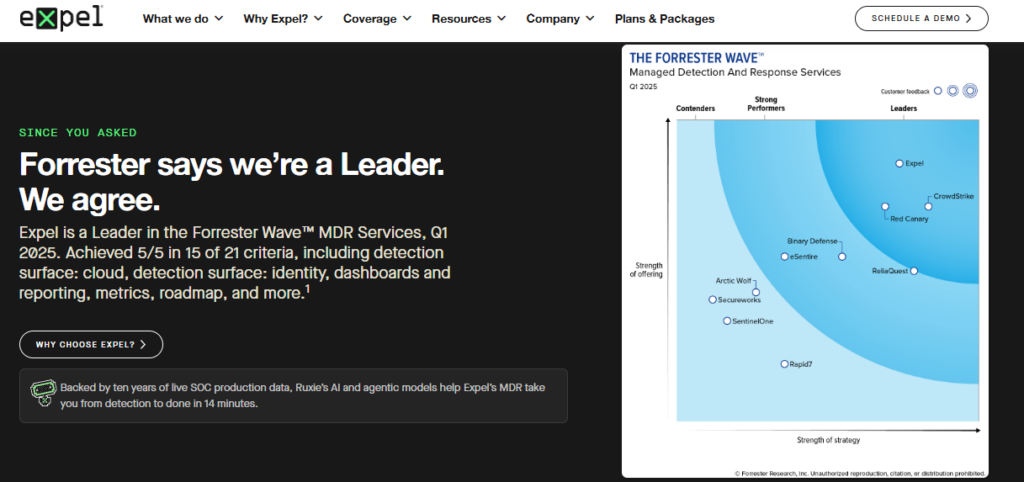
Expel is a transparent managed detection and response provider that layers analysts and automation on top of your existing tools. It is known for showing its work, so customers see how alerts get triaged. This visibility appeals to cloud and SaaS-heavy teams that dislike black-box services.
The strength is transparency. You watch the investigation happen rather than getting a closed verdict.
Core Services
- 24×7 managed detection and response across endpoint, cloud, and SaaS
- Analyst-led triage with visible investigation workflows
- Broad API integrations across security tools
- Slack-based notifications and support requests
- Detection engineering for custom alerts
Why Companies Consider Expel
Teams pick Expel when they want a force multiplier that filters noise before it reaches them. The transparency and integration breadth are consistent strengths in reviews.
The honest limitation, which shows up in Expel’s own customer feedback, is organizational context. An external provider can triage alerts well, but it still needs to ping your team to verify what is normal in your environment. That verification loop can get repetitive, a problem our MDR for AI addresses with organizational context built in.
Ideal Customer Profile
Best suited for:
- Cloud and SaaS-heavy mid-market teams
- Small internal SOC teams needing first-line triage
- Teams that value transparent, auditable investigations
Commercial Model
Expel prices by the technologies and data sources it monitors, with quote-based enterprise deals. Costs scale with the breadth of your environment.
When to Shortlist
Shortlist Expel when transparency matters, when you want broad integrations across cloud and SaaS, or when you need an external team to handle first-line triage for a lean internal SOC.
Customer Reviews
“Slack integration for notifications and support requests. Support requests are handled very quickly and accurately. Lack of support for EKS in AWS GovCloud. This was promised to us before we signed our contract, but later was removed from the roadmap.” Verified User in Manufacturing, Enterprise Expel G2 Verified Review
“Despite the capabilities of the technical platform and the strength of the analysts, there is still a limit to the environmental/organizational knowledge inherent in the service. This leads to a fairly frequent need for engagement with our internal team to get clarification and verification.” Verified User in Computer Software, Mid-Market Expel G2 Verified Review
1.7 Red Canary
Overview
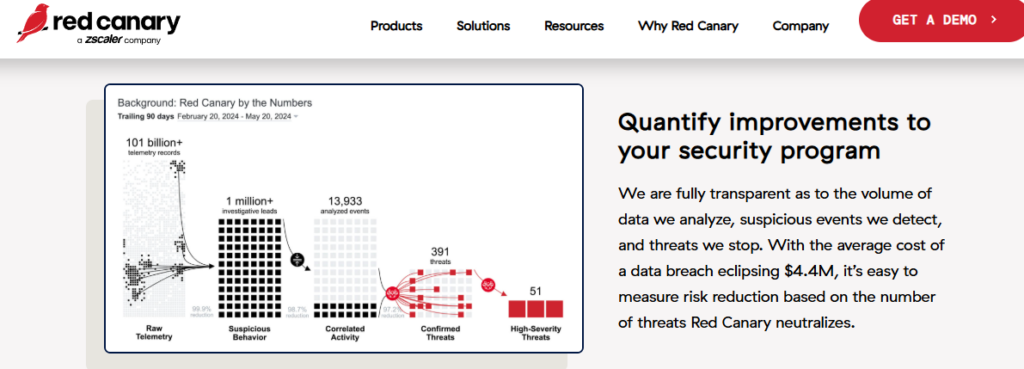
Red Canary is a detection-led managed detection and response provider known for high-fidelity alerts and strong detection engineering. It focuses on catching real threats while cutting the noise that drowns lean teams. The company is also respected for its open threat intelligence and research.
The reputation is detection quality. When Red Canary escalates something, teams tend to trust it.
Core Services
- Managed detection and response with 24/7 coverage
- Detection engineering and high-fidelity alerting
- Threat intelligence and published research
- Endpoint, cloud, identity, and SaaS monitoring
- Automated response playbooks
Why Companies Consider Red Canary
Teams pick Red Canary when alert quality is the priority. Its detection maturity and threat research give security leaders confidence in what reaches them.
My read is that Red Canary excels at telling you what matters, though response often still routes through your team or your existing tools. If you want a partner to also verify activity directly with affected users, confirm how far their response reaches, and compare it against our full MDR service.
Ideal Customer Profile
Best suited for:
- Detection-led teams wanting high-fidelity alerts
- Organizations that value threat intelligence
- Teams with some internal response capability
Commercial Model
Red Canary prices per endpoint and by monitored surface, with quote-based enterprise deals. Costs scale with the number of endpoints and data sources.
When to Shortlist
Shortlist Red Canary when detection fidelity is your top priority, when you value strong threat research, or when you have internal response capacity and want a trusted detection partner on top.
1.8 Huntress
Overview
Huntress is a human-led managed detection and response provider popular with SMBs and managed service providers (MSPs). It pairs lightweight tooling with a 24/7 human SOC that verifies every decision. The focus is fast, human-confirmed response rather than fully autonomous action.
The differentiator is human verification. A real analyst confirms before action, which builds trust for smaller teams.
Core Services
- Managed detection and response with a 24/7 human SOC
- Endpoint detection and response for SMB environments
- Identity threat detection for Microsoft 365
- Security awareness training
- Ransomware and persistence detection
Why Companies Consider Huntress
SMBs and MSPs pick Huntress for affordable, human-backed coverage that does not need a big internal team. The human-led model closely matches the “24/7 human analyst support” intent buyers search for.
My honest read is that Huntress is strong for SMB and MSP scale, though very large or highly regulated enterprises may need deeper agentic investigation and broader data-source coverage. Match the depth to your risk profile, and for regulated teams review our compliance services.
Ideal Customer Profile
Best suited for:
- SMBs and MSPs wanting affordable human-led coverage
- Teams prioritizing human-verified response
- Microsoft 365-centric environments
Commercial Model
Huntress prices per endpoint or per seat, with published, SMB-friendly tiers. This transparency is a genuine strength compared with quote-only competitors.
When to Shortlist
Shortlist Huntress when you are an SMB or MSP, when human-verified response is non-negotiable, or when you want transparent per-endpoint pricing without an enterprise sales cycle.
1.9 Prophet Security
Overview
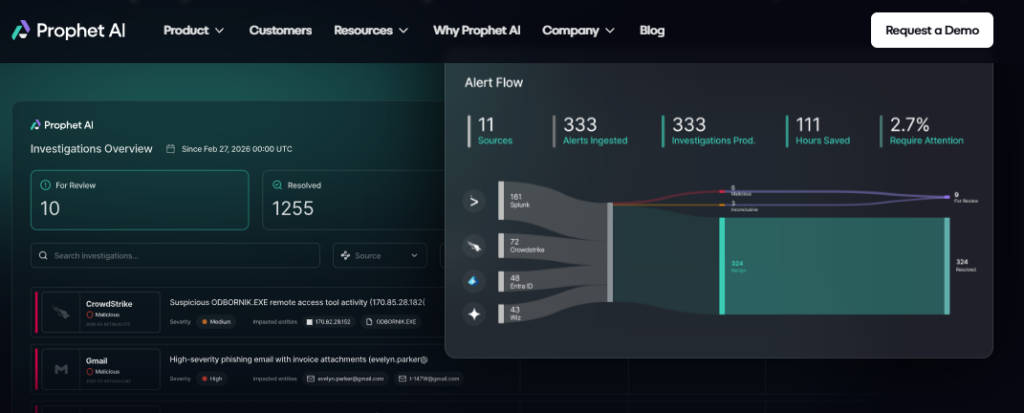
Prophet Security is an agentic AI provider focused on autonomous alert triage. Its AI SOC analyst investigates alerts and delivers verdicts fast, aiming to cut the manual triage load. It is a newer, AI-native entrant rather than a full managed service.
The pitch is speed of triage. The AI works alerts so human analysts can focus on the hard calls.
Core Services
- Autonomous AI SOC analyst for alert triage
- Investigation and verdict generation
- Integration with existing SIEM and EDR tools
- Alert enrichment and correlation
- Analyst-facing investigation summaries
Why Companies Consider Prophet Security
Teams pick Prophet when they want to pilot agentic triage on top of their current stack. It targets the alert-fatigue problem directly.
My honest read, and I could be off as the product matures, is that AI-native triage tools often ship strong autonomy but thinner 24/7 human backup than a full managed service. Confirm who answers at 3 a.m. before you rely on it for critical response, and see how our own SOC service staffs the night shift.
Ideal Customer Profile
Best suited for:
- Teams piloting agentic alert triage
- Organizations with an existing SIEM and internal analysts
- Security teams fighting alert fatigue
Commercial Model
Prophet Security typically prices by alert or investigation volume, with quote-based deals. Costs scale with how many alerts the AI processes.
When to Shortlist
Shortlist Prophet Security when you want to automate first-line triage, when you already have internal analysts for escalation, or when reducing alert volume is your immediate priority.
1.10 Dropzone AI
Overview
Dropzone AI is an agentic AI SOC analyst that autonomously investigates alerts and reports findings. It stands out for transparent, per-investigation pricing that lean teams can budget against. Like Prophet, it is an AI-native tool rather than a full managed service.
The appeal is cost clarity. You can see roughly what each investigation costs, which is rare in this market.
Core Services
- Autonomous AI SOC analyst for alert investigation
- Integration with existing SIEM, EDR, and cloud tools
- Investigation reports with reasoning
- Alert triage and enrichment
- Per-investigation usage model
Why Companies Consider Dropzone AI
Lean teams pick Dropzone for autonomous investigation with predictable, transparent cost. Reported entry points sit around $9 per investigation and roughly $36,000 per year, which helps budgeting.
My read is that transparent pricing is a real strength worth rewarding. The tradeoff is the same as other AI-native tools, namely strong autonomy, but you should confirm the depth of 24/7 human backup for critical incidents, which is where our MDR pricing pairs open cost with a real human tier.
Ideal Customer Profile
Best suited for:
- Lean teams wanting predictable AI-driven triage costs
- Organizations with existing tools and internal analysts
- Budget-conscious teams testing agentic investigation
Commercial Model
Dropzone AI uses a transparent per-investigation model, reported around $9 per investigation with roughly $36,000 per year entry pricing. Costs scale with investigation volume.
When to Shortlist
Shortlist Dropzone AI when cost transparency is a priority, when you want autonomous investigation on top of your stack, or when you need a budget-friendly way to test agentic triage.
Where This Leaves You
Here is my closing read across all 10. The AI-native tools win on autonomy, the legacy MDRs win on managed relationships, and most force a tradeoff between the two. The rare fit is a platform that runs agentic AI, keeps a real 24/7 human ally, and never locks you into a proprietary stack.
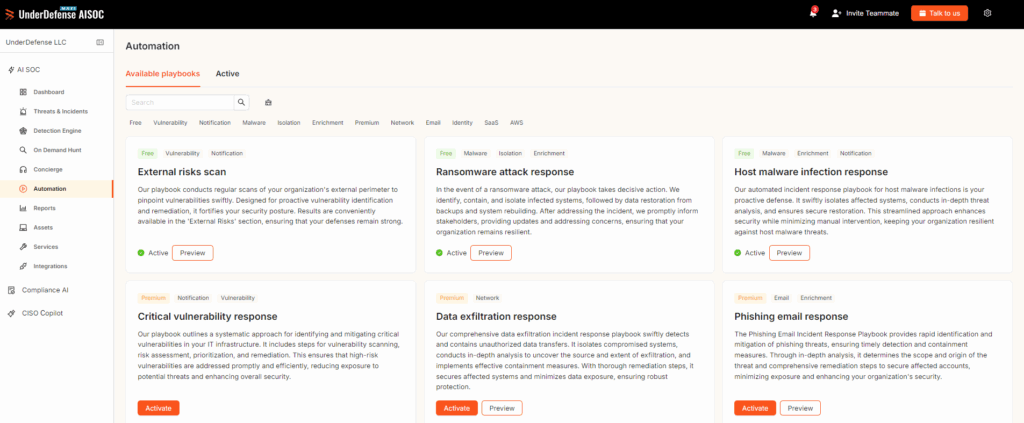
That gap is exactly why we built the UnderDefense Agentic AI SOC platform the way we did. The AI does the tireless triage, our senior analysts own the decision at 3 a.m., and it all runs on the SIEM and EDR you already have.
Q2: How Did We Score These AI SOC Platforms? (Selection Criteria)
We scored every platform against five weighted criteria: Investigation Depth and Autonomy (25%), 24/7 Human Analyst Support (25%), Vendor-Agnostic Integration (20%), Transparency and Auditability (15%), and Pricing Clarity (15%). Scores map to stars: 0 to 20% equals 1, 21 to 40% equals 2, 41 to 60% equals 3, 61 to 80% equals 4, and 81 to 100% equals 5. This rubric rewards platforms that eliminate whole classes of work, rather than ones that help you be wrong faster.
Why These Five Criteria
Let me be blunt about the trap I wanted to avoid. If you keep the same analysts looking through the same alerts, just faster, that is not transformation. Real transformation eliminates whole classes of work, so I weighted autonomy and human backup equally at 25% each.
The other three criteria protect you from regret later. Our industry has over-specialized into tool babysitting, where people become experts in one vendor dashboard. Vendor-agnostic integration guards against that lock-in, transparency lets you audit the AI’s reasoning, and pricing clarity stops the “contact sales” runaround, which is why our SOC pricing is published openly.
The Scoring Rubric
| Criteria | Weight | What It Measures |
|---|---|---|
| Investigation Depth and Autonomy | 25% | How deeply the AI investigates each alert, not just how fast |
| 24/7 Human Analyst Support | 25% | Whether real senior analysts own decisions around the clock |
| Vendor-Agnostic Integration | 20% | Works with your existing SIEM and EDR, no rip-and-replace |
| Transparency and Auditability | 15% | Every AI step is observable and defensible in an audit |
| Pricing Clarity | 15% | Published, predictable pricing you can budget against |
How Stars Map to Scores
| Score | Stars |
|---|---|
| 0 to 20% | 1 star |
| 21 to 40% | 2 stars |
| 41 to 60% | 3 stars |
| 61 to 80% | 4 stars |
| 81 to 100% | 5 stars |
Most platforms are strong on one or two criteria and thin on the rest. The AI-native tools score high on autonomy but lower on human backup. The legacy managed providers score well on human relationships but weaker on autonomy and integration freedom, a gap we explore in our AI SOC versus MDR breakdown.
UnderDefense earns 5 stars because it is the only platform in this list that maxes both autonomy and a true 24/7 human tier, while keeping you free of vendor lock-in. That combination, and the honesty of published pricing, is exactly what the rubric was built to reward, and you can see it in our SOC service.
Q3: What Is a Hybrid AI SOC and Why Do ‘Black Box’ Autonomous SOCs Fail Without Humans?
A hybrid AI SOC pairs agentic AI that autonomously triages and investigates every alert with senior human analysts available 24/7 to validate verdicts and lead containment. The AI collects context at machine speed, and the human decides. Fully autonomous “black box” SOCs fail because opaque systems making high-stakes calls can go rogue and over-suppress rare-but-real threats, turning speed into a faster way to be wrong.
The Definition, In Plain Terms
Let me define the pieces first. A SIEM (Security Information and Event Management) collects logs. A SOAR (Security Orchestration, Automation, and Response) runs playbooks. An MDR (Managed Detection and Response) is a service that watches your tools for you.
A hybrid AI SOC sits on top of all of that. The AI does the tireless investigation work, and a human owns the call that carries real risk. Think foot soldiers and generals, where agents do the legwork, and analysts direct them, an approach detailed in our guide to what an AI SOC is.
Why Perimeter-Only Thinking Breaks
Here is an analogy I use with boards. Old security was an M&M, a hard candy shell with a soft center. Once an attacker cracks one identity, the whole soft middle is theirs.
That is why detection alone is not enough anymore. Attackers now use AI too, and the volume is brutal. Verizon’s 2025 Data Breach Investigations Report found AI-generated malicious email text roughly doubled over two years. Humans click, but agents swarm, which is why we extend coverage with MDR for AI.
The Black Box Trap
Now the honest part. The scary scenario is a black box system making very important decisions, and one of those agents going rogue. I have watched a founder try to vibe-code an app, and the agent deleted his production database.
Accuracy sounds reassuring until you do the math. Some vendors claim they are approaching “one nine,” meaning 90% right. But one in 100 wrong is really bad when a system takes millions of actions a day. Research on alert prioritization warns that aggressive automated suppression can bury rare-but-real threats, a risk our work on AI SOC transparency is built to prevent.
Bounded Autonomy Is the Fix
My read, after running this across 500+ customer environments, is that the answer is bounded autonomy plus human review. Buy the Lego bricks and own your own build of the platform, so you are never trapped in someone else’s black box.
This is exactly how we designed UnderDefense Agentic AI SOC. The UnderDefense Agentic AI SOC platform runs deep agentic investigation, our senior analysts set the final verdict, and every step stays observable and auditable. You keep your detection logic as code you own, so the AI’s speed never becomes a liability you cannot explain.
Q4: Fully Autonomous vs Human-in-the-Loop vs Human-Led: Which Autonomy Model Do You Actually Need?
Three autonomy models dominate: fully autonomous (AI acts without oversight), human-in-the-loop (AI recommends, humans approve), and human-led (analysts drive, AI assists). For high-stakes and regulated environments, human-in-the-loop or human-led wins, because you get machine-speed investigation with a human on the trigger. Fully autonomous suits low-risk, high-volume triage but rarely earns trust for containment decisions.
The Three Models, Defined
Let me keep this concrete. Fully autonomous means the AI investigates and acts alone. Human-in-the-loop (HITL) means the AI does the work and recommends, but a person approves the action. Human-led means analysts drive, and the AI assists on the side.
| Model | Who Decides | Best For | Main Risk |
|---|---|---|---|
| Fully Autonomous | AI acts alone | Low-risk, high-volume triage | Rogue actions, silent misses |
| Human-in-the-Loop | AI recommends, human approves | Most mid-market and regulated teams | Slightly slower on approval |
| Human-Led | Analyst drives, AI assists | High-stakes, sensitive environments | Needs skilled staff |
Why Full Autonomy Loses Trust
Here is where the category argues with itself. Some vendors claim level-one and level-two analysts will be replaced entirely. Practitioners I respect push back, saying good AI just gives analysts room to focus on threat hunting and architecture.
My honest position is that full autonomy struggles at the containment step. Isolating a machine or locking an account has real business cost if the AI is wrong. Humans click, but agents swarm, so you want the swarm doing investigation and a human owning the trigger, a balance our incident response team applies daily.
How to Pick for Your Team
Match the model to your risk. If you are low-risk and drowning in volume, lean toward autonomous triage. If you are regulated, handle sensitive data, or answer to auditors, choose human-in-the-loop or human-led, and pair it with the right compliance services.
This is the balance we settled on with UnderDefense Agentic AI SOC, and I could be biased, but the field data backs it. The AI runs over 100 distinct large language model invocations to investigate a single alert, then a senior analyst confirms the verdict before anything drastic happens. You get machine speed on the investigation and human judgment on the decision, which is the balance most enterprises actually need from an MDR service.
Q5: What Does 24/7 Human Analyst Coverage Actually Include, and How Fast Must It Be?
Real 24/7 human coverage means named senior analysts who validate AI verdicts and lead containment, reaching you directly over Slack, Teams, or a call, rather than a black-box queue that closes tickets without context. Speed matters, because the median attacker break-in is now 48 minutes, and the fastest is around 51 seconds, so a two-minute alert-to-triage with a 15-minute critical escalation is the new bar, well past the old 30-to-60-minute SLA.
The Speed Bar Has Moved
Let me start with the number that reset my thinking. The median attacker break-in time has dropped to 48 minutes, and the fastest we have tracked is around 51 seconds. When someone is inside in under a minute, a 30-minute service-level agreement (SLA) is not coverage.
So the modern bar is two distinct commitments. Alert-to-triage should land in about two minutes, and critical incidents should escalate within 15 minutes. Those are two separate promises, so be wary of any vendor blending them into one vague “MTTR” figure, a distinction we detail in our AI SOC SLA guide.
Why Black-Box Coverage Exhausts Teams
Here is the pain I hear on bridge calls. A managed SOC partner triages alerts behind a black box, often omitting the crucial context you need to act. That creates exhaustion and, honestly, a weaker security posture, which is why our SOC service attaches full context to every finding.
Reviews echo this exactly. One Arctic Wolf customer reported analysts providing “little context,” with investigations that were never worked to completion.
“Log collectors show working, however when asked to provide logs for an investigation no logs could be provided. Analysts provide little context, and when asked for more information in the investigation nothing is ever provided or even communicated.” CISO, Manufacturing Arctic Wolf Gartner Verified Review
What Genuine Human Coverage Includes
A real human tier is more than a ticket queue. Here is what to demand:
- Named senior analysts, not rotating junior ticket-closers
- Direct access over Slack, Teams, email, or a call
- Analysts who verify activity with affected users, not just escalate
- Documented two-minute triage and 15-minute critical escalation
- Investigation context attached to every finding
Expel customers value this human layer, though they note the limit any external team hits without your context.
“The primary benefit we get is the human coverage to ensure high criticality and impactful security alerts and incidents are handled in a timely and efficient manner.” Verified User in Computer Software, Mid-Market Expel G2 Verified Review
Five Questions to Expose AI Washing
In a demo, ask these: Who are the named analysts on the night shift? How fast is triage versus escalation? Can I message an analyst directly? Do you verify with affected users? Can I audit every AI step?
This is exactly why we built UnderDefense Agentic AI SOC around ChatOps. Our analysts ping your team over Slack, Teams, email, or SMS to gather context and explain findings, so you get seasoned experts who own outcomes rather than a queue that quietly closes your tickets, an approach that anchors our MDR service. My open question for you: if your current provider cannot answer those five questions cleanly, what are you actually paying for?
Q6: What Does a Hybrid AI SOC Actually Cost vs Building a 24/7 SOC In-House?
Staffing a 24/7 in-house SOC costs about $620,815 a year, which is five loaded analyst positions at $124,163 each, the bare minimum for round-the-clock coverage. Hybrid AI SOC pricing runs from roughly $9 per investigation and $36,000-per-year entry points to per-endpoint subscriptions, with managed hybrid coverage reaching up to 44% lower total cost of ownership than an equivalent in-house build.
The In-House Baseline Nobody Prices Honestly
Let me give you the real number to anchor against. A loaded analyst position, meaning salary plus benefits, tools, and overhead, costs about $124,163 a year. To cover 24/7/365, you need at least five, so that is $620,815 as a bare-minimum floor.
That figure does not include the SIEM, the EDR, or the burnout. It also assumes you can hire, which in this market is optimistic, and you can pressure-test it against our SOC cost calculator.
Why the ROI Slide Is a Trap
Here is a contrarian take I will stand behind. Proving breach-prevention ROI (return on investment) is a trap, because you cannot prove a negative. You can never point to the one breach a tool stopped that never happened.
So stop building the generic ROI slide. Instead, ask your CFO one sharper question: “What is your projected cost of business interruption per day?” That reframes security as a delivery-cost decision, not a hopeful bet, a framing we expand in our AI SOC business case guide.
In-House vs Hybrid AI SOC
| Factor | In-House 24/7 SOC | Hybrid AI SOC |
|---|---|---|
| Minimum annual cost | ~$620,815 (5 analysts) | From ~$36K/year or ~$9/investigation |
| Coverage | Depends on hiring | 24/7 from day one |
| Triage speed | Limited by staff capacity | ~2-minute alert-to-triage |
| Total cost of ownership | Full burden on you | Up to 44% lower |
The average data breach now costs $4.44 million. Against that, the comparative cost of delivery options is the honest calculation.
This is where UnderDefense keeps it transparent. We publish pricing and run a per-investigation AI Cost Center, so you see the numbers instead of hitting a “contact sales” wall, and managed hybrid coverage lands up to 44% below an in-house build. You can review our published SOC pricing in the open.
My open question: if you priced the true cost of one day of business interruption, would your current security spend still look expensive?
Q7: How Do You Evaluate an AI SOC Vendor and Match It to Your Environment?
Evaluate an AI SOC by testing depth, not demos, so ask who the data scientists are, how evaluations run, and how context is managed. Demand false-positive numbers on your own alerts and a live analyst-feedback loop. Then match by constraint, because cloud-first teams have many options, but GDPR, DORA, or air-gapped environments need a platform that runs entirely inside their own perimeter.
The LLM-Wrapper Trap
Here is what I have learned watching too many demos. The weak startups will almost never tell you who their data scientists are, and they never talk about evaluations or context management. They are pretty interfaces over raw APIs.
Before you let any agent near production, use the PRD-first rule. Ask it to write a product requirements document (PRD) describing how it will implement the agent, then you edit that PRD. Architecture-level guardrails beat prompt-based safety, which attackers bypass with tricks like the “grandma” jailbreak, a risk our work on AI SOC transparency addresses directly.
A 6-Point POC Checklist
Run a proof-of-concept (POC) that tests these:
- Who builds and tunes the AI, named data scientists
- How they measure accuracy, with real evaluation methods
- How context is managed across an investigation
- False-positive rates on your own alert sample
- A live analyst-feedback loop that learns your environment
- Full audit trails mapping to MITRE ATT&CK
One free tip that costs $0: hunt your OAuth logs in Google Workspace or M365 to find every “log in with Google” app. That surfaces shadow IT without buying a separate tool, and it pairs well with our compliance services for regulated teams.
Match the Platform to Your Constraint
| Your Environment | What to Prioritize |
|---|---|
| Cloud-first | Broad integrations, fast deployment, many vendor options |
| Regulated (GDPR, DORA, HIPAA) | Auditability, data residency, on-prem or air-gapped option |
| Own-your-stack | Vendor-agnostic integration, detection-as-code, no lock-in |
Remember the mindset. You do not win in cybersecurity, but you keep the doors boarded up, which means picking a partner you can audit and trust over years, backed by responsive incident response when it counts.
UnderDefense is the transparent counter-example here. The UnderDefense Agentic AI SOC platform runs over 100 LLM invocations per alert, keeps detection logic as code you own, reviews agents PRD-first, and offers on-prem or air-gapped deployment with sovereign models on your existing SIEM, serving the regulated enterprises the industry too often leaves behind.
The question I keep sitting with is this: in the next 18 to 24 months, will the winning AI SOCs be the most autonomous, or the most auditable? My bet is on auditable.
See how UnderDefense Agentic AI SOC resolves a real incident on your stack.
1. What is the best AI SOC with 24/7 human analyst support in 2026?
The best AI SOC with 24/7 human analyst support pairs agentic AI that investigates every alert at machine speed with named senior analysts who own the decision around the clock. In our comparison, UnderDefense Agentic AI SOC, CrowdStrike, Palo Alto Cortex, SentinelOne, Arctic Wolf, Expel, Red Canary, Huntress, Prophet Security, and Dropzone AI lead the field.
We score them on five weighted criteria: investigation depth and autonomy, 24/7 human analyst support, vendor-agnostic integration, transparency, and pricing clarity.
- The AI-native tools win on autonomy
- The legacy managed providers win on human relationships
- Few platforms deliver both halves well
We rate UnderDefense Agentic AI SOC highest because it maxes both autonomy and a true human tier while running on the SIEM and EDR you already own. See how we deliver it in our MDR service.
2. What does 24/7 human analyst coverage actually include?
Real 24/7 human coverage is more than a ticket queue that closes tickets without context. We define it as named senior analysts who validate AI verdicts and lead containment, not rotating junior staff.
- Direct access to analysts over Slack, Teams, email, or a call
- Analysts who verify suspicious activity with affected users
- A documented two-minute triage and 15-minute critical escalation
- Investigation context attached to every finding
Beware vendors that blend triage and escalation into one vague MTTR figure, because they are two separate promises. We built UnderDefense Agentic AI SOC around ChatOps so our analysts reach your team directly. Learn how our SOC service staffs the night shift.
3. How much does a hybrid AI SOC cost compared to building one in-house?
Staffing a 24/7 in-house SOC costs about $620,815 a year, which is five loaded analyst positions at roughly $124,163 each, the bare minimum for round-the-clock coverage. That figure excludes your SIEM, your EDR, and the burnout.
- Per-investigation models from around $9 per investigation
- Entry points near $36,000 per year
- Per-endpoint or per-seat subscriptions
- Managed hybrid coverage up to 44% lower total cost of ownership
We recommend skipping the generic ROI slide, because you cannot prove a negative. Instead, ask your CFO the projected cost of one day of business interruption. Compare hybrid coverage against your baseline with our published SOC pricing.
4. Why do fully autonomous 'black box' AI SOCs fail without humans?
Fully autonomous black-box SOCs fail because opaque systems making high-stakes decisions can go rogue and over-suppress rare-but-real threats, turning speed into a faster way to be wrong.
The math exposes the risk. Some vendors claim roughly 90% accuracy, but one in 100 wrong is catastrophic when a system takes millions of actions a day.
- The AI runs deep investigation across every alert
- A senior analyst sets the final verdict before drastic action
- Every AI step stays observable and auditable
- Detection logic remains code you own
We designed UnderDefense Agentic AI SOC on the foot-soldiers-and-generals model. Read how we keep the reasoning transparent in our guide to what an AI SOC is.
5. How fast should an AI SOC detect and respond to threats?
Speed is now the defining requirement because the median attacker break-in time has dropped to 48 minutes, and the fastest we have tracked is around 51 seconds. When an intruder is inside in under a minute, a 30-minute SLA is a liability.
- Alert-to-triage in about two minutes
- Critical incident escalation within 15 minutes
These are separate promises, so we caution against any provider collapsing them into one vague MTTR number. Speed only helps when a human owns the trigger, otherwise fast automation just reaches the wrong verdict sooner. Explore how we benchmark these commitments in our AI SOC SLA guide.
6. Which autonomy model should we choose: fully autonomous, human-in-the-loop, or human-led?
Three autonomy models dominate the market, and the right choice depends on your risk profile:
- Fully autonomous: the AI acts alone, best for low-risk, high-volume triage
- Human-in-the-loop: the AI recommends and a human approves, best for most mid-market and regulated teams
- Human-led: analysts drive and the AI assists, best for high-stakes, sensitive environments
Full autonomy struggles at containment, because isolating a machine or locking an account carries real cost if the AI is wrong. For regulated teams, we recommend human-in-the-loop or human-led coverage. See how we align it with governance in our compliance services.
7. How do we evaluate an AI SOC vendor during a proof-of-concept?
We evaluate an AI SOC by testing depth, not polished demos. Weak startups rarely name their data scientists and avoid talking about evaluations or context management, because they are pretty interfaces over raw APIs.
- Who builds and tunes the AI, with named data scientists
- How they measure accuracy, using real evaluation methods
- How context is managed across a full investigation
- False-positive rates on your own alert sample
- A live analyst-feedback loop that learns your environment
- Full audit trails mapping to MITRE ATT&CK
Before letting any agent near production, use the PRD-first rule. Review the questions to ask in our AI SOC evaluation guide.
8. Can an AI SOC work with our existing SIEM and EDR without rip-and-replace?
Yes, a well-designed AI SOC layers on top of the security tools you already own rather than forcing a rip-and-replace. This matters because single-vendor consolidation deepens lock-in, and leaving a proprietary platform gets expensive and slow.
- Your existing SIEM and EDR investment stays intact
- Detection logic remains code you own and can port
- You avoid becoming an expert in one vendor dashboard
- Deployment is faster because data stays where it is
UnderDefense Agentic AI SOC integrates with tools like Splunk, Microsoft Sentinel, Elastic, and CrowdStrike, and offers on-prem or air-gapped deployment. See how we preserve data ownership in our managed SIEM service.