








Your largest client’s security questionnaire asks who watches your systems at 2 a.m. on a Sunday, and how fast you contain a breach of their files. If the honest answer is “our IT team, on Monday,” that answer can cost the firm its place at the client’s next outside counsel review and raise its cyber insurance premium at renewal.
Here is how to give that question a better answer.
TL;DR
- Why cybersecurity for law firms turns on nights and weekends, and what attackers want from a firm.
- What the American Bar Association (ABA) ethics rules ask of a firm, and what clients and insurers now ask it to prove.
- Seven controls that stop common law firm attacks, with the evidence clients accept for each.
- A step-by-step 24/7 incident response plan, plus three ways to cover nights and weekends.
Table of contents
- Why Attackers Target Law Firms: Client Files, Wire Instructions, and Unwatched Weekends
- What the Ethics Rules Ask: Reasonable Efforts Under Rule 1.6(c)
- What Clients and Insurers Now Ask Law Firms to Prove
- Seven Controls That Stop the Most Common Law Firm Attacks
- A 24/7 Incident Response Plan for a Law Firm, Step by Step
- Who Watches the Firm at Night: In-House, Outsourced, or Shared Coverage
- UnderDefense: 24/7 Detection and Response on the Stack Your Firm Already Runs
- Frequently Asked Questions
Clients now put that question in writing, in outside counsel guidelines and security questionnaires, and cyber insurance renewals ask it in their own form.
This guide is for managing partners and the IT leaders who answer client security questionnaires at firms running Microsoft 365, a document management system such as iManage or NetDocuments, and an endpoint detection and response tool. You’ll leave knowing what the ethics rules ask, which controls answer the questionnaire, and how to cover the hours when nobody is in the office.
The plan in section five is written for a small IT team without its own night shift. It assigns each step to a named role, so the managing partner, ethics counsel, IT, and outside responders all know their part before anything happens.
See who would answer your firm’s 2 a.m. alert, and how
Why Attackers Target Law Firms: Client Files, Wire Instructions, and Unwatched Weekends
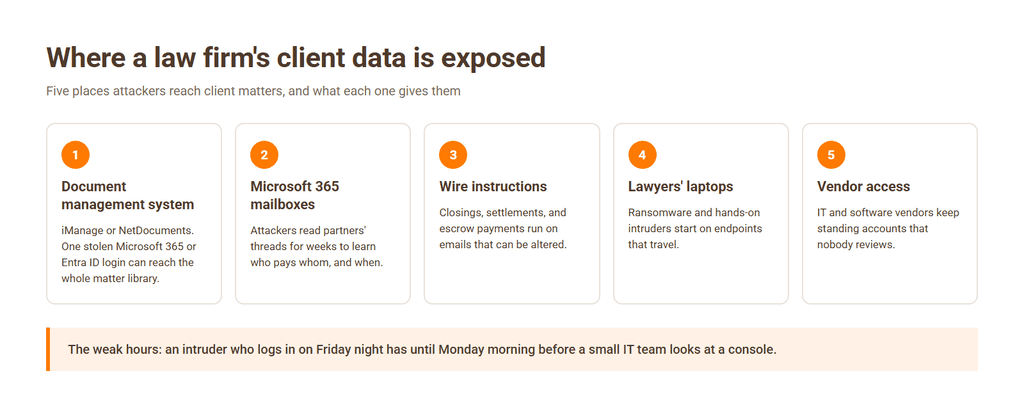
Attackers go after law firms for what the firm holds on behalf of others. A single firm keeps merger drafts, litigation strategy, patents, and personal data for hundreds of clients, which makes it a shortcut into all of them.
Client files in the document management system
Your document management system, whether iManage or NetDocuments, is where those files live. The ABA’s 2024 Legal Technology Survey Report, released in March 2025, found that 73% of firms use cloud-based legal tools, with document management among the most adopted. For you, that means one compromised Microsoft 365 or Entra ID (Microsoft’s sign-in service) login can reach the whole matter library from anywhere.
Email and wire instructions
Closings, settlements, and escrow payments run on emails that carry wire instructions. The FBI Internet Crime Complaint Center’s 2024 IC3 report, published in April 2025, logged 21,442 business email compromise complaints and $2.77 billion in reported losses, second only to investment fraud. A single spoofed email to a client before a closing can send their funds to an account nobody can recover.
The pattern repeats across firms: an attacker reads a partner’s mailbox for weeks, learns who pays whom, and then sends altered instructions at the right moment. That is how business email compromise works at a firm: the theft starts with quiet mailbox access, long before any money moves.
Access to clients, and the hours nobody watches
A firm’s systems connect to its clients’ systems through shared portals, data rooms, and trusted email threads. An intruder inside the firm can send a message from a real partner’s account, which a client’s staff has every reason to trust.
Timing does the rest. ⚠️ Intruders who log in on Friday night have until Monday morning before a small IT team looks at a console, and that weekend is enough to copy a matter library.
Firms in this position often add a security operations center (SOC), the team and tools that watch alerts around the clock, on top of the tools they already run, such as the UnderDefense Agentic AI SOC covered in section seven. That way a weekend alert reaches someone who can act on it.
What the Ethics Rules Ask: Reasonable Efforts Under Rule 1.6(c)
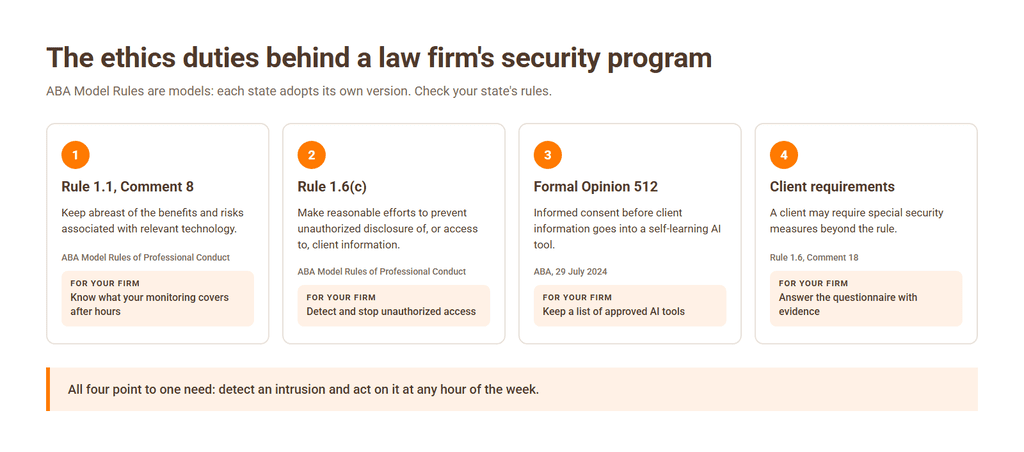
The ABA Model Rules of Professional Conduct are models: each state adopts its own version, sometimes with changes. Check your state’s rules and ethics opinions, but the model text below is the base most of them start from.
Rule 1.6(c): reasonable efforts
Model Rule 1.6(c) reads: “A lawyer shall make reasonable efforts to prevent the inadvertent or unauthorized disclosure of, or unauthorized access to, information relating to the representation of a client.” The duty covers unauthorized access, which a firm can only stop once someone notices it.
Comment 18 to the rule lists the factors that decide what “reasonable” means: the sensitivity of the information, the likelihood of disclosure without more safeguards, their cost, how hard they are to implement, and their effect on the lawyer’s work. In practice, that means weighing each safeguard against what the firm holds.
The same comment says “A client may require the lawyer to implement special security measures not required by this Rule”. A security questionnaire is exactly that requirement, put in writing.
Comment 8 to Rule 1.1: technology competence
Comment 8 to Model Rule 1.1 says a lawyer should keep abreast of “the benefits and risks associated with relevant technology”. In practice, that includes knowing what the firm’s monitoring covers after hours.
Formal Opinion 512: generative AI and client confidences
ABA Formal Opinion 512, issued on July 29, 2024, applies Rule 1.6 to generative AI tools. It says “a client’s informed consent is required prior to inputting information relating to the representation” into a self-learning tool whose output could disclose it.
The opinion also applies earlier guidance on outsourcing to AI providers, including “understanding vendor’s security policies and protocols”. If your lawyers paste matter details into AI tools, your security program needs a written answer on which tools are approved and how they store data.
What Clients and Insurers Now Ask Law Firms to Prove
Clients ask the questions their own regulators and auditors ask them. A bank, a health system, or a listed company passes its obligations down to outside counsel through engagement terms, and security becomes a contract matter as well as an ethics one.
Common asks in outside counsel guidelines include multifactor authentication on every account, encryption of client data, limits on who can open a matter, and notice of a breach within a set window. Many add a questionnaire that asks who monitors the firm’s systems, during which hours, and how quickly the firm contains an intrusion.
The questions are specific because the client will check the answers. Reviewers want the tool, the hours covered, and the name of whoever responds.
Cyber insurance applications ask the same things in their own form: MFA on email and remote access, endpoint detection and response on every device, tested backups, and an incident response plan. Many now also ask whether alerts are watched around the clock, and a cyber insurance readiness checklist maps each of those questions to the evidence an underwriter expects.
The same ABA survey found that 60% of firms have formal cybersecurity policies, and it names phishing and ransomware as major threats. A policy is what a client asks to see first, and the other 40% of firms did not report having one.
For the firms that do have one, the harder question is evidence: proof that MFA is enforced, that EDR alerts get answered at night, and that someone has rehearsed the response. Policies say what should happen, and evidence shows it does.
Before you answer the next questionnaire, list which answers you can back with a report or log, and which rest on good intentions. 💡 That list tells you where the firm’s security program is thinnest.
Seven Controls That Stop the Most Common Law Firm Attacks
The seven controls below are the core of law firm cybersecurity, covering how most intrusions start and spread: stolen logins, altered wire instructions, unmonitored laptops, and vendor accounts nobody reviews. For each one, the table names the attack it stops and the evidence a client usually accepts.
| Control | The attack it stops | Evidence a client accepts |
|---|---|---|
| Phishing-resistant MFA | Stolen passwords and session theft | Conditional access policy export |
| Email and wire-fraud controls | Altered wire instructions, spoofed partners | Call-back procedure, mail filtering report |
| EDR on every device | Ransomware and hands-on intruders | Device coverage report from the console |
| Document system access reviews | Quiet copying of whole matter libraries | Quarterly access review sign-off |
| Tested, isolated backups | Ransomware that encrypts the firm | Last restore test with date |
| Central logging | Intruders who go unnoticed for weeks | Log retention settings, alert rules |
| Vendor access controls | Breaches through IT and software vendors | Vendor account list with owners |
The first two do most of the work. Phishing-resistant MFA, such as FIDO2 keys (hardware sign-in keys) or Windows Hello for Business, stops the stolen-password logins that start most mailbox takeovers, and UnderDefense’s analysis of phishing that bypassed MFA shows why app-based codes alone fall short.
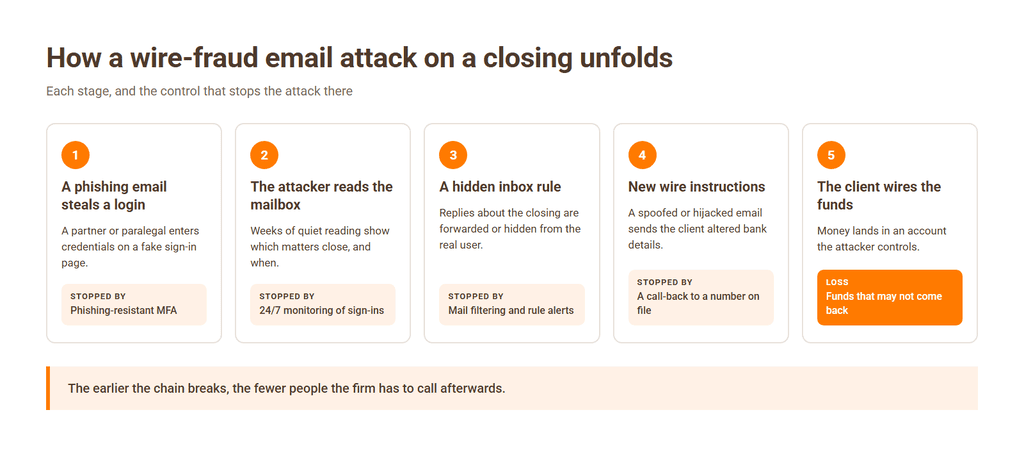
For wire fraud, a written call-back rule matters as much as any tool. Staff confirm every change to payment instructions by phone, using a number already on file, before any money moves.
EDR, logging, and access reviews only help if someone reads what they produce. CrowdStrike or SentinelOne can flag an intruder at 2 a.m., but the alert waits in a queue until a person acts on it, which is where the plan runs out.
See how your Microsoft 365 and endpoint alerts get answered at night
A 24/7 Incident Response Plan for a Law Firm, Step by Step
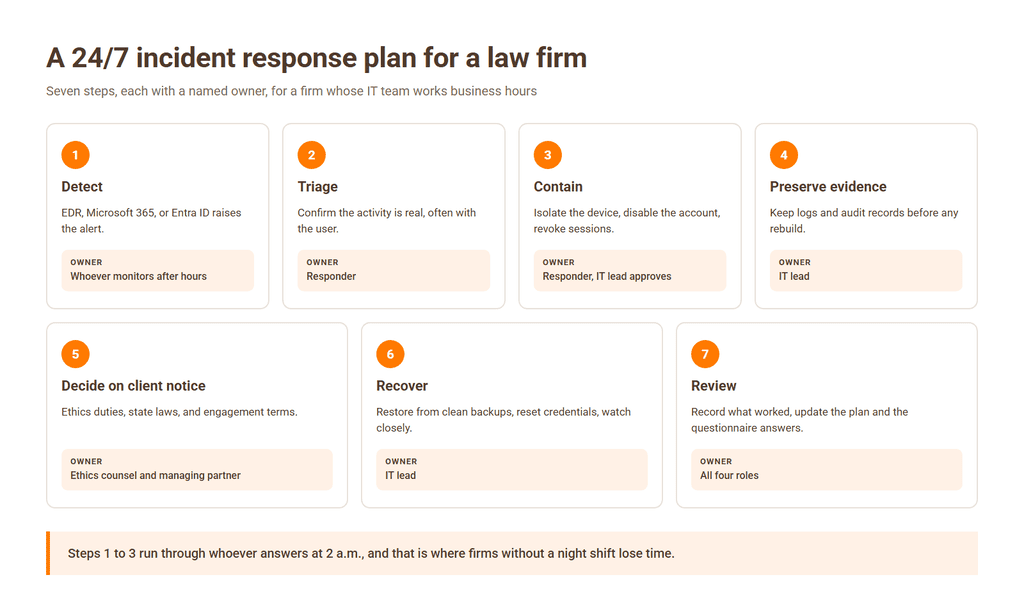
The ABA Journal reported that ABA Formal Opinion 483, issued on October 17, 2018, says lawyers “should consider proactively developing an incident response plan” before a breach happens. The plan below is built for a firm whose IT team works business hours, so every step names who acts at night and on weekends.
Before you write yours, name four roles: the managing partner, general counsel or ethics counsel, the IT lead, and an outside responder who answers at any hour, through monitoring or an incident response retainer. Put their phone numbers, and your cyber insurer’s claims contact, on paper, because a compromised mailbox is the wrong place to look them up.
- Detect. Your EDR, Microsoft 365, and Entra ID raise the alert. Whoever monitors after hours, in-house or outsourced, receives it and starts the clock.
- Triage. The responder confirms whether the activity is real, often by checking with the user whose account is involved. False alarms close here, and real ones go to the IT lead by phone.
- Contain. The responder isolates the affected device, disables the compromised account, and revokes its sessions. The IT lead approves any step that would stop lawyers working, such as taking the document system offline. If funds were sent, call the firm’s bank to request a recall and file with IC3 the same day.
- Preserve evidence. At night the responder keeps logs, mailbox audit records, and disk images, and the IT lead takes over in the morning; nobody wipes or rebuilds a machine first. Ethics counsel will need them to decide what was accessed.
- Decide on client notification. Ethics counsel and the managing partner review which client files the intruder reached. They apply the firm’s ethics duties, state breach-notification laws, and each client’s engagement terms, and decide who must hear what. On a weekend, the managing partner convenes them by phone.
- Recover. The IT lead restores systems from clean backups and resets credentials, while the responder watches the restored accounts overnight for a return visit.
- Review. Once the incident is closed, the four roles meet, record what worked, and update the plan and the questionnaire answers that depend on it.
Steps 1 to 3 are where firms without a night shift lose time. ⏱️ An intruder who is contained on Saturday morning has reached far less than one found on Monday, and that difference decides how many clients step 5 has to call.
As the ABA Journal reported, Formal Opinion 483 (October 17, 2018) also ties notice to the duty to communicate: lawyers must notify clients of a data breach under Model Rule 1.4 “in sufficient detail to keep clients ‘reasonably informed'”. Draft that notice in advance, so step 5 starts from a template.
Who Watches the Firm at Night: In-House, Outsourced, or Shared Coverage
A firm has three ways to cover nights and weekends. Each one answers the client’s 2 a.m. question differently, and each changes who acts when an alert fires.
| Option | What it covers | Who acts at night | What to ask a provider |
|---|---|---|---|
| In-house 24/7 team | Your tools, your rules, your staff | Your own analysts on shifts | Not applicable |
| Outsourced monitoring and response | Alerts from your existing tools | The provider’s analysts and responders | Microsoft 365 sign-ins and mailbox rules, or only endpoints? Response time, who contains |
| Shared coverage | Business hours in-house, nights outsourced | Provider at night, IT by day | Handover, escalation contacts, AI training on your data, data location, certification |
An in-house team gives the firm full control, but covering every hour of the week takes several analysts plus cover for leave. Few firms with a small IT team can staff that, which is why most look at the other two options.
Outsourced coverage hands monitoring and response to managed security providers, who work across your Microsoft 365, identity, and endpoint tools in shifts, the way 24/7 SOC coverage is usually staffed. Shared coverage keeps your IT team in charge during the day and hands the night to a provider, and it suits firms that want to keep their own people close to the lawyers.
Choose outsourced coverage if IT has no one to take a call after hours; choose shared coverage if your IT team wants to own daytime response and lawyer contact. UnderDefense runs either model on the tools the firm already has.
Whichever model you choose, use the table’s last column as your shortlist questions. A provider that returns an alert without the investigation leaves your team to start again on Monday, and that leaves the client’s 2 a.m. question unanswered.
UnderDefense: 24/7 Detection and Response on the Stack Your Firm Already Runs
The UnderDefense Agentic AI SOC watches your Microsoft 365, identity, and endpoint alerts every night and weekend, investigates each one, and records the reasoning behind every closed alert: which sources were checked, what was found, and who decided.
UnderDefense is rated 5.0 out of 5 from 83 reviews on G2 as of November 2026, and the company is ISO 27001 certified.
Suspicious sign-ins are confirmed with the lawyer over Teams, Slack, email, or SMS, so the 2 a.m. question on your client’s questionnaire has a log behind it. Your email, identity, CrowdStrike or SentinelOne, and security information and event management (SIEM) tools stay where they are. AI agents investigate each alert, and analysts decide on escalation and containment.
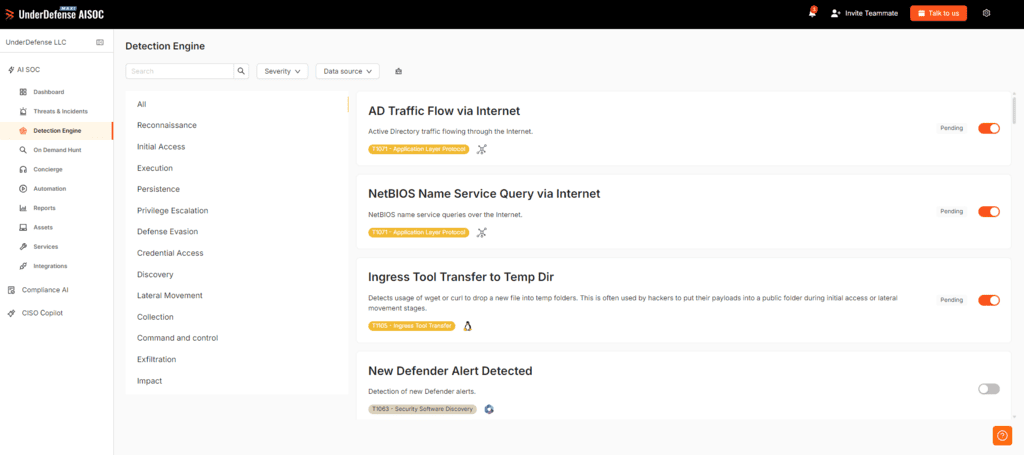
When a login from an unknown device fires on a Sunday, the Agentic AI SOC takes about 2 minutes from alert to triage. The SLA is 15 minutes for escalation of critical incidents, and your IT lead is alerted in Teams or Slack with the investigation attached.
With 250+ integrations, the tools you run today stay in place, and a team of 150+ people, including 40 incident response professionals, acts on what the agents find. The Agentic AI SOC goes live within 10 days, and full onboarding with detections customized to your firm takes 30 days.
The platform doesn’t train AI on client data, and it runs as SaaS in an isolated tenant, as a hybrid deployment, or fully on-premises and air-gapped, so matter data can stay where your clients require.
UnderDefense publishes its starting price, $11 per asset per month. The Standard tier covers your endpoints 24/7 and includes a 40-hour incident response retainer. Microsoft 365 monitoring sits in the next tier up, with cloud, SaaS, and email coverage, and each tier is quoted for your asset count.
A 100-person licensing firm in Colorado shows what an unwatched professional-services firm can be carrying. It had no dedicated security team, and a vulnerability scanner was its only tool.
During a security audit, 11 mission-critical servers turned out to be already infected with Cobalt Strike, an attacker’s remote-control tool. The case study reports: “It took us less than 24 hours to move from detecting Cobalt Strike to removing the malware from 11 critical servers.”
A founder and CEO of a small IT services company wrote this on G2 in August 2026:
“filling out complex security questionnaires for new enterprise clients is much easier now because we have proof of 24/7 monitoring” Bohdan P., Founder & CEO, Small-Business (50 or fewer emp.), G2 review
Plan your firm’s 24/7 coverage with a security expert
The UnderDefense Agentic AI SOC covers the nights and weekends this guide plans for, on the tools your firm already runs. Your next questionnaire gets a named 24/7 answer.
Walk through an after-hours alert on your firm’s own stack
- See the investigation record you can show a client reviewer
- Watch AI agents investigate an after-hours login while an analyst decides on escalation
- Get a rollout plan for your stack: SaaS, hybrid, or on-premises
Frequently Asked Questions
Are law firms required to have cybersecurity measures?
Yes, in practice. ABA Model Rule 1.6(c) requires reasonable efforts to prevent unauthorized access to client information, and most states have adopted a version of it. Client engagement terms, cyber insurance policies, and state data laws often add specific controls on top.
What should a law firm do in the first hour of a breach?
Contain the intrusion and preserve evidence. Disable the compromised account, isolate the affected device, keep the logs, and call the managing partner, ethics counsel, IT lead, and your outside responder. Hold decisions about clients until ethics counsel knows what was accessed.
Does a law firm have to tell clients about a data breach?
Often, yes. As the ABA Journal reported, ABA Formal Opinion 483 (October 17, 2018) says lawyers have a duty to notify clients of a breach under Model Rule 1.4. State breach-notification laws and each client’s engagement terms also apply, so ethics counsel should review all three. A notice template kept in your data breach response plan saves those hours.
Is cyber insurance enough to protect a law firm?
No. Insurance pays for some costs after a breach, but it does not detect or contain an intruder, and it does not meet the reasonable-efforts duty in Rule 1.6(c). Insurers also ask for MFA, EDR, backups, and a response plan before they quote.
Can a small IT team cover security around the clock?
Rarely on its own, because round-the-clock cover needs someone awake on every shift, holidays included. Most small teams keep business hours in-house and hand nights and weekends to a provider that works on their existing tools.