




24/7 monitoring and glossy dashboards give you visibility, but they aren’t a substitute for a legally enforceable Service Level Agreement (SLA). A well-written SLA in cybersecurity does three things: it clarifies who’s responsible for what, so there’s no finger-pointing during an incident; it converts vendor capabilities into testable, auditable commitments; and it gives your procurement and legal teams the leverage to demand remediation when targets are missed. In this article, we’ll explain what to look for in SLAs so you can secure measurable protection without overpaying.
Get the SOC Metrics & SLAs Guide
Expert-led insights on what to track, what to demand, and how to hold your SOC accountable.
Why the SLA in cybersecurity matters more than slides and demos
Vendors dazzle with flashy slides and polished demos, promising unbreakable security. But those sell potential, while your SLA in cybersecurity locks in real outcomes. A weak SLA offers “security theater”—unanswered alerts, inaction behind dashboards, and underperforming tools. A strong one turns vague promises into enforceable protections, detailing who responds to incidents, how quickly they act, what resources and tools are deployed, and the consequences if targets are missed.

Beyond hype, the SLA merges risk with accountability, converting claims like “24/7 monitoring” into measurable benchmarks. This matters when leaders ask about breach detection speed or regulators demand proof of controls. Without it, you’re stuck with evaporating slide decks, heightening vulnerabilities.
SLA failures ripple devastatingly. Weak commitments lead to:
- Extended downtime halting operations
- Data loss and regulatory fines (e.g., GDPR, CCPA)
- Reputational damage and customer loss
Precise SLAs are essential for resilience, compliance, and trust. In short, next time a vendor wows you with demos, pivot the conversation: “Show me the SLA.”
What a strong SOC SLA includes
A strong SOC SLA is your blueprint for reliable incident response. Focus on these essential, measurable components to ensure accountability and effectiveness:
- Scope & ownership — exactly which systems, data sources, and responsibilities the vendor covers, plus a clear list of exclusions.
- Measurable KPIs — MTTD, MTTA&A, MTTR, false positive/negative rates, and vulnerability remediation timelines. Each KPI must have a definition section that explains measurement methodology (e.g., “MTTD measured from first malicious activity timestamp to alert creation in SIEM”).
- Response & escalation — severity tiers, contact matrix, and escalation windows tied to minutes/hours, plus an executive escalation path for business-impacting incidents.
- Reporting & evidence — live dashboards, incident timelines, and post-incident RCA with improvement plans. Include what raw logs the vendor must retain and for how long.
- Legal & financial remedies — service credits, termination triggers, indemnities, and dispute resolution procedures. Define how credits are calculated and applied.
- Review cadence — scheduled SLA reviews (quarterly or biannually) so performance evolves with threats.
- Onboarding & tuning — a mandatory initial phase with milestones for rule tuning, false positive reduction, and baseline MTTD improvements.
Together, these sections make the SLA actionable: they tell your teams what to expect, force the vendor to prove performance, and provide the levers you need if service degrades.
Real metric examples you can copy into a contract
Before you paste targets into an agreement, decide which systems are most critical and whether SLA in cybersecurity clocks run 24/7 or only during business hours. Below are practical, copy-ready metric examples that balance ambition with realism.
Metric | Target | Scope / Notes |
Availability | 99.9% monthly | Covers platform uptime and SOC analyst availability for monitoring and triage. |
MTTA&A (Critical) | ≤ 15 minutes | From alert creation to analyst acknowledgement and the start of triage actions. |
MTTR (Critical) | ≤ 1 hour | Time to containment action, not full remediation. |
MTTR (High) | ≤ 2 hours | Time to containment action, not full remediation. |
Vulnerability Remediation | Critical: 24 hoursHigh: 30 days | Vendor to provide a remediation plan and escalate unpatched critical issues. |
False Positive Rate | Initial target < 50% | Vendor to provide a 6-month improvement plan; include quarterly improvement targets and remediation for persistent poor accuracy. |
Reporting | Weekly & Monthly | Weekly SLA summary; monthly trend report; raw incident timelines available on request. |
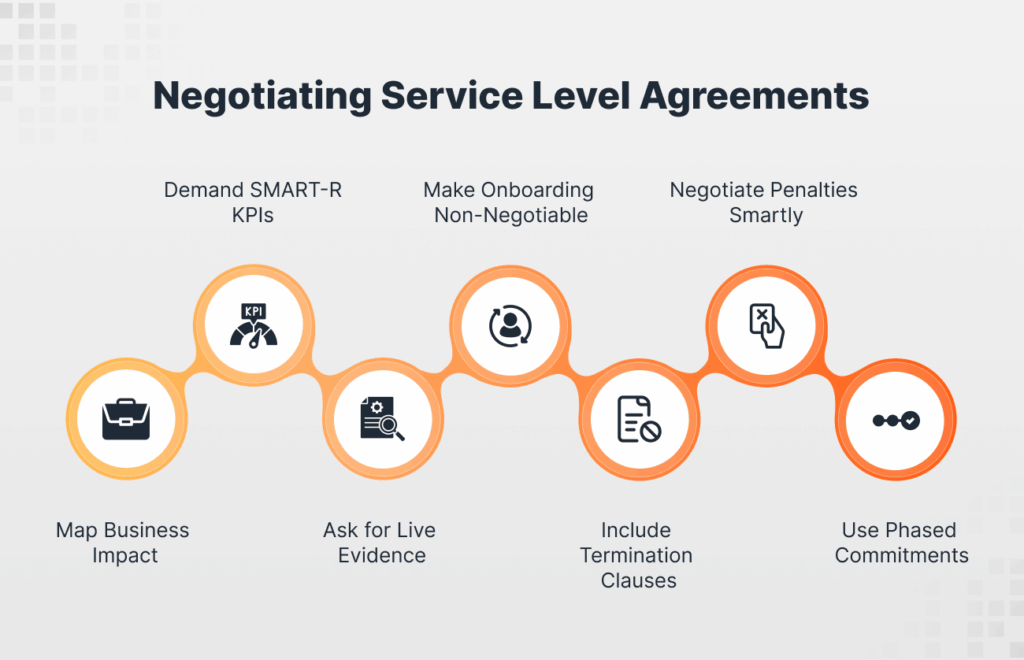
Use these as starting points, then tailor to your risk profile, compliance obligations, and operating hours. When negotiating, ask the vendor for historical performance against these targets and set realistic ramp-up expectations tied to onboarding.
Hidden SLA traps (and how to avoid them)
SLA pitfalls are usually hidden in the wording or the scope. Read contracts with an eye for what’s missing, not just what’s promised.
- Replace vague terms like “fast response” with exact timeframes in minutes or hours, and clearly define when the clock starts (business hours vs. 24/7).
- Avoid SLAs that measure speed without accuracy; add targets for false positive rate, false negative rate, or F-score to reduce alert fatigue and ensure meaningful detection.
- Ensure the SLA goes beyond detection by requiring mandatory remediation support or specifying clear handoff responsibilities, including what the vendor will do and what remains the customer’s responsibility.
- Include penalties or exit terms such as service credits, clear termination rights, and transition assistance with defined data export and knowledge transfer timelines.
- Review for hidden exclusions, such as clauses that leave out cloud-native telemetry, third-party SaaS applications, or ephemeral workloads, as these are often intentionally omitted.
To guard against these traps, require an explicit onboarding and tuning plan that includes acceptance criteria. If the vendor resists measurable commitments during the first 90 days, consider that a red flag.
Pro tip: Build a 90-day tuning and stabilization window into the contract, with explicit performance gates and acceptance criteria.
Final word: Why your SLA defines your security outcomes
A good SLA in cybersecurity forces clarity, limits ambiguity, and binds the vendor to delivering real security results. Cheap, vague SLAs are a false economy, as they buy you “security theater,” not resilience. Invest negotiation time up front: it’s the difference between a supplier who says they’ll help and a partner who actually reduces your risk.
When every minute counts, UnderDefense SOC-as-a-Service helps you outpace in-house teams with real-time detection, rapid containment, and a 99.9% commitment to keep your business protected. The combination of our human-led expertise, AI-driven accuracy, and a watertight SLA ensures that every alert leads to action and visibility.
Get the SOC Metrics & SLAs Guide
Expert-led insights on what to track, what to demand, and how to hold your SOC accountable.
1. What is an SLA in cybersecurity?
In cybersecurity, a Service Level Agreement (SLA) is a formal contract between a service provider and a client that defines measurable security performance commitments. It specifies clear metrics—such as incident response times, detection rates, system uptime, and recovery time objectives—so both parties know exactly what level of protection and service to expect. SLAs help ensure accountability, reduce ambiguity, and align the provider’s efforts with the client’s security needs.
2. What reporting, proof, and transparency should I require from a SOC provider in the SLA to ensure accountability and regulatory readiness?
Require live read-only KPI dashboards, raw incident timelines for major events, post-incident reports with root cause analysis, defined log retention and export rights, annual compliance evidence, and a set reporting cadence—plus the right to request an independent review if targets are repeatedly missed.
3. Can I mix vendor-standard SLAs with customer-specific addenda?
Yes. Use a multilevel SLA: standard vendor terms plus customer addenda for critical assets. The addenda should override conflicting standard terms and include the high-priority KPIs.
4. Are credits enough as penalties?
Credits are common but often insufficient; combine credits with remediation commitments, termination rights for repeated failures, and indemnities for negligence. For the highest-risk systems, require vendor liability for direct damages resulting from gross negligence.
5. How often should I review the SLA?
Quarterly for high-risk environments; biannual for stable setups. Also, trigger an immediate review after any material incident with repeatable findings.
6. Should SLAs include staff qualifications?
Yes. For premium tiers, require minimum analyst qualifications (e.g., GIAC, CISSP), minimum staffing levels, and documented on-call rotations.
7. What happens if cloud-native telemetry is excluded?
Clarify and negotiate a scope expansion or tool integration. Cloud telemetry exclusion often hides coverage gaps for containers, serverless, and managed cloud services.