What to do if you're hit by ransomware?

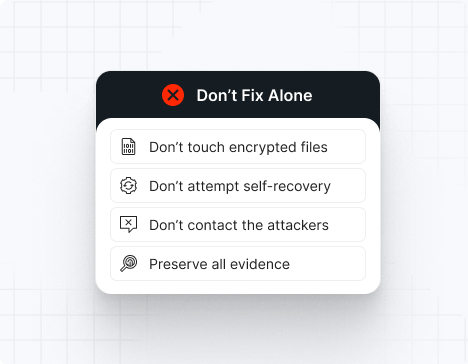
Do NOT attempt any self-remediation, as it can trigger further encryption and destroy recovery points. Instead, follow these steps:

1
Do NOT fix it yourself
2
Disconnect affected systems
3
Call us +1 332 331 8700

Contact us now for urgent ransomware response assistance, 24/7

Get Help Now
Frame

Experts. Finalists. Winners.

Accomplishments and recognitions, demonstrating our commitment to excellence and innovation.

Momentum Leader in MDR

Best Support in MDR & IR

Managed Detection and Response (MDR)

Top Cybersecurity Company 
2025

Best Managed Detection and Response Service

#4 of 184 teams Splunk Boss of the SOC

Best Of Cybersecurity Awards for Q1 2025

AWS Partner

Splunk Manage Premier Partner

Image (11) (1)

Why you shouldn’t attempt 
to fix it alone

Like a crime scene, a ransomware attack must be preserved — tampering with encrypted files, attempting self-recovery, or engaging with attackers can destroy critical evidence and reduce your chances of recovery.

Taking the right steps in the first moments after a Weyhro attack can make a huge difference and help you make a full recovery. Request 24/7 Weyhro ransomware recovery services to decrypt your data and maximize your chances of restoring operations.

Contact us now for urgent ransomware recovery assistance

Under attack?

Get Help Now

Weyhro ransomware statistics & facts

Weyhro decryptor
Weyhro IOCs
Weyhro attack vectors
Case outcomes
How to remove Weyhro ransomware?
How to recover from Weyhro ransomware?
Ransom amounts
Weyhro decryptor

Not applicable—Weyhro does not encrypt files. The threat is data publication rather than file encryption. No decryption is possible because no encryption occurs.

Weyhro IOCs

Indicators are identified through network-level data exfiltration detection, unusual file access patterns, reconnaissance tool usage, and dark web leak site monitoring.

File extensions
Not applicable—no file extensions are modified by Weyhro

Ransom note filenames
Ransom notes are typically delivered via email or Tor-based website rather than dropped on victim systems. Communication specifies amount, timeline, and Tor site contact information.

Weyhro hashes
Not applicable—Weyhro does not deploy traditional ransomware binaries to victim systems. Attack is conducted through legitimate network access and native data exfiltration tools.

Weyhro tools
– Reconnaissance: Active Directory enumeration, net.exe for network information gathering, systeminfo for system discovery
– Credential dumping: Mimikatz, lsass.exe memory extraction, registry dumping for cached credentials
– Lateral movement: PsExec, WinRM, RDP with stolen credentials, Kerberoasting
– Data exfiltration: Rclone to cloud storage (Mega.nz, OneDrive, Google Drive), FileZilla, 7-Zip + SFTP
– Persistence: Scheduled tasks, registry run keys, WMI event subscriptions
– Evasion: Firewall rule modifications, disabling security software, clearing audit logs

Most common red flag
Presence of Rclone configuration files and execution logs combined with unusual bulk file access patterns and transfers to external cloud storage accounts within 24–72 hours of initial compromise.

Weyhro attack vectors

Attack vector

% of Weyhro incidents

Notes

Phishing or credential reuse from data breaches

55%

Email phishing or credentials from previously published breaches

Unpatched external-facing applications

30%

Exchange, Fortinet, or other remote access portals without current patches

Insider threat or supply chain compromise

15%

Disgruntled employee or compromised third-party vendor with network access

Powered By WP Table Builder
Case outcomes

Weyhro victims typically experience 2–4 week intrusions before data exfiltration is complete and ransom demands are issued. Organizations with minimal data sensitivity (minimal personal or financial data) face lower ransom demands or may be ignored entirely. Organizations with valuable intellectual property, financial records, or personal customer data face demands of $100,000–$500,000. Documented victims have reported ransom demands ranging from $50,000 (smaller organizations) to $400,000 (mid-market). One documented victim in Canada paid $200,000 to prevent data publication. Organizations that refuse ransom demands typically experience data publication within 1–3 weeks.

How to remove Weyhro ransomware?

Not applicable—Weyhro does not deploy traditional ransomware. However, attackers must be removed from the network:
1. Identify and disconnect all attacker-controlled administrative accounts through forensic analysis of account creation and authentication logs.
2. Force password resets for all potentially compromised accounts, particularly administrative accounts used during the attack window.
3. Remove any persistence mechanisms created during the attack (scheduled tasks, registry run keys, WMI event subscriptions).
4. Review firewall and proxy logs to identify data exfiltration destinations and block communication to attacker-controlled cloud storage accounts.
5. Scan all systems with updated antivirus/EDR tools to identify any secondary backdoors or remote access tools.
6. Restore audit logs from backup if attackers cleared logs (check System Event Log backup files).

How to recover from Weyhro ransomware?

Not applicable—Weyhro does not encrypt data, so “recovery” is not possible in the traditional sense. However:
1. Conduct a thorough forensic investigation to identify what data was exfiltrated and document the extent of the breach.
2. Contact affected individuals if personal data was compromised; prepare for regulatory notification requirements.
3. Implement enhanced monitoring and network segmentation to prevent future intrusions.
4. Implement robust data loss prevention (DLP) solutions to detect and prevent future bulk data exfiltration.
5. Deploy EDR solutions with behavioral detection for reconnaissance and lateral movement activities.
6. Enforce multi-factor authentication on all critical accounts to reduce credential compromise impact.

Ransom amounts

Weyhro operators typically demand $50,000–$500,000 depending on the sensitivity and value of exfiltrated data, organization size, and assumed ability to pay. Organizations with large quantities of personal data (healthcare, financial services) face demands at the higher end. Negotiation may reduce initial demands by 30–50%. Payment is demanded in cryptocurrency (Bitcoin or Monero).

Our customers say it best

Contact us now for urgent ransomware recovery assistance

Under attack?

Get Help Now

Frequently asked questions

What is Weyhro ransomware?

Weyhro is an emerging ransomware-as-a-service operation that emerged in December 2024, operating a pure data extortion model without traditional file encryption. Rather than encrypting files (which triggers immediate detection at encryption time), Weyhro exfiltrates sensitive data and threatens publication on the dark web via Tor, leaving files intact but under threat of exposure. This approach avoids encryption-based detection mechanisms and eliminates the operational burden of maintaining decryption keys and managing customer recovery services.

Where is Weyhro gang located?

Operational indicators suggest Weyhro operators are based in Eastern Europe or the CIS region. The group’s activity, language patterns, and infrastructure suggest Russian or Ukrainian origin, though no definitive geolocation has been published.

How does Weyhro ransomware work?

Weyhro attacks begin with credential compromise via phishing, credential stuffing, or exploitation of unpatched external-facing applications. Attackers gain initial access and spend days or weeks conducting reconnaissance—mapping the network, identifying critical data, and locating sensitive files (contracts, financial records, personal data). Once high-value data is identified, attackers exfiltrate files using tools like Rclone to cloud storage accounts or FileZilla to attacker-controlled SFTP servers. No encryption occurs; files remain intact and functional on victim systems. Once exfiltration is complete, attackers contact the organization via Tor website or email, demanding ransom for non-publication of the stolen data.

How long do Weyhro attacks last?

From initial credential compromise to ransom demand, Weyhro attacks typically span 2–4 weeks. Initial access to reconnaissance may take 1 week; data identification and exfiltration spanning 1–3 weeks; ransom notification within 24–48 hours of completing exfiltration.

Can Weyhro ransomware be deleted or decrypted?

Not applicable—Weyhro does not encrypt files. The threat is data publication rather than file encryption. However, exfiltrated data cannot be recovered from attacker-controlled cloud storage accounts without law enforcement assistance.

What happens when infected?

When Weyhro gains access to your network, initially nothing appears unusual—files remain intact and accessible. However, attackers spend weeks accessing and copying sensitive data to attacker-controlled cloud storage. You discover the compromise only when you receive a ransom note (via email or Tor website) demanding payment to prevent data publication on the dark web. At this point, sensitive data (contracts, financial records, personal customer data, trade secrets) is already in attacker hands and cannot be recovered.

How can it be prevented?

Prevent Weyhro attacks by: (1) implementing robust email security with anti-phishing filtering and user training; (2) conducting password audits against data breach databases and forcing resets on compromised accounts; (3) implementing multi-factor authentication on all critical accounts; (4) patching all external-facing applications immediately upon release; (5) implementing network segmentation isolating sensitive data repositories; (6) deploying data loss prevention (DLP) solutions to detect and block bulk data exfiltration; (7) implementing EDR solutions with behavioral detection for reconnaissance and lateral movement; (8) maintaining detailed audit logs of file access and data movement; and (9) conducting quarterly threat-hunting exercises to identify persistence mechanisms.

What is a ransomware prevention checklist?

– Deploy robust email security with anti-phishing detection; conduct monthly security awareness training
– Audit all accounts against data breach databases; reset compromised passwords
– Implement multi-factor authentication on all critical accounts and administrative access
– Apply patches to all external-facing applications immediately (Exchange, Fortinet, Cisco, RDP services)
– Implement network segmentation isolating sensitive data repositories (finance, HR, IP) from general networks
– Deploy data loss prevention (DLP) tools to detect and alert on bulk file copying and cloud storage uploads
– Implement EDR solutions with behavioral detection for reconnaissance (net.exe, systeminfo, ADexplorer)
– Enable and monitor detailed audit logging for all file access, administrative actions, and network changes
– Implement firewall rules blocking outbound connections to suspicious cloud storage and SFTP services
– Conduct quarterly threat-hunting exercises focusing on lateral movement and persistence mechanisms
– Monitor for unusual data access patterns and alert on bulk file access by non-standard accounts
– Disable unnecessary local administrator accounts and implement privilege access management (PAM)

What makes Weyhro different from traditional ransomware groups?

Unlike traditional ransomware groups that encrypt files (triggering immediate detection at encryption time), Weyhro operates with pure data extortion. This approach is advantageous for attackers because: (1) no detection spike at encryption time, (2) no need to maintain decryption keys or provide recovery services, (3) longer dwell time before victims discover the breach (weeks vs. immediate for encryption), and (4) simpler operational model with fewer technical requirements. For defenders, Weyhro attacks are harder to detect because the only indicator is unusual data access and exfiltration—more subtle than file encryption.

How many victims has Weyhro claimed to date?

As of late February 2025, Weyhro’s leak site listed 5 documented victims. However, the group likely has conducted more attacks that have not yet been publicly acknowledged. Victims span multiple countries (Italy, Canada, United States) and appear to target mid-market and larger organizations with valuable data.