Security & Compliance Automation Platform
UnderDefense MAXI is the solution to day-to-day cybersecurity problems of IT leaders and teams. It builds your 24/7 business protection together with you on the driver’s seat.
UnderDefense MAXI Platform
UnderDefense Secures Top Honor at the 2025 Global Infosec Awards
We’re proud of being a winner at the 2025 Global Infosec Awards…
10-Point AWS Security Checklist for Executives
Quickly assess your cloud security posture with this executive-ready checklist covering IAM, monitoring, and compliance essentials.
Anti-Phishing Playbook
Your free PDF guide to spotting and stopping phishing attacks before they reach your team or data.
24/7 Threat Detection & MAXImum Responsiveness
Our human-led MDR service combines expert insight and automation and AI for fast, precise threat response. Get full context in 2 minutes and cut MTTC to 15, staying ahead of ransomware and other attacks.
Calculate your MDR price
Pay only for the services you actually need, with no hidden costs.
10-Point AWS Security Checklist for Executives
Quickly assess your cloud security posture with this executive-ready checklist covering IAM, monitoring, and compliance essentials.
Anti-Phishing Playbook
Your free PDF guide to spotting and stopping phishing attacks before they reach your team or data.
Spot threats faster and respond smarter than tools alone
24/7 MDR and SOC services led by award-winning security experts. We act as an extension to your team or as a fully remote team, providing detailed threat insights and actionable responses to secure your environment immediately.
UnderDefense is an AWS Partner
We’re excited to announce that UnderDefense is now an AWS partner and available on AWS Marketplace…
Managed SOC at Your Service
Augment your SOC with 24/7 monitoring, threat detection, and expert response—without the overhead. Integrated with your existing tools, our SOCaaS stops attacks before they cause harm.
Managed SIEM Pricing Guide
Download a clear, practical overview of Managed SIEM pricing, featuring detailed breakdowns by service type, pricing model, real-world pros and cons, and key cost factors.
Managed SOC at Your Service
Augment your SOC with 24/7 monitoring, threat detection, and expert response—without the overhead. Integrated with your existing tools, our SOCaaS stops attacks before they cause harm.
Managed SIEM Pricing Guide
Download a clear, practical overview of Managed SIEM pricing, featuring detailed breakdowns by service type, pricing model, real-world pros and cons, and key cost factors.

StormBreach ransomware recovery team on standby
StormBreach is an emerging ransomware group active in 2024–2025, distinguishing itself by combining cloud storage exfiltration with traditional file encryption to create compounded data-loss pressure on victims. Isolate affected systems and cloud accounts immediately and contact UnderDefense's incident response team — do not attempt recovery or negotiation alone.
Average Mttc
Ransom-Free recovery rate
Avoided in ransom
Global availability
Systems restored
IR experts
Ransomware cases resolved
IR experience
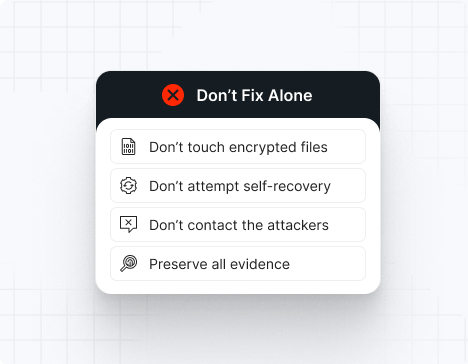
Do NOT attempt any self-remediation, as it can trigger further encryption and destroy recovery points. Instead, follow these steps:
Contact us now for urgent ransomware response assistance, 24/7
Get Help Now
Accomplishments and recognitions, demonstrating our commitment to excellence and innovation.
Momentum Leader in MDR
Best Support in MDR & IR
Managed Detection and Response (MDR)
Top Cybersecurity Company 2025
Best Managed Detection and Response Service
#4 of 184 teams Splunk Boss of the SOC
Best Of Cybersecurity Awards for Q1 2025
AWS Partner
Splunk Manage Premier Partner
Like a crime scene, a ransomware attack must be preserved — tampering with encrypted files, attempting self-recovery, or engaging with attackers can destroy critical evidence and reduce your chances of recovery.
Taking the right steps in the first moments after a StormBreach attack can make a huge difference and help you make a full recovery. Request 24/7 StormBreach ransomware recovery services to decrypt your data and maximize your chances of restoring operations.
StormBreach infections (on compromised infrastructure) display .stormbreach file extension and ransom notes named STORM_NOTICE.txt or BREACH_README.txt. Initial compromise traces to compromised cloud credentials, supply chain attacks, and internet-facing application exploitation. The group emphasizes cloud data exfiltration over traditional file encryption.
AES-256-GCM with RSA-2048 wrapping. Some cloud targets use partial encryption (database encryption preferred).
RaaS with cloud-specialist affiliate recruitment. Operators maintain infrastructure; affiliates source cloud-based targets through credential theft and cloud misconfiguration exploitation.
Dual extortion with emphasis on cloud data: database exfiltration, SaaS configuration theft, customer data leverage. Ransom demands emphasize customer notification costs and regulatory penalties as leverage.
Cloud-native: AWS S3 buckets, Azure databases, Salesforce instances, SaaS platforms. Some Windows/Linux infrastructure targeted for lateral movement to cloud.
STORM_NOTICE.txt or BREACH_README.txt with cloud-specific language about customer data and regulatory exposure.
No decryption tool available. Cloud data recovery depends on backup strategies and cloud provider recovery options.
File Extensions
.stormbreach
Ransom Note Filenames
STORM_NOTICE.txt, BREACH_README.txt, STORMBREACH_ALERT.txt
StormBreach Hashes
Limited samples. Process names less relevant (cloud-focused attacks); focus on IAM credential abuse.
StormBreach Tools
– Credential Theft: AWS access key theft, Azure service principal compromise
– Cloud Reconnaissance: S3 bucket enumeration, database discovery, SaaS app mapping
– Exfiltration: AWS/Azure CLI tools, direct cloud API data download
– Lateral Movement: Cross-cloud credential propagation, shared cloud services
– Malware: Cloud-focused malware, IAM policy modification
Most Common Red Flag
Unusual AWS/Azure API activity, large-scale S3 bucket access from anomalous IPs, database export operations, cloud credential creation/usage spikes, SaaS application logins from unusual locations.
Attack vector | % of StormBreach incidents | Notes |
Compromised Cloud Credentials | 55% | Stolen IAM keys, credential stuffing |
Supply Chain (Cloud Partners) | 25% | Third-party SaaS compromise |
Cloud Misconfiguration | 15% | Open S3 buckets, permissive IAM policies |
Internet-Facing Apps | 5% | Web application RCE to cloud access |
5–12 documented victims (primarily SaaS companies, tech firms). Ransom demands: $100K–$2M. Payment rate: 30–40% (cloud customers more motivated by customer notification costs). Cloud provider downtime: 0–24 hours typical.
Cloud focus means traditional “removal” less applicable. Remediation: 1) Revoke all compromised cloud credentials immediately, 2) Rotate AWS/Azure access keys, 3) Reset SaaS application passwords, 4) Audit IAM permissions (revoke anomalous policies), 5) Restore from cloud backups, 6) Enable cloud logging (CloudTrail, Azure audit logs).
Recovery focuses on cloud data restoration: 1) Restore databases from snapshots/backups, 2) Restore S3/Blob storage from versioning or backup, 3) Restore SaaS applications to known-good state, 4) Notify cloud provider of compromise for forensics, 5) Monitor cloud audit logs for ongoing attacker activity. Recovery timelines: 2–12 hours for cloud infrastructure (faster than traditional servers).
Documented demands: $100,000–$2,000,000. Average settlement: $250,000–$750,000. Leverage based on customer notification costs (GDPR fines, breach notification expenses) rather than pure data value.
10 reasons why you should choose the UnderDefense ransomware recovery consulting services:
Get Help NowStormBreach is an emerging RaaS operation (2024–2025) specializing in cloud infrastructure attacks. The group targets SaaS platforms, cloud-hosted databases, and technology companies. Operations emphasize cloud data exfiltration over traditional file encryption, leveraging customer data sensitivity and regulatory exposure as ransom leverage.
Cloud targets offer unique advantages: 1) Rapid data exfiltration via high-bandwidth cloud networks, 2) Customer data concentration (SaaS platforms hold thousands of customer databases), 3) Regulatory leverage (GDPR fines, SOX compliance penalties), 4) Often weaker security than on-premises infrastructure, 5) Faster victim impact (service disruption immediate). Cloud specialization allows StormBreach to operate without traditional ransomware deployment.
Common vectors: 1) Employee credential theft via phishing, 2) Compromised third-party integrations (supply chain), 3) AWS/Azure credential exposure in code repositories (GitHub accidental commits), 4) Credential stuffing on cloud platforms, 5) IAM misconfigurations (overly permissive policies), 6) Managed service provider (MSP) compromise affecting cloud customer access.
Traditional ransomware encrypts files; cloud attacks steal data directly via API calls. No encryption needed; data is immediately exfiltrated and monetized. This eliminates the need for decryption negotiations and focuses ransom on “data deletion promises” (unverifiable).
Decryption concept doesn’t apply to cloud data theft (no encryption). Recovery requires cloud backup restoration. Cloud platforms typically maintain versioning and snapshots, enabling faster recovery than traditional ransomware.
Stolen data is published on leak site and/or sold to competitors. Regulatory exposure (customer notification required, GDPR fines) often exceeds ransom amount, creating significant pressure.
1) Enforce MFA on all cloud IAM accounts and SaaS applications; 2) Implement least-privilege cloud IAM policies (deny by default); 3) Enable cloud audit logging (CloudTrail, Azure audit logs); 4) Monitor for anomalous cloud API activity; 5) Rotate cloud access keys regularly; 6) Implement cloud-native DLP (Data Loss Prevention); 7) Use cloud provider Security Groups to restrict data access; 8) Maintain immutable cloud backups; 9) Conduct cloud security posture management (CSPM) audits.
1) Assume all cloud credentials compromised; rotate immediately; 2) Revoke all anomalous IAM policies and API keys; 3) Review CloudTrail/audit logs for attacker activity timeline; 4) Identify which cloud resources were accessed (databases, S3 buckets, SaaS apps); 5) Estimate data exfiltration volume (CloudTrail shows data downloads); 6) Notify cloud provider (AWS, Azure, SaaS platform) immediately; 7) Restore from cloud backups/snapshots; 8) Enable strict monitoring on all restored resources; 9) Notify law enforcement (FBI) and customers if data exfiltration confirmed; 10) Conduct cloud security audit and remediate misconfigurations; 11) Monitor for re-compromise via anomalous cloud API activity.

StormBreach represents shift in ransomware targeting: traditional models (Hellcat, Cuba) target on-premises/hybrid infrastructure. StormBreach’s cloud specialization indicates attacker evolution toward cloud-native attacks, reflecting organizations’ increasing cloud adoption. This suggests future ransomware will increasingly target cloud platforms.
Cloud-focused operations eliminate need for traditional ransomware deployment (encryption engines, lateral movement, persistence). Attacks become faster (immediate exfiltration), cheaper (no custom malware needed), and more profitable (customer data high-value). Organizations with cloud-primary infrastructure face unique risks requiring cloud-native security approaches.