What to do if you're hit by ransomware?

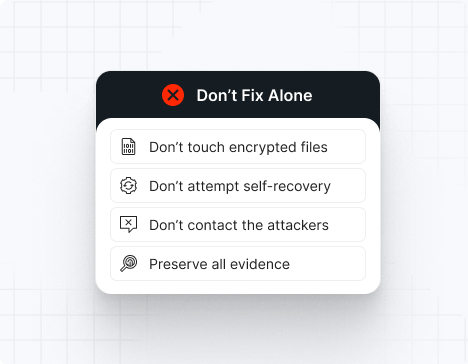
Do NOT attempt any self-remediation, as it can trigger further encryption and destroy recovery points. Instead, follow these steps:

1
Do NOT fix it yourself
2
Disconnect affected systems
3
Call us +1 332 331 8700

Contact us now for urgent ransomware response assistance, 24/7

Get Help Now
Frame

Experts. Finalists. Winners.

Accomplishments and recognitions, demonstrating our commitment to excellence and innovation.

Momentum Leader in MDR

Best Support in MDR & IR

Managed Detection and Response (MDR)

Top Cybersecurity Company 
2025

Best Managed Detection and Response Service

#4 of 184 teams Splunk Boss of the SOC

Best Of Cybersecurity Awards for Q1 2025

AWS Partner

Splunk Manage Premier Partner

Image (11) (1)

Why you shouldn’t attempt 
to fix it alone

Like a crime scene, a ransomware attack must be preserved — tampering with encrypted files, attempting self-recovery, or engaging with attackers can destroy critical evidence and reduce your chances of recovery.

Taking the right steps in the first moments after a RALord (Nova) attack can make a huge difference and help you make a full recovery. Request 24/7 RALord (Nova) ransomware recovery services to decrypt your data and maximize your chances of restoring operations.

Contact us now for urgent ransomware recovery assistance

Under attack?

Get Help Now

RALord (Nova) ransomware statistics & facts

RALord/Nova Decryptor
RALord/Nova IOCs
RALord/Nova Attack Vectors
Case Outcomes
How to Remove RALord/Nova Ransomware
How to Recover from RALord/Nova Ransomware
Ransom Amounts
RALord/Nova Decryptor

No legitimate public decryptor exists. RALord uses Rust-based encryption with unique keys per victim. Recovery requires offline backups or ransom payment. Law enforcement coordination with international partners may enable key recovery from seized C2 infrastructure, though success rate is historically low.

RALord/Nova IOCs

Search for .RALord file extension across encrypted systems. Ransom notes named README-[random_string].txt with qTox contact ID provide victim indicators. Monitor for Rust binary execution characteristics and qTox communication attempts.

File Extensions
.RALord, .ralord, .RALORD (variant-dependent; case variations observed)

Ransom Note Filenames
README-[random_string].txt (example: README-9a3f2b8c.txt)

RALord/Nova Hashes
SHA256 hashes vary significantly due to per-victim Rust compilation. Rust binary characteristics (Go/Rust runtime markers) enable behavioral detection despite compilation variations.

RALord/Nova Tools
Initial Access: Credential-based access (RDP, SSH, VPN), vulnerability exploitation (case-by-case)
Reconnaissance: Network enumeration, asset discovery, data staging
Lateral Movement: Windows administrative shares, RDP, SSH
Credential Dumping: Mimikatz, LSASS process injection techniques
Data Exfiltration: Rclone, legitimate cloud storage tools (customized per affiliate)
Encryption: Rust-based AES/RSA implementation
Communication: qTox encrypted messaging (enforced for all ransom negotiations)

Most Common Red Flag
.RALord file extensions across network shares, combined with README-[random_string].txt ransom notes containing qTox ID contact information, unusual credential usage patterns (RDP or SSH from unexpected geographies), and rapid data exfiltration via rclone or cloud storage tools.

RALord/Nova Attack Vectors

Attack vector

% of RALord incidents

Notes

Compromised Credentials (RDP/SSH/VPN)

55%

Credentials from breach databases, phishing, credential dumping

Supply Network Access

25%

Affiliate compromise of supply chain partners or service providers

Unpatched Vulnerabilities

12%

Application-specific exploits (case-by-case targeting)

Phishing with Credential Stealer

8%

Malware delivering credential dumpers

Powered By WP Table Builder
Case Outcomes

A municipality paid $300K ransom after 3-day negotiation; decryption key was provided and verified functional. An aerospace contractor refused payment; municipal government leak site exposure triggered supply chain pressure; client demanded compensation. An NGO targeted but organization claimed nonprofit status; gang did not escalate extortion per claimed policy.

How to Remove RALord/Nova Ransomware

Isolate all systems with .RALord file extensions from network immediately. Assume all credentials compromised; force password reset network-wide. Scan for and remove Mimikatz artifacts, scheduled tasks, and persistence mechanisms. Restore from verified offline backups. Monitor for re-infection attempts via credential re-use or qTox communication attempts for 6+ months.

How to Recover from RALord/Nova Ransomware

Complete recovery from offline backups is required; assume all credentials compromised and rotate all passwords before restoration. Implement network segmentation to prevent lateral movement in case of re-infection. Monitor for credential re-use attempts and qTox communication patterns for 6+ months. Engage law enforcement and negotiation specialists; Nova infrastructure may enable key recovery.

Ransom Amounts

RALord/Nova demands range from $200,000 to $5,000,000 depending on victim organization size and sector. Municipality and government targets receive higher demands. Aerospace organizations are specifically targeted with elevated demands. Negotiation is common; reported settlement rates are 30-50% of initial demand.

Our customers say it best

Contact us now for urgent ransomware recovery assistance

Under attack?

Get Help Now

Frequently asked questions

What Is RALord/Nova Ransomware?

RALord, rebranded as Nova RaaS as of April 2025, is an affiliate-based Ransomware-as-a-Service group using Rust-based encryption to target municipalities, aerospace organizations, NGOs, and international entities. The group appends .RALord extension to encrypted files and mandates qTox encrypted messaging for ransom negotiations, preventing law enforcement interception. Nova offers affiliates 85% revenue share and claims not to target schools or nonprofits—a rare ethical boundary in the ransomware ecosystem. The gang claims 73 victims since May 2025 with geographic concentration in the United States, France, Brazil, and Singapore.

Where Is RALord/Nova Based?

Attribution suggests Eastern European or Russian-based operations based on infrastructure patterns, Rust development expertise, and ransom communication preferences. The structured affiliate program suggests professional RaaS maturity and international operational capacity. No definitive nation-state affiliation has been published; group appears financially motivated.

How Does RALord/Nova Attack?

RALord/Nova gains initial access through compromised credentials (RDP, SSH, VPN) obtained from breach databases or phishing campaigns, or through recruitment of supply chain access brokers who provide network credentials. Operators establish persistence, conduct reconnaissance to identify high-value targets and data, exfiltrate sensitive data via rclone to cloud storage, and deploy the Rust-based ransomware encryptor. All ransom negotiations occur via qTox encrypted messaging to prevent law enforcement tracking.

How Long Do RALord/Nova Attacks Last?

From initial credential compromise to encryption deployment, RALord/Nova attacks average 5-12 days of dwell time, allowing for reconnaissance and data exfiltration. Some targeted incidents show acceleration to 24-48 hours if the gang detects active monitoring. The Rust encryptor enables rapid encryption due to optimized performance.

Can RALord/Nova Files Be Decrypted?

No legitimate public decryptor exists. RALord uses Rust-based encryption with unique keys per victim. Some victims who paid ransom report keys were provided and functional, suggesting the gang honors decryption agreements more reliably than some competitors. Recovery without ransom requires offline backups or law enforcement key recovery from seized infrastructure.

What Happens After RALord/Nova Encryption?

All files encrypted with .RALord extension become inaccessible. The gang exfiltrates sensitive data and threatens public release on dark web forums if ransom is not paid within 7-14 days. For municipalities and government organizations, this triggers regulatory notification obligations and public scandal. For aerospace and critical infrastructure, supply chain pressure from clients amplifies ransom pressure.

How Can Organizations Prevent RALord/Nova?

Implement multi-factor authentication on all remote access (RDP, SSH, VPN) and administrative accounts. Assume credentials from breach databases are compromised; rotate passwords quarterly. Monitor for unusual lateral movement via administrative shares and RDP sessions from expected geographies. Monitor for rclone execution; restrict to trusted administrative users only. Maintain offline, immutable backups tested quarterly. Monitor dark web forums for vendor mentions.

RALord/Nova Prevention Checklist

– Enforce MFA on all RDP, SSH, VPN, and administrative accounts
– Rotate credentials quarterly, assuming breach database compromise
– Monitor for unusual RDP/SSH sessions from unexpected geographies
– Restrict rclone execution; monitor for unauthorized use
– Implement EDR with detection rules for Mimikatz execution
– Monitor Windows administrative share access for unusual lateral movement
– Maintain offline, encrypted backup copies verified quarterly
– Implement network segmentation to restrict lateral movement
– Monitor dark web forums and threat feeds for organizational mentions
– Engage law enforcement early if compromise is detected; Nova infrastructure may enable key recovery

Why Does Nova Enforce the qTox Communication Requirement?

qTox encrypted messaging provides Nova operators multiple strategic advantages:
1) End-to-end encryption prevents law enforcement interception of ransom negotiations
2) Decentralized design prevents infrastructure seizure from disrupting communications
3) Removes paper trail compared to traditional email ransom notes
4) Forces victims to download qTox, exposing them to OSINT identification
5) Enables two-way negotiation without email authentication requirements

What Makes RALord/Nova Different from Other RaaS Groups?

Nova’s structured affiliate program (APIPN) with formalized revenue sharing (85% to affiliates) and claimed ethical boundaries (no schools/nonprofits) differentiate it from commodity RaaS groups. The specific targeting of municipalities and aerospace suggests preliminary reconnaissance and victim selection rather than indiscriminate affiliate attacks. The Rust re-implementation and qTox-mandated communication indicate technical sophistication and privacy-conscious operations.