Security & Compliance Automation Platform
UnderDefense MAXI is the solution to day-to-day cybersecurity problems of IT leaders and teams. It builds your 24/7 business protection together with you on the driver’s seat.
UnderDefense MAXI Platform
UnderDefense Secures Top Honor at the 2025 Global Infosec Awards
We’re proud of being a winner at the 2025 Global Infosec Awards…
10-Point AWS Security Checklist for Executives
Quickly assess your cloud security posture with this executive-ready checklist covering IAM, monitoring, and compliance essentials.
Anti-Phishing Playbook
Your free PDF guide to spotting and stopping phishing attacks before they reach your team or data.
24/7 Threat Detection & MAXImum Responsiveness
Our human-led MDR service combines expert insight and automation and AI for fast, precise threat response. Get full context in 2 minutes and cut MTTC to 15, staying ahead of ransomware and other attacks.
Calculate your MDR price
Pay only for the services you actually need, with no hidden costs.
10-Point AWS Security Checklist for Executives
Quickly assess your cloud security posture with this executive-ready checklist covering IAM, monitoring, and compliance essentials.
Anti-Phishing Playbook
Your free PDF guide to spotting and stopping phishing attacks before they reach your team or data.
Spot threats faster and respond smarter than tools alone
24/7 MDR and SOC services led by award-winning security experts. We act as an extension to your team or as a fully remote team, providing detailed threat insights and actionable responses to secure your environment immediately.
UnderDefense is an AWS Partner
We’re excited to announce that UnderDefense is now an AWS partner and available on AWS Marketplace…
Managed SOC at Your Service
Augment your SOC with 24/7 monitoring, threat detection, and expert response—without the overhead. Integrated with your existing tools, our SOCaaS stops attacks before they cause harm.
Managed SIEM Pricing Guide
Download a clear, practical overview of Managed SIEM pricing, featuring detailed breakdowns by service type, pricing model, real-world pros and cons, and key cost factors.
Managed SOC at Your Service
Augment your SOC with 24/7 monitoring, threat detection, and expert response—without the overhead. Integrated with your existing tools, our SOCaaS stops attacks before they cause harm.
Managed SIEM Pricing Guide
Download a clear, practical overview of Managed SIEM pricing, featuring detailed breakdowns by service type, pricing model, real-world pros and cons, and key cost factors.

Meow ransomware recovery team on standby
Meow ransomware has destroyed over 4,000 unsecured databases by exploiting misconfigured Elasticsearch, MongoDB, and Redis instances, and has since evolved into a full RaaS with file encryption and a dark-web leak site. Isolate affected systems immediately and contact UnderDefense's incident response team — do not attempt containment or negotiation alone.
Average Mttc
Ransom-Free recovery rate
Avoided in ransom
Global availability
Systems restored
IR experts
Ransomware cases resolved
IR experience
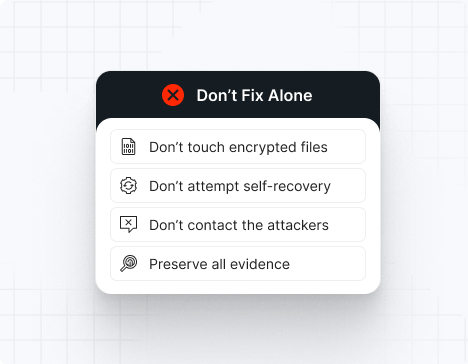
Do NOT attempt any self-remediation, as it can trigger further encryption and destroy recovery points. Instead, follow these steps:
Contact us now for urgent ransomware response assistance, 24/7
Get Help Now
Accomplishments and recognitions, demonstrating our commitment to excellence and innovation.
Momentum Leader in MDR
Best Support in MDR & IR
Managed Detection and Response (MDR)
Top Cybersecurity Company 2025
Best Managed Detection and Response Service
#4 of 184 teams Splunk Boss of the SOC
Best Of Cybersecurity Awards for Q1 2025
AWS Partner
Splunk Manage Premier Partner
Like a crime scene, a ransomware attack must be preserved — tampering with encrypted files, attempting self-recovery, or engaging with attackers can destroy critical evidence and reduce your chances of recovery.
Taking the right steps in the first moments after a Meow attack can make a huge difference and help you make a full recovery. Request 24/7 Meow ransomware recovery services to decrypt your data and maximize your chances of restoring operations.
Watch for Meow’s distinctive indicators of compromise: the .MEOW file extension on encrypted or deleted data, ransom notes (readme.txt or similar), disabled backup services, and evidence of automated scanning scripts in your logs. This malware evolved from the leaked Conti v2 ransomware code and represents a shift in extortion tactics.
Meow applies symmetric ChaCha20 encryption with rapid multi-threaded processing to maximize data corruption speed across large database installations.
Unlike traditional ransomware, Meow primarily targets unprotected databases (Elasticsearch 39%, MongoDB 11%, Redis 1.5%) rather than file systems, focusing on data destruction over recovery negotiation.
The malware scans the public internet for exposed databases with default credentials, using port-scanning techniques and banner-grabbing to identify vulnerable Elasticsearch and MongoDB clusters.
Meow operators do not maintain encryption keys or provide recovery options—data is simply overwritten or deleted, making negotiation futile and making early detection critical.
Ransom notes appear in dropped readme.txt files or are displayed via terminal output after encryption, directing victims to contact operators via email for non-existent payment arrangements.
No public decryptor exists for current Meow variants, as the malware does not preserve encryption keys and primarily focuses on data destruction rather than traditional file encryption. Any claimed decryption solutions are scams.
Attack vector | % of Meow incidents | Notes |
Unsecured Elasticsearch with default credentials | 40% | Internet-facing with no authentication enabled |
Misconfigured MongoDB with open 27017 port | 35% | Default port exposure with weak/missing auth |
Redis cache server exposure | 15% | Unprotected data stores, often missed in inventories |
Exposed Docker registries / K8s clusters | 8% | Database backups and container registries |
Cloud provider misconfiguration | 2% | AWS S3, Azure Cosmos DB with public access |
Victims typically discover Meow attacks only after data is already destroyed. Organizations report complete loss of databases in 2-6 hours after reconnaissance begins. Unlike traditional ransomware, there is no negotiation phase—the damage is permanent. Recovery depends entirely on backup solutions that were not indexed by the attacker. Many victims pay “ransoms” to non-existent operators, losing additional money with no recovery benefit. Regulatory fines and business interruption costs often exceed $500,000 for healthcare and financial entities.
1. Isolate all affected database servers immediately from the network (pull network cable if necessary) to prevent further data deletion.
2. Obtain forensic disk images of compromised systems before any remediation to preserve evidence for incident response and regulatory investigations.
3. Restore clean database snapshots or backups that were created before the attack window (verify backup integrity and air-gap protection).
4. Rebuild database infrastructure on new hardware with hardened authentication, strong credentials, and firewall rules restricting access to internal networks only.
5. Scan all network segments with updated vulnerability scanners to identify other exposed database instances.
6. Implement monitoring on MongoDB port 27017, Elasticsearch port 9200, and Redis port 6379 to detect unauthorized access attempts.
1. Assess the extent of data loss by comparing current database state against recent backups or transaction logs.
2. Restore from the most recent clean backup created before the attack (test restore process in isolated environment first).
3. If no backups exist, consult specialized database recovery firms—some data may be recoverable from disk sectors if the wiper did not perform cryptographic overwriting.
4. Validate restored data integrity through checksums, row counts, and application-layer consistency checks.
5. Re-implement access controls: enforce strong passwords (min. 16 characters), enable authentication on all database services, and require TLS encryption for all connections.
6. Set up continuous incremental backups with immutable storage (write-once, read-many backups) to prevent future data loss.
7. Document the incident timeline for regulatory reporting and cyber insurance claims.
Meow operators historically did not demand ransoms; rather, victims who contact them are directed to pay “recovery fees” ($5,000–$50,000) for keys that do not exist. Organizations that lost data typically incur recovery costs of $100,000–$2,000,000 depending on database size and criticality.
10 reasons why you should choose the UnderDefense ransomware recovery consulting services:
Get Help NowMeow is a destructive malware that targets unsecured, internet-facing databases (primarily Elasticsearch, MongoDB, and Redis) by automatically scanning for exposed instances with default or missing credentials. Rather than encrypting files for recovery negotiation, Meow either deletes or overwrites database contents entirely, making data loss permanent. The malware evolved from leaked Conti v2 ransomware source code and operates with both automated scanning infrastructure and a human-operated extortion model, though the latter involves fraudulent offers of “recovery keys” that do not actually exist.
Attribution remains uncertain, but operational patterns suggest the Meow operators are based in Eastern Europe or the CIS region. The group uses Russian-language job postings on dark web forums and demonstrates timezone-correlated activity during Eastern European business hours. No definitive nation-state attribution has been published.
Meow uses fully automated reconnaissance scanning (likely via Shodan API or similar) to identify internet-facing database instances running Elasticsearch, MongoDB, or Redis. Once a vulnerable instance is found (often with default credentials or no authentication), the malware connects directly to the database management interface and executes deletion or overwrite operations using native database commands (e.g., MongoDB’s deleteMany() or Elasticsearch’s bulk delete API). No traditional executable file is deployed to the victim’s system; instead, the attack occurs via remote database protocol exploitation.
From initial reconnaissance to complete data destruction, Meow attacks typically complete in 2–6 hours. The automated scanning and exploitation phases are extremely fast, giving organizations minimal window for detection and response once internet-facing databases are exposed.
No decryption is possible for Meow attacks. The malware does not encrypt data in a recoverable way; instead, it permanently deletes or overwrites database contents using native database operations. Even if you identify and remove the malware, the deleted data cannot be recovered without an existing backup. Paying any ransom is ineffective, as the operators do not possess keys and do not provide recovery solutions.
Upon infection, your database contents are systematically deleted or overwritten. You will discover this when application queries begin returning empty result sets or errors. A ransom note (typically readme.txt) may appear on the system, directing victims to contact operators. However, paying the requested fee will not restore data—the operators have no means to do so.
Prevent Meow attacks by: (1) never exposing database services directly to the internet; (2) enforcing strong authentication on all database services (minimum 16-character passwords, certificate-based auth preferred); (3) implementing network-level access controls and firewall rules to restrict database port access to internal networks only; (4) disabling default accounts and credentials; (5) regularly scanning your external IP ranges for exposed database ports using tools like Shodan, Censys, or nmap; (6) enabling TLS encryption for all database connections; and (7) maintaining immutable backups in a separate, air-gapped location.
– Inventory all databases and verify that none are accessible from the public internet
– Enable strong authentication (minimum 16-character passwords, preferably certificate-based) on all database services
– Disable default accounts and change all default credentials
– Implement network firewalls restricting database ports (27017, 9200, 6379) to internal access only
– Enable TLS/SSL encryption for all database connections
– Deploy continuous automated backups with immutable (write-once) storage
– Test backup restoration monthly to ensure recovery capability
– Monitor and alert on unusual database query patterns and bulk deletion operations
– Conduct a public IP scan weekly using Shodan/Censys to detect accidentally exposed services
– Require multi-factor authentication for database administrative accounts
– Implement database activity monitoring and audit logging
– Maintain offline copies of critical database schemas and configuration files
Meow is not a traditional file-encrypting ransomware; it is a database-destructive wiper that does not preserve encryption keys for negotiation. Victims cannot pay a ransom to recover files because the operators do not have decryption keys and do not offer recovery services. This makes Meow far more damaging and faster-moving than typical ransomware, as organizations have minimal opportunity to negotiate or recover through payment.
Victims are identified through automated internet-wide scanning (Shodan, Censys, or custom scanning tools) that fingerprints Elasticsearch and MongoDB banners. Once exposed databases are found, the malware immediately attempts login with default credentials, escalating to wiper operations if access is successful. Victims typically learn of the attack only after discovering their databases are empty.