What to do if you're hit by ransomware?

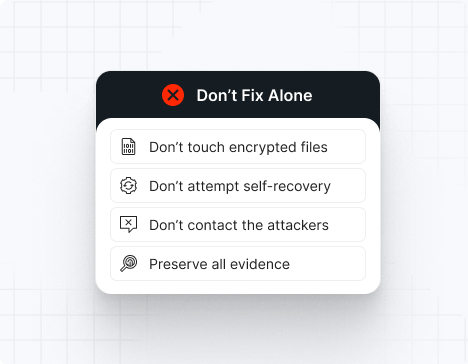
Do NOT attempt any self-remediation, as it can trigger further encryption and destroy recovery points. Instead, follow these steps:

1
Do NOT fix it yourself
2
Disconnect affected systems
3
Call us +1 332 331 8700

Contact us now for urgent ransomware response assistance, 24/7

Get Help Now
Frame

Experts. Finalists. Winners.

Accomplishments and recognitions, demonstrating our commitment to excellence and innovation.

Momentum Leader in MDR

Best Support in MDR & IR

Managed Detection and Response (MDR)

Top Cybersecurity Company 
2025

Best Managed Detection and Response Service

#4 of 184 teams Splunk Boss of the SOC

Best Of Cybersecurity Awards for Q1 2025

AWS Partner

Splunk Manage Premier Partner

Image (11) (1)

Why you shouldn’t attempt 
to fix it alone

Like a crime scene, a ransomware attack must be preserved — tampering with encrypted files, attempting self-recovery, or engaging with attackers can destroy critical evidence and reduce your chances of recovery.

Taking the right steps in the first moments after a Kairos attack can make a huge difference and help you make a full recovery. Request 24/7 Kairos ransomware recovery services to decrypt your data and maximize your chances of restoring operations.

Contact us now for urgent ransomware recovery assistance

Under attack?

Get Help Now

Kairos ransomware statistics & facts

Kairos Decryptor
Kairos IOCs
Kairos Attack Vectors
Case Outcomes
How to Remove Kairos Ransomware?
How to Recover from Kairos Ransomware?
Ransom Amounts
Kairos Decryptor

No decryption tool exists for Kairos as the group does not encrypt files. Recovery focuses on threat removal, network segmentation, and negotiation with law enforcement involvement.

Kairos IOCs

Indicators of compromise include evidence of data exfiltration tools, network connections to Kairos infrastructure, and compromised user accounts with unusual access patterns.

File Extensions
None (data-theft only model; no file encryption deployed).

Ransom Note Filenames
No ransom note files created. Victims are notified directly via appearance on the Kairos leak site at kairos-leak[.]onion.

Kairos Hashes
Kairos primarily uses legitimate tools rather than custom malware payloads. Hash intelligence is limited; focus on behavioral detection of data exfiltration and lateral movement.

Kairos Tools
Legitimate administrative tools observed in Kairos campaigns: RDP, WinRM, PowerShell remoting, credential-dumping utilities, and data transfer mechanisms via SFTP or custom uploader scripts.

Most Common Red Flag (Commands)
PowerShell commands enabling credential enumeration (Get-ADUser, Get-LocalUser), data discovery (Get-ChildItem on shares), and bulk file copying (robocopy to staging directories prior to exfiltration).

Kairos Attack Vectors

Attack vector

% of Kairos incidents

Notes

Exposed Remote Access (RDP/VPN)

45%

Weak or stolen credentials for remote services

Phishing & Credential Theft

30%

Email-based social engineering to harvest credentials

Compromised Third-Party Access

15%

Partner integrations or supply-chain compromise

Unpatched Services

10%

Exploitation of publicly known vulnerabilities

Powered By WP Table Builder
Case Outcomes

Reported victims across Kairos’ claimed portfolio include mid-market healthcare providers, insurance companies, and professional services firms. Most organizations chose to negotiate rather than pursue full incident response, suggesting high sensitivity of stolen data. Recovery timelines averaged 4–6 weeks post-detection.

How to Remove Kairos Ransomware?

Since Kairos does not deploy encryption malware, “removal” focuses on threat containment and evidence preservation. Isolate affected systems from the network immediately. Reset all credentials for affected user accounts. Conduct full network segmentation to prevent lateral movement. Engage incident response and law enforcement to coordinate containment and investigation. Forensic evidence preservation is critical for potential prosecution support.

How to Recover from Kairos Ransomware?

Recovery involves data restoration from clean backups created prior to the breach, reconstruction of exposed data architectures, and deployment of enhanced monitoring. Implement network access controls to segment sensitive data. Deploy data loss prevention (DLP) tools to detect future exfiltration attempts. Coordinate with law enforcement and cyber insurance providers. Notify affected individuals per HIPAA/GDPR requirements and establish credit monitoring services if PII was exposed.

Ransom Amounts

Kairos demands range from $100,000 to $2,000,000+ depending on organization size, data sensitivity, and perceived ability to pay. Healthcare organizations with large patient databases typically face higher demands. Negotiated settlements have reportedly ranged from 40–70% of initial demands.

Our customers say it best

Contact us now for urgent ransomware recovery assistance

Under attack?

Get Help Now

Frequently asked questions

What is Kairos Ransomware?

Kairos is an emerging extortion group that operates as a data-theft threat actor rather than a traditional file-encryption ransomware family. The group breaches corporate networks, exfiltrates sensitive data, and threatens public disclosure to force payment. Unlike ransomware that encrypts systems and forces operational disruption, Kairos causes data exposure risk and reputational damage. The group emerged in late 2024 and has primarily targeted healthcare organizations in the United States, claiming at least 13 victims within its first months of operation.

Where is the Kairos Gang Located?

The Kairos threat actor’s geographic origin is not publicly confirmed. Operational patterns and language use suggest possible Eastern European or Russian-speaking operators, but attribution remains speculative. The group uses Tor-based communication infrastructure and Session encrypted messaging for victim contact, making location determination difficult. Law enforcement agencies have not publicly linked Kairos to specific nation-state sponsors.

How Does Kairos Ransomware Work?

Kairos operates in stages: initial access via exposed remote services or phishing, credential harvesting to establish persistence, lateral movement through the target network using compromised accounts, and bulk data exfiltration using legitimate administrative tools. Once data is stolen, the group transfers it to attacker-controlled infrastructure. The victim organization is then notified of the theft and threatened with public data release unless ransom is paid. No encryption or malware deployment occurs, allowing the threat actor to remain undetected longer.

How Long Does a Kairos Attack Take?

Kairos campaigns typically unfold over 2–4 weeks from initial access to data exfiltration, depending on network size and data volume. The group appears to conduct thorough reconnaissance to identify high-value data repositories. Once sensitive information is staged and transferred off-network, victims are notified within days. The negotiation phase typically lasts 1–3 weeks before either payment or law enforcement intervention occurs.

Can Kairos Ransomware Be Decrypted?

Since Kairos does not encrypt files, decryption is not applicable. Recovery depends on restoring from clean backups and implementing stronger access controls. However, the exposure of exfiltrated data cannot be “undone”—sensitive information may still be sold or released publicly. Victims must focus on damage containment, breach notification, and regulatory compliance rather than file recovery.

What Happens If You Pay the Kairos Ransom?

Payment to Kairos does not guarantee data deletion or prevent future leaks. The group operates under no enforceable contracts or legal obligations. Historical analysis shows that some data is deleted, while other information may be sold to other threat actors or competitors. Payment does demonstrate financial capability to the threat actor, potentially increasing targeting of the same organization in the future. Most cybersecurity professionals recommend involving law enforcement and cyber insurance providers before paying.

How to Prevent Kairos Infection?

Implement multi-factor authentication (MFA) on all remote access services such as RDP, VPN, and cloud portals. Deploy endpoint detection and response (EDR) tools to monitor for lateral movement and data exfiltration. Conduct regular security awareness training focused on phishing and credential theft. Segment networks to restrict access to sensitive data repositories. Enable robust logging and SIEM alerting on credential enumeration and bulk data transfer activities. Enforce strong password policies and conduct regular credential audits.

Kairos Threat Checklist

– Disable and audit all remote access services (RDP, VPN) – Inventory and classify sensitive data repositories – Deploy multi-factor authentication on all user accounts – Enable network traffic analysis and data loss prevention tools – Conduct dark web monitoring for your organization’s data – Engage cyber insurance and legal counsel – Establish incident response procedures and test them quarterly – Train employees on phishing recognition and credential security

Does Kairos Target Specific Industries?

Kairos has shown a strong preference for healthcare organizations, particularly mid-sized providers with valuable patient data. The group also targets business services, insurance companies, and professional services firms. Healthcare is attractive due to the high value of medical records, regulatory penalties for breaches, and organizations’ willingness to pay to avoid patient notification costs and HIPAA fines.

What Should Happen If We Detect Kairos Activity?

Immediately isolate affected systems and preserve forensic evidence. Contact your incident response team and cyber insurance provider. Notify law enforcement (FBI/CISA in the US). Reset all user credentials and audit access logs. Conduct a comprehensive security assessment to identify all compromised systems. Prepare breach notification documentation for regulators and affected individuals. Implement enhanced monitoring to detect data exfiltration in progress. Do not pay ransom without law enforcement and insurance consultation.