What to do if you're hit by ransomware?

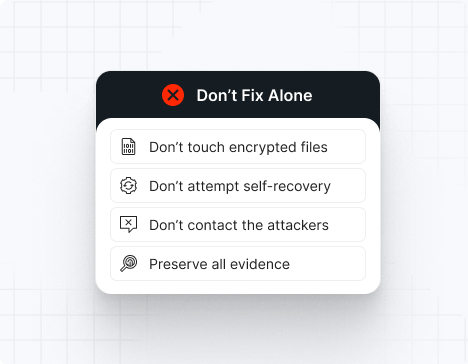
Do NOT attempt any self-remediation, as it can trigger further encryption and destroy recovery points. Instead, follow these steps:

1
Do NOT fix it yourself
2
Disconnect affected systems
3
Call us +1 332 331 8700

Contact us now for urgent ransomware response assistance, 24/7

Get Help Now
Frame

Experts. Finalists. Winners.

Accomplishments and recognitions, demonstrating our commitment to excellence and innovation.

Momentum Leader in MDR

Best Support in MDR & IR

Managed Detection and Response (MDR)

Top Cybersecurity Company 
2025

Best Managed Detection and Response Service

#4 of 184 teams Splunk Boss of the SOC

Best Of Cybersecurity Awards for Q1 2025

AWS Partner

Splunk Manage Premier Partner

Image (11) (1)

Why you shouldn’t attempt 
to fix it alone

Like a crime scene, a ransomware attack must be preserved — tampering with encrypted files, attempting self-recovery, or engaging with attackers can destroy critical evidence and reduce your chances of recovery.

Taking the right steps in the first moments after a Hellcat attack can make a huge difference and help you make a full recovery. Request 24/7 Hellcat ransomware recovery services to decrypt your data and maximize your chances of restoring operations.

Contact us now for urgent ransomware recovery assistance

Under attack?

Get Help Now

Hellcat ransomware statistics & facts

Hellcat Decryptor
Hellcat IOCs
Hellcat Attack Vectors
Case Outcomes
How to Remove Hellcat Ransomware?
How to Recover from Hellcat Ransomware?
Ransom Amounts
Hellcat Decryptor

No public decryption tool currently exists for Hellcat ransomware. Recovery depends on backups or future research breakthroughs. Security researchers continue analyzing samples from the leak site.

Hellcat IOCs

File Extensions
.hellcat

Ransom Note Filenames
HELLCAT_RECOVERY.txt, HELLCAT_README.html, HELLCAT_RANSOM.txt

Hellcat Process Hashes
Process monitoring should flag: jira.exe spawning unusual child processes, cmd.exe with encoded parameters, and powershell.exe launching remote access tools.

Hellcat Tools
– EDR Disabling: Disable Windows Defender via Group Policy, DBAN (disk wipe evasion)
– Credential Dumping: Jira credential harvesting via REST API, browser credential extraction
– Reconnaissance: VirusTotal API queries, Shodan scanning, Censys fingerprinting
– Exfiltration: Rclone, WinSCP, custom SSH-based tools
– Lateral Movement: Mimikatz via Jira plugin injection, SMB exploitation
– Malware: Qbot for initial access, Cobalt Strike for persistence

Most Common Red Flag
Command execution: `curl http://virustotal.com/api/v3/domains/[company-domain]` followed by Jira REST API calls to enumerate and modify user permissions. Followed by: `powershell.exe -NoProfile -ExecutionPolicy Bypass -Command “[Base64 encoded lateral movement script]”`

Hellcat Attack Vectors

Attack vector

% of Hellcat incidents

Notes

Compromised Jira Instance

65%

Unpatched or weak credential instances

Initial Access Broker (IAB)

20%

Purchased access to corporate networks

Phishing to Dev Staff

10%

Targeting engineers with admin access

Supply Chain Compromise

5%

Third-party SaaS integrations

Powered By WP Table Builder
Case Outcomes

Schneider Electric paid undisclosed amount; Jordan government refused payment and restored from backups. Approximately 40% of tracked victims have negotiated settlements ranging $200K–$2.5M. 30% recovered via backups; 20% unable to recover.

How to Remove Hellcat Ransomware?

Hellcat cannot be “removed” in the traditional sense—once encryption occurs, files are cryptographically locked. Removal focuses on eliminating the attacker’s access: revoke all Jira tokens, force password resets, isolate infected systems from the network, scan for persistence mechanisms (Cobalt Strike beacons, scheduled tasks), and restore from clean backups.

How to Recover from Hellcat Ransomware?

Recovery depends on backup strategy. Organizations with 3-2-1 backups (3 copies, 2 media types, 1 offsite) can restore within 24–72 hours. Those without backups face negotiation or total loss. Hellcat’s extortion threat makes incident response urgent: engage law enforcement (FBI/CISA), consider negotiation through authorized threat intelligence firms, and immediately secure all backup systems to prevent re-infection.

Ransom Amounts

Documented demands: $200,000–$2,500,000. Payments typically negotiated down 40–60%. Bitcoin ransom addresses link to known Hellcat infrastructure on blockchain analysis.

Our customers say it best

Contact us now for urgent ransomware recovery assistance

Under attack?

Get Help Now

Frequently asked questions

What is Hellcat Ransomware?

Hellcat is a sophisticated dual-extortion ransomware operation that emerged in 2024, targeting corporations and government entities. It encrypts critical files using AES-256-CBC while simultaneously exfiltrating sensitive data for public disclosure if ransom is not paid. The group is known for technical precision, leveraging compromised Jira instances as entry points and using VirusTotal to conduct reconnaissance on target infrastructure.

Where is the Hellcat Gang Located?

Attribution remains unclear, but operational hours and linguistic analysis suggest Eastern European origin, possibly linked to former cybercrime infrastructure. The group communicates fluent English and demonstrates knowledge of North American and European corporate environments, suggesting either international team members or effective OPSEC.

How Does Hellcat Ransomware Work?

Hellcat typically compromises Jira instances through weak credentials or unpatched vulnerabilities, using legitimate Jira plugins and API access to execute code. Attackers establish persistence via Cobalt Strike beacons, conduct weeks-long reconnaissance using Shodan and VirusTotal APIs, exfiltrate data using Rclone, then deploy ransomware across the network. Encryption is AES-256-CBC with RSA-wrapped keys.

How Long Does a Hellcat Attack Take?

From initial compromise to encryption deployment: typically 3–8 weeks. This extended timeline allows maximum data exfiltration and reconnaissance. Organizations with immature incident response may not detect activity until encryption begins.

Can Hellcat Ransomware Be Decrypted?

Currently, no public decryption tool exists. Decryption is only possible through negotiation/key recovery from attackers, future security research vulnerabilities, or restoration from backups. Never pay ransoms without law enforcement guidance, as funds may support further attacks.

What Happens if You Don't Pay the Hellcat Ransom?

Attackers publish stolen data on their leak site, exposing financial records, customer information, intellectual property, and trade secrets. Regulatory fines (GDPR, CCPA), litigation from affected parties, and reputational damage follow. Hellcat has documented approximately 80% follow-through on public disclosures.

How Can I Prevent Hellcat Infection?

Patch Jira immediately upon release; use multi-factor authentication for all admin accounts; monitor Jira API usage and user creation for anomalies; implement network segmentation isolating critical systems; block VirusTotal and Shodan API access from corporate networks; maintain immutable offline backups; deploy EDR with behavioral monitoring for lateral movement techniques.

What is the Hellcat Incident Response Checklist?

1) Isolate all infected systems immediately; 2) Preserve forensic evidence (memory, logs); 3) Reset all Jira credentials and revoke API tokens; 4) Scan for Cobalt Strike beacons and persistence; 5) Notify law enforcement (FBI) and legal counsel; 6) Assess backup integrity and data exfiltration scope; 7) Engage threat intelligence firm for negotiation if paying; 8) Publish incident details internally and to affected customers; 9) Implement network monitoring for attacker re-access; 10) Post-incident, conduct security audit of Jira configuration.

Why Does Hellcat Use Unusual Ransom Denominations Like "Baguettes"?

The group occasionally quotes ransom amounts in unconventional units (baguettes, cryptocurrencies with humor) to generate media attention and appear unpredictable. This psychological tactic destabilizes organizations and increases negotiation complexity, while the group’s actual demands remain in Bitcoin. It’s a form of social engineering used to manipulate victim perception and media coverage.

What Makes Hellcat Different from Other Ransomware Groups?

Hellcat combines technical sophistication (AES-256, custom reconnaissance automation) with aggressive PR strategies (creative ransom language, media engagement). Unlike pure encryption-focused ransomware, Hellcat prioritizes data exfiltration and reputational harm, making prevention and negotiation equally complex. Their VirusTotal-based reconnaissance is notably automated and efficient.