

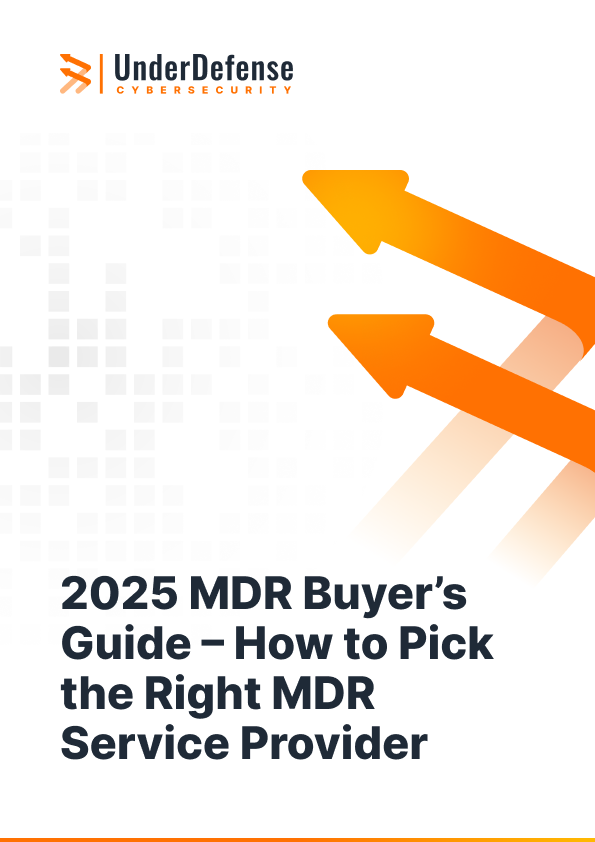
2026 MDR Buyer’s Guide – Choose the Right MDR Provider

You Have an MDR Contract. That Doesn't Mean You're Protected.

Most organizations that suffered a material breach in the past 18 months had security tooling in place. Some had MDR. The gap between having a vendor and having coverage is where attackers live.

Our MDR Buyer’s Guide helps you:

  • Stop evaluating MDR on feature lists and start evaluating on outcomes
  • Identify the silent gaps in your current stack: SIEM, EDR, cloud, identity, AI exposure
  • Ask the questions vendors hope you won't, and know what good answers should look like
Why You Need Our MDR Buyer’s Guide
This isn't a vendor comparison chart. It's a forcing function for honest self-assessment.
checkmark
Find your real exposure
with the 16-point security gap checklist that maps directly to how modern attacks unfold.
checkmark
Benchmark what "good" actually looks like
with specific MTTD, MTTR, and coverage thresholds that separate credible providers from expensive noise.
checkmark
Spot the false sense of security
before it costs you. Five common stack configurations that look protected and aren't, including the SIEM nobody's reading and the EDR that stops at the device.
checkmark
Use the red flag reference
to identify the ten provider behaviors that signal you're buying a reporting relationship, not a security one.
Download Your Free MDR Buyer’s Guide Now
What’s Inside?
checkmark
The Threat Landscape Has Moved
What changed since 2025: AI-driven attacks, identity as the primary breach surface, cloud environments attackers know better than your DevOps team.
checkmark
The False Sense of Security Problem
Five gap patterns hiding in modern security stacks and the consequences organizations discover too late.
checkmark
Eight Evaluation Frameworks
Coverage depth and breadth, detection quality, team structure, response benchmarks, compliance alignment, and the partnership questions that reveal what a vendor relationship actually looks like at 2 AM.
checkmark
Self-Assessment Tools
Maturity indicators, red flag checklist, and a 16-point challenge inventory that shows you where you stand before you talk to a single vendor.
Download Your Free MDR Buyer’s Guide Now
Download the MDR Buyer’s Guide 2026

Know what you're buying. Know what you're missing. Make the decision with clear eyes.

Claim your MDR Buyer’s guide

Why UnderDefense?

Choosing the right MDR service provider isn’t just about features—it’s about real security outcomes.

At UnderDefense, we combine AI-powered threat detection with 24/7 human-led response, ensuring no cyber threat goes undetected.

  • 24/7 SOC & threat hunting – Always-on security monitoring and response.
  • Proactive threat intelligence – I-powered detection with expert-led investigations.
  • Hands-on incident response – Fast containment and remediation of cyber threats.
  • Customizable & transparent MDR pricing – No hidden fees, full visibility into costs.
  • Compliance-ready security – Designed for SOC 2, ISO 27001, HIPAA, PCI DSS.

Frequently asked questions

Is MDR better than XDR?

MDR (Managed Detection and Response) and XDR (Extended Detection and Response) serve different roles. MDR is a fully managed security service that includes human-led threat detection, investigation, and response. XDR is a technology-driven platform that integrates multiple security tools to improve visibility and automate threat detection. If your organization lacks an in-house SOC team, MDR is a better choice for 24/7 expert protection.

What does MDR stand for?

MDR stands for Managed Detection and Response, a cybersecurity service that combines AI-driven detection with human security analysts to provide continuous monitoring, rapid incident response, and proactive threat hunting.

How big is the MDR market?

The MDR market is rapidly expanding due to the rising number of cyberattacks and the need for businesses to outsource security operations. Industry reports estimate the global MDR market will exceed $5 billion by 2027, growing at a CAGR of over 20%.

What is MDR for small businesses?

MDR for small businesses provides enterprise-level security without the need for a full in-house security team. It offers affordable, scalable protection, 24/7 monitoring, rapid response, and compliance support, making it a cost-effective solution for SMBs that need to safeguard against cyber threats.

What is included in MDR services?

MDR services typically include:
  • 24/7 threat monitoring & response
  • Proactive threat hunting
  • Incident investigation & forensics
  • Security log management & SIEM integration
  • Compliance support (SOC 2, ISO 27001, HIPAA, PCI DSS).

How does MDR compare to MSSP?

An MSSP (Managed Security Service Provider) mainly focuses on log monitoring and alerting, whereas MDR actively investigates, responds to, and contains threats. MDR provides hands-on security expertise and incident response, while MSSPs typically stop at alerting.

How much does MDR cost?

MDR pricing varies depending on the service level, organization size, and provider. Most MDR services use a per-endpoint, per-user, or tiered pricing model. Costs typically start at $30-$100 per endpoint per month but can scale based on custom integrations and response capabilities.

Does MDR help with compliance?

Yes, MDR helps businesses meet SOC 2, ISO 27001, HIPAA, PCI DSS, and other security regulations by providing continuous monitoring, log management, threat detection, and audit-ready reports.

Can MDR replace SIEM?

MDR and SIEM (Security Information and Event Management) serve different functions. MDR provides active threat response and investigation, while SIEM collects and analyzes security logs. Many businesses use both MDR and SIEM for a stronger security posture.

How do I choose the best MDR provider?

When selecting an MDR provider, consider:
  • Threat detection & investigation capabilities
  • Response time & 24/7 SOC availability
  • Technology integrations (SIEM, XDR, cloud security, endpoint protection)
  • Compliance support (SOC 2, HIPAA, PCI DSS, ISO 27001)
  • Pricing transparency & service scalability.