What to do if you're hit by ransomware?

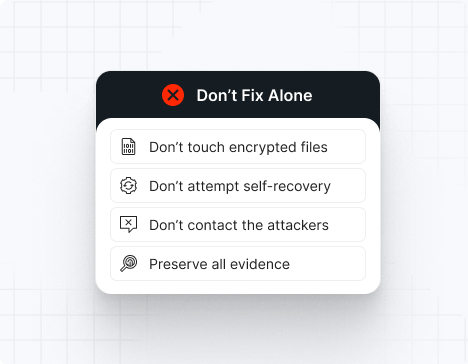
Do NOT attempt any self-remediation, as it can trigger further encryption and destroy recovery points. Instead, follow these steps:

1
Do NOT fix it yourself
2
Disconnect affected systems
3
Call us +1 332 331 8700

Contact us now for urgent ransomware response assistance, 24/7

Get Help Now
Frame

Experts. Finalists. Winners.

Accomplishments and recognitions, demonstrating our commitment to excellence and innovation.

Momentum Leader in MDR

Best Support in MDR & IR

Managed Detection and Response (MDR)

Top Cybersecurity Company 
2025

Best Managed Detection and Response Service

#4 of 184 teams Splunk Boss of the SOC

Best Of Cybersecurity Awards for Q1 2025

AWS Partner

Splunk Manage Premier Partner

Image (11) (1)

Why you shouldn’t attempt 
to fix it alone

Like a crime scene, a ransomware attack must be preserved — tampering with encrypted files, attempting self-recovery, or engaging with attackers can destroy critical evidence and reduce your chances of recovery.

Taking the right steps in the first moments after a Ghost attack can make a huge difference and help you make a full recovery. Request 24/7 Ghost ransomware recovery services to decrypt your data and maximize your chances of restoring operations.

Contact us now for urgent ransomware recovery assistance

Under attack?

Get Help Now

Ghost ransomware statistics & facts

Ghost Decryptor
Ghost IOCs
Ghost Attack Vectors
Case Outcomes
How to Remove Ghost Ransomware
How to Recover from Ghost Ransomware
Ransom Amounts
Ghost Decryptor

No legitimate public decryptor exists. RSA-2048 encryption is cryptographically sound. Recovery requires either offline backups or ransom payment with extreme caution. Some victims report paid keys were useless or partial, indicating gang breach of ransom agreements.

Ghost IOCs

Identify Ghost infections by searching for .ghost, .cring, .flip file extensions, ransom notes named GOD.txt, FILES_ENCRYPTED.txt, or TOX contact addresses. Monitor for Event Log clearing, Volume Shadow Copy deletion, and rapid file encryption across SMB shares.

File Extensions
.ghost, .cring, .flip, .Phantom, .strike, .hello, .wickrme, .HsHarada, .rapture (extensions rotate per variant)

Ransom Note Filenames
GOD.txt, FILES_ENCRYPTED.txt, UNLOCK_FILES.txt (naming varies by sample)

Ghost Hashes
SHA256 hashes: Ghost ransomware executables vary significantly across samples. Known samples include:
– Cring.exe variants (documented in threat intelligence feeds)
– Ghost.exe variants (rotated regularly)
– ElysiumO.exe variants (observed in 2024-2025 campaigns)
Monitor for process behavior rather than static signatures due to frequent re-compilation.

Ghost Tools
Reconnaissance: External vulnerability scanning (Shodan, public databases), network enumeration post-compromise
Exploitation: Known vulnerabilities in ProxyShell (Exchange), Fortinet FortiOS, Adobe ColdFusion
Data Exfiltration: Custom scripts, legitimate cloud storage (if accessed via compromised credentials)
Persistence: Registry modification, scheduled tasks for re-execution
Encryption: Custom AES-256/RSA-2048 implementation
Log Clearing: wevtutil to clear Event Logs, custom scripts to delete shadow copies

Most Common Red Flag
Simultaneous occurrence of Volume Shadow Copy deletion (via vssadmin or wmic), Event Log clearing (wevtutil clear-log security), and mass file encryption across network shares with .ghost or .cring extensions. Often preceded by probing of Exchange, Fortinet, or ColdFusion endpoints from external IP addresses.

Ghost Attack Vectors

Attack vector

% of Ghost incidents

Notes

Unpatched Exchange ProxyShell

35%

CVE-2021-26855, CVE-2021-26857, CVE-2021-27065

Unpatched Fortinet FortiOS

30%

Multiple CVEs including CVE-2018-13379 (VPN bypass)

Adobe ColdFusion RCE

20%

CVE-2023-26360 and predecessors; deserialization bugs

Unpatched Cisco/Palo Alto

10%

VPN and firewall vulnerabilities

Other Legacy Software

5%

VPN and firewall vulnerabilities

Powered By WP Table Builder
Case Outcomes

A U.S. school district paid ransom; data was publicly released 2 weeks later on multiple forums despite payment. A healthcare organization refused payment; Ghost re-entered via same Exchange vulnerability 6 months later and encrypted again. Law enforcement (FBI) seized some Ghost infrastructure in 2024, but group continues operations with new C2 servers.

How to Remove Ghost Ransomware

Immediately disconnect all affected systems from network. Isolate Exchange servers and Fortinet appliances from internet access. Patch all internet-facing services (Exchange, ColdFusion, Fortinet) within 24 hours. Scan for and delete ransom note files and suspicious scheduled tasks. Restore from verified offline backups created before infection. Monitor for re-infection attempts via external scanning.

How to Recover from Ghost Ransomware

Recovery depends entirely on offline backup availability. Assume all credentials compromised; reset administrative passwords and enforce MFA network-wide. Rebuild internet-facing services from clean snapshots. Patch all systems to current versions before bringing infrastructure back online. Monitor security logs for 90+ days for indicators of re-compromise (unusual logons, service creation, file access patterns).

Ransom Amounts

Ghost demands range from $50,000 to $500,000+ depending on organization size and data sensitivity. Demands are negotiable. Average settlement (among victims who disclose) is $150K-300K. Ransom payment provides no guarantee of data deletion—public gang track record shows 50%+ of victims have data released post-payment.

Our customers say it best

Contact us now for urgent ransomware recovery assistance

Under attack?

Get Help Now

Frequently asked questions

What Is Ghost Ransomware?

Ghost is an indiscriminate ransomware operation that targets outdated internet-facing software, compromising organizations across 70+ countries regardless of sector or size. The group uses AES-256/RSA-2048 hybrid encryption and conducts double extortion by stealing data before encryption and threatening public release. Recent activity (2025) shows acceleration to encryption within 24 hours and use of TOX peer-to-peer messaging for ransom demands, making law enforcement tracking difficult.

Where Is the Ghost Gang Based?

Attribution indicates the group operates from China based on infrastructure patterns, timing of activity (UTC+8), and operational style. The indiscriminate targeting suggests financially motivated cybercriminals rather than state-sponsored attackers. The group has not claimed APT designation or nation-state affiliation despite sophisticated exploitation expertise.

How Does Ghost Attack?

Ghost operators conduct continuous external vulnerability scanning using tools like Shodan, identifying organizations running outdated versions of Exchange, Fortinet, ColdFusion, and other internet-facing services. When vulnerable services are found, the gang exploits known vulnerabilities for remote code execution, establishes persistence, exfiltrates sensitive data, and deploys the ransomware encryptor. Recent improvements show automation of the exploitation chain, reducing time from discovery to encryption to 24 hours.

How Long Do Ghost Attacks Last?

Recent 2024-2025 activity shows dramatic compression of attack timeline. Early 2021 attacks averaged 2-4 weeks dwell time, but recent incidents show initial exploit to ransom note delivery within 24 hours or less. This acceleration suggests pre-staging of data exfiltration tools and ransomware binaries to minimize detection window.

Can Ghost Files Be Decrypted?

No legitimate public decryptor exists for Ghost ransomware. RSA-2048 encryption is mathematically secure. Some victims who paid ransom report keys were non-functional or incomplete, suggesting gang may not actually decrypt files even after payment. Recovery requires offline backups or payment with extreme caution and law enforcement coordination.

What Happens After Ghost Encryption?

All files encrypted with .ghost or variant extensions become inaccessible. The gang threatens release of exfiltrated data on dark web forums if ransom is not paid within 7 days. For organizations with critical dependencies on encrypted systems (healthcare, government, education), operational disruption is immediate and severe. The gang often leaks sample data (10-100 files) to prove they have exfiltrated the full dataset.

How Can Organizations Prevent Ghost?

Prioritize patching of internet-facing services. Exchange should be updated to latest version within 48 hours of CVE release. Fortinet appliances require monthly patch cycles. Disable internet-facing RDP and ColdFusion unless absolutely required; if required, use jump hosts and MFA. Remove or disable legacy systems running unsupported operating systems. Monitor for external vulnerability scanning and probing of known vulnerable endpoints. Maintain offline backups and test recovery procedures quarterly.

Ghost Prevention Checklist

– Patch Microsoft Exchange to latest cumulative update within 48 hours of release
– Monitor for ProxyShell exploitation attempts; block IMAP4 port 143 if not essential
– Patch Fortinet FortiOS devices monthly; disable internet-facing admin interfaces
– Remove or air-gap Adobe ColdFusion if not actively used; if required, disable public-facing folders
– Disable or restrict internet-facing RDP; use VPN with MFA instead
– Implement network segmentation to isolate internet-facing services from internal network
– Monitor for external vulnerability scanning and block scanning sources
– Maintain offline backups tested quarterly; assume online backups may be compromised
– Deploy EDR with detection rules for Event Log clearing and Volume Shadow Copy deletion

Why Do Ghost Actors Rotate Ransomware Filenames and Extensions?

Rotating filenames (Cring.exe, Ghost.exe, ElysiumO.exe) and extensions (.ghost, .cring, .flip) serves multiple purposes:
1) Bypasses signature-based detection that matches specific filenames
2) Complicates forensic analysis and victim attribution
3) Enables the gang to claim multiple “variants” while using substantially similar code
4) Prevents victims from filtering specific ransomware signatures in antivirus definitions

Is Ghost Linked to Nation-State Actors?

Despite China-based infrastructure attribution, Ghost is assessed as financially motivated cybercriminals rather than state-sponsored attackers. The indiscriminate targeting, focus on ransom payment, and lack of data exfiltration for espionage purposes suggest pure profit motive. However, sophisticated exploitation of ProxyShell and infrastructure sophistication suggests advanced technical capability beyond typical cybercriminals.