What to do if you're hit by ransomware?

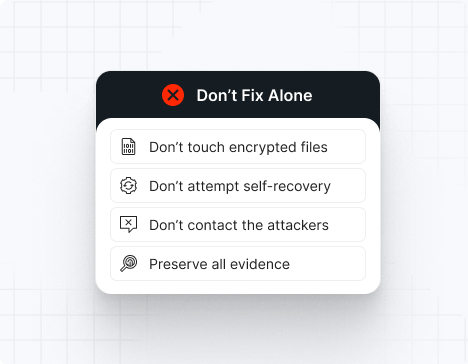
Do NOT attempt any self-remediation, as it can trigger further encryption and destroy recovery points. Instead, follow these steps:

1
Do NOT fix it yourself
2
Disconnect affected systems
3
Call us +1 332 331 8700

Contact us now for urgent ransomware response assistance, 24/7

Get Help Now
Frame

Experts. Finalists. Winners.

Accomplishments and recognitions, demonstrating our commitment to excellence and innovation.

Momentum Leader in MDR

Best Support in MDR & IR

Managed Detection and Response (MDR)

Top Cybersecurity Company 
2025

Best Managed Detection and Response Service

#4 of 184 teams Splunk Boss of the SOC

Best Of Cybersecurity Awards for Q1 2025

AWS Partner

Splunk Manage Premier Partner

Image (11) (1)

Why you shouldn’t attempt 
to fix it alone

Like a crime scene, a ransomware attack must be preserved — tampering with encrypted files, attempting self-recovery, or engaging with attackers can destroy critical evidence and reduce your chances of recovery.

Taking the right steps in the first moments after a Flocker attack can make a huge difference and help you make a full recovery. Request 24/7 Flocker ransomware recovery services to decrypt your data and maximize your chances of restoring operations.

Contact us now for urgent ransomware recovery assistance

Under attack?

Get Help Now

Flocker ransomware statistics & facts

Flocker Decryptor
Flocker IOCs
Flocker Attack Vectors
Case Outcomes
How to Remove Flocker Ransomware?
How to Recover from Flocker Ransomware?
Ransom Amounts
Flocker Decryptor

Device unlock possible through Android Safe Mode, factory reset (data loss), or restoration from backup. Advanced users can ADB (Android Debug Bridge) into devices to remove Accessibility Service permissions. No decryption tool needed; device restoration is the primary recovery method.

Flocker IOCs

File Extensions
No file extension (device-level lock). Some variants append .flocker or .locked to app files.

Ransom Note Filenames
Lock-screen overlay (not file-based). System UI hijacking observed in: /data/data/com.flocker.lock/ directories.

Flocker Package Hashes
Common package names: com.security.lockscreen, com.police.alert, com.fbi.android, com.device.protection, com.antivirus.guard (impersonation of legitimate apps). APK hash monitoring essential for network detection.

Flocker Tools
– Privilege Escalation: Device Administrator exploitation, Accessibility Service abuse
– Persistence: System app installation via ADB, boot-time script execution
– UI Hijacking: Lock-screen overlay, intent hijacking
– Malware: Often bundled with banking trojans or info-stealers for follow-on attacks

Most Common Red Flag
Logcat entries showing: `AccessibilityService binding request`, rapid Device Administrator registration attempts, UI framework system calls: `WindowManager.addView()` with overlay flags. On smart TVs: boot log modifications, firmware checksum mismatches.

Flocker Attack Vectors

Attack vector

% of Flocker incidents

Notes

Malicious App Store (third-party)

50%

Common on Android devices

SMS/Email Phishing

30%

Fake security alerts directing to malicious APK

USB/Sideloading

15%

Trojanized APKs shared via file-sharing apps

Rooted Device Exploitation

5%

Devices with existing Accessibility Service permissions

Powered By WP Table Builder
Case Outcomes

Flocker has locked an estimated 200,000+ devices since 2023. Payment rate: 3–5% (very low conversion due to low victim trust in fake law enforcement). Most users factory reset rather than pay. Smart TV infections less common but growing; estimated 5,000+ TV devices locked globally.

How to Remove Flocker Ransomware?

Device factory reset is the primary removal method: Settings > System > Reset Options > Erase All Data. For advanced users: boot into Android Safe Mode, use ADB to disable Accessibility Services (`adb shell settings put secure enabled_accessibility_services “”`), then uninstall suspicious apps. Smart TV removal requires firmware rollback or secure boot modifications.

How to Recover from Flocker Ransomware?

Recovery is straightforward compared to file-based ransomware. Restore from cloud backup (Google Drive, OneDrive) post-factory reset. If no backup exists, use Android’s emergency SOS mode to access critical contacts. Smart TV users can force factory reset via recovery menu during startup. Data loss depends on backup recency; most users lose minimal critical data.

Ransom Amounts

Flocker demands: $50–$500 per device. Payment via iTunes cards, Google Play credits, or Bitcoin. Actual ransom collection extremely low (3–5% payment rate), indicating unsophisticated attacker group relying on high-volume distribution rather than premium targeting.

Our customers say it best

Contact us now for urgent ransomware recovery assistance

Under attack?

Get Help Now

Frequently asked questions

What is Flocker Ransomware?

Flocker is a mobile and IoT ransomware that locks Android devices and smart TVs at the operating system level, displaying fake law enforcement messages to extort payment. Unlike traditional file-encryption ransomware, Flocker uses OS-level lock mechanisms (Accessibility Services, Device Administrator abuse) to prevent device access without dropping the lock. It’s primarily distributed through compromised app stores, malicious APKs, and SMS phishing.

Is Flocker a Major Enterprise Threat?

Flocker poses limited direct threat to enterprise infrastructure but creates indirect risk through BYOD (Bring Your Own Device) policies. Infected personal devices with corporate app access (Gmail, Slack, VPN) could be initial compromise vectors. Enterprise impact: reputational harm if employees perceive company BYOD policy as unsafe, potential data leakage if infected devices connect to corporate networks.

How Does the Fake Law Enforcement Impersonation Work?

Flocker displays a full-screen lock with police department logo, badge imagery, and false accusation (accessing illegal content, traffic violations, outstanding warrant). The message creates urgency and shame, exploiting users’ fear of legal consequences. Regional variants tailor messages to local law enforcement agencies (FBI in US, Gendarmerie in France, etc.), increasing psychological impact.
Can I Just Reboot My Phone to Remove Flocker?

Reboot alone won’t remove Flocker unless you access Safe Mode before infection fully establishes. If the lock-screen appears immediately after boot, the malware has already gained Accessibility Service or Device Administrator permissions. Factory reset is the reliable removal method.

How Is Flocker Different From Traditional Ransomware?

Flocker locks the device, not individual files. It exploits Android’s permission system rather than deploying file encryption. This makes it less technically sophisticated but more effective at scale: higher infection volume through app stores, lower development costs, and low-friction distribution via SMS phishing.

What Data Is at Risk With Flocker?

If the device is locked at the OS level, attackers can’t easily extract files unless the malware includes secondary payloads (banking trojans, info-stealers). However, many Flocker variants include spyware components that harvest SMS messages, contacts, and browsing history before displaying the lock-screen.

How Can I Prevent Flocker Infection on My Team's Devices?

1) Install apps only from official Google Play Store; 2) Disable installation from unknown sources; 3) Use MDM (Mobile Device Management) to enforce app whitelisting; 4) Monitor for Accessibility Service abuse via security logs; 5) Regular device patching for OS vulnerabilities; 6) User training on malicious app indicators (poor reviews, odd permissions, recently created accounts).

What's the Recovery Checklist for Flocker-Infected Devices?

1) Do not pay the ransom; 2) Boot into Recovery Mode (hold Power + Volume Down); 3) Factory reset the device; 4) Restore from backup (Google, iCloud, or corporate MDM); 5) Reinstall corporate apps through official channels; 6) Force password reset for all corporate accounts accessed from the device; 7) Review corporate network logs for unauthorized access during infection period; 8) If corporate data was on the device, trigger breach response protocol.

Why Is Smart TV Targeting Concerning?

Smart TVs increasingly connect to home networks and corporate WiFi in offices. A compromised smart TV could provide network access for pivoting into corporate infrastructure. Additionally, smart TV locks are harder to recover from (firmware issues, recovery menu access varies by manufacturer), making infection more persistent.

Is Flocker the Same as Ransomware I Read About Online?

Flocker is sometimes confused with traditional ransomware due to its ransom-demanding behavior, but it’s more accurately classified as “scareware” or “lock-screen malware.” No data is encrypted; the device is simply locked. This distinction matters for recovery: traditional ransomware requires negotiation or decryption tools, while Flocker typically requires only factory reset or ADB command-line access.