What to do if you're hit by ransomware?

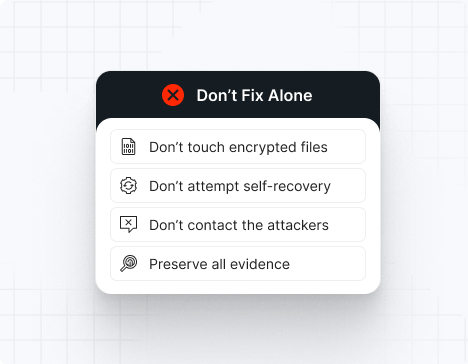
Do NOT attempt any self-remediation, as it can trigger further encryption and destroy recovery points. Instead, follow these steps:

1
Do NOT fix it yourself
2
Disconnect affected systems
3
Call us +1 332 331 8700

Contact us now for urgent ransomware response assistance, 24/7

Get Help Now
Frame

Experts. Finalists. Winners.

Accomplishments and recognitions, demonstrating our commitment to excellence and innovation.

Momentum Leader in MDR

Best Support in MDR & IR

Managed Detection and Response (MDR)

Top Cybersecurity Company 
2025

Best Managed Detection and Response Service

#4 of 184 teams Splunk Boss of the SOC

Best Of Cybersecurity Awards for Q1 2025

AWS Partner

Splunk Manage Premier Partner

Image (11) (1)

Why you shouldn’t attempt 
to fix it alone

Like a crime scene, a ransomware attack must be preserved — tampering with encrypted files, attempting self-recovery, or engaging with attackers can destroy critical evidence and reduce your chances of recovery.

Taking the right steps in the first moments after a Eldorado attack can make a huge difference and help you make a full recovery. Request 24/7 Eldorado ransomware recovery services to decrypt your data and maximize your chances of restoring operations.

Contact us now for urgent ransomware recovery assistance

Under attack?

Get Help Now

Eldorado ransomware statistics & facts

Eldorado Decryptor
Eldorado IOCs
Eldorado Attack Vectors
Case Outcomes
How to Remove Eldorado Ransomware
How to Recover from Eldorado Ransomware
Ransom Amounts
Eldorado Decryptor

No public decryptor exists for Eldorado ransomware. ChaCha20 combined with RSA-4096 is cryptographically secure. Recovery requires offline backups, ESXi snapshots, or ransom payment with no guarantee of key return or data non-release.

Eldorado IOCs

Search for .00000001 file extensions on encrypted systems and datastores. Ransom note files named HOW_RETURN_YOUR_DATA.TXT appearing in ESXi root directories or virtual machine filesystems. Monitor ESXi logs for unusual process execution (custom Golang binaries, shell access attempts).

File Extensions
.00000001, .encrypt, .eldorado (variant-dependent; operator-customizable)

Ransom Note Filenames
HOW_RETURN_YOUR_DATA.TXT, HOW_TO_RETURN_FILES.TXT (customizable by affiliate)

Eldorado Hashes
SHA256 hashes vary significantly due to per-victim compilation. Known Golang executable characteristics can be identified via static analysis (Go runtime markers), but signature-based detection is unreliable. Behavioral detection of ChaCha20 operations on ESXi is required.

Eldorado Tools
Reconnaissance: Network scanning, ESXi configuration assessment via legitimate vSphere API calls
Exploitation: Typically gains access via compromised credentials, RDP, or VPN; not leveraging known CVEs primarily
Encryption: Golang-compiled binary with customized ChaCha20 key derivation
Persistence: Scheduled tasks on Windows; cron jobs or systemd timers on Linux/ESXi
Data Exfiltration: Limited data theft compared to encryption focus; some variants include rclone for cloud exfiltration

Most Common Red Flag
Simultaneous encryption of multiple virtual machines with .00000001 extensions across a single ESXi host, combined with appearance of HOW_RETURN_YOUR_DATA.TXT in /root or virtual machine directories. Often preceded by credential compromise or RDP access from unusual IP addresses.

Eldorado Attack Vectors

Attack vector

% of Eldorado incidents

Notes

Compromised Credentials (RDP/SSH)

50%

Credentials obtained from breach databases or phishing

Unpatched VPN/RDP Appliances

25%

Exploitation of known vulnerabilities in remote access

Phishing with Credential Stealer

15%

Malware attachments delivering credential dumpers

Supply Chain/IAB Access

10%

Initial Access Brokers selling compromised credentials

Powered By WP Table Builder
Case Outcomes

A healthcare organization with 500+ virtual machines lost all clinical systems simultaneously when Eldorado encrypted the ESXi host. Recovery from backup took 6 weeks and involved data loss on recently modified files. An education institution paid $250K ransom; keys were provided but only recovered 70% of files before shutdown. One real estate firm refused payment; gang threatened to release property transaction data, escalating to regulatory fines.

How to Remove Eldorado Ransomware

Isolate all affected ESXi hosts from network immediately. Power off virtual machines to prevent continued encryption. Restore from verified ESXi snapshots or offline backup datastores predating infection. Assume all credentials compromised; reset vSphere administrator passwords and enforce certificate-based authentication. Patch any unpatched RDP or VPN appliances before bringing infrastructure back online.

How to Recover from Eldorado Ransomware

Recovery depends on ESXi snapshot availability or offline backup datastores. Restore virtual machines from verified clean snapshots, testing each VM for functionality before production use. Reset all vSphere and hypervisor credentials. Implement network segmentation to isolate hypervisor management interfaces from general network. Enable persistent logging on ESXi to detect future compromise attempts.

Ransom Amounts

Eldorado demands range from $500,000 to $3,000,000+ depending on organization size and datastore volume. Healthcare targets typically demand $2M+. Demands are negotiable; reported settlement rates are 30-50% of initial demand. Affiliate variation in negotiation approach means some victims receive better terms based on affiliate experience.

Our customers say it best

Contact us now for urgent ransomware recovery assistance

Under attack?

Get Help Now

Frequently asked questions

What Is Eldorado Ransomware?

Eldorado is an affiliate-based Ransomware-as-a-Service group that emerged in March 2024, using Golang for cross-platform compilation and specializing in VMware ESXi hypervisor encryption. The ransomware uses ChaCha20 for file encryption combined with RSA-4096 key protection, creating cryptographically secure encryption resistant to brute-force recovery. The gang offers customizable malware builders to affiliates, enabling rapid scaling and geographic dispersion of attacks.

Where Is Eldorado Based?

Attribution analysis suggests Eastern European or Russian-based operations based on infrastructure patterns, timezone activity (UTC+2 to UTC+3), and operational style. The affiliate-based RaaS model suggests the operator seeks distance from actual attacks. No definitive attribution to nation-state actors has been published; group appears financially motivated.

How Does Eldorado Attack?

Eldorado typically gains initial access through compromised credentials (RDP, SSH, VPN) obtained from breach databases or phishing campaigns. Operators establish persistence via scheduled tasks or cron jobs, conduct reconnaissance to identify ESXi hosts and datastore volumes, and then deploy the customized Eldorado encryptor. The Golang binary is compiled per-victim with unique encryption keys, making each infection cryptographically isolated.

How Long Do Eldorado Attacks Last?

From initial compromise to encryption deployment, Eldorado attacks average 5-10 days of dwell time, allowing for reconnaissance and credential harvesting. ESXi encryption itself is rapid—a 5TB datastore can be fully encrypted within 6-12 hours depending on storage performance. Some incidents show acceleration to 24-48 hours total if the gang detects active monitoring.

Can Eldorado Files Be Decrypted?

No legitimate public decryptor exists. ChaCha20 combined with RSA-4096 is cryptographically sound. Some victims who paid ransom report keys were functional but incomplete (recovering only 70-80% of files). Recovery without ransom requires offline backups or ESXi snapshots, both of which may not exist for recently encrypted data.

What Happens After Eldorado Encryption?

All virtual machines encrypted with .00000001 extensions become inaccessible. The gang threatens to release sensitive data (healthcare records, financial information, intellectual property) on dark web forums if ransom is not paid within 7-14 days. For organizations dependent on virtualized infrastructure (hospitals, financial institutions), operational disruption is immediate and severe—hundreds of applications fail simultaneously.

How Can Organizations Prevent Eldorado?

Implement multi-factor authentication on all RDP, SSH, and VPN access to hypervisor management interfaces. Assume credentials obtained from breaches are compromised; rotate passwords quarterly. Maintain offline, immutable backups of ESXi configurations and datastores, tested for recovery quarterly. Isolate hypervisor management networks using network segmentation. Disable or restrict RDP on hypervisor hosts; use jump hosts instead. Monitor ESXi logs for unusual process execution and SSH access.

Eldorado Prevention Checklist

– Enforce MFA on vSphere and hypervisor management interfaces
– Isolate hypervisor management networks from general corporate network
– Disable or restrict internet-facing RDP on hypervisors; use jump hosts instead
– Maintain offline, encrypted backup copies of ESXi configurations and datastores
– Monitor ESXi logs for unusual process execution (non-standard binaries, shell access)
– Implement VMware Update Manager (VUM) for automated patching
– Rotate hypervisor administrator credentials quarterly
– Conduct quarterly backup restoration drills on test environment
– Deploy EDR on management interfaces to detect suspicious processes
– Monitor for simultaneous virtual machine encryption (anomalous storage I/O)

Why Is Eldorado Targeting ESXi Hypervisors Instead of Individual Windows Systems?

Encrypting an ESXi host results in simultaneous encryption of dozens or hundreds of virtual machines, creating maximum impact with minimal operational complexity. A single successful compromise of a hypervisor host is equivalent to compromising 50-500 individual systems, dramatically increasing ransom leverage while reducing affiliate operational complexity. This targets infrastructure architecture weaknesses rather than endpoint weaknesses.

What Makes Eldorado Different from Other RaaS Groups?

Eldorado’s explicit focus on VMware ESXi differentiation sets it apart from commodity RaaS groups that target Windows desktops/servers. The Golang cross-platform implementation and customizable malware builder enable rapid affiliate onboarding. The group appears to target infrastructure-centric organizations (healthcare, finance, education, manufacturing) rather than broad SMB ransomware, suggesting higher ransom targets despite lower victim count.