What to do if you're hit by ransomware?

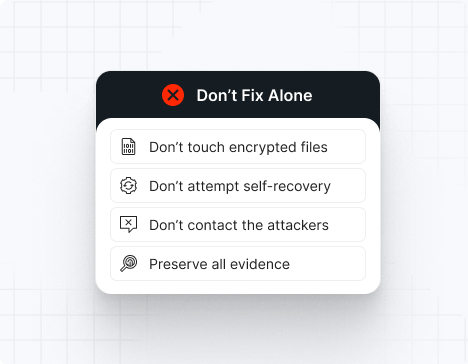
Do NOT attempt any self-remediation, as it can trigger further encryption and destroy recovery points. Instead, follow these steps:

1
Do NOT fix it yourself
2
Disconnect affected systems
3
Call us +1 332 331 8700

Contact us now for urgent ransomware response assistance, 24/7

Get Help Now
Frame

Experts. Finalists. Winners.

Accomplishments and recognitions, demonstrating our commitment to excellence and innovation.

Momentum Leader in MDR

Best Support in MDR & IR

Managed Detection and Response (MDR)

Top Cybersecurity Company 
2025

Best Managed Detection and Response Service

#4 of 184 teams Splunk Boss of the SOC

Best Of Cybersecurity Awards for Q1 2025

AWS Partner

Splunk Manage Premier Partner

Image (11) (1)

Why you shouldn’t attempt 
to fix it alone

Like a crime scene, a ransomware attack must be preserved — tampering with encrypted files, attempting self-recovery, or engaging with attackers can destroy critical evidence and reduce your chances of recovery.

Taking the right steps in the first moments after a CrazyHunter attack can make a huge difference and help you make a full recovery. Request 24/7 CrazyHunter ransomware recovery services to decrypt your data and maximize your chances of restoring operations.

Contact us now for urgent ransomware recovery assistance

Under attack?

Get Help Now

CrazyHunter ransomware statistics & facts

CrazyHunter Decryptor
CrazyHunter IOCs
CrazyHunter Attack Vectors
Case Outcomes
How to Remove CrazyHunter Ransomware?
How to Recover from CrazyHunter Ransomware?
Ransom Amounts
CrazyHunter Decryptor

No public decryption tool is available for CrazyHunter. The malware uses strong ChaCha20+ECIES encryption with private ECIES keys held exclusively by the threat actor. Decryption requires ransom payment (with no guarantee of functionality) or restoration from clean backups.

CrazyHunter IOCs

Specific indicators include .Hunter file extensions on encrypted files, SharpGPOAbuse tool artifacts, BYOVD exploitation evidence (vulnerable driver loading), unusual PowerShell execution patterns, and Active Directory enumeration activity. Network signatures may detect communication with CrazyHunter infrastructure.

File Extensions
All encrypted files append .Hunter extension (e.g., patient_records.sql.Hunter, config.xml.Hunter). The extension is consistent across all CrazyHunter incidents.

Ransom Note Filenames
“CrazyHunter_Ransom.txt”, “READ_ME_RECOVERY.txt”, or similar standardized filenames appearing in encrypted directories and system roots.

CrazyHunter Hashes
CrazyHunter samples share code patterns with Prince ransomware, reflecting the group’s use of modified Prince source code. Specific hashes vary across campaigns; behavioral analysis is more reliable than signature-based detection.

CrazyHunter Tools
Legitimate administrative tools: RDP, WinRM, PowerShell; SharpGPOAbuse for Group Policy abuse; vulnerable drivers (capcom.sys exploitation); Rclone for data exfiltration; GOAnyWhere (open-source tool); credential enumeration utilities.

Most Common Red Flag (Commands)
PowerShell commands: Get-ADUser with password spraying patterns, SharpGPOAbuse execution for privilege escalation via Group Policy, evidence of vulnerable driver loading (capcom.sys, etc.); Rclone commands for data exfiltration; unusual SYSTEM-level process execution; evidence of BYOVD exploitation.

CrazyHunter Attack Vectors

Attack vector

% of CrazyHunter incidents

Notes

Weak Active Directory Passwords

50%

Credential spraying against domain accounts

Phishing & Initial Access

25%

Email-based credential harvesting or malicious attachments

Unpatched Vulnerabilities

15%

CVEs in healthcare management software

Supply Chain/Third-Party Access

10%

Compromised partner or vendor accounts

Powered By WP Table Builder
Case Outcomes

Six confirmed Taiwan healthcare victims reported in early 2025. Recovery timelines averaged 3–8 weeks post-incident for most affected organizations. One organization paid ransom estimated at NT$50 million (~$1.6M USD); others engaged negotiation with law enforcement involvement. Operational disruption in critical care systems lasted 1–4 weeks during recovery.

How to Remove CrazyHunter Ransomware?

Immediately isolate infected systems from the network and disable all network access. Reset all Active Directory user credentials, particularly administrative and service accounts. Preserve forensic evidence of infection including PowerShell execution logs, driver loading artifacts, and file encryption timestamps. Restore encrypted files from clean backup copies predating the infection. Scan systems for persistence mechanisms, backdoors, and vulnerable driver artifacts. Remove any loaded vulnerable drivers (capcom.sys, etc.) from system memory and disk.

How to Recover from CrazyHunter Ransomware?

Restore all encrypted files from verified clean backup repositories created before encryption. Rebuild all user credentials with strong passwords and implement multi-factor authentication on all accounts. Deploy endpoint detection and response (EDR) solutions with focus on PowerShell execution, driver loading, and privilege escalation detection. Implement network segmentation to restrict access to critical healthcare systems. Enforce data loss prevention (DLP) tools to monitor for Rclone and suspicious data transfer activity. Maintain offline, immutable backup copies to prevent future encryption of recovery infrastructure.

Ransom Amounts

CrazyHunter demands range from NT$20 million to NT$100 million+ (~$650K to $3.2M USD) depending on victim healthcare organization size, patient population, and perceived ability to pay. Healthcare organizations with large critical care operations face the highest demands. Negotiated settlements have reportedly reduced demands by 40–60%.

Our customers say it best

Contact us now for urgent ransomware recovery assistance

Under attack?

Get Help Now

Frequently asked questions

What is CrazyHunter Ransomware?

CrazyHunter is a Go-based ransomware variant derived from Prince ransomware, emerging in mid-2024 and escalating in sophistication and targeting frequency by early 2025. The group specializes in attacking healthcare organizations in Taiwan, using advanced evasion techniques including BYOVD (Bring Your Own Vulnerable Driver) exploitation and Group Policy abuse. CrazyHunter combines ChaCha20 stream cipher encryption with ECIES asymmetric encryption, employing a distinctive partial encryption strategy. The group has demonstrated rapid evolution in attack techniques and evasion capabilities.

Where is the CrazyHunter Gang Located?

The CrazyHunter threat actor’s geographic origin is unconfirmed but operational focus on Taiwan organizations suggests potential regional knowledge and language capability. Targeting patterns and tool selection suggest operators familiar with Asian healthcare infrastructure and business practices. Law enforcement has not publicly attributed CrazyHunter to specific nation-states.

How Does CrazyHunter Ransomware Work?

CrazyHunter attacks follow a staged approach: Initial access via weak Active Directory credentials through password spraying attacks or phishing-based credential harvesting. Lateral movement using compromised domain credentials and legitimate administrative tools (RDP, WinRM, PowerShell). Privilege escalation via SharpGPOAbuse exploiting Group Policy or BYOVD (Bring Your Own Vulnerable Driver) exploitation using vulnerable drivers like capcom.sys. Data exfiltration using Rclone or GOAnyWhere tools to attacker-controlled servers. File encryption deployment using ChaCha20 with ECIES asymmetric key handling. Ransom note placement in encrypted directories. Victim notification via Tor leak site publication.

How Long Does a CrazyHunter Attack Take?

CrazyHunter campaigns typically span 2–4 weeks from initial access to encryption deployment, depending on network complexity and security controls. The group conducts targeting and reconnaissance to identify critical healthcare systems prior to payload deployment. Encryption phase typically completes within 24–72 hours once privilege escalation is achieved. Negotiation begins immediately upon victim discovery of ransom notes.

Can CrazyHunter Ransomware Be Decrypted?

No public decryption tools are available for CrazyHunter. The malware uses strong ChaCha20+ECIES encryption with private ECIES keys held exclusively by the threat actor. Decryption requires ransom payment (with no guarantee of functionality) or restoration from clean backup copies. The group has demonstrated willingness to provide functional decryption keys post-payment in several cases.

What Happens If You Pay the CrazyHunter Ransom?

Payment has resulted in decryption key provision in several documented cases, though no guarantee exists. Exfiltrated data may still be sold or published despite payment. The group operates under no legal enforcement mechanisms. Payment increases likelihood of future targeting and demonstrates financial capability to the broader threat actor ecosystem.

How to Prevent CrazyHunter Infection?

Implement multi-factor authentication on all administrative and user accounts, particularly domain credentials. Conduct regular Active Directory audits and password spraying tests to identify weak credentials. Deploy endpoint detection and response (EDR) solutions with focus on PowerShell execution, driver loading, and privilege escalation detection. Implement Group Policy monitoring to detect abuse. Segment networks to restrict administrative access to critical healthcare systems. Patch and monitor systems for vulnerable drivers (capcom.sys, etc.). Implement data loss prevention (DLP) tools to detect Rclone and suspicious data transfer activity.

CrazyHunter Threat Checklist

– Audit all Active Directory credentials and reset weak passwords – Deploy multi-factor authentication on all administrative accounts – Monitor for password spraying and credential enumeration activity – Detect and remove vulnerable drivers (capcom.sys) – Enable PowerShell logging and script block execution monitoring – Restrict administrative access to critical healthcare systems – Monitor for Rclone and suspicious file transfer activity – Verify backup integrity and test offline restoration procedures

Does CrazyHunter Target Specific Industries?

CrazyHunter demonstrates strong preference for healthcare organizations in Taiwan, with all confirmed victims being hospitals or healthcare providers. The group appears to specialize in healthcare sector targeting, suggesting operational knowledge of healthcare systems, regulatory pressures, and payment capabilities. Secondary targeting of education and government sectors in Taiwan has been suggested but not confirmed.

What Makes BYOVD Exploitation Significant?

BYOVD (Bring Your Own Vulnerable Driver) exploitation allows attackers to load legitimate but vulnerable drivers (like capcom.sys) to bypass security controls. CrazyHunter’s use of this technique demonstrates technical sophistication and awareness of kernel-level exploit methods. BYOVD enables privilege escalation, security software circumvention, and direct kernel access for malware operations. This technique is particularly effective against modern EDR/XDR solutions relying on user-mode monitoring.