Security & Compliance Automation Platform
UnderDefense MAXI is the solution to day-to-day cybersecurity problems of IT leaders and teams. It builds your 24/7 business protection together with you on the driver’s seat.
UnderDefense MAXI Platform
UnderDefense Secures Top Honor at the 2025 Global Infosec Awards
We’re proud of being a winner at the 2025 Global Infosec Awards…
10-Point AWS Security Checklist for Executives
Quickly assess your cloud security posture with this executive-ready checklist covering IAM, monitoring, and compliance essentials.
Anti-Phishing Playbook
Your free PDF guide to spotting and stopping phishing attacks before they reach your team or data.
24/7 Threat Detection & MAXImum Responsiveness
Our human-led MDR service combines expert insight and automation and AI for fast, precise threat response. Get full context in 2 minutes and cut MTTC to 15, staying ahead of ransomware and other attacks.
Calculate your MDR price
Pay only for the services you actually need, with no hidden costs.
10-Point AWS Security Checklist for Executives
Quickly assess your cloud security posture with this executive-ready checklist covering IAM, monitoring, and compliance essentials.
Anti-Phishing Playbook
Your free PDF guide to spotting and stopping phishing attacks before they reach your team or data.
Spot threats faster and respond smarter than tools alone
24/7 MDR and SOC services led by award-winning security experts. We act as an extension to your team or as a fully remote team, providing detailed threat insights and actionable responses to secure your environment immediately.
UnderDefense is an AWS Partner
We’re excited to announce that UnderDefense is now an AWS partner and available on AWS Marketplace…
Managed SOC at Your Service
Augment your SOC with 24/7 monitoring, threat detection, and expert response—without the overhead. Integrated with your existing tools, our SOCaaS stops attacks before they cause harm.
Managed SIEM Pricing Guide
Download a clear, practical overview of Managed SIEM pricing, featuring detailed breakdowns by service type, pricing model, real-world pros and cons, and key cost factors.
Managed SOC at Your Service
Augment your SOC with 24/7 monitoring, threat detection, and expert response—without the overhead. Integrated with your existing tools, our SOCaaS stops attacks before they cause harm.
Managed SIEM Pricing Guide
Download a clear, practical overview of Managed SIEM pricing, featuring detailed breakdowns by service type, pricing model, real-world pros and cons, and key cost factors.
CiphBit ransomware recovery team on standby
CiphBit has operated as a RaaS platform since April 2023, conducting double-extortion attacks across manufacturing, technology, and professional services using a fast AES-256 encryptor paired with an RSA-4096 key exchange. Isolate affected systems immediately and contact UnderDefense's incident response team — do not attempt decryption or negotiation alone.
Average Mttc
Ransom-Free recovery rate
Avoided in ransom
Global availability
Systems restored
IR experts
Ransomware cases resolved
IR experience
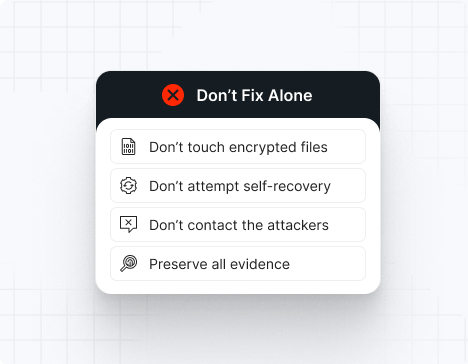
Do NOT attempt any self-remediation, as it can trigger further encryption and destroy recovery points. Instead, follow these steps:
Contact us now for urgent ransomware response assistance, 24/7
Get Help Now
Accomplishments and recognitions, demonstrating our commitment to excellence and innovation.
Momentum Leader in MDR
Best Support in MDR & IR
Managed Detection and Response (MDR)
Top Cybersecurity Company 2025
Best Managed Detection and Response Service
#4 of 184 teams Splunk Boss of the SOC
Best Of Cybersecurity Awards for Q1 2025
AWS Partner
Splunk Manage Premier Partner
Like a crime scene, a ransomware attack must be preserved — tampering with encrypted files, attempting self-recovery, or engaging with attackers can destroy critical evidence and reduce your chances of recovery.
Taking the right steps in the first moments after a CiphBit attack can make a huge difference and help you make a full recovery. Request 24/7 CiphBit ransomware recovery services to decrypt your data and maximize your chances of restoring operations.
CiphBit victims show distinctive IOCs including compromised credentials, email phishing artifacts, and unusual network traffic patterns indicating data exfiltration. Files encrypted by CiphBit append victim-specific extensions combining a random 4-character string with attacker email (e.g., .ABCD_onionmail.org), making identification straightforward. Look for lateral movement evidence via legitimate administrative tools and staging of sensitive data in temporary directories.
CiphBit implements strong file encryption using RSA and AES algorithms combined. The malware generates unique victim-specific encryption keys and stores public keys locally for verification. Encrypted files append a custom extension containing victim identifiers and attacker contact information, facilitating ransom note matching.
CiphBit operates a professional RaaS platform with structured affiliate programs. Affiliates pay $1,000 deposit to access exploitation toolkits and infrastructure. Revenue sharing starts at 30% to affiliates, dropping to 25% after three successful ransom payments. The platform provides affiliate management dashboards, victim negotiation support, and cryptocurrency payment processing.
Primary extortion involves encrypted files forcing operational disruption while stolen data threats compound pressure. The group publishes victim data on Tor-based leak sites, threatening to sell or publish sensitive information if ransom demands are unmet. Negotiation occurs via Tor sites or email, with the group demonstrating willingness to negotiate down from initial demands by 40–50%.
CiphBit targets Windows systems with no platform-specific focus on servers or desktops. Attacks are financially motivated, targeting any organization with valuable data and perceived ability to pay. No critical infrastructure focus observed; instead, the group targets profitable SMB and mid-market organizations with limited security maturity.
CiphBit ransom notes titled "RECOVERY_NOTICE.txt" or "[VICTIM_ID]_NOTICE.txt" appear in encrypted directories. Notes contain victim-specific identifiers, unique email addresses (onionmail.org), cryptocurrency wallet addresses, and Tor site URLs for ransom negotiation. Notes emphasize data theft, listing data volumes and threatening public release.
No public decryption tool is available for CiphBit. The malware uses strong RSA+AES encryption with private keys held by the threat actor. Decryption requires ransom payment (not guaranteed to work) or restoration from clean backups.
Indicators include compromised credentials with unusual login patterns, phishing email artifacts, evidence of legitimate administrative tool usage for lateral movement, and data staging in temporary directories. File extensions uniquely identify CiphBit infections.
File Extensions
Custom victim-specific extensions combining random 4-character strings with attacker email (e.g., .ABCD_onionmail.org, .WXYZ_onionmail.org). Each victim receives unique extension, complicating broad detection signatures.
Ransom Note Filenames
RECOVERY_NOTICE.txt, CONTACT_US.txt, [VICTIM_ID]_NOTICE.txt, or DECRYPTION_GUIDE.txt appearing in root directories and encrypted file locations.
CiphBit Hashes
CiphBit samples are tracked by researchers but vary significantly due to per-victim customization. Behavioral analysis of encryption routines is more reliable than hash-based detection.
CiphBit Tools
Legitimate administrative tools: RDP, WinRM, PowerShell, PsExec; phishing frameworks; data exfiltration utilities; open-source encryption libraries; custom malware loaders; Cobalt Strike beacons (affiliate use).
Most Common Red Flag (Commands)
PowerShell commands: Get-ChildItem -Recurse, Copy-Item to network shares, Get-ADUser for credential enumeration; evidence of RDP sessions to multiple systems; SMB enumeration and credential attempts; file compression utilities (7-Zip, WinRAR) for data staging.
Attack vector | % of CiphBit incidents | Notes |
Phishing Emails | 50% | Credential-harvesting attachments and links |
Exposed Remote Access | 25% | Weak RDP/VPN credentials or public exposure |
Supply Chain/Partner Access | 15% | Compromised third-party vendor accounts |
Unpatched Vulnerabilities | 10% | Exploitation of known application CVEs |
Banking organizations in Canada and US reported recovery timelines of 2–4 weeks post-incident. Manufacturing firms in Germany and UK negotiated ransoms averaging 40–50% of initial demands. Healthcare organizations averaged 3–6 week recovery periods. Law enforcement involvement in several cases led to partial perpetrator attribution and ongoing investigations.
Immediately isolate infected systems from the network using air-gapping or network segmentation. Identify all compromised user accounts and reset credentials with changed passwords. Preserve forensic evidence of infection including encryption logs and network traffic. Restore encrypted files from clean backup copies predating the infection. Implement enhanced monitoring to detect re-infection or persistence mechanisms. Scan all systems for secondary malware or backdoors planted by the threat actor.
Restore all encrypted files from verified clean backup repositories. Rebuild user credentials and implement multi-factor authentication on all accounts. Deploy endpoint detection and response (EDR) solutions to detect lateral movement and data exfiltration attempts. Implement network segmentation to restrict access to sensitive data repositories. Enforce data loss prevention (DLP) policies to alert on suspicious data transfers. Maintain immutable backup copies to prevent future encryption of recovery points.
CiphBit demands range from $5,000 to $500,000+ depending on victim organization size, industry sector, and data sensitivity. Manufacturing and financial services organizations face higher demands. Negotiated settlements average 40–50% of initial ransom requests.
10 reasons why you should choose the UnderDefense ransomware recovery consulting services:
Get Help NowCiphBit is a professionally operated RaaS platform offering double-extortion attacks since April 2023. The group combines file encryption with data exfiltration to maximize victim pressure and payment likelihood. CiphBit provides affiliate programs, allowing threat actors to purchase access to exploitation toolkits and infrastructure. The group targets small to mid-sized organizations globally with a focus on financial gain rather than geographic or sector-specific targeting. Technical sophistication is moderate, but operational professionalism and affiliate network make CiphBit a persistent threat.
CiphBit’s geographic origin is unconfirmed, but operational patterns and language use suggest Russian-speaking or Eastern European operators. The group maintains Tor-based infrastructure for affiliate management and victim communication, making direct geographic attribution difficult. Law enforcement has not publicly attributed CiphBit to specific nation-state sponsors or geographic regions.
CiphBit campaigns follow a structured approach: Initial access via phishing emails containing credential-harvesting attachments or malicious links. Lateral movement using compromised credentials and legitimate administrative tools. Reconnaissance to identify sensitive data repositories and critical systems. Data exfiltration to attacker-controlled servers or cloud storage. Encryption of files using RSA+AES algorithms with victim-specific extension appending. Ransom note deployment with victim identifiers and negotiation instructions. Threats leverage both encryption disruption and data publication threats for maximum impact.
CiphBit campaigns typically span 5–14 days from initial access to encryption deployment, depending on victim network complexity. The group conducts limited reconnaissance compared to sophisticated APTs, focusing on quick identification of valuable data and rapid encryption. Once encryption begins, files are typically encrypted within 24–48 hours. Negotiation phase begins immediately upon victim discovery of ransom notes.
No public decryption tools are available for CiphBit. The malware uses strong RSA+AES encryption with private keys held exclusively by the threat actor. Decryption requires ransom payment (with no guarantee of key functionality) or restoration from clean backups. Some victims reported key failures or incomplete decryption, suggesting deliberate manipulation by the threat actor.

Payment increases likelihood of future targeting, as demonstrated capability to pay encourages repeated extortion attempts. The group may provide functional decryption keys, but no guarantee exists. Exfiltrated data may still be sold or published despite payment. Many victims report that paying ransom does not prevent data publication or secondary ransom demands from the threat actor.
Implement multi-factor authentication on all user accounts and remote access services. Deploy security awareness training focused on phishing recognition and credential security. Use email filtering and content inspection to block phishing attachments. Enforce strong password policies and conduct regular credential audits. Segment networks to restrict access to sensitive data repositories. Implement EDR solutions to detect lateral movement and privilege escalation. Maintain regular backups with offline copies to prevent encryption of recovery points.
– Audit all user accounts and reset credentials immediately – Deploy multi-factor authentication on all accounts – Implement email authentication (SPF, DKIM, DMARC) – Enable endpoint detection and response (EDR) on all systems – Monitor for suspicious PowerShell and SMB activity – Verify backup integrity and test restoration procedures – Segment networks to restrict sensitive data access – Engage incident response and law enforcement upon detection
CiphBit attacks banking, manufacturing, healthcare, and logistics organizations without strong geographic or sector focus. The group targets any organization with valuable data and perceived financial ability to pay. Mid-sized organizations (100–5,000 employees) are preferred due to balance of data value and security maturity.
CiphBit’s RaaS program requires $1,000 minimum deposit for affiliate access. Affiliates receive exploitation toolkits, infrastructure for hosting, and affiliate management dashboards. Revenue split is 30% to affiliates on initial successful ransom payments, dropping to 25% after three payments. This structure creates incentive for high-volume, low-sophistication attacks on vulnerable targets.